








THEPROCESSOFPATIENTMANAGEMENT
DR. QURATULAIN MUGHAL
DPT (2019)
ISRA UNIVERSITY
DR. QURATULAIN MUGHAL
1
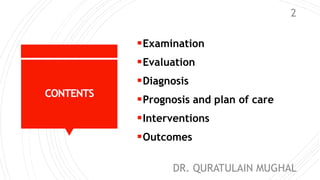
CONTENTS
Examination
Evaluation
Diagnosis
Prognosis and plan of care
Interventions
Outcomes
DR. QURATULAIN MUGHAL
2
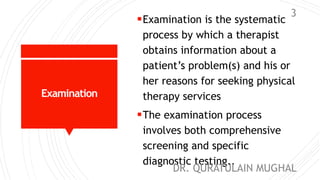
Examination
Examination is the systematic
process by which a therapist
obtains information about a
patient’s problem(s) and his or
her reasons for seeking physical
therapy services
The examination process
involves both comprehensive
screening and specific
diagnostic testing..
DR. QURATULAIN MUGHAL
3
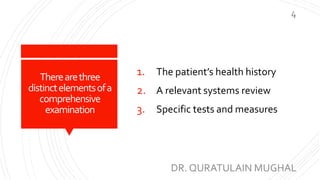
Therearethree
distinctelementsofa
comprehensive
examination
1. The patient’s health history
2. A relevant systems review
3. Specific tests and measures
DR. QURATULAIN MUGHAL
4
1. Information
Generated from
the Initial History
 Demographic Data
• Age, sex, race, ethnicity • Primary language • Education
 Social History
• Family and caregiver resources • Cultural background •
Social interactions/support systems
 Occupation/Leisure
• Current and previous employment • Job/school-related
activities • Recreational, community activities/tasks
 Growth and Development
• Developmental history • Hand and foot dominance
DR. QURATULAIN MUGHAL
5
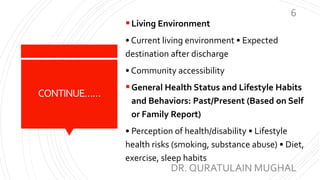
CONTINUE……
Living Environment
• Current living environment • Expected
destination after discharge
• Community accessibility
General Health Status and Lifestyle Habits
and Behaviors: Past/Present (Based on Self
or Family Report)
• Perception of health/disability • Lifestyle
health risks (smoking, substance abuse) • Diet,
exercise, sleep habits
DR. QURATULAIN MUGHAL
6
CONTINUE…..
Medical/Surgical/Psychological History
Medications: Current and Past Family
History
• Health risk factors • Family illnesses
Cognitive/Social/Emotional Status
• Orientation, memory • Communication
• Social/emotional interactions
DR. QURATULAIN MUGHAL
7
CONTINUE….
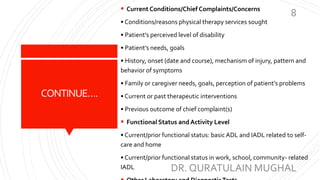
 Current Conditions/Chief Complaints/Concerns
• Conditions/reasons physical therapy services sought
• Patient’s perceived level of disability
• Patient’s needs, goals
• History, onset (date and course), mechanism of injury, pattern and
behavior of symptoms
• Family or caregiver needs, goals, perception of patient’s problems
• Current or past therapeutic interventions
• Previous outcome of chief complaint(s)
 Functional Status and Activity Level
• Current/prior functional status: basic ADL and IADL related to self-
care and home
• Current/prior functional status in work, school, community- related
IADL DR. QURATULAIN MUGHAL
8
Key Questions to
Consider During
the Initial
Examination
 What are the most complete and readily available sources for
obtaining the patient’s history?
 Is there a need to obtain additional information about the
patient’s presenting pathology or medical diagnosis if one is
available?
 Based on initial working hypotheses, which of the patient’s
signs and symptoms warrant additional testing by physical
therapy or by referral to another health-care practitioner?
 Do the patient’s problems seem to fall within or outside the
scope of physical therapy practice?
 What types of specific tests and measures should be selected
to gather data about the patient’s impairments, functional
limitations, or disability?
 Based on scientific evidence, which diagnostic tests have a
high level of accuracy to identify impairments, functional
limitations, or disability?
 What are the most important tests to do first? Which could be
DR. QURATULAIN MUGHAL
9
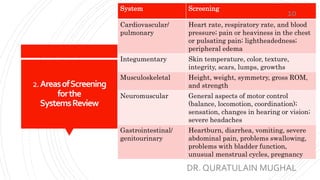
2.AreasofScreening
forthe
SystemsReview
System Screening
Cardiovascular/
pulmonary
Heart rate, respiratory rate, and blood
pressure; pain or heaviness in the chest
or pulsating pain; lightheadedness;
peripheral edema
Integumentary Skin temperature, color, texture,
integrity, scars, lumps, growths
Musculoskeletal Height, weight, symmetry, gross ROM,
and strength
Neuromuscular General aspects of motor control
(balance, locomotion, coordination);
sensation, changes in hearing or vision;
severe headaches
Gastrointestinal/
genitourinary
Heartburn, diarrhea, vomiting, severe
abdominal pain, problems swallowing,
problems with bladder function,
unusual menstrual cycles, pregnancy
DR. QURATULAIN MUGHAL
10
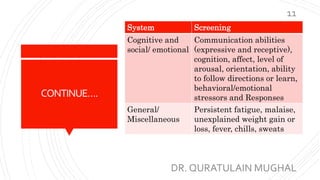
CONTINUE….
System Screening
Cognitive and
social/ emotional
Communication abilities
(expressive and receptive),
cognition, affect, level of
arousal, orientation, ability
to follow directions or learn,
behavioral/emotional
stressors and Responses
General/
Miscellaneous
Persistent fatigue, malaise,
unexplained weight gain or
loss, fever, chills, sweats
DR. QURATULAIN MUGHAL
11
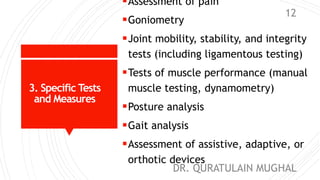
3. Specific Tests
and Measures
Assessment of pain
Goniometry
Joint mobility, stability, and integrity
tests (including ligamentous testing)
Tests of muscle performance (manual
muscle testing, dynamometry)
Posture analysis
Gait analysis
Assessment of assistive, adaptive, or
orthotic devices
DR. QURATULAIN MUGHAL
12
Guidelines for
Selection of
Specific Tests and
Measures
 Consider why particular tests are performed and how the interpretation of
their results may influence the formulation of a diagnosis.
 Select tests and measures that provide accurate information and are valid
and reliable and whose efficacy is supported by evidence generated from
sound scientific studies.
 Administer tests that target multiple levels of disablement: impairments,
functional limitations, the patient’s perceived level of disability.
 Prioritize tests and measures selected to gather in-depth information about
key problems identified during the history and systems review.
 Decide whether to administer generic tests or tests that are specific to a
particular region of the body.
 Choose tests that provide data specific enough to support or reject working
hypotheses formulated during the history and systems review and to
determine a diagnosis, prognosis, and plan of care when the data are
evaluated.
 Select tests and measures that help determine the types of intervention
that most likely are appropriate and effective.
 To complete the examination in a timely manner, avoid collecting more
information than is necessary to make informed decisions during the
evaluation, diagnosis, and treatment planning phases of management.
DR. QURATULAIN MUGHAL
13
Evaluation
Evaluation is a process
characterized by the
interpretation of collected
data.
The process involves
analysis and integration of
information to form
opinions by means of a
series of sound clinical
decisions. DR. QURATULAIN MUGHAL
14
Diagnosis
The term diagnosis can
be used in two ways; it
refers to either a
process or a category
(label) within a
classification system.
DR. QURATULAIN MUGHAL
15
Diagnostic
Process
begins with:
(1)the collection of data
(examination);
(2)the analysis and interpretation of all
relevant relevant data collected,
leading to the generation of working
hypotheses (evaluation); and
(3)organization of data, recognition of
clustering of data (a pattern of
findings), formation of a diagnostic
hypothesis, and subsequentDR. QURATULAIN MUGHAL
16
Diagnostic
Classifications for
the
Musculoskeletal
System
 Primary prevention/risk reduction for skeletal demineralization
(pattern 4A)
 Impaired posture (pattern 4B)
 Impaired muscle performance (pattern 4C)
 Impaired joint mobility, motor function, muscle performance, and
range of motion (ROM) associated with connective tissue
dysfunction (pattern 4D)
 Impaired joint mobility, motor function, muscle performance, and
ROM associated with localized inflammation (pattern 4E)
 Impaired joint mobility, motor function, muscle performance,
 ROM, and reflex integrity associated with spinal disorders (pattern
4F)
DR. QURATULAIN MUGHAL
17
CONTINUE…
 Impaired joint mobility, muscle performance, and
ROM associated with fracture (pattern 4G)
 Impaired joint mobility, motor function, muscle
performance, and ROM associated with joint
arthroplasty
 (pattern 4H)
 Impaired joint mobility, motor function, muscle
performance, and ROM associated with bony or soft
tissue surgery (pattern 4I)
 Impaired motor function, muscle performance, ROM,
gait, locomotion, and balance associated with
amputation (pattern 4J)
DR. QURATULAIN MUGHAL
18
Key Questions to
Consider During the
Evaluation and
Diagnostic Processes
 What is the extent, degree, or severity of impairments, functional
limitations, or disability?
 What is the stability or progression of dysfunction?
 Is the current condition(s) acute or chronic?
 What actions/events change (relieve or worsen) the patient’s signs and
symptoms?
 How do preexisting conditions (co-morbidities) affect the current
condition?
 How does the information from the patient’s medical/ surgical history
and tests and measures done by other health-care practitioners relate
to the findings of the physical therapy examination?
 Have identifiable clusters of findings (i.e., patterns) emerged relevant
to the patient’s dysfunction)?
 Is there an understandable relationship between the patient’s extent of
impairments and the degree of functional limitation or disability?
 What are the causal factors that seem to be contributing to the
patient’s impairments, functional limitations, or disability?
DR. QURATULAIN MUGHAL
19
Prognosis and
plan of care
A prognosis is a prediction of a
patient’s optimal level of function
expected as the result of a course of
treatment and the anticipated
length of time needed to reach
specified functional outcomes
DR. QURATULAIN MUGHAL
20
Factors That
Influence a
Patient’s
Prognosis/Expec
ted Outcomes
 Complexity, severity, acuity, or chronicity and expected
course of the patient’s condition(s) (pathology),
impairments, and functional limitations
 Patient’s general health status and presence of
comorbidities and risk factors
 Patient’s and/or family’s goals
 Patient’s motivation and adherence and responses to
previous interventions
 Safety issues and concerns
 Extent of support (physical, emotional, social)
DR. QURATULAIN MUGHAL
21
Theplanofcare,an
integral
componentofthe
prognosis,
delineatesthe
following
 Anticipated goals
 Expected functional outcomes that are meaningful, utilitarian,
sustainable, and measurable
 Extent of improvement predicted and length of time
necessary to reach that level
 Specific interventions
 Proposed frequency and duration of interventions
 Specific discharge plans
DR. QURATULAIN MUGHAL
22
Key Questions
to Establish
Patient-
Centered Goals
and Outcomes
in
the Plan of
Care
 What activities are most important to you at home, school, work, or
during your leisure time?
 What activities do you need help with that you would like to be able
to do independently?
 Of the activities you are finding difficult to do or cannot do at all at
this time, which ones would you like to be able to do better or do
again?
 Of the problems you are having, which ones do you want to try to
eliminate or minimize first?
 In what areas do you think you have the biggest problems during the
activities you would like to do on your own?
 What are your goals for coming to physical therapy?
 What would you like to be able to accomplish through therapy?
 What would make you feel that you were making progress in achieving
your goals?
 How soon do you want to reach your goals?
DR. QURATULAIN MUGHAL
23
Interven
tion
Intervention, a component of
patient management, refers to any
purposeful interaction a therapist
has that directly relates to a
patient’s care.
 There are three broad areas of intervention:
Coordination, communication, and
documentation
Procedural interventions
Patient-related instruction
DR. QURATULAIN MUGHAL
24
Outcomes
 Simply stated, outcomes are results.
 There are several broad areas of outcomes.
• Level of a patient’s physical function, including impairments,
functional limitations, and perceived disability
• Extent of prevention or reduced risk of occurrence or recurrence of
future dysfunction related to pathology, impairments, functional
limitations, or disability
• Patient’s general health status or level of wellness and fitness
• Degree of patient satisfaction
DR. QURATULAIN MUGHAL
25
REFERENCE
DR. QURATULAIN MUGHAL
26

Patient management process

  • 1.
    THEPROCESSOFPATIENTMANAGEMENT DR. QURATULAIN MUGHAL DPT(2019) ISRA UNIVERSITY DR. QURATULAIN MUGHAL 1
  • 2.
    CONTENTS Examination Evaluation Diagnosis Prognosis and planof care Interventions Outcomes DR. QURATULAIN MUGHAL 2
  • 3.
    Examination Examination is thesystematic process by which a therapist obtains information about a patient’s problem(s) and his or her reasons for seeking physical therapy services The examination process involves both comprehensive screening and specific diagnostic testing.. DR. QURATULAIN MUGHAL 3
  • 4.
    Therearethree distinctelementsofa comprehensive examination 1. The patient’shealth history 2. A relevant systems review 3. Specific tests and measures DR. QURATULAIN MUGHAL 4
  • 5.
    1. Information Generated from theInitial History  Demographic Data • Age, sex, race, ethnicity • Primary language • Education  Social History • Family and caregiver resources • Cultural background • Social interactions/support systems  Occupation/Leisure • Current and previous employment • Job/school-related activities • Recreational, community activities/tasks  Growth and Development • Developmental history • Hand and foot dominance DR. QURATULAIN MUGHAL 5
  • 6.
    CONTINUE…… Living Environment • Currentliving environment • Expected destination after discharge • Community accessibility General Health Status and Lifestyle Habits and Behaviors: Past/Present (Based on Self or Family Report) • Perception of health/disability • Lifestyle health risks (smoking, substance abuse) • Diet, exercise, sleep habits DR. QURATULAIN MUGHAL 6
  • 7.
    CONTINUE….. Medical/Surgical/Psychological History Medications: Currentand Past Family History • Health risk factors • Family illnesses Cognitive/Social/Emotional Status • Orientation, memory • Communication • Social/emotional interactions DR. QURATULAIN MUGHAL 7
  • 8.
    CONTINUE….  Current Conditions/ChiefComplaints/Concerns • Conditions/reasons physical therapy services sought • Patient’s perceived level of disability • Patient’s needs, goals • History, onset (date and course), mechanism of injury, pattern and behavior of symptoms • Family or caregiver needs, goals, perception of patient’s problems • Current or past therapeutic interventions • Previous outcome of chief complaint(s)  Functional Status and Activity Level • Current/prior functional status: basic ADL and IADL related to self- care and home • Current/prior functional status in work, school, community- related IADL DR. QURATULAIN MUGHAL 8
  • 9.
    Key Questions to ConsiderDuring the Initial Examination  What are the most complete and readily available sources for obtaining the patient’s history?  Is there a need to obtain additional information about the patient’s presenting pathology or medical diagnosis if one is available?  Based on initial working hypotheses, which of the patient’s signs and symptoms warrant additional testing by physical therapy or by referral to another health-care practitioner?  Do the patient’s problems seem to fall within or outside the scope of physical therapy practice?  What types of specific tests and measures should be selected to gather data about the patient’s impairments, functional limitations, or disability?  Based on scientific evidence, which diagnostic tests have a high level of accuracy to identify impairments, functional limitations, or disability?  What are the most important tests to do first? Which could be DR. QURATULAIN MUGHAL 9
  • 10.
    2.AreasofScreening forthe SystemsReview System Screening Cardiovascular/ pulmonary Heart rate,respiratory rate, and blood pressure; pain or heaviness in the chest or pulsating pain; lightheadedness; peripheral edema Integumentary Skin temperature, color, texture, integrity, scars, lumps, growths Musculoskeletal Height, weight, symmetry, gross ROM, and strength Neuromuscular General aspects of motor control (balance, locomotion, coordination); sensation, changes in hearing or vision; severe headaches Gastrointestinal/ genitourinary Heartburn, diarrhea, vomiting, severe abdominal pain, problems swallowing, problems with bladder function, unusual menstrual cycles, pregnancy DR. QURATULAIN MUGHAL 10
  • 11.
    CONTINUE…. System Screening Cognitive and social/emotional Communication abilities (expressive and receptive), cognition, affect, level of arousal, orientation, ability to follow directions or learn, behavioral/emotional stressors and Responses General/ Miscellaneous Persistent fatigue, malaise, unexplained weight gain or loss, fever, chills, sweats DR. QURATULAIN MUGHAL 11
  • 12.
    3. Specific Tests andMeasures Assessment of pain Goniometry Joint mobility, stability, and integrity tests (including ligamentous testing) Tests of muscle performance (manual muscle testing, dynamometry) Posture analysis Gait analysis Assessment of assistive, adaptive, or orthotic devices DR. QURATULAIN MUGHAL 12
  • 13.
    Guidelines for Selection of SpecificTests and Measures  Consider why particular tests are performed and how the interpretation of their results may influence the formulation of a diagnosis.  Select tests and measures that provide accurate information and are valid and reliable and whose efficacy is supported by evidence generated from sound scientific studies.  Administer tests that target multiple levels of disablement: impairments, functional limitations, the patient’s perceived level of disability.  Prioritize tests and measures selected to gather in-depth information about key problems identified during the history and systems review.  Decide whether to administer generic tests or tests that are specific to a particular region of the body.  Choose tests that provide data specific enough to support or reject working hypotheses formulated during the history and systems review and to determine a diagnosis, prognosis, and plan of care when the data are evaluated.  Select tests and measures that help determine the types of intervention that most likely are appropriate and effective.  To complete the examination in a timely manner, avoid collecting more information than is necessary to make informed decisions during the evaluation, diagnosis, and treatment planning phases of management. DR. QURATULAIN MUGHAL 13
  • 14.
    Evaluation Evaluation is aprocess characterized by the interpretation of collected data. The process involves analysis and integration of information to form opinions by means of a series of sound clinical decisions. DR. QURATULAIN MUGHAL 14
  • 15.
    Diagnosis The term diagnosiscan be used in two ways; it refers to either a process or a category (label) within a classification system. DR. QURATULAIN MUGHAL 15
  • 16.
    Diagnostic Process begins with: (1)the collectionof data (examination); (2)the analysis and interpretation of all relevant relevant data collected, leading to the generation of working hypotheses (evaluation); and (3)organization of data, recognition of clustering of data (a pattern of findings), formation of a diagnostic hypothesis, and subsequentDR. QURATULAIN MUGHAL 16
  • 17.
    Diagnostic Classifications for the Musculoskeletal System  Primaryprevention/risk reduction for skeletal demineralization (pattern 4A)  Impaired posture (pattern 4B)  Impaired muscle performance (pattern 4C)  Impaired joint mobility, motor function, muscle performance, and range of motion (ROM) associated with connective tissue dysfunction (pattern 4D)  Impaired joint mobility, motor function, muscle performance, and ROM associated with localized inflammation (pattern 4E)  Impaired joint mobility, motor function, muscle performance,  ROM, and reflex integrity associated with spinal disorders (pattern 4F) DR. QURATULAIN MUGHAL 17
  • 18.
    CONTINUE…  Impaired jointmobility, muscle performance, and ROM associated with fracture (pattern 4G)  Impaired joint mobility, motor function, muscle performance, and ROM associated with joint arthroplasty  (pattern 4H)  Impaired joint mobility, motor function, muscle performance, and ROM associated with bony or soft tissue surgery (pattern 4I)  Impaired motor function, muscle performance, ROM, gait, locomotion, and balance associated with amputation (pattern 4J) DR. QURATULAIN MUGHAL 18
  • 19.
    Key Questions to ConsiderDuring the Evaluation and Diagnostic Processes  What is the extent, degree, or severity of impairments, functional limitations, or disability?  What is the stability or progression of dysfunction?  Is the current condition(s) acute or chronic?  What actions/events change (relieve or worsen) the patient’s signs and symptoms?  How do preexisting conditions (co-morbidities) affect the current condition?  How does the information from the patient’s medical/ surgical history and tests and measures done by other health-care practitioners relate to the findings of the physical therapy examination?  Have identifiable clusters of findings (i.e., patterns) emerged relevant to the patient’s dysfunction)?  Is there an understandable relationship between the patient’s extent of impairments and the degree of functional limitation or disability?  What are the causal factors that seem to be contributing to the patient’s impairments, functional limitations, or disability? DR. QURATULAIN MUGHAL 19
  • 20.
    Prognosis and plan ofcare A prognosis is a prediction of a patient’s optimal level of function expected as the result of a course of treatment and the anticipated length of time needed to reach specified functional outcomes DR. QURATULAIN MUGHAL 20
  • 21.
    Factors That Influence a Patient’s Prognosis/Expec tedOutcomes  Complexity, severity, acuity, or chronicity and expected course of the patient’s condition(s) (pathology), impairments, and functional limitations  Patient’s general health status and presence of comorbidities and risk factors  Patient’s and/or family’s goals  Patient’s motivation and adherence and responses to previous interventions  Safety issues and concerns  Extent of support (physical, emotional, social) DR. QURATULAIN MUGHAL 21
  • 22.
    Theplanofcare,an integral componentofthe prognosis, delineatesthe following  Anticipated goals Expected functional outcomes that are meaningful, utilitarian, sustainable, and measurable  Extent of improvement predicted and length of time necessary to reach that level  Specific interventions  Proposed frequency and duration of interventions  Specific discharge plans DR. QURATULAIN MUGHAL 22
  • 23.
    Key Questions to Establish Patient- CenteredGoals and Outcomes in the Plan of Care  What activities are most important to you at home, school, work, or during your leisure time?  What activities do you need help with that you would like to be able to do independently?  Of the activities you are finding difficult to do or cannot do at all at this time, which ones would you like to be able to do better or do again?  Of the problems you are having, which ones do you want to try to eliminate or minimize first?  In what areas do you think you have the biggest problems during the activities you would like to do on your own?  What are your goals for coming to physical therapy?  What would you like to be able to accomplish through therapy?  What would make you feel that you were making progress in achieving your goals?  How soon do you want to reach your goals? DR. QURATULAIN MUGHAL 23
  • 24.
    Interven tion Intervention, a componentof patient management, refers to any purposeful interaction a therapist has that directly relates to a patient’s care.  There are three broad areas of intervention: Coordination, communication, and documentation Procedural interventions Patient-related instruction DR. QURATULAIN MUGHAL 24
  • 25.
    Outcomes  Simply stated,outcomes are results.  There are several broad areas of outcomes. • Level of a patient’s physical function, including impairments, functional limitations, and perceived disability • Extent of prevention or reduced risk of occurrence or recurrence of future dysfunction related to pathology, impairments, functional limitations, or disability • Patient’s general health status or level of wellness and fitness • Degree of patient satisfaction DR. QURATULAIN MUGHAL 25
  • 26.