Presented By: Dr ORAKWELU ARINZE
Physiotherapy Department AKTH
As the End of Orthopedic
and sport Posting
27/09/20191
Synopsis
• Introduction
• Relevant Anatomy
• Epidemiology
• Etiology/Risk Factors
• Pathophysiology
• Clinical Features
• Diagnosis
• Differential Diagnosis
• Management
• Physiotherapy Management
• Case Study
• Conclusion
• Recommendation
• References
2
Introduction
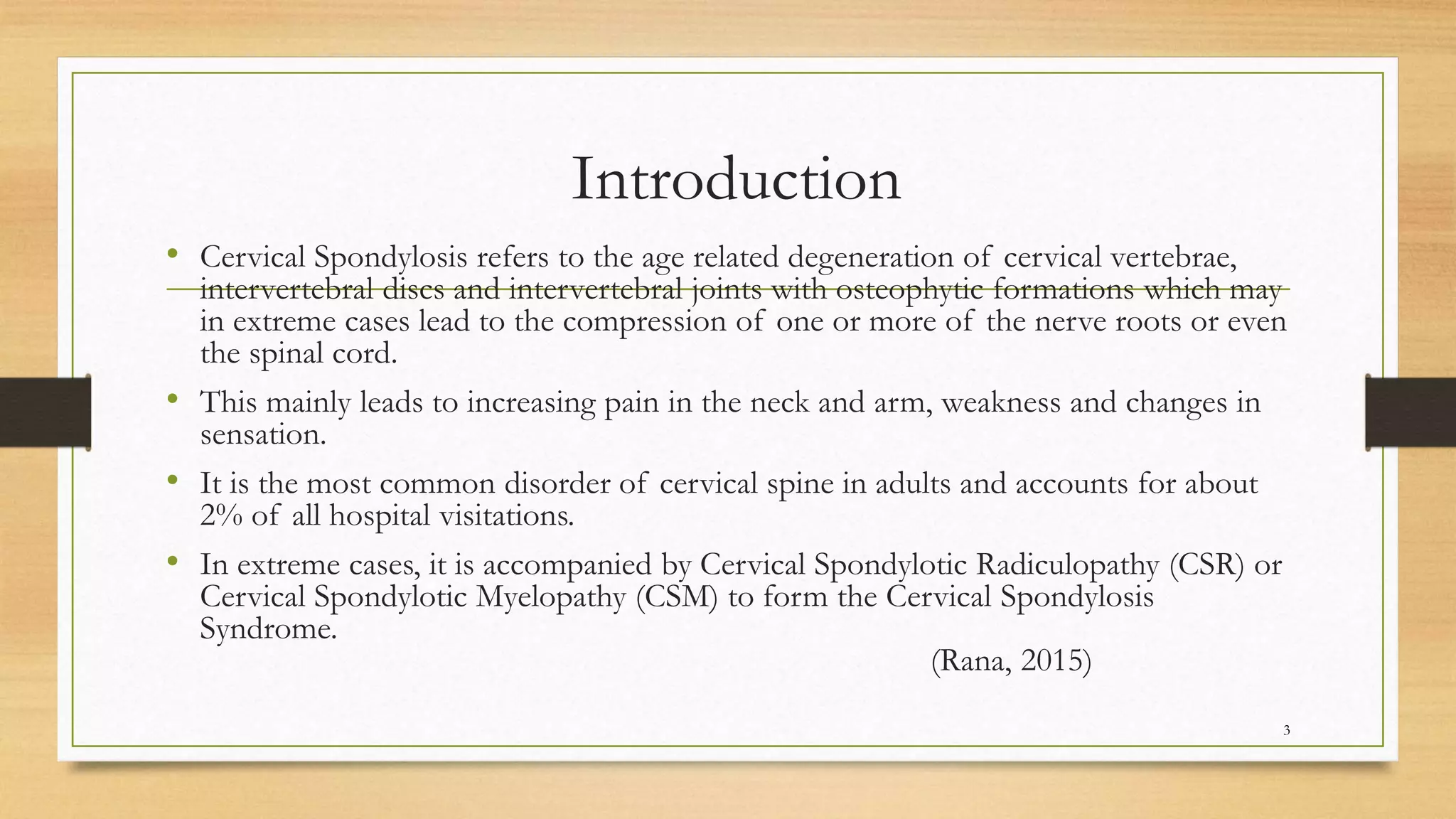
• Cervical Spondylosis refers to the age related degeneration of cervical vertebrae,
intervertebral discs and intervertebral joints with osteophytic formations which may
in extreme cases lead to the compression of one or more of the nerve roots or even
the spinal cord.
• This mainly leads to increasing pain in the neck and arm, weakness and changes in
sensation.
• It is the most common disorder of cervical spine in adults and accounts for about
2% of all hospital visitations.
• In extreme cases, it is accompanied by Cervical Spondylotic Radiculopathy (CSR) or
Cervical Spondylotic Myelopathy (CSM) to form the Cervical Spondylosis
Syndrome.
(Rana, 2015)
3
Relevant Anatomy
4
Epidemiology
• "Evidence of spondylotic change is frequently found in many asymptomatic adults, with 25% of adults
under the age of 40, 50% of adults over the age of 40, and 85% of adults over the age of 60 showing some
evidence of disc degeneration.
(Kelly et al., 2011)
• Another study of asymptomatic adults showed significant degenerative changes at 1 or more levels in 70%
of women and 95% of men at age 65 and 60.
• Cervical spondylosis is a common condition that is estimated to account for 2% of all hospital admissions. It
is the most frequent cause of spinal cord dysfunction in patients older than 55 years.
(Wang et al., 2005)
5
Epidemiology
• Evidence from a 2009 report indicated that cervical spondylosis with myelopathy was the most common primary
diagnosis(36%) among elderly US patients admitted to the hospital for surgical treatment of a degenerative cervical spine
between 1992 and 2005.
• Investigators in a study involving Ghanaians reported, "out of 225 patients who carried loads on their head, 143 (63.6%)
had cervical spondylosis, and of the 80 people who did not carry load on their head, 29 (36%) had cervical spondylosis."
( Hassan et al.., 2018)
• A study carried out in 2014 at a rheumatology clinic at Ogun state found 36 symptomatic CS pts with male to female ratio
of 1.8:1 and C4-C7 was the most affected cervical spine levels.
(Oguntona, 2014)
6
Epidemiology
• RACE:
• No apparent correlation between race
and cervical spondylosis exists.
• SEX:
• Both sexes are affected equally.
Cervical spondylosis usually starts
earlier in men than in women.
• AGE:
• Symptoms of cervical spondylosis may
appear in persons as young as 30 years
but are found most commonly in
individuals aged 40-60 years.
(Hassan et al., 2018)
7
Etiology
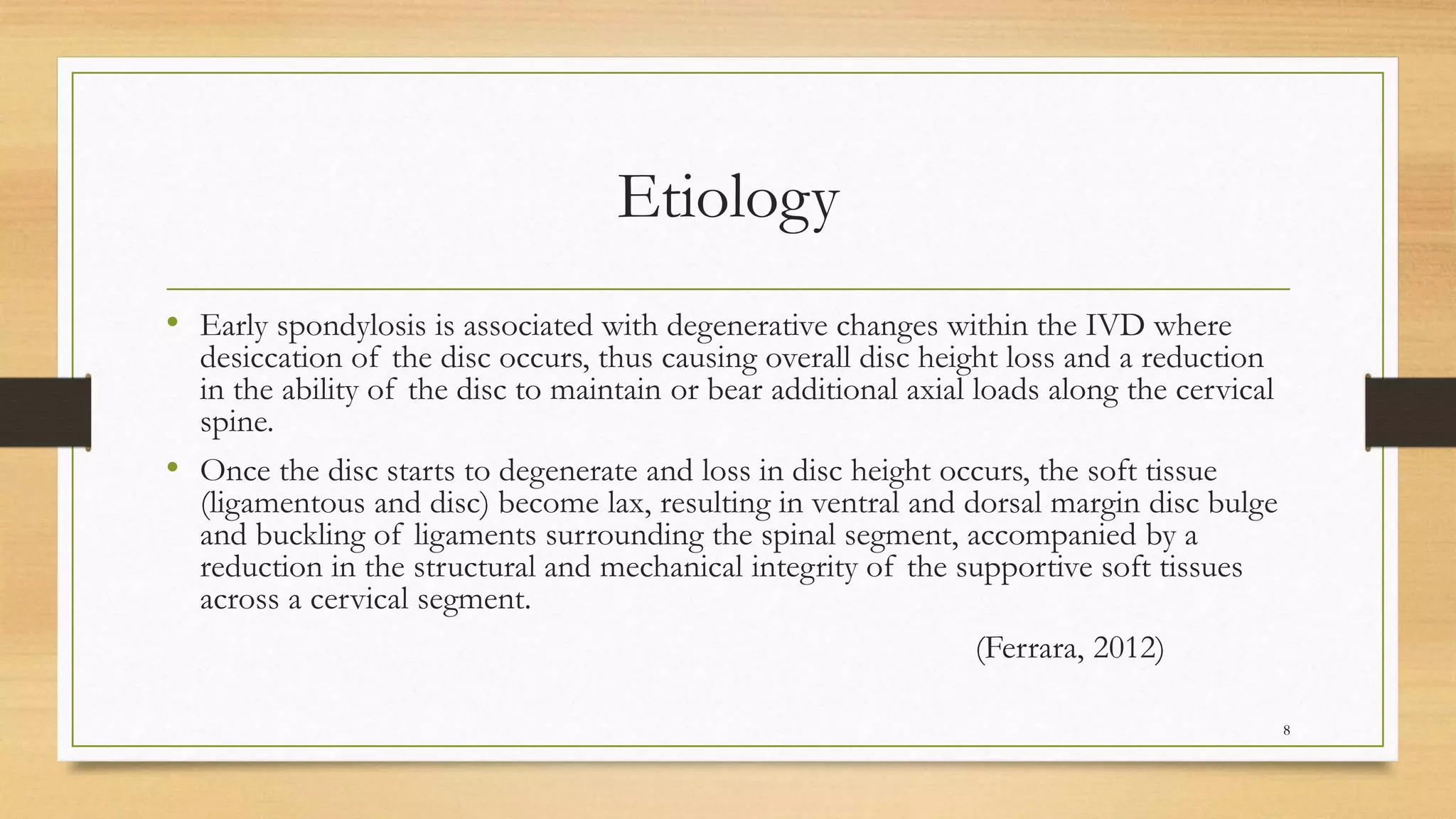
• Early spondylosis is associated with degenerative changes within the IVD where
desiccation of the disc occurs, thus causing overall disc height loss and a reduction
in the ability of the disc to maintain or bear additional axial loads along the cervical
spine.
• Once the disc starts to degenerate and loss in disc height occurs, the soft tissue
(ligamentous and disc) become lax, resulting in ventral and dorsal margin disc bulge
and buckling of ligaments surrounding the spinal segment, accompanied by a
reduction in the structural and mechanical integrity of the supportive soft tissues
across a cervical segment.
(Ferrara, 2012)
8
Pathophysiology
9
Age Related
Degeneration &
Dehydration of IVDs
Decreased cartilage
between adjacent
vertebral bodies
Developmental laxity
in the spinal
supportive ligaments
Hyper-mobility of
spinal segment
Bone on bone
apposition, bone
spur formation
Narrowing of cervical
spinal canal and/or
intervertebral foramina
Compression of
cervical nerve roots
and spinal cord
Clinical Features
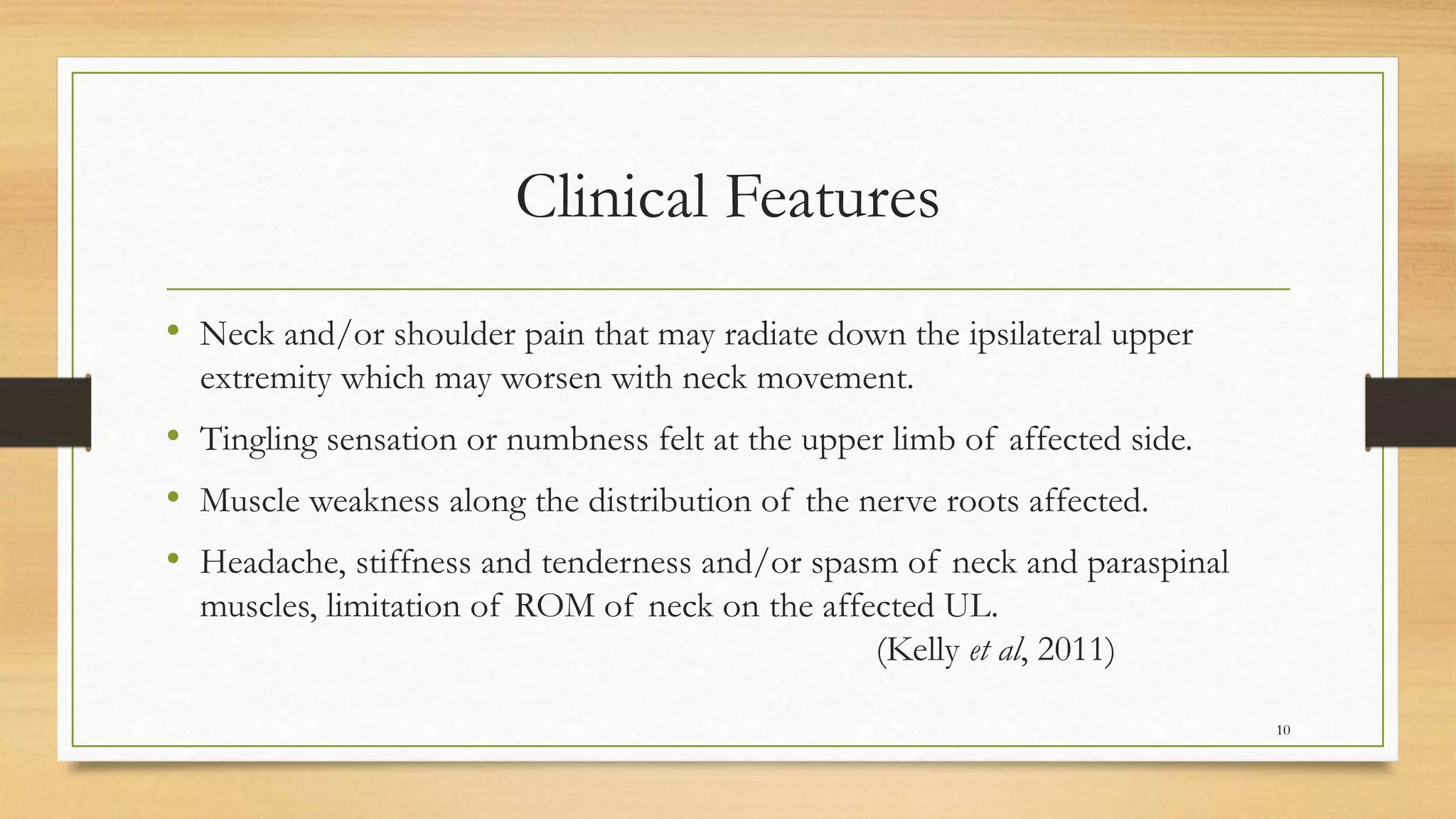
• Neck and/or shoulder pain that may radiate down the ipsilateral upper
extremity which may worsen with neck movement.
• Tingling sensation or numbness felt at the upper limb of affected side.
• Muscle weakness along the distribution of the nerve roots affected.
• Headache, stiffness and tenderness and/or spasm of neck and paraspinal
muscles, limitation of ROM of neck on the affected UL.
(Kelly et al, 2011)
10
Risk factors
• Risk Factors include;
• Age
• Previous injury
• Genetics
• Work activity e.g. Load carrying on the head.
(Singh et al, 2014)
11
Diagnosis
• Thorough Medical History
• Physical Examination
• Imaging Studies e.g. X-rays, MRI, CT scan, etc.
• Blood tests
(Binder, 2007)
12
Differential Diagnosis
• Acute neck strain
• Rheumatoid Arthritis
• Ankylosing Spondylitis
(Rana, 2015)
13
Management
• Medical Management;
• Pain relievers,
• muscle relaxants,
• tricyclic antidepressants,
• steroid injections.
(Rana, 2015)
14
Surgical management
• POOR PROGNOSTIC
INDICATORS FOR SURGERY
ARE:
• Progression of signs and symptoms
that don’t respond to conservative
management
• Compression ratio approaching 0.4 or
transverse area of the spinal cord of
40mm squared or less.
• GOALS OF SURGICAL
TREATMENT OF CS:
• Improvement or preservation of
neurological function.
• Prevention or correction of spinal
deformity
• Maintenance of spinal stability
(Melvin et al., 1993)
15
Physiotherapy Management
• INDICATIONS;
• Pain
• Limited neck ROM
• Muscle weakness
• AIMS;
• To relieve pain
• To improve the strength of weak neck mzls
• To improve ROM & optimize function
16
Physiotherapy Management
• TENS
• Traction
• Immobilization by use of neck collar
• Contrast therapy
• Neck exs
• Ultrasound
• Lifestyle modification and health advice
(Kieran et al, 2011)
17
Physiotherapy Management
18
CASE STUDY
• AGE: 63YRS Gender: M
• C/O: Neck pain *5yrs ago.
• HX: Patient was apparently healthy until 2005, when he was reportedly hit by a ball at his RT
shoulder which he could not raise up for about 3/7. He visited a peripheral hospital where he
was given drugs and massage and he was able to make functional use of the RT limb.
• In 2014 he started experiencing neck pain and lose of sensation on the palm of the right hand
he visited a peripheral physiotherapy clinic in Abuja where he received treatment but reported no
significant improvement.
• He was then transferred to Kano so he decided to seek for medical attention at AKTH.
• Aggravating factors is activity and relieving factors is rest.
19
CASE STUDY
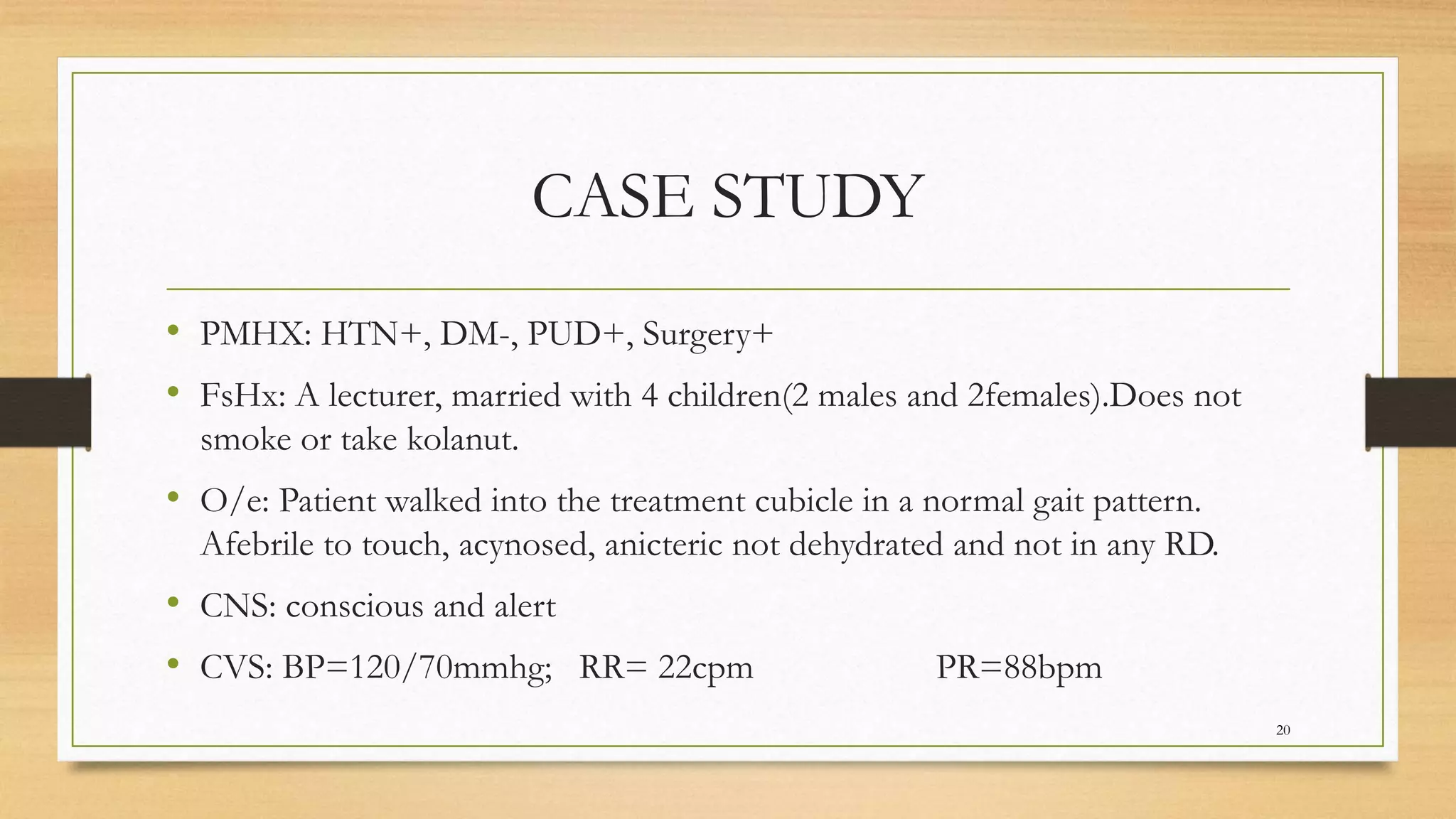
• PMHX: HTN+, DM-, PUD+, Surgery+
• FsHx: A lecturer, married with 4 children(2 males and 2females).Does not
smoke or take kolanut.
• O/e: Patient walked into the treatment cubicle in a normal gait pattern.
Afebrile to touch, acynosed, anicteric not dehydrated and not in any RD.
• CNS: conscious and alert
• CVS: BP=120/70mmhg; RR= 22cpm PR=88bpm
20
CASE STUDY
• SEGMENTAL ASSESMENT
• H & N:
• On observation there is reduction in the normal cervical lordosis
• No restriction in ROM except in right side flexion due to pain
• On palpation there is tenderness
• Neck pain(VAS 6/10)
21
CASE STUDY
• SPECIAL TEST:
• Spurlings test: +ve
• Compression test +ve
• Distraction test –ve
• DCT pain present from c3 to c7
22
Case study
UPPER LIMB RIGHT LEFT
GMP 3/5 5/5
AROM Full and painfree Full and painfree
SENSATION Intact(diminished at the palm) Intact
REFLEXES Biceps, supination and triceps are
diminished
Intact
Spasticity Absent Absent
ATROPHY Nil Nil
TENDERNESS Absent Absent
23
Case study
• T & A: NAD
• LL: NAD
24
CASE STUDY
25
CASE STUDY
• FUNCTIONAL ABILITIES/LIMITATIONS
• Patient can carry out ADL effectively
• Cannot write for long time without discomfort
• Cannot read for a long time without discomfort
• DIAGNOSIS: Neck pain 2° cervical spondylosis.
• AIMS
• To reduce pain
• To improve ROM
• To improve muscle strength
• To optimize function
26
CASE STUDY
• RX PLAN
• TENS *30mins
• Cryotherapy *15mins
• STM with neurogesic cream
• Cervical neck traction *10mins
• Isometric neck exs
• ROM exs to the neck
• Strengthening exs to RT lower limb
• H/P
27
CASE STUDY
• AFTER 5 TREATMENT SESSIONS:
• There was marked reduction in neck pain(VAS 210)
• There was also increase in the ROM on right side flexion
• Muscle power increased from 4/5 to 5/5
• There was also improved sensation on the palm.
28
CONCLUSION
• Physiotherapy interventions has proven beyond reasonable doubt to be very
effective in the management of patient with cervical spondylosis.
29
RECOMMENDATION
• Early referral of pts. to physiotherapy
• Good neck posture and positioning at home and work environment
• Public advocacy of physiotherapy management of CS
30
REFERENCES
Wang MC, Kreuter W, Wolfla CE, et al. Trends and variations in cervical spine surgery in the United States: Medicare beneficiaries, 1992 to 2005. Spine. 2009 Apr 2. [Medline
Cervical Spondylosi Author: Hassan Ahmad Hassan Al-Shatoury, MD, PhD, MHPE; Chief Editor: Dean H Hommer, MD 2018
Iheukwumere N, Okoye EC. Prevalence of symptomatic cervical spondylosis in Nigerian tertiary health institution. Trop J Med Res 2014;17:25-7
Oguntona SA. Cervical spondylosis in South West farmers and female traders. Ann Afr Med 2014;13:61-4
Singh S, Kumar D, Kumar S. Risk factors in cervical spondylosis. Journal of clinical orthopaedics and trauma. 2014 Dec 31;5(4):221-6.
Kelly JC, Groarke PJ, Butler JS, Poynton AR, O’Byrne JM. The natural history and clinical syndromes of degenerative cervical spondylosis. Advances in orthopedics. 2011 Nov 28;201-2.
Sandeep S Rana, MD. Diagnosis and Management of Cervical Spondylosis. Medscape, 2015.
Binder AI. Cervical Spondylosis and neck pain: clinical review. BMJ 2007;334:527-31
Kieran MH, Joseph SB, Roisin TD, John MO and Ashely RP. Nonoperative Modalities to Treat Symptomatic Cervical Spondylosis, Advances in Orthopedics, 2011.
Ferrara L: The biomechanics of cervical spondylosis. Advances in orthopedics. 2012 Feb 1:2012
Melvin D. Law, Jr M D Mark Bemhart M.D and Augustus A. White III, M.D., Cervical Spondylotic Myelopathy: A review of surgical indications and decision making, Yale journal of biology and Medcine, 1993.
31
THANKS FOR LISTENING
ANY QUESTION PLEASE FEEL FREE TO ASK
32

Cervical spondylosis; Physiotherapy approach

  • 1.
    Presented By: DrORAKWELU ARINZE Physiotherapy Department AKTH As the End of Orthopedic and sport Posting 27/09/20191
  • 2.
    Synopsis • Introduction • RelevantAnatomy • Epidemiology • Etiology/Risk Factors • Pathophysiology • Clinical Features • Diagnosis • Differential Diagnosis • Management • Physiotherapy Management • Case Study • Conclusion • Recommendation • References 2
  • 3.
    Introduction • Cervical Spondylosisrefers to the age related degeneration of cervical vertebrae, intervertebral discs and intervertebral joints with osteophytic formations which may in extreme cases lead to the compression of one or more of the nerve roots or even the spinal cord. • This mainly leads to increasing pain in the neck and arm, weakness and changes in sensation. • It is the most common disorder of cervical spine in adults and accounts for about 2% of all hospital visitations. • In extreme cases, it is accompanied by Cervical Spondylotic Radiculopathy (CSR) or Cervical Spondylotic Myelopathy (CSM) to form the Cervical Spondylosis Syndrome. (Rana, 2015) 3
  • 4.
  • 5.
    Epidemiology • "Evidence ofspondylotic change is frequently found in many asymptomatic adults, with 25% of adults under the age of 40, 50% of adults over the age of 40, and 85% of adults over the age of 60 showing some evidence of disc degeneration. (Kelly et al., 2011) • Another study of asymptomatic adults showed significant degenerative changes at 1 or more levels in 70% of women and 95% of men at age 65 and 60. • Cervical spondylosis is a common condition that is estimated to account for 2% of all hospital admissions. It is the most frequent cause of spinal cord dysfunction in patients older than 55 years. (Wang et al., 2005) 5
  • 6.
    Epidemiology • Evidence froma 2009 report indicated that cervical spondylosis with myelopathy was the most common primary diagnosis(36%) among elderly US patients admitted to the hospital for surgical treatment of a degenerative cervical spine between 1992 and 2005. • Investigators in a study involving Ghanaians reported, "out of 225 patients who carried loads on their head, 143 (63.6%) had cervical spondylosis, and of the 80 people who did not carry load on their head, 29 (36%) had cervical spondylosis." ( Hassan et al.., 2018) • A study carried out in 2014 at a rheumatology clinic at Ogun state found 36 symptomatic CS pts with male to female ratio of 1.8:1 and C4-C7 was the most affected cervical spine levels. (Oguntona, 2014) 6
  • 7.
    Epidemiology • RACE: • Noapparent correlation between race and cervical spondylosis exists. • SEX: • Both sexes are affected equally. Cervical spondylosis usually starts earlier in men than in women. • AGE: • Symptoms of cervical spondylosis may appear in persons as young as 30 years but are found most commonly in individuals aged 40-60 years. (Hassan et al., 2018) 7
  • 8.
    Etiology • Early spondylosisis associated with degenerative changes within the IVD where desiccation of the disc occurs, thus causing overall disc height loss and a reduction in the ability of the disc to maintain or bear additional axial loads along the cervical spine. • Once the disc starts to degenerate and loss in disc height occurs, the soft tissue (ligamentous and disc) become lax, resulting in ventral and dorsal margin disc bulge and buckling of ligaments surrounding the spinal segment, accompanied by a reduction in the structural and mechanical integrity of the supportive soft tissues across a cervical segment. (Ferrara, 2012) 8
  • 9.
    Pathophysiology 9 Age Related Degeneration & Dehydrationof IVDs Decreased cartilage between adjacent vertebral bodies Developmental laxity in the spinal supportive ligaments Hyper-mobility of spinal segment Bone on bone apposition, bone spur formation Narrowing of cervical spinal canal and/or intervertebral foramina Compression of cervical nerve roots and spinal cord
  • 10.
    Clinical Features • Neckand/or shoulder pain that may radiate down the ipsilateral upper extremity which may worsen with neck movement. • Tingling sensation or numbness felt at the upper limb of affected side. • Muscle weakness along the distribution of the nerve roots affected. • Headache, stiffness and tenderness and/or spasm of neck and paraspinal muscles, limitation of ROM of neck on the affected UL. (Kelly et al, 2011) 10
  • 11.
    Risk factors • RiskFactors include; • Age • Previous injury • Genetics • Work activity e.g. Load carrying on the head. (Singh et al, 2014) 11
  • 12.
    Diagnosis • Thorough MedicalHistory • Physical Examination • Imaging Studies e.g. X-rays, MRI, CT scan, etc. • Blood tests (Binder, 2007) 12
  • 13.
    Differential Diagnosis • Acuteneck strain • Rheumatoid Arthritis • Ankylosing Spondylitis (Rana, 2015) 13
  • 14.
    Management • Medical Management; •Pain relievers, • muscle relaxants, • tricyclic antidepressants, • steroid injections. (Rana, 2015) 14
  • 15.
    Surgical management • POORPROGNOSTIC INDICATORS FOR SURGERY ARE: • Progression of signs and symptoms that don’t respond to conservative management • Compression ratio approaching 0.4 or transverse area of the spinal cord of 40mm squared or less. • GOALS OF SURGICAL TREATMENT OF CS: • Improvement or preservation of neurological function. • Prevention or correction of spinal deformity • Maintenance of spinal stability (Melvin et al., 1993) 15
  • 16.
    Physiotherapy Management • INDICATIONS; •Pain • Limited neck ROM • Muscle weakness • AIMS; • To relieve pain • To improve the strength of weak neck mzls • To improve ROM & optimize function 16
  • 17.
    Physiotherapy Management • TENS •Traction • Immobilization by use of neck collar • Contrast therapy • Neck exs • Ultrasound • Lifestyle modification and health advice (Kieran et al, 2011) 17
  • 18.
  • 19.
    CASE STUDY • AGE:63YRS Gender: M • C/O: Neck pain *5yrs ago. • HX: Patient was apparently healthy until 2005, when he was reportedly hit by a ball at his RT shoulder which he could not raise up for about 3/7. He visited a peripheral hospital where he was given drugs and massage and he was able to make functional use of the RT limb. • In 2014 he started experiencing neck pain and lose of sensation on the palm of the right hand he visited a peripheral physiotherapy clinic in Abuja where he received treatment but reported no significant improvement. • He was then transferred to Kano so he decided to seek for medical attention at AKTH. • Aggravating factors is activity and relieving factors is rest. 19
  • 20.
    CASE STUDY • PMHX:HTN+, DM-, PUD+, Surgery+ • FsHx: A lecturer, married with 4 children(2 males and 2females).Does not smoke or take kolanut. • O/e: Patient walked into the treatment cubicle in a normal gait pattern. Afebrile to touch, acynosed, anicteric not dehydrated and not in any RD. • CNS: conscious and alert • CVS: BP=120/70mmhg; RR= 22cpm PR=88bpm 20
  • 21.
    CASE STUDY • SEGMENTALASSESMENT • H & N: • On observation there is reduction in the normal cervical lordosis • No restriction in ROM except in right side flexion due to pain • On palpation there is tenderness • Neck pain(VAS 6/10) 21
  • 22.
    CASE STUDY • SPECIALTEST: • Spurlings test: +ve • Compression test +ve • Distraction test –ve • DCT pain present from c3 to c7 22
  • 23.
    Case study UPPER LIMBRIGHT LEFT GMP 3/5 5/5 AROM Full and painfree Full and painfree SENSATION Intact(diminished at the palm) Intact REFLEXES Biceps, supination and triceps are diminished Intact Spasticity Absent Absent ATROPHY Nil Nil TENDERNESS Absent Absent 23
  • 24.
    Case study • T& A: NAD • LL: NAD 24
  • 25.
  • 26.
    CASE STUDY • FUNCTIONALABILITIES/LIMITATIONS • Patient can carry out ADL effectively • Cannot write for long time without discomfort • Cannot read for a long time without discomfort • DIAGNOSIS: Neck pain 2° cervical spondylosis. • AIMS • To reduce pain • To improve ROM • To improve muscle strength • To optimize function 26
  • 27.
    CASE STUDY • RXPLAN • TENS *30mins • Cryotherapy *15mins • STM with neurogesic cream • Cervical neck traction *10mins • Isometric neck exs • ROM exs to the neck • Strengthening exs to RT lower limb • H/P 27
  • 28.
    CASE STUDY • AFTER5 TREATMENT SESSIONS: • There was marked reduction in neck pain(VAS 210) • There was also increase in the ROM on right side flexion • Muscle power increased from 4/5 to 5/5 • There was also improved sensation on the palm. 28
  • 29.
    CONCLUSION • Physiotherapy interventionshas proven beyond reasonable doubt to be very effective in the management of patient with cervical spondylosis. 29
  • 30.
    RECOMMENDATION • Early referralof pts. to physiotherapy • Good neck posture and positioning at home and work environment • Public advocacy of physiotherapy management of CS 30
  • 31.
    REFERENCES Wang MC, KreuterW, Wolfla CE, et al. Trends and variations in cervical spine surgery in the United States: Medicare beneficiaries, 1992 to 2005. Spine. 2009 Apr 2. [Medline Cervical Spondylosi Author: Hassan Ahmad Hassan Al-Shatoury, MD, PhD, MHPE; Chief Editor: Dean H Hommer, MD 2018 Cervical Spondylosi Author: Hassan Ahmad Hassan Al-Shatoury, MD, PhD, MHPE; Chief Editor: Dean H Hommer, MD 2018 Iheukwumere N, Okoye EC. Prevalence of symptomatic cervical spondylosis in Nigerian tertiary health institution. Trop J Med Res 2014;17:25-7 Oguntona SA. Cervical spondylosis in South West farmers and female traders. Ann Afr Med 2014;13:61-4 Singh S, Kumar D, Kumar S. Risk factors in cervical spondylosis. Journal of clinical orthopaedics and trauma. 2014 Dec 31;5(4):221-6. Kelly JC, Groarke PJ, Butler JS, Poynton AR, O’Byrne JM. The natural history and clinical syndromes of degenerative cervical spondylosis. Advances in orthopedics. 2011 Nov 28;201-2. Sandeep S Rana, MD. Diagnosis and Management of Cervical Spondylosis. Medscape, 2015. Binder AI. Cervical Spondylosis and neck pain: clinical review. BMJ 2007;334:527-31 Kieran MH, Joseph SB, Roisin TD, John MO and Ashely RP. Nonoperative Modalities to Treat Symptomatic Cervical Spondylosis, Advances in Orthopedics, 2011. Ferrara L: The biomechanics of cervical spondylosis. Advances in orthopedics. 2012 Feb 1:2012 Melvin D. Law, Jr M D Mark Bemhart M.D and Augustus A. White III, M.D., Cervical Spondylotic Myelopathy: A review of surgical indications and decision making, Yale journal of biology and Medcine, 1993. 31
  • 32.
    THANKS FOR LISTENING ANYQUESTION PLEASE FEEL FREE TO ASK 32