T H I R D Y E A R B A C H E L O R O F P H Y S I O T H E R A P Y
D AT TA M E G H E C O L L E G E O F P H Y S I O T H E R A P Y
Department of Musculoskeletal
Physiotherapy
Examination of musculoskeletal
Dysfunction
Dr.Neha Deshmukh,
Assistant Professor,
Department of Musculoskeletal Physiotherapy
Purpose Statement
 The purpose of the lecture is to explain the
Examination of musculoskeletal Dysfunction
Learning Objective
 At the end of the lecture students should be able to
understand the
 Subjective Examination
 Objective Examination
Introduction
 A musculoskeletal assessment requires a proper and
thorough systematic examination of the patient.
 A correct diagnosis depends on a knowledge of functional
anatomy, an accurate patient history, diligent observation,
and a thorough examination.
 The differential diagnosis process involves the use of
clinical signs and symptoms, physical examination, a
knowledge of pathology and mechanisms of injury,
provocative and palpation (motion) tests, and laboratory
and diagnostic imaging techniques.
 It is only through a complete and systematic assessment
that an accurate diagnosis can be made.
 The purpose of the assessment should be to fully and
clearly understand the patient’s problems, from the
patient’s perspective as well as the clinician’s, and the
physical basis for the symptoms that have caused the
patient to complain.
 One of the more common assessment recording techniques
is the problem-oriented medical records method, which
uses “SOAP” notes.
 SOAP stands for the four parts of the assessment:
Subjective, Objective, Assessment , and Plan.
 This method is especially useful in helping the examiner to
solve a problem.
 Although the text deals primarily with musculoskeletal
physical assessment on an outpatient basis, it can easily be
adapted to evaluate inpatients.
 The assessment must be organized, comprehensive, and
reproducible.
 In general, the examiner compares one side of the body,
which is assumed to be normal, with the other side of the
body, which is abnormal or injured.
 When assessing an individual joint, the examiner must look
at the joint and injury in the context of how the injury may
affect other joints in the kinetic chain.
Total Musculoskeletal Assessment
 Patient history
 Observation
 Examination of movement
 Special tests
 Reflexes and cutaneous distribution
 Joint play movements
 Palpation
 Diagnostic imaging
PATIENT HISTORY
 A complete medical and injury history should be taken and
written to ensure reliability.
 This requires effective and efficient communication on the
part of the examiner and the ability to develop a good
rapport with the patient and, in some cases, family
members and other members of the health care team.
 This includes speaking at a level and using terms the
patient will understand; taking the time to listen; and being
empathic, interested, caring, and professional.
 Emphasis in taking the history should be placed on the
portion of the assessment that has the greatest clinical
relevance.
 Often the examiner can make the diagnosis by simply
listening to the patient.
 The history also enables the examiner to determine the type
of person the patient is, his or her language and cognitive
ability, the patient’s ability to articulate, any treatment the
patient has received, and the behavior of the injury.
 In addition to the history of the present illness or injury,
the examiner should note relevant past history, treatment,
and results.
 Past medical history should include any major illnesses,
surgery, accidents, or allergies.
 In some cases, it may be necessary to delve into the social
and family histories of the patient if they appear relevant.
 Lifestyle habit patterns, including sleep patterns, stress,
workload, and recreational pursuits, should also be noted.
 Questions and answers should provide practical
information about the problem.
 At the same time, to obtain optimum results in the
assessment, it is important for the examiner to establish a
good rapport with the patient.
 The examiner should listen for any potential red flag signs
and symptoms that would indicate the problem is not a
musculoskeletal one or a more serious problem that should
be referred to the appropriate health care professional.
 Yellow flag signs and symptoms are also important for the
examiner to note as they denote problems that may be
more severe or may involve more than one area requiring a
more extensive examination.
 The patient’s history is usually taken in an orderly
sequence.
 It offers the patient an opportunity to describe the problem
and the limitations caused by the problem as he or she
perceives them.
 To achieve a good functional outcome, it is essential that
the clinician heed to the patient’s concerns and
expectations for treatment
Types of History
 History of present illness
 Past History
 Medical History
 Personal History
 Surgical History
 Pain History
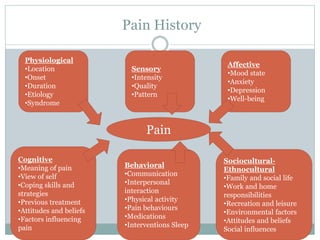
Pain History
Physiological
•Location
•Onset
•Duration
•Etiology
•Syndrome
Sensory
•Intensity
•Quality
•Pattern
Affective
•Mood state
•Anxiety
•Depression
•Well-being
Cognitive
•Meaning of pain
•View of self
•Coping skills and
strategies
•Previous treatment
•Attitudes and beliefs
•Factors influencing
pain
Behavioral
•Communication
•Interpersonal
interaction
•Physical activity
•Pain behaviours
•Medications
•Interventions Sleep
Sociocultural-
Ethnocultural
•Family and social life
•Work and home
responsibilities
•Recreation and leisure
•Environmental factors
•Attitudes and beliefs
Social influences
Pain
Pain Scales
 Mc-Gill Pain Questionnaire
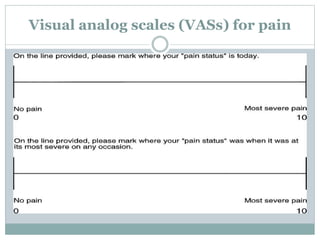
 Visual Pain Scale (VAS)
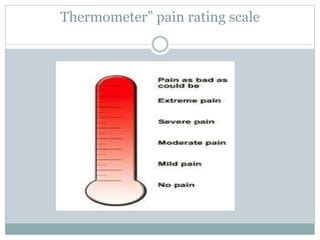
 Thermometer” pain rating scale
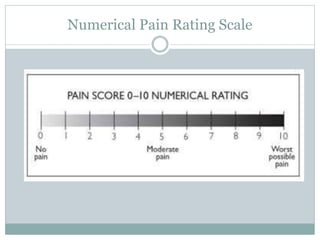
 Numeric Pain Rating Scale (NPRS)
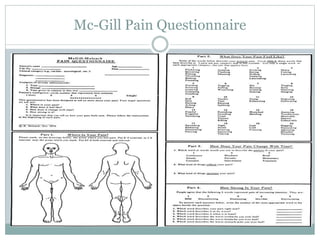
Mc-Gill Pain Questionnaire
Visual analog scales (VASs) for pain
Thermometer” pain rating scale
Numerical Pain Rating Scale
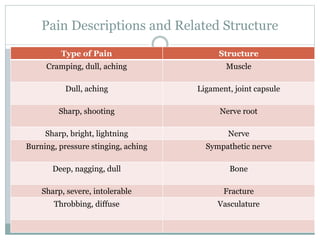
Pain Descriptions and Related Structure
Type of Pain Structure
Cramping, dull, aching Muscle
Dull, aching Ligament, joint capsule
Sharp, shooting Nerve root
Sharp, bright, lightning Nerve
Burning, pressure stinging, aching Sympathetic nerve
Deep, nagging, dull Bone
Sharp, severe, intolerable Fracture
Throbbing, diffuse Vasculature
Summary
 Subjective Examination
 History taking
 Types of History
 Pain Scales
Msk examination

Msk examination

  • 1.
    T H IR D Y E A R B A C H E L O R O F P H Y S I O T H E R A P Y D AT TA M E G H E C O L L E G E O F P H Y S I O T H E R A P Y Department of Musculoskeletal Physiotherapy
  • 2.
    Examination of musculoskeletal Dysfunction Dr.NehaDeshmukh, Assistant Professor, Department of Musculoskeletal Physiotherapy
  • 3.
    Purpose Statement  Thepurpose of the lecture is to explain the Examination of musculoskeletal Dysfunction
  • 4.
    Learning Objective  Atthe end of the lecture students should be able to understand the  Subjective Examination  Objective Examination
  • 5.
    Introduction  A musculoskeletalassessment requires a proper and thorough systematic examination of the patient.  A correct diagnosis depends on a knowledge of functional anatomy, an accurate patient history, diligent observation, and a thorough examination.  The differential diagnosis process involves the use of clinical signs and symptoms, physical examination, a knowledge of pathology and mechanisms of injury, provocative and palpation (motion) tests, and laboratory and diagnostic imaging techniques.
  • 6.
     It isonly through a complete and systematic assessment that an accurate diagnosis can be made.  The purpose of the assessment should be to fully and clearly understand the patient’s problems, from the patient’s perspective as well as the clinician’s, and the physical basis for the symptoms that have caused the patient to complain.
  • 7.
     One ofthe more common assessment recording techniques is the problem-oriented medical records method, which uses “SOAP” notes.  SOAP stands for the four parts of the assessment: Subjective, Objective, Assessment , and Plan.  This method is especially useful in helping the examiner to solve a problem.
  • 8.
     Although thetext deals primarily with musculoskeletal physical assessment on an outpatient basis, it can easily be adapted to evaluate inpatients.  The assessment must be organized, comprehensive, and reproducible.  In general, the examiner compares one side of the body, which is assumed to be normal, with the other side of the body, which is abnormal or injured.  When assessing an individual joint, the examiner must look at the joint and injury in the context of how the injury may affect other joints in the kinetic chain.
  • 9.
    Total Musculoskeletal Assessment Patient history  Observation  Examination of movement  Special tests  Reflexes and cutaneous distribution  Joint play movements  Palpation  Diagnostic imaging
  • 10.
    PATIENT HISTORY  Acomplete medical and injury history should be taken and written to ensure reliability.  This requires effective and efficient communication on the part of the examiner and the ability to develop a good rapport with the patient and, in some cases, family members and other members of the health care team.
  • 11.
     This includesspeaking at a level and using terms the patient will understand; taking the time to listen; and being empathic, interested, caring, and professional.  Emphasis in taking the history should be placed on the portion of the assessment that has the greatest clinical relevance.  Often the examiner can make the diagnosis by simply listening to the patient.
  • 12.
     The historyalso enables the examiner to determine the type of person the patient is, his or her language and cognitive ability, the patient’s ability to articulate, any treatment the patient has received, and the behavior of the injury.  In addition to the history of the present illness or injury, the examiner should note relevant past history, treatment, and results.
  • 13.
     Past medicalhistory should include any major illnesses, surgery, accidents, or allergies.  In some cases, it may be necessary to delve into the social and family histories of the patient if they appear relevant.  Lifestyle habit patterns, including sleep patterns, stress, workload, and recreational pursuits, should also be noted.
  • 14.
     Questions andanswers should provide practical information about the problem.  At the same time, to obtain optimum results in the assessment, it is important for the examiner to establish a good rapport with the patient.  The examiner should listen for any potential red flag signs and symptoms that would indicate the problem is not a musculoskeletal one or a more serious problem that should be referred to the appropriate health care professional.
  • 15.
     Yellow flagsigns and symptoms are also important for the examiner to note as they denote problems that may be more severe or may involve more than one area requiring a more extensive examination.  The patient’s history is usually taken in an orderly sequence.  It offers the patient an opportunity to describe the problem and the limitations caused by the problem as he or she perceives them.  To achieve a good functional outcome, it is essential that the clinician heed to the patient’s concerns and expectations for treatment
  • 16.
    Types of History History of present illness  Past History  Medical History  Personal History  Surgical History  Pain History
  • 17.
    Pain History Physiological •Location •Onset •Duration •Etiology •Syndrome Sensory •Intensity •Quality •Pattern Affective •Mood state •Anxiety •Depression •Well-being Cognitive •Meaningof pain •View of self •Coping skills and strategies •Previous treatment •Attitudes and beliefs •Factors influencing pain Behavioral •Communication •Interpersonal interaction •Physical activity •Pain behaviours •Medications •Interventions Sleep Sociocultural- Ethnocultural •Family and social life •Work and home responsibilities •Recreation and leisure •Environmental factors •Attitudes and beliefs Social influences Pain
  • 18.
    Pain Scales  Mc-GillPain Questionnaire  Visual Pain Scale (VAS)  Thermometer” pain rating scale  Numeric Pain Rating Scale (NPRS)
  • 19.
  • 20.
    Visual analog scales(VASs) for pain
  • 21.
  • 22.
  • 23.
    Pain Descriptions andRelated Structure Type of Pain Structure Cramping, dull, aching Muscle Dull, aching Ligament, joint capsule Sharp, shooting Nerve root Sharp, bright, lightning Nerve Burning, pressure stinging, aching Sympathetic nerve Deep, nagging, dull Bone Sharp, severe, intolerable Fracture Throbbing, diffuse Vasculature
  • 24.
    Summary  Subjective Examination History taking  Types of History  Pain Scales