Erik
Nason, MS, ATC, CSCS, MBA
KSC RehabWorks
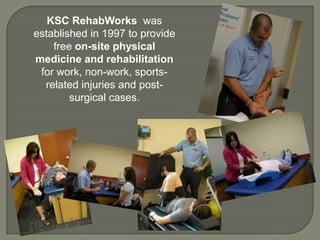
KSC RehabWorks was
established in 1997 to provide
free on-site physical
medicine and rehabilitation
for work, non-work, sports-
related injuries and post-
surgical cases.
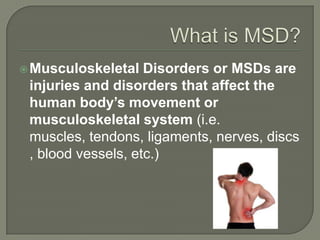
Musculoskeletal Disorders or MSDs are
injuries and disorders that affect the
human body’s movement or
musculoskeletal system (i.e.
muscles, tendons, ligaments, nerves, discs
, blood vessels, etc.)
The human and financial costs of
musculoskeletal disorders impose a
significant burden on workers and
businesses in the United States.
Properly defining MSD and knowing the
different types, costs and risks associated
with MSD is an educational building block
you can use to create an effective injury
prevention program.
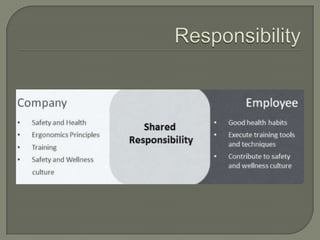
The employer is responsible for providing
a safe place of work, sound ergonomic
principles, proper training for all
employees, and a clear focus on safety
culture within all levels of the organization.
Each employee is responsible for taking
care of their bodies and staying fit for the
work they have chosen to do.
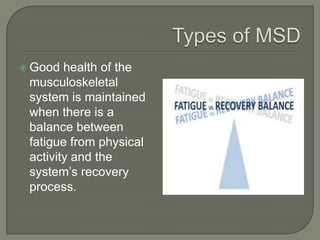
 Good health of the
musculoskeletal
system is maintained
when there is a
balance between
fatigue from physical
activity and the
system’s recovery
process.
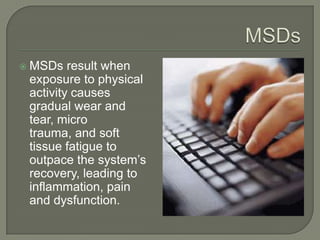
 MSDs result when
exposure to physical
activity causes
gradual wear and
tear, micro
trauma, and soft
tissue fatigue to
outpace the system’s
recovery, leading to
inflammation, pain
and dysfunction.
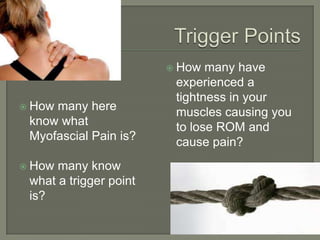
 How many here
know what
Myofascial Pain is?
 How many know
what a trigger point
is?
 How many have
experienced a
tightness in your
muscles causing you
to lose ROM and
cause pain?
Currently reported to affect approximately
85% of the population at some point during
their lives
The mean prevalence of this condition
among middle-aged adults (30–60 years)
is reported to be 37% in men and 65% in
women, respectively
 In the elderly (>65 years), the prevalence
reaches 85%
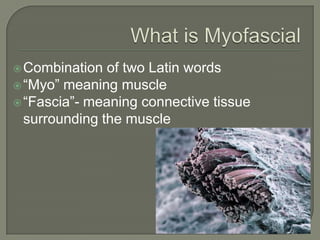
Combination of two Latin words
“Myo” meaning muscle
“Fascia”- meaning connective tissue
surrounding the muscle
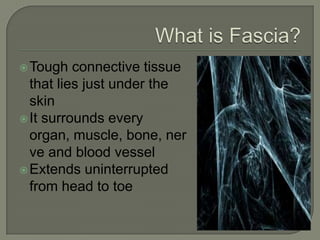
Tough connective tissue
that lies just under the
skin
It surrounds every
organ, muscle, bone, ner
ve and blood vessel
Extends uninterrupted
from head to toe
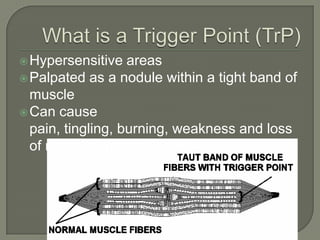
Hypersensitive areas
Palpated as a nodule within a tight band of
muscle
Can cause
pain, tingling, burning, weakness and loss
of range of motion (ROM)
 MFP is an umbrella term that is given to TrPs
and referred pain
 TrPs are the TRUE source of soft tissue pain
 MPS is more of a medical “garbage” term
expressing the fact that the person is
experiencing broad soft tissue pain unrelated
to any MOI- possibly the result of multiple
TrPs with referred pain
 Tight MF and/or tight, fatigue, strained
muscles can develop active TrPs therefore
creating pain
Chronic or acute pain disorder
Initiated trough TrP’s, inducing referred
pain into a specific body region depending
on the muscle involved
Typically occurs after a muscle has been
contracted repetitively
Untreated it can cause
tightness, tenderness, stiffness, popping
and clicking, loss of ROM
2 Types
• Latent
• Active
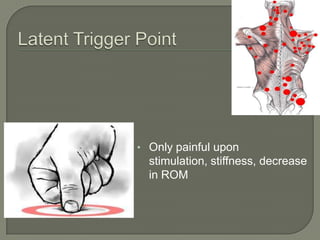
• Only painful upon
stimulation, stiffness, decrease
in ROM
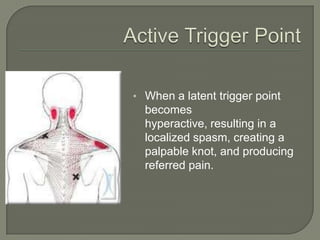
• When a latent trigger point
becomes
hyperactive, resulting in a
localized spasm, creating a
palpable knot, and producing
referred pain.
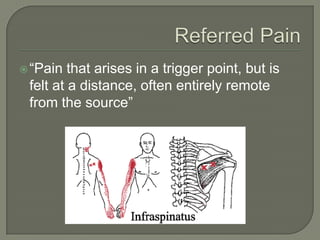
“Pain that arises in a trigger point, but is
felt at a distance, often entirely remote
from the source”
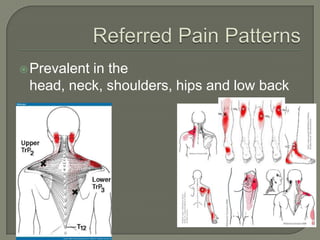
Prevalent in the
head, neck, shoulders, hips and low back
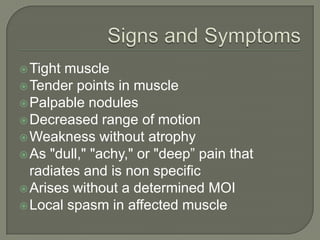
Tight muscle
Tender points in muscle
Palpable nodules
Decreased range of motion
Weakness without atrophy
As "dull," "achy," or "deep” pain that
radiates and is non specific
Arises without a determined MOI
Local spasm in affected muscle
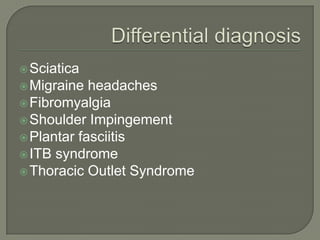
Sciatica
Migraine headaches
Fibromyalgia
Shoulder Impingement
Plantar fasciitis
ITB syndrome
Thoracic Outlet Syndrome
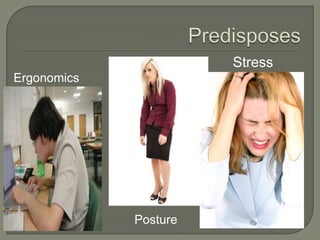
Stress
Posture
Ergonomics
History
• How long has this been going on?
• Has anything in your daily routine changed that
might evoke this?
• What makes it better or worse?
• Has there been any trauma to this area currently?
• Any limitations of ROM since onset?
• Do you notice a decrease in pain over the
weekend?
• What type of work do you do?
What is your posture like?
How are your workstation ergonomics?
Do you exercise on a daily bases?
Technique used to help lengthen the
muscle and fascial layers and enable them
to remain in the lengthened state
Goal is to decrease the amount of tension
to the trigger points and decrease their
hypersensitivity
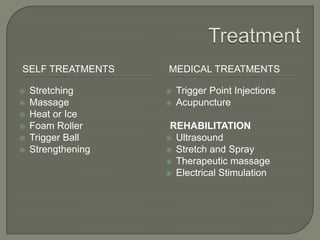
SELF TREATMENTS
 Stretching
 Massage
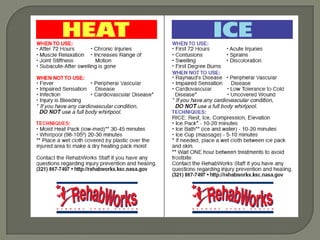
 Heat or Ice
 Foam Roller
 Trigger Ball
 Strengthening
MEDICAL TREATMENTS
 Trigger Point Injections
 Acupuncture
REHABILITATION
 Ultrasound
 Stretch and Spray
 Therapeutic massage
 Electrical Stimulation
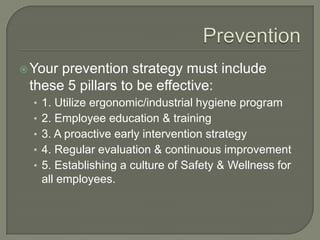
Your prevention strategy must include
these 5 pillars to be effective:
• 1. Utilize ergonomic/industrial hygiene program
• 2. Employee education & training
• 3. A proactive early intervention strategy
• 4. Regular evaluation & continuous improvement
• 5. Establishing a culture of Safety & Wellness for
all employees.
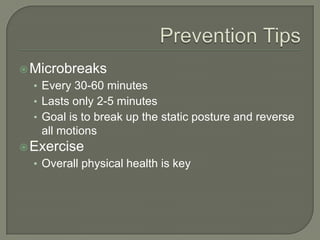
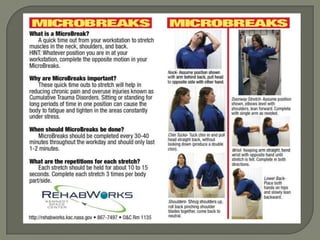
Microbreaks
• Every 30-60 minutes
• Lasts only 2-5 minutes
• Goal is to break up the static posture and reverse
all motions
Exercise
• Overall physical health is key
1. Myofascial pain and TrPs are caused
from a contraction of the muscle
fibers, such as repetative motions or
injury
2. Self techniques that help enhance the
treatment of MPS and TrPs include
stretching, strengthening, foam rolling
and massage
3. Techniques involved in the prevention
include microbreaks, postural
training, exercise and stress
“90% of the game is half mental”
Yogi Berra

Musculoskeletal Disorders

  • 1.
    Erik Nason, MS, ATC,CSCS, MBA KSC RehabWorks
  • 2.
    KSC RehabWorks was establishedin 1997 to provide free on-site physical medicine and rehabilitation for work, non-work, sports- related injuries and post- surgical cases.
  • 4.
    Musculoskeletal Disorders orMSDs are injuries and disorders that affect the human body’s movement or musculoskeletal system (i.e. muscles, tendons, ligaments, nerves, discs , blood vessels, etc.)
  • 5.
    The human andfinancial costs of musculoskeletal disorders impose a significant burden on workers and businesses in the United States. Properly defining MSD and knowing the different types, costs and risks associated with MSD is an educational building block you can use to create an effective injury prevention program.
  • 6.
    The employer isresponsible for providing a safe place of work, sound ergonomic principles, proper training for all employees, and a clear focus on safety culture within all levels of the organization. Each employee is responsible for taking care of their bodies and staying fit for the work they have chosen to do.
  • 8.
     Good healthof the musculoskeletal system is maintained when there is a balance between fatigue from physical activity and the system’s recovery process.
  • 9.
     MSDs resultwhen exposure to physical activity causes gradual wear and tear, micro trauma, and soft tissue fatigue to outpace the system’s recovery, leading to inflammation, pain and dysfunction.
  • 10.
     How manyhere know what Myofascial Pain is?  How many know what a trigger point is?  How many have experienced a tightness in your muscles causing you to lose ROM and cause pain?
  • 11.
    Currently reported toaffect approximately 85% of the population at some point during their lives The mean prevalence of this condition among middle-aged adults (30–60 years) is reported to be 37% in men and 65% in women, respectively  In the elderly (>65 years), the prevalence reaches 85%
  • 12.
    Combination of twoLatin words “Myo” meaning muscle “Fascia”- meaning connective tissue surrounding the muscle
  • 13.
    Tough connective tissue thatlies just under the skin It surrounds every organ, muscle, bone, ner ve and blood vessel Extends uninterrupted from head to toe
  • 14.
    Hypersensitive areas Palpated asa nodule within a tight band of muscle Can cause pain, tingling, burning, weakness and loss of range of motion (ROM)
  • 15.
     MFP isan umbrella term that is given to TrPs and referred pain  TrPs are the TRUE source of soft tissue pain  MPS is more of a medical “garbage” term expressing the fact that the person is experiencing broad soft tissue pain unrelated to any MOI- possibly the result of multiple TrPs with referred pain  Tight MF and/or tight, fatigue, strained muscles can develop active TrPs therefore creating pain
  • 16.
    Chronic or acutepain disorder Initiated trough TrP’s, inducing referred pain into a specific body region depending on the muscle involved Typically occurs after a muscle has been contracted repetitively Untreated it can cause tightness, tenderness, stiffness, popping and clicking, loss of ROM
  • 17.
  • 18.
    • Only painfulupon stimulation, stiffness, decrease in ROM
  • 19.
    • When alatent trigger point becomes hyperactive, resulting in a localized spasm, creating a palpable knot, and producing referred pain.
  • 20.
    “Pain that arisesin a trigger point, but is felt at a distance, often entirely remote from the source”
  • 21.
    Prevalent in the head,neck, shoulders, hips and low back
  • 22.
    Tight muscle Tender pointsin muscle Palpable nodules Decreased range of motion Weakness without atrophy As "dull," "achy," or "deep” pain that radiates and is non specific Arises without a determined MOI Local spasm in affected muscle
  • 23.
  • 24.
  • 25.
    History • How longhas this been going on? • Has anything in your daily routine changed that might evoke this? • What makes it better or worse? • Has there been any trauma to this area currently? • Any limitations of ROM since onset? • Do you notice a decrease in pain over the weekend? • What type of work do you do?
  • 26.
    What is yourposture like? How are your workstation ergonomics? Do you exercise on a daily bases?
  • 28.
    Technique used tohelp lengthen the muscle and fascial layers and enable them to remain in the lengthened state Goal is to decrease the amount of tension to the trigger points and decrease their hypersensitivity
  • 29.
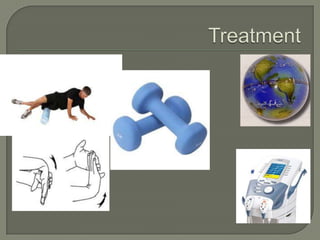
    SELF TREATMENTS  Stretching Massage  Heat or Ice  Foam Roller  Trigger Ball  Strengthening MEDICAL TREATMENTS  Trigger Point Injections  Acupuncture REHABILITATION  Ultrasound  Stretch and Spray  Therapeutic massage  Electrical Stimulation
  • 30.
    Your prevention strategymust include these 5 pillars to be effective: • 1. Utilize ergonomic/industrial hygiene program • 2. Employee education & training • 3. A proactive early intervention strategy • 4. Regular evaluation & continuous improvement • 5. Establishing a culture of Safety & Wellness for all employees.
  • 31.
    Microbreaks • Every 30-60minutes • Lasts only 2-5 minutes • Goal is to break up the static posture and reverse all motions Exercise • Overall physical health is key
  • 34.
    1. Myofascial painand TrPs are caused from a contraction of the muscle fibers, such as repetative motions or injury 2. Self techniques that help enhance the treatment of MPS and TrPs include stretching, strengthening, foam rolling and massage 3. Techniques involved in the prevention include microbreaks, postural training, exercise and stress
  • 35.
    “90% of thegame is half mental” Yogi Berra

Editor's Notes

  • #12 MPSWhy does it increase with age? By becoming inactive muscles and tendons and ligaments loose their flexibility increasing more tension, nutritional deficiency, it Is thought that muscles is younger individuals are better able to handle stress and overuseWhy is it so much more prevalent in women
  • #13 Let me begin by explaining what myofascial is, it is actually a combination of 2 latin wordsAnalogy: Think of a piece of steak, the thin tissue on it, that’s fascia. Or, here is another way to think of it, Spider Web
  • #14 Analogy: Think of a piece of steak, the thin tissue on it, that’s fascia. Or, here is another way to think of it, Spider WebIt surrounds every structure in the body
  • #15 AKA Knot-NoduleTransition???
  • #16 Correlation betweenHow they relate to one another, how does trigger points relate to MFPMFP is an umbrella term that is given to Trigger points and referred pain
  • #17 Now that you have a better understanding lets talk about MFPSRepetitive motions- constantly reaching, sitting with poor posture, staring at a computer screen
  • #18 The two most common types of trigger points that we deal with are active and latent trigger points
  • #20 Pain during activity and at rest
  • #21 Meaning pain from the trigger point causes pain in a different part of the body away from the true source of the pain
  • #22 Structural muscles
  • #24 The most important criteria for differential diagnosis are the presence of tender points (TePs) and widespread, nonspecific, soft tissue pain in FM, compared with regional and characteristic referred pain patterns with discrete muscular trigger points (TrPs) and taut bands of skeletal muscle in MPS.Be able to describe all of these
  • #25 In the industrial settingOverhead motionsFind a better stress pictures
  • #27 Self evaluationDo you exercise on a daily bases and if so what type of exercise do you do? Strengthening? Or just cardio?
  • #29 Technique used to help lengthen the muscle and fascial layers and enable them to remain in the lengthened state
  • #30 HVPC-muscles spasms can be released, in the muscle is continuously stimulated to exhaustion If ice makes it feel better that is a sign of nerve entrapment If ice makes it worse and heat reliefs the pain, then there is no nerve entrapment