ERGONOMICS IN WORKPLACE
SETTING
By Ragini Susan Shraddha
OBJECTIVES
• Ergonomics
• Cumulative trauma disorders
• Pathophysiology
• Risk factors causing CTDs
• Management of CTDs
• Assessment strategies
• Role of Physiotherapy
ERGONOMICS
Definition
ERGO + NOMOS = ERGONOMICS
“work” + “laws” = “ laws of work ”
“Ergonomics (or human factors) is the scientific discipline concerned with
the understanding of the interactions among human and other elements
of a system and the profession that applies theory, principles, data and
methods to design in order to optimize human well-being and overall
system performance.”
International Ergonomics Association Executive Council
WHY IS IT IMPORTANT?
● It prevents work related injuries and promotes safety , comfort at work
station.
● enhancing relationship between person, equipment ,workplace, and the
environment.
● It recognizes risks.
● Realize how to eliminate or reduce injuries.
● Increase work efficiency and productivity, quality of life.
Principles of BODY ergonomics
1)Keep everything in easy reach
2)Maintain neutral posture
3)Work at proper height
4)Reduce repetitive motions
5)Allow for movement and stretching
6)Minimise fatigue and static load
7)Minimise excessive force
8)Reduce contact stresses
9)Provide clearance
10)Maintain a comfortable environment.
BUT WHY?
Cumulative trauma disorders
Definition
• Cumulative Trauma Disorders is an umbrella term that includes the
micro traumatic injuries caused due to repetitive stresses on the soft
tissues of the body most commonly incurred during occupational
activities.
• Wear and tear injuries.
• Most common areas affected:
1. Neck and shoulder - trapezitis, cervical spondylitis, rotator cuff
impingements
2. Low back- muscular weakness ,PIVD, Spondylitis
3. Wrist and hand- carpal tunnel syndrome, tennis elbow
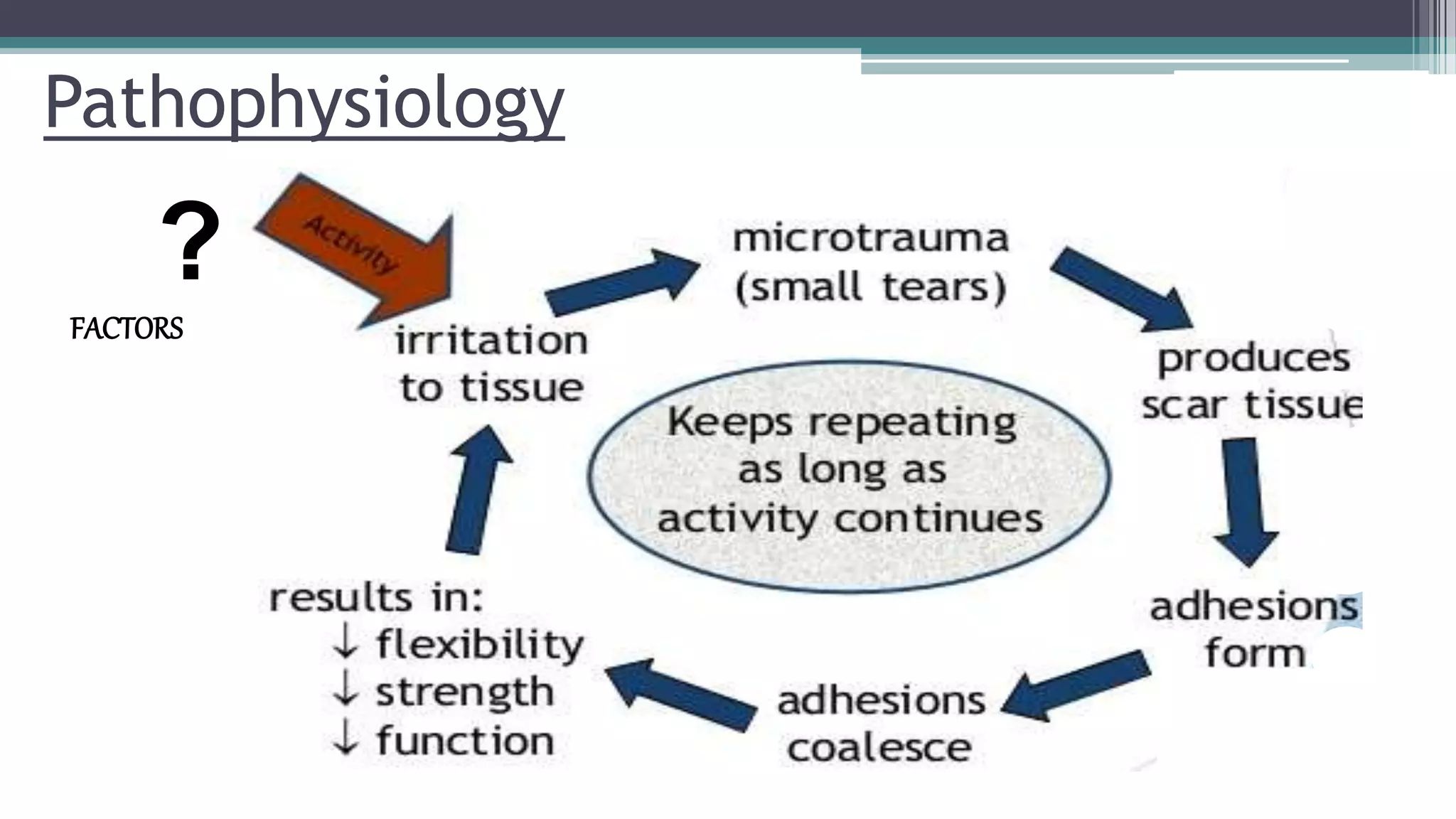
Pathophysiology
?
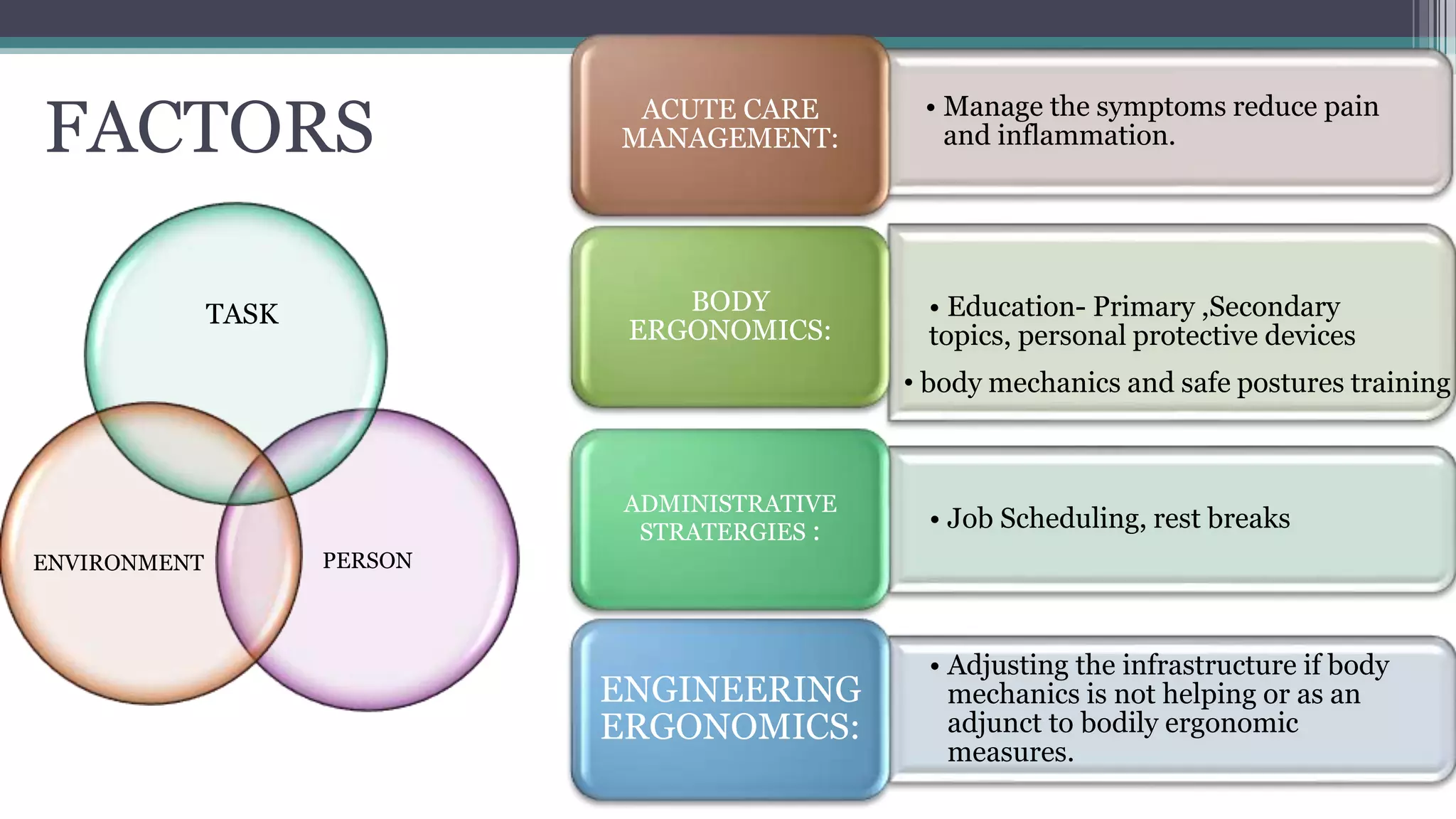
FACTORS
FACTORS
PERSONENVIRONMENT
TASK
• Manage the symptoms reduce pain
and inflammation.
ACUTE CARE
MANAGEMENT:
• Education- Primary ,Secondary
topics, personal protective devices
BODY
ERGONOMICS:
• Job Scheduling, rest breaks
ADMINISTRATIVE
STRATERGIES :
• Adjusting the infrastructure if body
mechanics is not helping or as an
adjunct to bodily ergonomic
measures.
ENGINEERING
ERGONOMICS:
• body mechanics and safe postures training
TASK
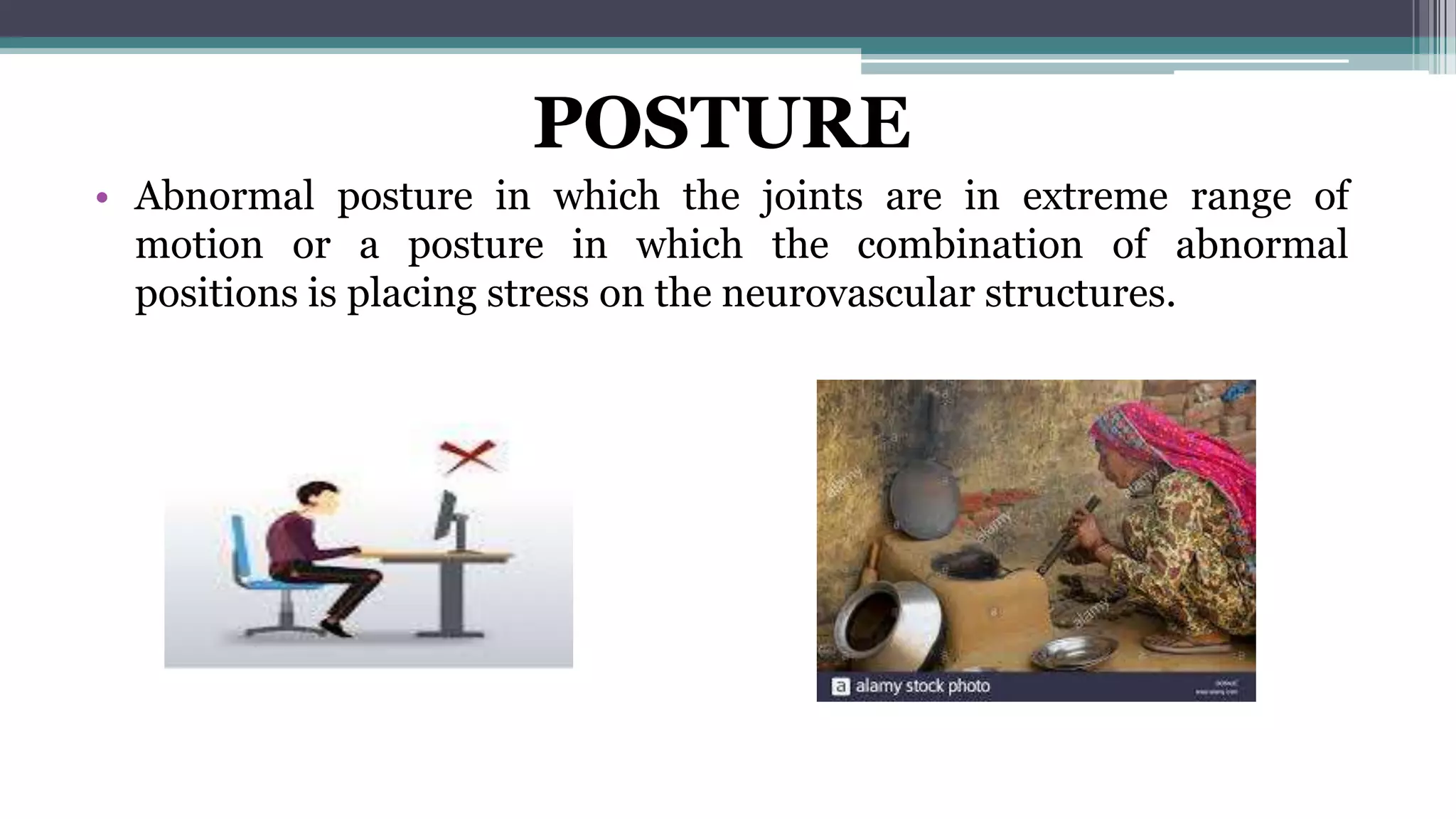
POSTURE
• Abnormal posture in which the joints are in extreme range of
motion or a posture in which the combination of abnormal
positions is placing stress on the neurovascular structures.
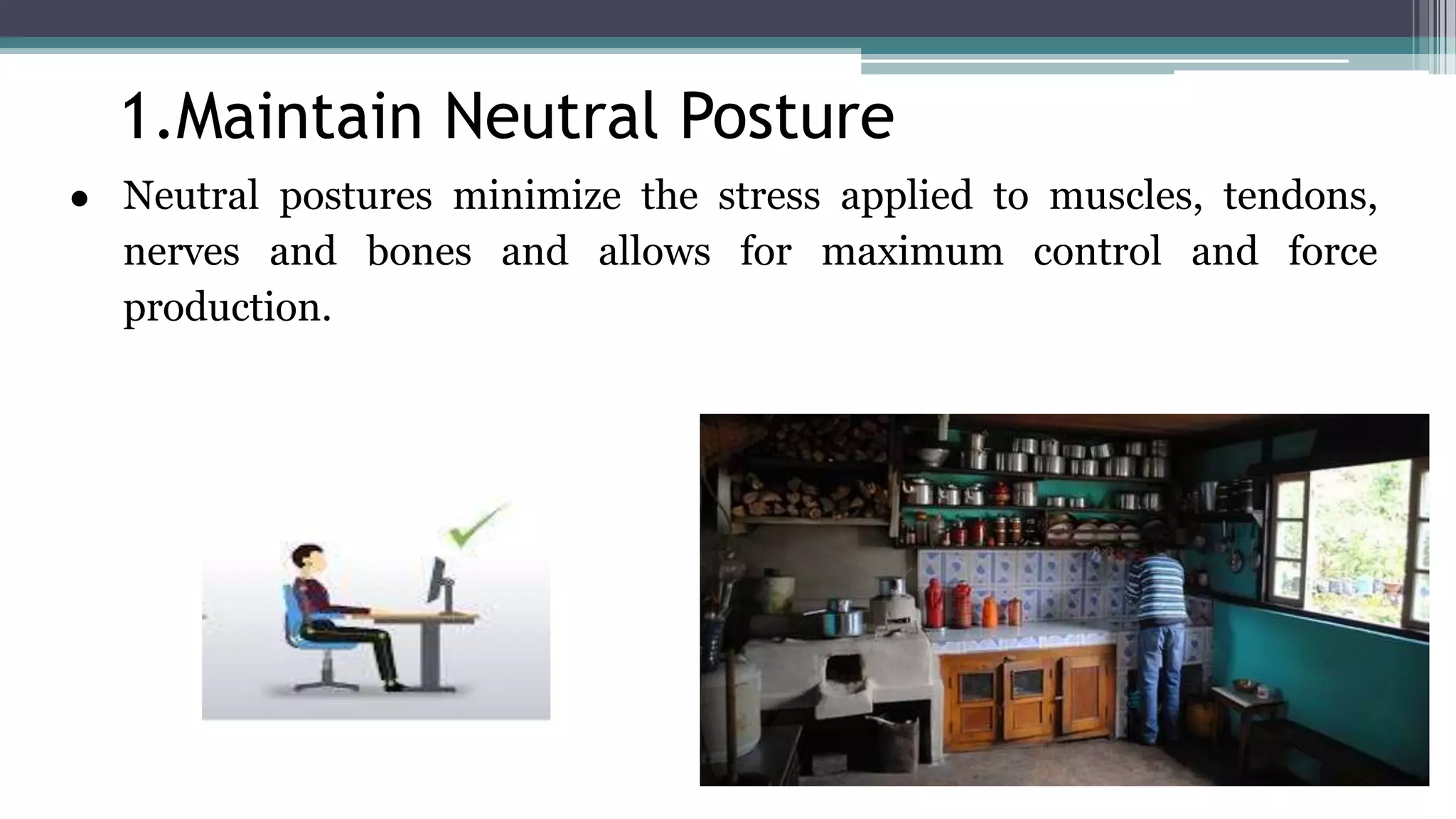
1.Maintain Neutral Posture
● Neutral postures minimize the stress applied to muscles, tendons,
nerves and bones and allows for maximum control and force
production.
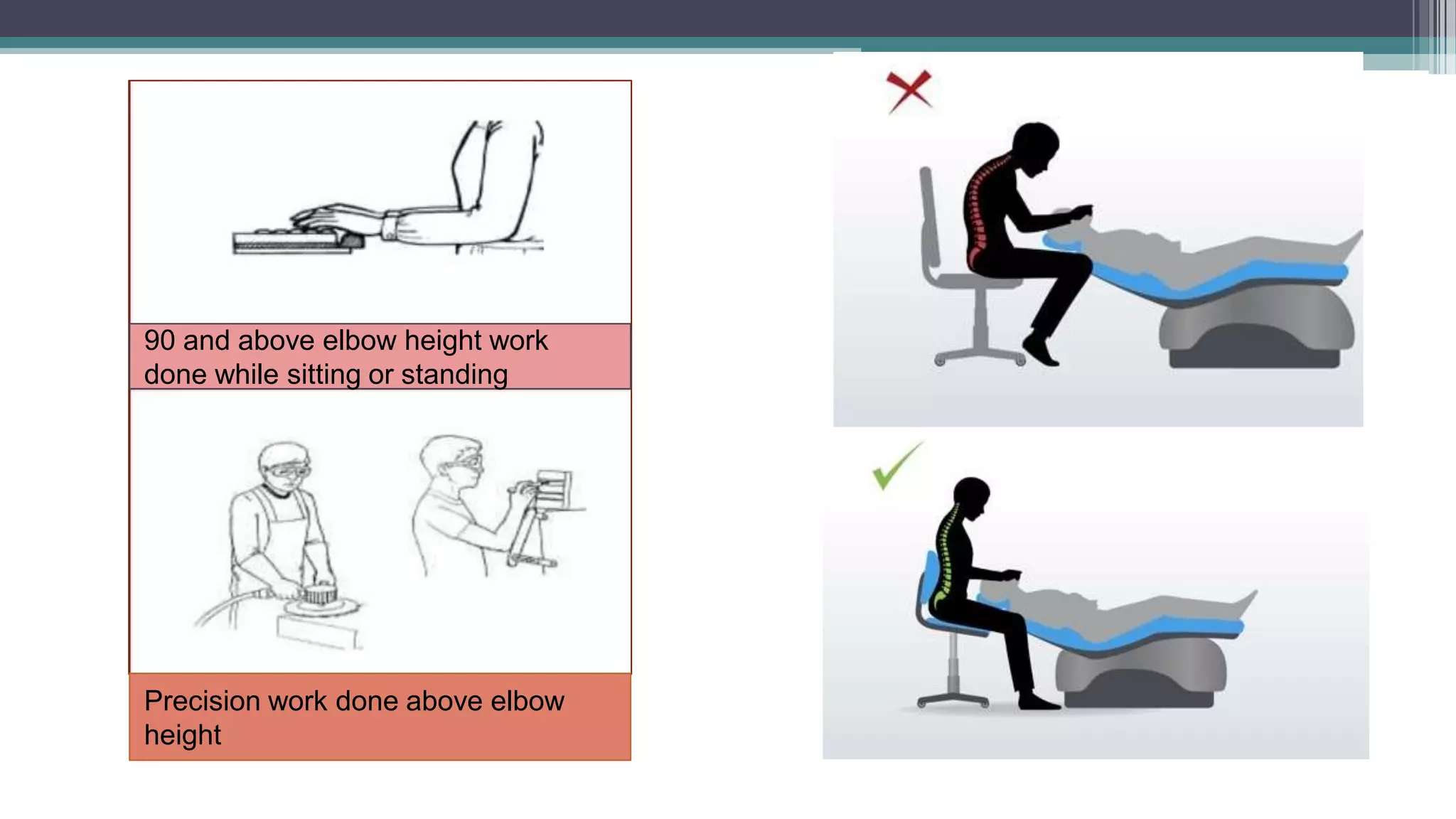
2.Work at proper height
● Most work should be done at about elbow height, whether sitting or
standing.
● Work within the power range- (i.e) mid range of muscular action.
● Adjust heights by extending or cutting the legs to a work tables ,
adjustable height chair.
● you can either put a work platform on top of the table (to raise the
work up) or stand on a platform (to raise YOU up).
90 and above elbow height work
done while sitting or standing
Precision work done above elbow
height
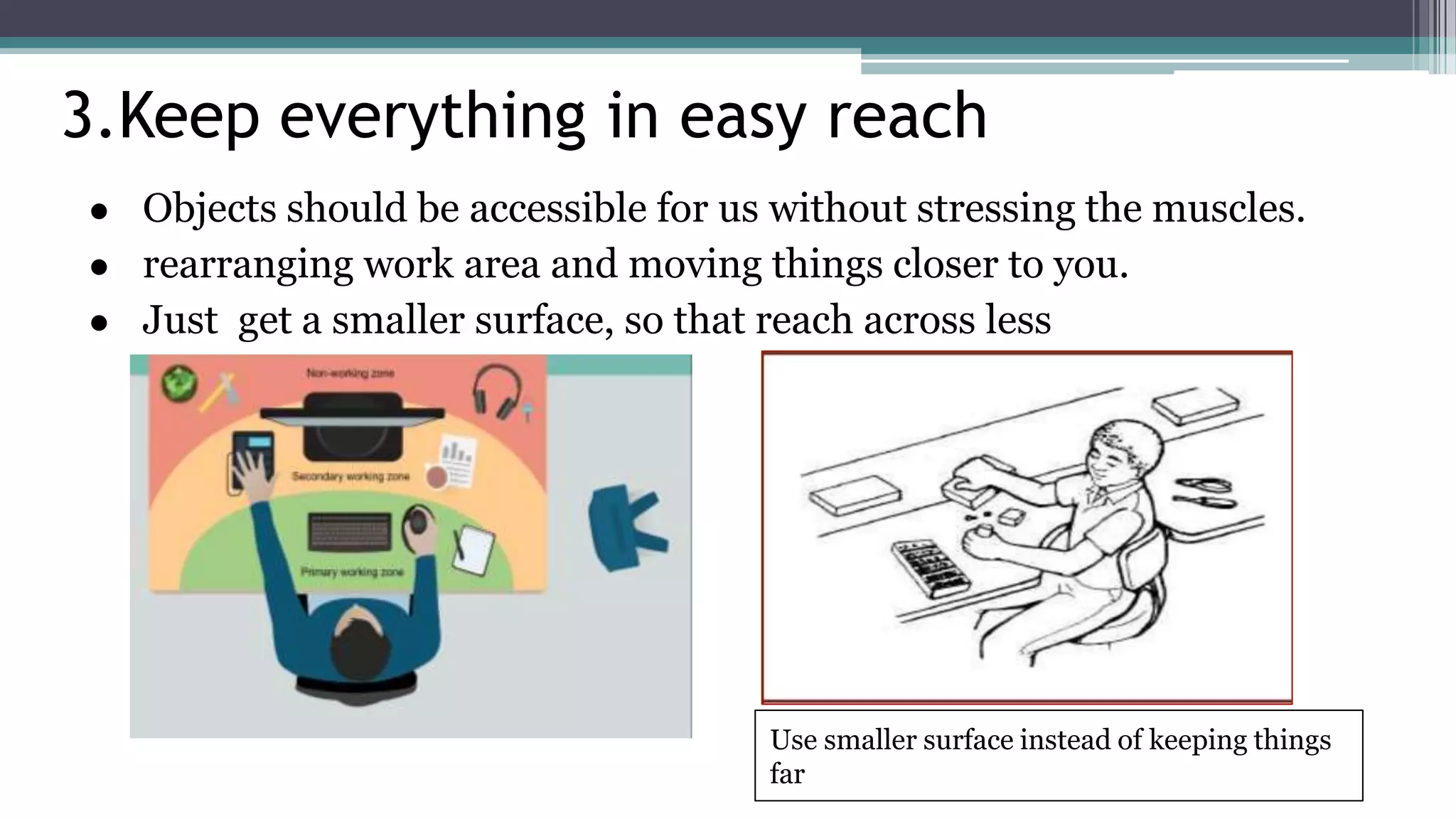
3.Keep everything in easy reach
● Objects should be accessible for us without stressing the muscles.
● rearranging work area and moving things closer to you.
● Just get a smaller surface, so that reach across less
Use smaller surface instead of keeping things
far
4. Stretch a bit (20- 20 rule)
● Stretching reduces fatigue,
improves muscular balance and
posture and improves muscle
coordination.
● Prepare your body for work by
warming up to improve
performance and lower injury risk.
● maintains blood circulation.
EFFORT
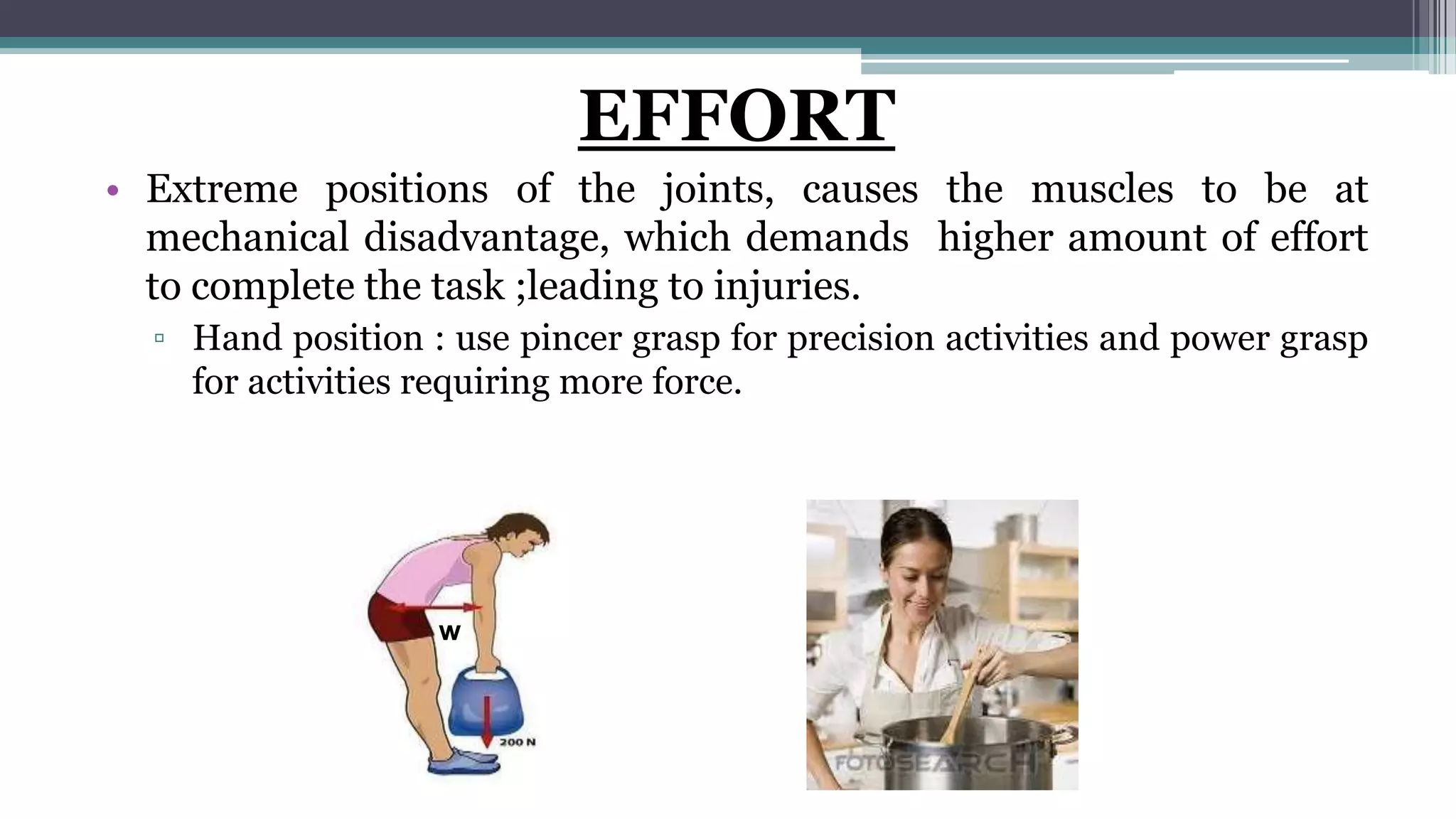
• Extreme positions of the joints, causes the muscles to be at
mechanical disadvantage, which demands higher amount of effort
to complete the task ;leading to injuries.
▫ Hand position : use pincer grasp for precision activities and power grasp
for activities requiring more force.
w
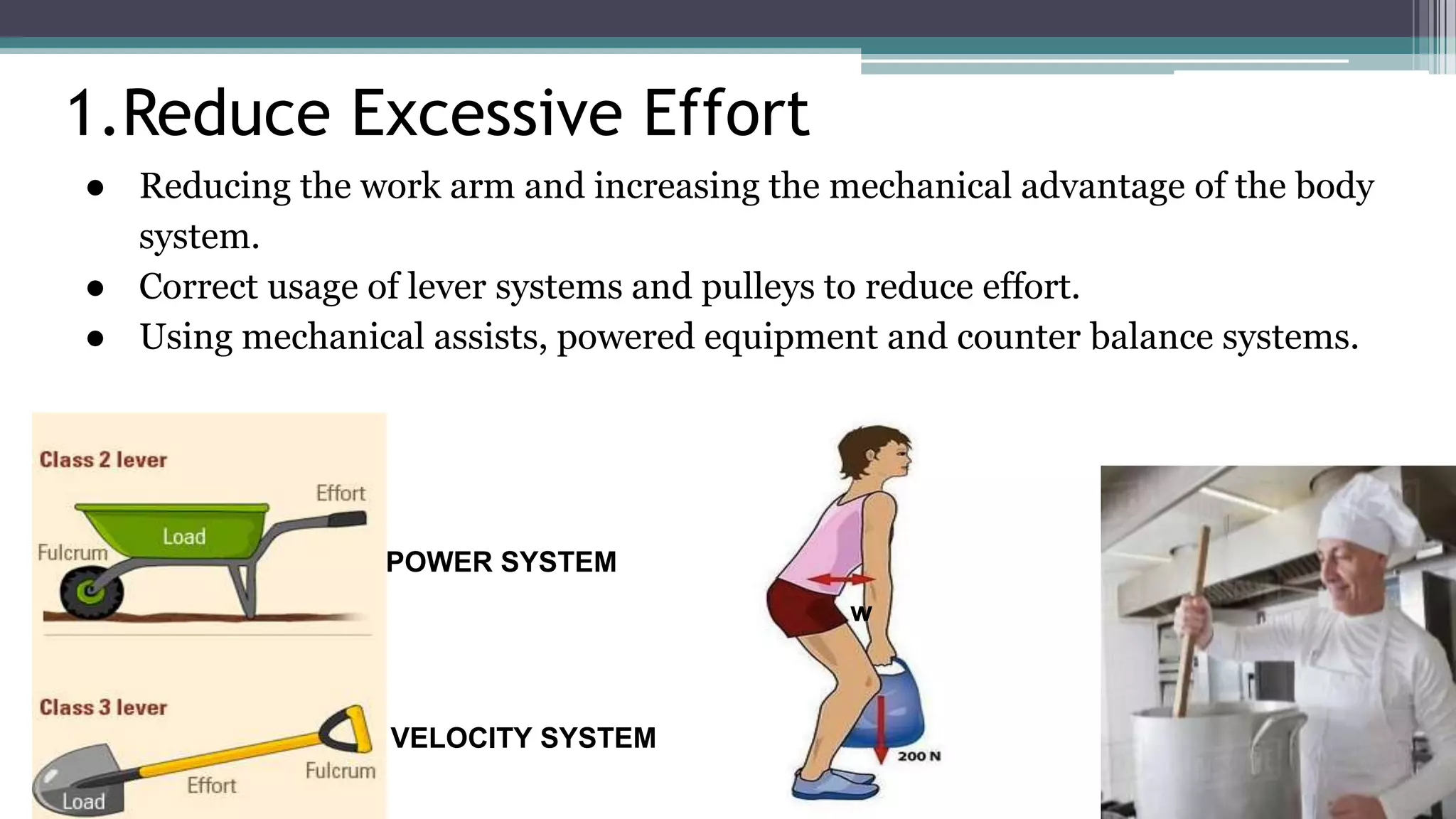
1.Reduce Excessive Effort
● Reducing the work arm and increasing the mechanical advantage of the body
system.
● Correct usage of lever systems and pulleys to reduce effort.
● Using mechanical assists, powered equipment and counter balance systems.
w
POWER SYSTEM
VELOCITY SYSTEM
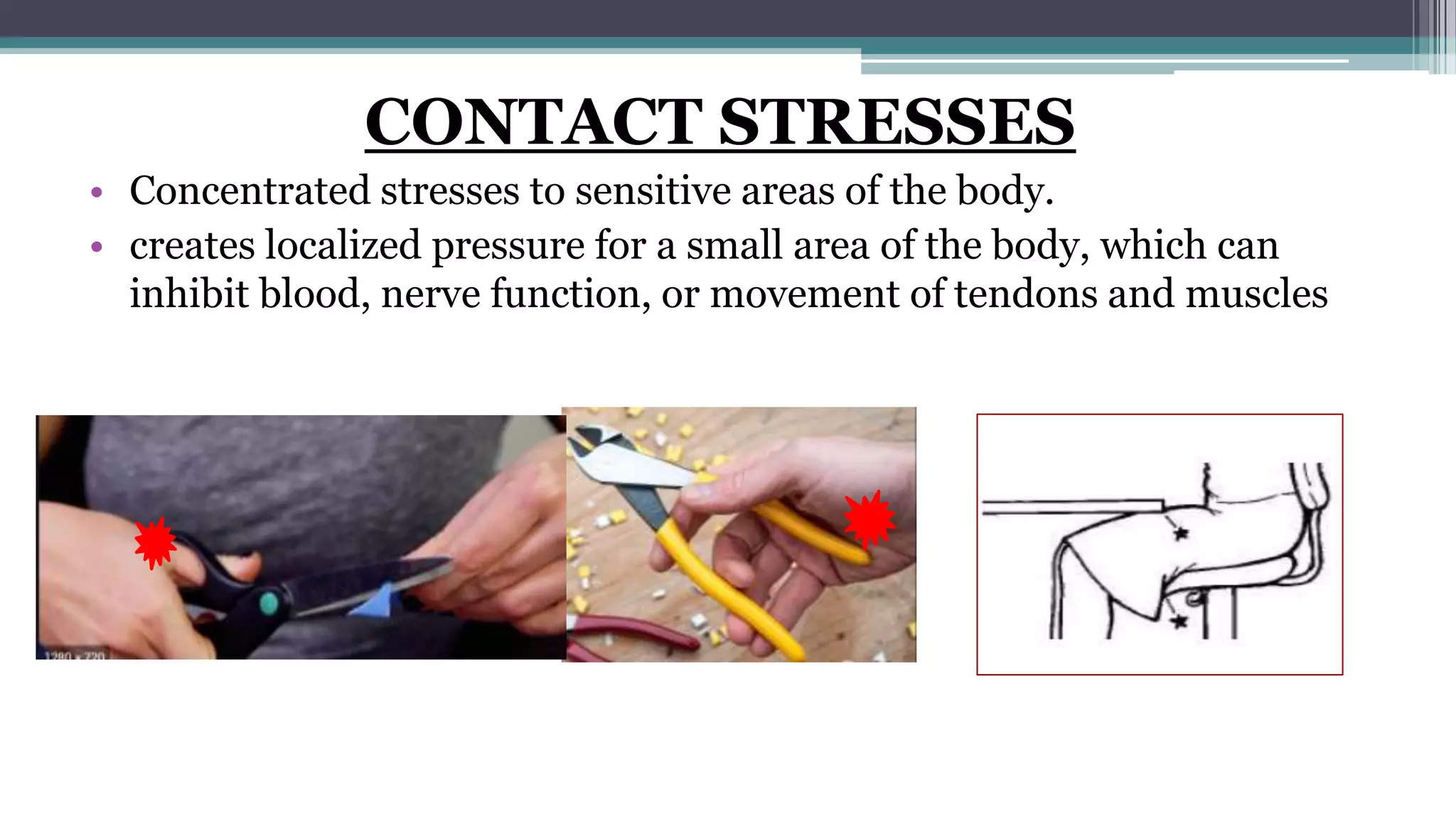
CONTACT STRESSES
• Concentrated stresses to sensitive areas of the body.
• creates localized pressure for a small area of the body, which can
inhibit blood, nerve function, or movement of tendons and muscles
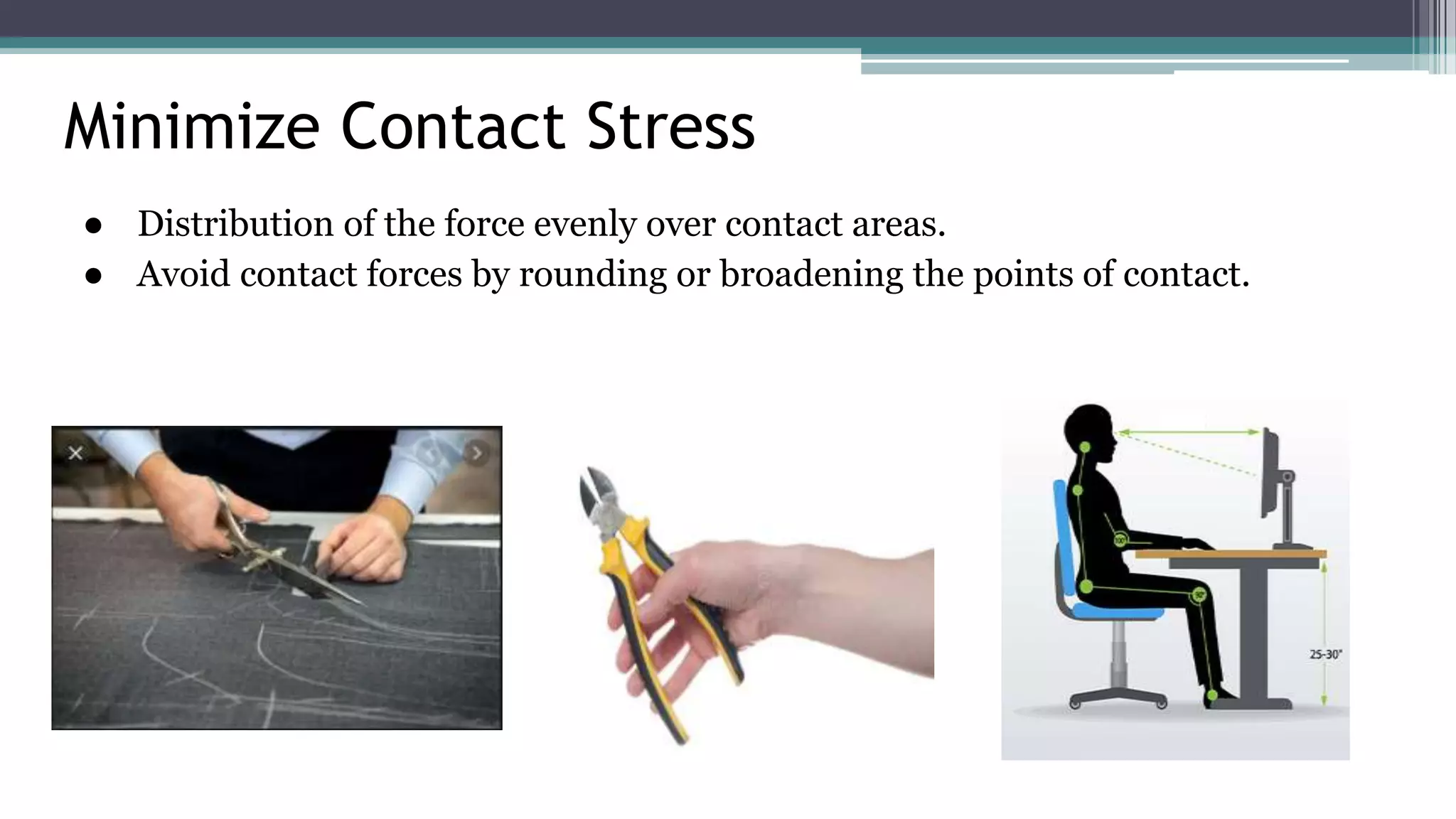
Minimize Contact Stress
● Distribution of the force evenly over contact areas.
● Avoid contact forces by rounding or broadening the points of contact.
REPETITION
• Repetition of tasks causes particular soft tissues to be under
stress and strains for a long period of time that causes fatigue
and injuries.
• Ineffective recovery time contributes to CTDs.
• A job is considered highly repetitive if the cycle time
is 30 seconds or less.
• Assessed by repeated movement analysis.
• Ex-carpal tunnel syndrome, tendinitis and trigger finger
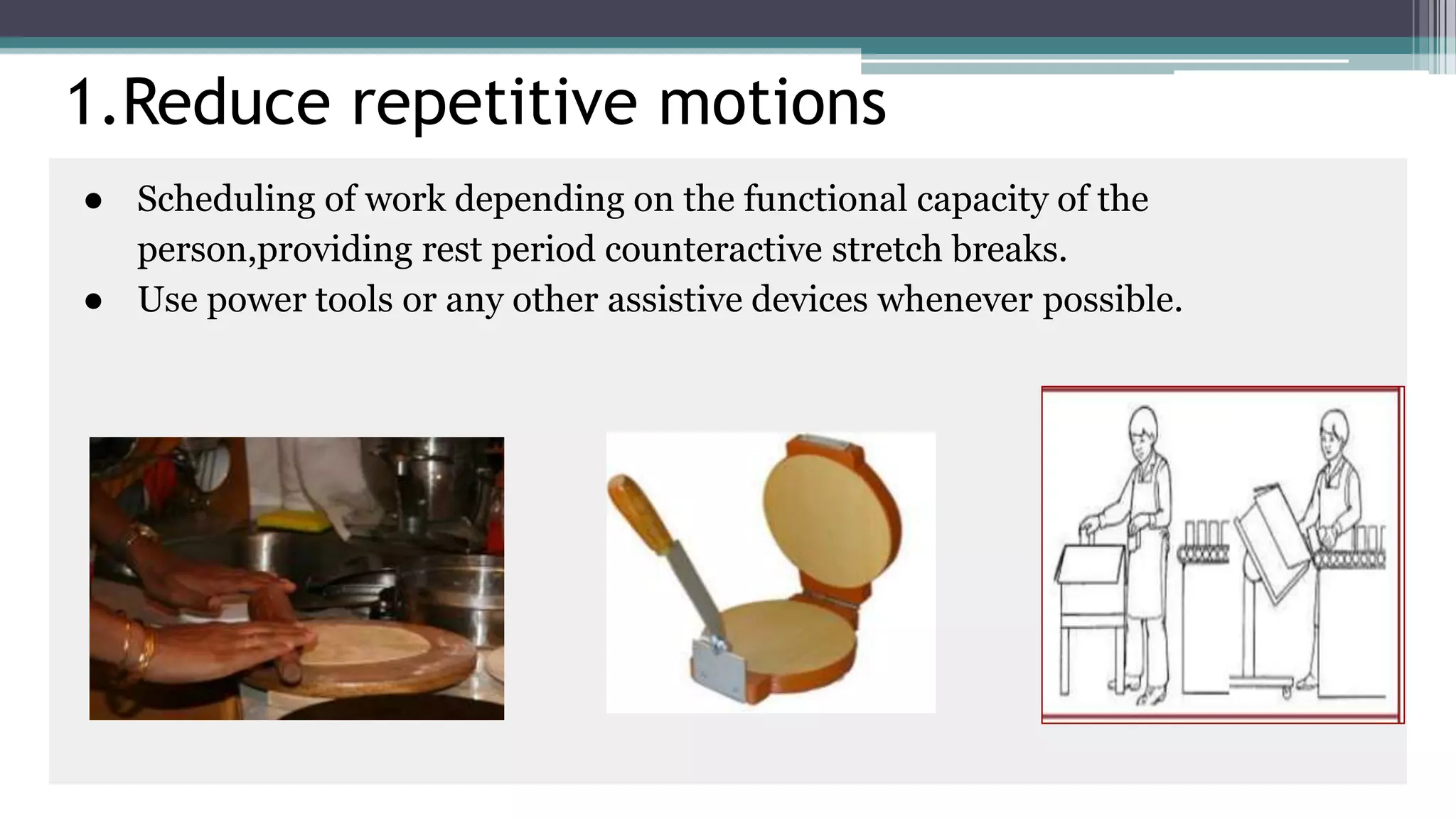
1.Reduce repetitive motions
● Scheduling of work depending on the functional capacity of the
person,providing rest period counteractive stretch breaks.
● Use power tools or any other assistive devices whenever possible.
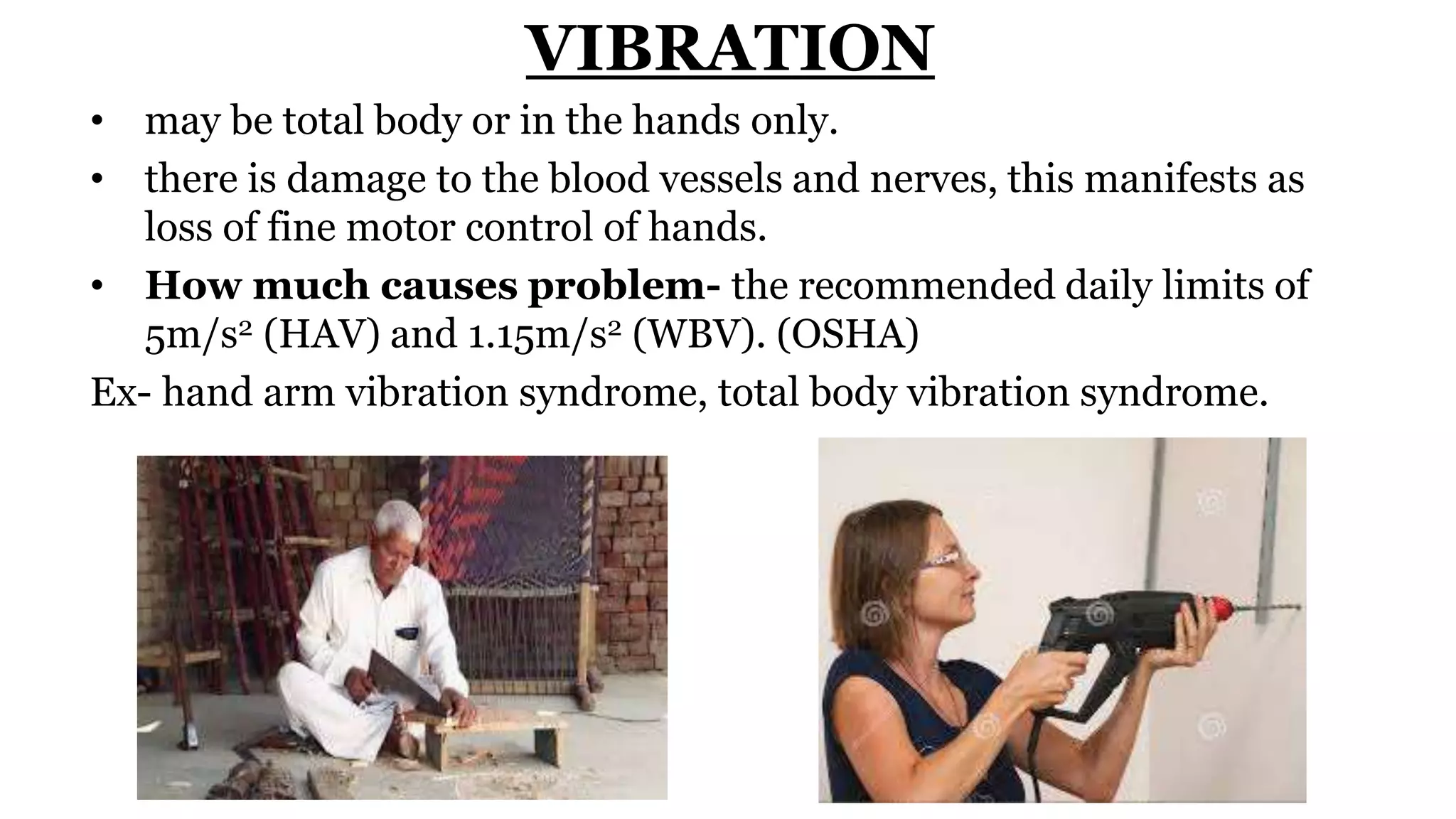
VIBRATION
• may be total body or in the hands only.
• there is damage to the blood vessels and nerves, this manifests as
loss of fine motor control of hands.
• How much causes problem- the recommended daily limits of
5m/s2 (HAV) and 1.15m/s2 (WBV). (OSHA)
Ex- hand arm vibration syndrome, total body vibration syndrome.
Engineering ergonomics to reduce vibration
EQUIPMENT MAINTENANCE
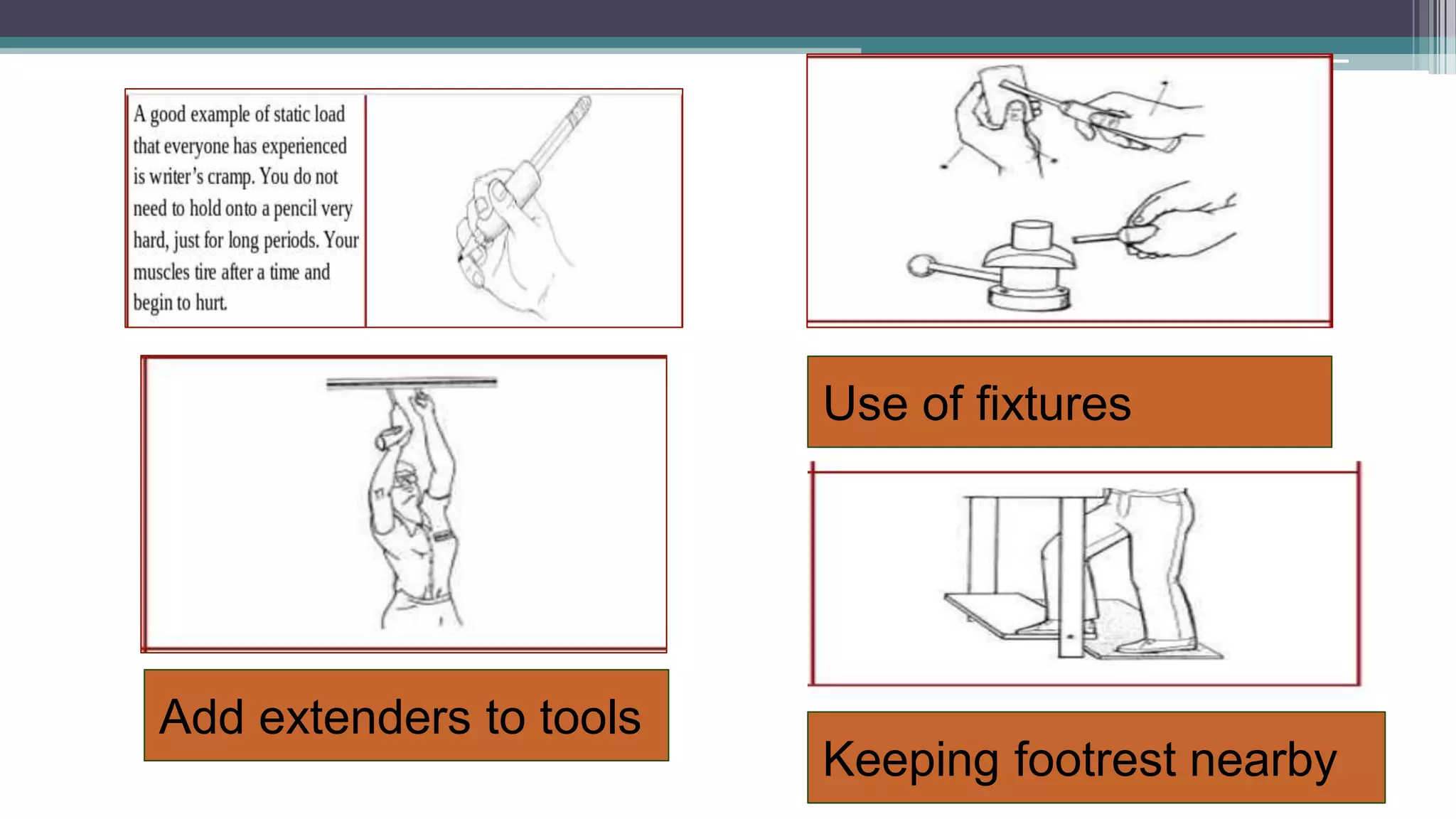
Minimise fatigue and static load
● In the workplace, having to hold parts and tools continually is an example of
static load.In this case, using a fixture eliminates the need to hold onto the
part.
● Having to hold your arms overhead for a few minutes is another classic
example of static load, this time affecting the shoulder muscles. Sometimes
you can change the orientation of the work area to prevent this, or sometimes
you can add extenders to the tools.
● Having to stand for a long time creates a static load on your legs. Using a
footrest can permit you to reposition your legs and make it easier to stand.
Add extenders to tools
Use of fixtures
Keeping footrest nearby
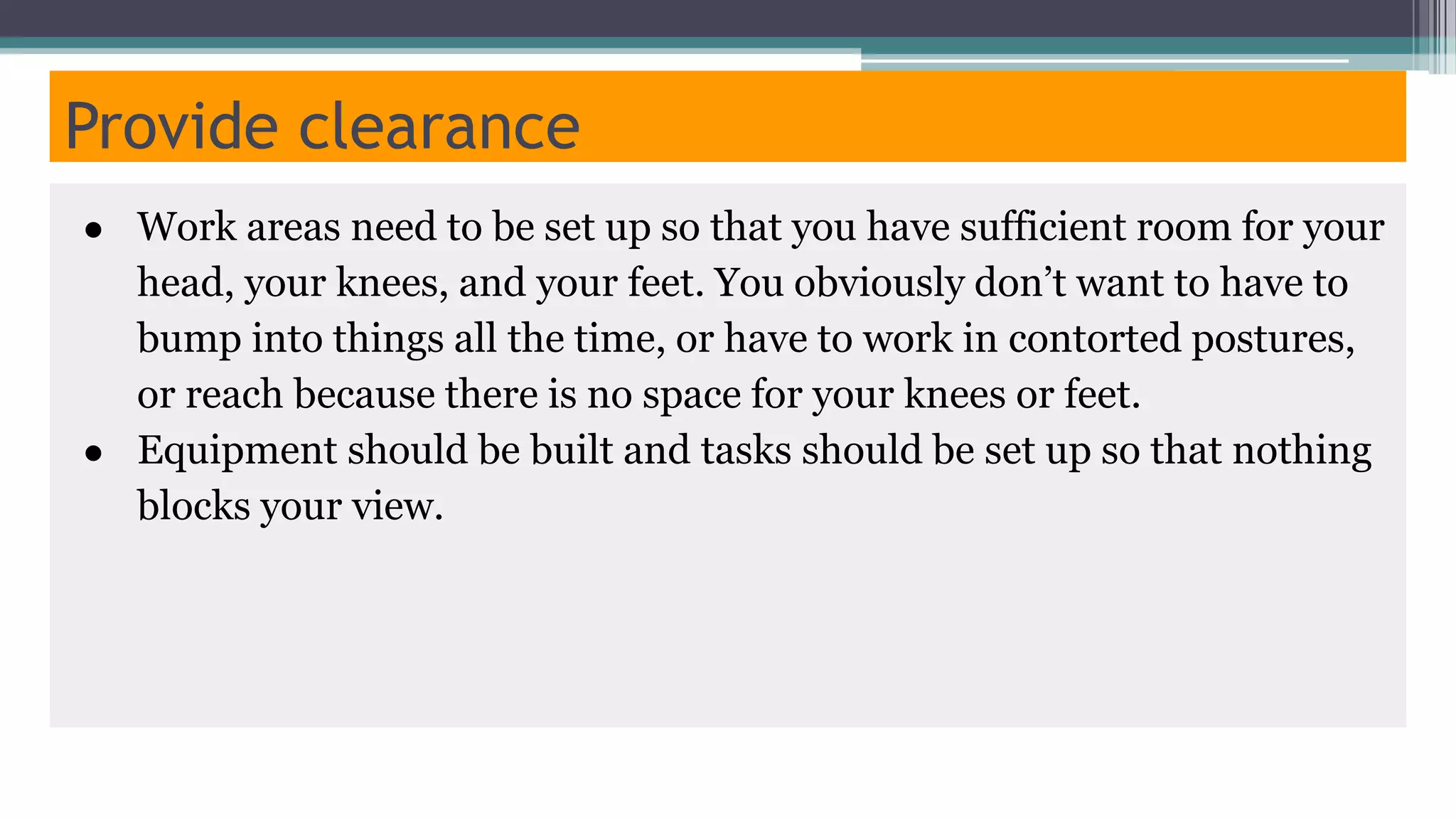
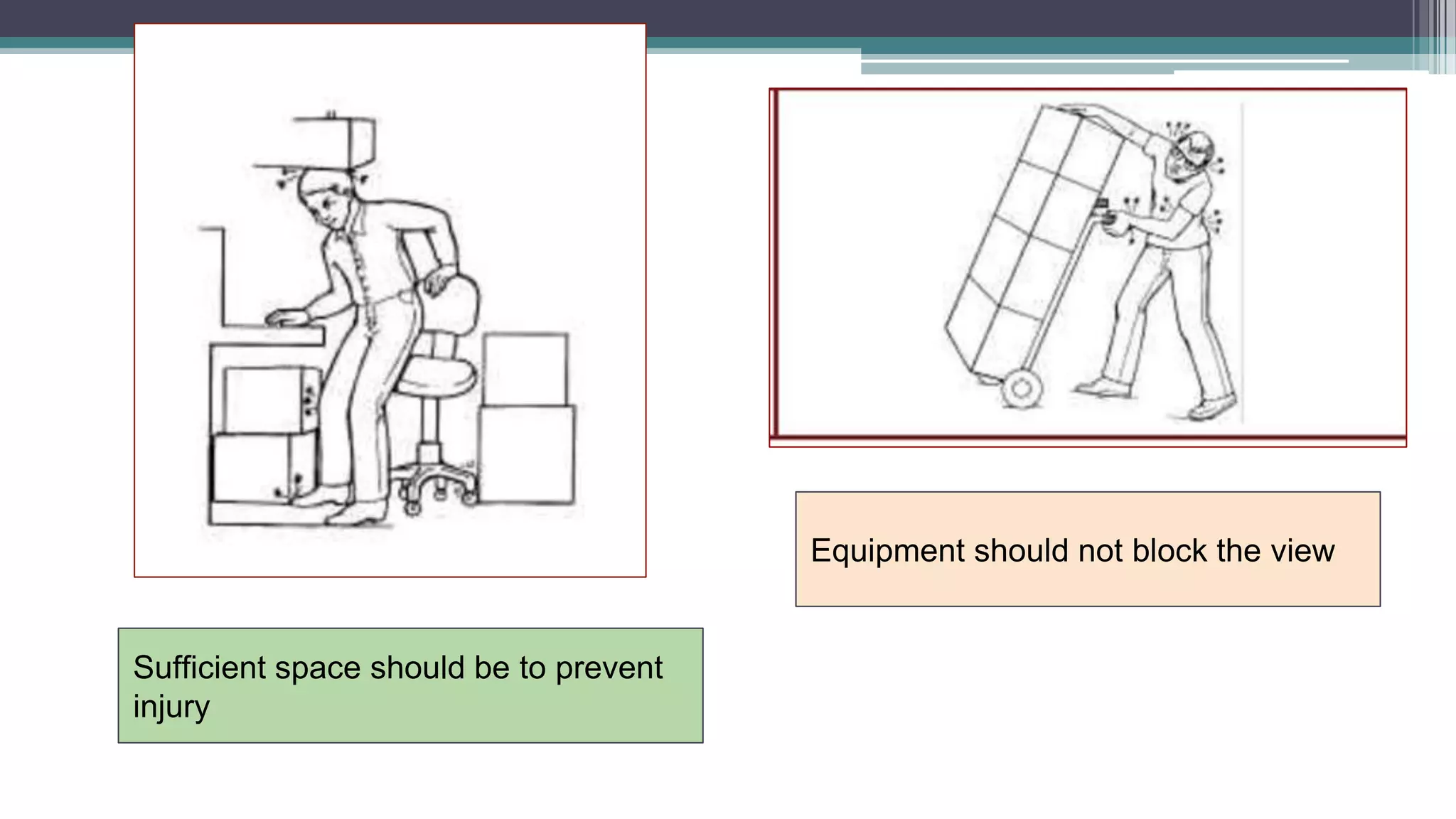
Provide clearance
● Work areas need to be set up so that you have sufficient room for your
head, your knees, and your feet. You obviously don’t want to have to
bump into things all the time, or have to work in contorted postures,
or reach because there is no space for your knees or feet.
● Equipment should be built and tasks should be set up so that nothing
blocks your view.
Sufficient space should be to prevent
injury
Equipment should not block the view
ENVIRONMENT
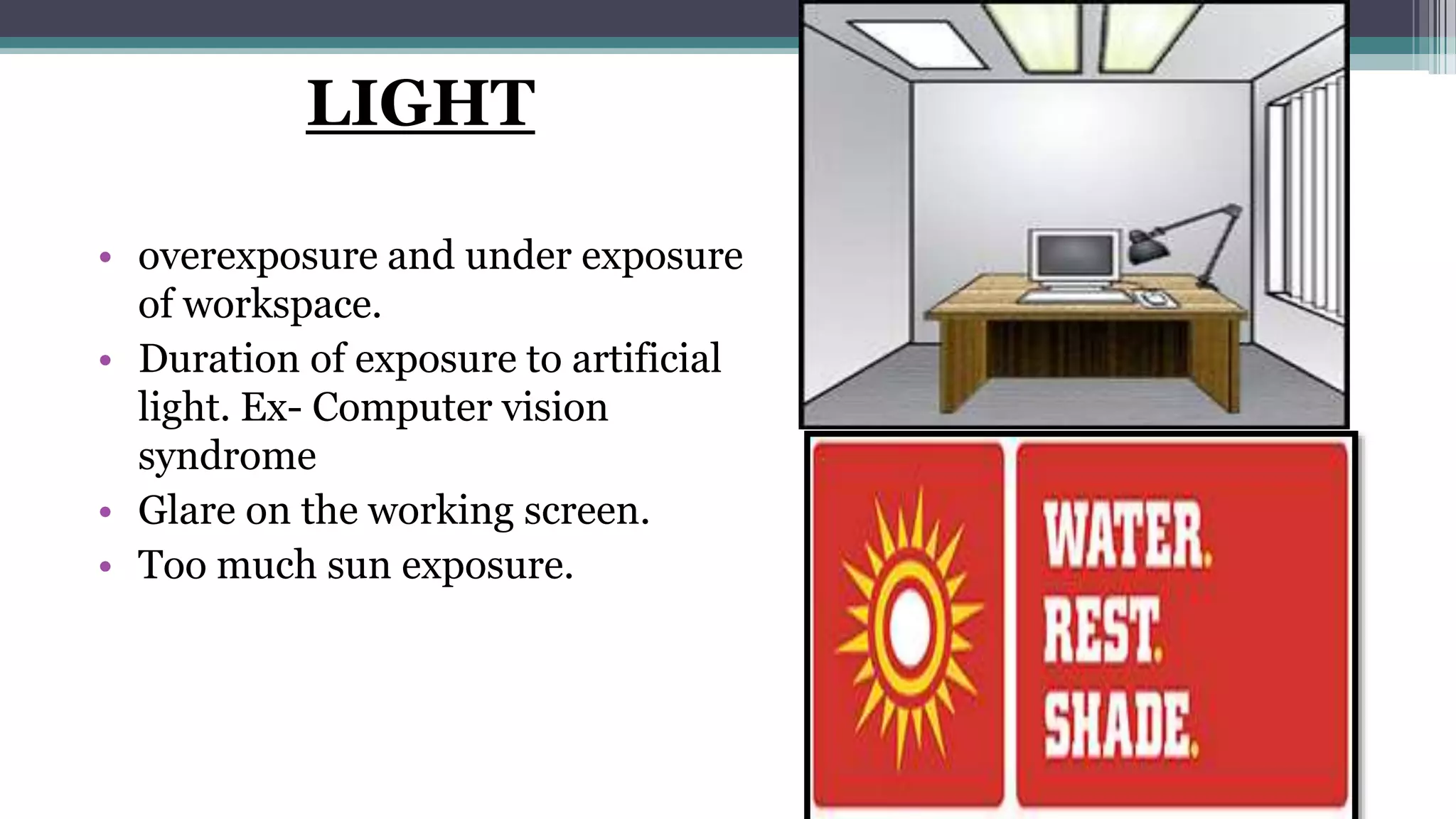
LIGHT
• overexposure and under exposure
of workspace.
• Duration of exposure to artificial
light. Ex- Computer vision
syndrome
• Glare on the working screen.
• Too much sun exposure.
• Temperature:
▫ Too much hotness- Range of caution-32- 35 deg. celcius
▫ early fatigue and dehydration further pushing the body to complete
the task causes micro traumas.
▫ Too much cold + Wet - Less than -15 degree celcius. Causes
decreased nerve conduction velocity and vasospasm, skin
breakdown.
▫ Ex- frostbite trench feet, Reynaud's disorder
▫ Ideal temp for working-20- 24 deg celcius. (OSHA)
▫ Use protective gears
• Noise- constant exposure the sound more than 85 dBls for long duration
causes acquired early onset hearing loss.
• Use ear plugs, repair the machineries regularly.
• Radiations
• Electricity
• Chemical
PERSON
III.RELATED TO THE PERSON
• Age
• Sex females are more susceptible
• Previous injury to that part ex- CTS in person with past
colle’s fracture.
• Presence of other co morbidities- diabetes mellitus,
obesity
• Stressful lifestyle- mental stress manifested as increase
in muscular stress and breath holding. This reduced the
efficiency of the body and causes early onset of fatigue.
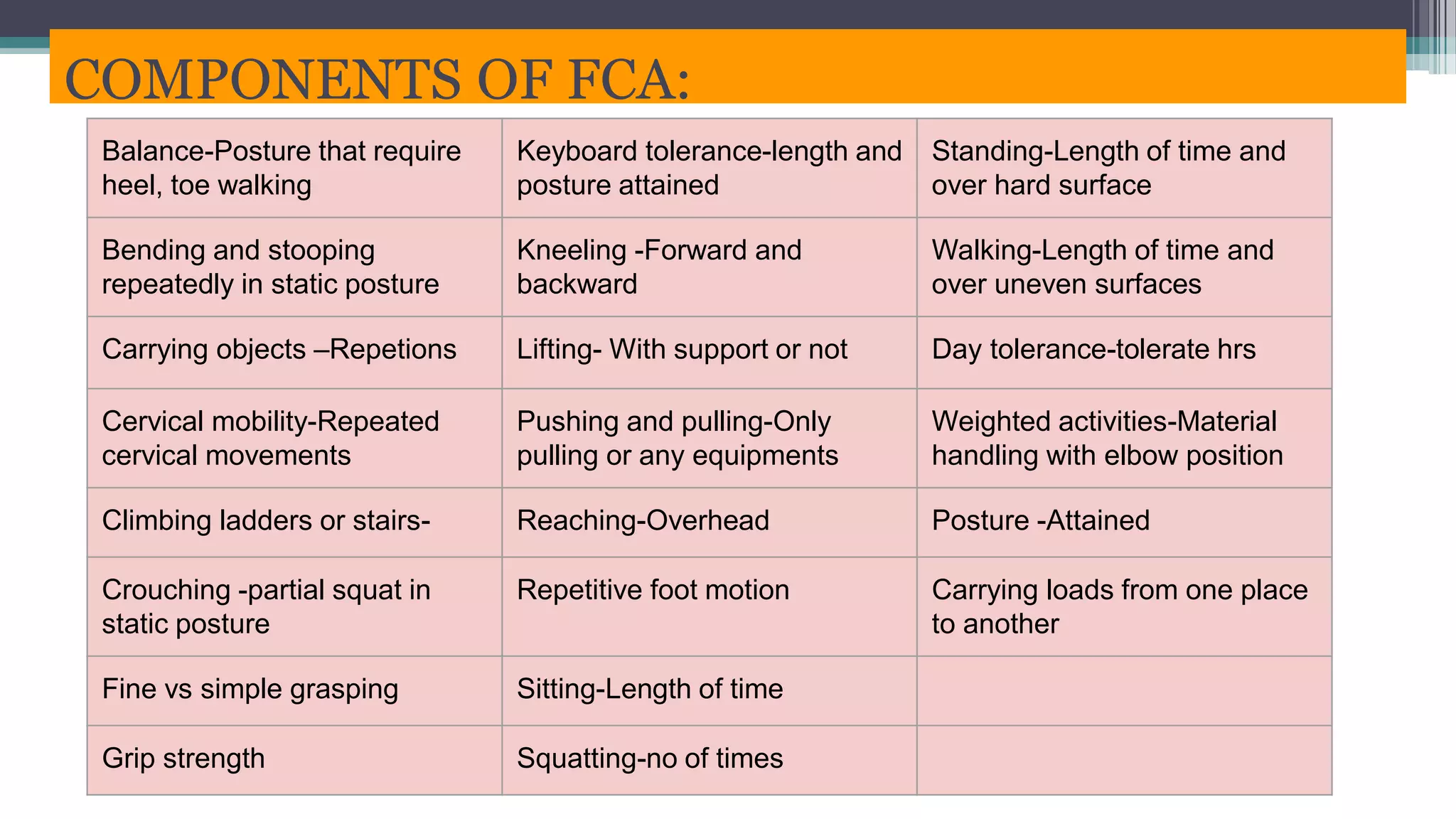
Assessment
PHYSICAL
ASSESSMENT
WORK PLACE AND POSTURAL
ASSESSMENT
FUNCTIONAL CAPACITY
ASSESSMENT
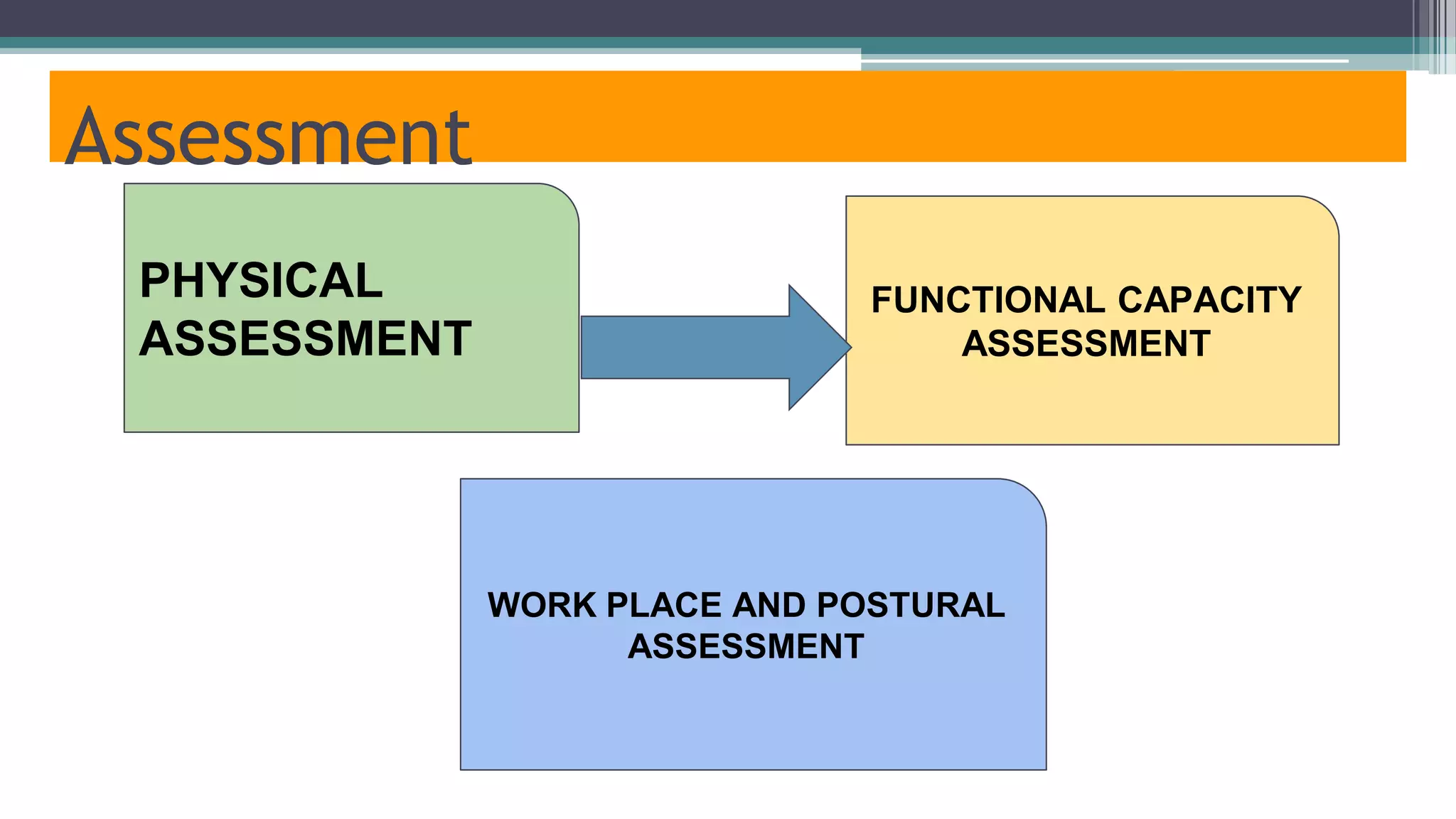
FUNCTIONAL CAPACITY ASSESSMENT
● Analyzes a person’s ability to safely perform
number of job related functions .
● Whether the injury is because of the job depends
on the job description analysis.
● The activities to be assessed are the tasks that
are in the job description.
● FCA are used to assist guide rehabilitation in
goal setting , program designing , progress
monitoring return to work parameters and job
modification measures if required.
● ADV- Assess triplanar movement that is similar
to the work setting.
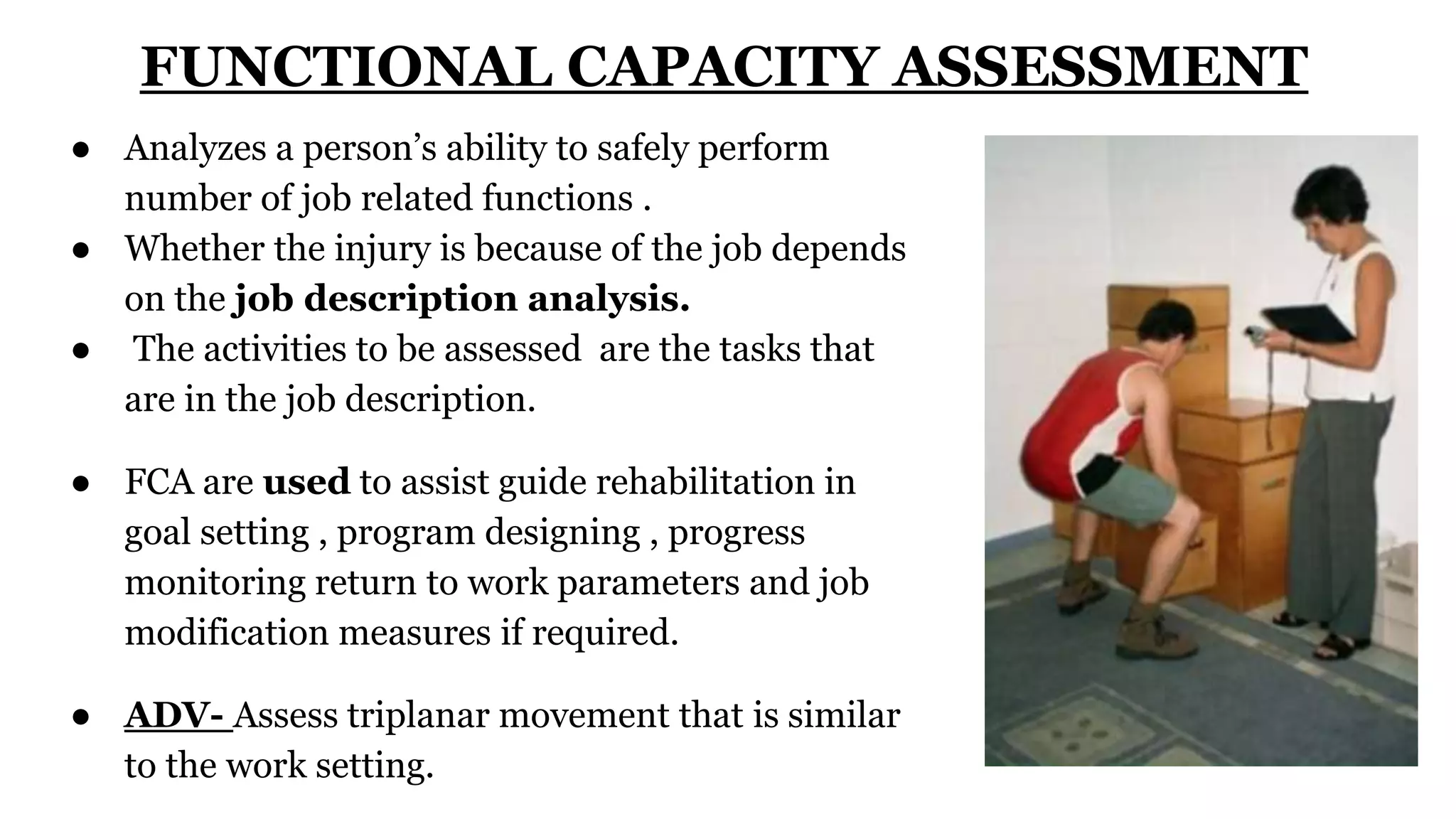
COMPONENTS OF FCA:
Balance-Posture that require
heel, toe walking
Keyboard tolerance-length and
posture attained
Standing-Length of time and
over hard surface
Bending and stooping
repeatedly in static posture
Kneeling -Forward and
backward
Walking-Length of time and
over uneven surfaces
Carrying objects –Repetions Lifting- With support or not Day tolerance-tolerate hrs
Cervical mobility-Repeated
cervical movements
Pushing and pulling-Only
pulling or any equipments
Weighted activities-Material
handling with elbow position
Climbing ladders or stairs- Reaching-Overhead Posture -Attained
Crouching -partial squat in
static posture
Repetitive foot motion Carrying loads from one place
to another
Fine vs simple grasping Sitting-Length of time
Grip strength Squatting-no of times
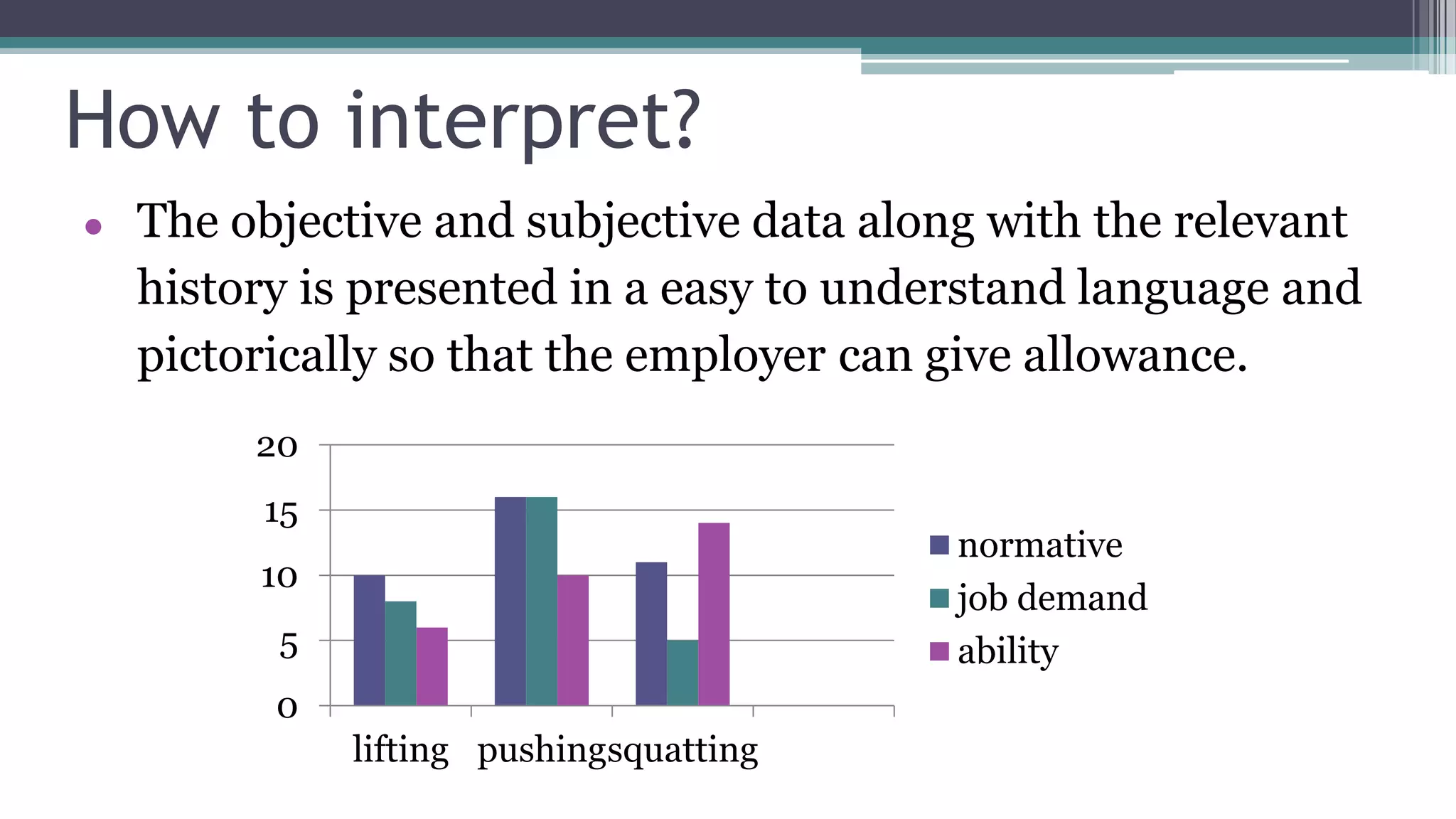
How to interpret?
● The objective and subjective data along with the relevant
history is presented in a easy to understand language and
pictorically so that the employer can give allowance.
0
5
10
15
20
lifting pushingsquatting
normative
job demand
ability
Work site analysis
● It should be a part of job description.If it has not
been done before recruiting then it is done if the
client gets injured.
● Assess for the presence of all the earlier
mentioned risk factors.
● Helps suggest for architectural modifications.
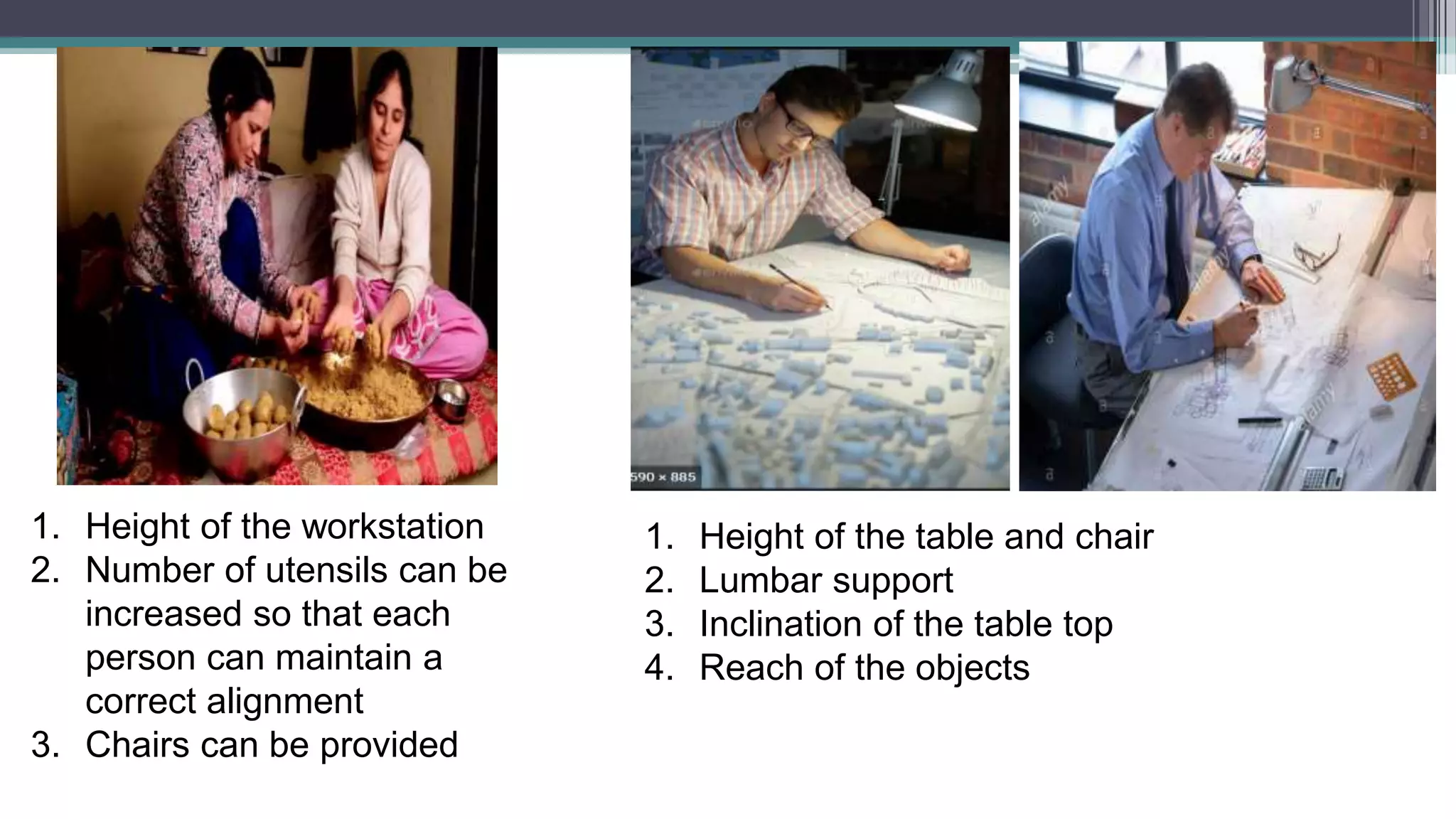
1. Height of the workstation
2. Number of utensils can be
increased so that each
person can maintain a
correct alignment
3. Chairs can be provided
1. Height of the table and chair
2. Lumbar support
3. Inclination of the table top
4. Reach of the objects
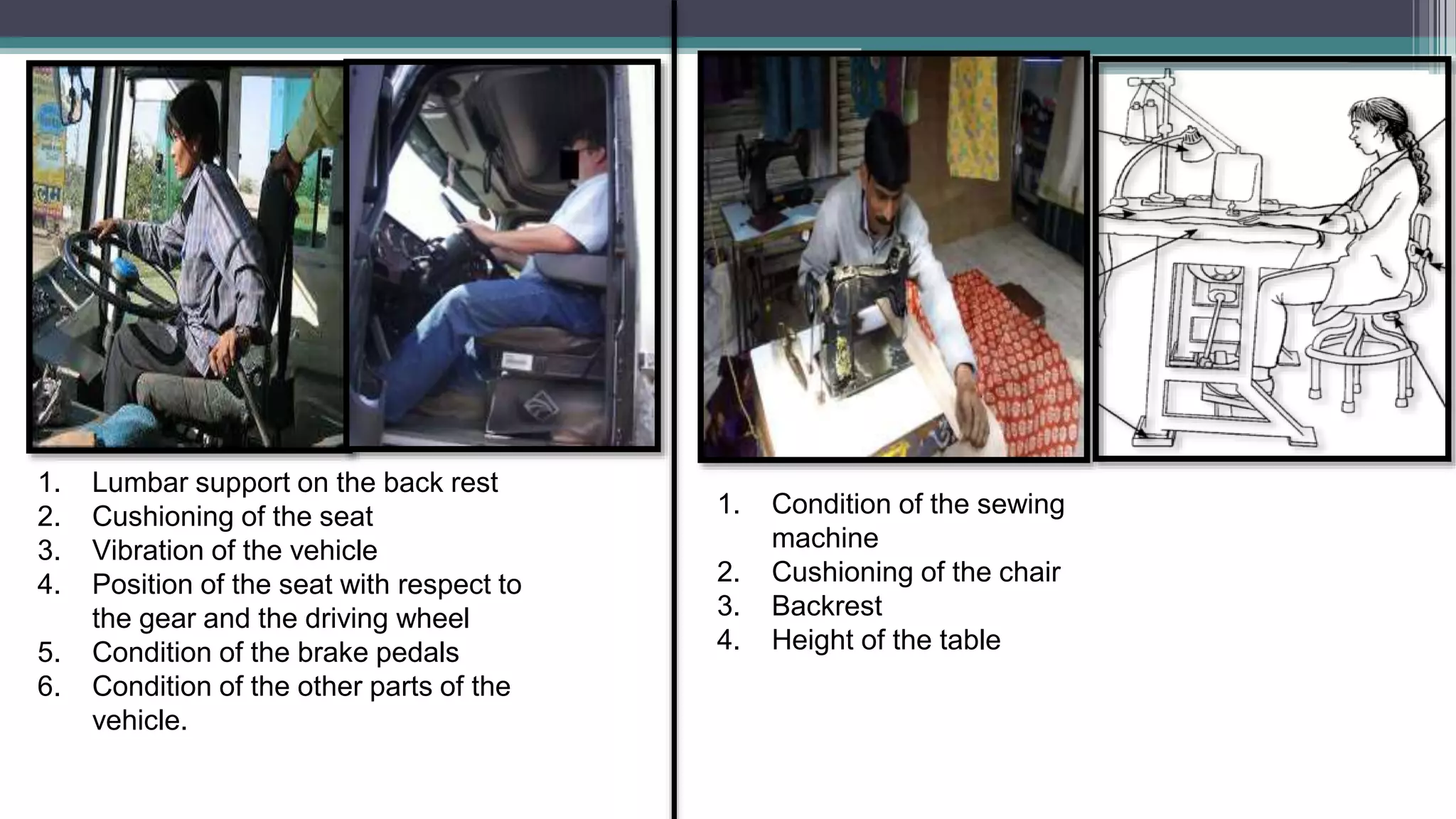
1. Lumbar support on the back rest
2. Cushioning of the seat
3. Vibration of the vehicle
4. Position of the seat with respect to
the gear and the driving wheel
5. Condition of the brake pedals
6. Condition of the other parts of the
vehicle.
1. Condition of the sewing
machine
2. Cushioning of the chair
3. Backrest
4. Height of the table
Roles of physiotherapist
Preventive
• Job analysis & Job placement assessment.
• Ergonomic and injury prevention.
• Employee fitness programme.
• Use of protective equipment.
• Substitution of less dangerous equipments or agents is the best protection
from hazardous situation because it totally removes chances of exposure.
• Make use of protective equipments like Helmet, safety glasses, face
shields, welding helmets, goggles, ear plugs, fall protection systems,
respirators, clothing, gloves, footwear.
• Reduce rate of injury.
• Functional capacity training programmes.
• Job simulation.
Curative
• Immediate care after injury depending upon the injury and symptoms.
• Referral to psychologist , doctor , vocational counselor when required.
Rehabilitative
• Functional capacity evaluation of work after injury.
• Work conditioning & work hardening programme implementation.
• Flexibility and mobility assessment and training programme.
• Strength programme post injury to increase the functional capacity.
• Reduce rate of re-injury post injury rehab.
• Assessment for temporary as well as permanent physical impairment and
disability percentage for helping workers to return to productivity.
WORK HARDENING
❑Address the physical, functional, behavioral and vocational needs
of the injured worker, for a successful return to work. Work
hardening programs are:
• Job specific strengthening and endurance
• Daily treatment, increasing weekly from 4-7 hours a day
• Job analysis
• Focus on work simulation, conditioning, body mechanics.
WORK CONDITIONING
❑Address the physical issues of flexibility, strength, endurance,
coordination, and work-related function for a successful return to
work. Work conditioning programs are:
• General strengthening
• 2-5 days per week of rehab
• 4-8 week duration
• Focus on build strength and endurance
• This process of change can be facilitated by actively involving
managers, supervisors and workers from the planning stage.
Information on good practices and training in participatory steps
are particularly helpful in encouraging the process.
• Educational seminars on the principles of ergonomics.
• Regular meetings to discuss workplace problems and solutions
• Planning of improvement steps in safety committees and
management-worker consultations, working in conjunction with
the Ergonomics Facilitation Team.
• Award presentation meetings for commending workplace
improvements contributing to safety, health and productivity.
Advantages of ergonomics
• Reduction of work related injury
• Higher productivity
• Increased work quality
• Reduced absenteeism
Disadvantages of ergonomics
• It costs money to develop and design it
• Highly requires efforts in planning and executing it
• Time consuming
CONCLUSION
● Ergonomics demands a two way approach namely, fitting the job to the
worker and fitting the worker to the job.
● The two way adaptation process is mainly determined by a person’s
abilities and disabilities.
● We need to think about how we are working, about our postures and
habits. It is always a good time to learn and adapt.
Ergonomics has gained importance and relevance because :-
● It prevents injuries
● Promotes safety, comfort at work station
● Increases work efficiency and productivity
● Improve quality of life
References
• Glenda key- book of ergonomics
• OSHA standards for workers
Ergonomics in Physiotherapy and Workplace

Ergonomics in Physiotherapy and Workplace

  • 1.
  • 2.
    OBJECTIVES • Ergonomics • Cumulativetrauma disorders • Pathophysiology • Risk factors causing CTDs • Management of CTDs • Assessment strategies • Role of Physiotherapy
  • 3.
  • 4.
    Definition ERGO + NOMOS= ERGONOMICS “work” + “laws” = “ laws of work ” “Ergonomics (or human factors) is the scientific discipline concerned with the understanding of the interactions among human and other elements of a system and the profession that applies theory, principles, data and methods to design in order to optimize human well-being and overall system performance.” International Ergonomics Association Executive Council
  • 5.
    WHY IS ITIMPORTANT? ● It prevents work related injuries and promotes safety , comfort at work station. ● enhancing relationship between person, equipment ,workplace, and the environment. ● It recognizes risks. ● Realize how to eliminate or reduce injuries. ● Increase work efficiency and productivity, quality of life.
  • 6.
    Principles of BODYergonomics 1)Keep everything in easy reach 2)Maintain neutral posture 3)Work at proper height 4)Reduce repetitive motions 5)Allow for movement and stretching 6)Minimise fatigue and static load 7)Minimise excessive force 8)Reduce contact stresses 9)Provide clearance 10)Maintain a comfortable environment.
  • 7.
  • 8.
  • 9.
    Definition • Cumulative TraumaDisorders is an umbrella term that includes the micro traumatic injuries caused due to repetitive stresses on the soft tissues of the body most commonly incurred during occupational activities. • Wear and tear injuries. • Most common areas affected: 1. Neck and shoulder - trapezitis, cervical spondylitis, rotator cuff impingements 2. Low back- muscular weakness ,PIVD, Spondylitis 3. Wrist and hand- carpal tunnel syndrome, tennis elbow
  • 10.
  • 11.
    FACTORS PERSONENVIRONMENT TASK • Manage thesymptoms reduce pain and inflammation. ACUTE CARE MANAGEMENT: • Education- Primary ,Secondary topics, personal protective devices BODY ERGONOMICS: • Job Scheduling, rest breaks ADMINISTRATIVE STRATERGIES : • Adjusting the infrastructure if body mechanics is not helping or as an adjunct to bodily ergonomic measures. ENGINEERING ERGONOMICS: • body mechanics and safe postures training
  • 12.
  • 13.
    POSTURE • Abnormal posturein which the joints are in extreme range of motion or a posture in which the combination of abnormal positions is placing stress on the neurovascular structures.
  • 14.
    1.Maintain Neutral Posture ●Neutral postures minimize the stress applied to muscles, tendons, nerves and bones and allows for maximum control and force production.
  • 15.
    2.Work at properheight ● Most work should be done at about elbow height, whether sitting or standing. ● Work within the power range- (i.e) mid range of muscular action. ● Adjust heights by extending or cutting the legs to a work tables , adjustable height chair. ● you can either put a work platform on top of the table (to raise the work up) or stand on a platform (to raise YOU up).
  • 16.
    90 and aboveelbow height work done while sitting or standing Precision work done above elbow height
  • 17.
    3.Keep everything ineasy reach ● Objects should be accessible for us without stressing the muscles. ● rearranging work area and moving things closer to you. ● Just get a smaller surface, so that reach across less Use smaller surface instead of keeping things far
  • 18.
    4. Stretch abit (20- 20 rule) ● Stretching reduces fatigue, improves muscular balance and posture and improves muscle coordination. ● Prepare your body for work by warming up to improve performance and lower injury risk. ● maintains blood circulation.
  • 19.
    EFFORT • Extreme positionsof the joints, causes the muscles to be at mechanical disadvantage, which demands higher amount of effort to complete the task ;leading to injuries. ▫ Hand position : use pincer grasp for precision activities and power grasp for activities requiring more force. w
  • 20.
    1.Reduce Excessive Effort ●Reducing the work arm and increasing the mechanical advantage of the body system. ● Correct usage of lever systems and pulleys to reduce effort. ● Using mechanical assists, powered equipment and counter balance systems. w POWER SYSTEM VELOCITY SYSTEM
  • 21.
    CONTACT STRESSES • Concentratedstresses to sensitive areas of the body. • creates localized pressure for a small area of the body, which can inhibit blood, nerve function, or movement of tendons and muscles
  • 22.
    Minimize Contact Stress ●Distribution of the force evenly over contact areas. ● Avoid contact forces by rounding or broadening the points of contact.
  • 23.
    REPETITION • Repetition oftasks causes particular soft tissues to be under stress and strains for a long period of time that causes fatigue and injuries. • Ineffective recovery time contributes to CTDs. • A job is considered highly repetitive if the cycle time is 30 seconds or less. • Assessed by repeated movement analysis. • Ex-carpal tunnel syndrome, tendinitis and trigger finger
  • 24.
    1.Reduce repetitive motions ●Scheduling of work depending on the functional capacity of the person,providing rest period counteractive stretch breaks. ● Use power tools or any other assistive devices whenever possible.
  • 25.
    VIBRATION • may betotal body or in the hands only. • there is damage to the blood vessels and nerves, this manifests as loss of fine motor control of hands. • How much causes problem- the recommended daily limits of 5m/s2 (HAV) and 1.15m/s2 (WBV). (OSHA) Ex- hand arm vibration syndrome, total body vibration syndrome.
  • 26.
    Engineering ergonomics toreduce vibration EQUIPMENT MAINTENANCE
  • 27.
    Minimise fatigue andstatic load ● In the workplace, having to hold parts and tools continually is an example of static load.In this case, using a fixture eliminates the need to hold onto the part. ● Having to hold your arms overhead for a few minutes is another classic example of static load, this time affecting the shoulder muscles. Sometimes you can change the orientation of the work area to prevent this, or sometimes you can add extenders to the tools. ● Having to stand for a long time creates a static load on your legs. Using a footrest can permit you to reposition your legs and make it easier to stand.
  • 28.
    Add extenders totools Use of fixtures Keeping footrest nearby
  • 29.
    Provide clearance ● Workareas need to be set up so that you have sufficient room for your head, your knees, and your feet. You obviously don’t want to have to bump into things all the time, or have to work in contorted postures, or reach because there is no space for your knees or feet. ● Equipment should be built and tasks should be set up so that nothing blocks your view.
  • 30.
    Sufficient space shouldbe to prevent injury Equipment should not block the view
  • 31.
  • 32.
    LIGHT • overexposure andunder exposure of workspace. • Duration of exposure to artificial light. Ex- Computer vision syndrome • Glare on the working screen. • Too much sun exposure.
  • 33.
    • Temperature: ▫ Toomuch hotness- Range of caution-32- 35 deg. celcius ▫ early fatigue and dehydration further pushing the body to complete the task causes micro traumas. ▫ Too much cold + Wet - Less than -15 degree celcius. Causes decreased nerve conduction velocity and vasospasm, skin breakdown. ▫ Ex- frostbite trench feet, Reynaud's disorder ▫ Ideal temp for working-20- 24 deg celcius. (OSHA) ▫ Use protective gears • Noise- constant exposure the sound more than 85 dBls for long duration causes acquired early onset hearing loss. • Use ear plugs, repair the machineries regularly. • Radiations • Electricity • Chemical
  • 34.
  • 35.
    III.RELATED TO THEPERSON • Age • Sex females are more susceptible • Previous injury to that part ex- CTS in person with past colle’s fracture. • Presence of other co morbidities- diabetes mellitus, obesity • Stressful lifestyle- mental stress manifested as increase in muscular stress and breath holding. This reduced the efficiency of the body and causes early onset of fatigue.
  • 36.
    Assessment PHYSICAL ASSESSMENT WORK PLACE ANDPOSTURAL ASSESSMENT FUNCTIONAL CAPACITY ASSESSMENT
  • 37.
    FUNCTIONAL CAPACITY ASSESSMENT ●Analyzes a person’s ability to safely perform number of job related functions . ● Whether the injury is because of the job depends on the job description analysis. ● The activities to be assessed are the tasks that are in the job description. ● FCA are used to assist guide rehabilitation in goal setting , program designing , progress monitoring return to work parameters and job modification measures if required. ● ADV- Assess triplanar movement that is similar to the work setting.
  • 38.
    COMPONENTS OF FCA: Balance-Posturethat require heel, toe walking Keyboard tolerance-length and posture attained Standing-Length of time and over hard surface Bending and stooping repeatedly in static posture Kneeling -Forward and backward Walking-Length of time and over uneven surfaces Carrying objects –Repetions Lifting- With support or not Day tolerance-tolerate hrs Cervical mobility-Repeated cervical movements Pushing and pulling-Only pulling or any equipments Weighted activities-Material handling with elbow position Climbing ladders or stairs- Reaching-Overhead Posture -Attained Crouching -partial squat in static posture Repetitive foot motion Carrying loads from one place to another Fine vs simple grasping Sitting-Length of time Grip strength Squatting-no of times
  • 39.
    How to interpret? ●The objective and subjective data along with the relevant history is presented in a easy to understand language and pictorically so that the employer can give allowance. 0 5 10 15 20 lifting pushingsquatting normative job demand ability
  • 40.
    Work site analysis ●It should be a part of job description.If it has not been done before recruiting then it is done if the client gets injured. ● Assess for the presence of all the earlier mentioned risk factors. ● Helps suggest for architectural modifications.
  • 41.
    1. Height ofthe workstation 2. Number of utensils can be increased so that each person can maintain a correct alignment 3. Chairs can be provided 1. Height of the table and chair 2. Lumbar support 3. Inclination of the table top 4. Reach of the objects
  • 42.
    1. Lumbar supporton the back rest 2. Cushioning of the seat 3. Vibration of the vehicle 4. Position of the seat with respect to the gear and the driving wheel 5. Condition of the brake pedals 6. Condition of the other parts of the vehicle. 1. Condition of the sewing machine 2. Cushioning of the chair 3. Backrest 4. Height of the table
  • 43.
    Roles of physiotherapist Preventive •Job analysis & Job placement assessment. • Ergonomic and injury prevention. • Employee fitness programme. • Use of protective equipment. • Substitution of less dangerous equipments or agents is the best protection from hazardous situation because it totally removes chances of exposure. • Make use of protective equipments like Helmet, safety glasses, face shields, welding helmets, goggles, ear plugs, fall protection systems, respirators, clothing, gloves, footwear.
  • 44.
    • Reduce rateof injury. • Functional capacity training programmes. • Job simulation.
  • 45.
    Curative • Immediate careafter injury depending upon the injury and symptoms. • Referral to psychologist , doctor , vocational counselor when required.
  • 46.
    Rehabilitative • Functional capacityevaluation of work after injury. • Work conditioning & work hardening programme implementation. • Flexibility and mobility assessment and training programme. • Strength programme post injury to increase the functional capacity. • Reduce rate of re-injury post injury rehab. • Assessment for temporary as well as permanent physical impairment and disability percentage for helping workers to return to productivity.
  • 47.
    WORK HARDENING ❑Address thephysical, functional, behavioral and vocational needs of the injured worker, for a successful return to work. Work hardening programs are: • Job specific strengthening and endurance • Daily treatment, increasing weekly from 4-7 hours a day • Job analysis • Focus on work simulation, conditioning, body mechanics.
  • 48.
    WORK CONDITIONING ❑Address thephysical issues of flexibility, strength, endurance, coordination, and work-related function for a successful return to work. Work conditioning programs are: • General strengthening • 2-5 days per week of rehab • 4-8 week duration • Focus on build strength and endurance
  • 49.
    • This processof change can be facilitated by actively involving managers, supervisors and workers from the planning stage. Information on good practices and training in participatory steps are particularly helpful in encouraging the process. • Educational seminars on the principles of ergonomics. • Regular meetings to discuss workplace problems and solutions • Planning of improvement steps in safety committees and management-worker consultations, working in conjunction with the Ergonomics Facilitation Team. • Award presentation meetings for commending workplace improvements contributing to safety, health and productivity.
  • 50.
    Advantages of ergonomics •Reduction of work related injury • Higher productivity • Increased work quality • Reduced absenteeism Disadvantages of ergonomics • It costs money to develop and design it • Highly requires efforts in planning and executing it • Time consuming
  • 51.
    CONCLUSION ● Ergonomics demandsa two way approach namely, fitting the job to the worker and fitting the worker to the job. ● The two way adaptation process is mainly determined by a person’s abilities and disabilities. ● We need to think about how we are working, about our postures and habits. It is always a good time to learn and adapt.
  • 52.
    Ergonomics has gainedimportance and relevance because :- ● It prevents injuries ● Promotes safety, comfort at work station ● Increases work efficiency and productivity ● Improve quality of life
  • 53.
    References • Glenda key-book of ergonomics • OSHA standards for workers