Musculoskeletal Disorders Part I


 Maria Carmela L. Domocmat, RN,MSN
 Instructor, Curative and Rehabilitative Nursing Care Management II
 School of Nursing
 Northern Luzon Adventist College
 Artacho, Sison, Pangasinan
Overview
    Part I                               Part II
      Bone infections                      Degenerative bone disorders:
          Osteomyelitis                    OA
          Septic arthritis                 Metabolic bone disorders
      Disorders of foot                      Osteoporosis
          Hallux valgus (bunions)            Paget’s dse
          Morton’s neuroma (plantar          Osteomalacia
          neuroma)                           Gout and gouty arthritis
          Hammer toe                       Spinal column deformities
      Muscular disorders                     Scoliosis
          Muscular dystrophy                 Kyphosis
          Rhabdomyolysis                     Lordosis

2   Maria Carmela L. Domocmat, RN, MSN                            8/24/2011
Bone infections
       Osteomyelitis
       Septic arthritis


3   Maria Carmela L. Domocmat, RN, MSN   8/24/2011
Bone infections:
    Osteomyelitis


4   Maria Carmela L. Domocmat, RN, MSN   8/24/2011
Osteomyelitis
       is an acute or chronic bone infection or inflammatory process
       of the bone and its structures secondary to infection with
       pyogenic organisms.


5   Maria Carmela L. Domocmat, RN, MSN                       8/24/2011
Osteomyelitis


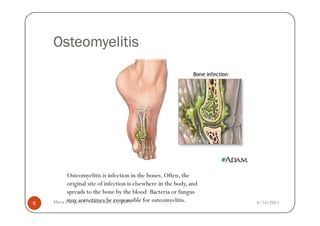
          Osteomyelitis is infection in the bones. Often, the
          original site of infection is elsewhere in the body, and
          spreads to the bone by the blood. Bacteria or fungus
6
          may sometimes be responsible for osteomyelitis.
    Maria Carmela L. Domocmat, RN, MSN                               8/24/2011
Causes, incidence, and risk factors
       Bone infection can be caused by bacteria (more common) or fungi
       (less common).
       Infection may spread to a bone from infected skin, muscles, or
       tendons next to the bone, as in osteomyelitis that occurs under a
       chronic skin ulcer (sore).
       The infection that causes osteomyelitis can also start in another
       part of the body and spread to the bone through the blood.
       A current or past injury may have made the affected bone more
       likely to develop the infection. A bone infection can also start after
       bone surgery, especially if the surgery is done after an injury or if
       metal rods or plates are placed in the bone.
       In children, the long bones are usually affected. In adults, the feet,
       spine bones (vertebrae), and the hips (pelvis) are most commonly
       affected.

7   Maria Carmela L. Domocmat, RN, MSN                               8/24/2011
Risk factors
       Diabetes
       Hemodialysis
       Injected drug use
       Poor blood supply
       Recent trauma
       People who have had their spleen removed are also at higher
       risk for osteomyelitis


8   Maria Carmela L. Domocmat, RN, MSN                      8/24/2011
Symptoms
       Bone pain
       Fever
       General discomfort, uneasiness, or ill-feeling (malaise)
       Local swelling, redness, and warmth
       Other symptoms that may occur with this disease:
       Chills
       Excessive sweating
       Low back pain
       Swelling of the ankles, feet, and legs

9   Maria Carmela L. Domocmat, RN, MSN                            8/24/2011
Osteomyelitis
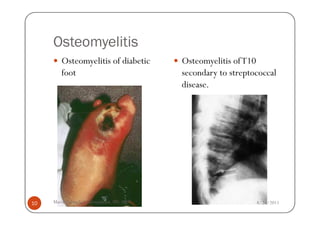
        Osteomyelitis of diabetic         Osteomyelitis of T10
        foot                              secondary to streptococcal
                                          disease.


10   Maria Carmela L. Domocmat, RN, MSN                       8/24/2011
Osteomyelitis
        Osteomyelitis of the great        Osteomyelitis of index
        toe                               finger metacarpal head
                                          secondary to clenched fist
                                          injury


11   Maria Carmela L. Domocmat, RN, MSN                        8/24/2011
Osteomyelitis
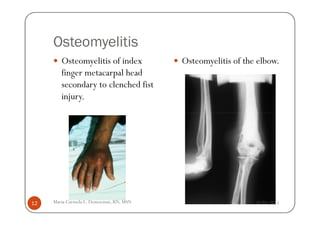
        Osteomyelitis of index            Osteomyelitis of the elbow.
        finger metacarpal head
        secondary to clenched fist
        injury.


12   Maria Carmela L. Domocmat, RN, MSN                       8/24/2011
Dx tests
        A physical examination shows bone tenderness and possibly
        swelling and redness.
        Tests may include:
            Blood cultures
            Bone biopsy (which is then cultured)
            Bone scan
            Bone x-ray
            Complete blood count (CBC)
            C-reactive protein (CRP)
            Erythrocyte sedimentation rate (ESR)
            MRI of the bone
            Needle aspiration of the area around affected bones


13   Maria Carmela L. Domocmat, RN, MSN                             8/24/2011
Dx tests
               Diagnosis requires 2 of the 4 following criteria:
                   Purulent material on aspiration of affected bone
                   Positive findings of bone tissue or blood culture
                   Localized classic physical findings of bony tenderness, with
                   overlying soft-tissue erythema or edema
                   Positive radiological imaging study


     http://emedicine.medscape.com/article/785020-treatment

14        Maria Carmela L. Domocmat, RN, MSN                                 8/24/2011
Emergency Department Care
               rarely requires emergent stabilization or resuscitation.
               The primary challenge for ED physicians is considering the
               appropriate diagnosis in the face of subtle signs or symptoms.
               Treatment for osteomyelitis involves the following:
                   Initiation of intravenous antibiotics that penetrate bone and
                   joint cavities
                   Referral of the patient to an orthopedist or general surgeon
                   Possible medical infectious disease consultation


     http://emedicine.medscape.com/article/785020-treatment


15        Maria Carmela L. Domocmat, RN, MSN                                 8/24/2011
Emergency Department Care
               Select the appropriate antibiotics using direct culture results
               in samples from the infected site, whenever possible.
               Empiric therapy is often initiated on the basis of the patient's
               age and the clinical presentation.
                Empiric therapy should always include coverage for S
               aureus and consideration of CA-MRSA.
                Further surgical management may involve removal of the
               nidus of infection, implantation of antibiotic beads or pumps,
               hyperbaric oxygen therapy, or other modalities.


     http://emedicine.medscape.com/article/785020-treatment

16        Maria Carmela L. Domocmat, RN, MSN                            8/24/2011
Treatment
        goal of treatment
            get rid of the infection
            reduce damage to the bone and surrounding tissues.
        Antibiotics are given to destroy the bacteria causing the
        infection.
            may receive more than one antibiotic at a time.
            Often, the antibiotics are given through an IV (intravenously,
            meaning through a vein) rather than by mouth.
            Antibiotics are taken for at least 4 - 6 weeks, sometimes longer.


17   Maria Carmela L. Domocmat, RN, MSN                               8/24/2011
Treatment
        Surgery
            to remove dead bone tissue if have an infection that does not go away.
            If there are metal plates near the infection, they may need to be
            removed.
            The open space left by the removed bone tissue may be filled
            with bone graft or packing material that promotes the growth of new
            bone tissue.
        Infection of an orthopedic prosthesis, such as an artificial joint,
        may need surgery to remove the prosthesis and infected tissue
        around the area.
        If have diabetes- need to be well controlled.
        If problems with blood supply to the infected area, such as the
        foot, surgery to improve blood flow may be needed.


18   Maria Carmela L. Domocmat, RN, MSN                                   8/24/2011
Medication Summary
        The primary treatment for osteomyelitis
            is parenteral antibiotics that penetrate bone and joint cavities.
            for at least 4-6 weeks.
            After intravenous antibiotics are initiated on an inpatient basis,
            therapy may be continued with intravenous or oral antibiotics,
            depending on the type and location of the infection, on an
            outpatient basis.


19   Maria Carmela L. Domocmat, RN, MSN                                 8/24/2011
Medication Summary
        The following are recommendations for the initiation of empiric
        antibiotic treatment based on the age of the patient and
        mechanism of infection:
        hematogenous osteomyelitis (newborn to adult),
            infectious agents include S aureus, Enterobacteriaceae organisms,
            group A and BStreptococcus species, and H influenzae.
            Primary treatment - combination of penicillinase-resistant
            synthetic penicillin and a third-generation cephalosporin.
            Alternate therapy - vancomycin or clindamycin and a third-
            generation cephalosporin, particularly if methicillin-resistant S
            aureus (MRSA)
            Linezolid
            ciprofloxacin and rifampin

20   Maria Carmela L. Domocmat, RN, MSN                               8/24/2011
Medication Summary
        with sickle cell anemia and osteomyelitis
            primary bacterial causes are S aureus and Salmonellae species.
            primary choice for treatment - fluoroquinolone antibiotic
            (not in children).
            alternative choice - a third-generation cephalosporin (eg,
            ceftriaxone)


21   Maria Carmela L. Domocmat, RN, MSN                              8/24/2011
Medication Summary

        nail puncture through an athletic shoe
            the infecting agents may include S aureus and Pseudomonas
            aeruginosa.
            primary antibiotics - ceftazidime or cefepime.
            alternative treatment - Ciprofloxacin
        osteomyelitis due to trauma
            infecting agents include S aureus, coliform bacilli,
            and Pseudomonas aeruginosa.
            Primary antibiotics - nafcillin and ciprofloxacin.
            Alternatives - vancomycin and a third-generation cephalosporin
            with antipseudomonal activity.

22   Maria Carmela L. Domocmat, RN, MSN                                 8/24/2011
Antibiotics
        Nafcillin (Nafcil, Unipen)
             Initial therapy for suspected penicillin G–resistant
            streptococcal or staphylococcal infections.
            Use parenteral therapy initially in severe infections. Change to
            oral therapy as condition warrants.
            Because of thrombophlebitis, particularly in elderly patients,
            administer parenterally for only the short term (1-2 d).
            Change to PO route as clinically indicated.
            Note: Administer in combination with a third-generation
            cephalosporin to treat osteomyelitis.
            Do not admix with aminoglycosides for IV administration.

23   Maria Carmela L. Domocmat, RN, MSN                               8/24/2011
Antibiotics
        Ceftriaxone (Rocephin)
            Third-generation cephalosporin with broad-spectrum gram-
            negative activity;
            lower efficacy against gram-positive organisms;
            higher efficacy against resistant organisms;
            arrests bacterial growth by binding to one or more penicillin-
            binding proteins.
            Note: Administer with a penicillinase-resistant synthetic
            penicillin, when treating osteomyelitis.


24   Maria Carmela L. Domocmat, RN, MSN                              8/24/2011
Antibiotics
        Cefazolin (Ancef)
            First-generation semisynthetic cephalosporin that arrests
            bacterial cell wall synthesis, inhibiting bacterial growth;
            primarily active against skin flora, including S aureus;
            typically used alone for skin and skin-structure coverage.


25   Maria Carmela L. Domocmat, RN, MSN                                   8/24/2011
Antibiotics
        Ciprofloxacin (Cipro)
            Fluoroquinolone with activity against pseudomonads,
            streptococci, MRSA, Staphylococcus epidermidis, and most gram-
            negative organisms,
            but no activity against anaerobes.
            Inhibits bacterial DNA synthesis and, consequently, growth.
            Continue treatment for at least 2 d (typical treatment, 7-14 d)
            after signs and symptoms disappear.


26   Maria Carmela L. Domocmat, RN, MSN                              8/24/2011
Antibiotics
        Ceftazidime (Fortaz, Ceptaz)
            Third-generation cephalosporin with broad-spectrum gram-
            negative activity;
            lower efficacy against gram-positive organisms;
            higher efficacy against resistant organisms;
            arrests bacterial growth by binding to one or more penicillin-
            binding proteins.


27   Maria Carmela L. Domocmat, RN, MSN                              8/24/2011
Antibiotics
        Clindamycin (Cleocin)
            Lincosamide for the treatment of serious skin and soft-tissue
            staphylococcal infections;
            also effective against aerobic and anaerobic streptococci (except
            enterococci);
             inhibits bacterial growth, possibly by blocking dissociation of
            peptidyl t-RNA from ribosomes, arresting RNA-dependent
            protein synthesis.


28   Maria Carmela L. Domocmat, RN, MSN                               8/24/2011
Antibiotics
        Vancomycin (Vancocin)
             Potent antibiotic directed against gram-positive organisms and active
            againstEnterococcus species. Useful in the treatment of septicemia and
            skin structure infections. Indicated for patients who can not receive
            or have failed to respond to penicillins and cephalosporins or have
            infections with resistant staphylococci. For abdominal penetrating
            injuries, it is combined with an agent active against enteric flora
            and/or anaerobes.
            To avoid toxicity, current recommendation is to assay vancomycin
            trough levels after third dose drawn 0.5 h prior to next dosing. Use
            creatinine clearance to adjust dose in patients with renal impairment.
            Used in conjunction with gentamicin for prophylaxis in penicillin-
            allergic patients undergoing gastrointestinal or genitourinary
            procedures.

29   Maria Carmela L. Domocmat, RN, MSN                                   8/24/2011
Antibiotics
        Linezolid (Zyvox)
             Prevents formation of functional 70S initiation complex, which
            is essential for bacterial translation process. Bacteriostatic
            against staphylococci.
            The FDA warns against the concurrent use of linezolid with
            serotonergic psychiatric drugs, unless indicated for life-
            threatening or urgent conditions. Linezolid may increase
            serotonin CNS levels as a result of MAO-A inhibition,
            increasing the risk of serotonin syndrome.[14]


30   Maria Carmela L. Domocmat, RN, MSN                             8/24/2011
(prognosis)
     Expectations (prognosis)
        The prognosis for osteomyelitis varies but is markedly
        improved with timely diagnosis and aggressive therapeutic
        intervention.
        The outlook is worse for those with long-term (chronic)
        osteomyelitis, even with surgery. Amputation may be needed,
        especially in those with diabetes or poor blood circulation.
        The outlook for those with an infection of an orthopedic
        prosthesis depends, in part, on:
            The patient's health
            The type of infection
            Whether the infected prosthesis can be safely removed


31   Maria Carmela L. Domocmat, RN, MSN                             8/24/2011
Complications
        When the bone is infected, pus is produced in the bone,
        which may result in an abscess. The abscess steals the bone's
        blood supply. The lost blood supply can result in a
        complication called chronic osteomyelitis. This chronic
        infection can cause symptoms that come and go for years.
        Other complications include:
        Need for amputation
        Reduced limb or joint function
        Spread of infection to surrounding tissues or the bloodstream


32   Maria Carmela L. Domocmat, RN, MSN                       8/24/2011
Complications
        Complications of osteomyelitis may include the following:
        Bone abscess
        Paravertebral/epidural abscess
        Bacteremia
        Fracture
        Loosening of the prosthetic implant
        Overlying soft-tissue cellulitis
        Draining soft-tissue sinus tracts


33   Maria Carmela L. Domocmat, RN, MSN                      8/24/2011
Prevention
        Prompt and complete treatment of infections is helpful.
        People who are at high risk or who have a compromised
        immune system should see a health care provider promptly if
        they have signs of an infection anywhere in the body.


34   Maria Carmela L. Domocmat, RN, MSN                      8/24/2011
Deterrence/Prevention
        Acute hematogenous osteomyelitis can potentially be avoided
        by preventing bacterial seeding of bone from a remote site.
        This involves the appropriate diagnosis and treatment of
        primary bacterial infections.
        Direct inoculation osteomyelitis can best be prevented with
        appropriate wound management and consideration of
        prophylactic antibiotic use at the time of injury.


35   Maria Carmela L. Domocmat, RN, MSN                     8/24/2011
References
        Espinoza LR. Infections of bursae, joints, and bones. In:
        Goldman L, Ausiello D, eds. Cecil Medicine. 23rd ed.
        Philadelphia, Pa: Saunders Elsevier; 2007:chap 293.
        Gutierrez KM. Osteomyelitis. In: Long SS, ed. Principles and
        Practice of Pediatric Infectious Diseases. 3rd ed. Philadelphia, Pa:
        Elsevier Churchill Livingstone; 2008:chap 80.
        http://www.ncbi.nlm.nih.gov/pubmedhealth/PMH000147
        3/


36   Maria Carmela L. Domocmat, RN, MSN                              8/24/2011
Bone infections:
     Septic arthritis


37   Maria Carmela L. Domocmat, RN, MSN   8/24/2011
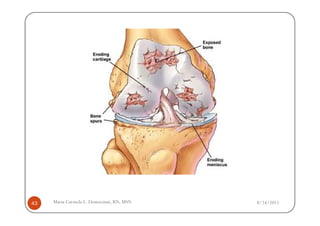
Septic arthritis
        Septic arthritis is inflammation of a joint due to a bacterial or
        fungal infection.
        AKA:
            infectious arthritis
            Bacterial arthritis
            Non-gonococcal bacterial arthritis
        Reactive arthritis
            a sterile inflammatory process that usually results from an
            extra-articular infectious process.
            Bacteria are the most significant pathogens because of their
            rapidly destructive nature.


38   Maria Carmela L. Domocmat, RN, MSN                               8/24/2011
Causes
        Septic arthritis develops when bacteria or other tiny disease-
        causing organisms (microorganisms) spread through the
        bloodstream to a joint. It may also occur when the joint is directly
        infected with a microorganism from an injury or during surgery.
        most common sites - knee and hip.
        acute septic arthritis
            bacteria such as staphylococcus or streptococcus.
        chronic septic arthritis –
            less common
            caused by organisms such as Mycobacterium tuberculosisand Candida
            albicans.

39   Maria Carmela L. Domocmat, RN, MSN                                   8/24/2011
Risk factors
        Artificial joint implants
        Bacterial infection somewhere else in your body
        Chronic illness or disease (such as diabetes, rheumatoid
        arthritis, and sickle cell disease)
        Intravenous (IV) or injection drug use
        Medications that suppress your immune system
        Recent joint injury
        Recent joint arthroscopy or other surgery


40   Maria Carmela L. Domocmat, RN, MSN                        8/24/2011
Risk factors
        seen at any age.
        Children
            occurs most often in those younger than 3 years.
            The hip is often the site of infection in infants.
        uncommon from age 3 to adolescence.
        Children - more likely than adults infected with Group B
        streptococcus or Haemophilus influenza, if they have not been
        vaccinated.


41   Maria Carmela L. Domocmat, RN, MSN                          8/24/2011
Symptoms
        Symptoms usually come on quickly.
        Fever
        joint swelling - usually just one joint.
        intense joint pain- gets worse with movement.


42   Maria Carmela L. Domocmat, RN, MSN                 8/24/2011
43   Maria Carmela L. Domocmat, RN, MSN   8/24/2011
Symptoms in newborns or infants:
        Cries when infected joint is moved (example: diaper change
        causes crying if hip joint is infected)
        Fever
        Inability to move the limb with the infected joint
        (pseudoparalysis)
        Irritability


44   Maria Carmela L. Domocmat, RN, MSN                      8/24/2011
Symptoms in children and adults:
        Inability to move the limb with the infected joint
        (pseudoparalysis)
        Intense joint pain
        Joint swelling
        Joint redness
        Low fever
        Chills may occur, but are uncommon


45   Maria Carmela L. Domocmat, RN, MSN                      8/24/2011
Exams and Tests
        Aspiration of joint fluid for cell count, examination of
        crystals under the microscope, gram stain, and culture
        Blood culture
        X-ray of affected joint


46   Maria Carmela L. Domocmat, RN, MSN                            8/24/2011
47   Maria Carmela L. Domocmat, RN, MSN   8/24/2011
Treatment
        Antibiotics are used to treat the infection.
        Resting, keeping the joint still, raising the joint, and using
        cool compresses may help relieve pain. Exercising the
        affected joint helps the recovery process.
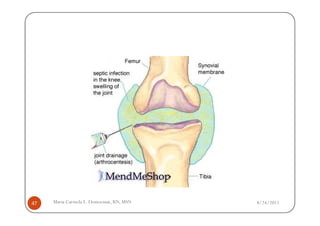
        If synovial fluid builds up quickly due to the infection, a
        needle may be inserted into the joint often to aspirate the
        fluid.
        Severe cases may need surgery to drain the infected joint
        fluid.


48   Maria Carmela L. Domocmat, RN, MSN                            8/24/2011
Medical management of infective arthritis focuses
            adequate and timely drainage of the infected synovial fluid,
            administration of appropriate antimicrobial therapy
            immobilization of the joint to control pain.


49   Maria Carmela L. Domocmat, RN, MSN                               8/24/2011
Antibiotic Therapy
        In native joint infections, parenteralantibiotics - at least 2 weeks.
        Infection with either methicillin-resistant S aureus (MRSA) or
        methicillin-susceptible S aureus (MSSA) - at least 4 full weeks IV
        antibiotic therapy.
        Orally administered antimicrobial agents are almost never
        indicated in the treatment of S aureus infections.
        Gram-negative native joint infections with a pathogen that is
        sensitive to quinolones can be treated with oral ciprofloxacin for
        the final 1-2 weeks of treatment.
        As a rule, a 2-week course of intravenous antibiotics is sufficient to
        treat gonococcal arthritis.

50   Maria Carmela L. Domocmat, RN, MSN                               8/24/2011
Antibiotics
        linezolid with or without rifampin - for staphylococcal
        prosthetic joint infection (PJI).
        Ceftriaxone (Rocephin)
            drug of choice (DOC) against N gonorrhoeae.
            This agent is effective against gram-negative enteric rods.
            Monitor sensitivity data.
        Ciprofloxacin (Cipro)
            alternative antibiotic to ceftriaxone to treat N gonorrhoeae and
            gram-negative enteric rods.


51   Maria Carmela L. Domocmat, RN, MSN                               8/24/2011
Antibiotics
        Cefixime (Suprax)
            a third-generation oral cephalosporin with broad activity against
            gram-negative bacteria.
            Oral cefixime is used as a follow-up to intravenous (IV)
            ceftriaxone to treat N gonorrhoeae.
        Oxacillin
            useful against methicillin-sensitive S aureus (MSSA).


52   Maria Carmela L. Domocmat, RN, MSN                              8/24/2011
Antibiotics
         Vancomycin (Vancocin)
             anti-infective agent used against methicillin-sensitive S aureus
             (MSSA), methicillin-resistant coagulase-negative S aureus
             (CONS), and ampicillin-resistant enterococci in patients
             allergic to penicillin.
         Linezolid (Zyvox)
             an alternative antibiotic that is used in patients allergic to
             vancomycin and for the treatment of vancomycin-resistant
             enterococci.

     http://emedicine.medscape.com/article/236299-
     medication#showall
53    Maria Carmela L. Domocmat, RN, MSN                                 8/24/2011
Joint Immobilization and Physical
     Therapy
        Usually, immobilization of the infected joint to control pain is
        not necessary after the first few days. If the patient's
        condition responds adequately after 5 days of treatment,
        begin gentle mobilization of the infected joint. Most patients
        require aggressive physical therapy to allow maximum
        postinfection functioning of the joint.
        Initial physical therapy consists of maintaining the joint in its
        functional position and providing passive range-of-motion
        exercises. The joint should bear no weight until the clinical
        signs and symptoms of synovitis have resolved. Aggressive
        physical therapy is often required to achieve maximum
        therapy benefit.

54   Maria Carmela L. Domocmat, RN, MSN                           8/24/2011
Synovial Fluid Drainage
        The choice of the type of drainage, whether percutaneous or surgical, has not
        been resolved completely.[19, 25] In general, use a needle aspirate initially,
        repeating joint taps frequently enough to prevent significant reaccumulation of
        fluid. Aspirating the joint 2-3 times a day may be necessary during the first few
        days. If frequent drainage is necessary, surgical drainage becomes more
        attractive.
        Gonococcal-infected joints rarely require surgical drainage.
        Surgical drainage is indicated when one or more of the following occur:
        The appropriate choice of antibiotic and vigorous percutaneous drainage fails to
        clear the infection after 5-7 days
        The infected joints are difficult to aspirate (eg, hip)
        Adjacent soft tissue is infected
        Routine arthroscopic lavage is rarely indicated. However, drainage through the
        arthroscope is replacing open surgical drainage. With arthroscopic drainage, the
        operator can visualize the interior of the joint and can drain pus, debride, and
        lyse adhesions.

55   Maria Carmela L. Domocmat, RN, MSN                                         8/24/2011
56   Maria Carmela L. Domocmat, RN, MSN   8/24/2011
Surgical Intervention in Prosthetic Joint
     Infection
        In cases of prosthetic joint infection (PJI) that require surgery for cure,
        successful treatment requires appropriate antibiotic therapy combined with
        removal of the hardware. Despite appropriate antibiotic use, the success rate has
        been only about 20% if the prosthesis is left in place. In recent years, evidence
        has shown that debridement alone could yield a cure rate of 74.5% of patients
        with a prosthetic joint infection and a C-reactive protein (CRP) level of 15
        mg/dL or less who are treated with a fluoroquinolone.[26] For the time being, a
        2-stage approach should be regarded as the most effective technique.
        First, remove the prosthesis and follow with 6 weeks of antibiotic therapy.
        Then, place the new joint, impregnating the methylmethacrylate cement with
        an anti-infective agent (ie, gentamicin, tobramycin). Antibiotic diffusion into
        the surrounding tissues is the goal. The success rate for this approach is
        approximately 95% for both hip and knee joints.
        An intermediate method is to exchange the new joint for the infected joint in a
        1-stage surgical procedure with concomitant antibiotic therapy. This method,
        with concurrent use of antibiotic cement, succeeds in 70-90% of cases.


57   Maria Carmela L. Domocmat, RN, MSN                                         8/24/2011
(Prognosis)
     Outlook (Prognosis)
        Recovery is good with prompt antibiotic treatment. If
        treatment is delayed, permanent joint damage may result.


58   Maria Carmela L. Domocmat, RN, MSN                      8/24/2011
Possible Complications
        Joint degeneration (arthritis)


59   Maria Carmela L. Domocmat, RN, MSN   8/24/2011
Prevention
        Strictly adhere to sterile procedures whenever the joint space
        is invaded (eg, in aspiration or arthroscopic procedures).
        Antibiotic prophylaxis
            with an antistaphylococcal antibiotic has been demonstrated to
            reduce wound infections in joint replacement surgery.
            Polymethylmethacrylate cement impregnated with antibiotics
            may decrease perioperative infections.


60   Maria Carmela L. Domocmat, RN, MSN                             8/24/2011
Prevention
        Treat any infection promptly to lessen the chance of
        bloodstream invasion.
        decreasing the incidence of underlying infections best
        prevents reactive arthritis


61   Maria Carmela L. Domocmat, RN, MSN                          8/24/2011
References
        Espinoza LR. Infections of bursae, joints, and bones. In:
        Goldman L, Ausiello D, eds. Cecil Medicine. 23rd ed.
        Philadelphia, Pa: Saunders Elsevier; 2007:chap 290.
        Ohl CA. Infectious arthritis of native joints. In: Mandell GL,
        Bennett JE, Dolin R, eds. Mandell, Douglas, and Bennett's
        Principles and Practice of Infectious Disease. 7th ed. Philadelphia,
        Pa: Saunders Elsevier; 2009:chap 102.
        http://www.nlm.nih.gov/medlineplus/ency/article/00043
        0.htm
        http://emedicine.medscape.com/article/236299-
        medication#showall

62   Maria Carmela L. Domocmat, RN, MSN                              8/24/2011
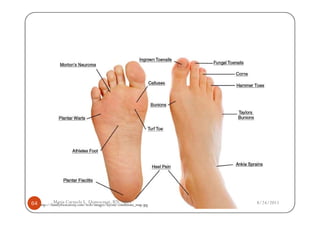
Disorders of foot
     Hallux valgus (bunions)
     Morton’s neuroma (plantar neuroma)
     Hammer toe


63   Maria Carmela L. Domocmat, RN, MSN   8/24/2011
64           Maria Carmela L. Domocmat, RN, MSN
     http://familyfootcarenj.com/web/images/layout/conditions_map.jpg   8/24/2011
Disorders of foot :
     Hallux valgus (bunions)


65   Maria Carmela L. Domocmat, RN, MSN   8/24/2011
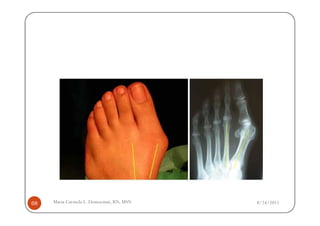
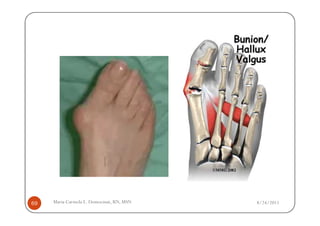
Hallux valgus
        is a condition that affects the joint at the base of the big toe.
        The condition is commonly called a bunion.
            bunion - refers to the bump that grows on the side of the first
            metatarsophalangeal (MTP) joint.


66   Maria Carmela L. Domocmat, RN, MSN                               8/24/2011
Hallux valgus (bunion)
        The deformity involves the big toe and the long bone behind the big toe, the 1st
        metatarsal.
        Over time, the 1st metatarsal will begin to move towards the other foot
        (medial) while the big toe will move out of joint towards the 2nd toe (lateral).
        As the end of the 1st metatarsal bone begins to stick out, it will be under
        pressure from shoes and the ground.
        this constant pressure and friction will cause extra bone formation, leading to
        the bump that is seen on the side of the foot.
        The big toe will continue to shift towards the second toe causing an unbalanced
        big toe joint. Over time arthritis can develop in the joint due to the mal-
        positioned joint.
        A bunion deformity is always progressive. It will always get worse over time.

     http://www.footankleinstitute.com/hallux-valgus-bunion-surgery/


67   Maria Carmela L. Domocmat, RN, MSN                                        8/24/2011
68   Maria Carmela L. Domocmat, RN, MSN   8/24/2011
69   Maria Carmela L. Domocmat, RN, MSN   8/24/2011
Hallux valgus (bunion)
        term hallux valgus actually describes what happens to the big
        toe.
        Hallux - medical term for big toe
        Valgus - anatomic term that means the deformity goes in a
        direction away from the midline of the body.
        hallux valgus - big toe begins to point towards the outside of
        the foot.
            As this condition worsens, other changes occur in the foot that
            increase the problem.


70   Maria Carmela L. Domocmat, RN, MSN                              8/24/2011
Hallux valgus (bunion)
        Changes include:
        bone just above the big toe, the first metatarsal
            usually develops too much of an angle in the other direction.
            This condition is called metatarsus primus varus.
            Metatarsus primus -means first metatarsal
            varus - medical term that means the deformity goes in a direction
            towards the midline of the body.
            This creates a situation where the first metatarsal and the big toe now
            form an angle with the point sticking out at the inside edge of the ball
            of the foot. The bunion that develops is actually a response to the
            pressure from the shoe on the point of this angle. At first the bump is
            made up of irritated, swollen tissue that is constantly caught between
            the shoe and the bone beneath the skin. As time goes on, the constant
            pressure may cause the bone to thicken as well, creating an even
            larger lump to rub against the shoe.

71   Maria Carmela L. Domocmat, RN, MSN                                     8/24/2011
Etiology
        Contrary to common belief,
            high-heeled shoes with a small toe box or tight-fitting shoes do
            not cause hallux valgus.
            such footwear does keep the hallux in an abducted position if
            hallux valgus is present, causing mechanical stretch and
            deviation of the medial soft tissue.
            In addition, tight shoes can cause medial bump pain and nerve
            entrapment.


72   Maria Carmela L. Domocmat, RN, MSN                               8/24/2011
Etiology
        Biomechanical instability
        Arthritic/metabolic conditions
        Structural deformity
        Neuromuscular disease
        Traumatic compromise


73   Maria Carmela L. Domocmat, RN, MSN   8/24/2011
Etiology
        Biomechanical instability
            most common yet most difficult to understand etiology
            Contributing factors, if present, include
               gastrocnemius or gastrocsoleus equinus,
               flexible or rigid pes plano valgus,
               rigid or flexible forefoot varus,
               dorsiflexed first ray,
               hypermobility, or
               short first metatarsal.
               Most often, excessive pronation at the midtarsal and subtalar joints
               compensates for these factors throughout the gait cycle.


74   Maria Carmela L. Domocmat, RN, MSN                                          8/24/2011
Etiology
        Biomechanical instability
            Some pronation must occur in gait to absorb ground-reactive
            forces. However, excessive pronation produces too much
            midfoot mobility, which decreases stability and prevents
            resupination and creation of a rigid lever arm; these effects
            make propulsion difficult.


75   Maria Carmela L. Domocmat, RN, MSN                              8/24/2011
Etiology
        Biomechanical instability
            During normal propulsion
               approximately 65° of dorsiflexion is necessary at the first
               metatarsophalangeal joint,
               only 20-30° is available from hallux dorsiflexion.
               Therefore, the first metatarsal must plantarflex at the sesamoid complex to
               gain the additional 40° of motion needed.
               Failure to attain the full 65° because of jamming of the joint during pronation
               subjects the first metatarsophalangeal to intense forces from which hallux
               valgus develops.
            If the foot is sufficiently hypermobile as a result of excessive
            pronation, the metatarsal tends to drift medially and the hallux drifts
            laterally, producing hallux valgus. If no hypermobility is present,
            hallux rigidus develops instead.


76   Maria Carmela L. Domocmat, RN, MSN                                              8/24/2011
Etiology
     Arthritic/metabolic
     conditions                           Structural deformity
            Gouty arthritis                 Malalignment of articular
            Rheumatoid arthritis            surface or metatarsal shaft
            Psoriatic arthritis             Abnormal metatarsal
            Connective tissue               length
            disorders such as Ehlers-       Metatarsus primus elevatus
            Danlos syndrome, Marfan
            syndrome, Down                  External tibial torsion
            syndrome, and                   Genu varum or valgum
            ligamentous laxity              Femoral retrotorsion

77   Maria Carmela L. Domocmat, RN, MSN                          8/24/2011
Etiology
     Neuromuscular disease                Traumatic compromise
        Multiple sclerosis                 Malunions
        Charcot-Marie-Tooth                Intra-articular damage
        disease                            Soft-tissue sprains
        Cerebral palsy                     Dislocations


78   Maria Carmela L. Domocmat, RN, MSN                        8/24/2011
Symptoms
              Symptoms of Hallux valgus depending on the
              degree of severity:
              Aesthetic problem.
              Formation of calluses, chronic irritation of the skin and
              bursa.
              Increasing pain under load and when moving.
              Progressive arthrosis and stiffening in the base joint of the
              toe.
              Corollary deformities such as hammer and claw toe.

 http://www.hallufix.org/english/hallux_valgus.html


79       Maria Carmela L. Domocmat, RN, MSN                             8/24/2011
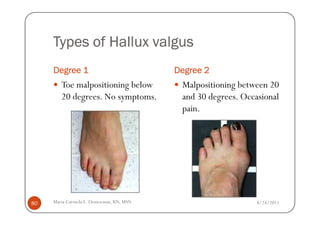
Types of Hallux valgus
     Degree 1                             Degree 2
        Toe malpositioning below           Malpositioning between 20
        20 degrees. No symptoms.           and 30 degrees. Occasional
                                           pain.


80   Maria Carmela L. Domocmat, RN, MSN                        8/24/2011
Types of Hallux valgus
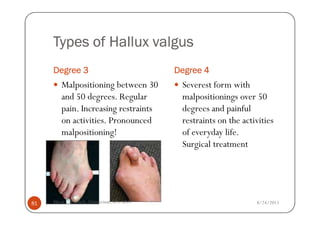
     Degree 3                             Degree 4
        Malpositioning between 30          Severest form with
        and 50 degrees. Regular            malpositionings over 50
        pain. Increasing restraints        degrees and painful
        on activities. Pronounced          restraints on the activities
        malpositioning!                    of everyday life.
                                           Surgical treatment


81   Maria Carmela L. Domocmat, RN, MSN                          8/24/2011
Treatment
        Medical Therapy
            Adapting footwear
            Pharmacologic or physical therapy
            Functional orthotic therapy
        Surgical Therapy
            Capsulotendon balancing or exostectomy
            Osteotomy
            Resectional arthroplasty
            Resectional arthroplasty with implant
            First metatarsophalangeal joint arthrodesis
            First metatarsocuneiform joint arthrodesis

82   Maria Carmela L. Domocmat, RN, MSN                   8/24/2011
83   Maria Carmela L. Domocmat, RN, MSN   8/24/2011
84   Maria Carmela L. Domocmat, RN, MSN   8/24/2011
Bunionectomy
                 remove the bump that makes up the bunion.
                 performed through a small incision on the side of the foot immediately over the
                 area of the bunion.
                 Once the skin is opened the bump is removed using a special surgical saw or
                 chisel.
                 The bone is smoothed of all rough edges and the skin incision is closed with
                 small stitches.
                 It is more likely that realignment of the big toe will also be necessary. The major
                 decision that must be made is whether or not the metatarsal bone will need to
                 be cut and realigned as well. The angle made between the first metatarsal and
                 the second metatarsal is used to make this decision. The normal angle is around
                 nine or ten degrees. If the angle is 13 degrees or more, the metatarsal will
                 probably need to be cut and realigned.
                 When a surgeon cuts and repositions a bone, it is referred to as an osteotomy.
                 There are two basic techniques used to perform an osteotomy to realign the
                 first metatarsal.


85          Maria Carmela L. Domocmat, RN, MSN
     http://www.concordortho.com/patient-education/topic-detail-                           8/24/2011
     popup.aspx?topicID=a5cea3a8a6d8093483657c959125dbaf
Distal Osteotomy
                 the far end of the bone is cut and moved laterally
                 This effectively reduces the angle between the first and
                 second metatarsal bones.
                 usually requires one or two small incisions in the foot.
                 Once the surgeon is satisfied with the position of the bones,
                 the osteotomy is held in the desired position with one, or
                 several,metal pins.
                 Once the bone heals, the pin is removed. The metal pins are
                 usually removed between three and six weeks following
                 surgery.

86          Maria Carmela L. Domocmat, RN, MSN
     http://www.concordortho.com/patient-education/topic-detail-         8/24/2011
     popup.aspx?topicID=a5cea3a8a6d8093483657c959125dbaf
Proximal Osteotomy
                 the first metatarsal is cut at the near end of the bone
                 usually requires two or three small incisions in the foot.
                 Once the skin is opened the surgeon performs the osteotomy. The bone
                 is then realigned and held in place with metal pins until it heals. Again,
                 this reduces the angle between the first and second metatarsal bones.
                 Realignment of the big toe is then done by releasing the tight structures
                 on the lateral, or outer, side of the first MTP joint. This includes the
                 tight joint capsule and the tendon of the adductor hallucis muscle. This
                 muscle tends to pull the big toe inward. By releasing the tendon, the toe
                 is no longer pulled out of alignment. The toe is realigned and the joint
                 capsule on the side of the big toe closest to the other toe is tightened to
                 keep the toe straight, or balanced.
                 Once the surgeon is satisfied that the toe is straight and well balanced,
                 the skin incisions are closed with small stitches. A bulky bandage is
                 applied to the foot before you are returned to the recovery room.

87          Maria Carmela L. Domocmat, RN, MSN
     http://www.concordortho.com/patient-education/topic-detail-                    8/24/2011
     popup.aspx?topicID=a5cea3a8a6d8093483657c959125dbaf
Good footwear is often all that is needed
        Wearing good footwear does not cure the deformity but may ease
        symptoms of pain and discomfort. Ideally, get advice about footwear
        from a podiatrist or chiropodist.
        Advice may include:
        Wear shoes, trainers or slippers that fit well and are roomy.
        Don't wear high-heeled, pointed or tight shoes.
        You might find that shoes with laces or straps are best, as they can be
        adjusted to the width of your foot.
        Padding over the bunion may help, as may ice packs.
        Devices which help to straighten the toe (orthoses) are still occasionally
        recommended, although trials investigating their use have not found
        them much better than no treatment at all.
             http://www.patient.co.uk/health/Bunions-(Hallux-Valgus).htm

88   Maria Carmela L. Domocmat, RN, MSN                                    8/24/2011
Resectional arthroplasty
                is a joint-destructive procedure
                most commonly is reserved for elderly patients with advanced
                degenerative joint disease and significant limitation of motion.
                The typical resectional arthroplasty that is performed is known as
                a Keller procedure.
                It is performed when morbidity might be increased with the more
                aggressive osteotomy that would otherwise be selected. The
                procedure includes resection of the base of the proximal phalanx
                with reapproximation of the abductor and adductor tendon
                groups. The technique is inherently unstable and should be used
                judiciously. The postoperative course includes limited-to-full
                weight bearing in a surgical shoe immediately after the procedure.
     http://emedicine.medscape.com/article/1232902-treatment#showall


89        Maria Carmela L. Domocmat, RN, MSN                               8/24/2011
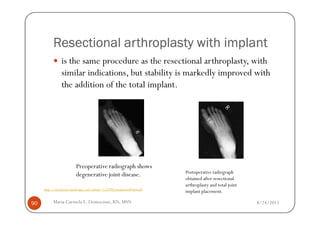
Resectional arthroplasty with implant
                is the same procedure as the resectional arthroplasty, with
                similar indications, but stability is markedly improved with
                the addition of the total implant.


                         Preoperative radiograph shows
                                                                       Postoperative radiograph
                         degenerative joint disease.
                                                                       obtained after resectional
                                                                       arthroplasty and total joint
     http://emedicine.medscape.com/article/1232902-treatment#showall
                                                                       implant placement.

90        Maria Carmela L. Domocmat, RN, MSN                                                          8/24/2011
First metatarsophalangeal joint
     arthrodesis
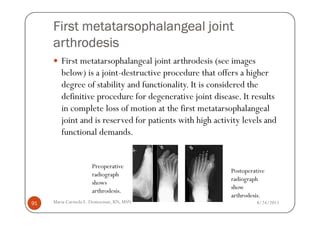
        First metatarsophalangeal joint arthrodesis (see images
        below) is a joint-destructive procedure that offers a higher
        degree of stability and functionality. It is considered the
        definitive procedure for degenerative joint disease. It results
        in complete loss of motion at the first metatarsophalangeal
        joint and is reserved for patients with high activity levels and
        functional demands.


                     Preoperative
                                                          Postoperative
                     radiograph
                                                          radiograph
                     shows
                                                          show
                     arthrodesis.
                                                          arthrodesis.
91   Maria Carmela L. Domocmat, RN, MSN                            8/24/2011
First metatarsocuneiform joint
     arthrodesis
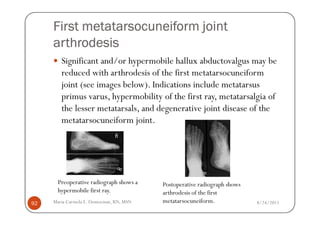
        Significant and/or hypermobile hallux abductovalgus may be
        reduced with arthrodesis of the first metatarsocuneiform
        joint (see images below). Indications include metatarsus
        primus varus, hypermobility of the first ray, metatarsalgia of
        the lesser metatarsals, and degenerative joint disease of the
        metatarsocuneiform joint.


      Preoperative radiograph shows a     Postoperative radiograph shows
      hypermobile first ray.              arthrodesis of the first
92   Maria Carmela L. Domocmat, RN, MSN   metatarsocuneiform.              8/24/2011
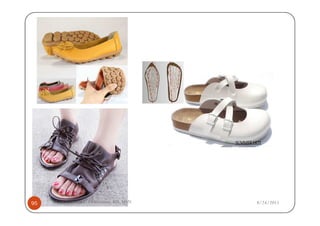
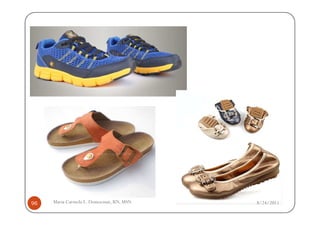
How to Choose Shoes
              1. Know your foot.
                  Take a look at your old shoes. Look at what areas the most worn out shoes. A well-
                  chosen shoes will help to endure the physical stress well. One way to determine your
                  foot's shape is to do a "wet test"--- wet your foot, step on a piece of brown paper and
                  trace your footprint. Or just look at where your last pair of shoes shows the most wear.
              2. Don't buy uncomfortable shoes even if they are hot!
              3. Ideally, you should avoid wearing heels
              4. Don't make shoes multitask.
              5. Knowing your foot's particular quirks is key to selecting the right pair of shoes.
              6.You must find shoes with well cushioned soles and ideally, some type of soft arch-support.
              7. Measure your foot frequently. Foot size changes as we get older.
              8.You should not buy shoes in the morning. The size of our feet at night more than in the
                  morning. Feet swell over the course of the day; they also expand while you run or walk,
                  so shoes should fit your feet when they're at their largest.

     http://hallux-valgus-rigidus.com/index.php?option=com_content&view=article&id=74&Itemid=88


93            Maria Carmela L. Domocmat, RN, MSN                                                  8/24/2011
How to Choose Shoes
     9. Always buy shoes to fit the larger or wider foot.
        Buy well-fitting shoes with a wide toe box.
     10. Use bunion shields, bunion pads or bunion cushions to protect
        the bunion when wearing shoes. A bunion sleeve can be especially
        effective at relieving shoe pressure when walking with a hallux
        valgus.
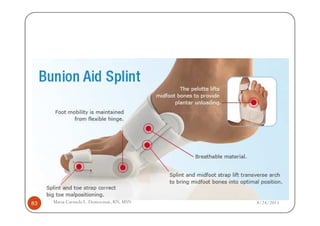
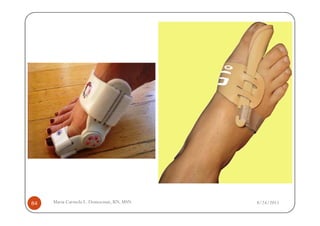
     11. Utilize an orthotic device or insert, such as a bunion splint or
        bunion brace, to redistribute the pressure along the arch and ball
        of the foot and control the separation of the bones. These devices
        help support your foot and reduce the tendency toward hallux
        valgus formation.
     12. Use a bunion regulator to stretch tight tendons and toe muscles
        overnight – especially if you want to avoid surgery.

              http://hallux-valgus-rigidus.com/index.php?option=com_content&view=article&id=74&Itemid=88

94   Maria Carmela L. Domocmat, RN, MSN                                                                    8/24/2011
95   Maria Carmela L. Domocmat, RN, MSN   8/24/2011
96   Maria Carmela L. Domocmat, RN, MSN   8/24/2011
97   Maria Carmela L. Domocmat, RN, MSN   8/24/2011
Marfan syndrome (MFS)
        is a spectrum disorder caused by a heritable genetic defect of connective tissue
        that has an autosomal dominant mode of transmission
        The defect itself has been isolated to the FBN1 gene on chromosome 15, which
        codes for the connective tissue protein fibrillin.
        Abnormalities in this protein cause a myriad of distinct clinical problems, of
        which the musculoskeletal, cardiac, and ocular system problems predominate.
        The skeleton of patients with MFS typically displays multiple deformities
        including arachnodactyly (ie, abnormally long and thin digits),
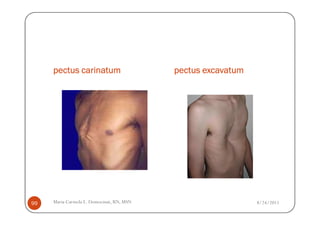
        dolichostenomelia (ie, long limbs relative to trunk length), pectus deformities
        (ie, pectus excavatum and pectus carinatum), and thoracolumbar scoliosis
        In the cardiovascular system, aortic dilatation, aortic regurgitation, and
        aneurysms are the most worrisome clinical findings. Mitral valve prolapse that
        requires valve replacement can occur as well. Ocular findings
        include myopia,cataracts, retinal detachment and superior dislocation of the
        lens


98   Maria Carmela L. Domocmat, RN, MSN                                         8/24/2011
pectus carinatum                     pectus excavatum


99   Maria Carmela L. Domocmat, RN, MSN                      8/24/2011
Ehlers-
      Genetics of Ehlers-Danlos Syndrome
         Ehlers-Danlos family of disorders is a group of related
         conditions that share a common decrease in the tensile
         strength and integrity of the skin, joints, and other
         connective tissues.
         The first detailed clinical description of the syndrome is
         attributed to Tschernogobow in 1892. The syndrome derives
         its name from reports by Edward Ehlers, a Danish
         dermatologist, in 1901 and by Henri-Alexandre Danlos, a
         French physician with expertise in chemistry of skin
         disorders, in 1908. These 2 physicians combined the
         pertinent features of the condition and accurately delineated
         the phenotype of this group of disorders.

100   Maria Carmela L. Domocmat, RN, MSN                        8/24/2011
The amazing, almost unnatural, contortions that some
         patients with Ehlers-Danlos syndrome can perform often
         arouse curiosity. Historically, some patients with Ehlers-
         Danlos syndrome displayed the maneuvers publically in
         circuses, shows, and performance tours. Some achieved
         modest degrees of fame and bore titles such as "The India
         Rubber Man," "The Elastic Lady," and "The Human
         Pretzel." Such clinical features also raise suspicion of the
         diagnosis when identified upon physical examination.
         Unfortunately, patients often go many years before being
         diagnosed

101   Maria Carmela L. Domocmat, RN, MSN                          8/24/2011
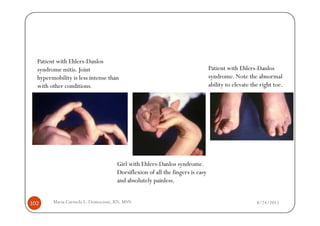
Patient with Ehlers-Danlos
  syndrome mitis. Joint                                                      Patient with Ehlers-Danlos
  hypermobility is less intense than                                         syndrome. Note the abnormal
  with other conditions.                                                     ability to elevate the right toe.


                                   Girl with Ehlers-Danlos syndrome.
                                   Dorsiflexion of all the fingers is easy
                                   and absolutely painless.


102     Maria Carmela L. Domocmat, RN, MSN                                                        8/24/2011
All forms of Ehlers-Danlos syndrome share the following
         primary features to varying degrees:
             Skin hyperextensibility
             Joint hypermobility and excessive dislocations
             Tissue fragility
             Poor wound healing, leading to wide thin scars: The classic
             description of abnormal scar formation in Ehlers-Danlos
             syndrome is "cigarette paper scars."
             Easy bruising


103   Maria Carmela L. Domocmat, RN, MSN                              8/24/2011
Type     Inheritance Previous     Major Diagnostic Minor Diagnostic
                     Nomenclature Criteria         Criteria
Kyphoscol Autosomal        Type VI – lysyl   Joint laxity, severe     Tissue fragility,
iosis     recessive        hydroxylase       hypotonia at birth,      easy bruising, arterial rupture,
                           deficiency        scoliosis, progressive   marfanoid,
                                             scleral fragility or     microcornea,
                                             rupture of globe         osteopenia,
                                                                      positive family
                                                                      history (affected sibling)
Arthrocha Autosomal
ArthrochaAutosomal         Type VII A, B     Congenital bilateral     Skin hyperextensibility,
lasia     dominant                           dislocated hips,         tissue fragility with atrophic
                                             severe joint             scars, muscle hypotonia,
                                             hypermobility,           easy bruising,
                                             recurrent subluxations   kyphoscoliosis, mild osteopenia
Dermatos Autosomal         Type VII C        Severe skin fragility;   Soft, doughy skin;
paraxis recessive                            saggy, redundant skin    easy bruising; premature
                                                                      rupture of membranes; hernias
                                                                      (umbilical and inguinal)

104     Maria Carmela L. Domocmat, RN, MSN                                               8/24/2011
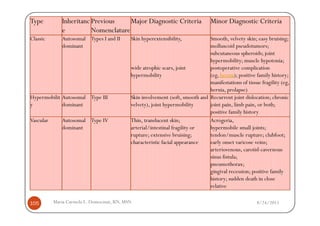
Type          Inheritanc Previous     Major Diagnostic Criteria                  Minor Diagnostic Criteria
              e          Nomenclature
Classic       Autosomal Types I and II      Skin hyperextensibility,           Smooth, velvety skin; easy bruising;
              dominant                                                         molluscoid pseudotumors;
                                                                               subcutaneous spheroids; joint
                                                                               hypermobility; muscle hypotonia;
                                            wide atrophic scars, joint         postoperative complication
                                            hypermobility                      (eg, hernia); positive family history;
                                                                               manifestations of tissue fragility (eg,
                                                                               hernia, prolapse)
Hypermobilit Autosomal Type III             Skin involvement (soft, smooth and Recurrent joint dislocation; chronic
y            dominant                       velvety), joint hypermobility      joint pain, limb pain, or both;
                                                                               positive family history
Vascular      Autosomal Type IV             Thin, translucent skin;            Acrogeria,
              dominant                      arterial/intestinal fragility or   hypermobile small joints;
                                            rupture; extensive bruising;       tendon/muscle rupture; clubfoot;
                                            characteristic facial appearance   early onset varicose veins;
                                                                               arteriovenous, carotid-cavernous
                                                                               sinus fistula;
                                                                               pneumothorax;
                                                                               gingival recession; positive family
                                                                               history; sudden death in close
                                                                               relative

105        Maria Carmela L. Domocmat, RN, MSN                                                         8/24/2011
Down syndrome
         Down syndrome is by far the most common and best
         known chromosomal disorder in humans and the most
         common cause of intellectual disability.[3]
         Mental retardation, dysmorphic facial features, and other
         distinctive phenotypic traits characterize the syndrome


106   Maria Carmela L. Domocmat, RN, MSN                       8/24/2011
Disorders of foot :
      Morton’s neuroma (plantar neuroma


107   Maria Carmela L. Domocmat, RN, MSN   8/24/2011
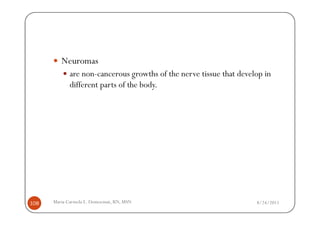
Neuromas
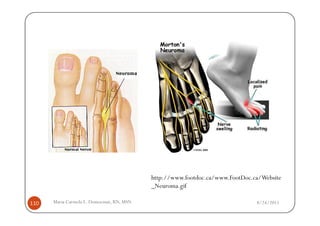
             are non-cancerous growths of the nerve tissue that develop in
             different parts of the body.


108   Maria Carmela L. Domocmat, RN, MSN                             8/24/2011
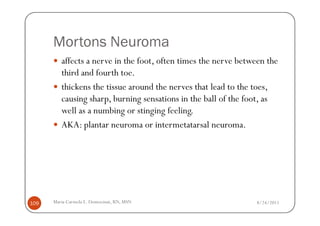
Mortons Neuroma
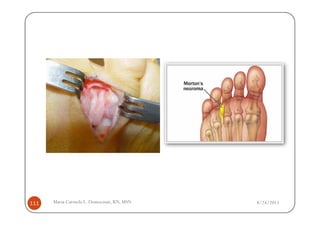
         affects a nerve in the foot, often times the nerve between the
         third and fourth toe.
         thickens the tissue around the nerves that lead to the toes,
         causing sharp, burning sensations in the ball of the foot, as
         well as a numbing or stinging feeling.
         AKA: plantar neuroma or intermetatarsal neuroma.


109   Maria Carmela L. Domocmat, RN, MSN                        8/24/2011
http://www.footdoc.ca/www.FootDoc.ca/Website
                                           _Neuroma.gif

110   Maria Carmela L. Domocmat, RN, MSN                                      8/24/2011
111   Maria Carmela L. Domocmat, RN, MSN   8/24/2011
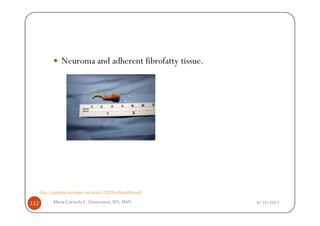
Neuroma and adherent fibrofatty tissue.


      http://emedicine.medscape.com/article/308284-clinical#showall

112           Maria Carmela L. Domocmat, RN, MSN                      8/24/2011
Sex
                        The female-to-male ratio for Morton's neuroma is 5:1.

                   Age
                        The highest prevalence of Morton's neuroma is found in
                        patients aged 15-50 years, but the condition may occur in any
                        ambulatory patient.


      http://emedicine.medscape.com/article/308284-clinical#showall

113           Maria Carmela L. Domocmat, RN, MSN                                8/24/2011
Causes
                   Various factors have been implicated in the precipitation of Morton's neuroma.
                   Morton's neuroma is known to develop as a result of chronic nerve stress and
                   irritation, particularly with excessive toe dorsiflexion.
                   Poorly fitting and constricting shoes (ie, small toe box) or shoes with heel lifts
                   often contribute to Morton's neuroma. Women who wear high-heeled shoes for
                   a number of years or men who are required to wear constrictive shoe gear are
                   at risk.
                   A biomechanical theory of causation involves the mechanics of the foot and
                   ankle. For instance, individuals with tight gastrocnemius-soleus muscles or who
                   excessively pronate the foot may compensate by dorsiflexion of the metatarsals
                   subsequently irritating of the interdigital nerve.
                   Certain activities carry increased risk of excessive toe dorsiflexion, such as
                   prolonged walking, running, squatting, and demi-pointe position in ballet.[4]


      http://emedicine.medscape.com/article/308284-clinical#showall

114           Maria Carmela L. Domocmat, RN, MSN                                            8/24/2011
Manifestations
                   Obtaining an accurate history is important to making the diagnosis of Morton's
                   neuroma. Possible reported findings provided by the patient with Morton's
                   neuroma include the following:
                   The most common presenting complaints include pain and dysesthesias in the
                   forefoot and corresponding toes adjacent to the neuroma.
                   Pain is described as sharp and burning, and it may be associated with cramping.
                   Numbness often is observed in the toes adjacent to the neuroma and seems to
                   occur along with episodes of pain.
                   Pain typically is intermittent, as episodes often occur for minutes to hours at a
                   time and have long intervals (ie, weeks to months) between a single or small
                   group of multiple attacks.
                   Some patients describe the sensation as "walking on a marble."
                   Massage of the affected area offers significant relief.
                   Narrow tight high-heeled shoes aggravate the symptoms.
                   Night pain is reported but is rare.
      http://emedicine.medscape.com/article/308284-clinical#showall

115           Maria Carmela L. Domocmat, RN, MSN                                            8/24/2011
Dx tests
                   palpable mass or a "click" between the bones.
                   Doctor put pressure on the spaces between the toe bones to
                   try to replicate the pain and look for calluses or evidence of
                   stress fractures in the bones that might be the cause of the
                   pain.
                   Range of motion tests will rule out arthritis or joint
                   inflammations.
                   X-rays may be required to rule out a stress fracture or
                   arthritis of the joints that join the toes to the foot.

      http://emedicine.medscape.com/article/308284-clinical#showall

116           Maria Carmela L. Domocmat, RN, MSN                           8/24/2011
Treatment
                   Rehabilitation Program
                   Physical Therapy
                   Treatment strategies for Morton's neuroma range from conservative to surgical
                   management. The conservative approach to treating Morton's neuroma may benefit from
                   the involvement of a physical therapist. The physical therapist can assist the physician in
                   decisions regarding the modification of footwear, which is the first treatment step.
                   Recommend soft-soled shoes with a wide toe box and low heel (eg, an athletic shoe).
                   High-heeled, narrow, nonpadded shoes should not be worn, because they aggravate the
                   condition.
                   The next step in conservative management is to alter alignment of the metatarsal heads.
                   One recommended action is to elevate the metatarsal head medial and adjacent to the
                   neuroma, thereby preventing compression and irritation of the digital nerve. A plantar
                   pad is used most often for elevation. Have the patient insert a felt or gel pad into the
                   shoe to achieve the desired elevation of the above metatarsal head.
                   Other possible physical therapy treatment ideas for patients with Morton's neuroma
                   include cryotherapy, ultrasonography, deep tissue massage, and stretching exercises. Ice
                   is beneficial to decrease the associated inflammation. Phonophoresis also can be used,
                   rather than just ultrasonography, to further decrease pain and inflammation.
      http://emedicine.medscape.com/article/308284-clinical#showall

117           Maria Carmela L. Domocmat, RN, MSN                                                    8/24/2011
Treatment
                  Initial therapies are nonsurgical and relatively simple. They
                  can involve one or more of the following treatments:
                      Changes in footwear. Avoid high heels or tight shoes, and
                      wear wider shoes with lower heels and a soft sole. This enables
                      the bones to spread out and may reduce pressure on the nerve,
                      giving it time to heal.
                      Orthoses. Custom shoe inserts and pads also help relieve
                      irritation by lifting and separating the bones, reducing the
                      pressure on the nerve.


      http://orthoinfo.aaos.org/topic.cfm?topic=a00158
118          Maria Carmela L. Domocmat, RN, MSN                                8/24/2011
Treatment
                  Injection. One or more injections of a corticosteroid
                  medication can reduce the swelling and inflammation of the
                  nerve, bringing some relief.
                  Combination
                      Several studies have shown that a combination of roomier,
                      more comfortable shoes, nonsteroidal anti-
                      inflammatory medication, custom foot orthoses and
                      cortisone injections provide relief in over 80 percent of
                      people with Morton's Neuroma.


      http://orthoinfo.aaos.org/topic.cfm?topic=a00158
119          Maria Carmela L. Domocmat, RN, MSN                           8/24/2011
Surgical Intervention
                   When conservative measures for Morton's neuroma are
                   unsuccessful, surgical excision of the area of fibrosis in
                   the common digital nerve may be curative.
                   Common adverse outcomes include
                        dysesthesias radiating from a painful nerve stump. Dysesthesias
                        may be treated as any other dysesthetic pain.
                   Surgical options include the following:
                        Neurectomy with nerve burial
                        Transverse intermetatarsal ligament release, with or
                        without neurolysis
                        Endoscopic decompression of the transverse
                        metatarsal ligament
      http://emedicine.medscape.com/article/308284-clinical#showall

120           Maria Carmela L. Domocmat, RN, MSN                                 8/24/2011
Other Treatment
         Perform injection into the dorsal aspect of the foot, 1-2 cm proximal to the
         webspace, in line with the MTP joints.
         Advance the needle through the midwebspace into the plantar aspect of the foot
         until the needle gently tents the skin. Then withdraw it about 1 cm to where the
         tip of the neuroma is located.
         Inject a corticosteroid/anesthetic mix. A reasonable volume is 1 mL of
         corticosteroid and 2 mL of anesthetic. T
         he anesthetic used should not contain epinephrine, as necrosis may result. Care
         also should be taken not to inject into the plantar pad.
         Adverse outcomes include plantar fat pad necrosis. Transient numbness of the
         toes also may occur. Although many practitioners use multiple injections, the
         likelihood of benefit from subsequent injections, after failure to achieve relief
         from the initial injection, is negligible.
         An Australian investigation using a single, ultrasonographically guided
         corticosteroid injection for Morton's neuroma found that 9 months after
         treatment, complete pain relief had occurred in 11 of the 39 neuromas studied.


121   Maria Carmela L. Domocmat, RN, MSN                                         8/24/2011
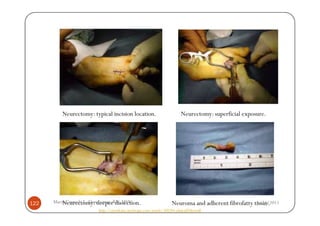
Neurectomy: typical incision location.                         Neurectomy: superficial exposure.


122   Maria Carmela L. Domocmat, RN, MSN
          Neurectomy: deeper dissection.                          Neuroma and adherent fibrofatty tissue.
                                                                                                   8/24/2011
                       http://emedicine.medscape.com/article/308284-clinical#showall
Medication Summary
         Dysesthesias may be treated as any other dysesthetic pain.
         Tricyclic antidepressants, such as amitriptyline at 10-25 mg
         PO qhs, may be tried. If this approach is unsuccessful,
         anticonvulsants (eg, gabapentin, carbamazepine) often are
         effective.


123   Maria Carmela L. Domocmat, RN, MSN                        8/24/2011
Tricyclic Antidepressants
         Class Summary
         A complex group of drugs that have central and peripheral
         anticholinergic effects, as well as sedative effects. They have
         central effects on pain transmission, and they block the active
         re-uptake of norepinephrine and serotonin.
         Amitriptyline (Elavil)
             Analgesic for certain chronic and neuropathic pain. Low doses,
             10-25 mg qhs, may provide pain relief from burning and
             tingling occurring at rest but function only as an adjunct to
             definitive treatment.


124   Maria Carmela L. Domocmat, RN, MSN                             8/24/2011
Anticonvulsants
         Class Summary
             Use of certain antiepileptic drugs (AEDs), such as the GABA
             analogue Neurontin (gabapentin), has proven helpful in some cases of
             neuropathic pain. Thus, although unstudied, a trial of such an agent
             might conceivably provide analgesia for symptomatic neuropathy.
             Used for dysesthesias not controlled with definitive treatment plus
             tricyclic antidepressants (or in patients unable to take tricyclic
             antidepressants).
         Gabapentin (Neurontin)
             Neuromembrane stabilizer useful in pain reduction with dysesthetic
             pain. Has antineuralgic effects; however, exact mechanism of action is
             unknown. Structurally related to GABA, but does not interact with
             GABA receptors.


125   Maria Carmela L. Domocmat, RN, MSN                                   8/24/2011
Anticonvulsants
         Pregabalin (Lyrica)
              Structural derivative of GABA. Mechanism of action unknown.
             Binds with high affinity to alpha2-delta site (a calcium channel
             subunit). In vitro, reduces calcium-dependent release of several
             neurotransmitters, possibly by modulating calcium channel
             function. FDA approved for neuropathic pain associated with
             diabetic peripheral neuropathy or postherpetic neuralgia and as
             adjunctive therapy in partial-onset seizures.


126   Maria Carmela L. Domocmat, RN, MSN                              8/24/2011
Serotonin-
      Serotonin-Norepinephrine Reuptake
      Inhibitors
         Class Summary
             These agents inhibit neuronal serotonin and norepinephrine
             reuptake.
         Duloxetine (Cymbalta)
              Description Indicated for diabetic peripheral neuropathic pain.
             Potent inhibitor of neuronal serotonin and norepinephrine
             reuptake


127   Maria Carmela L. Domocmat, RN, MSN                              8/24/2011
Disorders of foot :
      Hammer toe


128   Maria Carmela L. Domocmat, RN, MSN   8/24/2011
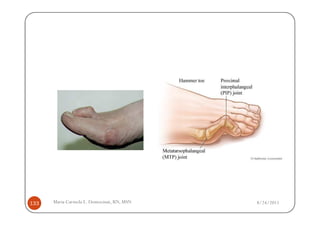
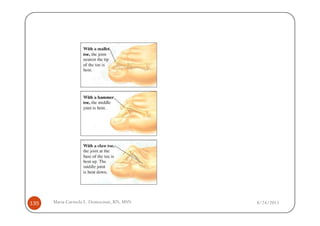
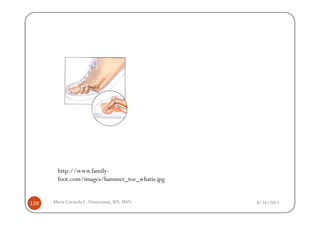
Hammer toe
         is a deformity of the toe, in which the end of the toe is bent
         downward.


129   Maria Carmela L. Domocmat, RN, MSN                          8/24/2011
Causes, incidence, and risk factors
         Hammer toe usually affects the second toe. However, it may also
         affect the other toes. The toe moves into a claw-like position.
         The most common cause of hammer toe is wearing short, narrow
         shoes that are too tight. The toe is forced into a bent position.
         Muscles and tendons in the toe tighten and become shorter.
         Hammer toe is more likely to occur in:
         Women who wear shoes that do not fit well or have high heels
         Children who keep wearing shoes they have outgrown
         The condition may be present at birth (congenital) or develop
         over time.
         In rare cases, all of the toes are affected. This may be caused by a
         problem with the nerves or spinal cord.

130   Maria Carmela L. Domocmat, RN, MSN                              8/24/2011
Symptoms
         The middle joint of the toe is bent. The end part of the toe
         bends down into a claw-like deformity. At first, you may be
         able to move and straighten the toe. Over time, you will no
         longer be able to move the toe.
         A corn often forms on the top of the toe. A callus is found on
         the sole of the foot.
         Walking or wearing shoes can be painful.


131   Maria Carmela L. Domocmat, RN, MSN                        8/24/2011
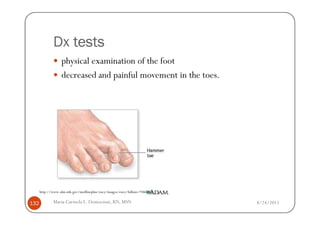
Dx tests
                   physical examination of the foot
                   decreased and painful movement in the toes.


      http://www.nlm.nih.gov/medlineplus/ency/images/ency/fullsize/9360.jpg

132           Maria Carmela L. Domocmat, RN, MSN                              8/24/2011
133   Maria Carmela L. Domocmat, RN, MSN   8/24/2011
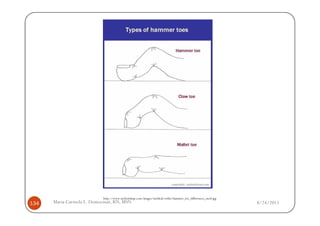
http://www.myfootshop.com/images/medical/ortho/hammer_toe_differences_mod.jpg
134   Maria Carmela L. Domocmat, RN, MSN                                                                   8/24/2011
135   Maria Carmela L. Domocmat, RN, MSN   8/24/2011
http://www.family-
       foot.com/images/hammer_toe_whatis.jpg


136   Maria Carmela L. Domocmat, RN, MSN       8/24/2011
Treatment
         Mild hammer toe in children can be treated by manipulating
         and splinting the affected toe.


137   Maria Carmela L. Domocmat, RN, MSN                     8/24/2011
Treatment
         The following changes in footwear may help relieve
         symptoms:
             Wear the right size shoes or shoes with wide toe boxes for
             comfort, and to avoid making hammer toe worse.
             Avoid high heels as much as possible.
             Wear soft insoles to relieve pressure on the toe.
             Protect the joint that is sticking out with corn pads or felt pads


138   Maria Carmela L. Domocmat, RN, MSN                                 8/24/2011
Treatment
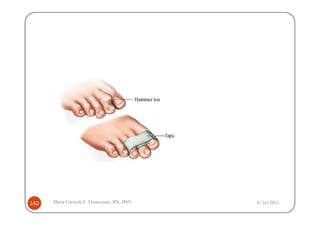
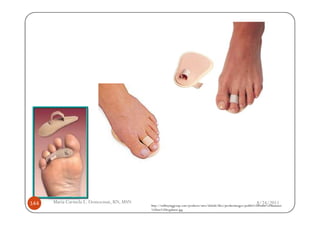
         A foot doctor can make foot devices called hammer toe
         regulators or straighteners for you, or you can buy them at
         the store.
         Exercises may be helpful.
             You can try gentle stretching exercises if the toe is not already
             in a fixed position.
             Picking up a towel with your toes can help stretch and
             straighten the small muscles in the foot.


139   Maria Carmela L. Domocmat, RN, MSN                                8/24/2011
Treatment
         For severe hammer toe, you will need an operation to
         straighten the joint.
         The surgery often involves cutting or moving tendons and
         ligaments.
         Sometimes the bones on each side of the joint need to be
         connected (fussed) together.
         Most of the time, you will go home on the same day as the
         surgery. The toe may still be stiff afterward, and it may be
         shorter.


140   Maria Carmela L. Domocmat, RN, MSN                         8/24/2011
Prevention and Cure of Hammer Toes
      with Products
         Hammer Toe Regulator              Toe Rings
         Hammer Toe Cushion                Toe Brace
         Foam Toe Tubes                    Toe Alignment Splint
         Gel Toe Cap                       Toe Trainers
         Toe Spreader                      Hammer Toe Straightener
         Silicone Toe Crest
         Toe Spacer Cushion
         Digital Toe Pad
         Yoga Toes Toe Stretcher

141   Maria Carmela L. Domocmat, RN, MSN                       8/24/2011
142   Maria Carmela L. Domocmat, RN, MSN   8/24/2011
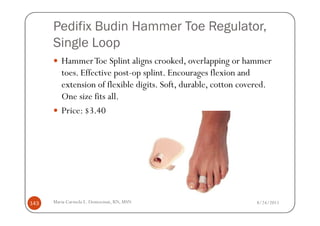
Pedifix Budin Hammer Toe Regulator,
      Single Loop
         Hammer Toe Splint aligns crooked, overlapping or hammer
         toes. Effective post-op splint. Encourages flexion and
         extension of flexible digits. Soft, durable, cotton covered.
         One size fits all.
         Price: $3.40


143   Maria Carmela L. Domocmat, RN, MSN                        8/24/2011
144   Maria Carmela L. Domocmat, RN, MSN                                                                             8/24/2011
                                           http://mdbuyinggroup.com/products/sites/default/files/productimages/pedifix%20budin%20hammer
                                           %20toe%20regulator.jpg
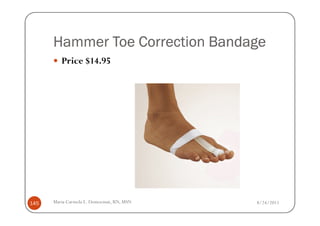
Hammer Toe Correction Bandage
         Price $14.95


145   Maria Carmela L. Domocmat, RN, MSN   8/24/2011
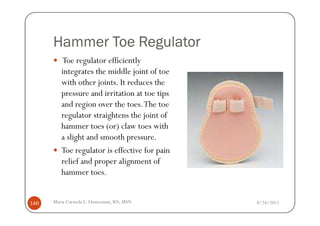
Hammer Toe Regulator
         Toe regulator efficiently
         integrates the middle joint of toe
         with other joints. It reduces the
         pressure and irritation at toe tips
         and region over the toes. The toe
         regulator straightens the joint of
         hammer toes (or) claw toes with
         a slight and smooth pressure.
         Toe regulator is effective for pain
         relief and proper alignment of
         hammer toes.


146   Maria Carmela L. Domocmat, RN, MSN       8/24/2011
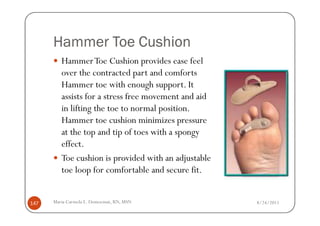
Hammer Toe Cushion
         Hammer Toe Cushion provides ease feel
         over the contracted part and comforts
         Hammer toe with enough support. It
         assists for a stress free movement and aid
         in lifting the toe to normal position.
         Hammer toe cushion minimizes pressure
         at the top and tip of toes with a spongy
         effect.
         Toe cushion is provided with an adjustable
         toe loop for comfortable and secure fit.


147   Maria Carmela L. Domocmat, RN, MSN              8/24/2011
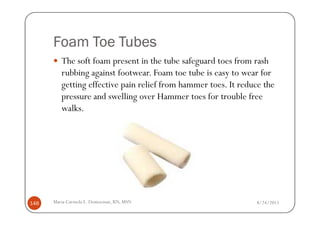
Foam Toe Tubes
         The soft foam present in the tube safeguard toes from rash
         rubbing against footwear. Foam toe tube is easy to wear for
         getting effective pain relief from hammer toes. It reduce the
         pressure and swelling over Hammer toes for trouble free
         walks.


148   Maria Carmela L. Domocmat, RN, MSN                        8/24/2011
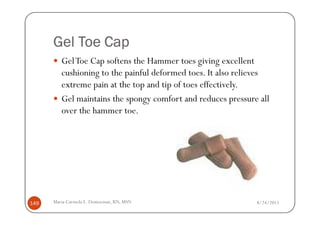
Gel Toe Cap
         Gel Toe Cap softens the Hammer toes giving excellent
         cushioning to the painful deformed toes. It also relieves
         extreme pain at the top and tip of toes effectively.
         Gel maintains the spongy comfort and reduces pressure all
         over the hammer toe.


149   Maria Carmela L. Domocmat, RN, MSN                      8/24/2011
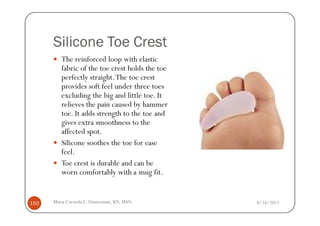
Silicone Toe Crest
         The reinforced loop with elastic
         fabric of the toe crest holds the toe
         perfectly straight. The toe crest
         provides soft feel under three toes
         excluding the big and little toe. It
         relieves the pain caused by hammer
         toe. It adds strength to the toe and
         gives extra smoothness to the
         affected spot.
         Silicone soothes the toe for ease
         feel.
         Toe crest is durable and can be
         worn comfortably with a snug fit.


150   Maria Carmela L. Domocmat, RN, MSN         8/24/2011
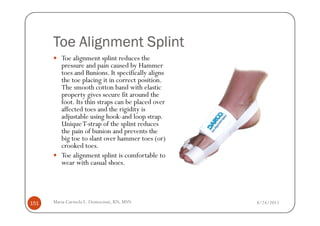
Toe Alignment Splint
         Toe alignment splint reduces the
         pressure and pain caused by Hammer
         toes and Bunions. It specifically aligns
         the toe placing it in correct position.
         The smooth cotton band with elastic
         property gives secure fit around the
         foot. Its thin straps can be placed over
         affected toes and the rigidity is
         adjustable using hook-and loop strap.
         Unique T-strap of the splint reduces
         the pain of bunion and prevents the
         big toe to slant over hammer toes (or)
         crooked toes.
         Toe alignment splint is comfortable to
         wear with casual shoes.


151   Maria Carmela L. Domocmat, RN, MSN            8/24/2011
Toe Trainers

         Toe trainer comforts flexible
         hammer toes. It gives better
         relief against the pain and
         irritation. Toe trainer
         separates the toes and aligns
         them to look straight. It is an
         effective item to cure slightly
         movable Hammer toes.
         The cotton-covered foam
         provides secure feel to the
         crooked toes.
         Toe trainer is easy to wear
         and fits snugly for efficient
         correction of hammer toes.


152   Maria Carmela L. Domocmat, RN, MSN   8/24/2011
Hammer Toe Straightener

         The toe Straightener perfectly aligns
         Hammer toes with little pressure. Its
         cotton-covered loop with elasticity holds the
         toe firmly in proper place and it can be
         easily adjusted for stress free movements.
         The smooth foam pad molds accordingly
         with the foot shape and renders superior
         cushioning at the bottom of the feet. It also
         stops the pain caused by hammer toes. The
         hook closure present in the toe straightener
         pulls down and aligns the deformed toes to
         keep you always smiling.
         Hammer toe Straightener assists for healthy
         feet by strengthening the toes and forefoot
         muscles.


153   Maria Carmela L. Domocmat, RN, MSN                 8/24/2011
Prevention
         Avoid wearing shoes that are too short or narrow.
         Check children's shoe sizes often, especially during periods of
         fast growth.


154   Maria Carmela L. Domocmat, RN, MSN                         8/24/2011
(prognosis)
      Expectations (prognosis)
         If the condition is treated early, you can often avoid surgery.
         Treatment will reduce pain and walking difficulty.


155   Maria Carmela L. Domocmat, RN, MSN                          8/24/2011
Complications
         Foot deformity
         Posture changes caused by difficulty in walking


156   Maria Carmela L. Domocmat, RN, MSN                   8/24/2011
References
         Krug RJ, Lee EH, Dugan S, Mashey K. Hammer toe. In:
         FronteraWR, Silver JK, Rizzo TD Jr., eds. Essentials of
         Physical Medicine and Rehabilitation. 2nd ed. Philadelphia, Pa:
         Saunders Elsevier;2008:chap 82.
         http://www.ncbi.nlm.nih.gov/pubmedhealth/PMH000221
         5/


157   Maria Carmela L. Domocmat, RN, MSN                         8/24/2011
Muscular disorders:
      Muscular dystrophy


158   Maria Carmela L. Domocmat, RN, MSN   8/24/2011
The word "dystrophy" comes originally from the Greek
                    "dys," which means "difficult" or "faulty," and "trophe,"
                    meaning "nourishment." This word was chosen many years
                    ago because it was at first believed that poor nourishment of
                    the muscles was in some way to blame for muscular
                    dystrophy. Today we know that muscle wasting in the
                    disorder is caused by defective genes rather than poor
                    nutrition.


  http://www.humanillnesses.com/original/Men-Os/Muscular-Dystrophy.html


159           Maria Carmela L. Domocmat, RN, MSN                           8/24/2011
Muscular dystrophy(MD)
            refers to a group of more than 30 inherited diseases that
            cause muscle weakness and muscle loss.
            Some forms of MD appear in infancy or childhood, while
            others may not appear until middle age or later.
            The different muscular dystrophies vary in who they affect
            and the symptoms.
            All forms of MD grow worse as the person's muscles get
            weaker.
            Most people with MD eventually lose the ability to walk.

      http://www.nlm.nih.gov/medlineplus/musculardystrophy.html


160    Maria Carmela L. Domocmat, RN, MSN                         8/24/2011
http://www.humanillnesses.com/original/images/hdc_0001_0002_0_img0181.jpg


161   Maria Carmela L. Domocmat, RN, MSN                                                             8/24/2011
Muscular Dystrophies (MD)
                characterized by progressive weakness and degeneration
                of the skeletal muscles that control movement.
                 Some forms seen in infancy or childhood-
                others may not appear until middle age or later.
                 differ in terms of the
                      distribution and extent of muscle weakness
                           (some forms of MD also affect cardiac muscle)
                      age of onset
                      rate of progression, and
                      pattern of inheritance

      http://www.ninds.nih.gov/disorders/md/md.htm

162        Maria Carmela L. Domocmat, RN, MSN                              8/24/2011
Etiology
                   are a group of inherited conditions
                   It’s caused by incorrect or missing
                   genetic information that prevents the
                   body from making the proteins
                   needed to build and maintain healthy
                   muscles.
                   Many cases of MD occur from
                   spontaneous mutations that are not
                   found in the genes of either parent,
                   and this defect can be passed to the
                   next generation.

  http://pathologyproject.wordpress.com/2011/04/24/muscular-dystrophy/

163          Maria Carmela L. Domocmat, RN, MSN                          8/24/2011
Muscular dystrophy is a general term for a group of inherited
         diseases involving a defective gene. Each form of muscular
         dystrophy is caused by a genetic mutation that's particular to
         that type of the disease. The most common types of muscular
         dystrophy appear to be due to a genetic deficiency of the
         muscle protein dystrophin


                                  http://www.mayoclinic.com/health/muscular-
                                  dystrophy/DS00200/DSECTION=symptoms

164   Maria Carmela L. Domocmat, RN, MSN                                       8/24/2011
Inheriting Duchenne's or Becker's MD
         Duchenne's and Becker's muscular dystrophies - passed from mother to son through one
         of the mother's genes in a pattern called X-linked recessive inheritance.
         Boys inherit an X chromosome from their mothers and a Y chromosome from their
         fathers. The X-Y combination makes them male. Girls inherit two X chromosomes, one
         from their mothers and one from their fathers. The X-X combination determines that
         they are female.
         The defective gene that causes Duchenne's and Becker's muscular dystrophies is located
         on the X-chromosome.
         Women who have only one X-chromosome with the defective gene that causes these
         muscular dystrophies are carriers and sometimes develop heart muscle problems
         (cardiomyopathy) and mild muscle weakness.
         The disease can skip a generation until another son inherits the defective gene on the X-
         chromosome.
         In some cases of Duchenne's and Becker's muscular dystrophies, the disease arises from a
         new mutation in a gene rather than from an inherited defective gene.


                                  http://www.mayoclinic.com/health/muscular-
                                  dystrophy/DS00200/DSECTION=symptoms

165   Maria Carmela L. Domocmat, RN, MSN                                                8/24/2011
X-linked recessive inheritance pattern
             with carrier mother
                  Women can pass down X-linked
                  recessive disorders such as
                  Duchenne's muscular dystrophy.
                  A woman who is a carrier of an
                  X-linked recessive disorder has a
                  25 percent chance of having an
                  unaffected son, a 25 percent
                  chance of having an affected son,
                  a 25 percent chance of having an
                  unaffected daughter and a 25
                  percent chance of having a
                  daughter who also is a carrier.
      http://www.mayoclinic.com/health/medical/IM02723


166          Maria Carmela L. Domocmat, RN, MSN          8/24/2011
Patterns differ for other types of MD
         Myotonic dystrophy and most MFMs -passed along in a pattern
         called autosomal dominant inheritance.
         If either parent carries the defective gene for myotonic dystrophy,
         there's a 50 percent chance the disorder will be passed along to a
         child.
         Some of the less common types of muscular dystrophy are passed
         along in the same inheritance pattern that marks Duchenne's and
         Becker's muscular dystrophies.
         Other types of muscular dystrophy can be passed on from
         generation to generation and affect males and females equally. Still
         others require a defective gene from both parents.
                                  http://www.mayoclinic.com/health/muscular-
                                  dystrophy/DS00200/DSECTION=symptoms

167   Maria Carmela L. Domocmat, RN, MSN                                       8/24/2011
In an autosomal dominant disorder, the mutated gene is a
                    dominant gene located on one of the nonsex chromosomes
                    (autosomes).You need only one mutated gene to be affected
                    by this type of disorder. A person with an autosomal
                    dominant disorder — in this case, the father — has a 50
                    percent chance of having an affected child with one mutated
                    gene (dominant gene) and a 50 percent chance of having an
                    unaffected child with two normal genes (recessive genes).


      http://www.mayoclinic.com/health/medical/IM00991


168            Maria Carmela L. Domocmat, RN, MSN                         8/24/2011
Duchenne MD
                most common form of MD
                primarily affects boys.
                caused by the absence of dystrophin, aprotein involved in mai
                ntaining the integrity of muscle.
                Onset is between 3 and 5 years
                Progresses rapidly.
                      Most boys are unable to walk by age 12, and later need a respira
                      tor to breathe.
             Girls in these families have a 50percent chance of inheriting
           and passing the defective gene to their children.
      http://www.ninds.nih.gov/disorders/md/md.htm

169        Maria Carmela L. Domocmat, RN, MSN                                  8/24/2011
Duchenne muscular dystrophy (DMD)
                   a group of genetic disorders that affect the use of muscles in the
                   body.
                   inherited as an X-linked disorder. This is why Duchenne MD
                   primarily affects boys. Girls can inherit the gene for DMD but not
                   have any symptoms of the disease.
                   affects approximately 1 in every 3,500 live male births.
                   There are thousands of new cases every year.
                   affects children of all ethnic backgrounds.
                   causes an absence of dystrophin, a protein that helps keep muscle
                   cells intact.
                         This means that muscle cells are easily damaged and become weak
                         over time.

http://www.checkorphan.org/grid/iwishes/duchenne-muscular-dystrophy

170           Maria Carmela L. Domocmat, RN, MSN                                    8/24/2011
Duchenne muscular dystrophy


http://www.checkorphan.org/grid/iwishes/duchenne-muscular-dystrophy

171           Maria Carmela L. Domocmat, RN, MSN                      8/24/2011
Duchenne muscular dystrophy


               http://trialx.com/curetalk/wp-
               content/blogs.dir/7/files/2011/05/diseases/Muscular_Dystrophy_Duchenne-3.jpg


172   Maria Carmela L. Domocmat, RN, MSN                                                      8/24/2011
Becker Muscular Dystrophy
                       similar to Duchenne but the symptoms are milder and can
                       appear till 25 years of age.
                       Boys with Becker MD have faulty or not enough dystrophi
                       Usually the affected people can live and enjoy life and are also
                       able to walk but they have some heart problems and is
                       present only in males.


      http://healthmedcare.com/muscular-dystrophy-types-symptoms-of-each-form/


         http://www.ninds.nih.gov/disorders/md/md.htm

173              Maria Carmela L. Domocmat, RN, MSN                              8/24/2011
Facioscapulohumeral MD
                        usually begins in the teenage years.
                       causes progressive weakness in muscles of the
                       face, arms, legs, and around the shoulders and chest.
                       affects both males and females
                       progresses slowly and can vary in symptoms from mild to
                       disabling.
                       about half of the sufferers are able to walk throughout their
                       life and almost all the patients live a normal life span.


      http://healthmedcare.com/muscular-dystrophy-types-symptoms-of-each-form/


         http://www.ninds.nih.gov/disorders/md/md.htm

174              Maria Carmela L. Domocmat, RN, MSN                              8/24/2011
Facioscapulohumeral muscular
      dystrophy
         Also known as Landouzy-Dejerine dystrophy
         involves progressive muscle weakness involving:
             Face
             Shoulders
             Abdomen
             Feet
             Upper arms
             Pelvic area
             Lower arms

                                  http://www.mayoclinic.com/health/muscular-
                                  dystrophy/DS00200/DSECTION=symptoms

175   Maria Carmela L. Domocmat, RN, MSN                                       8/24/2011
When someone with facioscapulohumeral MD raises his or
         her arms, the shoulder blades may stick out like wings.
         Progression of this form is slow, with some spurts of rapidly
         increasing weakness. Onset usually occurs during the teen to
         early adult years.


                                  http://www.mayoclinic.com/health/muscular-
                                  dystrophy/DS00200/DSECTION=symptoms

176   Maria Carmela L. Domocmat, RN, MSN                                       8/24/2011
Myotonic MD
          Aka: Steinert’s disease
          the disorder's most common adult form
          produces stiffness of muscles and an inability to relax muscles
          at will (myotonia), as well as the muscle weakness of the
          other forms of muscular dystrophy.
          typified by prolonged muscle spasms, cataracts,
          cardiac abnormalities, and endocrine disturbances.
          Individuals with myotonic MD have
              long, thin faces
              drooping eyelids
              a swan-like neck
                                         http://www.mayoclinic.com/health/muscular-
                                         dystrophy/DS00200/DSECTION=symptoms

177   Maria Carmela L. Domocmat, RN, MSN
                                     http://www.ninds.nih.gov/disorders/md/md.htm     8/24/2011
Myotonic MD
                  Cause
                       A repeated section of DNA on either chromosome 19 or
                       chromosome 3.
                  Onset
                       Congenital form appears at birth.
                       More common form may begin in teen or adult years.


      http://www.mda.org/disease/dm.html

178          Maria Carmela L. Domocmat, RN, MSN                               8/24/2011
http://www.websters-online-
                                                                                dictionary.org/images/wiki/wikipedia/commons/thumb/e/e1/Autodominant.jpg/180px-Autodominant.jpg
      http://www.websters-online-

179          Maria Carmela L. Domocmat, RN, MSN
      dictionary.org/images/wiki/wikipedia/commons/thumb/e/e1/Autodominant.jpg/180px-Autodominant.jpg
                                                                                                                                                                  8/24/2011
Myotonic MD
                  Symptoms
                       Generalized weakness and muscle wasting first affecting the
                       face, lower legs, forearms, hands and neck, with delayed
                       relaxation of muscles after contraction common.
                       Other symptoms involve the gastrointestinal system, vision,
                       heart or respiration.
                       Learning disabilities occur in some cases.
                       Congenital myotonic dystrophy is the more severe form.
                       Men with myotonic muscular dystrophy have baldness on their
                       foreheads.

      http://www.mda.org/disease/dm.html

180          Maria Carmela L. Domocmat, RN, MSN                             8/24/2011
Myotonic MD
                  Progression
                       Progression is slow, sometimes spanning 50 to 60 years.
                  Inheritance
                       Autosomal dominant; the disease may be inherited through
                       either the father or the mother.


      http://www.mda.org/disease/dm.html

181          Maria Carmela L. Domocmat, RN, MSN                                  8/24/2011
Myotonic MD


182             Maria Carmela L. Domocmat, RN, MSN                 8/24/2011
  http://blog.thirdeyehealth.com/images/muscular-dystrophy-1.jpg
Other major types of muscular
      dystrophy
         The other major types of muscular dystrophy include:
             Limb-girdle muscular dystrophy
             Congenital muscular dystrophy
             Oculopharyngeal muscular dystrophy
             Distal muscular dystrophy
             Emery-Dreifuss muscular dystrophy
             Myofibrillar myopathies


                                  http://www.mayoclinic.com/health/muscular-
                                  dystrophy/DS00200/DSECTION=symptoms

183   Maria Carmela L. Domocmat, RN, MSN                                       8/24/2011
Limb-
                 Limb-Girdle
                       the type which affects from teenage years to adulthood
                       is present in both males and females.
                       As the name indicates, in this type the problem starts from
                       hip (pelvic girdle) region and then reaches to the shoulders
                       ( pectoral girdle ) and later legs and arms are also affected,
                       sufferers are unable to walk and most patients live past mid
                       adulthood.


      http://healthmedcare.com/muscular-dystrophy-types-symptoms-of-each-form/


184              Maria Carmela L. Domocmat, RN, MSN                              8/24/2011
Congenital Muscular Dystrophy
                       the form which is present at the time of birth
                       rare
                       cause the loss of muscles
                       The term "congenital muscular dystrophy" refers to a group
                       of inherited muscular dystrophies. Signs of these disorders
                       may include:
                              General muscle weakness
                              Joint deformities

       http://www.mayoclinic.com/health/muscular-
       dystrophy/DS00200/DSECTION=symptoms

      http://healthmedcare.com/muscular-dystrophy-types-symptoms-of-each-form/


185              Maria Carmela L. Domocmat, RN, MSN                              8/24/2011
Congenital Muscular Dystrophy
         is apparent at birth or becomes evident before age 2.
         The course of this disorder varies significantly depending on
         the type.
             Some forms of congenital MD progress slowly and cause only
             mild disability, while others progress rapidly and cause severe
             impairment.


                                  http://www.mayoclinic.com/health/muscular-
                                  dystrophy/DS00200/DSECTION=symptoms

186   Maria Carmela L. Domocmat, RN, MSN                                       8/24/2011
Congenital myotonic dystrophy
         Signs in infants may include:
             Severe muscle weakness
             Difficulty sucking and swallowing
             Difficulty breathing
             Cognitive impairment


                                  http://www.mayoclinic.com/health/muscular-
                                  dystrophy/DS00200/DSECTION=symptoms

187   Maria Carmela L. Domocmat, RN, MSN                                       8/24/2011
Oculophyrangeal Muscular Dystrophy
                        affects primarily the muscles of eyes and throat which occur
                       around 40s to onward ages
                       symptoms include the weakness of eyes and facial muscles
                       which could later cause dysphagia - predisposes the patients
                       to pneumonia and choking.


      http://healthmedcare.com/muscular-dystrophy-types-symptoms-of-each-form/


188              Maria Carmela L. Domocmat, RN, MSN                              8/24/2011
Oculopharyngeal muscular dystrophy
         The first sign of this type of muscular dystrophy is usually
         drooping of the eyelids
         followed by weakness of the muscles of the eye, face and
         throat, resulting in difficulty swallowing. Progression is slow.
         Signs and symptoms first appear in adulthood, usually in a
         person's 40s or 50s.


                                  http://www.mayoclinic.com/health/muscular-
                                  dystrophy/DS00200/DSECTION=symptoms

189   Maria Carmela L. Domocmat, RN, MSN                                       8/24/2011
Distal MD
                       very rare
                       mildest
                       affects the muscles of fore arms to hands and muscles of
                       lower legs to feet
                       very slowly progressing
                        not very severe


      http://healthmedcare.com/muscular-dystrophy-types-symptoms-of-each-form/


190              Maria Carmela L. Domocmat, RN, MSN                              8/24/2011
Distal muscular dystrophy
         This group involves the muscles farthest away from the
         center of the body (distal muscles) — those of the hands,
         forearms, feet and lower legs. The severity is generally less
         than for other forms of MD, and this form tends to progress
         slowly. Distal MD generally begins in adulthood between the
         ages of 40 and 60.


                                  http://www.mayoclinic.com/health/muscular-
                                  dystrophy/DS00200/DSECTION=symptoms

191   Maria Carmela L. Domocmat, RN, MSN                                       8/24/2011
Emery-
                 Emery-Dreifuss
                       the type which affects from childhood to teen years
                       present only in the males
                       affects the muscles of pectoral region to upper arms and
                       lower parts of legs and along with that patients
                       have extreme heart problems that are usually fatal.
                       This is the type which also affects the carriers (females) but
                       the symptoms are not very severe.


      http://healthmedcare.com/muscular-dystrophy-types-symptoms-of-each-form/


192              Maria Carmela L. Domocmat, RN, MSN                              8/24/2011
Emery-
      Emery-Dreifuss muscular dystrophy
         This form of muscular dystrophy usually begins in the
         muscles of the:
             Shoulders
             Upper arms
             Shins
         Cardiac arrhythmias, stiffness of the spine and muscle
         contractures are other features of Emery-Dreifuss MD.
         Emery-Dreifuss MD usually begins in the childhood to early
         teen years and progresses slowly.

                                  http://www.mayoclinic.com/health/muscular-
                                  dystrophy/DS00200/DSECTION=symptoms

193   Maria Carmela L. Domocmat, RN, MSN                                       8/24/2011
Myofibrillar myopathies(MFMs)
                             (MFMs)
         Though in some cases the MFMs affect only the muscles
         closest to the center of the body (proximal muscles) — such
         as the shoulder and hip muscles — the distal muscles also are
         usually involved. This group of muscle disorders also is
         commonly associated with:
             Stiffness of the spine
             Muscle contractures
             Nerve damage (peripheral neuropathy)
             Thickening and stiffening of the heart muscle (cardiomyopathy)


                                  http://www.mayoclinic.com/health/muscular-
                                  dystrophy/DS00200/DSECTION=symptoms

194   Maria Carmela L. Domocmat, RN, MSN                                       8/24/2011
http://healthmedcare.com/muscular-dystrophy-types-symptoms-of-each-form/
             Maria Carmela L. Domocmat, RN, MSN
195                                                                              8/24/2011
Clinical manifestations
         Progressive muscular weakness
         Delayed meeting of motor milestones
         Waddling gait
         Walking on toes
         Frequent falls
         Gower’s sign
         Hyperthrophied calf muscles
         Poor balance
         Scoliosis of the spine
         Fracture of long bones
         Inability to walk (late stages)

196   Maria Carmela L. Domocmat, RN, MSN       8/24/2011
Waddling gait, a distinctive ducklike walk, is an important
              sign of muscular dystrophy, spinal muscle atrophy or, rarely,
              congenital hip displacement.
              The gait results from deterioration of the pelvic girdle
              muscles—primarily the gluteus medius, hip flexors, and hip
              extensors. Weakness in these muscles hinders stabilization of
              the weight-bearing hip during walking, causing the opposite
              hip to drop and the trunk to lean toward that side in an
              attempt to maintain balance. (

      http://www.wrongdiagnosis.com/bookimages/8/2591.1.png


197      Maria Carmela L. Domocmat, RN, MSN                          8/24/2011
Typically, the legs assume a wide stance and the trunk is
              thrown back to further improve stability, exaggerating
              lordosis and abdominal protrusion. In severe cases, leg and
              foot muscle contractures may cause equinovarus deformity of
              the foot combined with circumduction or bowing of the legs.


      http://www.wrongdiagnosis.com/bookimages/8/2591.1.png


198      Maria Carmela L. Domocmat, RN, MSN                       8/24/2011
With Duchenne's muscular dystrophy, waddling gait becomes
                     clinically evident between ages 3 and 5. The gait worsens as the
                     disease progresses, until the child loses the ability to walk and
                     requires the use of a wheelchair, usually between ages 10 and 12.
                     Early signs are usually subtle: a delay in learning to walk, frequent
                     falls, gait or posture abnormalities, and intermittent calf pain
                     With Becker's muscular dystrophy, waddling gait typically becomes
                     apparent in late adolescence, slowly worsens during the third
                     decade, and culminates in total loss of ambulation. Muscle
                     weakness first appears in the pelvic and upper arm muscles.
                     Progressive wasting with selected muscle hypertrophy produces
                     lordosis with abdominal protrusion, poor balance, a positive
                     Gowers'sign and, possibly, mental retardation.
 http://www.wrongdiagnosis.com/symptoms/walking_symptoms/book-causes-16g.htm


199           Maria Carmela L. Domocmat, RN, MSN                                   8/24/2011
With facioscapulohumeral muscular dystrophy, which usually
                     occurs late in childhood and during adolescence, waddling
                     gait appears after muscle wasting has spread downward from
                     the face and shoulder girdle to the pelvic girdle and legs.
                     Earlier effects include progressive weakness and atrophy of
                     facial, shoulder, and arm muscles; slight lordosis; and pelvic
                     instability.


 http://www.wrongdiagnosis.com/symptoms/walking_symptoms/book-causes-16g.htm


200           Maria Carmela L. Domocmat, RN, MSN                               8/24/2011
Gower’s sign
         to stand, affected children press their hands against their
         ankles, knees and thighs


201   Maria Carmela L. Domocmat, RN, MSN                          8/24/2011
202   Maria Carmela L. Domocmat, RN, MSN   8/24/2011
Incidence and Mortality
         Morbidity and mortality rates depend on the type of congenital
         muscular dystrophy.
          Its incidence varies, as some forms are more common than
         others.
         Duchenne muscular dystrophy affects one in 3300 live male births.
         Myotonic muscular dystrophy is the most frequent form of
         muscular dystrophy among adults. Its prevalence is estimated at
         one case for every 10,000 people in most countries. However, this
         frequency is 20 times higher in the Charlevoix and Saguenay-Lac-
         St-Jean regions, where one person out of 500 is estimated to carry
         the disease.         http://pathologyproject.wordpress.com/2011/04/24/muscular-dystrophy/


203   Maria Carmela L. Domocmat, RN, MSN                                                             8/24/2011
Diagnostic tests
                    A careful review of your family's history of muscle disease can help your doctor reach a diagnosis. In addition to a
                    medical history review and physical examination, your doctor may rely on the following in diagnosing muscular
                    dystrophy:
                    Blood tests. Damaged muscles release enzymes, such as creatine kinase (CK), into your blood. High blood levels
                    of CK suggest a muscle disease, such as muscular dystrophy.
                    Electromyography. A thin-needle electrode is inserted through your skin into the muscle to be tested.
                    Electrical activity is measured as you relax and as you gently tighten the muscle. Changes in the pattern of
                    electrical activity can confirm a muscle disease. The distribution of the disease can be determined by testing
                    different muscles.
                    Ultrasonography. High-frequency sound waves are used to produce precise images of tissues and structures
                    within your body. An ultrasound is a noninvasive way of detecting certain muscle abnormalities, even in the early
                    stages of the disease.
                    Muscle biopsy. A small piece of muscle is taken for laboratory analysis. The analysis distinguishes muscular
                    dystrophies from other muscle diseases. Special tests can identify dystrophin and other markers associated with
                    specific forms of muscular dystrophy.
                    Genetic testing. Blood samples are examined for mutations in some of the genes that cause different types of
                    muscular dystrophy. For Duchenne's and Becker's muscular dystrophies, standard tests examine just the portions
                    of the dystrophin gene responsible for most cases of these types of MD. These tests identify deletions or
                    duplications on the dystrophin gene in more than two-thirds of people with Duchenne's and Becker's MDs. The
                    genetic defects responsible for Duchenne's and Becker's muscular dystrophies are harder to identify in other cases
                    of those affected, but new tests that examine the entire dystrophin gene are making it possible to pinpoint tiny,
                    less common mutations.
  http://www.mayoclinic.com/health/muscular-dystrophy/DS00200/DSECTION=treatments-and-drugs


204           Maria Carmela L. Domocmat, RN, MSN                                                                           8/24/2011
Treatment
            There is no cure for muscular dystrophy.
            Treatments include
                 Physical and speech therapy
                 Orthopedic devices
                 Surgery
                 Medications
            Some people with muscular dystrophy have mild cases that
            worsen slowly. Other cases are disabling and severe.


      http://www.nlm.nih.gov/medlineplus/musculardystrophy.html


205    Maria Carmela L. Domocmat, RN, MSN                         8/24/2011
There's currently no cure for any form of muscular dystrophy. Research into gene therapy may eventually provide treatment to stop the progression of some
                    types of muscular dystrophy. Current treatment is designed to help prevent or reduce deformities in the joints and the spine and to allow people with MD to
                    remain mobile as long as possible. Treatments may include various types of physical therapy, medications, assistive devices and surgery.
                    Physical therapy
                    As muscular dystrophy progresses and muscles weaken, fixations (contractures) can develop in joints. Tendons can shorten, restricting the flexibility and
                    mobility of joints. Contractures are uncomfortable and may affect the joints of your hands, feet, elbows, knees and hips.
                    One goal of physical therapy is to provide regular range-of-motion exercises to keep your joints as flexible as possible, delaying the progression of contractures,
                    and reducing or delaying curvature of your spine. Using hot baths (hydrotherapy) also can help maintain range of motion in joints.
                    Medications
                    In some cases, doctors may prescribe medications to slow the progression and manage signs and symptoms of muscular dystrophy:
                    Muscle spasms, stiffness and weakness (myotonia).Medications that may be used to help manage myotonia associated with MD include mexiletine
                    (Mexitil), phenytoin (Dilantin, Phenytek), baclofen (Lioresal), dantrolene (Dantrium) and carbamazepine (Tegretol, Carbatrol).
                    Muscle deterioration. The anti-inflammatory corticosteroid medication prednisone may help improve muscle strength and delay the progression of
                    Duchenne's MD. The immunosuppressive drugs cyclosporin and azathioprine also are sometimes prescribed to delay some damage to dying muscle cells.
                    Assistive devices
                    Braces can both provide support for weakened muscles of your hands and lower legs and help keep muscles and tendons stretched and flexible, slowing the
                    progression of contractures. Other devices, such as canes, walkers and wheelchairs, can help maintain mobility and independence. If respiratory muscles
                    become weakened, using a ventilator may become necessary.
                    Surgery
                    To release the contractures that may develop and that can position joints in painful ways, doctors can perform a tendon release surgery. This may be done to
                    relieve tendons of your hip and knee and on the Achilles tendon at the back of your foot. Surgery may also be needed to correct curvature of the spine.
                    Other treatments
                    Because respiratory infections may become a problem in later stages of muscular dystrophy, it's important to be vaccinated for pneumonia and to keep up to
                    date with influenza shots.


  http://www.mayoclinic.com/health/muscular-dystrophy/DS00200/DSECTION=treatments-and-drugs


206           Maria Carmela L. Domocmat, RN, MSN                                                                                                                     8/24/2011
Nursing considerations
                     ▪ Perform passive and active muscle-stretching exercises to the
                     arms and legs.
                     ▪ Encourage the patient to walk at least 3 hours each day (with leg
                     braces, if necessary) to maintain muscle strength, reduce
                     contractures, and delay further gait deterioration, if possible.
                     ▪ Stay near the patient during ambulation, to provide support if
                     necessary.
                     ▪ Provide a balanced diet to maintain energy levels and prevent
                     obesity.
                     ▪ Because of the grim prognosis associated with muscular
                     dystrophy and spinal muscle atrophy, provide emotional support
                     for the patient and his family.
 http://www.wrongdiagnosis.com/symptoms/walking_symptoms/book-causes-16g.htm


207           Maria Carmela L. Domocmat, RN, MSN                                 8/24/2011
Patient teaching
                     ▪ Caution the patient about long, unbroken periods of bed
                     rest, which accelerate muscle deterioration.
                     ▪ Refer the patient to a local Muscular Dystrophy Association
                     chapter, as indicated.
                     ▪ Suggest genetic counseling for parents, if they're
                     considering having more children.


 http://www.wrongdiagnosis.com/symptoms/walking_symptoms/book-causes-16g.htm


208           Maria Carmela L. Domocmat, RN, MSN                               8/24/2011
On the cover: Andy Vladimir,
         of Coconut Grove, Fla., had
         MMD and used a wheelchair,
         but that barely slowed him
         down. A successful
         businessman, textbook author,
         world traveler and travel
         writer, including for MDA's
         Quest magazine, Andy lived to
         age 76.


209   Maria Carmela L. Domocmat, RN, MSN   8/24/2011
References
         http://www.mdausa.org/
         http://www.mayoclinic.com/health/muscular-
         dystrophy/DS00200/DSECTION=treatments-and-drugs


210   Maria Carmela L. Domocmat, RN, MSN             8/24/2011
211   Maria Carmela L. Domocmat, RN, MSN   8/24/2011
Muscular disorders:
      Rhabdomyolysis


212   Maria Carmela L. Domocmat, RN, MSN   8/24/2011
Rhabdomyolysis
              a condition that may occur when muscle tissue is damaged
              due to an injury in which muscle in the body is damaged
              rhabdomyo=skeletal muscle + lysis= rapid breakdown
              There are a three of types of muscle in the body, including:
                  skeletal muscles that move the body;
                  cardiac muscle located in the heart; and
                  smooth muscle that lines blood vessels, gastrointestinal tract,
                  bronchi in the lung, and the bladder and uterus. This type of
                  muscle is not under conscious control.
              Rhabdomyolysis occurs when there is damage to the skeletal
              muscle.
  http://www.emedicinehealth.com/rhabdomyolysis/page2_em.htm


213       Maria Carmela L. Domocmat, RN, MSN                                 8/24/2011
Rhabdomyolysis
         is the breakdown of muscle fibers with leakage of potentially
         toxic cellular contents into the systemic circulation.
         The final common pathway of rhabdomyolysis may be a
         disturbance in myocyte calcium homeostasis


214   Maria Carmela L. Domocmat, RN, MSN                        8/24/2011
Rhabdomyolysis
                The injured muscle cell leaks myoglobin (a protein) into the blood
                stream.
                Myoglobin can be directly toxic to kidney cells, and it can impair
                and clog the filtration system of the kidney.
                Both mechanisms can lead to kidney failure (the major
                complication of rhabdomyolysis).
                Significant muscle injury can cause fluid and electrolyte shifts from
                the bloodstream into the damaged muscle cells, and in the other
                direction (from the damaged muscle cells into the bloodstream).
                As a result, dehydration may occur. Elevated levels of potassium in
                the bloodstream (hyperkalemia) may be associated with heart
                rhythm disturbances and sudden cardiac death due to ventricular
                tachycardia and ventricular fibrillation.


215 http://www.emedicinehealth.com/rhabdomyolysis/page2_em.htm
           Maria Carmela L. Domocmat, RN, MSN                                8/24/2011
When muscles are damaged, especially due to a crush injury,
            swelling within the muscle can occur, causing compartment
            syndrome.
            If this occurs in an area where the muscle is bound by fascia (a
            tough fibrous tissue membrane), the pressure inside the muscle
            compartment can increase to the point at which blood supply to
            the muscle is compromised and muscle cells begin to die.
            Rhabdomyolysis was first appreciated as a significant complication
            from crush and blast injuries sustained in a volcano eruption in
            Italy, in 1908. Victims of the blast injuries during the first and
            second World Wars help further understand the relationship
            between massive muscle damage and kidney failure.


216 Medscpae Carmela L. Domocmat, RN, MSN
         Maria                                                         8/24/2011
Incidence
         United States
             Rhabdomyolysis accounts for an estimated 8-15% of cases of
             acute renal failure.


217   Maria Carmela L. Domocmat, RN, MSN                           8/24/2011
Causes
         When muscle is damaged
             myoglobin (protein pigment) - released into the bloodstream
             and filtered out of the body by the kidneys.
             Myoglobin breaks down into potentially harmful compounds.
             It may block the structures of the kidney, causing damage such
             as acute tubular necrosis or kidney failure.
         Dead muscle tissue may cause a large amount of fluid to
         move from the blood into the muscle, reducing the fluid
         volume of the body and leading to shock and reduced blood
         flow to the kidneys.
         The disorder may be caused by any condition that results in
         damage to skeletal muscle, especially trauma.

218   Maria Carmela L. Domocmat, RN, MSN                             8/24/2011
Causes
              The etiologies may be subdivided into
                  Traumatic
                  exercise induced
                  toxicologic
                  Environmental
                  Metabolic
                  Infectious
                  Immunologic
                  inherited classifications.

      http://emedicine.medscape.com/article/827738-clinical#showall


219      Maria Carmela L. Domocmat, RN, MSN                           8/24/2011
Causes
                    Major blunt trauma and crush injury
                    Electrocution
                    Lightening strikes
                    Major burns
                    Excessive exercise, for example, running a marathon or
                    excessive weight lifting
                    Patients in status epilepticus, in which the seizure lasts for a
                    prolonged period of time and muscles involuntarily contract


      http://www.emedicinehealth.com/rhabdomyolysis/page3_em.htm


220           Maria Carmela L. Domocmat, RN, MSN                              8/24/2011
Causes
                    Prolonged immobilization
                           (for example, patients who have been lying in one position for a
                           prolonged period of time due to a debilitating stroke, alcohol
                           or drug overdose,
                           or those who have remained unconscious for a prolonged
                           period of time for other reasons).
                           The weight of the body is enough to crush the muscles that are
                           pushed up against a hard surface such as the floor.


      http://www.emedicinehealth.com/rhabdomyolysis/page3_em.htm


221           Maria Carmela L. Domocmat, RN, MSN                                    8/24/2011
Causes
                    Dystonic reactions cause muscles to spasm, and if left
                    untreated can damage muscle
                    Cholesterol lowering medications [for example, statins
                    prescribed to treat high cholesterol (particularly when
                    combined with other cholesterol lowering medications such
                    as fibrates)
                    Antidepressant medications
                           [for example selective serotonin reuptake inhibitors (SSRIs)
                           antidepressants may cause a serotonin syndrome characterized
                           by agitation, fever, and muscle spasm]
      http://www.emedicinehealth.com/rhabdomyolysis/page3_em.htm


222           Maria Carmela L. Domocmat, RN, MSN                                  8/24/2011
Causes
                    Some anesthetics can cause malignant hyperthermia syndrome
                    with high fever and muscle rigidity
                    A variety of drugs of abuse [for example, cocaine, heroin,
                    phencyclidine (PCP), and amphetamines]
                    Hyperthermia and hypothermia (high and low body temperature,
                    respectively)
                    Complications from a variety of infections caused by bacteria,
                    viruses, and fungi
                    Association with other diseases such as sickle cell
                    disease, polymyositis, and dermatomyositis
                    Complications from the venom from snake bites and black widow
                    spider bites
      http://www.emedicinehealth.com/rhabdomyolysis/page3_em.htm


223           Maria Carmela L. Domocmat, RN, MSN                            8/24/2011
Risk factors
         Alcoholism (with subsequent muscle tremors)
         Certain inherited or genetic syndromes
         Crush Injuries
         Heat intolerance
         Heatstroke
         Ischemia or necrosis of the muscles (as may occur with arterial occlusion, deep
         venous thrombosis, or other conditions)
         Low phosphate levels
         Seizures
         Severe exertion such as marathon running or calisthenics
         Shaking chills
         Trauma
         Use or overdose of drugs, especially cocaine, amphetamines, statins, heroin, or
         PCP


224   Maria Carmela L. Domocmat, RN, MSN                                        8/24/2011
Risk factors
               Melli et al reviewed 475 patients with rhabdomyolysis
               hospitalized at Johns Hopkins Hospital and found that the
               most common risk factors were exogenous toxins, with
                     illicit drugs, alcohol, and prescription medications responsible
                     in 46% of patients.


      http://emedicine.medscape.com/article/827738-clinical#showall


225      Maria Carmela L. Domocmat, RN, MSN                                    8/24/2011
Symptoms
         Abnormal urine color (dark, red, or cola colored)
         General weakness
         Muscle stiffness or aching (myalgia)
         Muscle tenderness
         Weakness of the affected muscles


226   Maria Carmela L. Domocmat, RN, MSN                     8/24/2011
Symptoms
         Additional symptoms that may be associated with this disease
         include the following:
             Fatigue
             Joint pain
             Seizures
             Weight gain (unintentional)


227   Maria Carmela L. Domocmat, RN, MSN                       8/24/2011
Diagnostic Exams
         An examination reveals tender or damaged skeletal muscles.
             CPK is very high.
             Serum myoglobin test is positive.
             Serum potassium may be very high
             Urinalysis may reveal casts and be positive for hemoglobin without
             evidence of red blood cells on microscopic examination.
             Urine myoglobin test is positive.
         This disease may also alter the results of the following tests:
             CPK isoenzymes
             Urine creatinine
             Serum creatinine


228   Maria Carmela L. Domocmat, RN, MSN                                   8/24/2011
Prehospital Care
           Vigorous hydration with isotonic crystalloid
                the cornerstone of therapy for rhabdomyolysis.
                Support of the intravascular volume increases the glomerular
                filtration rate (GFR) and oxygen delivery and dilutes myoglobin
                and other renal tubular toxins.
                Immediately obtain intravenous access with a large-bore
                catheter.
                Administer isotonic crystalloid 500 mL/h and then titrate to
                maintain a urine output of 200-300 mL/h.
           Because injured myocytes can sequester large volumes of
           extracellular fluid, crystalloid requirements may be
           surprisingly large.
      http://emedicine.medscape.com/article/827738-clinical#showall
229    Maria Carmela L. Domocmat, RN, MSN                               8/24/2011
Emergency Department Care
              Assess ABCs and support as needed.
              Treat any underlying conditions, such as trauma, infection, or
              toxins.
              General recommendations for the treatment of
              rhabdomyolysis include
                  fluid resuscitation
                  prevention of end-organ complications


      http://emedicine.medscape.com/article/827738-clinical#showall


230      Maria Carmela L. Domocmat, RN, MSN                           8/24/2011
Emergency Department Care
              Patients with CK elevation in excess of 2-3 times the
              reference range, appropriate clinical history, and risk factors
              should be suspected of having rhabdomyolysis.
              Administer isotonic crystalloid 500 mL/h and titrate to
              maintain a urine output of 200-300 mL/h.
              Consider central venous pressures or Swan-Ganz
              catheterization in patients with cardiac or renal disease.
                  These invasive studies can assist in the assessment of the
                  intravascular volume.
              Repeat CK assay every 6-12 hours in order to determine
              peak CK level.
      http://emedicine.medscape.com/article/827738-clinical#showall


231      Maria Carmela L. Domocmat, RN, MSN                                    8/24/2011
Emergency Department Care
           Acute renal failure develops in 30-40% of patients with
           rhabdomyolysis.
           Suggested mechanisms include
                precipitation of myoglobin and uric acid crystals within renal
                tubules,
                decreased glomerular perfusion, and
                the nephrotoxic effect of ferrihemate (formed upon dissociation
                of myoglobin in the acidic environment of the renal
                parenchyma). I
                To prevent renal failure, many authorities advocate urine
                alkalinization, mannitol, and loop diuretics.

      http://emedicine.medscape.com/article/827738-clinical#showall
       Maria Carmela L. Domocmat, RN, MSN                               8/24/2011
232
Urinary alkalinization
             recommended for patients with rhabdomyolysis and CK levels
             in excess of 6000 IU/L.
             should be considered earlier in patients with acidemia,
             dehydration, or underlying renal disease.
             0.5 isotonic sodium chloride solution with one ampule of
             sodium bicarbonate administered at 100 mL/h and titrated to a
             urine pH higher than 7.
             After establishing an adequate intravascular volume, mannitol
             may be administered to enhance renal perfusion. Loop diuretics
             may be used to enhance urinary output in oliguric patients,
             despite adequate intravascular volume.

      http://emedicine.medscape.com/article/827738-clinical#showall
233   Maria Carmela L. Domocmat, RN, MSN                              8/24/2011
Treatment of hyperkalemia consists of
                  intravenous sodium bicarbonate, glucose, and insulin;
                  oral or rectal sodium polystyrene sulfonate (Kayexalate); and
                  hemodialysis.
                  Administer intravenous calcium chloride for patients who are
                  hemodynamically compromised and hyperkalemic.


      http://emedicine.medscape.com/article/827738-clinical#showall


234      Maria Carmela L. Domocmat, RN, MSN                               8/24/2011
Hypocalcemia is noted early in the course of
              rhabdomyolysis and generally is not of clinical significance.
                  Calcium supplementation is not recommended.
              Compartment syndrome
                  requires immediate orthopedic consultation for fasciotomy.
              DIC
                  fresh frozen plasma, cryoprecipitate, and platelet transfusions.
              Hyperuricemia and hyperphosphatemia
                  rarely are of clinical significance and rarely require treatment.

      http://emedicine.medscape.com/article/827738-clinical#showall


235      Maria Carmela L. Domocmat, RN, MSN                                   8/24/2011
Medication Summary
              Medical therapy for rhabdomyolysis focuses on
                  restoring adequate intravascular volume using isotonic
                  crystalloid.
                  Adjunctive measures that may decrease the incidence of acute
                  myoglobinuric renal failure include urinary alkalinization and
                  osmotic and loop diuresis.


      http://emedicine.medscape.com/article/827738-clinical#showall


236      Maria Carmela L. Domocmat, RN, MSN                                8/24/2011
Alkalinizing agents
              Class Summary
                  Sodium bicarbonate is administered IV to alkalinize urine in
                  patients with rhabdomyolysis. This may prevent toxicity caused
                  by the presence of myoglobin in acidic urine and crystallization
                  of uric acid.
              Sodium bicarbonate (Neut)
                   Useful in alkalization of urine to prevent acute myoglobinuric
                  renal failure. Titrate dose to increase pH to >7.


      http://emedicine.medscape.com/article/827738-clinical#showall


237      Maria Carmela L. Domocmat, RN, MSN                                 8/24/2011
Osmotic diuretics
              Class Summary
                  These agents increase osmolarity of glomerular filtrate and induce
                  diuresis. They hinder tubular reabsorption of water, causing sodium
                  and chloride excretion to increase.
              Mannitol (Osmitrol)
                   Alternative diuretic used when urine output is inadequate despite
                  aggressive fluid therapy.
                  Initially assess for adequate renal function in adults by administering a
                  test dose of 200 mg/kg IV over 3-5 min. Should produce a urine flow
                  of at least 30-50 mL/h over 2-3 h.
                  In children, assess for adequate renal function by administering a test
                  dose of 200 mg/kg IV over 3-5 min. It should produce a urine flow
                  of at least 1 mL/h over 1-3 h.
      http://emedicine.medscape.com/article/827738-clinical#showall


238      Maria Carmela L. Domocmat, RN, MSN                                        8/24/2011
Loop diuretics
              Class Summary
                  These agents elicit a loss of free water, increasing diuresis.
              Furosemide (Lasix)
                   Increases water excretion by interfering with the chloride-
                  binding cotransport system, resulting in inhibition of sodium
                  and chloride reabsorption in the ascending loop of Henle and
                  distal renal tubule.
                  Individualize doses. Depending on response, administer at
                  increments of 20-40 mg q6-8h until desired diuresis occurs.
                  When treating infants, titrate with 1-mg/kg/dose increments
                  until a satisfactory effect is achieved
      http://emedicine.medscape.com/article/827738-clinical#showall


239      Maria Carmela L. Domocmat, RN, MSN                                    8/24/2011
Further Inpatient Care
              continued volume support and urinary
              alkalinization.
              Obtain serial CK measurements to verify that values have
              peaked and are returning to reference range.
              Serial physical examinations and laboratory studies are
              indicated to monitor for
                  compartment syndrome
                  Hyperkalemia
                  acute oliguric or nonoliguric renal failure
                  DIC

      http://emedicine.medscape.com/article/827738-clinical#showall
240      Maria Carmela L. Domocmat, RN, MSN                           8/24/2011
Further Inpatient Care
              In patients with no apparent precipitating factors for
              rhabdomyolysis
                  consider inherited disorders of carbohydrate or lipid
                  metabolism and myopathies.


      http://emedicine.medscape.com/article/827738-clinical#showall
241      Maria Carmela L. Domocmat, RN, MSN                               8/24/2011
Complications
              Death from hyperkalemia or renal failure
              Compartment syndrome
              Disseminated intravascular coagulation (DIC)
              Hepatic insufficiency
              Hypovolemia (sequestration of plasma water within injured
              myocytes)
              Hyperkalemia (release of cellular potassium into the systemic
              circulation)
              Metabolic acidosis (release of cellular phosphate and sulfate)
              Acute tubular necrosis (ATN)
              Acute renal failure (nephrotoxic effects of liberated myocyte
              components)
      http://emedicine.medscape.com/article/827738-clinical#showall


242      Maria Carmela L. Domocmat, RN, MSN                               8/24/2011
(Prognosis)
         Outlook (Prognosis)
              The prognosis depends on the underlying etiology and any
              existing comorbidities.

              Acute kidney failure occurs in many patients.
              Treatment soon after rhabdomyolysis begins will reduce the
              risk of chronic kidney damage.
              People with milder cases may return to normal activity
              within a few weeks to a month or more. However, some
              continue to have problems with fatigue and muscle pain.
      http://emedicine.medscape.com/article/827738-clinical#showall


243      Maria Carmela L. Domocmat, RN, MSN                           8/24/2011
Patient Education
              Advise patients with rhabdomyolysis caused by hyperthermia
              and/or inordinate exertion to exercise in moderation with
              careful attention to hydration and external methods of
              cooling.
              Advise patients with rhabdomyolysis related to ethanol,
              recreational drugs, or prescription medications to
              discontinue use of the offending agent and refer them to a
              rehabilitation program.


      http://emedicine.medscape.com/article/827738-clinical#showall


244      Maria Carmela L. Domocmat, RN, MSN                           8/24/2011
Prevention

         Drink plenty of fluids after strenuous exercise to dilute the
         urine and flush the myoglobin out of the kidney.
         Proper hydration is also necessary after any condition or
         event that may involve damage to skeletal muscle.


245   Maria Carmela L. Domocmat, RN, MSN                         8/24/2011
References
         In: Goldman L, Ausiello D, eds. Cecil Medicine. 23rd ed.
         Philadelphia, Pa: Saunders Elsevier; 2007:chap 114.
         http://www.nlm.nih.gov/medlineplus/ency/article/00047
         3.htm
         http://emedicine.medscape.com/article/827738-
         clinical#showall


246   Maria Carmela L. Domocmat, RN, MSN                   8/24/2011

Musculoskeletal disorders part 1

  • 1.
    Musculoskeletal Disorders PartI Maria Carmela L. Domocmat, RN,MSN Instructor, Curative and Rehabilitative Nursing Care Management II School of Nursing Northern Luzon Adventist College Artacho, Sison, Pangasinan
  • 2.
    Overview Part I Part II Bone infections Degenerative bone disorders: Osteomyelitis OA Septic arthritis Metabolic bone disorders Disorders of foot Osteoporosis Hallux valgus (bunions) Paget’s dse Morton’s neuroma (plantar Osteomalacia neuroma) Gout and gouty arthritis Hammer toe Spinal column deformities Muscular disorders Scoliosis Muscular dystrophy Kyphosis Rhabdomyolysis Lordosis 2 Maria Carmela L. Domocmat, RN, MSN 8/24/2011
  • 3.
    Bone infections Osteomyelitis Septic arthritis 3 Maria Carmela L. Domocmat, RN, MSN 8/24/2011
  • 4.
    Bone infections: Osteomyelitis 4 Maria Carmela L. Domocmat, RN, MSN 8/24/2011
  • 5.
    Osteomyelitis is an acute or chronic bone infection or inflammatory process of the bone and its structures secondary to infection with pyogenic organisms. 5 Maria Carmela L. Domocmat, RN, MSN 8/24/2011
  • 6.
    Osteomyelitis Osteomyelitis is infection in the bones. Often, the original site of infection is elsewhere in the body, and spreads to the bone by the blood. Bacteria or fungus 6 may sometimes be responsible for osteomyelitis. Maria Carmela L. Domocmat, RN, MSN 8/24/2011
  • 7.
    Causes, incidence, andrisk factors Bone infection can be caused by bacteria (more common) or fungi (less common). Infection may spread to a bone from infected skin, muscles, or tendons next to the bone, as in osteomyelitis that occurs under a chronic skin ulcer (sore). The infection that causes osteomyelitis can also start in another part of the body and spread to the bone through the blood. A current or past injury may have made the affected bone more likely to develop the infection. A bone infection can also start after bone surgery, especially if the surgery is done after an injury or if metal rods or plates are placed in the bone. In children, the long bones are usually affected. In adults, the feet, spine bones (vertebrae), and the hips (pelvis) are most commonly affected. 7 Maria Carmela L. Domocmat, RN, MSN 8/24/2011
  • 8.
    Risk factors Diabetes Hemodialysis Injected drug use Poor blood supply Recent trauma People who have had their spleen removed are also at higher risk for osteomyelitis 8 Maria Carmela L. Domocmat, RN, MSN 8/24/2011
  • 9.
    Symptoms Bone pain Fever General discomfort, uneasiness, or ill-feeling (malaise) Local swelling, redness, and warmth Other symptoms that may occur with this disease: Chills Excessive sweating Low back pain Swelling of the ankles, feet, and legs 9 Maria Carmela L. Domocmat, RN, MSN 8/24/2011
  • 10.
    Osteomyelitis Osteomyelitis of diabetic Osteomyelitis of T10 foot secondary to streptococcal disease. 10 Maria Carmela L. Domocmat, RN, MSN 8/24/2011
  • 11.
    Osteomyelitis Osteomyelitis of the great Osteomyelitis of index toe finger metacarpal head secondary to clenched fist injury 11 Maria Carmela L. Domocmat, RN, MSN 8/24/2011
  • 12.
    Osteomyelitis Osteomyelitis of index Osteomyelitis of the elbow. finger metacarpal head secondary to clenched fist injury. 12 Maria Carmela L. Domocmat, RN, MSN 8/24/2011
  • 13.
    Dx tests A physical examination shows bone tenderness and possibly swelling and redness. Tests may include: Blood cultures Bone biopsy (which is then cultured) Bone scan Bone x-ray Complete blood count (CBC) C-reactive protein (CRP) Erythrocyte sedimentation rate (ESR) MRI of the bone Needle aspiration of the area around affected bones 13 Maria Carmela L. Domocmat, RN, MSN 8/24/2011
  • 14.
    Dx tests Diagnosis requires 2 of the 4 following criteria: Purulent material on aspiration of affected bone Positive findings of bone tissue or blood culture Localized classic physical findings of bony tenderness, with overlying soft-tissue erythema or edema Positive radiological imaging study http://emedicine.medscape.com/article/785020-treatment 14 Maria Carmela L. Domocmat, RN, MSN 8/24/2011
  • 15.
    Emergency Department Care rarely requires emergent stabilization or resuscitation. The primary challenge for ED physicians is considering the appropriate diagnosis in the face of subtle signs or symptoms. Treatment for osteomyelitis involves the following: Initiation of intravenous antibiotics that penetrate bone and joint cavities Referral of the patient to an orthopedist or general surgeon Possible medical infectious disease consultation http://emedicine.medscape.com/article/785020-treatment 15 Maria Carmela L. Domocmat, RN, MSN 8/24/2011
  • 16.
    Emergency Department Care Select the appropriate antibiotics using direct culture results in samples from the infected site, whenever possible. Empiric therapy is often initiated on the basis of the patient's age and the clinical presentation. Empiric therapy should always include coverage for S aureus and consideration of CA-MRSA. Further surgical management may involve removal of the nidus of infection, implantation of antibiotic beads or pumps, hyperbaric oxygen therapy, or other modalities. http://emedicine.medscape.com/article/785020-treatment 16 Maria Carmela L. Domocmat, RN, MSN 8/24/2011
  • 17.
    Treatment goal of treatment get rid of the infection reduce damage to the bone and surrounding tissues. Antibiotics are given to destroy the bacteria causing the infection. may receive more than one antibiotic at a time. Often, the antibiotics are given through an IV (intravenously, meaning through a vein) rather than by mouth. Antibiotics are taken for at least 4 - 6 weeks, sometimes longer. 17 Maria Carmela L. Domocmat, RN, MSN 8/24/2011
  • 18.
    Treatment Surgery to remove dead bone tissue if have an infection that does not go away. If there are metal plates near the infection, they may need to be removed. The open space left by the removed bone tissue may be filled with bone graft or packing material that promotes the growth of new bone tissue. Infection of an orthopedic prosthesis, such as an artificial joint, may need surgery to remove the prosthesis and infected tissue around the area. If have diabetes- need to be well controlled. If problems with blood supply to the infected area, such as the foot, surgery to improve blood flow may be needed. 18 Maria Carmela L. Domocmat, RN, MSN 8/24/2011
  • 19.
    Medication Summary The primary treatment for osteomyelitis is parenteral antibiotics that penetrate bone and joint cavities. for at least 4-6 weeks. After intravenous antibiotics are initiated on an inpatient basis, therapy may be continued with intravenous or oral antibiotics, depending on the type and location of the infection, on an outpatient basis. 19 Maria Carmela L. Domocmat, RN, MSN 8/24/2011
  • 20.
    Medication Summary The following are recommendations for the initiation of empiric antibiotic treatment based on the age of the patient and mechanism of infection: hematogenous osteomyelitis (newborn to adult), infectious agents include S aureus, Enterobacteriaceae organisms, group A and BStreptococcus species, and H influenzae. Primary treatment - combination of penicillinase-resistant synthetic penicillin and a third-generation cephalosporin. Alternate therapy - vancomycin or clindamycin and a third- generation cephalosporin, particularly if methicillin-resistant S aureus (MRSA) Linezolid ciprofloxacin and rifampin 20 Maria Carmela L. Domocmat, RN, MSN 8/24/2011
  • 21.
    Medication Summary with sickle cell anemia and osteomyelitis primary bacterial causes are S aureus and Salmonellae species. primary choice for treatment - fluoroquinolone antibiotic (not in children). alternative choice - a third-generation cephalosporin (eg, ceftriaxone) 21 Maria Carmela L. Domocmat, RN, MSN 8/24/2011
  • 22.
    Medication Summary nail puncture through an athletic shoe the infecting agents may include S aureus and Pseudomonas aeruginosa. primary antibiotics - ceftazidime or cefepime. alternative treatment - Ciprofloxacin osteomyelitis due to trauma infecting agents include S aureus, coliform bacilli, and Pseudomonas aeruginosa. Primary antibiotics - nafcillin and ciprofloxacin. Alternatives - vancomycin and a third-generation cephalosporin with antipseudomonal activity. 22 Maria Carmela L. Domocmat, RN, MSN 8/24/2011
  • 23.
    Antibiotics Nafcillin (Nafcil, Unipen) Initial therapy for suspected penicillin G–resistant streptococcal or staphylococcal infections. Use parenteral therapy initially in severe infections. Change to oral therapy as condition warrants. Because of thrombophlebitis, particularly in elderly patients, administer parenterally for only the short term (1-2 d). Change to PO route as clinically indicated. Note: Administer in combination with a third-generation cephalosporin to treat osteomyelitis. Do not admix with aminoglycosides for IV administration. 23 Maria Carmela L. Domocmat, RN, MSN 8/24/2011
  • 24.
    Antibiotics Ceftriaxone (Rocephin) Third-generation cephalosporin with broad-spectrum gram- negative activity; lower efficacy against gram-positive organisms; higher efficacy against resistant organisms; arrests bacterial growth by binding to one or more penicillin- binding proteins. Note: Administer with a penicillinase-resistant synthetic penicillin, when treating osteomyelitis. 24 Maria Carmela L. Domocmat, RN, MSN 8/24/2011
  • 25.
    Antibiotics Cefazolin (Ancef) First-generation semisynthetic cephalosporin that arrests bacterial cell wall synthesis, inhibiting bacterial growth; primarily active against skin flora, including S aureus; typically used alone for skin and skin-structure coverage. 25 Maria Carmela L. Domocmat, RN, MSN 8/24/2011
  • 26.
    Antibiotics Ciprofloxacin (Cipro) Fluoroquinolone with activity against pseudomonads, streptococci, MRSA, Staphylococcus epidermidis, and most gram- negative organisms, but no activity against anaerobes. Inhibits bacterial DNA synthesis and, consequently, growth. Continue treatment for at least 2 d (typical treatment, 7-14 d) after signs and symptoms disappear. 26 Maria Carmela L. Domocmat, RN, MSN 8/24/2011
  • 27.
    Antibiotics Ceftazidime (Fortaz, Ceptaz) Third-generation cephalosporin with broad-spectrum gram- negative activity; lower efficacy against gram-positive organisms; higher efficacy against resistant organisms; arrests bacterial growth by binding to one or more penicillin- binding proteins. 27 Maria Carmela L. Domocmat, RN, MSN 8/24/2011
  • 28.
    Antibiotics Clindamycin (Cleocin) Lincosamide for the treatment of serious skin and soft-tissue staphylococcal infections; also effective against aerobic and anaerobic streptococci (except enterococci); inhibits bacterial growth, possibly by blocking dissociation of peptidyl t-RNA from ribosomes, arresting RNA-dependent protein synthesis. 28 Maria Carmela L. Domocmat, RN, MSN 8/24/2011
  • 29.
    Antibiotics Vancomycin (Vancocin) Potent antibiotic directed against gram-positive organisms and active againstEnterococcus species. Useful in the treatment of septicemia and skin structure infections. Indicated for patients who can not receive or have failed to respond to penicillins and cephalosporins or have infections with resistant staphylococci. For abdominal penetrating injuries, it is combined with an agent active against enteric flora and/or anaerobes. To avoid toxicity, current recommendation is to assay vancomycin trough levels after third dose drawn 0.5 h prior to next dosing. Use creatinine clearance to adjust dose in patients with renal impairment. Used in conjunction with gentamicin for prophylaxis in penicillin- allergic patients undergoing gastrointestinal or genitourinary procedures. 29 Maria Carmela L. Domocmat, RN, MSN 8/24/2011
  • 30.
    Antibiotics Linezolid (Zyvox) Prevents formation of functional 70S initiation complex, which is essential for bacterial translation process. Bacteriostatic against staphylococci. The FDA warns against the concurrent use of linezolid with serotonergic psychiatric drugs, unless indicated for life- threatening or urgent conditions. Linezolid may increase serotonin CNS levels as a result of MAO-A inhibition, increasing the risk of serotonin syndrome.[14] 30 Maria Carmela L. Domocmat, RN, MSN 8/24/2011
  • 31.
    (prognosis) Expectations (prognosis) The prognosis for osteomyelitis varies but is markedly improved with timely diagnosis and aggressive therapeutic intervention. The outlook is worse for those with long-term (chronic) osteomyelitis, even with surgery. Amputation may be needed, especially in those with diabetes or poor blood circulation. The outlook for those with an infection of an orthopedic prosthesis depends, in part, on: The patient's health The type of infection Whether the infected prosthesis can be safely removed 31 Maria Carmela L. Domocmat, RN, MSN 8/24/2011
  • 32.
    Complications When the bone is infected, pus is produced in the bone, which may result in an abscess. The abscess steals the bone's blood supply. The lost blood supply can result in a complication called chronic osteomyelitis. This chronic infection can cause symptoms that come and go for years. Other complications include: Need for amputation Reduced limb or joint function Spread of infection to surrounding tissues or the bloodstream 32 Maria Carmela L. Domocmat, RN, MSN 8/24/2011
  • 33.
    Complications Complications of osteomyelitis may include the following: Bone abscess Paravertebral/epidural abscess Bacteremia Fracture Loosening of the prosthetic implant Overlying soft-tissue cellulitis Draining soft-tissue sinus tracts 33 Maria Carmela L. Domocmat, RN, MSN 8/24/2011
  • 34.
    Prevention Prompt and complete treatment of infections is helpful. People who are at high risk or who have a compromised immune system should see a health care provider promptly if they have signs of an infection anywhere in the body. 34 Maria Carmela L. Domocmat, RN, MSN 8/24/2011
  • 35.
    Deterrence/Prevention Acute hematogenous osteomyelitis can potentially be avoided by preventing bacterial seeding of bone from a remote site. This involves the appropriate diagnosis and treatment of primary bacterial infections. Direct inoculation osteomyelitis can best be prevented with appropriate wound management and consideration of prophylactic antibiotic use at the time of injury. 35 Maria Carmela L. Domocmat, RN, MSN 8/24/2011
  • 36.
    References Espinoza LR. Infections of bursae, joints, and bones. In: Goldman L, Ausiello D, eds. Cecil Medicine. 23rd ed. Philadelphia, Pa: Saunders Elsevier; 2007:chap 293. Gutierrez KM. Osteomyelitis. In: Long SS, ed. Principles and Practice of Pediatric Infectious Diseases. 3rd ed. Philadelphia, Pa: Elsevier Churchill Livingstone; 2008:chap 80. http://www.ncbi.nlm.nih.gov/pubmedhealth/PMH000147 3/ 36 Maria Carmela L. Domocmat, RN, MSN 8/24/2011
  • 37.
    Bone infections: Septic arthritis 37 Maria Carmela L. Domocmat, RN, MSN 8/24/2011
  • 38.
    Septic arthritis Septic arthritis is inflammation of a joint due to a bacterial or fungal infection. AKA: infectious arthritis Bacterial arthritis Non-gonococcal bacterial arthritis Reactive arthritis a sterile inflammatory process that usually results from an extra-articular infectious process. Bacteria are the most significant pathogens because of their rapidly destructive nature. 38 Maria Carmela L. Domocmat, RN, MSN 8/24/2011
  • 39.
    Causes Septic arthritis develops when bacteria or other tiny disease- causing organisms (microorganisms) spread through the bloodstream to a joint. It may also occur when the joint is directly infected with a microorganism from an injury or during surgery. most common sites - knee and hip. acute septic arthritis bacteria such as staphylococcus or streptococcus. chronic septic arthritis – less common caused by organisms such as Mycobacterium tuberculosisand Candida albicans. 39 Maria Carmela L. Domocmat, RN, MSN 8/24/2011
  • 40.
    Risk factors Artificial joint implants Bacterial infection somewhere else in your body Chronic illness or disease (such as diabetes, rheumatoid arthritis, and sickle cell disease) Intravenous (IV) or injection drug use Medications that suppress your immune system Recent joint injury Recent joint arthroscopy or other surgery 40 Maria Carmela L. Domocmat, RN, MSN 8/24/2011
  • 41.
    Risk factors seen at any age. Children occurs most often in those younger than 3 years. The hip is often the site of infection in infants. uncommon from age 3 to adolescence. Children - more likely than adults infected with Group B streptococcus or Haemophilus influenza, if they have not been vaccinated. 41 Maria Carmela L. Domocmat, RN, MSN 8/24/2011
  • 42.
    Symptoms Symptoms usually come on quickly. Fever joint swelling - usually just one joint. intense joint pain- gets worse with movement. 42 Maria Carmela L. Domocmat, RN, MSN 8/24/2011
  • 43.
    43 Maria Carmela L. Domocmat, RN, MSN 8/24/2011
  • 44.
    Symptoms in newbornsor infants: Cries when infected joint is moved (example: diaper change causes crying if hip joint is infected) Fever Inability to move the limb with the infected joint (pseudoparalysis) Irritability 44 Maria Carmela L. Domocmat, RN, MSN 8/24/2011
  • 45.
    Symptoms in childrenand adults: Inability to move the limb with the infected joint (pseudoparalysis) Intense joint pain Joint swelling Joint redness Low fever Chills may occur, but are uncommon 45 Maria Carmela L. Domocmat, RN, MSN 8/24/2011
  • 46.
    Exams and Tests Aspiration of joint fluid for cell count, examination of crystals under the microscope, gram stain, and culture Blood culture X-ray of affected joint 46 Maria Carmela L. Domocmat, RN, MSN 8/24/2011
  • 47.
    47 Maria Carmela L. Domocmat, RN, MSN 8/24/2011
  • 48.
    Treatment Antibiotics are used to treat the infection. Resting, keeping the joint still, raising the joint, and using cool compresses may help relieve pain. Exercising the affected joint helps the recovery process. If synovial fluid builds up quickly due to the infection, a needle may be inserted into the joint often to aspirate the fluid. Severe cases may need surgery to drain the infected joint fluid. 48 Maria Carmela L. Domocmat, RN, MSN 8/24/2011
  • 49.
    Medical management ofinfective arthritis focuses adequate and timely drainage of the infected synovial fluid, administration of appropriate antimicrobial therapy immobilization of the joint to control pain. 49 Maria Carmela L. Domocmat, RN, MSN 8/24/2011
  • 50.
    Antibiotic Therapy In native joint infections, parenteralantibiotics - at least 2 weeks. Infection with either methicillin-resistant S aureus (MRSA) or methicillin-susceptible S aureus (MSSA) - at least 4 full weeks IV antibiotic therapy. Orally administered antimicrobial agents are almost never indicated in the treatment of S aureus infections. Gram-negative native joint infections with a pathogen that is sensitive to quinolones can be treated with oral ciprofloxacin for the final 1-2 weeks of treatment. As a rule, a 2-week course of intravenous antibiotics is sufficient to treat gonococcal arthritis. 50 Maria Carmela L. Domocmat, RN, MSN 8/24/2011
  • 51.
    Antibiotics linezolid with or without rifampin - for staphylococcal prosthetic joint infection (PJI). Ceftriaxone (Rocephin) drug of choice (DOC) against N gonorrhoeae. This agent is effective against gram-negative enteric rods. Monitor sensitivity data. Ciprofloxacin (Cipro) alternative antibiotic to ceftriaxone to treat N gonorrhoeae and gram-negative enteric rods. 51 Maria Carmela L. Domocmat, RN, MSN 8/24/2011
  • 52.
    Antibiotics Cefixime (Suprax) a third-generation oral cephalosporin with broad activity against gram-negative bacteria. Oral cefixime is used as a follow-up to intravenous (IV) ceftriaxone to treat N gonorrhoeae. Oxacillin useful against methicillin-sensitive S aureus (MSSA). 52 Maria Carmela L. Domocmat, RN, MSN 8/24/2011
  • 53.
    Antibiotics Vancomycin (Vancocin) anti-infective agent used against methicillin-sensitive S aureus (MSSA), methicillin-resistant coagulase-negative S aureus (CONS), and ampicillin-resistant enterococci in patients allergic to penicillin. Linezolid (Zyvox) an alternative antibiotic that is used in patients allergic to vancomycin and for the treatment of vancomycin-resistant enterococci. http://emedicine.medscape.com/article/236299- medication#showall 53 Maria Carmela L. Domocmat, RN, MSN 8/24/2011
  • 54.
    Joint Immobilization andPhysical Therapy Usually, immobilization of the infected joint to control pain is not necessary after the first few days. If the patient's condition responds adequately after 5 days of treatment, begin gentle mobilization of the infected joint. Most patients require aggressive physical therapy to allow maximum postinfection functioning of the joint. Initial physical therapy consists of maintaining the joint in its functional position and providing passive range-of-motion exercises. The joint should bear no weight until the clinical signs and symptoms of synovitis have resolved. Aggressive physical therapy is often required to achieve maximum therapy benefit. 54 Maria Carmela L. Domocmat, RN, MSN 8/24/2011
  • 55.
    Synovial Fluid Drainage The choice of the type of drainage, whether percutaneous or surgical, has not been resolved completely.[19, 25] In general, use a needle aspirate initially, repeating joint taps frequently enough to prevent significant reaccumulation of fluid. Aspirating the joint 2-3 times a day may be necessary during the first few days. If frequent drainage is necessary, surgical drainage becomes more attractive. Gonococcal-infected joints rarely require surgical drainage. Surgical drainage is indicated when one or more of the following occur: The appropriate choice of antibiotic and vigorous percutaneous drainage fails to clear the infection after 5-7 days The infected joints are difficult to aspirate (eg, hip) Adjacent soft tissue is infected Routine arthroscopic lavage is rarely indicated. However, drainage through the arthroscope is replacing open surgical drainage. With arthroscopic drainage, the operator can visualize the interior of the joint and can drain pus, debride, and lyse adhesions. 55 Maria Carmela L. Domocmat, RN, MSN 8/24/2011
  • 56.
    56 Maria Carmela L. Domocmat, RN, MSN 8/24/2011
  • 57.
    Surgical Intervention inProsthetic Joint Infection In cases of prosthetic joint infection (PJI) that require surgery for cure, successful treatment requires appropriate antibiotic therapy combined with removal of the hardware. Despite appropriate antibiotic use, the success rate has been only about 20% if the prosthesis is left in place. In recent years, evidence has shown that debridement alone could yield a cure rate of 74.5% of patients with a prosthetic joint infection and a C-reactive protein (CRP) level of 15 mg/dL or less who are treated with a fluoroquinolone.[26] For the time being, a 2-stage approach should be regarded as the most effective technique. First, remove the prosthesis and follow with 6 weeks of antibiotic therapy. Then, place the new joint, impregnating the methylmethacrylate cement with an anti-infective agent (ie, gentamicin, tobramycin). Antibiotic diffusion into the surrounding tissues is the goal. The success rate for this approach is approximately 95% for both hip and knee joints. An intermediate method is to exchange the new joint for the infected joint in a 1-stage surgical procedure with concomitant antibiotic therapy. This method, with concurrent use of antibiotic cement, succeeds in 70-90% of cases. 57 Maria Carmela L. Domocmat, RN, MSN 8/24/2011
  • 58.
    (Prognosis) Outlook (Prognosis) Recovery is good with prompt antibiotic treatment. If treatment is delayed, permanent joint damage may result. 58 Maria Carmela L. Domocmat, RN, MSN 8/24/2011
  • 59.
    Possible Complications Joint degeneration (arthritis) 59 Maria Carmela L. Domocmat, RN, MSN 8/24/2011
  • 60.
    Prevention Strictly adhere to sterile procedures whenever the joint space is invaded (eg, in aspiration or arthroscopic procedures). Antibiotic prophylaxis with an antistaphylococcal antibiotic has been demonstrated to reduce wound infections in joint replacement surgery. Polymethylmethacrylate cement impregnated with antibiotics may decrease perioperative infections. 60 Maria Carmela L. Domocmat, RN, MSN 8/24/2011
  • 61.
    Prevention Treat any infection promptly to lessen the chance of bloodstream invasion. decreasing the incidence of underlying infections best prevents reactive arthritis 61 Maria Carmela L. Domocmat, RN, MSN 8/24/2011
  • 62.
    References Espinoza LR. Infections of bursae, joints, and bones. In: Goldman L, Ausiello D, eds. Cecil Medicine. 23rd ed. Philadelphia, Pa: Saunders Elsevier; 2007:chap 290. Ohl CA. Infectious arthritis of native joints. In: Mandell GL, Bennett JE, Dolin R, eds. Mandell, Douglas, and Bennett's Principles and Practice of Infectious Disease. 7th ed. Philadelphia, Pa: Saunders Elsevier; 2009:chap 102. http://www.nlm.nih.gov/medlineplus/ency/article/00043 0.htm http://emedicine.medscape.com/article/236299- medication#showall 62 Maria Carmela L. Domocmat, RN, MSN 8/24/2011
  • 63.
    Disorders of foot Hallux valgus (bunions) Morton’s neuroma (plantar neuroma) Hammer toe 63 Maria Carmela L. Domocmat, RN, MSN 8/24/2011
  • 64.
    64 Maria Carmela L. Domocmat, RN, MSN http://familyfootcarenj.com/web/images/layout/conditions_map.jpg 8/24/2011
  • 65.
    Disorders of foot: Hallux valgus (bunions) 65 Maria Carmela L. Domocmat, RN, MSN 8/24/2011
  • 66.
    Hallux valgus is a condition that affects the joint at the base of the big toe. The condition is commonly called a bunion. bunion - refers to the bump that grows on the side of the first metatarsophalangeal (MTP) joint. 66 Maria Carmela L. Domocmat, RN, MSN 8/24/2011
  • 67.
    Hallux valgus (bunion) The deformity involves the big toe and the long bone behind the big toe, the 1st metatarsal. Over time, the 1st metatarsal will begin to move towards the other foot (medial) while the big toe will move out of joint towards the 2nd toe (lateral). As the end of the 1st metatarsal bone begins to stick out, it will be under pressure from shoes and the ground. this constant pressure and friction will cause extra bone formation, leading to the bump that is seen on the side of the foot. The big toe will continue to shift towards the second toe causing an unbalanced big toe joint. Over time arthritis can develop in the joint due to the mal- positioned joint. A bunion deformity is always progressive. It will always get worse over time. http://www.footankleinstitute.com/hallux-valgus-bunion-surgery/ 67 Maria Carmela L. Domocmat, RN, MSN 8/24/2011
  • 68.
    68 Maria Carmela L. Domocmat, RN, MSN 8/24/2011
  • 69.
    69 Maria Carmela L. Domocmat, RN, MSN 8/24/2011
  • 70.
    Hallux valgus (bunion) term hallux valgus actually describes what happens to the big toe. Hallux - medical term for big toe Valgus - anatomic term that means the deformity goes in a direction away from the midline of the body. hallux valgus - big toe begins to point towards the outside of the foot. As this condition worsens, other changes occur in the foot that increase the problem. 70 Maria Carmela L. Domocmat, RN, MSN 8/24/2011
  • 71.
    Hallux valgus (bunion) Changes include: bone just above the big toe, the first metatarsal usually develops too much of an angle in the other direction. This condition is called metatarsus primus varus. Metatarsus primus -means first metatarsal varus - medical term that means the deformity goes in a direction towards the midline of the body. This creates a situation where the first metatarsal and the big toe now form an angle with the point sticking out at the inside edge of the ball of the foot. The bunion that develops is actually a response to the pressure from the shoe on the point of this angle. At first the bump is made up of irritated, swollen tissue that is constantly caught between the shoe and the bone beneath the skin. As time goes on, the constant pressure may cause the bone to thicken as well, creating an even larger lump to rub against the shoe. 71 Maria Carmela L. Domocmat, RN, MSN 8/24/2011
  • 72.
    Etiology Contrary to common belief, high-heeled shoes with a small toe box or tight-fitting shoes do not cause hallux valgus. such footwear does keep the hallux in an abducted position if hallux valgus is present, causing mechanical stretch and deviation of the medial soft tissue. In addition, tight shoes can cause medial bump pain and nerve entrapment. 72 Maria Carmela L. Domocmat, RN, MSN 8/24/2011
  • 73.
    Etiology Biomechanical instability Arthritic/metabolic conditions Structural deformity Neuromuscular disease Traumatic compromise 73 Maria Carmela L. Domocmat, RN, MSN 8/24/2011
  • 74.
    Etiology Biomechanical instability most common yet most difficult to understand etiology Contributing factors, if present, include gastrocnemius or gastrocsoleus equinus, flexible or rigid pes plano valgus, rigid or flexible forefoot varus, dorsiflexed first ray, hypermobility, or short first metatarsal. Most often, excessive pronation at the midtarsal and subtalar joints compensates for these factors throughout the gait cycle. 74 Maria Carmela L. Domocmat, RN, MSN 8/24/2011
  • 75.
    Etiology Biomechanical instability Some pronation must occur in gait to absorb ground-reactive forces. However, excessive pronation produces too much midfoot mobility, which decreases stability and prevents resupination and creation of a rigid lever arm; these effects make propulsion difficult. 75 Maria Carmela L. Domocmat, RN, MSN 8/24/2011
  • 76.
    Etiology Biomechanical instability During normal propulsion approximately 65° of dorsiflexion is necessary at the first metatarsophalangeal joint, only 20-30° is available from hallux dorsiflexion. Therefore, the first metatarsal must plantarflex at the sesamoid complex to gain the additional 40° of motion needed. Failure to attain the full 65° because of jamming of the joint during pronation subjects the first metatarsophalangeal to intense forces from which hallux valgus develops. If the foot is sufficiently hypermobile as a result of excessive pronation, the metatarsal tends to drift medially and the hallux drifts laterally, producing hallux valgus. If no hypermobility is present, hallux rigidus develops instead. 76 Maria Carmela L. Domocmat, RN, MSN 8/24/2011
  • 77.
    Etiology Arthritic/metabolic conditions Structural deformity Gouty arthritis Malalignment of articular Rheumatoid arthritis surface or metatarsal shaft Psoriatic arthritis Abnormal metatarsal Connective tissue length disorders such as Ehlers- Metatarsus primus elevatus Danlos syndrome, Marfan syndrome, Down External tibial torsion syndrome, and Genu varum or valgum ligamentous laxity Femoral retrotorsion 77 Maria Carmela L. Domocmat, RN, MSN 8/24/2011
  • 78.
    Etiology Neuromuscular disease Traumatic compromise Multiple sclerosis Malunions Charcot-Marie-Tooth Intra-articular damage disease Soft-tissue sprains Cerebral palsy Dislocations 78 Maria Carmela L. Domocmat, RN, MSN 8/24/2011
  • 79.
    Symptoms Symptoms of Hallux valgus depending on the degree of severity: Aesthetic problem. Formation of calluses, chronic irritation of the skin and bursa. Increasing pain under load and when moving. Progressive arthrosis and stiffening in the base joint of the toe. Corollary deformities such as hammer and claw toe. http://www.hallufix.org/english/hallux_valgus.html 79 Maria Carmela L. Domocmat, RN, MSN 8/24/2011
  • 80.
    Types of Halluxvalgus Degree 1 Degree 2 Toe malpositioning below Malpositioning between 20 20 degrees. No symptoms. and 30 degrees. Occasional pain. 80 Maria Carmela L. Domocmat, RN, MSN 8/24/2011
  • 81.
    Types of Halluxvalgus Degree 3 Degree 4 Malpositioning between 30 Severest form with and 50 degrees. Regular malpositionings over 50 pain. Increasing restraints degrees and painful on activities. Pronounced restraints on the activities malpositioning! of everyday life. Surgical treatment 81 Maria Carmela L. Domocmat, RN, MSN 8/24/2011
  • 82.
    Treatment Medical Therapy Adapting footwear Pharmacologic or physical therapy Functional orthotic therapy Surgical Therapy Capsulotendon balancing or exostectomy Osteotomy Resectional arthroplasty Resectional arthroplasty with implant First metatarsophalangeal joint arthrodesis First metatarsocuneiform joint arthrodesis 82 Maria Carmela L. Domocmat, RN, MSN 8/24/2011
  • 83.
    83 Maria Carmela L. Domocmat, RN, MSN 8/24/2011
  • 84.
    84 Maria Carmela L. Domocmat, RN, MSN 8/24/2011
  • 85.
    Bunionectomy remove the bump that makes up the bunion. performed through a small incision on the side of the foot immediately over the area of the bunion. Once the skin is opened the bump is removed using a special surgical saw or chisel. The bone is smoothed of all rough edges and the skin incision is closed with small stitches. It is more likely that realignment of the big toe will also be necessary. The major decision that must be made is whether or not the metatarsal bone will need to be cut and realigned as well. The angle made between the first metatarsal and the second metatarsal is used to make this decision. The normal angle is around nine or ten degrees. If the angle is 13 degrees or more, the metatarsal will probably need to be cut and realigned. When a surgeon cuts and repositions a bone, it is referred to as an osteotomy. There are two basic techniques used to perform an osteotomy to realign the first metatarsal. 85 Maria Carmela L. Domocmat, RN, MSN http://www.concordortho.com/patient-education/topic-detail- 8/24/2011 popup.aspx?topicID=a5cea3a8a6d8093483657c959125dbaf
  • 86.
    Distal Osteotomy the far end of the bone is cut and moved laterally This effectively reduces the angle between the first and second metatarsal bones. usually requires one or two small incisions in the foot. Once the surgeon is satisfied with the position of the bones, the osteotomy is held in the desired position with one, or several,metal pins. Once the bone heals, the pin is removed. The metal pins are usually removed between three and six weeks following surgery. 86 Maria Carmela L. Domocmat, RN, MSN http://www.concordortho.com/patient-education/topic-detail- 8/24/2011 popup.aspx?topicID=a5cea3a8a6d8093483657c959125dbaf
  • 87.
    Proximal Osteotomy the first metatarsal is cut at the near end of the bone usually requires two or three small incisions in the foot. Once the skin is opened the surgeon performs the osteotomy. The bone is then realigned and held in place with metal pins until it heals. Again, this reduces the angle between the first and second metatarsal bones. Realignment of the big toe is then done by releasing the tight structures on the lateral, or outer, side of the first MTP joint. This includes the tight joint capsule and the tendon of the adductor hallucis muscle. This muscle tends to pull the big toe inward. By releasing the tendon, the toe is no longer pulled out of alignment. The toe is realigned and the joint capsule on the side of the big toe closest to the other toe is tightened to keep the toe straight, or balanced. Once the surgeon is satisfied that the toe is straight and well balanced, the skin incisions are closed with small stitches. A bulky bandage is applied to the foot before you are returned to the recovery room. 87 Maria Carmela L. Domocmat, RN, MSN http://www.concordortho.com/patient-education/topic-detail- 8/24/2011 popup.aspx?topicID=a5cea3a8a6d8093483657c959125dbaf
  • 88.
    Good footwear isoften all that is needed Wearing good footwear does not cure the deformity but may ease symptoms of pain and discomfort. Ideally, get advice about footwear from a podiatrist or chiropodist. Advice may include: Wear shoes, trainers or slippers that fit well and are roomy. Don't wear high-heeled, pointed or tight shoes. You might find that shoes with laces or straps are best, as they can be adjusted to the width of your foot. Padding over the bunion may help, as may ice packs. Devices which help to straighten the toe (orthoses) are still occasionally recommended, although trials investigating their use have not found them much better than no treatment at all. http://www.patient.co.uk/health/Bunions-(Hallux-Valgus).htm 88 Maria Carmela L. Domocmat, RN, MSN 8/24/2011
  • 89.
    Resectional arthroplasty is a joint-destructive procedure most commonly is reserved for elderly patients with advanced degenerative joint disease and significant limitation of motion. The typical resectional arthroplasty that is performed is known as a Keller procedure. It is performed when morbidity might be increased with the more aggressive osteotomy that would otherwise be selected. The procedure includes resection of the base of the proximal phalanx with reapproximation of the abductor and adductor tendon groups. The technique is inherently unstable and should be used judiciously. The postoperative course includes limited-to-full weight bearing in a surgical shoe immediately after the procedure. http://emedicine.medscape.com/article/1232902-treatment#showall 89 Maria Carmela L. Domocmat, RN, MSN 8/24/2011
  • 90.
    Resectional arthroplasty withimplant is the same procedure as the resectional arthroplasty, with similar indications, but stability is markedly improved with the addition of the total implant. Preoperative radiograph shows Postoperative radiograph degenerative joint disease. obtained after resectional arthroplasty and total joint http://emedicine.medscape.com/article/1232902-treatment#showall implant placement. 90 Maria Carmela L. Domocmat, RN, MSN 8/24/2011
  • 91.
    First metatarsophalangeal joint arthrodesis First metatarsophalangeal joint arthrodesis (see images below) is a joint-destructive procedure that offers a higher degree of stability and functionality. It is considered the definitive procedure for degenerative joint disease. It results in complete loss of motion at the first metatarsophalangeal joint and is reserved for patients with high activity levels and functional demands. Preoperative Postoperative radiograph radiograph shows show arthrodesis. arthrodesis. 91 Maria Carmela L. Domocmat, RN, MSN 8/24/2011
  • 92.
    First metatarsocuneiform joint arthrodesis Significant and/or hypermobile hallux abductovalgus may be reduced with arthrodesis of the first metatarsocuneiform joint (see images below). Indications include metatarsus primus varus, hypermobility of the first ray, metatarsalgia of the lesser metatarsals, and degenerative joint disease of the metatarsocuneiform joint. Preoperative radiograph shows a Postoperative radiograph shows hypermobile first ray. arthrodesis of the first 92 Maria Carmela L. Domocmat, RN, MSN metatarsocuneiform. 8/24/2011
  • 93.
    How to ChooseShoes 1. Know your foot. Take a look at your old shoes. Look at what areas the most worn out shoes. A well- chosen shoes will help to endure the physical stress well. One way to determine your foot's shape is to do a "wet test"--- wet your foot, step on a piece of brown paper and trace your footprint. Or just look at where your last pair of shoes shows the most wear. 2. Don't buy uncomfortable shoes even if they are hot! 3. Ideally, you should avoid wearing heels 4. Don't make shoes multitask. 5. Knowing your foot's particular quirks is key to selecting the right pair of shoes. 6.You must find shoes with well cushioned soles and ideally, some type of soft arch-support. 7. Measure your foot frequently. Foot size changes as we get older. 8.You should not buy shoes in the morning. The size of our feet at night more than in the morning. Feet swell over the course of the day; they also expand while you run or walk, so shoes should fit your feet when they're at their largest. http://hallux-valgus-rigidus.com/index.php?option=com_content&view=article&id=74&Itemid=88 93 Maria Carmela L. Domocmat, RN, MSN 8/24/2011
  • 94.
    How to ChooseShoes 9. Always buy shoes to fit the larger or wider foot. Buy well-fitting shoes with a wide toe box. 10. Use bunion shields, bunion pads or bunion cushions to protect the bunion when wearing shoes. A bunion sleeve can be especially effective at relieving shoe pressure when walking with a hallux valgus. 11. Utilize an orthotic device or insert, such as a bunion splint or bunion brace, to redistribute the pressure along the arch and ball of the foot and control the separation of the bones. These devices help support your foot and reduce the tendency toward hallux valgus formation. 12. Use a bunion regulator to stretch tight tendons and toe muscles overnight – especially if you want to avoid surgery. http://hallux-valgus-rigidus.com/index.php?option=com_content&view=article&id=74&Itemid=88 94 Maria Carmela L. Domocmat, RN, MSN 8/24/2011
  • 95.
    95 Maria Carmela L. Domocmat, RN, MSN 8/24/2011
  • 96.
    96 Maria Carmela L. Domocmat, RN, MSN 8/24/2011
  • 97.
    97 Maria Carmela L. Domocmat, RN, MSN 8/24/2011
  • 98.
    Marfan syndrome (MFS) is a spectrum disorder caused by a heritable genetic defect of connective tissue that has an autosomal dominant mode of transmission The defect itself has been isolated to the FBN1 gene on chromosome 15, which codes for the connective tissue protein fibrillin. Abnormalities in this protein cause a myriad of distinct clinical problems, of which the musculoskeletal, cardiac, and ocular system problems predominate. The skeleton of patients with MFS typically displays multiple deformities including arachnodactyly (ie, abnormally long and thin digits), dolichostenomelia (ie, long limbs relative to trunk length), pectus deformities (ie, pectus excavatum and pectus carinatum), and thoracolumbar scoliosis In the cardiovascular system, aortic dilatation, aortic regurgitation, and aneurysms are the most worrisome clinical findings. Mitral valve prolapse that requires valve replacement can occur as well. Ocular findings include myopia,cataracts, retinal detachment and superior dislocation of the lens 98 Maria Carmela L. Domocmat, RN, MSN 8/24/2011
  • 99.
    pectus carinatum pectus excavatum 99 Maria Carmela L. Domocmat, RN, MSN 8/24/2011
  • 100.
    Ehlers- Genetics of Ehlers-Danlos Syndrome Ehlers-Danlos family of disorders is a group of related conditions that share a common decrease in the tensile strength and integrity of the skin, joints, and other connective tissues. The first detailed clinical description of the syndrome is attributed to Tschernogobow in 1892. The syndrome derives its name from reports by Edward Ehlers, a Danish dermatologist, in 1901 and by Henri-Alexandre Danlos, a French physician with expertise in chemistry of skin disorders, in 1908. These 2 physicians combined the pertinent features of the condition and accurately delineated the phenotype of this group of disorders. 100 Maria Carmela L. Domocmat, RN, MSN 8/24/2011
  • 101.
    The amazing, almostunnatural, contortions that some patients with Ehlers-Danlos syndrome can perform often arouse curiosity. Historically, some patients with Ehlers- Danlos syndrome displayed the maneuvers publically in circuses, shows, and performance tours. Some achieved modest degrees of fame and bore titles such as "The India Rubber Man," "The Elastic Lady," and "The Human Pretzel." Such clinical features also raise suspicion of the diagnosis when identified upon physical examination. Unfortunately, patients often go many years before being diagnosed 101 Maria Carmela L. Domocmat, RN, MSN 8/24/2011
  • 102.
    Patient with Ehlers-Danlos syndrome mitis. Joint Patient with Ehlers-Danlos hypermobility is less intense than syndrome. Note the abnormal with other conditions. ability to elevate the right toe. Girl with Ehlers-Danlos syndrome. Dorsiflexion of all the fingers is easy and absolutely painless. 102 Maria Carmela L. Domocmat, RN, MSN 8/24/2011
  • 103.
    All forms ofEhlers-Danlos syndrome share the following primary features to varying degrees: Skin hyperextensibility Joint hypermobility and excessive dislocations Tissue fragility Poor wound healing, leading to wide thin scars: The classic description of abnormal scar formation in Ehlers-Danlos syndrome is "cigarette paper scars." Easy bruising 103 Maria Carmela L. Domocmat, RN, MSN 8/24/2011
  • 104.
    Type Inheritance Previous Major Diagnostic Minor Diagnostic Nomenclature Criteria Criteria Kyphoscol Autosomal Type VI – lysyl Joint laxity, severe Tissue fragility, iosis recessive hydroxylase hypotonia at birth, easy bruising, arterial rupture, deficiency scoliosis, progressive marfanoid, scleral fragility or microcornea, rupture of globe osteopenia, positive family history (affected sibling) Arthrocha Autosomal ArthrochaAutosomal Type VII A, B Congenital bilateral Skin hyperextensibility, lasia dominant dislocated hips, tissue fragility with atrophic severe joint scars, muscle hypotonia, hypermobility, easy bruising, recurrent subluxations kyphoscoliosis, mild osteopenia Dermatos Autosomal Type VII C Severe skin fragility; Soft, doughy skin; paraxis recessive saggy, redundant skin easy bruising; premature rupture of membranes; hernias (umbilical and inguinal) 104 Maria Carmela L. Domocmat, RN, MSN 8/24/2011
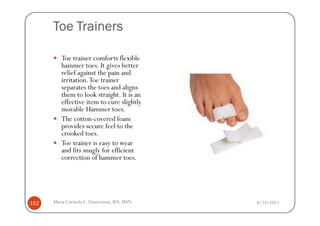
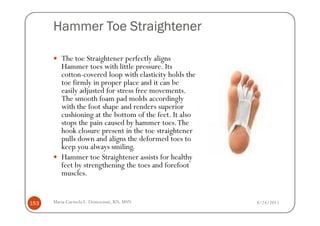
  • 105.
    Type Inheritanc Previous Major Diagnostic Criteria Minor Diagnostic Criteria e Nomenclature Classic Autosomal Types I and II Skin hyperextensibility, Smooth, velvety skin; easy bruising; dominant molluscoid pseudotumors; subcutaneous spheroids; joint hypermobility; muscle hypotonia; wide atrophic scars, joint postoperative complication hypermobility (eg, hernia); positive family history; manifestations of tissue fragility (eg, hernia, prolapse) Hypermobilit Autosomal Type III Skin involvement (soft, smooth and Recurrent joint dislocation; chronic y dominant velvety), joint hypermobility joint pain, limb pain, or both; positive family history Vascular Autosomal Type IV Thin, translucent skin; Acrogeria, dominant arterial/intestinal fragility or hypermobile small joints; rupture; extensive bruising; tendon/muscle rupture; clubfoot; characteristic facial appearance early onset varicose veins; arteriovenous, carotid-cavernous sinus fistula; pneumothorax; gingival recession; positive family history; sudden death in close relative 105 Maria Carmela L. Domocmat, RN, MSN 8/24/2011
  • 106.
    Down syndrome Down syndrome is by far the most common and best known chromosomal disorder in humans and the most common cause of intellectual disability.[3] Mental retardation, dysmorphic facial features, and other distinctive phenotypic traits characterize the syndrome 106 Maria Carmela L. Domocmat, RN, MSN 8/24/2011
  • 107.
    Disorders of foot: Morton’s neuroma (plantar neuroma 107 Maria Carmela L. Domocmat, RN, MSN 8/24/2011
  • 108.
    Neuromas are non-cancerous growths of the nerve tissue that develop in different parts of the body. 108 Maria Carmela L. Domocmat, RN, MSN 8/24/2011
  • 109.
    Mortons Neuroma affects a nerve in the foot, often times the nerve between the third and fourth toe. thickens the tissue around the nerves that lead to the toes, causing sharp, burning sensations in the ball of the foot, as well as a numbing or stinging feeling. AKA: plantar neuroma or intermetatarsal neuroma. 109 Maria Carmela L. Domocmat, RN, MSN 8/24/2011
  • 110.
    http://www.footdoc.ca/www.FootDoc.ca/Website _Neuroma.gif 110 Maria Carmela L. Domocmat, RN, MSN 8/24/2011
  • 111.
    111 Maria Carmela L. Domocmat, RN, MSN 8/24/2011
  • 112.
    Neuroma and adherentfibrofatty tissue. http://emedicine.medscape.com/article/308284-clinical#showall 112 Maria Carmela L. Domocmat, RN, MSN 8/24/2011
  • 113.
    Sex The female-to-male ratio for Morton's neuroma is 5:1. Age The highest prevalence of Morton's neuroma is found in patients aged 15-50 years, but the condition may occur in any ambulatory patient. http://emedicine.medscape.com/article/308284-clinical#showall 113 Maria Carmela L. Domocmat, RN, MSN 8/24/2011
  • 114.
    Causes Various factors have been implicated in the precipitation of Morton's neuroma. Morton's neuroma is known to develop as a result of chronic nerve stress and irritation, particularly with excessive toe dorsiflexion. Poorly fitting and constricting shoes (ie, small toe box) or shoes with heel lifts often contribute to Morton's neuroma. Women who wear high-heeled shoes for a number of years or men who are required to wear constrictive shoe gear are at risk. A biomechanical theory of causation involves the mechanics of the foot and ankle. For instance, individuals with tight gastrocnemius-soleus muscles or who excessively pronate the foot may compensate by dorsiflexion of the metatarsals subsequently irritating of the interdigital nerve. Certain activities carry increased risk of excessive toe dorsiflexion, such as prolonged walking, running, squatting, and demi-pointe position in ballet.[4] http://emedicine.medscape.com/article/308284-clinical#showall 114 Maria Carmela L. Domocmat, RN, MSN 8/24/2011
  • 115.
    Manifestations Obtaining an accurate history is important to making the diagnosis of Morton's neuroma. Possible reported findings provided by the patient with Morton's neuroma include the following: The most common presenting complaints include pain and dysesthesias in the forefoot and corresponding toes adjacent to the neuroma. Pain is described as sharp and burning, and it may be associated with cramping. Numbness often is observed in the toes adjacent to the neuroma and seems to occur along with episodes of pain. Pain typically is intermittent, as episodes often occur for minutes to hours at a time and have long intervals (ie, weeks to months) between a single or small group of multiple attacks. Some patients describe the sensation as "walking on a marble." Massage of the affected area offers significant relief. Narrow tight high-heeled shoes aggravate the symptoms. Night pain is reported but is rare. http://emedicine.medscape.com/article/308284-clinical#showall 115 Maria Carmela L. Domocmat, RN, MSN 8/24/2011
  • 116.
    Dx tests palpable mass or a "click" between the bones. Doctor put pressure on the spaces between the toe bones to try to replicate the pain and look for calluses or evidence of stress fractures in the bones that might be the cause of the pain. Range of motion tests will rule out arthritis or joint inflammations. X-rays may be required to rule out a stress fracture or arthritis of the joints that join the toes to the foot. http://emedicine.medscape.com/article/308284-clinical#showall 116 Maria Carmela L. Domocmat, RN, MSN 8/24/2011
  • 117.
    Treatment Rehabilitation Program Physical Therapy Treatment strategies for Morton's neuroma range from conservative to surgical management. The conservative approach to treating Morton's neuroma may benefit from the involvement of a physical therapist. The physical therapist can assist the physician in decisions regarding the modification of footwear, which is the first treatment step. Recommend soft-soled shoes with a wide toe box and low heel (eg, an athletic shoe). High-heeled, narrow, nonpadded shoes should not be worn, because they aggravate the condition. The next step in conservative management is to alter alignment of the metatarsal heads. One recommended action is to elevate the metatarsal head medial and adjacent to the neuroma, thereby preventing compression and irritation of the digital nerve. A plantar pad is used most often for elevation. Have the patient insert a felt or gel pad into the shoe to achieve the desired elevation of the above metatarsal head. Other possible physical therapy treatment ideas for patients with Morton's neuroma include cryotherapy, ultrasonography, deep tissue massage, and stretching exercises. Ice is beneficial to decrease the associated inflammation. Phonophoresis also can be used, rather than just ultrasonography, to further decrease pain and inflammation. http://emedicine.medscape.com/article/308284-clinical#showall 117 Maria Carmela L. Domocmat, RN, MSN 8/24/2011
  • 118.
    Treatment Initial therapies are nonsurgical and relatively simple. They can involve one or more of the following treatments: Changes in footwear. Avoid high heels or tight shoes, and wear wider shoes with lower heels and a soft sole. This enables the bones to spread out and may reduce pressure on the nerve, giving it time to heal. Orthoses. Custom shoe inserts and pads also help relieve irritation by lifting and separating the bones, reducing the pressure on the nerve. http://orthoinfo.aaos.org/topic.cfm?topic=a00158 118 Maria Carmela L. Domocmat, RN, MSN 8/24/2011
  • 119.
    Treatment Injection. One or more injections of a corticosteroid medication can reduce the swelling and inflammation of the nerve, bringing some relief. Combination Several studies have shown that a combination of roomier, more comfortable shoes, nonsteroidal anti- inflammatory medication, custom foot orthoses and cortisone injections provide relief in over 80 percent of people with Morton's Neuroma. http://orthoinfo.aaos.org/topic.cfm?topic=a00158 119 Maria Carmela L. Domocmat, RN, MSN 8/24/2011
  • 120.
    Surgical Intervention When conservative measures for Morton's neuroma are unsuccessful, surgical excision of the area of fibrosis in the common digital nerve may be curative. Common adverse outcomes include dysesthesias radiating from a painful nerve stump. Dysesthesias may be treated as any other dysesthetic pain. Surgical options include the following: Neurectomy with nerve burial Transverse intermetatarsal ligament release, with or without neurolysis Endoscopic decompression of the transverse metatarsal ligament http://emedicine.medscape.com/article/308284-clinical#showall 120 Maria Carmela L. Domocmat, RN, MSN 8/24/2011
  • 121.
    Other Treatment Perform injection into the dorsal aspect of the foot, 1-2 cm proximal to the webspace, in line with the MTP joints. Advance the needle through the midwebspace into the plantar aspect of the foot until the needle gently tents the skin. Then withdraw it about 1 cm to where the tip of the neuroma is located. Inject a corticosteroid/anesthetic mix. A reasonable volume is 1 mL of corticosteroid and 2 mL of anesthetic. T he anesthetic used should not contain epinephrine, as necrosis may result. Care also should be taken not to inject into the plantar pad. Adverse outcomes include plantar fat pad necrosis. Transient numbness of the toes also may occur. Although many practitioners use multiple injections, the likelihood of benefit from subsequent injections, after failure to achieve relief from the initial injection, is negligible. An Australian investigation using a single, ultrasonographically guided corticosteroid injection for Morton's neuroma found that 9 months after treatment, complete pain relief had occurred in 11 of the 39 neuromas studied. 121 Maria Carmela L. Domocmat, RN, MSN 8/24/2011
  • 122.
    Neurectomy: typical incisionlocation. Neurectomy: superficial exposure. 122 Maria Carmela L. Domocmat, RN, MSN Neurectomy: deeper dissection. Neuroma and adherent fibrofatty tissue. 8/24/2011 http://emedicine.medscape.com/article/308284-clinical#showall
  • 123.
    Medication Summary Dysesthesias may be treated as any other dysesthetic pain. Tricyclic antidepressants, such as amitriptyline at 10-25 mg PO qhs, may be tried. If this approach is unsuccessful, anticonvulsants (eg, gabapentin, carbamazepine) often are effective. 123 Maria Carmela L. Domocmat, RN, MSN 8/24/2011
  • 124.
    Tricyclic Antidepressants Class Summary A complex group of drugs that have central and peripheral anticholinergic effects, as well as sedative effects. They have central effects on pain transmission, and they block the active re-uptake of norepinephrine and serotonin. Amitriptyline (Elavil) Analgesic for certain chronic and neuropathic pain. Low doses, 10-25 mg qhs, may provide pain relief from burning and tingling occurring at rest but function only as an adjunct to definitive treatment. 124 Maria Carmela L. Domocmat, RN, MSN 8/24/2011
  • 125.
    Anticonvulsants Class Summary Use of certain antiepileptic drugs (AEDs), such as the GABA analogue Neurontin (gabapentin), has proven helpful in some cases of neuropathic pain. Thus, although unstudied, a trial of such an agent might conceivably provide analgesia for symptomatic neuropathy. Used for dysesthesias not controlled with definitive treatment plus tricyclic antidepressants (or in patients unable to take tricyclic antidepressants). Gabapentin (Neurontin) Neuromembrane stabilizer useful in pain reduction with dysesthetic pain. Has antineuralgic effects; however, exact mechanism of action is unknown. Structurally related to GABA, but does not interact with GABA receptors. 125 Maria Carmela L. Domocmat, RN, MSN 8/24/2011
  • 126.
    Anticonvulsants Pregabalin (Lyrica) Structural derivative of GABA. Mechanism of action unknown. Binds with high affinity to alpha2-delta site (a calcium channel subunit). In vitro, reduces calcium-dependent release of several neurotransmitters, possibly by modulating calcium channel function. FDA approved for neuropathic pain associated with diabetic peripheral neuropathy or postherpetic neuralgia and as adjunctive therapy in partial-onset seizures. 126 Maria Carmela L. Domocmat, RN, MSN 8/24/2011
  • 127.
    Serotonin- Serotonin-Norepinephrine Reuptake Inhibitors Class Summary These agents inhibit neuronal serotonin and norepinephrine reuptake. Duloxetine (Cymbalta) Description Indicated for diabetic peripheral neuropathic pain. Potent inhibitor of neuronal serotonin and norepinephrine reuptake 127 Maria Carmela L. Domocmat, RN, MSN 8/24/2011
  • 128.
    Disorders of foot: Hammer toe 128 Maria Carmela L. Domocmat, RN, MSN 8/24/2011
  • 129.
    Hammer toe is a deformity of the toe, in which the end of the toe is bent downward. 129 Maria Carmela L. Domocmat, RN, MSN 8/24/2011
  • 130.
    Causes, incidence, andrisk factors Hammer toe usually affects the second toe. However, it may also affect the other toes. The toe moves into a claw-like position. The most common cause of hammer toe is wearing short, narrow shoes that are too tight. The toe is forced into a bent position. Muscles and tendons in the toe tighten and become shorter. Hammer toe is more likely to occur in: Women who wear shoes that do not fit well or have high heels Children who keep wearing shoes they have outgrown The condition may be present at birth (congenital) or develop over time. In rare cases, all of the toes are affected. This may be caused by a problem with the nerves or spinal cord. 130 Maria Carmela L. Domocmat, RN, MSN 8/24/2011
  • 131.
    Symptoms The middle joint of the toe is bent. The end part of the toe bends down into a claw-like deformity. At first, you may be able to move and straighten the toe. Over time, you will no longer be able to move the toe. A corn often forms on the top of the toe. A callus is found on the sole of the foot. Walking or wearing shoes can be painful. 131 Maria Carmela L. Domocmat, RN, MSN 8/24/2011
  • 132.
    Dx tests physical examination of the foot decreased and painful movement in the toes. http://www.nlm.nih.gov/medlineplus/ency/images/ency/fullsize/9360.jpg 132 Maria Carmela L. Domocmat, RN, MSN 8/24/2011
  • 133.
    133 Maria Carmela L. Domocmat, RN, MSN 8/24/2011
  • 134.
  • 135.
    135 Maria Carmela L. Domocmat, RN, MSN 8/24/2011
  • 136.
    http://www.family- foot.com/images/hammer_toe_whatis.jpg 136 Maria Carmela L. Domocmat, RN, MSN 8/24/2011
  • 137.
    Treatment Mild hammer toe in children can be treated by manipulating and splinting the affected toe. 137 Maria Carmela L. Domocmat, RN, MSN 8/24/2011
  • 138.
    Treatment The following changes in footwear may help relieve symptoms: Wear the right size shoes or shoes with wide toe boxes for comfort, and to avoid making hammer toe worse. Avoid high heels as much as possible. Wear soft insoles to relieve pressure on the toe. Protect the joint that is sticking out with corn pads or felt pads 138 Maria Carmela L. Domocmat, RN, MSN 8/24/2011
  • 139.
    Treatment A foot doctor can make foot devices called hammer toe regulators or straighteners for you, or you can buy them at the store. Exercises may be helpful. You can try gentle stretching exercises if the toe is not already in a fixed position. Picking up a towel with your toes can help stretch and straighten the small muscles in the foot. 139 Maria Carmela L. Domocmat, RN, MSN 8/24/2011
  • 140.
    Treatment For severe hammer toe, you will need an operation to straighten the joint. The surgery often involves cutting or moving tendons and ligaments. Sometimes the bones on each side of the joint need to be connected (fussed) together. Most of the time, you will go home on the same day as the surgery. The toe may still be stiff afterward, and it may be shorter. 140 Maria Carmela L. Domocmat, RN, MSN 8/24/2011
  • 141.
    Prevention and Cureof Hammer Toes with Products Hammer Toe Regulator Toe Rings Hammer Toe Cushion Toe Brace Foam Toe Tubes Toe Alignment Splint Gel Toe Cap Toe Trainers Toe Spreader Hammer Toe Straightener Silicone Toe Crest Toe Spacer Cushion Digital Toe Pad Yoga Toes Toe Stretcher 141 Maria Carmela L. Domocmat, RN, MSN 8/24/2011
  • 142.
    142 Maria Carmela L. Domocmat, RN, MSN 8/24/2011
  • 143.
    Pedifix Budin HammerToe Regulator, Single Loop Hammer Toe Splint aligns crooked, overlapping or hammer toes. Effective post-op splint. Encourages flexion and extension of flexible digits. Soft, durable, cotton covered. One size fits all. Price: $3.40 143 Maria Carmela L. Domocmat, RN, MSN 8/24/2011
  • 144.
    144 Maria Carmela L. Domocmat, RN, MSN 8/24/2011 http://mdbuyinggroup.com/products/sites/default/files/productimages/pedifix%20budin%20hammer %20toe%20regulator.jpg
  • 145.
    Hammer Toe CorrectionBandage Price $14.95 145 Maria Carmela L. Domocmat, RN, MSN 8/24/2011
  • 146.
    Hammer Toe Regulator Toe regulator efficiently integrates the middle joint of toe with other joints. It reduces the pressure and irritation at toe tips and region over the toes. The toe regulator straightens the joint of hammer toes (or) claw toes with a slight and smooth pressure. Toe regulator is effective for pain relief and proper alignment of hammer toes. 146 Maria Carmela L. Domocmat, RN, MSN 8/24/2011
  • 147.
    Hammer Toe Cushion Hammer Toe Cushion provides ease feel over the contracted part and comforts Hammer toe with enough support. It assists for a stress free movement and aid in lifting the toe to normal position. Hammer toe cushion minimizes pressure at the top and tip of toes with a spongy effect. Toe cushion is provided with an adjustable toe loop for comfortable and secure fit. 147 Maria Carmela L. Domocmat, RN, MSN 8/24/2011
  • 148.
    Foam Toe Tubes The soft foam present in the tube safeguard toes from rash rubbing against footwear. Foam toe tube is easy to wear for getting effective pain relief from hammer toes. It reduce the pressure and swelling over Hammer toes for trouble free walks. 148 Maria Carmela L. Domocmat, RN, MSN 8/24/2011
  • 149.
    Gel Toe Cap Gel Toe Cap softens the Hammer toes giving excellent cushioning to the painful deformed toes. It also relieves extreme pain at the top and tip of toes effectively. Gel maintains the spongy comfort and reduces pressure all over the hammer toe. 149 Maria Carmela L. Domocmat, RN, MSN 8/24/2011
  • 150.
    Silicone Toe Crest The reinforced loop with elastic fabric of the toe crest holds the toe perfectly straight. The toe crest provides soft feel under three toes excluding the big and little toe. It relieves the pain caused by hammer toe. It adds strength to the toe and gives extra smoothness to the affected spot. Silicone soothes the toe for ease feel. Toe crest is durable and can be worn comfortably with a snug fit. 150 Maria Carmela L. Domocmat, RN, MSN 8/24/2011
  • 151.
    Toe Alignment Splint Toe alignment splint reduces the pressure and pain caused by Hammer toes and Bunions. It specifically aligns the toe placing it in correct position. The smooth cotton band with elastic property gives secure fit around the foot. Its thin straps can be placed over affected toes and the rigidity is adjustable using hook-and loop strap. Unique T-strap of the splint reduces the pain of bunion and prevents the big toe to slant over hammer toes (or) crooked toes. Toe alignment splint is comfortable to wear with casual shoes. 151 Maria Carmela L. Domocmat, RN, MSN 8/24/2011
  • 152.
    Toe Trainers Toe trainer comforts flexible hammer toes. It gives better relief against the pain and irritation. Toe trainer separates the toes and aligns them to look straight. It is an effective item to cure slightly movable Hammer toes. The cotton-covered foam provides secure feel to the crooked toes. Toe trainer is easy to wear and fits snugly for efficient correction of hammer toes. 152 Maria Carmela L. Domocmat, RN, MSN 8/24/2011
  • 153.
    Hammer Toe Straightener The toe Straightener perfectly aligns Hammer toes with little pressure. Its cotton-covered loop with elasticity holds the toe firmly in proper place and it can be easily adjusted for stress free movements. The smooth foam pad molds accordingly with the foot shape and renders superior cushioning at the bottom of the feet. It also stops the pain caused by hammer toes. The hook closure present in the toe straightener pulls down and aligns the deformed toes to keep you always smiling. Hammer toe Straightener assists for healthy feet by strengthening the toes and forefoot muscles. 153 Maria Carmela L. Domocmat, RN, MSN 8/24/2011
  • 154.
    Prevention Avoid wearing shoes that are too short or narrow. Check children's shoe sizes often, especially during periods of fast growth. 154 Maria Carmela L. Domocmat, RN, MSN 8/24/2011
  • 155.
    (prognosis) Expectations (prognosis) If the condition is treated early, you can often avoid surgery. Treatment will reduce pain and walking difficulty. 155 Maria Carmela L. Domocmat, RN, MSN 8/24/2011
  • 156.
    Complications Foot deformity Posture changes caused by difficulty in walking 156 Maria Carmela L. Domocmat, RN, MSN 8/24/2011
  • 157.
    References Krug RJ, Lee EH, Dugan S, Mashey K. Hammer toe. In: FronteraWR, Silver JK, Rizzo TD Jr., eds. Essentials of Physical Medicine and Rehabilitation. 2nd ed. Philadelphia, Pa: Saunders Elsevier;2008:chap 82. http://www.ncbi.nlm.nih.gov/pubmedhealth/PMH000221 5/ 157 Maria Carmela L. Domocmat, RN, MSN 8/24/2011
  • 158.
    Muscular disorders: Muscular dystrophy 158 Maria Carmela L. Domocmat, RN, MSN 8/24/2011
  • 159.
    The word "dystrophy"comes originally from the Greek "dys," which means "difficult" or "faulty," and "trophe," meaning "nourishment." This word was chosen many years ago because it was at first believed that poor nourishment of the muscles was in some way to blame for muscular dystrophy. Today we know that muscle wasting in the disorder is caused by defective genes rather than poor nutrition. http://www.humanillnesses.com/original/Men-Os/Muscular-Dystrophy.html 159 Maria Carmela L. Domocmat, RN, MSN 8/24/2011
  • 160.
    Muscular dystrophy(MD) refers to a group of more than 30 inherited diseases that cause muscle weakness and muscle loss. Some forms of MD appear in infancy or childhood, while others may not appear until middle age or later. The different muscular dystrophies vary in who they affect and the symptoms. All forms of MD grow worse as the person's muscles get weaker. Most people with MD eventually lose the ability to walk. http://www.nlm.nih.gov/medlineplus/musculardystrophy.html 160 Maria Carmela L. Domocmat, RN, MSN 8/24/2011
  • 161.
  • 162.
    Muscular Dystrophies (MD) characterized by progressive weakness and degeneration of the skeletal muscles that control movement. Some forms seen in infancy or childhood- others may not appear until middle age or later. differ in terms of the distribution and extent of muscle weakness (some forms of MD also affect cardiac muscle) age of onset rate of progression, and pattern of inheritance http://www.ninds.nih.gov/disorders/md/md.htm 162 Maria Carmela L. Domocmat, RN, MSN 8/24/2011
  • 163.
    Etiology are a group of inherited conditions It’s caused by incorrect or missing genetic information that prevents the body from making the proteins needed to build and maintain healthy muscles. Many cases of MD occur from spontaneous mutations that are not found in the genes of either parent, and this defect can be passed to the next generation. http://pathologyproject.wordpress.com/2011/04/24/muscular-dystrophy/ 163 Maria Carmela L. Domocmat, RN, MSN 8/24/2011
  • 164.
    Muscular dystrophy isa general term for a group of inherited diseases involving a defective gene. Each form of muscular dystrophy is caused by a genetic mutation that's particular to that type of the disease. The most common types of muscular dystrophy appear to be due to a genetic deficiency of the muscle protein dystrophin http://www.mayoclinic.com/health/muscular- dystrophy/DS00200/DSECTION=symptoms 164 Maria Carmela L. Domocmat, RN, MSN 8/24/2011
  • 165.
    Inheriting Duchenne's orBecker's MD Duchenne's and Becker's muscular dystrophies - passed from mother to son through one of the mother's genes in a pattern called X-linked recessive inheritance. Boys inherit an X chromosome from their mothers and a Y chromosome from their fathers. The X-Y combination makes them male. Girls inherit two X chromosomes, one from their mothers and one from their fathers. The X-X combination determines that they are female. The defective gene that causes Duchenne's and Becker's muscular dystrophies is located on the X-chromosome. Women who have only one X-chromosome with the defective gene that causes these muscular dystrophies are carriers and sometimes develop heart muscle problems (cardiomyopathy) and mild muscle weakness. The disease can skip a generation until another son inherits the defective gene on the X- chromosome. In some cases of Duchenne's and Becker's muscular dystrophies, the disease arises from a new mutation in a gene rather than from an inherited defective gene. http://www.mayoclinic.com/health/muscular- dystrophy/DS00200/DSECTION=symptoms 165 Maria Carmela L. Domocmat, RN, MSN 8/24/2011
  • 166.
    X-linked recessive inheritancepattern with carrier mother Women can pass down X-linked recessive disorders such as Duchenne's muscular dystrophy. A woman who is a carrier of an X-linked recessive disorder has a 25 percent chance of having an unaffected son, a 25 percent chance of having an affected son, a 25 percent chance of having an unaffected daughter and a 25 percent chance of having a daughter who also is a carrier. http://www.mayoclinic.com/health/medical/IM02723 166 Maria Carmela L. Domocmat, RN, MSN 8/24/2011
  • 167.
    Patterns differ forother types of MD Myotonic dystrophy and most MFMs -passed along in a pattern called autosomal dominant inheritance. If either parent carries the defective gene for myotonic dystrophy, there's a 50 percent chance the disorder will be passed along to a child. Some of the less common types of muscular dystrophy are passed along in the same inheritance pattern that marks Duchenne's and Becker's muscular dystrophies. Other types of muscular dystrophy can be passed on from generation to generation and affect males and females equally. Still others require a defective gene from both parents. http://www.mayoclinic.com/health/muscular- dystrophy/DS00200/DSECTION=symptoms 167 Maria Carmela L. Domocmat, RN, MSN 8/24/2011
  • 168.
    In an autosomaldominant disorder, the mutated gene is a dominant gene located on one of the nonsex chromosomes (autosomes).You need only one mutated gene to be affected by this type of disorder. A person with an autosomal dominant disorder — in this case, the father — has a 50 percent chance of having an affected child with one mutated gene (dominant gene) and a 50 percent chance of having an unaffected child with two normal genes (recessive genes). http://www.mayoclinic.com/health/medical/IM00991 168 Maria Carmela L. Domocmat, RN, MSN 8/24/2011
  • 169.
    Duchenne MD most common form of MD primarily affects boys. caused by the absence of dystrophin, aprotein involved in mai ntaining the integrity of muscle. Onset is between 3 and 5 years Progresses rapidly. Most boys are unable to walk by age 12, and later need a respira tor to breathe. Girls in these families have a 50percent chance of inheriting and passing the defective gene to their children. http://www.ninds.nih.gov/disorders/md/md.htm 169 Maria Carmela L. Domocmat, RN, MSN 8/24/2011
  • 170.
    Duchenne muscular dystrophy(DMD) a group of genetic disorders that affect the use of muscles in the body. inherited as an X-linked disorder. This is why Duchenne MD primarily affects boys. Girls can inherit the gene for DMD but not have any symptoms of the disease. affects approximately 1 in every 3,500 live male births. There are thousands of new cases every year. affects children of all ethnic backgrounds. causes an absence of dystrophin, a protein that helps keep muscle cells intact. This means that muscle cells are easily damaged and become weak over time. http://www.checkorphan.org/grid/iwishes/duchenne-muscular-dystrophy 170 Maria Carmela L. Domocmat, RN, MSN 8/24/2011
  • 171.
  • 172.
    Duchenne muscular dystrophy http://trialx.com/curetalk/wp- content/blogs.dir/7/files/2011/05/diseases/Muscular_Dystrophy_Duchenne-3.jpg 172 Maria Carmela L. Domocmat, RN, MSN 8/24/2011
  • 173.
    Becker Muscular Dystrophy similar to Duchenne but the symptoms are milder and can appear till 25 years of age. Boys with Becker MD have faulty or not enough dystrophi Usually the affected people can live and enjoy life and are also able to walk but they have some heart problems and is present only in males. http://healthmedcare.com/muscular-dystrophy-types-symptoms-of-each-form/ http://www.ninds.nih.gov/disorders/md/md.htm 173 Maria Carmela L. Domocmat, RN, MSN 8/24/2011
  • 174.
    Facioscapulohumeral MD usually begins in the teenage years. causes progressive weakness in muscles of the face, arms, legs, and around the shoulders and chest. affects both males and females progresses slowly and can vary in symptoms from mild to disabling. about half of the sufferers are able to walk throughout their life and almost all the patients live a normal life span. http://healthmedcare.com/muscular-dystrophy-types-symptoms-of-each-form/ http://www.ninds.nih.gov/disorders/md/md.htm 174 Maria Carmela L. Domocmat, RN, MSN 8/24/2011
  • 175.
    Facioscapulohumeral muscular dystrophy Also known as Landouzy-Dejerine dystrophy involves progressive muscle weakness involving: Face Shoulders Abdomen Feet Upper arms Pelvic area Lower arms http://www.mayoclinic.com/health/muscular- dystrophy/DS00200/DSECTION=symptoms 175 Maria Carmela L. Domocmat, RN, MSN 8/24/2011
  • 176.
    When someone withfacioscapulohumeral MD raises his or her arms, the shoulder blades may stick out like wings. Progression of this form is slow, with some spurts of rapidly increasing weakness. Onset usually occurs during the teen to early adult years. http://www.mayoclinic.com/health/muscular- dystrophy/DS00200/DSECTION=symptoms 176 Maria Carmela L. Domocmat, RN, MSN 8/24/2011
  • 177.
    Myotonic MD Aka: Steinert’s disease the disorder's most common adult form produces stiffness of muscles and an inability to relax muscles at will (myotonia), as well as the muscle weakness of the other forms of muscular dystrophy. typified by prolonged muscle spasms, cataracts, cardiac abnormalities, and endocrine disturbances. Individuals with myotonic MD have long, thin faces drooping eyelids a swan-like neck http://www.mayoclinic.com/health/muscular- dystrophy/DS00200/DSECTION=symptoms 177 Maria Carmela L. Domocmat, RN, MSN http://www.ninds.nih.gov/disorders/md/md.htm 8/24/2011
  • 178.
    Myotonic MD Cause A repeated section of DNA on either chromosome 19 or chromosome 3. Onset Congenital form appears at birth. More common form may begin in teen or adult years. http://www.mda.org/disease/dm.html 178 Maria Carmela L. Domocmat, RN, MSN 8/24/2011
  • 179.
    http://www.websters-online- dictionary.org/images/wiki/wikipedia/commons/thumb/e/e1/Autodominant.jpg/180px-Autodominant.jpg http://www.websters-online- 179 Maria Carmela L. Domocmat, RN, MSN dictionary.org/images/wiki/wikipedia/commons/thumb/e/e1/Autodominant.jpg/180px-Autodominant.jpg 8/24/2011
  • 180.
    Myotonic MD Symptoms Generalized weakness and muscle wasting first affecting the face, lower legs, forearms, hands and neck, with delayed relaxation of muscles after contraction common. Other symptoms involve the gastrointestinal system, vision, heart or respiration. Learning disabilities occur in some cases. Congenital myotonic dystrophy is the more severe form. Men with myotonic muscular dystrophy have baldness on their foreheads. http://www.mda.org/disease/dm.html 180 Maria Carmela L. Domocmat, RN, MSN 8/24/2011
  • 181.
    Myotonic MD Progression Progression is slow, sometimes spanning 50 to 60 years. Inheritance Autosomal dominant; the disease may be inherited through either the father or the mother. http://www.mda.org/disease/dm.html 181 Maria Carmela L. Domocmat, RN, MSN 8/24/2011
  • 182.
    Myotonic MD 182 Maria Carmela L. Domocmat, RN, MSN 8/24/2011 http://blog.thirdeyehealth.com/images/muscular-dystrophy-1.jpg
  • 183.
    Other major typesof muscular dystrophy The other major types of muscular dystrophy include: Limb-girdle muscular dystrophy Congenital muscular dystrophy Oculopharyngeal muscular dystrophy Distal muscular dystrophy Emery-Dreifuss muscular dystrophy Myofibrillar myopathies http://www.mayoclinic.com/health/muscular- dystrophy/DS00200/DSECTION=symptoms 183 Maria Carmela L. Domocmat, RN, MSN 8/24/2011
  • 184.
    Limb- Limb-Girdle the type which affects from teenage years to adulthood is present in both males and females. As the name indicates, in this type the problem starts from hip (pelvic girdle) region and then reaches to the shoulders ( pectoral girdle ) and later legs and arms are also affected, sufferers are unable to walk and most patients live past mid adulthood. http://healthmedcare.com/muscular-dystrophy-types-symptoms-of-each-form/ 184 Maria Carmela L. Domocmat, RN, MSN 8/24/2011
  • 185.
    Congenital Muscular Dystrophy the form which is present at the time of birth rare cause the loss of muscles The term "congenital muscular dystrophy" refers to a group of inherited muscular dystrophies. Signs of these disorders may include: General muscle weakness Joint deformities http://www.mayoclinic.com/health/muscular- dystrophy/DS00200/DSECTION=symptoms http://healthmedcare.com/muscular-dystrophy-types-symptoms-of-each-form/ 185 Maria Carmela L. Domocmat, RN, MSN 8/24/2011
  • 186.
    Congenital Muscular Dystrophy is apparent at birth or becomes evident before age 2. The course of this disorder varies significantly depending on the type. Some forms of congenital MD progress slowly and cause only mild disability, while others progress rapidly and cause severe impairment. http://www.mayoclinic.com/health/muscular- dystrophy/DS00200/DSECTION=symptoms 186 Maria Carmela L. Domocmat, RN, MSN 8/24/2011
  • 187.
    Congenital myotonic dystrophy Signs in infants may include: Severe muscle weakness Difficulty sucking and swallowing Difficulty breathing Cognitive impairment http://www.mayoclinic.com/health/muscular- dystrophy/DS00200/DSECTION=symptoms 187 Maria Carmela L. Domocmat, RN, MSN 8/24/2011
  • 188.
    Oculophyrangeal Muscular Dystrophy affects primarily the muscles of eyes and throat which occur around 40s to onward ages symptoms include the weakness of eyes and facial muscles which could later cause dysphagia - predisposes the patients to pneumonia and choking. http://healthmedcare.com/muscular-dystrophy-types-symptoms-of-each-form/ 188 Maria Carmela L. Domocmat, RN, MSN 8/24/2011
  • 189.
    Oculopharyngeal muscular dystrophy The first sign of this type of muscular dystrophy is usually drooping of the eyelids followed by weakness of the muscles of the eye, face and throat, resulting in difficulty swallowing. Progression is slow. Signs and symptoms first appear in adulthood, usually in a person's 40s or 50s. http://www.mayoclinic.com/health/muscular- dystrophy/DS00200/DSECTION=symptoms 189 Maria Carmela L. Domocmat, RN, MSN 8/24/2011
  • 190.
    Distal MD very rare mildest affects the muscles of fore arms to hands and muscles of lower legs to feet very slowly progressing not very severe http://healthmedcare.com/muscular-dystrophy-types-symptoms-of-each-form/ 190 Maria Carmela L. Domocmat, RN, MSN 8/24/2011
  • 191.
    Distal muscular dystrophy This group involves the muscles farthest away from the center of the body (distal muscles) — those of the hands, forearms, feet and lower legs. The severity is generally less than for other forms of MD, and this form tends to progress slowly. Distal MD generally begins in adulthood between the ages of 40 and 60. http://www.mayoclinic.com/health/muscular- dystrophy/DS00200/DSECTION=symptoms 191 Maria Carmela L. Domocmat, RN, MSN 8/24/2011
  • 192.
    Emery- Emery-Dreifuss the type which affects from childhood to teen years present only in the males affects the muscles of pectoral region to upper arms and lower parts of legs and along with that patients have extreme heart problems that are usually fatal. This is the type which also affects the carriers (females) but the symptoms are not very severe. http://healthmedcare.com/muscular-dystrophy-types-symptoms-of-each-form/ 192 Maria Carmela L. Domocmat, RN, MSN 8/24/2011
  • 193.
    Emery- Emery-Dreifuss muscular dystrophy This form of muscular dystrophy usually begins in the muscles of the: Shoulders Upper arms Shins Cardiac arrhythmias, stiffness of the spine and muscle contractures are other features of Emery-Dreifuss MD. Emery-Dreifuss MD usually begins in the childhood to early teen years and progresses slowly. http://www.mayoclinic.com/health/muscular- dystrophy/DS00200/DSECTION=symptoms 193 Maria Carmela L. Domocmat, RN, MSN 8/24/2011
  • 194.
    Myofibrillar myopathies(MFMs) (MFMs) Though in some cases the MFMs affect only the muscles closest to the center of the body (proximal muscles) — such as the shoulder and hip muscles — the distal muscles also are usually involved. This group of muscle disorders also is commonly associated with: Stiffness of the spine Muscle contractures Nerve damage (peripheral neuropathy) Thickening and stiffening of the heart muscle (cardiomyopathy) http://www.mayoclinic.com/health/muscular- dystrophy/DS00200/DSECTION=symptoms 194 Maria Carmela L. Domocmat, RN, MSN 8/24/2011
  • 195.
    http://healthmedcare.com/muscular-dystrophy-types-symptoms-of-each-form/ Maria Carmela L. Domocmat, RN, MSN 195 8/24/2011
  • 196.
    Clinical manifestations Progressive muscular weakness Delayed meeting of motor milestones Waddling gait Walking on toes Frequent falls Gower’s sign Hyperthrophied calf muscles Poor balance Scoliosis of the spine Fracture of long bones Inability to walk (late stages) 196 Maria Carmela L. Domocmat, RN, MSN 8/24/2011
  • 197.
    Waddling gait, adistinctive ducklike walk, is an important sign of muscular dystrophy, spinal muscle atrophy or, rarely, congenital hip displacement. The gait results from deterioration of the pelvic girdle muscles—primarily the gluteus medius, hip flexors, and hip extensors. Weakness in these muscles hinders stabilization of the weight-bearing hip during walking, causing the opposite hip to drop and the trunk to lean toward that side in an attempt to maintain balance. ( http://www.wrongdiagnosis.com/bookimages/8/2591.1.png 197 Maria Carmela L. Domocmat, RN, MSN 8/24/2011
  • 198.
    Typically, the legsassume a wide stance and the trunk is thrown back to further improve stability, exaggerating lordosis and abdominal protrusion. In severe cases, leg and foot muscle contractures may cause equinovarus deformity of the foot combined with circumduction or bowing of the legs. http://www.wrongdiagnosis.com/bookimages/8/2591.1.png 198 Maria Carmela L. Domocmat, RN, MSN 8/24/2011
  • 199.
    With Duchenne's musculardystrophy, waddling gait becomes clinically evident between ages 3 and 5. The gait worsens as the disease progresses, until the child loses the ability to walk and requires the use of a wheelchair, usually between ages 10 and 12. Early signs are usually subtle: a delay in learning to walk, frequent falls, gait or posture abnormalities, and intermittent calf pain With Becker's muscular dystrophy, waddling gait typically becomes apparent in late adolescence, slowly worsens during the third decade, and culminates in total loss of ambulation. Muscle weakness first appears in the pelvic and upper arm muscles. Progressive wasting with selected muscle hypertrophy produces lordosis with abdominal protrusion, poor balance, a positive Gowers'sign and, possibly, mental retardation. http://www.wrongdiagnosis.com/symptoms/walking_symptoms/book-causes-16g.htm 199 Maria Carmela L. Domocmat, RN, MSN 8/24/2011
  • 200.
    With facioscapulohumeral musculardystrophy, which usually occurs late in childhood and during adolescence, waddling gait appears after muscle wasting has spread downward from the face and shoulder girdle to the pelvic girdle and legs. Earlier effects include progressive weakness and atrophy of facial, shoulder, and arm muscles; slight lordosis; and pelvic instability. http://www.wrongdiagnosis.com/symptoms/walking_symptoms/book-causes-16g.htm 200 Maria Carmela L. Domocmat, RN, MSN 8/24/2011
  • 201.
    Gower’s sign to stand, affected children press their hands against their ankles, knees and thighs 201 Maria Carmela L. Domocmat, RN, MSN 8/24/2011
  • 202.
    202 Maria Carmela L. Domocmat, RN, MSN 8/24/2011
  • 203.
    Incidence and Mortality Morbidity and mortality rates depend on the type of congenital muscular dystrophy. Its incidence varies, as some forms are more common than others. Duchenne muscular dystrophy affects one in 3300 live male births. Myotonic muscular dystrophy is the most frequent form of muscular dystrophy among adults. Its prevalence is estimated at one case for every 10,000 people in most countries. However, this frequency is 20 times higher in the Charlevoix and Saguenay-Lac- St-Jean regions, where one person out of 500 is estimated to carry the disease. http://pathologyproject.wordpress.com/2011/04/24/muscular-dystrophy/ 203 Maria Carmela L. Domocmat, RN, MSN 8/24/2011
  • 204.
    Diagnostic tests A careful review of your family's history of muscle disease can help your doctor reach a diagnosis. In addition to a medical history review and physical examination, your doctor may rely on the following in diagnosing muscular dystrophy: Blood tests. Damaged muscles release enzymes, such as creatine kinase (CK), into your blood. High blood levels of CK suggest a muscle disease, such as muscular dystrophy. Electromyography. A thin-needle electrode is inserted through your skin into the muscle to be tested. Electrical activity is measured as you relax and as you gently tighten the muscle. Changes in the pattern of electrical activity can confirm a muscle disease. The distribution of the disease can be determined by testing different muscles. Ultrasonography. High-frequency sound waves are used to produce precise images of tissues and structures within your body. An ultrasound is a noninvasive way of detecting certain muscle abnormalities, even in the early stages of the disease. Muscle biopsy. A small piece of muscle is taken for laboratory analysis. The analysis distinguishes muscular dystrophies from other muscle diseases. Special tests can identify dystrophin and other markers associated with specific forms of muscular dystrophy. Genetic testing. Blood samples are examined for mutations in some of the genes that cause different types of muscular dystrophy. For Duchenne's and Becker's muscular dystrophies, standard tests examine just the portions of the dystrophin gene responsible for most cases of these types of MD. These tests identify deletions or duplications on the dystrophin gene in more than two-thirds of people with Duchenne's and Becker's MDs. The genetic defects responsible for Duchenne's and Becker's muscular dystrophies are harder to identify in other cases of those affected, but new tests that examine the entire dystrophin gene are making it possible to pinpoint tiny, less common mutations. http://www.mayoclinic.com/health/muscular-dystrophy/DS00200/DSECTION=treatments-and-drugs 204 Maria Carmela L. Domocmat, RN, MSN 8/24/2011
  • 205.
    Treatment There is no cure for muscular dystrophy. Treatments include Physical and speech therapy Orthopedic devices Surgery Medications Some people with muscular dystrophy have mild cases that worsen slowly. Other cases are disabling and severe. http://www.nlm.nih.gov/medlineplus/musculardystrophy.html 205 Maria Carmela L. Domocmat, RN, MSN 8/24/2011
  • 206.
    There's currently nocure for any form of muscular dystrophy. Research into gene therapy may eventually provide treatment to stop the progression of some types of muscular dystrophy. Current treatment is designed to help prevent or reduce deformities in the joints and the spine and to allow people with MD to remain mobile as long as possible. Treatments may include various types of physical therapy, medications, assistive devices and surgery. Physical therapy As muscular dystrophy progresses and muscles weaken, fixations (contractures) can develop in joints. Tendons can shorten, restricting the flexibility and mobility of joints. Contractures are uncomfortable and may affect the joints of your hands, feet, elbows, knees and hips. One goal of physical therapy is to provide regular range-of-motion exercises to keep your joints as flexible as possible, delaying the progression of contractures, and reducing or delaying curvature of your spine. Using hot baths (hydrotherapy) also can help maintain range of motion in joints. Medications In some cases, doctors may prescribe medications to slow the progression and manage signs and symptoms of muscular dystrophy: Muscle spasms, stiffness and weakness (myotonia).Medications that may be used to help manage myotonia associated with MD include mexiletine (Mexitil), phenytoin (Dilantin, Phenytek), baclofen (Lioresal), dantrolene (Dantrium) and carbamazepine (Tegretol, Carbatrol). Muscle deterioration. The anti-inflammatory corticosteroid medication prednisone may help improve muscle strength and delay the progression of Duchenne's MD. The immunosuppressive drugs cyclosporin and azathioprine also are sometimes prescribed to delay some damage to dying muscle cells. Assistive devices Braces can both provide support for weakened muscles of your hands and lower legs and help keep muscles and tendons stretched and flexible, slowing the progression of contractures. Other devices, such as canes, walkers and wheelchairs, can help maintain mobility and independence. If respiratory muscles become weakened, using a ventilator may become necessary. Surgery To release the contractures that may develop and that can position joints in painful ways, doctors can perform a tendon release surgery. This may be done to relieve tendons of your hip and knee and on the Achilles tendon at the back of your foot. Surgery may also be needed to correct curvature of the spine. Other treatments Because respiratory infections may become a problem in later stages of muscular dystrophy, it's important to be vaccinated for pneumonia and to keep up to date with influenza shots. http://www.mayoclinic.com/health/muscular-dystrophy/DS00200/DSECTION=treatments-and-drugs 206 Maria Carmela L. Domocmat, RN, MSN 8/24/2011
  • 207.
    Nursing considerations ▪ Perform passive and active muscle-stretching exercises to the arms and legs. ▪ Encourage the patient to walk at least 3 hours each day (with leg braces, if necessary) to maintain muscle strength, reduce contractures, and delay further gait deterioration, if possible. ▪ Stay near the patient during ambulation, to provide support if necessary. ▪ Provide a balanced diet to maintain energy levels and prevent obesity. ▪ Because of the grim prognosis associated with muscular dystrophy and spinal muscle atrophy, provide emotional support for the patient and his family. http://www.wrongdiagnosis.com/symptoms/walking_symptoms/book-causes-16g.htm 207 Maria Carmela L. Domocmat, RN, MSN 8/24/2011
  • 208.
    Patient teaching ▪ Caution the patient about long, unbroken periods of bed rest, which accelerate muscle deterioration. ▪ Refer the patient to a local Muscular Dystrophy Association chapter, as indicated. ▪ Suggest genetic counseling for parents, if they're considering having more children. http://www.wrongdiagnosis.com/symptoms/walking_symptoms/book-causes-16g.htm 208 Maria Carmela L. Domocmat, RN, MSN 8/24/2011
  • 209.
    On the cover:Andy Vladimir, of Coconut Grove, Fla., had MMD and used a wheelchair, but that barely slowed him down. A successful businessman, textbook author, world traveler and travel writer, including for MDA's Quest magazine, Andy lived to age 76. 209 Maria Carmela L. Domocmat, RN, MSN 8/24/2011
  • 210.
    References http://www.mdausa.org/ http://www.mayoclinic.com/health/muscular- dystrophy/DS00200/DSECTION=treatments-and-drugs 210 Maria Carmela L. Domocmat, RN, MSN 8/24/2011
  • 211.
    211 Maria Carmela L. Domocmat, RN, MSN 8/24/2011
  • 212.
    Muscular disorders: Rhabdomyolysis 212 Maria Carmela L. Domocmat, RN, MSN 8/24/2011
  • 213.
    Rhabdomyolysis a condition that may occur when muscle tissue is damaged due to an injury in which muscle in the body is damaged rhabdomyo=skeletal muscle + lysis= rapid breakdown There are a three of types of muscle in the body, including: skeletal muscles that move the body; cardiac muscle located in the heart; and smooth muscle that lines blood vessels, gastrointestinal tract, bronchi in the lung, and the bladder and uterus. This type of muscle is not under conscious control. Rhabdomyolysis occurs when there is damage to the skeletal muscle. http://www.emedicinehealth.com/rhabdomyolysis/page2_em.htm 213 Maria Carmela L. Domocmat, RN, MSN 8/24/2011
  • 214.
    Rhabdomyolysis is the breakdown of muscle fibers with leakage of potentially toxic cellular contents into the systemic circulation. The final common pathway of rhabdomyolysis may be a disturbance in myocyte calcium homeostasis 214 Maria Carmela L. Domocmat, RN, MSN 8/24/2011
  • 215.
    Rhabdomyolysis The injured muscle cell leaks myoglobin (a protein) into the blood stream. Myoglobin can be directly toxic to kidney cells, and it can impair and clog the filtration system of the kidney. Both mechanisms can lead to kidney failure (the major complication of rhabdomyolysis). Significant muscle injury can cause fluid and electrolyte shifts from the bloodstream into the damaged muscle cells, and in the other direction (from the damaged muscle cells into the bloodstream). As a result, dehydration may occur. Elevated levels of potassium in the bloodstream (hyperkalemia) may be associated with heart rhythm disturbances and sudden cardiac death due to ventricular tachycardia and ventricular fibrillation. 215 http://www.emedicinehealth.com/rhabdomyolysis/page2_em.htm Maria Carmela L. Domocmat, RN, MSN 8/24/2011
  • 216.
    When muscles aredamaged, especially due to a crush injury, swelling within the muscle can occur, causing compartment syndrome. If this occurs in an area where the muscle is bound by fascia (a tough fibrous tissue membrane), the pressure inside the muscle compartment can increase to the point at which blood supply to the muscle is compromised and muscle cells begin to die. Rhabdomyolysis was first appreciated as a significant complication from crush and blast injuries sustained in a volcano eruption in Italy, in 1908. Victims of the blast injuries during the first and second World Wars help further understand the relationship between massive muscle damage and kidney failure. 216 Medscpae Carmela L. Domocmat, RN, MSN Maria 8/24/2011
  • 217.
    Incidence United States Rhabdomyolysis accounts for an estimated 8-15% of cases of acute renal failure. 217 Maria Carmela L. Domocmat, RN, MSN 8/24/2011
  • 218.
    Causes When muscle is damaged myoglobin (protein pigment) - released into the bloodstream and filtered out of the body by the kidneys. Myoglobin breaks down into potentially harmful compounds. It may block the structures of the kidney, causing damage such as acute tubular necrosis or kidney failure. Dead muscle tissue may cause a large amount of fluid to move from the blood into the muscle, reducing the fluid volume of the body and leading to shock and reduced blood flow to the kidneys. The disorder may be caused by any condition that results in damage to skeletal muscle, especially trauma. 218 Maria Carmela L. Domocmat, RN, MSN 8/24/2011
  • 219.
    Causes The etiologies may be subdivided into Traumatic exercise induced toxicologic Environmental Metabolic Infectious Immunologic inherited classifications. http://emedicine.medscape.com/article/827738-clinical#showall 219 Maria Carmela L. Domocmat, RN, MSN 8/24/2011
  • 220.
    Causes Major blunt trauma and crush injury Electrocution Lightening strikes Major burns Excessive exercise, for example, running a marathon or excessive weight lifting Patients in status epilepticus, in which the seizure lasts for a prolonged period of time and muscles involuntarily contract http://www.emedicinehealth.com/rhabdomyolysis/page3_em.htm 220 Maria Carmela L. Domocmat, RN, MSN 8/24/2011
  • 221.
    Causes Prolonged immobilization (for example, patients who have been lying in one position for a prolonged period of time due to a debilitating stroke, alcohol or drug overdose, or those who have remained unconscious for a prolonged period of time for other reasons). The weight of the body is enough to crush the muscles that are pushed up against a hard surface such as the floor. http://www.emedicinehealth.com/rhabdomyolysis/page3_em.htm 221 Maria Carmela L. Domocmat, RN, MSN 8/24/2011
  • 222.
    Causes Dystonic reactions cause muscles to spasm, and if left untreated can damage muscle Cholesterol lowering medications [for example, statins prescribed to treat high cholesterol (particularly when combined with other cholesterol lowering medications such as fibrates) Antidepressant medications [for example selective serotonin reuptake inhibitors (SSRIs) antidepressants may cause a serotonin syndrome characterized by agitation, fever, and muscle spasm] http://www.emedicinehealth.com/rhabdomyolysis/page3_em.htm 222 Maria Carmela L. Domocmat, RN, MSN 8/24/2011
  • 223.
    Causes Some anesthetics can cause malignant hyperthermia syndrome with high fever and muscle rigidity A variety of drugs of abuse [for example, cocaine, heroin, phencyclidine (PCP), and amphetamines] Hyperthermia and hypothermia (high and low body temperature, respectively) Complications from a variety of infections caused by bacteria, viruses, and fungi Association with other diseases such as sickle cell disease, polymyositis, and dermatomyositis Complications from the venom from snake bites and black widow spider bites http://www.emedicinehealth.com/rhabdomyolysis/page3_em.htm 223 Maria Carmela L. Domocmat, RN, MSN 8/24/2011
  • 224.
    Risk factors Alcoholism (with subsequent muscle tremors) Certain inherited or genetic syndromes Crush Injuries Heat intolerance Heatstroke Ischemia or necrosis of the muscles (as may occur with arterial occlusion, deep venous thrombosis, or other conditions) Low phosphate levels Seizures Severe exertion such as marathon running or calisthenics Shaking chills Trauma Use or overdose of drugs, especially cocaine, amphetamines, statins, heroin, or PCP 224 Maria Carmela L. Domocmat, RN, MSN 8/24/2011
  • 225.
    Risk factors Melli et al reviewed 475 patients with rhabdomyolysis hospitalized at Johns Hopkins Hospital and found that the most common risk factors were exogenous toxins, with illicit drugs, alcohol, and prescription medications responsible in 46% of patients. http://emedicine.medscape.com/article/827738-clinical#showall 225 Maria Carmela L. Domocmat, RN, MSN 8/24/2011
  • 226.
    Symptoms Abnormal urine color (dark, red, or cola colored) General weakness Muscle stiffness or aching (myalgia) Muscle tenderness Weakness of the affected muscles 226 Maria Carmela L. Domocmat, RN, MSN 8/24/2011
  • 227.
    Symptoms Additional symptoms that may be associated with this disease include the following: Fatigue Joint pain Seizures Weight gain (unintentional) 227 Maria Carmela L. Domocmat, RN, MSN 8/24/2011
  • 228.
    Diagnostic Exams An examination reveals tender or damaged skeletal muscles. CPK is very high. Serum myoglobin test is positive. Serum potassium may be very high Urinalysis may reveal casts and be positive for hemoglobin without evidence of red blood cells on microscopic examination. Urine myoglobin test is positive. This disease may also alter the results of the following tests: CPK isoenzymes Urine creatinine Serum creatinine 228 Maria Carmela L. Domocmat, RN, MSN 8/24/2011
  • 229.
    Prehospital Care Vigorous hydration with isotonic crystalloid the cornerstone of therapy for rhabdomyolysis. Support of the intravascular volume increases the glomerular filtration rate (GFR) and oxygen delivery and dilutes myoglobin and other renal tubular toxins. Immediately obtain intravenous access with a large-bore catheter. Administer isotonic crystalloid 500 mL/h and then titrate to maintain a urine output of 200-300 mL/h. Because injured myocytes can sequester large volumes of extracellular fluid, crystalloid requirements may be surprisingly large. http://emedicine.medscape.com/article/827738-clinical#showall 229 Maria Carmela L. Domocmat, RN, MSN 8/24/2011
  • 230.
    Emergency Department Care Assess ABCs and support as needed. Treat any underlying conditions, such as trauma, infection, or toxins. General recommendations for the treatment of rhabdomyolysis include fluid resuscitation prevention of end-organ complications http://emedicine.medscape.com/article/827738-clinical#showall 230 Maria Carmela L. Domocmat, RN, MSN 8/24/2011
  • 231.
    Emergency Department Care Patients with CK elevation in excess of 2-3 times the reference range, appropriate clinical history, and risk factors should be suspected of having rhabdomyolysis. Administer isotonic crystalloid 500 mL/h and titrate to maintain a urine output of 200-300 mL/h. Consider central venous pressures or Swan-Ganz catheterization in patients with cardiac or renal disease. These invasive studies can assist in the assessment of the intravascular volume. Repeat CK assay every 6-12 hours in order to determine peak CK level. http://emedicine.medscape.com/article/827738-clinical#showall 231 Maria Carmela L. Domocmat, RN, MSN 8/24/2011
  • 232.
    Emergency Department Care Acute renal failure develops in 30-40% of patients with rhabdomyolysis. Suggested mechanisms include precipitation of myoglobin and uric acid crystals within renal tubules, decreased glomerular perfusion, and the nephrotoxic effect of ferrihemate (formed upon dissociation of myoglobin in the acidic environment of the renal parenchyma). I To prevent renal failure, many authorities advocate urine alkalinization, mannitol, and loop diuretics. http://emedicine.medscape.com/article/827738-clinical#showall Maria Carmela L. Domocmat, RN, MSN 8/24/2011 232
  • 233.
    Urinary alkalinization recommended for patients with rhabdomyolysis and CK levels in excess of 6000 IU/L. should be considered earlier in patients with acidemia, dehydration, or underlying renal disease. 0.5 isotonic sodium chloride solution with one ampule of sodium bicarbonate administered at 100 mL/h and titrated to a urine pH higher than 7. After establishing an adequate intravascular volume, mannitol may be administered to enhance renal perfusion. Loop diuretics may be used to enhance urinary output in oliguric patients, despite adequate intravascular volume. http://emedicine.medscape.com/article/827738-clinical#showall 233 Maria Carmela L. Domocmat, RN, MSN 8/24/2011
  • 234.
    Treatment of hyperkalemiaconsists of intravenous sodium bicarbonate, glucose, and insulin; oral or rectal sodium polystyrene sulfonate (Kayexalate); and hemodialysis. Administer intravenous calcium chloride for patients who are hemodynamically compromised and hyperkalemic. http://emedicine.medscape.com/article/827738-clinical#showall 234 Maria Carmela L. Domocmat, RN, MSN 8/24/2011
  • 235.
    Hypocalcemia is notedearly in the course of rhabdomyolysis and generally is not of clinical significance. Calcium supplementation is not recommended. Compartment syndrome requires immediate orthopedic consultation for fasciotomy. DIC fresh frozen plasma, cryoprecipitate, and platelet transfusions. Hyperuricemia and hyperphosphatemia rarely are of clinical significance and rarely require treatment. http://emedicine.medscape.com/article/827738-clinical#showall 235 Maria Carmela L. Domocmat, RN, MSN 8/24/2011
  • 236.
    Medication Summary Medical therapy for rhabdomyolysis focuses on restoring adequate intravascular volume using isotonic crystalloid. Adjunctive measures that may decrease the incidence of acute myoglobinuric renal failure include urinary alkalinization and osmotic and loop diuresis. http://emedicine.medscape.com/article/827738-clinical#showall 236 Maria Carmela L. Domocmat, RN, MSN 8/24/2011
  • 237.
    Alkalinizing agents Class Summary Sodium bicarbonate is administered IV to alkalinize urine in patients with rhabdomyolysis. This may prevent toxicity caused by the presence of myoglobin in acidic urine and crystallization of uric acid. Sodium bicarbonate (Neut) Useful in alkalization of urine to prevent acute myoglobinuric renal failure. Titrate dose to increase pH to >7. http://emedicine.medscape.com/article/827738-clinical#showall 237 Maria Carmela L. Domocmat, RN, MSN 8/24/2011
  • 238.
    Osmotic diuretics Class Summary These agents increase osmolarity of glomerular filtrate and induce diuresis. They hinder tubular reabsorption of water, causing sodium and chloride excretion to increase. Mannitol (Osmitrol) Alternative diuretic used when urine output is inadequate despite aggressive fluid therapy. Initially assess for adequate renal function in adults by administering a test dose of 200 mg/kg IV over 3-5 min. Should produce a urine flow of at least 30-50 mL/h over 2-3 h. In children, assess for adequate renal function by administering a test dose of 200 mg/kg IV over 3-5 min. It should produce a urine flow of at least 1 mL/h over 1-3 h. http://emedicine.medscape.com/article/827738-clinical#showall 238 Maria Carmela L. Domocmat, RN, MSN 8/24/2011
  • 239.
    Loop diuretics Class Summary These agents elicit a loss of free water, increasing diuresis. Furosemide (Lasix) Increases water excretion by interfering with the chloride- binding cotransport system, resulting in inhibition of sodium and chloride reabsorption in the ascending loop of Henle and distal renal tubule. Individualize doses. Depending on response, administer at increments of 20-40 mg q6-8h until desired diuresis occurs. When treating infants, titrate with 1-mg/kg/dose increments until a satisfactory effect is achieved http://emedicine.medscape.com/article/827738-clinical#showall 239 Maria Carmela L. Domocmat, RN, MSN 8/24/2011
  • 240.
    Further Inpatient Care continued volume support and urinary alkalinization. Obtain serial CK measurements to verify that values have peaked and are returning to reference range. Serial physical examinations and laboratory studies are indicated to monitor for compartment syndrome Hyperkalemia acute oliguric or nonoliguric renal failure DIC http://emedicine.medscape.com/article/827738-clinical#showall 240 Maria Carmela L. Domocmat, RN, MSN 8/24/2011
  • 241.
    Further Inpatient Care In patients with no apparent precipitating factors for rhabdomyolysis consider inherited disorders of carbohydrate or lipid metabolism and myopathies. http://emedicine.medscape.com/article/827738-clinical#showall 241 Maria Carmela L. Domocmat, RN, MSN 8/24/2011
  • 242.
    Complications Death from hyperkalemia or renal failure Compartment syndrome Disseminated intravascular coagulation (DIC) Hepatic insufficiency Hypovolemia (sequestration of plasma water within injured myocytes) Hyperkalemia (release of cellular potassium into the systemic circulation) Metabolic acidosis (release of cellular phosphate and sulfate) Acute tubular necrosis (ATN) Acute renal failure (nephrotoxic effects of liberated myocyte components) http://emedicine.medscape.com/article/827738-clinical#showall 242 Maria Carmela L. Domocmat, RN, MSN 8/24/2011
  • 243.
    (Prognosis) Outlook (Prognosis) The prognosis depends on the underlying etiology and any existing comorbidities. Acute kidney failure occurs in many patients. Treatment soon after rhabdomyolysis begins will reduce the risk of chronic kidney damage. People with milder cases may return to normal activity within a few weeks to a month or more. However, some continue to have problems with fatigue and muscle pain. http://emedicine.medscape.com/article/827738-clinical#showall 243 Maria Carmela L. Domocmat, RN, MSN 8/24/2011
  • 244.
    Patient Education Advise patients with rhabdomyolysis caused by hyperthermia and/or inordinate exertion to exercise in moderation with careful attention to hydration and external methods of cooling. Advise patients with rhabdomyolysis related to ethanol, recreational drugs, or prescription medications to discontinue use of the offending agent and refer them to a rehabilitation program. http://emedicine.medscape.com/article/827738-clinical#showall 244 Maria Carmela L. Domocmat, RN, MSN 8/24/2011
  • 245.
    Prevention Drink plenty of fluids after strenuous exercise to dilute the urine and flush the myoglobin out of the kidney. Proper hydration is also necessary after any condition or event that may involve damage to skeletal muscle. 245 Maria Carmela L. Domocmat, RN, MSN 8/24/2011
  • 246.
    References In: Goldman L, Ausiello D, eds. Cecil Medicine. 23rd ed. Philadelphia, Pa: Saunders Elsevier; 2007:chap 114. http://www.nlm.nih.gov/medlineplus/ency/article/00047 3.htm http://emedicine.medscape.com/article/827738- clinical#showall 246 Maria Carmela L. Domocmat, RN, MSN 8/24/2011