Myofascial Release &Myofascial Release &
Trigger Point TherapyTrigger Point Therapy
Modern Manual Therapy IModern Manual Therapy I
KNR 494KNR 494
FasciaFascia
• 3D network of connective tissue from3D network of connective tissue from
head to toehead to toe
• ContainsContains
- Vascular structuresVascular structures
- Adipose cellsAdipose cells
- Sensory receptorsSensory receptors (Manheim, 2001)(Manheim, 2001)
• Myofascial tissue?Myofascial tissue?
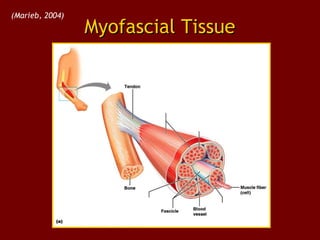
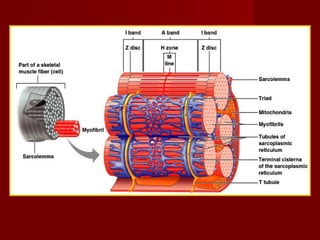
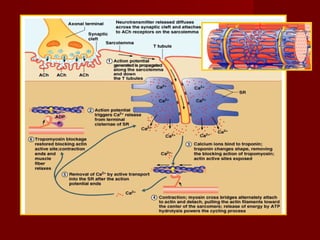
Myofascial TissueMyofascial Tissue
(Marieb, 2004)
Myofascial PainMyofascial Pain
• Originates in both muscle & fasciaOriginates in both muscle & fascia
• SymptomsSymptoms
- Deep, sharp, burning, dull, diffuse, heavy,Deep, sharp, burning, dull, diffuse, heavy,
squeezingsqueezing
• Needs to be treated quicklyNeeds to be treated quickly
- Why?Why?
What is Myofascial ReleaseWhat is Myofascial Release
(MFR)?(MFR)?
• Interactive stretching technique that usesInteractive stretching technique that uses
manual pressure to facilitate maximummanual pressure to facilitate maximum
relaxation of tight or restricted tissuesrelaxation of tight or restricted tissues
- DirectionDirection
- ForceForce
- DurationDuration
(Manheim, 2001;(Manheim, 2001; Ferguson & Gerwin)Ferguson & Gerwin)
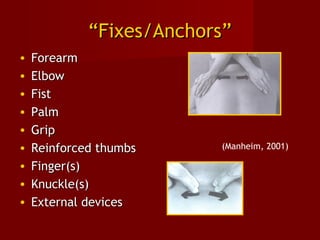
““Fixes/Anchors”Fixes/Anchors”
• ForearmForearm
• ElbowElbow
• FistFist
• PalmPalm
• GripGrip
• Reinforced thumbsReinforced thumbs
• Finger(s)Finger(s)
• Knuckle(s)Knuckle(s)
• External devicesExternal devices
(Manheim, 2001)
Direction of StretchDirection of Stretch
• HorizontalHorizontal
• DiagonalDiagonal
• PerpendicularPerpendicular
• VerticalVertical
Why not just use a grossWhy not just use a gross
stretch?stretch?
Benefits of MFR over GTBenefits of MFR over GT
• Less expensiveLess expensive
• Patient easePatient ease
• Less invasiveLess invasive
• Self-treatSelf-treat
• Tightness vs. restrictionsTightness vs. restrictions
• Difficult to evaluate some areas with GTDifficult to evaluate some areas with GT
General IndicationsGeneral Indications
Myofascial restrictionsMyofascial restrictions
• Pain has not been alleviated by otherPain has not been alleviated by other
treatmentstreatments
• Pain is complex, global, or specific painPain is complex, global, or specific pain
• Underlying chronic condition causing tightnessUnderlying chronic condition causing tightness
and restrictionsand restrictions
• Complex postural asymmetriesComplex postural asymmetries
• Athlete needs stretching to increaseAthlete needs stretching to increase
performance and prevent injuryperformance and prevent injury
(Manheim, 2001)
Precautions/ContraindicationsPrecautions/Contraindications
Myofascial RestrictionsMyofascial Restrictions
• InflammationInflammation
• Patient uncomfortable with touchPatient uncomfortable with touch
• DermatitisDermatitis
• Contagious/infectious diseaseContagious/infectious disease
• Fractures/open woundsFractures/open wounds
• Circulatory problemsCirculatory problems
• Taking blood clotting medicineTaking blood clotting medicine
• OsteoporosisOsteoporosis (Manheim, 2001)
MFR Treatment StepsMFR Treatment Steps
1.1. Gross stretch of entire body areaGross stretch of entire body area
2.2. Focused stretch of muscles in sameFocused stretch of muscles in same
body areabody area
3.3. Finish with gross stretch of entireFinish with gross stretch of entire
musclemuscle
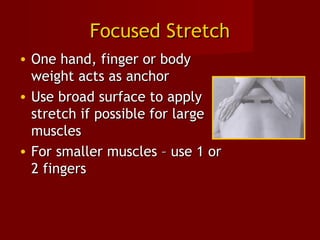
Focused StretchFocused Stretch
• One hand, finger or bodyOne hand, finger or body
weight acts as anchorweight acts as anchor
• Use broad surface to applyUse broad surface to apply
stretch if possible for largestretch if possible for large
musclesmuscles
• For smaller muscles – use 1 orFor smaller muscles – use 1 or
2 fingers2 fingers
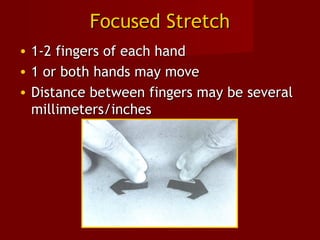
Focused StretchFocused Stretch
• 1-2 fingers of each hand1-2 fingers of each hand
• 1 or both hands may move1 or both hands may move
• Distance between fingers may be severalDistance between fingers may be several
millimeters/inchesmillimeters/inches
Levels of MFRLevels of MFR
1.1. No stretch/pre-tensionNo stretch/pre-tension
2.2. Pre-tension (stripping)Pre-tension (stripping)
3.3. Moderate passive stretchModerate passive stretch
4.4. Active MFRActive MFR
(Leahy & Mock)(Leahy & Mock)
Common MistakesCommon Mistakes
• Too much pressureToo much pressure
• Too long of stretchToo long of stretch
• Too many applicationsToo many applications
Myofascial Trigger PointsMyofascial Trigger Points
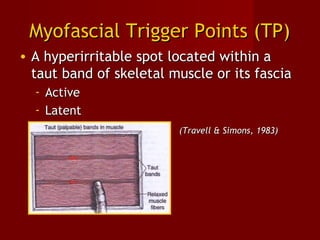
Myofascial Trigger Points (TP)Myofascial Trigger Points (TP)
• A hyperirritable spot located within aA hyperirritable spot located within a
taut band of skeletal muscle or its fasciataut band of skeletal muscle or its fascia
- ActiveActive
- LatentLatent
(Travell & Simons, 1983)(Travell & Simons, 1983)
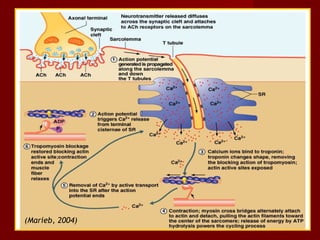
(Marieb, 2004)
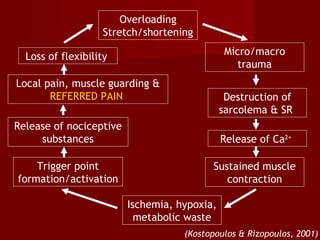
Overloading
Stretch/shortening
Micro/macro
trauma
Destruction of
sarcolema & SR
Release of Ca2+
Sustained muscle
contraction
Ischemia, hypoxia,
metabolic waste
Trigger point
formation/activation
Release of nociceptive
substances
Local pain, muscle guarding &
REFERRED PAIN
Loss of flexibility
(Kostopoulos & Rizopoulos, 2001)
How can TP therapy alleviateHow can TP therapy alleviate
this pathologic cycle?this pathologic cycle?
Considering FibromyalgiaConsidering Fibromyalgia
Trigger PointsTrigger Points
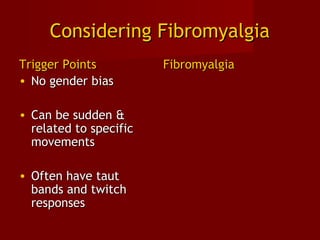
• No gender biasNo gender bias
• Can be sudden &Can be sudden &
related to specificrelated to specific
movementsmovements
• Often have tautOften have taut
bands and twitchbands and twitch
responsesresponses
FibromyalgiaFibromyalgia
General IndicationsGeneral Indications
Myofascial Trigger PointsMyofascial Trigger Points
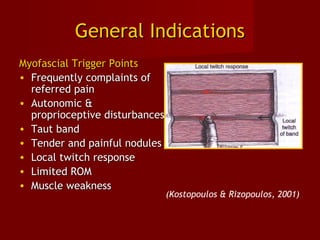
• Frequently complaints ofFrequently complaints of
referred painreferred pain
• Autonomic &Autonomic &
proprioceptive disturbancesproprioceptive disturbances
• Taut bandTaut band
• Tender and painful nodulesTender and painful nodules
• Local twitch responseLocal twitch response
• Limited ROMLimited ROM
• Muscle weaknessMuscle weakness
(Kostopoulos & Rizopoulos, 2001)
Precautions/ContraindicationsPrecautions/Contraindications
Trigger PointsTrigger Points
• InflammationInflammation
• Patient uncomfortable with touchPatient uncomfortable with touch
• DermatitisDermatitis
• Contagious/infectious diseaseContagious/infectious disease
• Fractures/open woundsFractures/open wounds
• Circulatory problemsCirculatory problems
• Taking blood clotting medicineTaking blood clotting medicine
• OsteoporosisOsteoporosis (Manheim, 2001)
Trigger Point TherapyTrigger Point Therapy
Progressive pressure technique/IschemicProgressive pressure technique/Ischemic
CompressionCompression
• Use pain as guideUse pain as guide
- Varying pressure (light pressure/stretching,Varying pressure (light pressure/stretching,
heavy pressure)heavy pressure)
• 10 seconds to 2 minutes10 seconds to 2 minutes
• Follow with myofascial stretchingFollow with myofascial stretching
• Positive stretch signPositive stretch sign
(Kostopoulos & Rizopoulos, 2001)
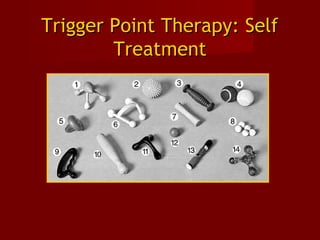
Trigger Point Therapy: SelfTrigger Point Therapy: Self
TreatmentTreatment
Trigger Point TherapyTrigger Point Therapy
Positional Release Therapy/Strain-Positional Release Therapy/Strain-
CounterstrainCounterstrain
• Trigger points are addressed while body isTrigger points are addressed while body is
a position of comforta position of comfort
(D’Ambrogio & Roth, 1997)(D’Ambrogio & Roth, 1997)
Physiologic basis?Physiologic basis?
Reduce muscle spindle inputReduce muscle spindle input
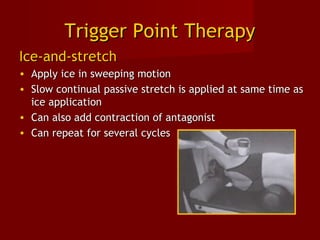
Trigger Point TherapyTrigger Point Therapy
Ice-and-stretchIce-and-stretch
• Apply ice in sweeping motionApply ice in sweeping motion
• Slow continual passive stretch is applied at same time asSlow continual passive stretch is applied at same time as
ice applicationice application
• Can also add contraction of antagonistCan also add contraction of antagonist
• Can repeat for several cyclesCan repeat for several cycles
Trigger Point TherapyTrigger Point Therapy
Stripping MassageStripping Massage
• Deep-stroking massage applied with minimalDeep-stroking massage applied with minimal
lubrication on the fingertipslubrication on the fingertips
• Increase pressure with each successive passIncrease pressure with each successive pass
along musclealong muscle
Both stripping and ischemic compression areBoth stripping and ischemic compression are
believed to cause a reflexive hyperemia thatbelieved to cause a reflexive hyperemia that
returns the site to a normal conditionreturns the site to a normal condition
Myofascial & TriggerMyofascial & Trigger
Point Treatments:Point Treatments:
Upper ExtremitiesUpper Extremities
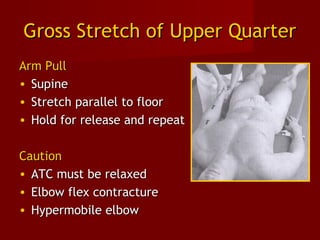
Gross Stretch of Upper QuarterGross Stretch of Upper Quarter
Arm PullArm Pull
• SupineSupine
• Stretch parallel to floorStretch parallel to floor
• Hold for release and repeatHold for release and repeat
CautionCaution
• ATC must be relaxedATC must be relaxed
• Elbow flex contractureElbow flex contracture
• Hypermobile elbowHypermobile elbow
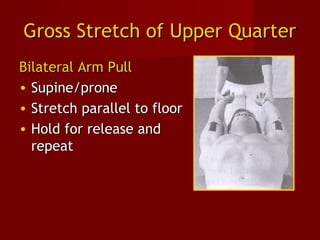
Gross Stretch of Upper QuarterGross Stretch of Upper Quarter
Bilateral Arm PullBilateral Arm Pull
• Supine/proneSupine/prone
• Stretch parallel to floorStretch parallel to floor
• Hold for release andHold for release and
repeatrepeat
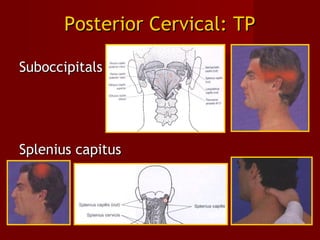
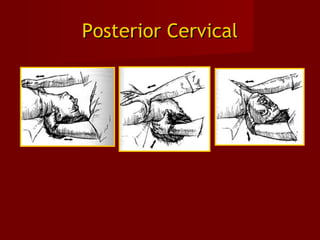
Posterior Cervical: TPPosterior Cervical: TP
SuboccipitalsSuboccipitals
Splenius capitusSplenius capitus
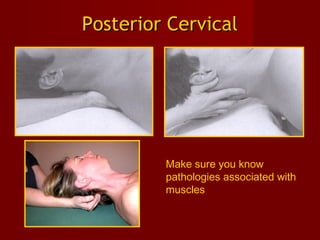
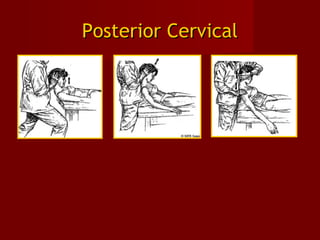
Posterior CervicalPosterior Cervical
Make sure you know
pathologies associated with
muscles
Posterior CervicalPosterior Cervical
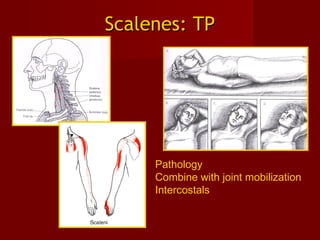
Scalenes: TPScalenes: TP
Pathology
Combine with joint mobilization
Intercostals
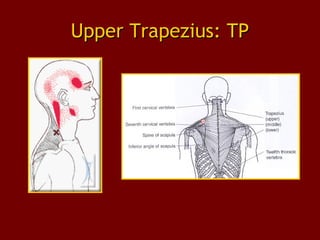
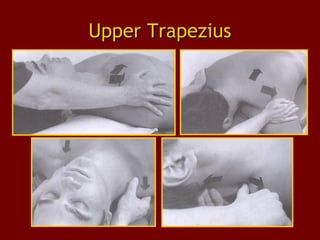
Upper Trapezius: TPUpper Trapezius: TP
Upper TrapeziusUpper Trapezius
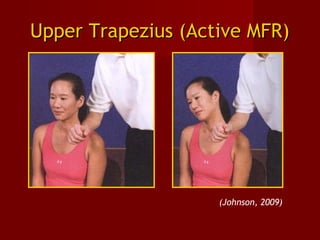
Upper Trapezius (Active MFR)Upper Trapezius (Active MFR)
(Johnson, 2009)
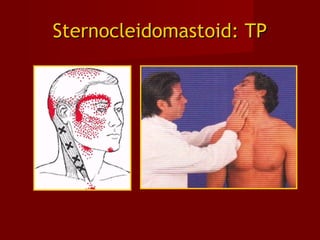
Sternocleidomastoid: TPSternocleidomastoid: TP
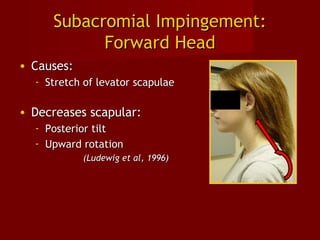
Subacromial Impingement:Subacromial Impingement:
Forward HeadForward Head
• Causes:Causes:
- Stretch of levator scapulaeStretch of levator scapulae
• Decreases scapular:Decreases scapular:
- Posterior tiltPosterior tilt
- Upward rotationUpward rotation
(Ludewig et al, 1996)(Ludewig et al, 1996)
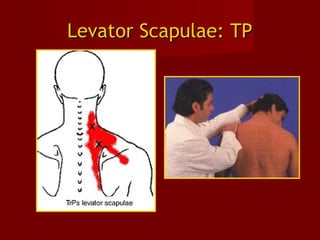
Levator Scapulae: TPLevator Scapulae: TP
X
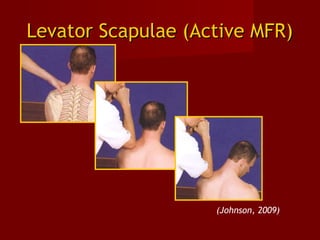
Levator Scapulae (Active MFR)Levator Scapulae (Active MFR)
(Johnson, 2009)
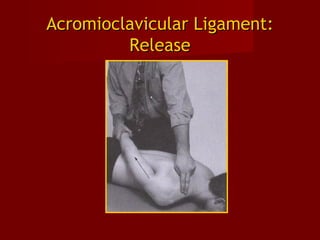
Acromioclavicular Ligament:Acromioclavicular Ligament:
ReleaseRelease
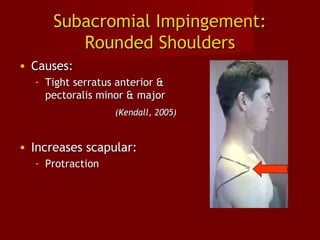
Subacromial Impingement:Subacromial Impingement:
Rounded ShouldersRounded Shoulders
• Causes:Causes:
- Tight serratus anterior &Tight serratus anterior &
pectoralis minor & majorpectoralis minor & major
(Kendall, 2005)(Kendall, 2005)
• Increases scapular:Increases scapular:
- ProtractionProtraction
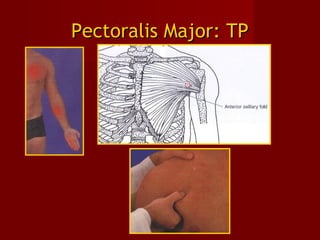
Pectoralis Major: TPPectoralis Major: TP
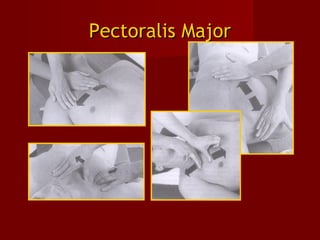
Pectoralis MajorPectoralis Major
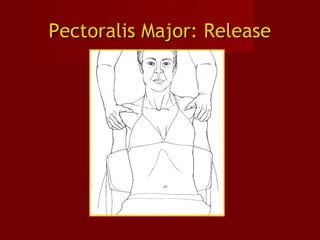
Pectoralis Major: ReleasePectoralis Major: Release
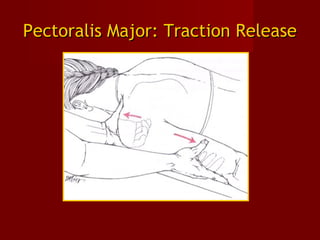
Pectoralis Major: Traction ReleasePectoralis Major: Traction Release
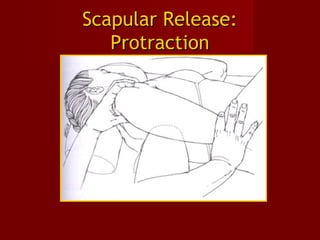
Scapular Release:Scapular Release:
ProtractionProtraction
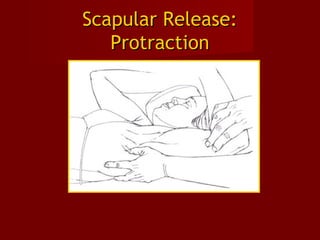
Scapular Release:Scapular Release:
ProtractionProtraction
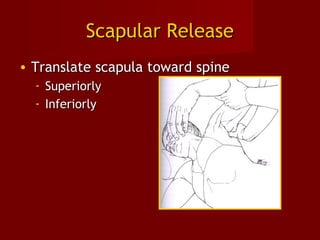
Scapular ReleaseScapular Release
• Translate scapula toward spineTranslate scapula toward spine
- SuperiorlySuperiorly
- InferiorlyInferiorly
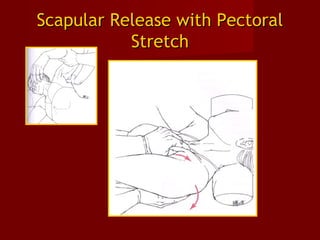
Scapular Release with PectoralScapular Release with Pectoral
StretchStretch
Scapular ReleaseScapular Release
• Side lyingSide lying
• Push scapula superiorlyPush scapula superiorly
• Pull humerus inferiorlyPull humerus inferiorly
Pathology?Pathology?
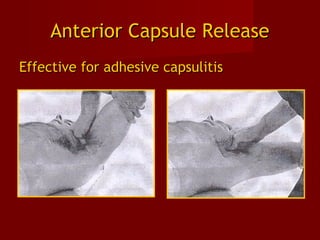
Anterior Capsule ReleaseAnterior Capsule Release
Effective for adhesive capsulitisEffective for adhesive capsulitis
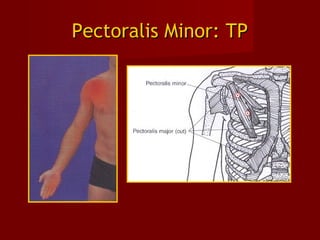
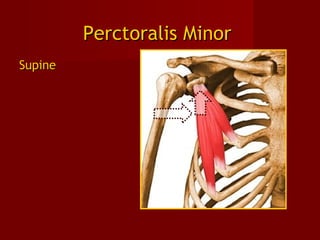
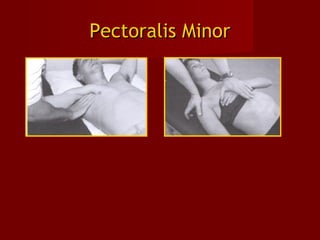
Pectoralis Minor: TPPectoralis Minor: TP
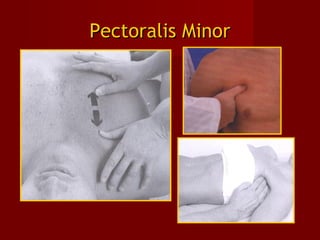
Pectoralis MinorPectoralis Minor
Perctoralis MinorPerctoralis Minor
SupineSupine
Pectoralis MinorPectoralis Minor
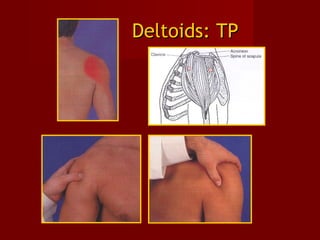
Deltoids: TPDeltoids: TP
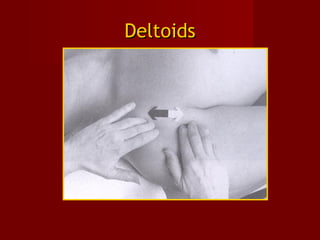
DeltoidsDeltoids
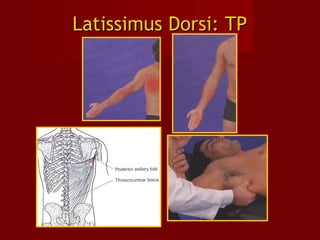
Latissimus Dorsi: TPLatissimus Dorsi: TP
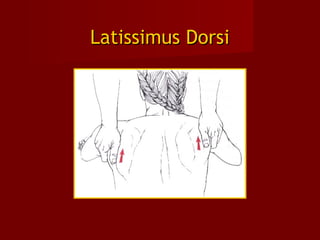
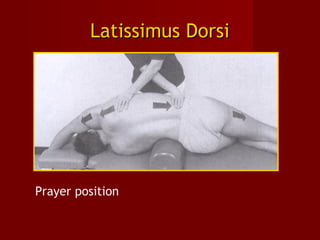
Latissimus DorsiLatissimus Dorsi
Prayer position
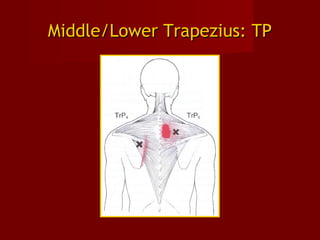
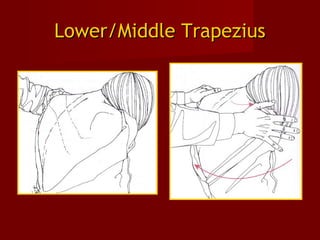
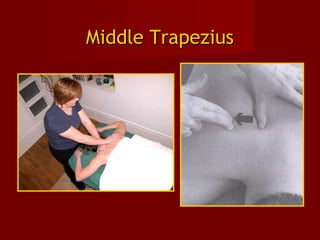
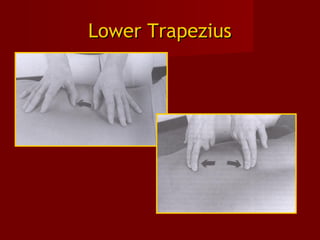
Middle/Lower Trapezius: TPMiddle/Lower Trapezius: TP
Lower/Middle TrapeziusLower/Middle Trapezius
Middle TrapeziusMiddle Trapezius
Lower TrapeziusLower Trapezius
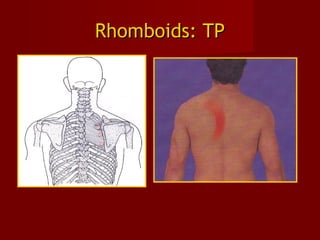
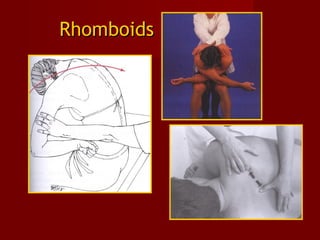
Rhomboids: TPRhomboids: TP
RhomboidsRhomboids
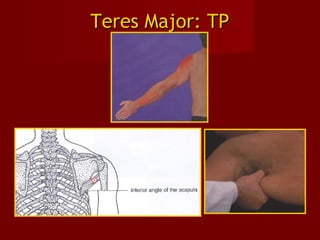
Teres Major: TPTeres Major: TP
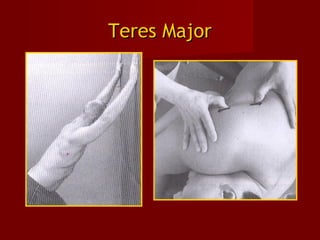
Teres MajorTeres Major
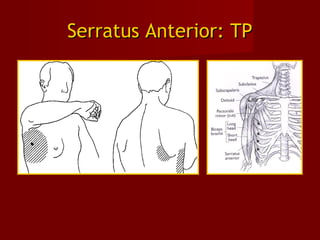
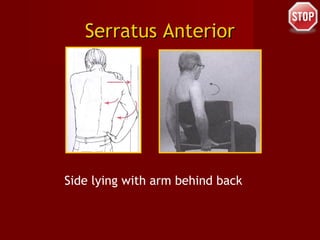
Serratus Anterior: TPSerratus Anterior: TP
Serratus AnteriorSerratus Anterior
Side lying with arm behind back
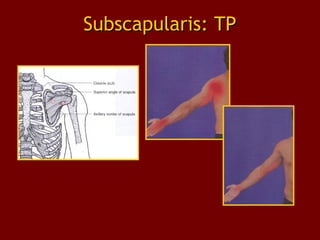
Subscapularis: TPSubscapularis: TP
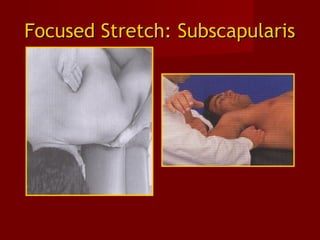
Focused Stretch: SubscapularisFocused Stretch: Subscapularis
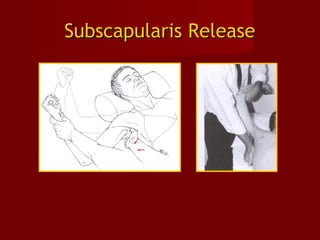
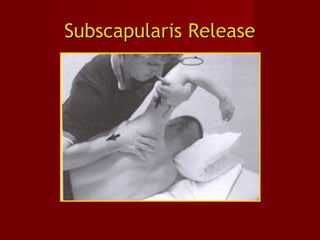
Subscapularis ReleaseSubscapularis Release
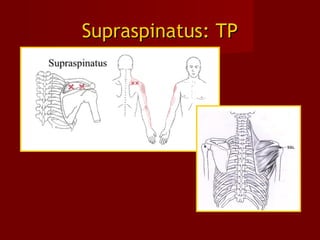
Supraspinatus: TPSupraspinatus: TP
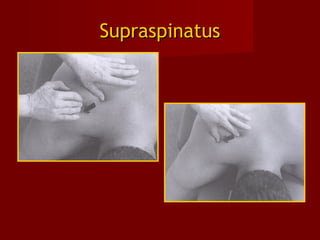
SupraspinatusSupraspinatus
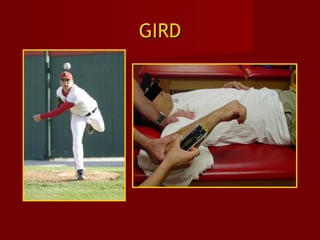
GIRDGIRD
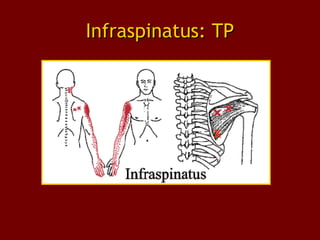
Infraspinatus: TPInfraspinatus: TP
X
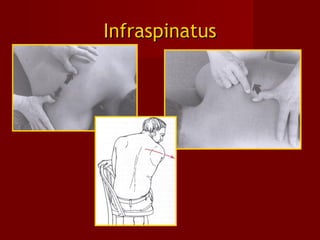
InfraspinatusInfraspinatus
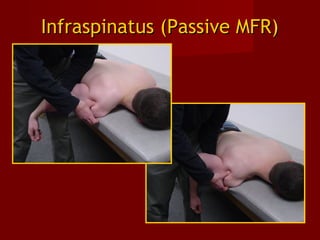
Infraspinatus (Passive MFR)Infraspinatus (Passive MFR)
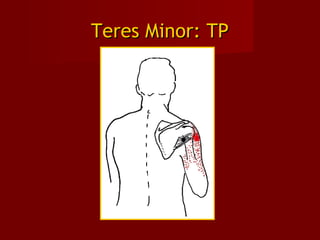
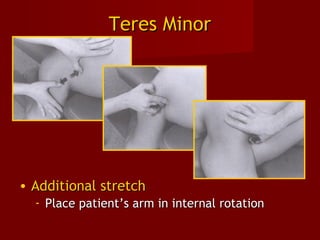
Teres Minor: TPTeres Minor: TP
Teres MinorTeres Minor
• Additional stretchAdditional stretch
- Place patient’s arm in internal rotationPlace patient’s arm in internal rotation
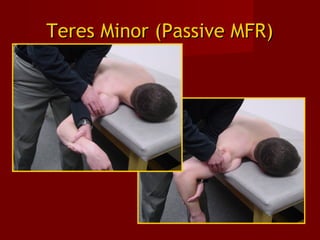
Teres Minor (Passive MFR)Teres Minor (Passive MFR)
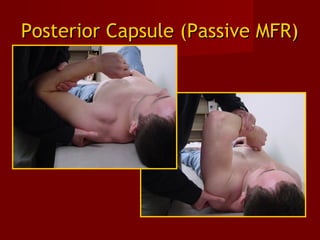
Posterior Capsule (Passive MFR)Posterior Capsule (Passive MFR)
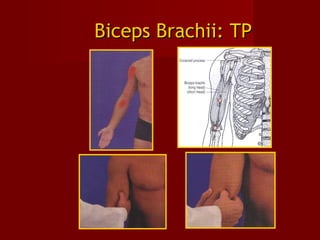
Biceps Brachii: TPBiceps Brachii: TP
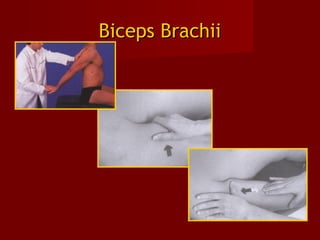
Biceps BrachiiBiceps Brachii
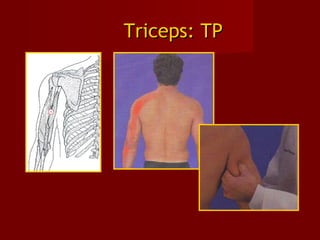
Triceps: TPTriceps: TP
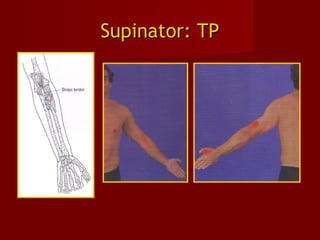
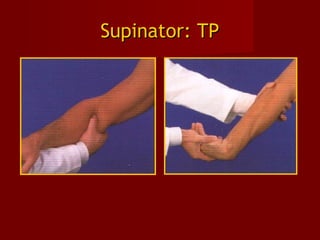
Supinator: TPSupinator: TP
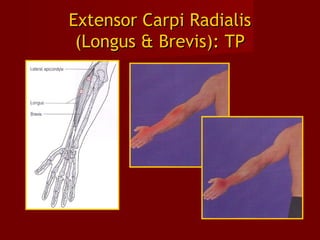
Extensor Carpi RadialisExtensor Carpi Radialis
(Longus & Brevis): TP(Longus & Brevis): TP
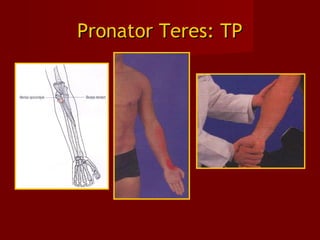
Pronator Teres: TPPronator Teres: TP
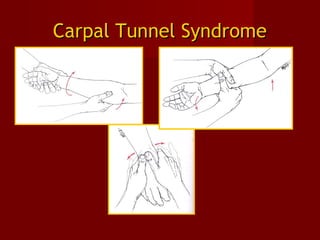
Carpal Tunnel SyndromeCarpal Tunnel Syndrome
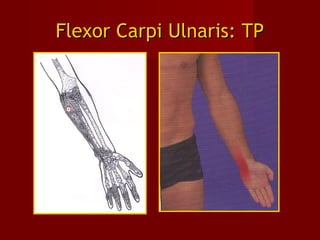
Flexor Carpi Ulnaris: TPFlexor Carpi Ulnaris: TP
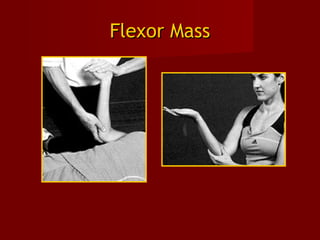
Flexor MassFlexor Mass

Myofascial release ue (1)