Classification, Epidemiology and Medical
     Management of Cerebral Palsy

                       Dr Jill Kisler
     Consultant in Child Development and Neurodisability
               Child Development Centre, RVI
                         January 2010
History
• CP affects 2-3/1000 children
• Most common cause of physical disability in
  childhood
• Debate over 150 years – regarding definition
  and classification – this remains ongoing
• 2005: Multinational consensus group – revised
  definition + classification (Bax and Rosenbaum)
  – Based on: SCPE data, functional ability measures
    (GMFCS – 1997)
SCPE: Surveillance Cerebral Palsy in
              Europe
• 1998 – Collaborative group CP Registers
• 14 European Centres
• Classification Motor Disorder
  – Spastic
  – Dyskinesia
  – Ataxia
  – (Mixed)
• Guidelines and Educational Tool
SCPE: Surveillance Cerebral Palsy in
              Europe
• Informs Prevalence Data
  – Trends in Subgroups
     •   Increase (4x) multiple birth – related to gestation
     •   Decreasing trend infection as post natal aetiology
     •   Optimal birthweight – lower risk of CP
     •   Reducing prevalence CP in birthweight 1000-1500g
          – Impact on bilateral CP prevelance


• Qualitative work on QOL and Participation
  – SPARCLE
Definition
Cerebral Palsy
“ Cerebral Palsy describes a group of permanent
  disorders of the development of movement and
  posture, causing activity limitation, that are
  attributed to non progressive disturbances that
  occurred in the developing fetal or infant brain. The
  motor disorders of cerebral palsy are often
  accompanied by disturbances of sensation,
  perception, cognition, communication, and
  behaviour, by epilepsy and by secondary
  musculoskeletal problems.”

Rosenbaum et al, 2006: Definition and classification of CP
Cerebral Palsy
“ Cerebral Palsy describes a group of permanent
  disorders of the development of movement and
  posture, causing activity limitation, that are
  attributed to non progressive disturbances that
  occurred in the developing fetal or infant brain. The
  motor disorders of cerebral palsy are often
  accompanied by disturbances of sensation,
  perception, cognition, communication, and
  behaviour, by epilepsy and by secondary
  musculoskeletal problems.”

Rosenbaum et al, 2006: Definition and classification of CP
Cerebral Palsy
“ Cerebral Palsy describes a group of permanent
  disorders of the development of movement and
  posture, causing activity limitation, that are
  attributed to non progressive disturbances that
  occurred in the developing fetal or infant brain. The
  motor disorders of cerebral palsy are often
  accompanied by disturbances of sensation,
  perception, cognition, communication, and
  behaviour, by epilepsy and by secondary
  musculoskeletal problems.”

Rosenbaum et al, 2006: Definition and classification of CP
Cerebral Palsy
“ Cerebral Palsy describes a group of permanent
  disorders of the development of movement and
  posture, causing activity limitation, that are
  attributed to non progressive disturbances that
  occurred in the developing fetal or infant brain. The
  motor disorders of cerebral palsy are often
  accompanied by disturbances of sensation,
  perception, cognition, communication, and
  behaviour, by epilepsy and by secondary
  musculoskeletal problems.”

Rosenbaum et al, 2006: Definition and classification of CP
Cerebral Palsy
“ Cerebral Palsy describes a group of permanent
  disorders of the development of movement and
  posture, causing activity limitation, that are
  attributed to non progressive disturbances that
  occurred in the developing fetal or infant brain. The
  motor disorders of cerebral palsy are often
  accompanied by disturbances of sensation,
  perception, cognition, communication, and
  behaviour, by epilepsy and by secondary
  musculoskeletal problems.”

Rosenbaum et al, 2006: Definition and classification of CP
Cerebral Palsy
“ Cerebral Palsy describes a group of permanent
  disorders of the development of movement and
  posture, causing activity limitation, that are
  attributed to non progressive disturbances that
  occurred in the developing fetal or infant brain. The
  motor disorders of cerebral palsy are often
  accompanied by disturbances of sensation,
  perception, cognition, communication, and
  behaviour, by epilepsy and by secondary
  musculoskeletal problems.”

Rosenbaum et al, 2006: Definition and classification of CP
Cerebral Palsy
“ Cerebral Palsy describes a group of permanent
  disorders of the development of movement and
  posture, causing activity limitation, that are
  attributed to non progressive disturbances that
  occurred in the developing fetal or infant brain. The
  motor disorders of cerebral palsy are often
  accompanied by disturbances of sensation,
  perception, cognition, communication, and
  behaviour, by epilepsy and by secondary
  musculoskeletal problems.”

Rosenbaum et al, 2006: Definition and classification of CP
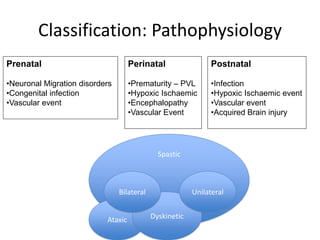
Classification: Pathophysiology
Prenatal                            Perinatal                  Postnatal

•Neuronal Migration disorders       •Prematurity – PVL         •Infection
•Congenital infection               •Hypoxic Ischaemic         •Hypoxic Ischaemic event
•Vascular event                     •Encephalopathy            •Vascular event
                                    •Vascular Event            •Acquired Brain injury


                                              Spastic


                                Bilateral                Unilateral


                           Ataxic           Dyskinetic
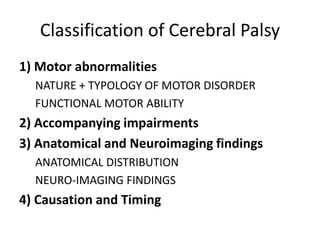
Classification of Cerebral Palsy
1) Motor abnormalities
  NATURE + TYPOLOGY OF MOTOR DISORDER
  FUNCTIONAL MOTOR ABILITY
2) Accompanying impairments
3) Anatomical and Neuroimaging findings
  ANATOMICAL DISTRIBUTION
  NEURO-IMAGING FINDINGS
4) Causation and Timing
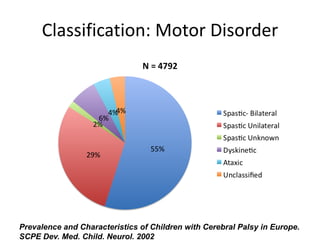
Classification: Motor Disorder


Prevalence and Characteristics of Children with Cerebral Palsy in Europe.
SCPE Dev. Med. Child. Neurol. 2002
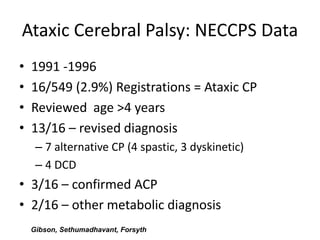
Ataxic Cerebral Palsy: NECCPS Data
•   1991 -1996
•   16/549 (2.9%) Registrations = Ataxic CP
•   Reviewed age >4 years
•   13/16 – revised diagnosis
     – 7 alternative CP (4 spastic, 3 dyskinetic)
     – 4 DCD
• 3/16 – confirmed ACP
• 2/16 – other metabolic diagnosis
    Gibson, Sethumadhavant, Forsyth
Classification
• Anatomical distribution   • Associated impairments
• Motor Function                 – Severe intellectual
   – GMFCS                         impairment - 31%
   – BFMF                        – Severe Visual
                                   impairment – 11.1%
   – MACS
                                 – Active Seizures – 20.7%
• QOL                            – Severe intellectual
• Participation                    impairment + not
                                   walking – 20.2%

                            •   SCPE, DCMN 2002
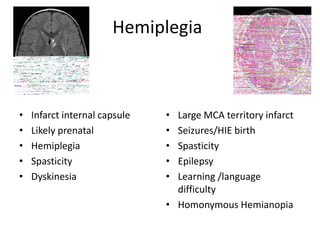
Hemiplegia


•   Infarct internal capsule   • Large MCA territory infarct
•   Likely prenatal            • Seizures/HIE birth
•   Hemiplegia                 • Spasticity
•   Spasticity                 • Epilepsy
•   Dyskinesia                 • Learning /language
                                 difficulty
                               • Homonymous Hemianopia
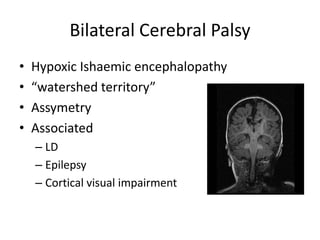
Bilateral Cerebral Palsy
•   Hypoxic Ishaemic encephalopathy
•   “watershed territory”
•   Assymetry
•   Associated
    – LD
    – Epilepsy
    – Cortical visual impairment
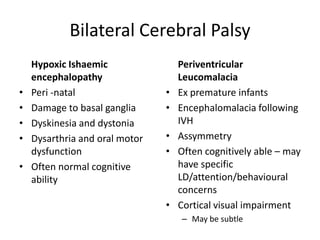
Bilateral Cerebral Palsy
    Hypoxic Ishaemic                Periventricular
    encephalopathy                  Leucomalacia
•   Peri -natal                 •   Ex premature infants
•   Damage to basal ganglia     •   Encephalomalacia following
•   Dyskinesia and dystonia         IVH
•   Dysarthria and oral motor   •   Assymmetry
    dysfunction                 •   Often cognitively able – may
•   Often normal cognitive          have specific
    ability                         LD/attention/behavioural
                                    concerns
                                •   Cortical visual impairment
                                    – May be subtle
Why image children with CP?
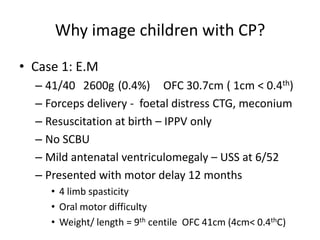
• Case 1: E.M
  – 41/40 2600g (0.4%) OFC 30.7cm ( 1cm < 0.4th)
  – Forceps delivery - foetal distress CTG, meconium
  – Resuscitation at birth – IPPV only
  – No SCBU
  – Mild antenatal ventriculomegaly – USS at 6/52
  – Presented with motor delay 12 months
     • 4 limb spasticity
     • Oral motor difficulty
     • Weight/ length = 9th centile OFC 41cm (4cm< 0.4thC)
Why image children with CP?
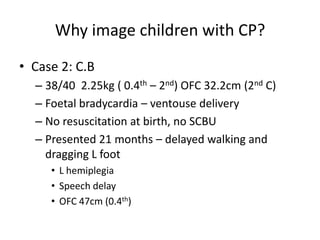
• Case 2: C.B
  – 38/40 2.25kg ( 0.4th – 2nd) OFC 32.2cm (2nd C)
  – Foetal bradycardia – ventouse delivery
  – No resuscitation at birth, no SCBU
  – Presented 21 months – delayed walking and
    dragging L foot
     • L hemiplegia
     • Speech delay
     • OFC 47cm (0.4th)
Why image children with CP?
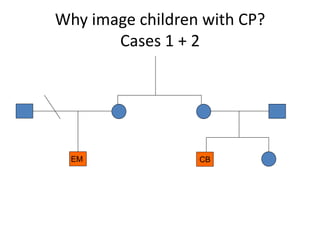
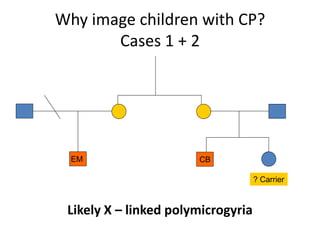
       Cases 1 + 2


  EM              CB
Why image children with CP?
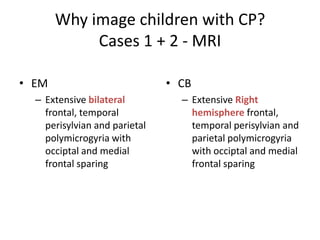
            Cases 1 + 2 - MRI

• EM                           • CB
  – Extensive bilateral          – Extensive Right
    frontal, temporal              hemisphere frontal,
    perisylvian and parietal       temporal perisylvian and
    polymicrogyria with            parietal polymicrogyria
    occiptal and medial            with occiptal and medial
    frontal sparing                frontal sparing
Why image children with CP?
       Cases 1 + 2


  EM                   CB

                                    ? Carrier


 Likely X – linked polymicrogyria
When is it not Cerebral Palsy?
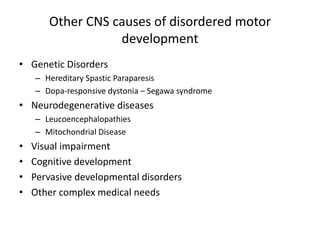
Other CNS causes of disordered motor
                  development
• Genetic Disorders
    – Hereditary Spastic Paraparesis
    – Dopa-responsive dystonia – Segawa syndrome
• Neurodegenerative diseases
    – Leucoencephalopathies
    – Mitochondrial Disease
•   Visual impairment
•   Cognitive development
•   Pervasive developmental disorders
•   Other complex medical needs
Red Flags
• No significant perinatal history
• MRI
  – Unexpected result
     • Normal or Abnormal
• Family History
• Clinical signs inconsistent with history
• Progression of neurological signs or
  deterioration of expected motor function
• Ataxic cerebral palsy
Medical Management of
    Cerebral Palsy
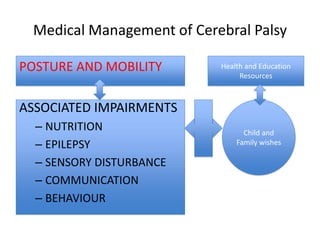
Medical Management of Cerebral Palsy

POSTURE AND MOBILITY       Health and Education
                                Resources


ASSOCIATED IMPAIRMENTS
  – NUTRITION                    Child and
  – EPILEPSY                   Family wishes

  – SENSORY DISTURBANCE
  – COMMUNICATION
  – BEHAVIOUR
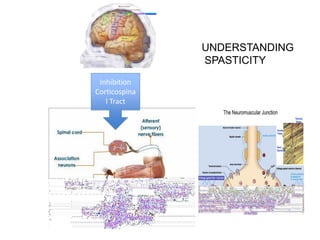
UNDERSTANDING
               SPASTICITY
 Inhibition
Corticospina
   l Tract
Baclofen
• Centrally acting GABA agonist – increases
  inhibition of descending cortico-spinal tract
• Oral medication:
  – Systemic side effects
     • Reduced truncal tone including oral motor control
     • Lethargy
  – Gradual increasing dose = improved tolerance
• Intra-thecal Baclofen
  – Direct effect on CNS – reduced systemic side
    effects
Botulinum Toxin
•   Targeted treatment of spasticity
•   Toxin inhibits Ach release from NMJ
•   Individual muscle vs multi-level
•   Evidence – limited to equinus foot deformity
•   Goal orientated approach – functional benefit
    – Ambulant: gait, range of movement, orthoses
    – Non-ambulant: Hygiene, pain reduction
• Dyskinesia and spasticity: regulatory control
  feedback via gamma motor neurone
Posture and Mobility Management
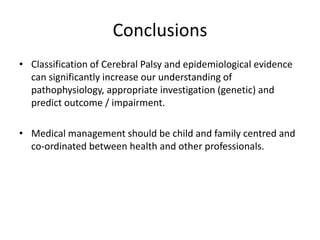
                         Acceptable
   Functional
                         Accessible              Orthopaedic
  Therapy and
                    Integrated to lifestyle        Surgery
    Orthoses
                   Minimal adverse effects


                                                  Selective
    Oral                 Child and                 Dorsal
  Medication              Family                 Rhizotomy


   Botulinum           Goal Orientated
                                                 Intra-thecal
      Toxin          Functional outcome
                                                   Baclofen
   Injections   Increase Participation and QOL
Conclusions
• Classification of Cerebral Palsy and epidemiological evidence
  can significantly increase our understanding of
  pathophysiology, appropriate investigation (genetic) and
  predict outcome / impairment.

• Medical management should be child and family centred and
  co-ordinated between health and other professionals.
Thank you for your attention!

        Any Questions?

Dr Jill Kisler

  • 1.
    Classification, Epidemiology andMedical Management of Cerebral Palsy Dr Jill Kisler Consultant in Child Development and Neurodisability Child Development Centre, RVI January 2010
  • 2.
    History • CP affects2-3/1000 children • Most common cause of physical disability in childhood • Debate over 150 years – regarding definition and classification – this remains ongoing • 2005: Multinational consensus group – revised definition + classification (Bax and Rosenbaum) – Based on: SCPE data, functional ability measures (GMFCS – 1997)
  • 3.
    SCPE: Surveillance CerebralPalsy in Europe • 1998 – Collaborative group CP Registers • 14 European Centres • Classification Motor Disorder – Spastic – Dyskinesia – Ataxia – (Mixed) • Guidelines and Educational Tool
  • 4.
    SCPE: Surveillance CerebralPalsy in Europe • Informs Prevalence Data – Trends in Subgroups • Increase (4x) multiple birth – related to gestation • Decreasing trend infection as post natal aetiology • Optimal birthweight – lower risk of CP • Reducing prevalence CP in birthweight 1000-1500g – Impact on bilateral CP prevelance • Qualitative work on QOL and Participation – SPARCLE
  • 5.
  • 6.
    Cerebral Palsy “ CerebralPalsy describes a group of permanent disorders of the development of movement and posture, causing activity limitation, that are attributed to non progressive disturbances that occurred in the developing fetal or infant brain. The motor disorders of cerebral palsy are often accompanied by disturbances of sensation, perception, cognition, communication, and behaviour, by epilepsy and by secondary musculoskeletal problems.” Rosenbaum et al, 2006: Definition and classification of CP
  • 7.
    Cerebral Palsy “ CerebralPalsy describes a group of permanent disorders of the development of movement and posture, causing activity limitation, that are attributed to non progressive disturbances that occurred in the developing fetal or infant brain. The motor disorders of cerebral palsy are often accompanied by disturbances of sensation, perception, cognition, communication, and behaviour, by epilepsy and by secondary musculoskeletal problems.” Rosenbaum et al, 2006: Definition and classification of CP
  • 8.
    Cerebral Palsy “ CerebralPalsy describes a group of permanent disorders of the development of movement and posture, causing activity limitation, that are attributed to non progressive disturbances that occurred in the developing fetal or infant brain. The motor disorders of cerebral palsy are often accompanied by disturbances of sensation, perception, cognition, communication, and behaviour, by epilepsy and by secondary musculoskeletal problems.” Rosenbaum et al, 2006: Definition and classification of CP
  • 9.
    Cerebral Palsy “ CerebralPalsy describes a group of permanent disorders of the development of movement and posture, causing activity limitation, that are attributed to non progressive disturbances that occurred in the developing fetal or infant brain. The motor disorders of cerebral palsy are often accompanied by disturbances of sensation, perception, cognition, communication, and behaviour, by epilepsy and by secondary musculoskeletal problems.” Rosenbaum et al, 2006: Definition and classification of CP
  • 10.
    Cerebral Palsy “ CerebralPalsy describes a group of permanent disorders of the development of movement and posture, causing activity limitation, that are attributed to non progressive disturbances that occurred in the developing fetal or infant brain. The motor disorders of cerebral palsy are often accompanied by disturbances of sensation, perception, cognition, communication, and behaviour, by epilepsy and by secondary musculoskeletal problems.” Rosenbaum et al, 2006: Definition and classification of CP
  • 11.
    Cerebral Palsy “ CerebralPalsy describes a group of permanent disorders of the development of movement and posture, causing activity limitation, that are attributed to non progressive disturbances that occurred in the developing fetal or infant brain. The motor disorders of cerebral palsy are often accompanied by disturbances of sensation, perception, cognition, communication, and behaviour, by epilepsy and by secondary musculoskeletal problems.” Rosenbaum et al, 2006: Definition and classification of CP
  • 12.
    Cerebral Palsy “ CerebralPalsy describes a group of permanent disorders of the development of movement and posture, causing activity limitation, that are attributed to non progressive disturbances that occurred in the developing fetal or infant brain. The motor disorders of cerebral palsy are often accompanied by disturbances of sensation, perception, cognition, communication, and behaviour, by epilepsy and by secondary musculoskeletal problems.” Rosenbaum et al, 2006: Definition and classification of CP
  • 13.
    Classification: Pathophysiology Prenatal Perinatal Postnatal •Neuronal Migration disorders •Prematurity – PVL •Infection •Congenital infection •Hypoxic Ischaemic •Hypoxic Ischaemic event •Vascular event •Encephalopathy •Vascular event •Vascular Event •Acquired Brain injury Spastic Bilateral Unilateral Ataxic Dyskinetic
  • 14.
    Classification of CerebralPalsy 1) Motor abnormalities NATURE + TYPOLOGY OF MOTOR DISORDER FUNCTIONAL MOTOR ABILITY 2) Accompanying impairments 3) Anatomical and Neuroimaging findings ANATOMICAL DISTRIBUTION NEURO-IMAGING FINDINGS 4) Causation and Timing
  • 15.
    Classification: Motor Disorder Prevalenceand Characteristics of Children with Cerebral Palsy in Europe. SCPE Dev. Med. Child. Neurol. 2002
  • 16.
    Ataxic Cerebral Palsy:NECCPS Data • 1991 -1996 • 16/549 (2.9%) Registrations = Ataxic CP • Reviewed age >4 years • 13/16 – revised diagnosis – 7 alternative CP (4 spastic, 3 dyskinetic) – 4 DCD • 3/16 – confirmed ACP • 2/16 – other metabolic diagnosis Gibson, Sethumadhavant, Forsyth
  • 17.
    Classification • Anatomical distribution • Associated impairments • Motor Function – Severe intellectual – GMFCS impairment - 31% – BFMF – Severe Visual impairment – 11.1% – MACS – Active Seizures – 20.7% • QOL – Severe intellectual • Participation impairment + not walking – 20.2% • SCPE, DCMN 2002
  • 18.
    Hemiplegia • Infarct internal capsule • Large MCA territory infarct • Likely prenatal • Seizures/HIE birth • Hemiplegia • Spasticity • Spasticity • Epilepsy • Dyskinesia • Learning /language difficulty • Homonymous Hemianopia
  • 19.
    Bilateral Cerebral Palsy • Hypoxic Ishaemic encephalopathy • “watershed territory” • Assymetry • Associated – LD – Epilepsy – Cortical visual impairment
  • 20.
    Bilateral Cerebral Palsy Hypoxic Ishaemic Periventricular encephalopathy Leucomalacia • Peri -natal • Ex premature infants • Damage to basal ganglia • Encephalomalacia following • Dyskinesia and dystonia IVH • Dysarthria and oral motor • Assymmetry dysfunction • Often cognitively able – may • Often normal cognitive have specific ability LD/attention/behavioural concerns • Cortical visual impairment – May be subtle

  • 21.
    Why image childrenwith CP? • Case 1: E.M – 41/40 2600g (0.4%) OFC 30.7cm ( 1cm < 0.4th) – Forceps delivery - foetal distress CTG, meconium – Resuscitation at birth – IPPV only – No SCBU – Mild antenatal ventriculomegaly – USS at 6/52 – Presented with motor delay 12 months • 4 limb spasticity • Oral motor difficulty • Weight/ length = 9th centile OFC 41cm (4cm< 0.4thC)
  • 22.
    Why image childrenwith CP? • Case 2: C.B – 38/40 2.25kg ( 0.4th – 2nd) OFC 32.2cm (2nd C) – Foetal bradycardia – ventouse delivery – No resuscitation at birth, no SCBU – Presented 21 months – delayed walking and dragging L foot • L hemiplegia • Speech delay • OFC 47cm (0.4th)
  • 23.
    Why image childrenwith CP? Cases 1 + 2 EM CB
  • 24.
    Why image childrenwith CP? Cases 1 + 2 - MRI • EM • CB – Extensive bilateral – Extensive Right frontal, temporal hemisphere frontal, perisylvian and parietal temporal perisylvian and polymicrogyria with parietal polymicrogyria occiptal and medial with occiptal and medial frontal sparing frontal sparing
  • 25.
    Why image childrenwith CP? Cases 1 + 2 EM CB ? Carrier Likely X – linked polymicrogyria
  • 26.
    When is itnot Cerebral Palsy?
  • 27.
    Other CNS causesof disordered motor development • Genetic Disorders – Hereditary Spastic Paraparesis – Dopa-responsive dystonia – Segawa syndrome • Neurodegenerative diseases – Leucoencephalopathies – Mitochondrial Disease • Visual impairment • Cognitive development • Pervasive developmental disorders • Other complex medical needs
  • 28.
    Red Flags • Nosignificant perinatal history • MRI – Unexpected result • Normal or Abnormal • Family History • Clinical signs inconsistent with history • Progression of neurological signs or deterioration of expected motor function • Ataxic cerebral palsy
  • 29.
    Medical Management of Cerebral Palsy
  • 30.
    Medical Management ofCerebral Palsy POSTURE AND MOBILITY Health and Education Resources ASSOCIATED IMPAIRMENTS – NUTRITION Child and – EPILEPSY Family wishes – SENSORY DISTURBANCE – COMMUNICATION – BEHAVIOUR
  • 31.
    UNDERSTANDING SPASTICITY Inhibition Corticospina l Tract
  • 32.
    Baclofen • Centrally actingGABA agonist – increases inhibition of descending cortico-spinal tract • Oral medication: – Systemic side effects • Reduced truncal tone including oral motor control • Lethargy – Gradual increasing dose = improved tolerance • Intra-thecal Baclofen – Direct effect on CNS – reduced systemic side effects
  • 33.
    Botulinum Toxin • Targeted treatment of spasticity • Toxin inhibits Ach release from NMJ • Individual muscle vs multi-level • Evidence – limited to equinus foot deformity • Goal orientated approach – functional benefit – Ambulant: gait, range of movement, orthoses – Non-ambulant: Hygiene, pain reduction • Dyskinesia and spasticity: regulatory control feedback via gamma motor neurone
  • 34.
    Posture and MobilityManagement Acceptable Functional Accessible Orthopaedic Therapy and Integrated to lifestyle Surgery Orthoses Minimal adverse effects Selective Oral Child and Dorsal Medication Family Rhizotomy Botulinum Goal Orientated Intra-thecal Toxin Functional outcome Baclofen Injections Increase Participation and QOL
  • 35.
    Conclusions • Classification ofCerebral Palsy and epidemiological evidence can significantly increase our understanding of pathophysiology, appropriate investigation (genetic) and predict outcome / impairment. • Medical management should be child and family centred and co-ordinated between health and other professionals.
  • 36.
    Thank you foryour attention! Any Questions?