THE MUSCULOSKELETAL
     SYSTEM
    Bones, joints and muscles
 Tendons, ligaments and cartilage
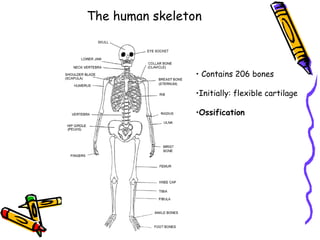
The human skeleton


                 • Contains 206 bones

                 •Initially: flexible cartilage

                 •Ossification
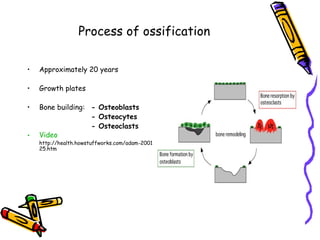
Process of ossification

•   Approximately 20 years

•   Growth plates

•   Bone building: - Osteoblasts
                   - Osteocytes
                   - Osteoclasts
•   Video
    http://health.howstuffworks.com/adam-2001
    25.htm
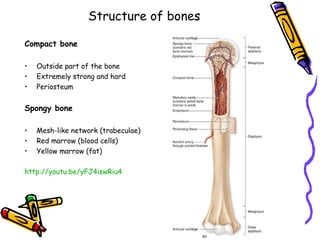
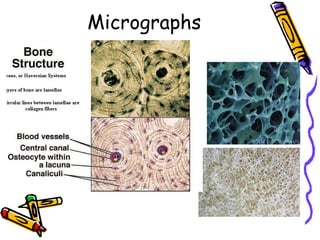
Structure of bones

Compact bone

•   Outside part of the bone
•   Extremely strong and hard
•   Periosteum


Spongy bone

•   Mesh-like network (trabeculae)
•   Red marrow (blood cells)
•   Yellow marrow (fat)

http://youtu.be/yFJ4iswRiu4
Micrographs
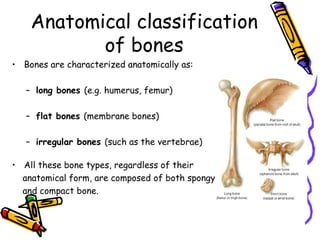
Anatomical classification
           of bones
• Bones are characterized anatomically as:

   – long bones (e.g. humerus, femur)

   – flat bones (membrane bones)

   – irregular bones (such as the vertebrae)

• All these bone types, regardless of their
  anatomical form, are composed of both spongy
  and compact bone.
Functions of the skeleton
    • Bone provides the internal support of the body
      and provides sites of attachment of tendons and
      muscles, essential for locomotion.

    • Bone provides protection for the vital organs of
      the body: the skull protects the brain; the ribs
      protect the heart and lungs.

    • The hematopoietic bone marrow is protected by
      the surrounding bony tissue.

    • The main store of calcium and phosphate is in
      bone. Bone has several metabolic functions
      especially in calcium homeostasis.
    •   http://youtu.be/8d-RBe8JBVs
Joints
•   Meeting of two bones

•   Make the skeleton flexible

•   Types:

    - Immovable or fibrous

    - Partially movable, or cartilaginous

    - Freely movable, or synovial
Joints
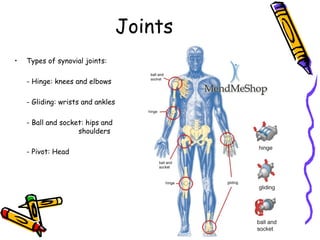
•   Types of synovial joints:

    - Hinge: knees and elbows

    - Gliding: wrists and ankles

    - Ball and socket: hips and
                    shoulders

    - Pivot: Head
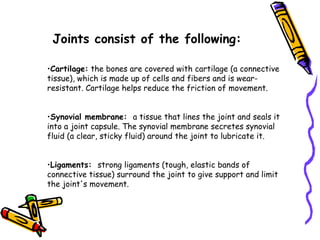
Joints consist of the following:

•Cartilage: the bones are covered with cartilage (a connective
tissue), which is made up of cells and fibers and is wear-
resistant. Cartilage helps reduce the friction of movement.


•Synovial membrane: a tissue that lines the joint and seals it
into a joint capsule. The synovial membrane secretes synovial
fluid (a clear, sticky fluid) around the joint to lubricate it.


•Ligaments: strong ligaments (tough, elastic bands of
connective tissue) surround the joint to give support and limit
the joint's movement.
Joints consist of the
            following (II)
•   Tendons: tendons (another type of tough connective tissue) on
    each side of a joint attach to muscles that control movement of
    the joint.

•   Bursas: fluid-filled sacs, between bones, ligaments, or other
    adjacent structures help cushion the friction in a joint.

•   Synovial fluid: a clear, sticky fluid secreted by the synovial
    membrane.

•   Meniscus: a curved part of cartilage in the knees and other joints.
Synovial joints
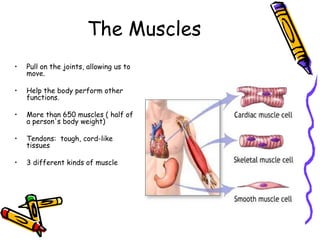
The Muscles
•   Pull on the joints, allowing us to
    move.

•   Help the body perform other
    functions.

•   More than 650 muscles ( half of
    a person's body weight)

•   Tendons: tough, cord-like
    tissues

•   3 different kinds of muscle
How do muscles move?
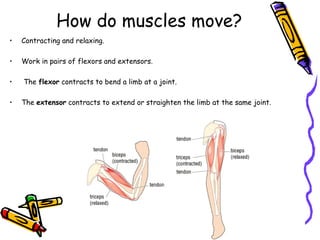
•   Contracting and relaxing.

•   Work in pairs of flexors and extensors.

•   The flexor contracts to bend a limb at a joint.

•   The extensor contracts to extend or straighten the limb at the same joint.
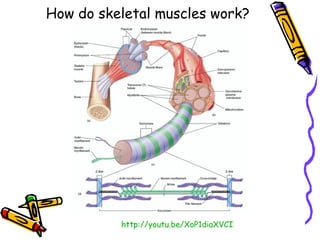
How do skeletal muscles work?


          http://youtu.be/XoP1diaXVCI

The musculoskeletal system

  • 1.
    THE MUSCULOSKELETAL SYSTEM Bones, joints and muscles Tendons, ligaments and cartilage
  • 2.
    The human skeleton • Contains 206 bones •Initially: flexible cartilage •Ossification
  • 3.
    Process of ossification • Approximately 20 years • Growth plates • Bone building: - Osteoblasts - Osteocytes - Osteoclasts • Video http://health.howstuffworks.com/adam-2001 25.htm
  • 4.
    Structure of bones Compactbone • Outside part of the bone • Extremely strong and hard • Periosteum Spongy bone • Mesh-like network (trabeculae) • Red marrow (blood cells) • Yellow marrow (fat) http://youtu.be/yFJ4iswRiu4
  • 5.
  • 6.
    Anatomical classification of bones • Bones are characterized anatomically as: – long bones (e.g. humerus, femur) – flat bones (membrane bones) – irregular bones (such as the vertebrae) • All these bone types, regardless of their anatomical form, are composed of both spongy and compact bone.
  • 7.
    Functions of theskeleton • Bone provides the internal support of the body and provides sites of attachment of tendons and muscles, essential for locomotion. • Bone provides protection for the vital organs of the body: the skull protects the brain; the ribs protect the heart and lungs. • The hematopoietic bone marrow is protected by the surrounding bony tissue. • The main store of calcium and phosphate is in bone. Bone has several metabolic functions especially in calcium homeostasis. • http://youtu.be/8d-RBe8JBVs
  • 8.
    Joints • Meeting of two bones • Make the skeleton flexible • Types: - Immovable or fibrous - Partially movable, or cartilaginous - Freely movable, or synovial
  • 9.
    Joints • Types of synovial joints: - Hinge: knees and elbows - Gliding: wrists and ankles - Ball and socket: hips and shoulders - Pivot: Head
  • 10.
    Joints consist ofthe following: •Cartilage: the bones are covered with cartilage (a connective tissue), which is made up of cells and fibers and is wear- resistant. Cartilage helps reduce the friction of movement. •Synovial membrane: a tissue that lines the joint and seals it into a joint capsule. The synovial membrane secretes synovial fluid (a clear, sticky fluid) around the joint to lubricate it. •Ligaments: strong ligaments (tough, elastic bands of connective tissue) surround the joint to give support and limit the joint's movement.
  • 11.
    Joints consist ofthe following (II) • Tendons: tendons (another type of tough connective tissue) on each side of a joint attach to muscles that control movement of the joint. • Bursas: fluid-filled sacs, between bones, ligaments, or other adjacent structures help cushion the friction in a joint. • Synovial fluid: a clear, sticky fluid secreted by the synovial membrane. • Meniscus: a curved part of cartilage in the knees and other joints.
  • 12.
  • 13.
    The Muscles • Pull on the joints, allowing us to move. • Help the body perform other functions. • More than 650 muscles ( half of a person's body weight) • Tendons: tough, cord-like tissues • 3 different kinds of muscle
  • 14.
    How do musclesmove? • Contracting and relaxing. • Work in pairs of flexors and extensors. • The flexor contracts to bend a limb at a joint. • The extensor contracts to extend or straighten the limb at the same joint.
  • 15.
    How do skeletalmuscles work? http://youtu.be/XoP1diaXVCI