Sreeraj S R
Wound Healing
Sreeraj S R
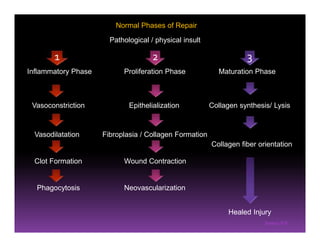
Pathological / physical insult
Inflammatory Phase Proliferation Phase Maturation Phase
Vasoconstriction
Vasodilatation
Clot Formation
Phagocytosis
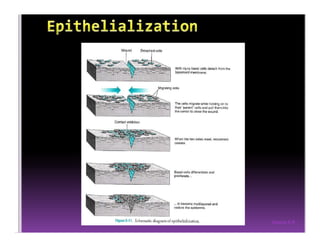
Epithelialization
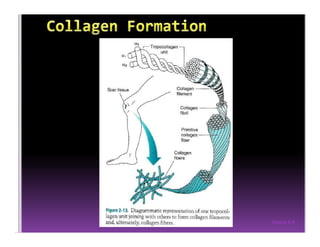
Fibroplasia / Collagen Formation
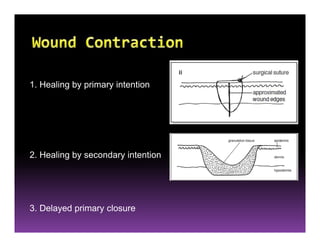
Wound Contraction
Neovascularization
Collagen synthesis/ Lysis
Collagen fiber orientation
Healed Injury
Normal Phases of Repair
21 3
Sreeraj S R
Sreeraj S R
Sreeraj S R
1. Healing by primary intention
2. Healing by secondary intention
3. Delayed primary closure
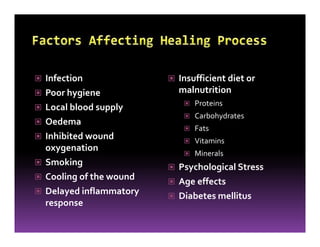
Infection
Poor hygiene
Local blood supply
Oedema
Inhibited wound
oxygenation
Smoking
Cooling of the wound
Delayed inflammatory
response
Insufficient diet or
malnutrition
Proteins
Carbohydrates
Fats
Vitamins
Minerals
Psychological Stress
Age effects
Diabetes mellitus
Sreeraj S R
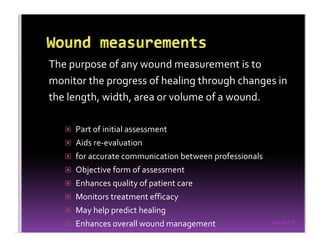
The purpose of any wound measurement is to
monitor the progress of healing through changes in
the length, width, area or volume of a wound.
Part of initial assessment
Aids re-evaluation
for accurate communication between professionals
Objective form of assessment
Enhances quality of patient care
Monitors treatment efficacy
May help predict healing
Enhances overall wound management
Sreeraj S R
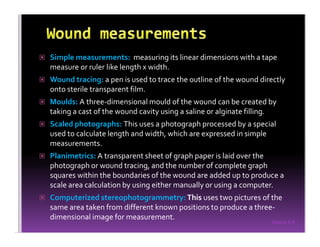
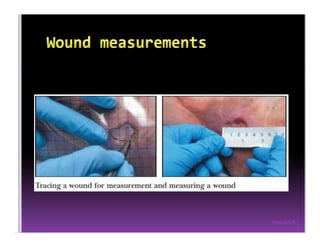
Simple measurements: measuring its linear dimensions with a tape
measure or ruler like length x width.
Wound tracing: a pen is used to trace the outline of the wound directly
onto sterile transparent film.
Moulds: A three-dimensional mould of the wound can be created by
taking a cast of the wound cavity using a saline or alginate filling.
Scaled photographs: This uses a photograph processed by a special
used to calculate length and width, which are expressed in simple
measurements.
Planimetrics: A transparent sheet of graph paper is laid over the
photograph or wound tracing, and the number of complete graph
squares within the boundaries of the wound are added up to produce a
scale area calculation by using either manually or using a computer.
Computerized stereophotogrammetry:This uses two pictures of the
same area taken from different known positions to produce a three-
dimensional image for measurement.
Sreeraj S R
Sreeraj S R
Wound Healing
Sreeraj S R
High Frequency modalities used to promote
wound healing are…
1. Ultrasound
2. LASER
3. Ultraviolet
4. PSW
Sreeraj S R
Ultrasound benefit wound healing in..
1. Inflammatory Phase :
causes a degranulation of mast cells
resulting in the release of histamine.
2. Proliferative Phase :
effect fibroblasts and stimulate them to
secrete collagen.This can accelerate the
process of wound contraction and increase
tensile strength of the healing tissue
Sreeraj S R
1. Treat at the lowest intensity.
2. Assure that the applicator is kept in constant
motion throughout treatment
3. Proper acoustic coupling medium is used.
4. Reduce the intensity or terminate treatment
if the patient complains of any increase in
pain.
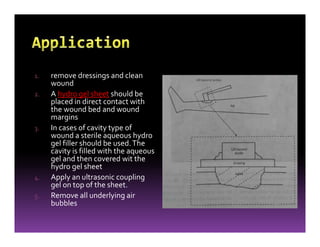
1. remove dressings and clean
wound
2. A hydro gel sheet should be
placed in direct contact with
the wound bed and wound
margins
3. In cases of cavity type of
wound a sterile aqueous hydro
gel filler should be used.The
cavity is filled with the aqueous
gel and then covered wit the
hydro gel sheet
4. Apply an ultrasonic coupling
gel on top of the sheet.
5. Remove all underlying air
bubbles
Sreeraj S R
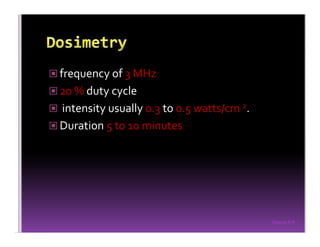
frequency of 3 MHz
20 % duty cycle
intensity usually 0.3 to 0.5 watts/cm 2.
Duration 5 to 10 minutes
Sreeraj S R
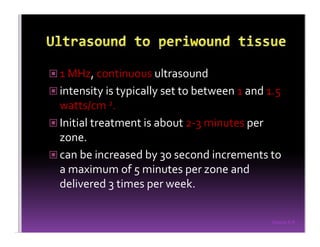
1 MHz, continuous ultrasound
intensity is typically set to between 1 and 1.5
watts/cm 2.
Initial treatment is about 2-3 minutes per
zone.
can be increased by 30 second increments to
a maximum of 5 minutes per zone and
delivered 3 times per week.
Sreeraj S R
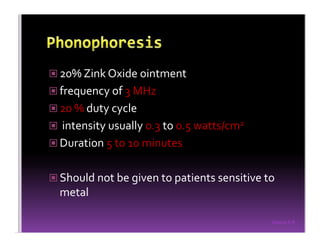
20% Zink Oxide ointment
frequency of 3 MHz
20 % duty cycle
intensity usually 0.3 to 0.5 watts/cm2
Duration 5 to 10 minutes
Should not be given to patients sensitive to
metal
Sreeraj S R
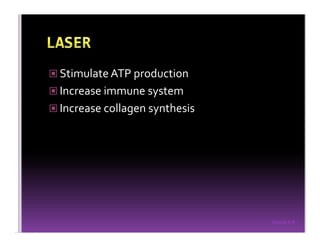
Stimulate ATP production
Increase immune system
Increase collagen synthesis
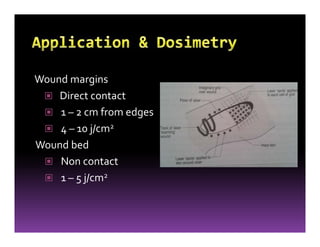
Wound margins
Direct contact
1 – 2 cm from edges
4 – 10 j/cm2
Wound bed
Non contact
1 – 5 j/cm2
Sreeraj S R
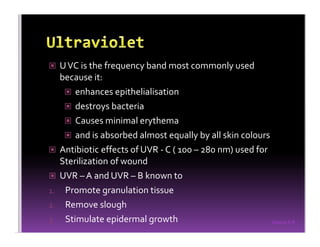
UVC is the frequency band most commonly used
because it:
enhances epithelialisation
destroys bacteria
Causes minimal erythema
and is absorbed almost equally by all skin colours
Antibiotic effects of UVR - C ( 100 – 280 nm) used for
Sterilization of wound
UVR – A and UVR – B known to
1. Promote granulation tissue
2. Remove slough
3. Stimulate epidermal growth
Sreeraj S R
Sreeraj S R
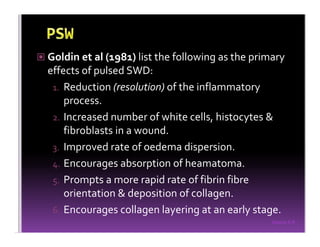
Goldin et al (1981) list the following as the primary
effects of pulsed SWD:
1. Reduction (resolution) of the inflammatory
process.
2. Increased number of white cells, histocytes &
fibroblasts in a wound.
3. Improved rate of oedema dispersion.
4. Encourages absorption of heamatoma.
5. Prompts a more rapid rate of fibrin fibre
orientation & deposition of collagen.
6. Encourages collagen layering at an early stage.
Sreeraj S R
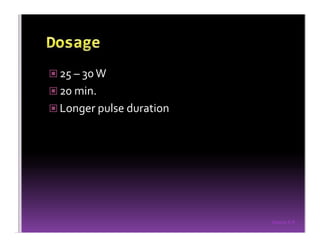
25 – 30 W
20 min.
Longer pulse duration
Sreeraj S R
Wound Healing
Sreeraj S R
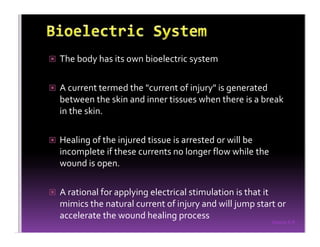
The body has its own bioelectric system
A current termed the "current of injury" is generated
between the skin and inner tissues when there is a break
in the skin.
Healing of the injured tissue is arrested or will be
incomplete if these currents no longer flow while the
wound is open.
A rational for applying electrical stimulation is that it
mimics the natural current of injury and will jump start or
accelerate the wound healing process
Sreeraj S R
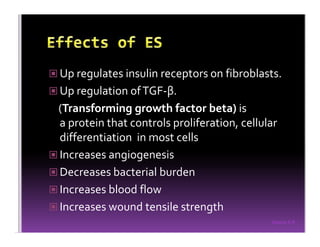
Up regulates insulin receptors on fibroblasts.
Up regulation ofTGF-β.
(Transforming growth factor beta) is
a protein that controls proliferation, cellular
differentiation in most cells
Increases angiogenesis
Decreases bacterial burden
Increases blood flow
Increases wound tensile strength
Sreeraj S R
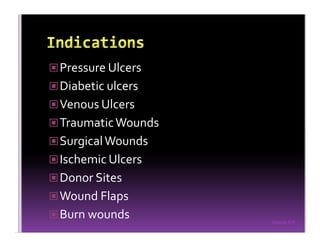
Pressure Ulcers
Diabetic ulcers
Venous Ulcers
TraumaticWounds
SurgicalWounds
Ischemic Ulcers
Donor Sites
Wound Flaps
Burn wounds
Sreeraj S R
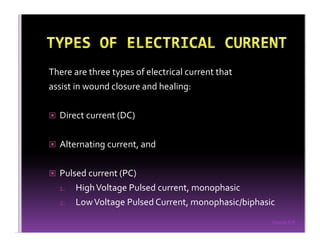
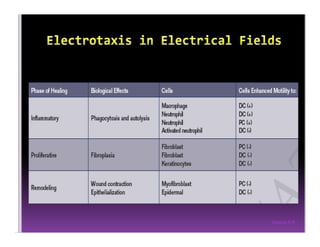
There are three types of electrical current that
assist in wound closure and healing:
Direct current (DC)
Alternating current, and
Pulsed current (PC)
1. HighVoltage Pulsed current, monophasic
2. LowVoltage Pulsed Current, monophasic/biphasic
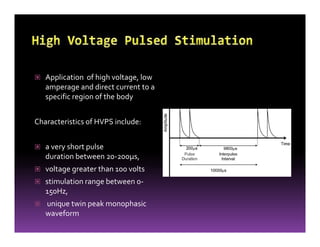
Application of high voltage, low
amperage and direct current to a
specific region of the body
Characteristics of HVPS include:
a very short pulse
duration between 20-200µs,
voltage greater than 100 volts
stimulation range between 0-
150Hz,
unique twin peak monophasic
waveform
Sreeraj S R
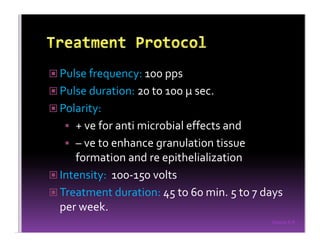
Pulse frequency: 100 pps
Pulse duration: 20 to 100 µ sec.
Polarity:
+ ve for anti microbial effects and
– ve to enhance granulation tissue
formation and re epithelialization
Intensity: 100-150 volts
Treatment duration: 45 to 60 min. 5 to 7 days
per week.
Sreeraj S R
Sreeraj S R
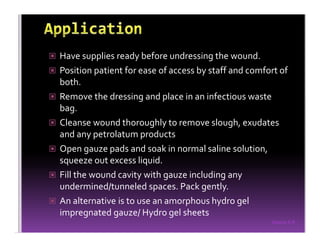
Have supplies ready before undressing the wound.
Position patient for ease of access by staff and comfort of
both.
Remove the dressing and place in an infectious waste
bag.
Cleanse wound thoroughly to remove slough, exudates
and any petrolatum products
Open gauze pads and soak in normal saline solution,
squeeze out excess liquid.
Fill the wound cavity with gauze including any
undermined/tunneled spaces. Pack gently.
An alternative is to use an amorphous hydro gel
impregnated gauze/ Hydro gel sheets
Sreeraj S R
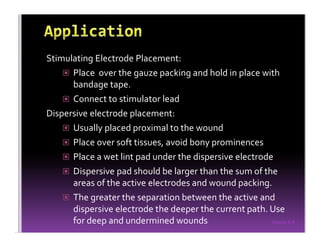
Stimulating Electrode Placement:
Place over the gauze packing and hold in place with
bandage tape.
Connect to stimulator lead
Dispersive electrode placement:
Usually placed proximal to the wound
Place over soft tissues, avoid bony prominences
Place a wet lint pad under the dispersive electrode
Dispersive pad should be larger than the sum of the
areas of the active electrodes and wound packing.
The greater the separation between the active and
dispersive electrode the deeper the current path. Use
for deep and undermined wounds
Sreeraj S R
1. Georgina G.The importance of continuous wound measuring. Wounds UK, 2006,Vol
2, No 2. 60-68
2. http://www.worldwidewounds.com/2006/january/Fette/Clinimetric-Analysis-
Wound-Measurement-Tools.html#ref10
3. http://medicaledu.com/ultrasnd.htm
4. http://www.campbellteaching.co.uk/sample.pdf
5. Electrotherapy explained, 4th edition, Low & Reed, Elsevier
6. Clayton’s electrotherapy, 10th edition, Sheila Kitchen
7. Handbook of practical electrotherapy, Mitra PK, Jaypee publications
8. Physical Agents in Rehabilitation, From Research to Practice, 2nd edition, Michelle
H. Cameron, Saunders Elsevier
9. David Cukjati, Rajmond Savrin. Electric Current Wound Healing.
10. Katheriene Lampe, Electrotherapy inTissue Repair, Journal of HandTherapy, 1998,
131 – 138
11. Julia Shaw , Patrick M. Bell. Wound Measurement in Diabetic Foot Ulceration.
Global Perspective on Diabetic Foot Ulcerations. InTech 2011. 72 - 82

Electrotherapy in wound healing

  • 1.
  • 2.
    Sreeraj S R Pathological/ physical insult Inflammatory Phase Proliferation Phase Maturation Phase Vasoconstriction Vasodilatation Clot Formation Phagocytosis Epithelialization Fibroplasia / Collagen Formation Wound Contraction Neovascularization Collagen synthesis/ Lysis Collagen fiber orientation Healed Injury Normal Phases of Repair 21 3
  • 3.
  • 4.
  • 5.
  • 6.
    1. Healing byprimary intention 2. Healing by secondary intention 3. Delayed primary closure
  • 7.
    Infection Poor hygiene Local bloodsupply Oedema Inhibited wound oxygenation Smoking Cooling of the wound Delayed inflammatory response Insufficient diet or malnutrition Proteins Carbohydrates Fats Vitamins Minerals Psychological Stress Age effects Diabetes mellitus
  • 8.
    Sreeraj S R Thepurpose of any wound measurement is to monitor the progress of healing through changes in the length, width, area or volume of a wound. Part of initial assessment Aids re-evaluation for accurate communication between professionals Objective form of assessment Enhances quality of patient care Monitors treatment efficacy May help predict healing Enhances overall wound management
  • 9.
    Sreeraj S R Simplemeasurements: measuring its linear dimensions with a tape measure or ruler like length x width. Wound tracing: a pen is used to trace the outline of the wound directly onto sterile transparent film. Moulds: A three-dimensional mould of the wound can be created by taking a cast of the wound cavity using a saline or alginate filling. Scaled photographs: This uses a photograph processed by a special used to calculate length and width, which are expressed in simple measurements. Planimetrics: A transparent sheet of graph paper is laid over the photograph or wound tracing, and the number of complete graph squares within the boundaries of the wound are added up to produce a scale area calculation by using either manually or using a computer. Computerized stereophotogrammetry:This uses two pictures of the same area taken from different known positions to produce a three- dimensional image for measurement.
  • 10.
  • 11.
  • 12.
    Sreeraj S R HighFrequency modalities used to promote wound healing are… 1. Ultrasound 2. LASER 3. Ultraviolet 4. PSW
  • 13.
    Sreeraj S R Ultrasoundbenefit wound healing in.. 1. Inflammatory Phase : causes a degranulation of mast cells resulting in the release of histamine. 2. Proliferative Phase : effect fibroblasts and stimulate them to secrete collagen.This can accelerate the process of wound contraction and increase tensile strength of the healing tissue
  • 14.
    Sreeraj S R 1.Treat at the lowest intensity. 2. Assure that the applicator is kept in constant motion throughout treatment 3. Proper acoustic coupling medium is used. 4. Reduce the intensity or terminate treatment if the patient complains of any increase in pain.
  • 15.
    1. remove dressingsand clean wound 2. A hydro gel sheet should be placed in direct contact with the wound bed and wound margins 3. In cases of cavity type of wound a sterile aqueous hydro gel filler should be used.The cavity is filled with the aqueous gel and then covered wit the hydro gel sheet 4. Apply an ultrasonic coupling gel on top of the sheet. 5. Remove all underlying air bubbles
  • 16.
    Sreeraj S R frequencyof 3 MHz 20 % duty cycle intensity usually 0.3 to 0.5 watts/cm 2. Duration 5 to 10 minutes
  • 17.
    Sreeraj S R 1MHz, continuous ultrasound intensity is typically set to between 1 and 1.5 watts/cm 2. Initial treatment is about 2-3 minutes per zone. can be increased by 30 second increments to a maximum of 5 minutes per zone and delivered 3 times per week.
  • 18.
    Sreeraj S R 20%Zink Oxide ointment frequency of 3 MHz 20 % duty cycle intensity usually 0.3 to 0.5 watts/cm2 Duration 5 to 10 minutes Should not be given to patients sensitive to metal
  • 19.
    Sreeraj S R StimulateATP production Increase immune system Increase collagen synthesis
  • 20.
    Wound margins Direct contact 1– 2 cm from edges 4 – 10 j/cm2 Wound bed Non contact 1 – 5 j/cm2
  • 21.
    Sreeraj S R UVCis the frequency band most commonly used because it: enhances epithelialisation destroys bacteria Causes minimal erythema and is absorbed almost equally by all skin colours Antibiotic effects of UVR - C ( 100 – 280 nm) used for Sterilization of wound UVR – A and UVR – B known to 1. Promote granulation tissue 2. Remove slough 3. Stimulate epidermal growth
  • 22.
  • 23.
    Sreeraj S R Goldinet al (1981) list the following as the primary effects of pulsed SWD: 1. Reduction (resolution) of the inflammatory process. 2. Increased number of white cells, histocytes & fibroblasts in a wound. 3. Improved rate of oedema dispersion. 4. Encourages absorption of heamatoma. 5. Prompts a more rapid rate of fibrin fibre orientation & deposition of collagen. 6. Encourages collagen layering at an early stage.
  • 24.
    Sreeraj S R 25– 30 W 20 min. Longer pulse duration
  • 25.
  • 26.
    Sreeraj S R Thebody has its own bioelectric system A current termed the "current of injury" is generated between the skin and inner tissues when there is a break in the skin. Healing of the injured tissue is arrested or will be incomplete if these currents no longer flow while the wound is open. A rational for applying electrical stimulation is that it mimics the natural current of injury and will jump start or accelerate the wound healing process
  • 27.
    Sreeraj S R Upregulates insulin receptors on fibroblasts. Up regulation ofTGF-β. (Transforming growth factor beta) is a protein that controls proliferation, cellular differentiation in most cells Increases angiogenesis Decreases bacterial burden Increases blood flow Increases wound tensile strength
  • 28.
    Sreeraj S R PressureUlcers Diabetic ulcers Venous Ulcers TraumaticWounds SurgicalWounds Ischemic Ulcers Donor Sites Wound Flaps Burn wounds
  • 29.
    Sreeraj S R Thereare three types of electrical current that assist in wound closure and healing: Direct current (DC) Alternating current, and Pulsed current (PC) 1. HighVoltage Pulsed current, monophasic 2. LowVoltage Pulsed Current, monophasic/biphasic
  • 30.
    Application of highvoltage, low amperage and direct current to a specific region of the body Characteristics of HVPS include: a very short pulse duration between 20-200µs, voltage greater than 100 volts stimulation range between 0- 150Hz, unique twin peak monophasic waveform
  • 31.
    Sreeraj S R Pulsefrequency: 100 pps Pulse duration: 20 to 100 µ sec. Polarity: + ve for anti microbial effects and – ve to enhance granulation tissue formation and re epithelialization Intensity: 100-150 volts Treatment duration: 45 to 60 min. 5 to 7 days per week.
  • 32.
  • 33.
    Sreeraj S R Havesupplies ready before undressing the wound. Position patient for ease of access by staff and comfort of both. Remove the dressing and place in an infectious waste bag. Cleanse wound thoroughly to remove slough, exudates and any petrolatum products Open gauze pads and soak in normal saline solution, squeeze out excess liquid. Fill the wound cavity with gauze including any undermined/tunneled spaces. Pack gently. An alternative is to use an amorphous hydro gel impregnated gauze/ Hydro gel sheets
  • 34.
    Sreeraj S R StimulatingElectrode Placement: Place over the gauze packing and hold in place with bandage tape. Connect to stimulator lead Dispersive electrode placement: Usually placed proximal to the wound Place over soft tissues, avoid bony prominences Place a wet lint pad under the dispersive electrode Dispersive pad should be larger than the sum of the areas of the active electrodes and wound packing. The greater the separation between the active and dispersive electrode the deeper the current path. Use for deep and undermined wounds
  • 35.
    Sreeraj S R 1.Georgina G.The importance of continuous wound measuring. Wounds UK, 2006,Vol 2, No 2. 60-68 2. http://www.worldwidewounds.com/2006/january/Fette/Clinimetric-Analysis- Wound-Measurement-Tools.html#ref10 3. http://medicaledu.com/ultrasnd.htm 4. http://www.campbellteaching.co.uk/sample.pdf 5. Electrotherapy explained, 4th edition, Low & Reed, Elsevier 6. Clayton’s electrotherapy, 10th edition, Sheila Kitchen 7. Handbook of practical electrotherapy, Mitra PK, Jaypee publications 8. Physical Agents in Rehabilitation, From Research to Practice, 2nd edition, Michelle H. Cameron, Saunders Elsevier 9. David Cukjati, Rajmond Savrin. Electric Current Wound Healing. 10. Katheriene Lampe, Electrotherapy inTissue Repair, Journal of HandTherapy, 1998, 131 – 138 11. Julia Shaw , Patrick M. Bell. Wound Measurement in Diabetic Foot Ulceration. Global Perspective on Diabetic Foot Ulcerations. InTech 2011. 72 - 82