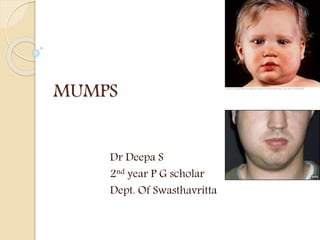
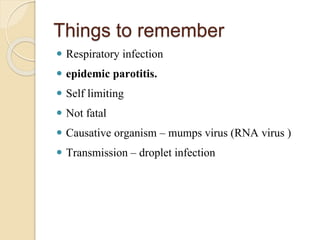
MUMPS
Dr Deepa S
2nd year P G scholar
Dept. Of Swasthavritta
Things to remember
 Respiratory infection
 epidemic parotitis.
 Self limiting
 Not fatal
 Causative organism – mumps virus (RNA virus )
 Transmission – droplet infection
 Mumps typically starts with a few days of fever,
headache, muscle aches, tiredness, loss of
appetite, and is followed by painful swelling of
salivary glands.
3
Agent factors
 AGENT :- RNA VIRUS of PARAMYXOVIRUS
family
Genus :- Rubula virus
 Can be grown readily in chick embryo or tissue
culture
 There is only 1 serotype
 SOURCE OF INFECTION :- Both clinical and
subclinical (30-40% of all cases)
• Virus can be isolated from the saliva and from swabs
taken from the surface of stenson’s duct
• Also found in blood urine human milk and occasionally in
CSF
 PERIOD OF COMMUNICABILITY
• Usually 4 – 6 days before the onset of symptoms
and a week or more there after
• Period of maximum infectivity :- just before and at
the onset of swelling
• No longer infectious after the swelling is subsided
Host factors
 Age &sex :- mostly in children of age group 5 – 9 yrs
•More severe in adults than children
• Immunity :- 1 attack , clinical or subclinical is
assumed to induce lifelong immunity
• Most infants below the age of 6 months are
immune because of maternal antibodies
Environmental factors
 Endemic disease
 Case occur throughout the year
 Peak incidence is in winter and spring
 Epidemics are often associated with overcrowding
Mode of transmission
 Mainly by droplet infection and after direct contact
with the infected persons .
Incubation period
Varies from 2 – 3 weeks , usually 18 days
Clinical features
 Pain and swelling in either one or both the parotid
glands
 Sublingual and submandibular glands may also involve
 Earache often present on the affected side prior to the
onset of swelling
 Pain and swelling in the opening of mouth before the
swelling is evident .
 May also affect the testes , pancrease , CNS , ovaries ,
prostrate etc..
 In severe cases there may be fever , headache and
other constitutional symptoms which last for 3 – 5
days .
 Swelling subsides slowly over 1 – 2 weeks
complications

Mumps

  • 1.
    MUMPS Dr Deepa S 2ndyear P G scholar Dept. Of Swasthavritta
  • 2.
    Things to remember Respiratory infection  epidemic parotitis.  Self limiting  Not fatal  Causative organism – mumps virus (RNA virus )  Transmission – droplet infection
  • 3.
     Mumps typicallystarts with a few days of fever, headache, muscle aches, tiredness, loss of appetite, and is followed by painful swelling of salivary glands. 3
  • 4.
    Agent factors  AGENT:- RNA VIRUS of PARAMYXOVIRUS family Genus :- Rubula virus  Can be grown readily in chick embryo or tissue culture  There is only 1 serotype
  • 5.
     SOURCE OFINFECTION :- Both clinical and subclinical (30-40% of all cases) • Virus can be isolated from the saliva and from swabs taken from the surface of stenson’s duct • Also found in blood urine human milk and occasionally in CSF
  • 6.
     PERIOD OFCOMMUNICABILITY • Usually 4 – 6 days before the onset of symptoms and a week or more there after • Period of maximum infectivity :- just before and at the onset of swelling • No longer infectious after the swelling is subsided
  • 7.
    Host factors  Age&sex :- mostly in children of age group 5 – 9 yrs •More severe in adults than children • Immunity :- 1 attack , clinical or subclinical is assumed to induce lifelong immunity • Most infants below the age of 6 months are immune because of maternal antibodies
  • 8.
    Environmental factors  Endemicdisease  Case occur throughout the year  Peak incidence is in winter and spring  Epidemics are often associated with overcrowding
  • 9.
    Mode of transmission Mainly by droplet infection and after direct contact with the infected persons . Incubation period Varies from 2 – 3 weeks , usually 18 days
  • 10.
    Clinical features  Painand swelling in either one or both the parotid glands  Sublingual and submandibular glands may also involve  Earache often present on the affected side prior to the onset of swelling  Pain and swelling in the opening of mouth before the swelling is evident .  May also affect the testes , pancrease , CNS , ovaries , prostrate etc..
  • 11.
     In severecases there may be fever , headache and other constitutional symptoms which last for 3 – 5 days .  Swelling subsides slowly over 1 – 2 weeks
  • 12.