BACTERIAL
MENINGITIS
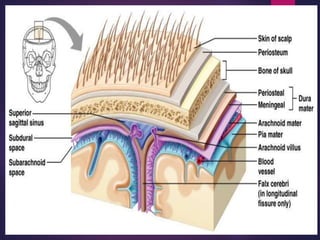
The meninges is the system of membranes which envelops
the central nervous system.
The meninges consist of three layers:
•Dura mater - thick, durable membrane, closest to the skull.
•Arachnoid mater - thin, transparent membrane. Named
because of its spider web-like appearance. It provides a
cushioning effect for the central nervous system.
•Pia mater – it’s a very delicate membrane, which forms the
meningeal envelope and firmly adheres to the surface of the
brain and spinal cord.
**subarachnoid space - is the space which normally exists
between the arachnoid and the pia mater, which is filled with
cerebrospinal fluid.
Meningitis is inflammation of the membranes (meninges)
surrounding brain and spinal cord .
•Infection predominantly involves the subarachnoid space
•Bacterial meningitis is caused by an infection of bacteria.
•The most serious form of bacterial meningitis is called acute
bacterial meningitis.
•Acute bacterial meningitis develops within hours or days and
can be rapidly fatal .
•It Can cause permanent complications if not recognized and
treated immediately.
•Bacteria which cause meningitis Are as follow:
1. Streptococcus pneumonia (Most common),
2. N. meningitidis (Second most common),
3. Group B streptococci
4. Listeria monocytogenes
5. H. influenza
•Now these days Streptococcus pneumoniae and Neisseria
meningitidis are the leading causes of bacterial meningitis
S. pneumonia - the most common cause of meningitis in
adults >20 years of age.
50% of all cases of bacterial meningitis
Mortality remains ∼20% despite antibiotic therapy.
Factors they may increase the risk:
•Alcohol use
• diabetes
•History of meningitis
• Infection of a heart valve with S pneumoniae
•Injury or trauma to the head
•Meningitis in which there is leakage of spinal fluid
•Recent ear infection with S pneumoniae
•Recent pneumonia with S pneumoniae
•Recent upper respiratory infection
•Spleen removal or a spleen that does not function
•Head trauma with basilar skull fracture and CSF rhinorrhea.
N. meningitidis
 25% of all cases of bacterial meningitis
 60% of cases in children and young adults between the ages of
2 and 20.
 Petechial or purpuric skin lesions
 Nasopharyngeal colonization results in either:
1. an asymptomatic carrier state
2. invasive meningococcal disease - risk depends on bacterial
virulence factors and host immune defenses – capacity to produce
anti-meningococcal antibodies and to lyse meningococci by
complement
 The Individuals with deficiencies of any of the complement
components - highly susceptible to meningococcal infections.
Listeria monocytogenes - important cause of meningitis in:
Neonates (<1 month of age),
Pregnant women,
Individuals >60 years,
Immunocompromised individuals of all ages.
Infection is acquired by ingesting foods contaminated by Listeria.
contaminated coleslaw, milk, soft cheeses, and “ready-to-eat”
foods - delicatessen meat and uncooked hotdogs.
H. Influenzae type b meningitis in children has declined
dramatically since the introduction of the Hib conjugate vaccine.
H. influenzae causes meningitis in unvaccinated children and
adults.
PATHOPHYSIOLOGY
Bacteria are able to multiply rapidly in CSF:
• Normal CSF contains
few white blood cells (WBCs) (<5 cells)
small amounts of complement proteins and immunoglobulins. (<50mg/dl
glucose(40-80mg/dl)
• fluid nature of CSF - less conducive to phagocytosis than a solid tissue
• The immune response to the invading pathogen - Critical event
• The lysis of bacteria and release of cell-wall components into the subarachnoid
space – induces inflammatory response
• Many neurologic manifestations and complications result from the immune
response rather than from direct bacteria-induced tissue injury.
• Inflammatory cytokines (tumor necrosis factor (TNF) and interleukin 1 (IL-1))
are released - increase in CSF proteins and leukocytes.
• TNF and IL-1 increase the permeability of the blood-brain barrier:
1. induction of vasogenic edema
2. leakage of serum proteins into the subarachnoid space
• proteinaceous material and leukocytes - obstruct the flow of CSF
• Resorptive capacity of the arachnoid granulations in the dural sinuses diminishes
• obstructive and communicating hydrocephalus and interstitial edema.
 Neutrophil degranulation - release of toxic metabolites - cytotoxic edema, cell
injury, and death.
 Vasculitis - Infiltration of the arterial wall by inflammatory cells with intimal thickening
• may result in ischemia and infarction,
• The combination of interstitial, vasogenic, and cytotoxic edema leads to raised
ICP and coma.
PATHOPHYSIOLOGY
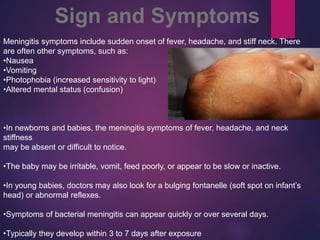
Meningitis symptoms include sudden onset of fever, headache, and stiff neck. There
are often other symptoms, such as:
•Nausea
•Vomiting
•Photophobia (increased sensitivity to light)
•Altered mental status (confusion)
•In newborns and babies, the meningitis symptoms of fever, headache, and neck
stiffness
may be absent or difficult to notice.
•The baby may be irritable, vomit, feed poorly, or appear to be slow or inactive.
•In young babies, doctors may also look for a bulging fontanelle (soft spot on infant’s
head) or abnormal reflexes.
•Symptoms of bacterial meningitis can appear quickly or over several days.
•Typically they develop within 3 to 7 days after exposure
Sign and Symptoms
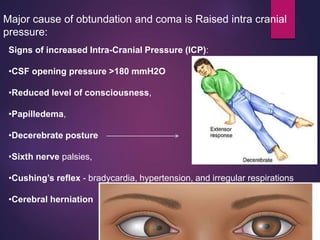
Major cause of obtundation and coma is Raised intra cranial
pressure:
Signs of increased Intra-Cranial Pressure (ICP):
•CSF opening pressure >180 mmH2O
•Reduced level of consciousness,
•Papilledema,
•Decerebrate posture
•Sixth nerve palsies,
•Cushing’s reflex - bradycardia, hypertension, and irregular respirations
•Cerebral herniation
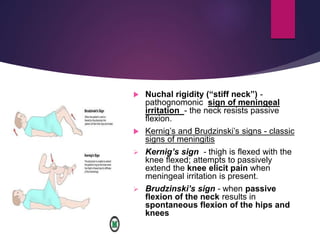
 Nuchal rigidity (“stiff neck”) -
pathognomonic sign of meningeal
irritation - the neck resists passive
flexion.
 Kernig’s and Brudzinski’s signs - classic
signs of meningitis
 Kernig’s sign - thigh is flexed with the
knee flexed; attempts to passively
extend the knee elicit pain when
meningeal irritation is present.
 Brudzinski’s sign - when passive
flexion of the neck results in
spontaneous flexion of the hips and
knees
•Bacterial meningitis can happen at any age, but infants are more
susceptible.
Other factors that increase the risk include:
1. an anatomical defect or trauma, such as a skull fracture, and some kinds
of surgery, if these allow a way for bacteria to enter the nervous system
2. an infection in the head or neck area
3. spending time in communities, for example, at school or college
4. living in or traveling to certain locations, such as sub-Saharan Africa
5. having a weakened immune system, due to a medical condition or
treatment
6. working in laboratories and other settings where meningitis pathogens
are present
7. Recurrent bacterial meningitis is possible but rare. Studies show that 59
percent of recurrent cases are due to anatomical defects, and 36 percent
Risk Factor
Diagnosis
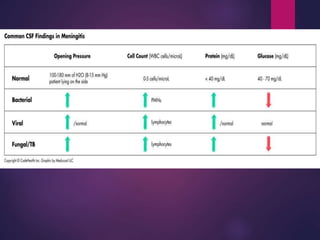
• The classic CSF abnormalities in bacterial meningitis are:
1. polymorphonuclear (PMN) leukocytosis (>100 cells/μL in
90%),
2. Decreased glucose concentration [<2.2 mmol/L (<40
mg/dL)
3. CSF/ serum glucose ratio of <0.4 in ∼60%,
4. Increased protein concentration [>0.45 g/L (>45 mg/dL) in
90%],
5. Increased opening pressure (>180 mmH2O in 90%).
6. CSF bacterial cultures - positive in >80% of patients,
7. CSF Gram’s stain demonstrates organisms in >60%
• PCR - detect small numbers of organisms in CSF – used in
patients who have been pretreated with antibiotics
• If LP is delayed to obtain neuroimaging studies - empirical
Diagnosis
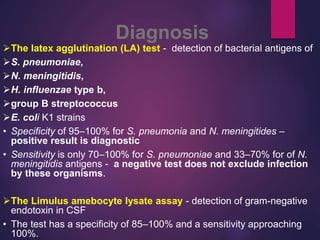
The latex agglutination (LA) test - detection of bacterial antigens of
S. pneumoniae,
N. meningitidis,
H. influenzae type b,
group B streptococcus
E. coli K1 strains
• Specificity of 95–100% for S. pneumonia and N. meningitides –
positive result is diagnostic
• Sensitivity is only 70–100% for S. pneumoniae and 33–70% for of N.
meningitidis antigens - a negative test does not exclude infection
by these organisms.
The Limulus amebocyte lysate assay - detection of gram-negative
endotoxin in CSF
• The test has a specificity of 85–100% and a sensitivity approaching
100%.
Treatment:
• Bacterial meningitis is a medical emergency.
• The goal is to begin antibiotic therapy within 60 min of a
patient’s arrival in the emergency room.
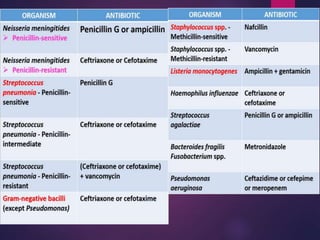
• Empirical antimicrobial therapy
EMPIRICAL ANTIMICROBIAL THERAPY of bacterial
meningitis is combination of:
• Dexamethasone,
• A third- generation cephalosporin (ceftriaxone or cefotaxime)
• Vancomycin,
• Acyclovir - HSV encephalitis is in the differential diagnosis,
• Doxycycline - during tick season to treat tick-borne bacterial
infections.
• Ampicillin - for coverage of L.monocytogenes .
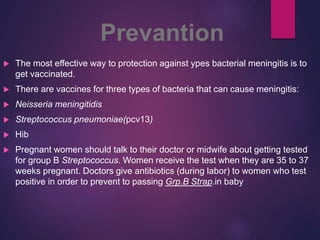
Prevantion
 The most effective way to protection against ypes bacterial meningitis is to
get vaccinated.
 There are vaccines for three types of bacteria that can cause meningitis:
 Neisseria meningitidis
 Streptococcus pneumoniae(pcv13)
 Hib
 Pregnant women should talk to their doctor or midwife about getting tested
for group B Streptococcus. Women receive the test when they are 35 to 37
weeks pregnant. Doctors give antibiotics (during labor) to women who test
positive in order to prevent to passing Grp.B Strap.in baby
Refrences
 https://www.cdc.gov/meningitis/bacterial.html
 https://www.medicalnewstoday.com/articles/9276.php
 Harrisons book of infectious disease

bacterial meningitis

  • 1.
  • 2.
    The meninges isthe system of membranes which envelops the central nervous system. The meninges consist of three layers: •Dura mater - thick, durable membrane, closest to the skull. •Arachnoid mater - thin, transparent membrane. Named because of its spider web-like appearance. It provides a cushioning effect for the central nervous system. •Pia mater – it’s a very delicate membrane, which forms the meningeal envelope and firmly adheres to the surface of the brain and spinal cord. **subarachnoid space - is the space which normally exists between the arachnoid and the pia mater, which is filled with cerebrospinal fluid.
  • 4.
    Meningitis is inflammationof the membranes (meninges) surrounding brain and spinal cord . •Infection predominantly involves the subarachnoid space •Bacterial meningitis is caused by an infection of bacteria. •The most serious form of bacterial meningitis is called acute bacterial meningitis. •Acute bacterial meningitis develops within hours or days and can be rapidly fatal . •It Can cause permanent complications if not recognized and treated immediately.
  • 5.
    •Bacteria which causemeningitis Are as follow: 1. Streptococcus pneumonia (Most common), 2. N. meningitidis (Second most common), 3. Group B streptococci 4. Listeria monocytogenes 5. H. influenza •Now these days Streptococcus pneumoniae and Neisseria meningitidis are the leading causes of bacterial meningitis
  • 6.
    S. pneumonia -the most common cause of meningitis in adults >20 years of age. 50% of all cases of bacterial meningitis Mortality remains ∼20% despite antibiotic therapy. Factors they may increase the risk: •Alcohol use • diabetes •History of meningitis • Infection of a heart valve with S pneumoniae •Injury or trauma to the head •Meningitis in which there is leakage of spinal fluid •Recent ear infection with S pneumoniae •Recent pneumonia with S pneumoniae •Recent upper respiratory infection •Spleen removal or a spleen that does not function •Head trauma with basilar skull fracture and CSF rhinorrhea.
  • 7.
    N. meningitidis  25%of all cases of bacterial meningitis  60% of cases in children and young adults between the ages of 2 and 20.  Petechial or purpuric skin lesions  Nasopharyngeal colonization results in either: 1. an asymptomatic carrier state 2. invasive meningococcal disease - risk depends on bacterial virulence factors and host immune defenses – capacity to produce anti-meningococcal antibodies and to lyse meningococci by complement  The Individuals with deficiencies of any of the complement components - highly susceptible to meningococcal infections.
  • 8.
    Listeria monocytogenes -important cause of meningitis in: Neonates (<1 month of age), Pregnant women, Individuals >60 years, Immunocompromised individuals of all ages. Infection is acquired by ingesting foods contaminated by Listeria. contaminated coleslaw, milk, soft cheeses, and “ready-to-eat” foods - delicatessen meat and uncooked hotdogs. H. Influenzae type b meningitis in children has declined dramatically since the introduction of the Hib conjugate vaccine. H. influenzae causes meningitis in unvaccinated children and adults.
  • 9.
    PATHOPHYSIOLOGY Bacteria are ableto multiply rapidly in CSF: • Normal CSF contains few white blood cells (WBCs) (<5 cells) small amounts of complement proteins and immunoglobulins. (<50mg/dl glucose(40-80mg/dl) • fluid nature of CSF - less conducive to phagocytosis than a solid tissue • The immune response to the invading pathogen - Critical event • The lysis of bacteria and release of cell-wall components into the subarachnoid space – induces inflammatory response • Many neurologic manifestations and complications result from the immune response rather than from direct bacteria-induced tissue injury. • Inflammatory cytokines (tumor necrosis factor (TNF) and interleukin 1 (IL-1)) are released - increase in CSF proteins and leukocytes.
  • 10.
    • TNF andIL-1 increase the permeability of the blood-brain barrier: 1. induction of vasogenic edema 2. leakage of serum proteins into the subarachnoid space • proteinaceous material and leukocytes - obstruct the flow of CSF • Resorptive capacity of the arachnoid granulations in the dural sinuses diminishes • obstructive and communicating hydrocephalus and interstitial edema.  Neutrophil degranulation - release of toxic metabolites - cytotoxic edema, cell injury, and death.  Vasculitis - Infiltration of the arterial wall by inflammatory cells with intimal thickening • may result in ischemia and infarction, • The combination of interstitial, vasogenic, and cytotoxic edema leads to raised ICP and coma. PATHOPHYSIOLOGY
  • 11.
    Meningitis symptoms includesudden onset of fever, headache, and stiff neck. There are often other symptoms, such as: •Nausea •Vomiting •Photophobia (increased sensitivity to light) •Altered mental status (confusion) •In newborns and babies, the meningitis symptoms of fever, headache, and neck stiffness may be absent or difficult to notice. •The baby may be irritable, vomit, feed poorly, or appear to be slow or inactive. •In young babies, doctors may also look for a bulging fontanelle (soft spot on infant’s head) or abnormal reflexes. •Symptoms of bacterial meningitis can appear quickly or over several days. •Typically they develop within 3 to 7 days after exposure Sign and Symptoms
  • 12.
    Major cause ofobtundation and coma is Raised intra cranial pressure: Signs of increased Intra-Cranial Pressure (ICP): •CSF opening pressure >180 mmH2O •Reduced level of consciousness, •Papilledema, •Decerebrate posture •Sixth nerve palsies, •Cushing’s reflex - bradycardia, hypertension, and irregular respirations •Cerebral herniation
  • 13.
     Nuchal rigidity(“stiff neck”) - pathognomonic sign of meningeal irritation - the neck resists passive flexion.  Kernig’s and Brudzinski’s signs - classic signs of meningitis  Kernig’s sign - thigh is flexed with the knee flexed; attempts to passively extend the knee elicit pain when meningeal irritation is present.  Brudzinski’s sign - when passive flexion of the neck results in spontaneous flexion of the hips and knees
  • 14.
    •Bacterial meningitis canhappen at any age, but infants are more susceptible. Other factors that increase the risk include: 1. an anatomical defect or trauma, such as a skull fracture, and some kinds of surgery, if these allow a way for bacteria to enter the nervous system 2. an infection in the head or neck area 3. spending time in communities, for example, at school or college 4. living in or traveling to certain locations, such as sub-Saharan Africa 5. having a weakened immune system, due to a medical condition or treatment 6. working in laboratories and other settings where meningitis pathogens are present 7. Recurrent bacterial meningitis is possible but rare. Studies show that 59 percent of recurrent cases are due to anatomical defects, and 36 percent Risk Factor
  • 15.
    Diagnosis • The classicCSF abnormalities in bacterial meningitis are: 1. polymorphonuclear (PMN) leukocytosis (>100 cells/μL in 90%), 2. Decreased glucose concentration [<2.2 mmol/L (<40 mg/dL) 3. CSF/ serum glucose ratio of <0.4 in ∼60%, 4. Increased protein concentration [>0.45 g/L (>45 mg/dL) in 90%], 5. Increased opening pressure (>180 mmH2O in 90%). 6. CSF bacterial cultures - positive in >80% of patients, 7. CSF Gram’s stain demonstrates organisms in >60% • PCR - detect small numbers of organisms in CSF – used in patients who have been pretreated with antibiotics • If LP is delayed to obtain neuroimaging studies - empirical
  • 17.
    Diagnosis The latex agglutination(LA) test - detection of bacterial antigens of S. pneumoniae, N. meningitidis, H. influenzae type b, group B streptococcus E. coli K1 strains • Specificity of 95–100% for S. pneumonia and N. meningitides – positive result is diagnostic • Sensitivity is only 70–100% for S. pneumoniae and 33–70% for of N. meningitidis antigens - a negative test does not exclude infection by these organisms. The Limulus amebocyte lysate assay - detection of gram-negative endotoxin in CSF • The test has a specificity of 85–100% and a sensitivity approaching 100%.
  • 18.
    Treatment: • Bacterial meningitisis a medical emergency. • The goal is to begin antibiotic therapy within 60 min of a patient’s arrival in the emergency room. • Empirical antimicrobial therapy EMPIRICAL ANTIMICROBIAL THERAPY of bacterial meningitis is combination of: • Dexamethasone, • A third- generation cephalosporin (ceftriaxone or cefotaxime) • Vancomycin, • Acyclovir - HSV encephalitis is in the differential diagnosis, • Doxycycline - during tick season to treat tick-borne bacterial infections. • Ampicillin - for coverage of L.monocytogenes .
  • 20.
    Prevantion  The mosteffective way to protection against ypes bacterial meningitis is to get vaccinated.  There are vaccines for three types of bacteria that can cause meningitis:  Neisseria meningitidis  Streptococcus pneumoniae(pcv13)  Hib  Pregnant women should talk to their doctor or midwife about getting tested for group B Streptococcus. Women receive the test when they are 35 to 37 weeks pregnant. Doctors give antibiotics (during labor) to women who test positive in order to prevent to passing Grp.B Strap.in baby
  • 21.