Memory Mapping
Ms. Snehalata Agasti
Department CSE
Cache
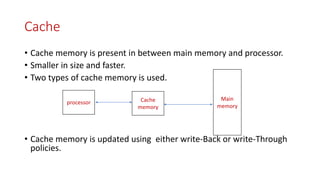
• Cache memory is present in between main memory and processor.
• Smaller in size and faster.
• Two types of cache memory is used.
• Cache memory is updated using either write-Back or write-Through
policies.
processor Cache
memory
Main
memory
Mapping
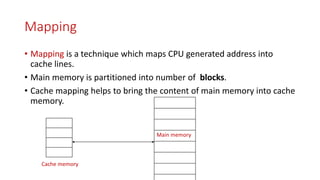
• Mapping is a technique which maps CPU generated address into
cache lines.
• Main memory is partitioned into number of blocks.
• Cache mapping helps to bring the content of main memory into cache
memory.
Cache memory
Main memory
Some important points
• Number of cache block=size of cache memory / size of each block
• Size of cache memory = Number of cache block x size of each block
• If main memory size is given M then number of bits required to
represent the address lines = log2
M
• If block size is given B then number of bits required to represent block
offset = log2
B
• If number of cache blocks =C then number of bits required to
represent cache offset= log2
C
Types of mapping
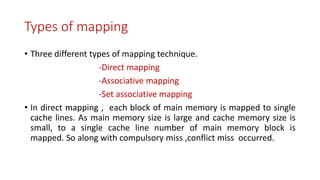
• Three different types of mapping technique.
-Direct mapping
-Associative mapping
-Set associative mapping
• In direct mapping , each block of main memory is mapped to single
cache lines. As main memory size is large and cache memory size is
small, to a single cache line number of main memory block is
mapped. So along with compulsory miss ,conflict miss occurred.
Direct mapping
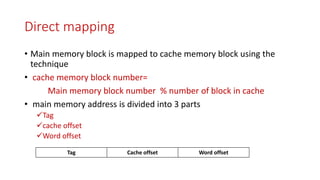
• Main memory block is mapped to cache memory block using the
technique
• cache memory block number=
Main memory block number % number of block in cache
• main memory address is divided into 3 parts
✓Tag
✓cache offset
✓Word offset
Tag Cache offset Word offset
Explanation of Cache lines mapping
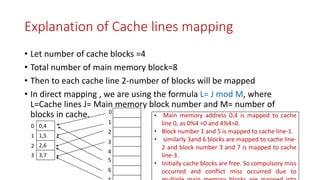
• Let number of cache blocks =4
• Total number of main memory block=8
• Then to each cache line 2-number of blocks will be mapped
• In direct mapping , we are using the formula L= J mod M, where
L=Cache lines J= Main memory block number and M= number of
blocks in cache.
0,4
1,5
2,6
3,7
0
1
3
2
0
1
2
3
4
5
6
• Main memory address 0,4 is mapped to cache
line 0, as 0%4 =0 and 4%4=0.
• Block number 1 and 5 is mapped to cache line-1.
• similarly 3and 6 blocks are mapped to cache line-
2 and block number 3 and 7 is mapped to cache
line-3.
• Initially cache blocks are free. So compulsory miss
occurred and conflict miss occurred due to
Direct Mapping Problem
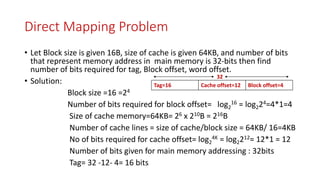
• Let Block size is given 16B, size of cache is given 64KB, and number of bits
that represent memory address in main memory is 32-bits then find
number of bits required for tag, Block offset, word offset.
• Solution:
Block size =16 =24
Number of bits required for block offset= log2
16 = log224=4*1=4
Size of cache memory=64KB= 26 x 210B = 216B
Number of cache lines = size of cache/block size = 64KB/ 16=4KB
No of bits required for cache offset= log2
4K = log2212= 12*1 = 12
Number of bits given for main memory addressing : 32bits
Tag= 32 -12- 4= 16 bits
Tag=16 Cache offset=12 Block offset=4
32
Memory mapping

Memory mapping

  • 1.
    Memory Mapping Ms. SnehalataAgasti Department CSE
  • 2.
    Cache • Cache memoryis present in between main memory and processor. • Smaller in size and faster. • Two types of cache memory is used. • Cache memory is updated using either write-Back or write-Through policies. processor Cache memory Main memory
  • 3.
    Mapping • Mapping isa technique which maps CPU generated address into cache lines. • Main memory is partitioned into number of blocks. • Cache mapping helps to bring the content of main memory into cache memory. Cache memory Main memory
  • 4.
    Some important points •Number of cache block=size of cache memory / size of each block • Size of cache memory = Number of cache block x size of each block • If main memory size is given M then number of bits required to represent the address lines = log2 M • If block size is given B then number of bits required to represent block offset = log2 B • If number of cache blocks =C then number of bits required to represent cache offset= log2 C
  • 5.
    Types of mapping •Three different types of mapping technique. -Direct mapping -Associative mapping -Set associative mapping • In direct mapping , each block of main memory is mapped to single cache lines. As main memory size is large and cache memory size is small, to a single cache line number of main memory block is mapped. So along with compulsory miss ,conflict miss occurred.
  • 6.
    Direct mapping • Mainmemory block is mapped to cache memory block using the technique • cache memory block number= Main memory block number % number of block in cache • main memory address is divided into 3 parts ✓Tag ✓cache offset ✓Word offset Tag Cache offset Word offset
  • 7.
    Explanation of Cachelines mapping • Let number of cache blocks =4 • Total number of main memory block=8 • Then to each cache line 2-number of blocks will be mapped • In direct mapping , we are using the formula L= J mod M, where L=Cache lines J= Main memory block number and M= number of blocks in cache. 0,4 1,5 2,6 3,7 0 1 3 2 0 1 2 3 4 5 6 • Main memory address 0,4 is mapped to cache line 0, as 0%4 =0 and 4%4=0. • Block number 1 and 5 is mapped to cache line-1. • similarly 3and 6 blocks are mapped to cache line- 2 and block number 3 and 7 is mapped to cache line-3. • Initially cache blocks are free. So compulsory miss occurred and conflict miss occurred due to
  • 8.
    Direct Mapping Problem •Let Block size is given 16B, size of cache is given 64KB, and number of bits that represent memory address in main memory is 32-bits then find number of bits required for tag, Block offset, word offset. • Solution: Block size =16 =24 Number of bits required for block offset= log2 16 = log224=4*1=4 Size of cache memory=64KB= 26 x 210B = 216B Number of cache lines = size of cache/block size = 64KB/ 16=4KB No of bits required for cache offset= log2 4K = log2212= 12*1 = 12 Number of bits given for main memory addressing : 32bits Tag= 32 -12- 4= 16 bits Tag=16 Cache offset=12 Block offset=4 32