MULTIPROCESSOR
CONTENTS
• Introduction
• Why Choose a Multiprocessor?
• How multiprocessor are classified?
• Interconnection structures
INTRODUCTION
• Multiprocessor system is an interconnection of two or more CPUs with memory and input-
output equipment
• The components that forms multiprocessor are CPUs IOPs connected to input –output
devices , and memory unit that may be partitioned into a number of separate modules.
• Multiprocessor are classified as multiple instruction stream, multiple data stream (MIMD)
system.
WHY CHOOSE A MULTIPROCESSOR?
• A single CPU can only go so fast, use more than one CPU to improve performance
• Multiple users
• Multiple applications
• Multi-tasking within an application
• Responsiveness and/or throughput
• Share hardware between CPUs
WHAT ARE THE DIFFERENCE BETWEEN
MULTIPROCESSOR AND MULTICOMPUTER?
MULTIPROCESSOR
• A multiprocessor system is simply a
computer that has more than one CPU on
its motherboard.
• Multiprocessing is the use of two or more
central processing units (CPUs) within a
single computer system.
MULTICOMPUTER
• A computer made up of several
computers.The term generally refers to
an architecture in which each processor
has its own memory rather than multiple
processors with a shared memory
HOW MULTIPROCESSOR ARE
CLASSIFIED?
• Multiprocessor are classified by the way their memory is organized, mainly it is classified into
two types
– Tightly coupled multiprocessor
– Loosely coupled multiprocessor
TIGHTLY COUPLED MULTIPROCESSOR
• A multiprocessor is a tightly coupled computer system having two or more processing units
(Multiple Processors) each sharing main memory and peripherals, in order to simultaneously
process programs
• Tightly coupled Multiprocessor is also know as shared memory system
LOOSELY-COUPLED MULTIPROCESSOR
• Loosely-coupled multiprocessor systems (often referred to as clusters ) are based on multiple
standalone single or dual processor commodity computers interconnected via a high speed
communication system.
• Loosely-coupled multiprocessor is also known as distributed memory.
DIFFERENCE B/W TIGHTLY COUPLED AND
LOOSELY COUPLED MULTIPROCESSOR
TIGHTLY COUPLED
• Tightly-coupled systems physically smaller
than loosely-coupled system.
• More expensive
LOOSELY COUPLED
• It is just opposite of tightly coupled
system.
• Less expensive.
INTERCONNECTION STRUCTURES
The physical forms for establishing an interconnection network .
– Time shared common bus.
– Multiport memory.
– Crossbar switch
– Multistage switching network.
– Hypercube system.
TIME –SHARED COMMON BUS
• A system common bus multiprocessor system consists of a number of processors connected
through path to a memory unit.
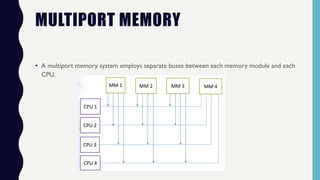
MULTIPORT MEMORY
• A multiport memory system employs separate buses between each memory module and each
CPU.
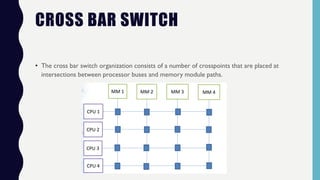
CROSS BAR SWITCH
• The cross bar switch organization consists of a number of crosspoints that are placed at
intersections between processor buses and memory module paths.
MULTISTAGE SWITCHING NETWORK
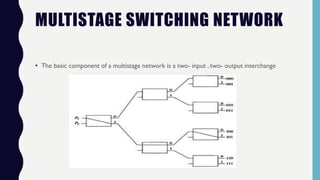
• The basic component of a multistage network is a two- input , two- output interchange
HYPERCUBE INTERCONNECTION
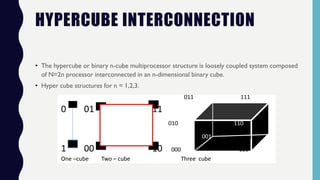
• The hypercube or binary n-cube multiprocessor structure is loosely coupled system composed
of N=2n processor interconnected in an n-dimensional binary cube.
• Hyper cube structures for n = 1,2,3.
ADVANTAGES OF MULTIPROCESSING
• A benefit derived from multiprocessing is improved system performance.This happens because
computations can proceed in parallel in one of two ways:-
a) Multiple independent jobs can be made to operate in parallel.
b) b) A single job can be partitioned into multiple parallel tasks.
• Increased Reliability:A failure or error in one part has a limited effect on the rest of the
system. If a fault causes one processor to fail, a second processor can be assigned to perform
the functions of the disabled processor.
• IncreasedThroughput:An increase in the number of processors completes the work in less
time. It is important to note that doubling the number of processors does not halve the time
to complete a job.
THANKYOU
ANY QUERY??

Multiprocessor

  • 1.
  • 2.
    CONTENTS • Introduction • WhyChoose a Multiprocessor? • How multiprocessor are classified? • Interconnection structures
  • 3.
    INTRODUCTION • Multiprocessor systemis an interconnection of two or more CPUs with memory and input- output equipment • The components that forms multiprocessor are CPUs IOPs connected to input –output devices , and memory unit that may be partitioned into a number of separate modules. • Multiprocessor are classified as multiple instruction stream, multiple data stream (MIMD) system.
  • 4.
    WHY CHOOSE AMULTIPROCESSOR? • A single CPU can only go so fast, use more than one CPU to improve performance • Multiple users • Multiple applications • Multi-tasking within an application • Responsiveness and/or throughput • Share hardware between CPUs
  • 5.
    WHAT ARE THEDIFFERENCE BETWEEN MULTIPROCESSOR AND MULTICOMPUTER? MULTIPROCESSOR • A multiprocessor system is simply a computer that has more than one CPU on its motherboard. • Multiprocessing is the use of two or more central processing units (CPUs) within a single computer system. MULTICOMPUTER • A computer made up of several computers.The term generally refers to an architecture in which each processor has its own memory rather than multiple processors with a shared memory
  • 6.
    HOW MULTIPROCESSOR ARE CLASSIFIED? •Multiprocessor are classified by the way their memory is organized, mainly it is classified into two types – Tightly coupled multiprocessor – Loosely coupled multiprocessor
  • 7.
    TIGHTLY COUPLED MULTIPROCESSOR •A multiprocessor is a tightly coupled computer system having two or more processing units (Multiple Processors) each sharing main memory and peripherals, in order to simultaneously process programs • Tightly coupled Multiprocessor is also know as shared memory system
  • 8.
    LOOSELY-COUPLED MULTIPROCESSOR • Loosely-coupledmultiprocessor systems (often referred to as clusters ) are based on multiple standalone single or dual processor commodity computers interconnected via a high speed communication system. • Loosely-coupled multiprocessor is also known as distributed memory.
  • 9.
    DIFFERENCE B/W TIGHTLYCOUPLED AND LOOSELY COUPLED MULTIPROCESSOR TIGHTLY COUPLED • Tightly-coupled systems physically smaller than loosely-coupled system. • More expensive LOOSELY COUPLED • It is just opposite of tightly coupled system. • Less expensive.
  • 10.
    INTERCONNECTION STRUCTURES The physicalforms for establishing an interconnection network . – Time shared common bus. – Multiport memory. – Crossbar switch – Multistage switching network. – Hypercube system.
  • 11.
    TIME –SHARED COMMONBUS • A system common bus multiprocessor system consists of a number of processors connected through path to a memory unit.
  • 12.
    MULTIPORT MEMORY • Amultiport memory system employs separate buses between each memory module and each CPU.
  • 13.
    CROSS BAR SWITCH •The cross bar switch organization consists of a number of crosspoints that are placed at intersections between processor buses and memory module paths.
  • 14.
    MULTISTAGE SWITCHING NETWORK •The basic component of a multistage network is a two- input , two- output interchange
  • 15.
    HYPERCUBE INTERCONNECTION • Thehypercube or binary n-cube multiprocessor structure is loosely coupled system composed of N=2n processor interconnected in an n-dimensional binary cube. • Hyper cube structures for n = 1,2,3.
  • 16.
    ADVANTAGES OF MULTIPROCESSING •A benefit derived from multiprocessing is improved system performance.This happens because computations can proceed in parallel in one of two ways:- a) Multiple independent jobs can be made to operate in parallel. b) b) A single job can be partitioned into multiple parallel tasks. • Increased Reliability:A failure or error in one part has a limited effect on the rest of the system. If a fault causes one processor to fail, a second processor can be assigned to perform the functions of the disabled processor. • IncreasedThroughput:An increase in the number of processors completes the work in less time. It is important to note that doubling the number of processors does not halve the time to complete a job.
  • 17.