MULTIPROCESSING
Presented By:
Aamir
Department Of Information Technology
 CONTENTS
Introduction
Difference between multiprocessor &
multicomputer
Classification
Advantages
Disadvantages
2
INTRODUCTION
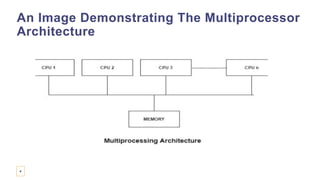
• Interconnection of two or more CPUs with memory and input-output
equipment.
• The term “processor” in multiprocessor can mean either a central
processing unit (CPU) or an input-output processor (IOP).
• The components that forms multiprocessor are CPUs , IOPs connected
to input output devices, and memory unit.
• More than one processor with common memory, shared between
processors.
• Multiprocessors are classified as multiple instruction stream, multiple
data stream (MIMD) systems.
3
4
An Image Demonstrating The Multiprocessor
Architecture
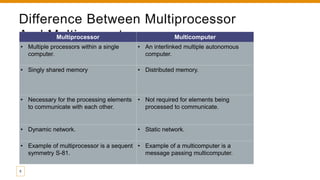
Difference Between Multiprocessor
And Multicomputer
5
Multiprocessor Multicomputer
• Multiple processors within a single
computer.
• An interlinked multiple autonomous
computer.
• Singly shared memory • Distributed memory.
• Necessary for the processing elements
to communicate with each other.
• Not required for elements being
processed to communicate.
• Dynamic network. • Static network.
• Example of multiprocessor is a sequent
symmetry S-81.
• Example of a multicomputer is a
message passing multicomputer.
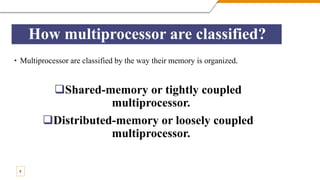
• Multiprocessor are classified by the way their memory is organized.
Shared-memory or tightly coupled
multiprocessor.
Distributed-memory or loosely coupled
multiprocessor.
How multiprocessor are classified?
6
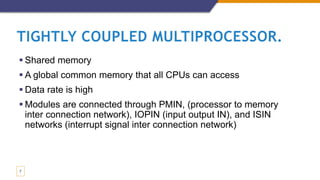
TIGHTLY COUPLED MULTIPROCESSOR.
 Shared memory
 A global common memory that all CPUs can access
 Data rate is high
 Modules are connected through PMIN, (processor to memory
inter connection network), IOPIN (input output IN), and ISIN
networks (interrupt signal inter connection network)
7
8
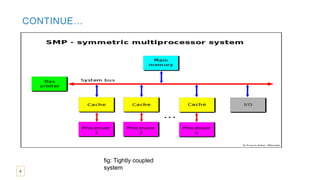
CONTINUE…
fig: Tightly coupled
system
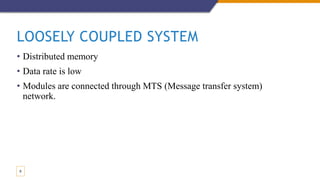
LOOSELY COUPLED SYSTEM
• Distributed memory
• Data rate is low
• Modules are connected through MTS (Message transfer system)
network.
9
10
CONTINUE…
11
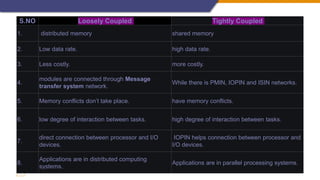
S.NO Loosely Coupled Tightly Coupled
1. distributed memory shared memory
2. Low data rate. high data rate.
3. Less costly. more costly.
4.
modules are connected through Message
transfer system network.
While there is PMIN, IOPIN and ISIN networks.
5. Memory conflicts don’t take place. have memory conflicts.
6. low degree of interaction between tasks. high degree of interaction between tasks.
7.
direct connection between processor and I/O
devices.
IOPIN helps connection between processor and
I/O devices.
8.
Applications are in distributed computing
systems.
Applications are in parallel processing systems.
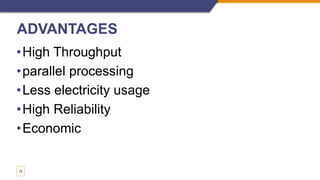
•High Throughput
•parallel processing
•Less electricity usage
•High Reliability
•Economic
ADVANTAGES
12
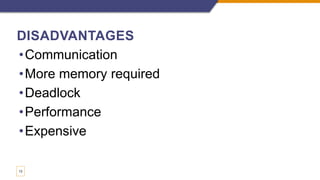
DISADVANTAGES
•Communication
•More memory required
•Deadlock
•Performance
•Expensive
13
REFERENCES
 https://www.geeksforgeeks.org/introduction-of-multiprocessor-and-
multicomputer/
 https://www.tutorialspoint.com/what-is-
multiprocessor#:~:text=Computer%20ArchitectureComputer%20Science
Network,known%20as%20a%20multiprocessing%20system.
 William Stallings, Computer Organization and Architecture, Pearson,
9th Ed
THANK YOU

Multiprocessing, difference, advantages and disadvantages