MULTIMODAL STRATEGIES,
EDUCATION, AND TRAINING
Brian Kristensen
Head, senior consultant, phd
National Center for Infection Control
Infection preparedness
AGENDA
Multimodal strategies is what is needed to reach the defined goal, or
more precise, what is needed to change
With regard to IPC, a multimodal approach is needed both on a national
level and on the hospital level
Multimodal strategies, St Petersburg December 2019 2
INFECTION PREVENTION AND CONTROL
A process where activities, policies and procedures are designed to
control and prevent the transmission of infectious diseases within the
healthcare environment and the community
HCWs should know how and when to apply the basic principles of
infection prevention
- including administrators, staff, students, (patients, their family.)
This responsibility applies to everybody working and visiting a healthcare
facility
is critical to the success of an infection control program.
Multimodal strategies, St Petersburg December 2019 3
INFECTION PREVENTION AND CONTROL II
Working with infection Control had to be based on
Evidence and science
Behavioural science
Proper use of technology
Ready to use innovative technology
All this had to be put into a framework of
Society and culture
Economical conditions
Regulation of other parts of the society (environment, CO2 reduction etc)
Multimodal strategies, St Petersburg December 2019 4
MULTIMODAL STRATEGY
consists of several components implemented in an integrated way with the
aim of improving an outcome and changing behavior, e.g.:
• (i) system change (that is, availability of the appropriate infrastructure
and supplies to enable IPC good practices);
• (ii) education and training of health care workers and managers
• (iii) monitoring infrastructures, practices, processes, outcomes and
providing data feedback;
• (iv) reminders in the workplace/communications; and
• (v) culture change with the establishment or strengthening of a safety
climate
Multimodal strategies, St Petersburg December 2019 5
THE USE OF A MULTIMODAL STRATEGY
Multimodal strategies, St Petersburg December 2019 6
Pittet & Boyce 2001
Simmelweis in Vienna, 1847
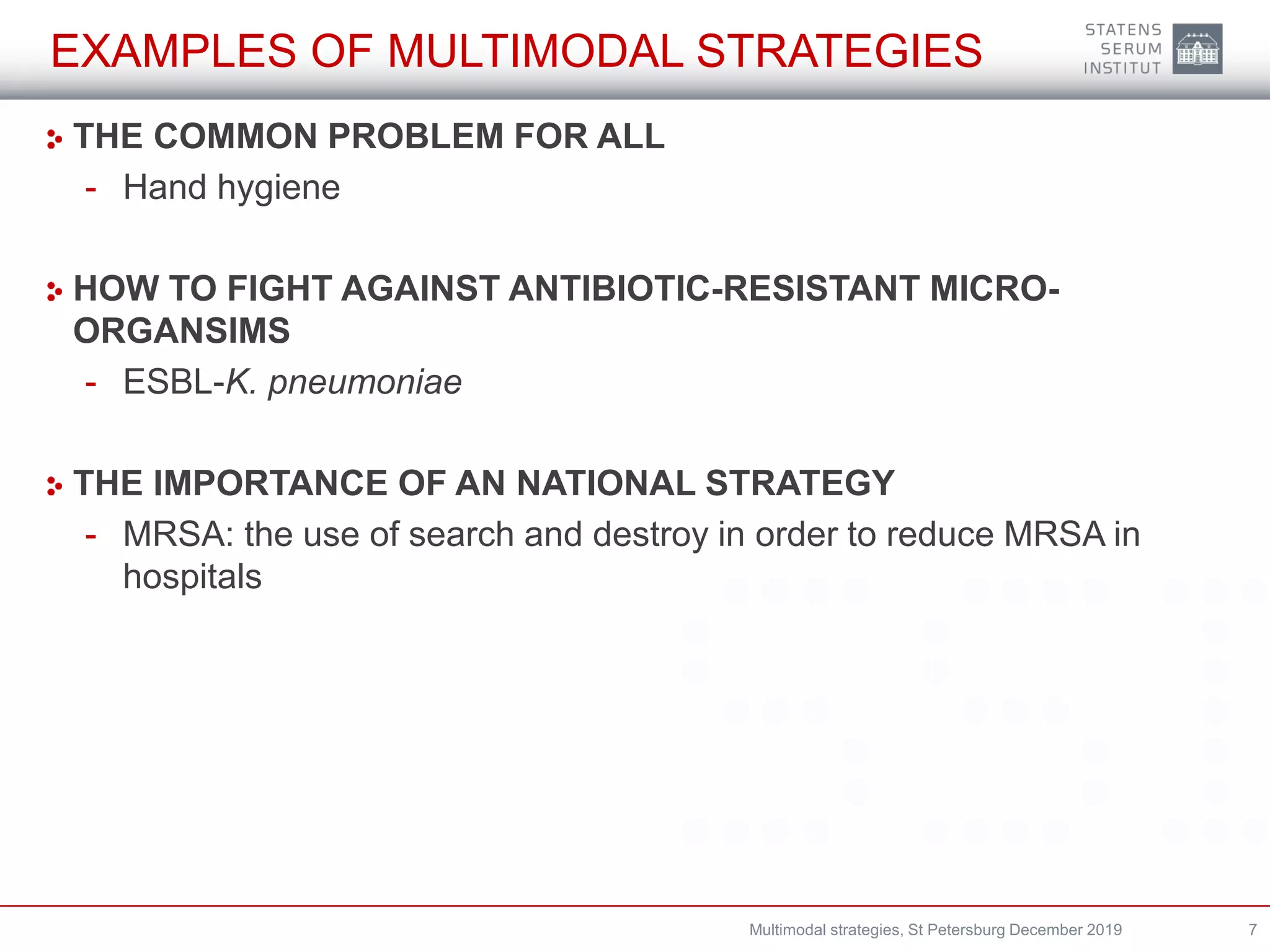
EXAMPLES OF MULTIMODAL STRATEGIES
THE COMMON PROBLEM FOR ALL
- Hand hygiene
HOW TO FIGHT AGAINST ANTIBIOTIC-RESISTANT MICRO-
ORGANSIMS
- ESBL-K. pneumoniae
THE IMPORTANCE OF AN NATIONAL STRATEGY
- MRSA: the use of search and destroy in order to reduce MRSA in
hospitals
Multimodal strategies, St Petersburg December 2019 7
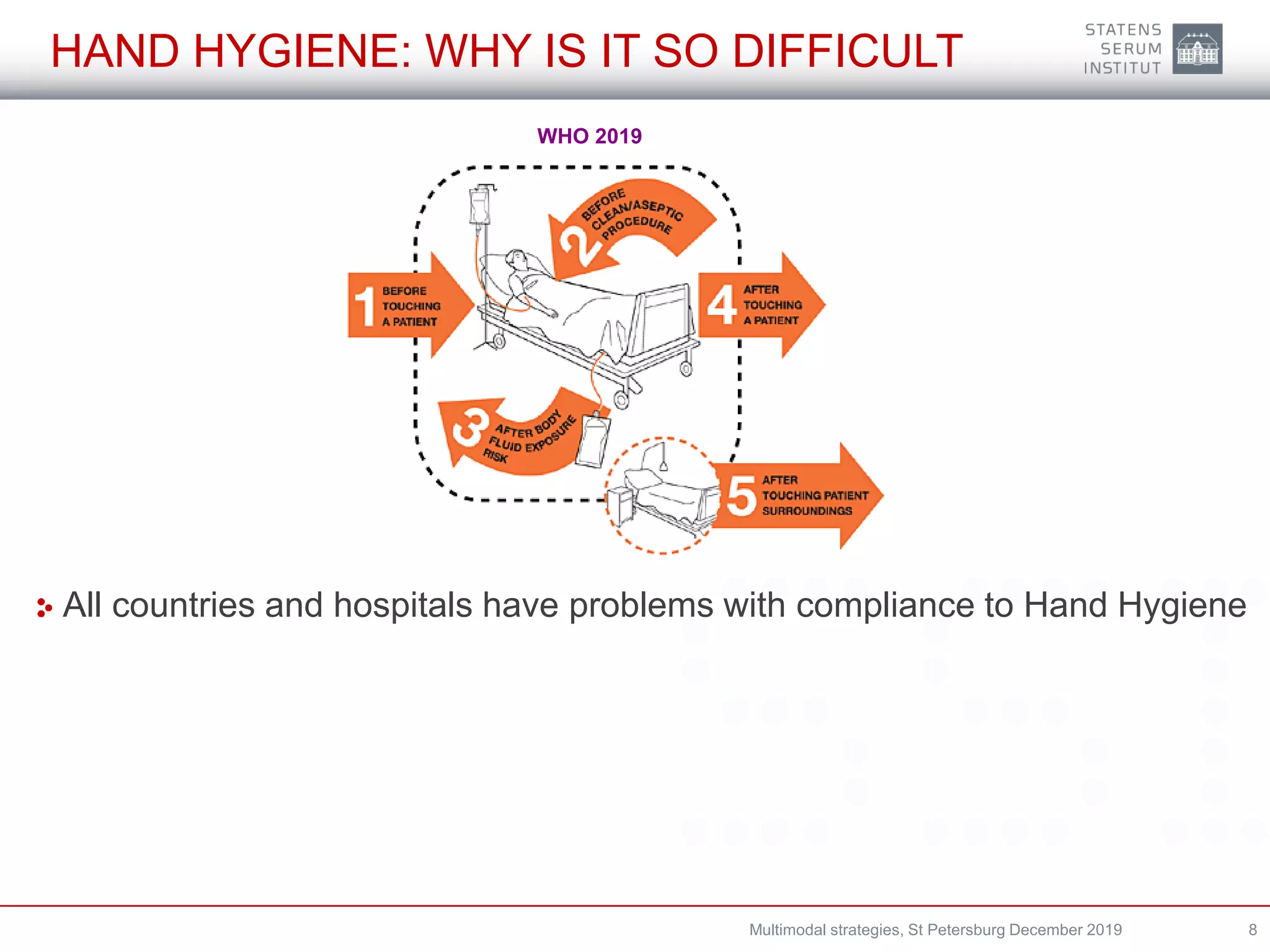
HAND HYGIENE: WHY IS IT SO DIFFICULT
Multimodal strategies, St Petersburg December 2019
WHO 2019
All countries and hospitals have problems with compliance to Hand Hygiene
8
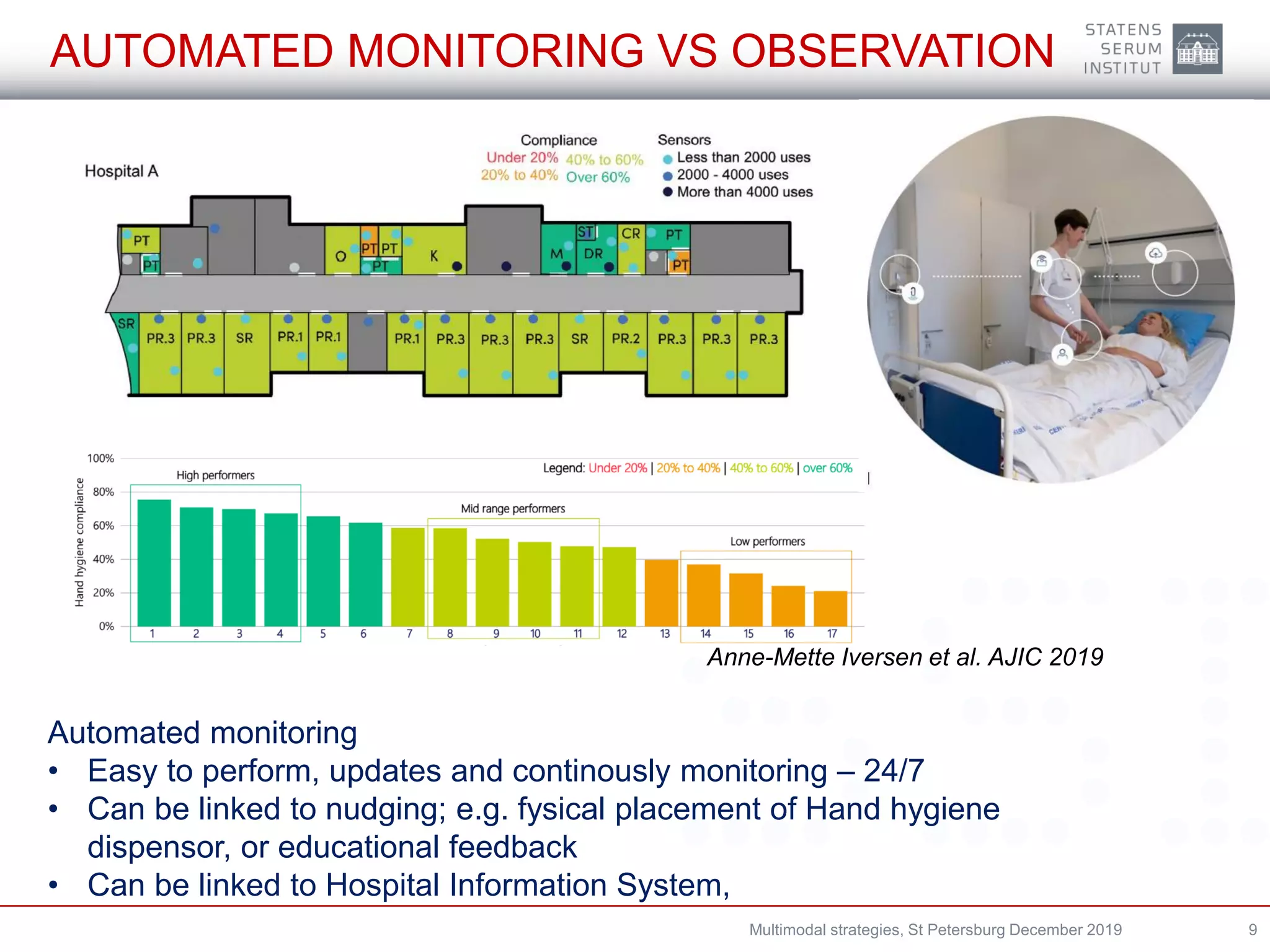
AUTOMATED MONITORING VS OBSERVATION
Multimodal strategies, St Petersburg December 2019 9
Anne-Mette Iversen et al. AJIC 2019
Automated monitoring
• Easy to perform, updates and continously monitoring – 24/7
• Can be linked to nudging; e.g. fysical placement of Hand hygiene
dispensor, or educational feedback
• Can be linked to Hospital Information System,
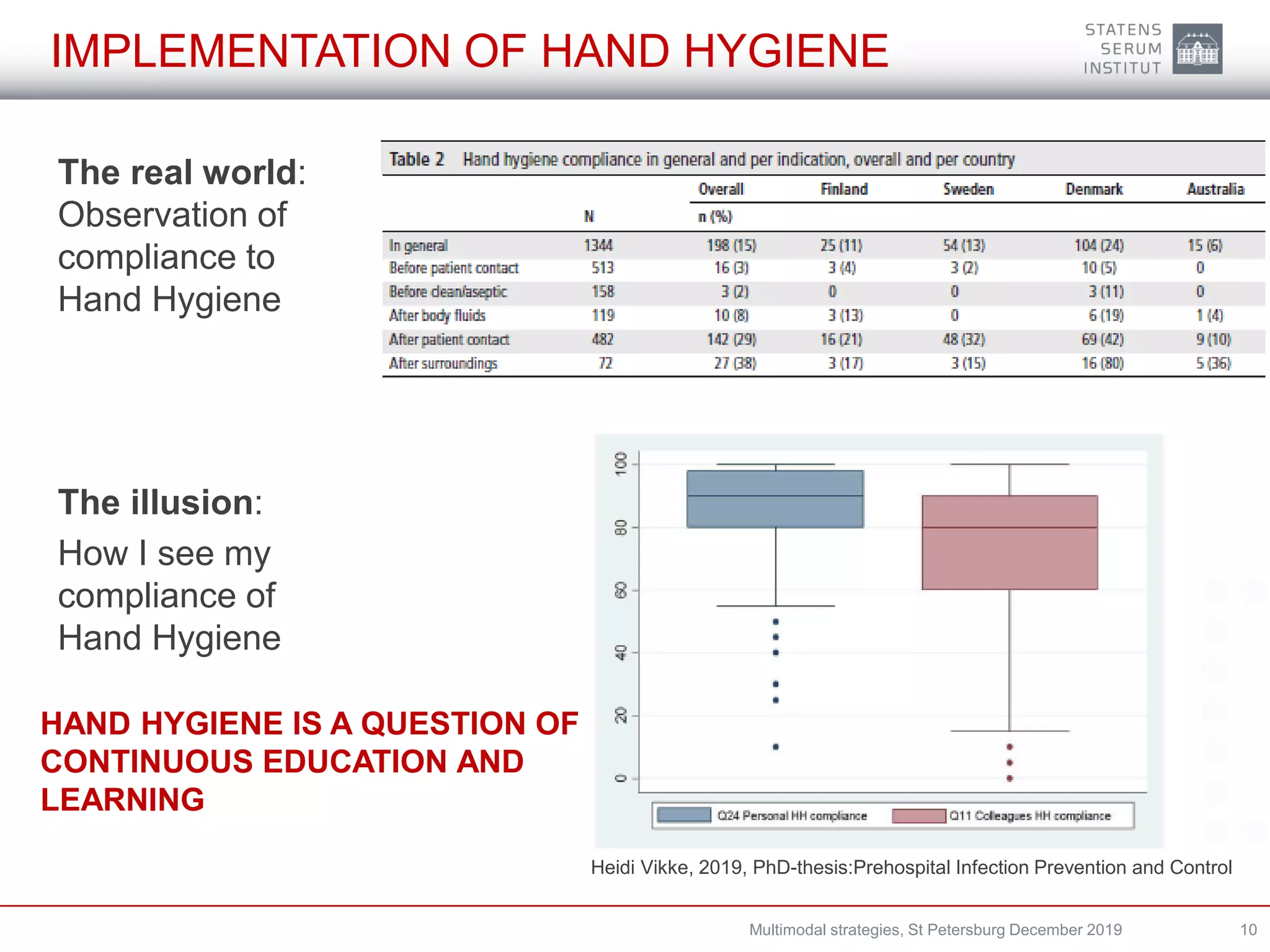
IMPLEMENTATION OF HAND HYGIENE
Heidi Vikke, 2019, PhD-thesis:Prehospital Infection Prevention and Control
Multimodal strategies, St Petersburg December 2019 10
The real world:
Observation of
compliance to
Hand Hygiene
The illusion:
How I see my
compliance of
Hand Hygiene
HAND HYGIENE IS A QUESTION OF
CONTINUOUS EDUCATION AND
LEARNING
MULTIDISCIPLINARY INTERVENTION
The setting
- 5 hospital in Greater Copenhagen
• Approximately 1800 beds,
• Antibiotic consumption: approx. 800 DDD per 1000 bedday
The problem
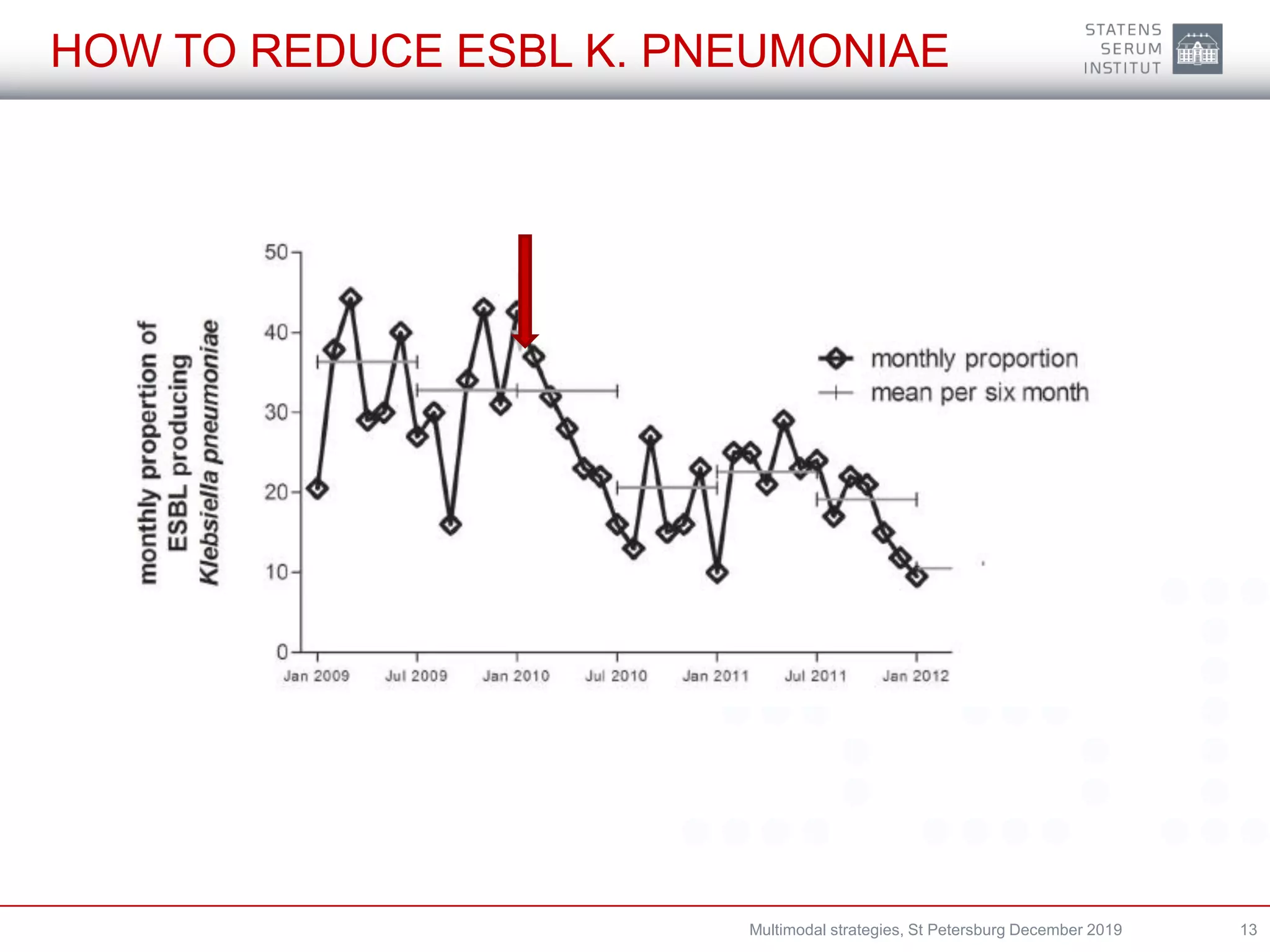
- One (later two) hospitals noted an increase in ESBL-K. pneumoniae
The intervention (in one hospital, Bispebjerg)
- Antimicrobial stewardship and restrictions of ab-use (cephalosporins,
carbapenems and flouroquinoles)
- Isolation precautions
- Communication and education
- Establishing a task-force [pharmacologist, IC-nurses, Quality staff]
- Steering group [Hospital director, clin.microbiologists]
Strategy: involving all health care workers
Multimodal strategies, St Petersburg December 2019 11
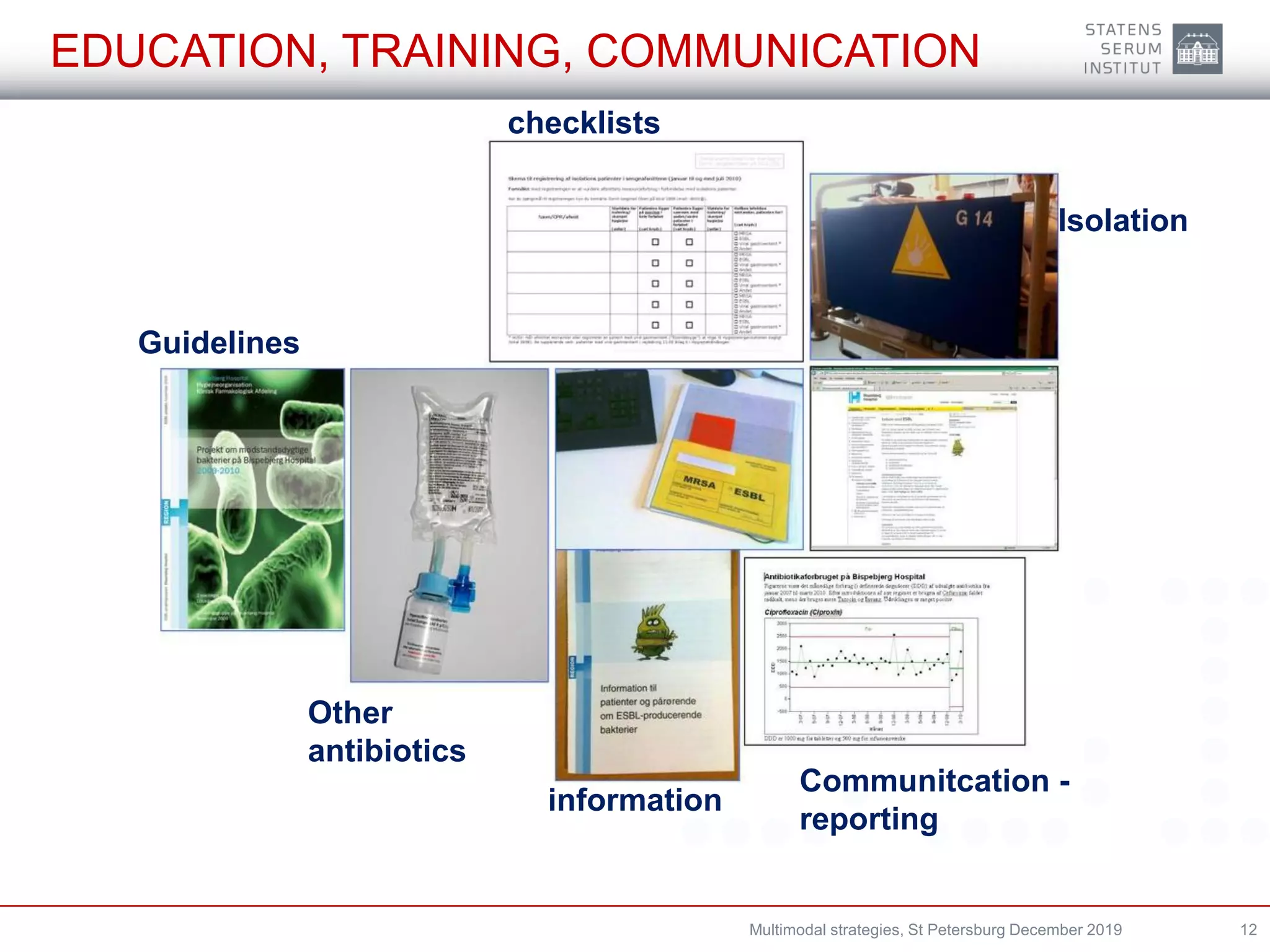
EDUCATION, TRAINING, COMMUNICATION
Multimodal strategies, St Petersburg December 2019
Guidelines
Other
antibiotics
Communitcation -
reporting
checklists
information
Isolation
12
HOW TO REDUCE ESBL K. PNEUMONIAE
Multimodal strategies, St Petersburg December 2019 13
TIMELINE AND OTHER HOSPITAL
Multimodal strategies, St Petersburg December 2019 14
AMR PRECAUTIONS IN DENMARK
PREEMPTIVE
Screening in target populations
Sampling from relevant places
Speed-up in diagnostic time
Single-room isolation
Emphasis on Generel Precautions
Multimodal strategies, St Petersburg December 2019
DETECTION OF A CASE
Screening of fellow-patients (HCW)
Single-room isolation/cohorte-isolaton
Extensive use of PPE
Enhanced cleaning
Follow-up on case(s) including
decolonization if feasible
Monitoring of cases
Alert and Reporting
Documentation
Search and Destroy is state of the art
15
ANTIBIOTIC RESISTANCE AND INFECTION CONTROL
Screening Isolation Outbreak
and HCW
Year Typing/
Surveillance
Regu-
lation
Guide-
lines
Trend
MRSA mandatory mandatory mandatory 2006 mandatory Yes Yes Limited
transmis
sion
hospitals
VRE Optional Optional No - Voluntary No (Yes) Endemic
at
hospitals
ESBL No No No - Voluntary No (partly) Endemic
at
hospitals
CPO mandatory mandatory mandatory 2018 mandatory Yes Yes Sporadic
cases
CD
027
mandatory mandatory mandatory 2010 Mandatory Yes Yes Endemic,
limited
transmis
sion in
hospitals
C.
auris
Optional Optional No - Voluntary No (Yes) Not seen
in
Denmark
Multimodal strategies, St Petersburg December 2019 16
COLLABORATION BETWEEN SSI AND NAT BOARD OF
HEALTH ON AMR
National Board of Health: Authorative guidelines
- E.g. on MRSA and CPO
SSI:
- recommendations, e.g. FAQ
- Surveillance and reporting,
- Reference laboratory: typing/ characterization
Hospitals:
- Screening and isolation of patients
- Implementation of guidelines recommendations, e.g. FAQ
- Culture sampling, treatment of patients, follow-up,
Multimodal strategies, St Petersburg December 2019
The major goal: keep low numbers of MRSA in hospitals
17
AMR SURVEILLANCE: NOTIFIED AMR, E.G. MRSA
Each case of MRSA must be notified
Data included in a national database
- Demographic data (e.g. Gender, age, work)
- Exposure data (e.g. foreign hospital, travel)
- Risk data (e.g. comorbidity)
- Clinical (e.g. infection, asymptomatic)
Combined with national data on typing
- Clonality, virulence-factors
Updated reports on occurence and prevalence on
SSI-website (”tal og grafer”)
Annually report on MRSA (Epi-news)
Multimodal strategies, St Petersburg December 2019 18
ANNUALLY REPORT ON MRSA 2019
Main focus on the surveillance
- Total number and changes
- The proportion acquired at Danish
hospitals
- The number of live-stock
associated MRSA
Multimodal strategies, St Petersburg December 2019
Main focus on typing
- To characterize the most prevalent
clones/types
- To deliver data to the Regions on
possible transmission-links
- To assist the regions in possible
(hospital)-outbreaks
19
GAMECHANGER: LIVE-STOCK ASSOCIATED MRSA
Live-stock associated MRSA
advisory service established
in 2014
AIM: to assist in reducing
spread from barn/stable to
society
2018: All pig-workers are
mandated to complete an e-
learning programme
- Background
- How do you limit spread
from stable to society
- How do you act when
being admitted at hospital
Multimodal strategies, St Petersburg December 2019 20
INTERVENTION: STEPS TO BE CONSIDERED
Understand and define the problem
Define the intervention
Define the goal
Use the compentencies from all HCW and employees and partners
Define the responsibilities
Make a timeplan, define your milestone
Evaluate
Adjust
Did you reach your goal
- and is it now time for solving a new problem
Multimodal strategies, St Petersburg December 2019 21
IPC: EDUCATION AND TRAINING
Doctors
- IPC is a part of the curriculum to become a specilist in Clinical
microbiology (4 year of training)
Nurses
- Nurses within infection control are usually persons with several years
of employment – in other fields e.g., ICU, surgical teams
- All is expected to pass a 2-year course on IPC
- Formalized IPC courses used in Denmark since 1980
Others
- Only a few Infectious Disease specialists are employed at an Infection
Control Unit
Multimodal strategies, St Petersburg December 2019 22
THE NORDIC COURSE ON IPC
Situated in Gothenburg
All can apply for the course (nordic applicants preferred but not
exclusively) – is for both Doctors and Nurses
Course fee: 50.000 swedish kronors per module (4 in total)
Started in 2019
Curriculum
Basic microbiology
Basic epidemiology
Infection Prevention and Control management in Nordic courses
- Outbreak, Desinfection and Sterilization, Vaccination, AMR
Examen
Multimodal strategies, St Petersburg December 2019 23
ELEMENTS IN TRAINING
How to gain knowledge of evidence and science
How to perform audit and risk-assessment
How to initiate and participate in multimodal interventions
How to motivate colleaques, leaders, and hospital managers to secure a
good work within IPC
Multimodal strategies, St Petersburg December 2019 24
QUESTIONS ?
Multimodal strategies, St Petersburg December 2019 25
QUESTIONS FOR NW RUSSIA
How do you initiate and perform an intervention
Do you have to communicate with your local/regional leaders
How do you evaluate your intervention
How do you educate and train your specialists
Do you have an russian society of infection prevention and control
Multimodal strategies, St Petersburg December 2019 26

Multimodal strategies and education

  • 1.
    MULTIMODAL STRATEGIES, EDUCATION, ANDTRAINING Brian Kristensen Head, senior consultant, phd National Center for Infection Control Infection preparedness
  • 2.
    AGENDA Multimodal strategies iswhat is needed to reach the defined goal, or more precise, what is needed to change With regard to IPC, a multimodal approach is needed both on a national level and on the hospital level Multimodal strategies, St Petersburg December 2019 2
  • 3.
    INFECTION PREVENTION ANDCONTROL A process where activities, policies and procedures are designed to control and prevent the transmission of infectious diseases within the healthcare environment and the community HCWs should know how and when to apply the basic principles of infection prevention - including administrators, staff, students, (patients, their family.) This responsibility applies to everybody working and visiting a healthcare facility is critical to the success of an infection control program. Multimodal strategies, St Petersburg December 2019 3
  • 4.
    INFECTION PREVENTION ANDCONTROL II Working with infection Control had to be based on Evidence and science Behavioural science Proper use of technology Ready to use innovative technology All this had to be put into a framework of Society and culture Economical conditions Regulation of other parts of the society (environment, CO2 reduction etc) Multimodal strategies, St Petersburg December 2019 4
  • 5.
    MULTIMODAL STRATEGY consists ofseveral components implemented in an integrated way with the aim of improving an outcome and changing behavior, e.g.: • (i) system change (that is, availability of the appropriate infrastructure and supplies to enable IPC good practices); • (ii) education and training of health care workers and managers • (iii) monitoring infrastructures, practices, processes, outcomes and providing data feedback; • (iv) reminders in the workplace/communications; and • (v) culture change with the establishment or strengthening of a safety climate Multimodal strategies, St Petersburg December 2019 5
  • 6.
    THE USE OFA MULTIMODAL STRATEGY Multimodal strategies, St Petersburg December 2019 6 Pittet & Boyce 2001 Simmelweis in Vienna, 1847
  • 7.
    EXAMPLES OF MULTIMODALSTRATEGIES THE COMMON PROBLEM FOR ALL - Hand hygiene HOW TO FIGHT AGAINST ANTIBIOTIC-RESISTANT MICRO- ORGANSIMS - ESBL-K. pneumoniae THE IMPORTANCE OF AN NATIONAL STRATEGY - MRSA: the use of search and destroy in order to reduce MRSA in hospitals Multimodal strategies, St Petersburg December 2019 7
  • 8.
    HAND HYGIENE: WHYIS IT SO DIFFICULT Multimodal strategies, St Petersburg December 2019 WHO 2019 All countries and hospitals have problems with compliance to Hand Hygiene 8
  • 9.
    AUTOMATED MONITORING VSOBSERVATION Multimodal strategies, St Petersburg December 2019 9 Anne-Mette Iversen et al. AJIC 2019 Automated monitoring • Easy to perform, updates and continously monitoring – 24/7 • Can be linked to nudging; e.g. fysical placement of Hand hygiene dispensor, or educational feedback • Can be linked to Hospital Information System,
  • 10.
    IMPLEMENTATION OF HANDHYGIENE Heidi Vikke, 2019, PhD-thesis:Prehospital Infection Prevention and Control Multimodal strategies, St Petersburg December 2019 10 The real world: Observation of compliance to Hand Hygiene The illusion: How I see my compliance of Hand Hygiene HAND HYGIENE IS A QUESTION OF CONTINUOUS EDUCATION AND LEARNING
  • 11.
    MULTIDISCIPLINARY INTERVENTION The setting -5 hospital in Greater Copenhagen • Approximately 1800 beds, • Antibiotic consumption: approx. 800 DDD per 1000 bedday The problem - One (later two) hospitals noted an increase in ESBL-K. pneumoniae The intervention (in one hospital, Bispebjerg) - Antimicrobial stewardship and restrictions of ab-use (cephalosporins, carbapenems and flouroquinoles) - Isolation precautions - Communication and education - Establishing a task-force [pharmacologist, IC-nurses, Quality staff] - Steering group [Hospital director, clin.microbiologists] Strategy: involving all health care workers Multimodal strategies, St Petersburg December 2019 11
  • 12.
    EDUCATION, TRAINING, COMMUNICATION Multimodalstrategies, St Petersburg December 2019 Guidelines Other antibiotics Communitcation - reporting checklists information Isolation 12
  • 13.
    HOW TO REDUCEESBL K. PNEUMONIAE Multimodal strategies, St Petersburg December 2019 13
  • 14.
    TIMELINE AND OTHERHOSPITAL Multimodal strategies, St Petersburg December 2019 14
  • 15.
    AMR PRECAUTIONS INDENMARK PREEMPTIVE Screening in target populations Sampling from relevant places Speed-up in diagnostic time Single-room isolation Emphasis on Generel Precautions Multimodal strategies, St Petersburg December 2019 DETECTION OF A CASE Screening of fellow-patients (HCW) Single-room isolation/cohorte-isolaton Extensive use of PPE Enhanced cleaning Follow-up on case(s) including decolonization if feasible Monitoring of cases Alert and Reporting Documentation Search and Destroy is state of the art 15
  • 16.
    ANTIBIOTIC RESISTANCE ANDINFECTION CONTROL Screening Isolation Outbreak and HCW Year Typing/ Surveillance Regu- lation Guide- lines Trend MRSA mandatory mandatory mandatory 2006 mandatory Yes Yes Limited transmis sion hospitals VRE Optional Optional No - Voluntary No (Yes) Endemic at hospitals ESBL No No No - Voluntary No (partly) Endemic at hospitals CPO mandatory mandatory mandatory 2018 mandatory Yes Yes Sporadic cases CD 027 mandatory mandatory mandatory 2010 Mandatory Yes Yes Endemic, limited transmis sion in hospitals C. auris Optional Optional No - Voluntary No (Yes) Not seen in Denmark Multimodal strategies, St Petersburg December 2019 16
  • 17.
    COLLABORATION BETWEEN SSIAND NAT BOARD OF HEALTH ON AMR National Board of Health: Authorative guidelines - E.g. on MRSA and CPO SSI: - recommendations, e.g. FAQ - Surveillance and reporting, - Reference laboratory: typing/ characterization Hospitals: - Screening and isolation of patients - Implementation of guidelines recommendations, e.g. FAQ - Culture sampling, treatment of patients, follow-up, Multimodal strategies, St Petersburg December 2019 The major goal: keep low numbers of MRSA in hospitals 17
  • 18.
    AMR SURVEILLANCE: NOTIFIEDAMR, E.G. MRSA Each case of MRSA must be notified Data included in a national database - Demographic data (e.g. Gender, age, work) - Exposure data (e.g. foreign hospital, travel) - Risk data (e.g. comorbidity) - Clinical (e.g. infection, asymptomatic) Combined with national data on typing - Clonality, virulence-factors Updated reports on occurence and prevalence on SSI-website (”tal og grafer”) Annually report on MRSA (Epi-news) Multimodal strategies, St Petersburg December 2019 18
  • 19.
    ANNUALLY REPORT ONMRSA 2019 Main focus on the surveillance - Total number and changes - The proportion acquired at Danish hospitals - The number of live-stock associated MRSA Multimodal strategies, St Petersburg December 2019 Main focus on typing - To characterize the most prevalent clones/types - To deliver data to the Regions on possible transmission-links - To assist the regions in possible (hospital)-outbreaks 19
  • 20.
    GAMECHANGER: LIVE-STOCK ASSOCIATEDMRSA Live-stock associated MRSA advisory service established in 2014 AIM: to assist in reducing spread from barn/stable to society 2018: All pig-workers are mandated to complete an e- learning programme - Background - How do you limit spread from stable to society - How do you act when being admitted at hospital Multimodal strategies, St Petersburg December 2019 20
  • 21.
    INTERVENTION: STEPS TOBE CONSIDERED Understand and define the problem Define the intervention Define the goal Use the compentencies from all HCW and employees and partners Define the responsibilities Make a timeplan, define your milestone Evaluate Adjust Did you reach your goal - and is it now time for solving a new problem Multimodal strategies, St Petersburg December 2019 21
  • 22.
    IPC: EDUCATION ANDTRAINING Doctors - IPC is a part of the curriculum to become a specilist in Clinical microbiology (4 year of training) Nurses - Nurses within infection control are usually persons with several years of employment – in other fields e.g., ICU, surgical teams - All is expected to pass a 2-year course on IPC - Formalized IPC courses used in Denmark since 1980 Others - Only a few Infectious Disease specialists are employed at an Infection Control Unit Multimodal strategies, St Petersburg December 2019 22
  • 23.
    THE NORDIC COURSEON IPC Situated in Gothenburg All can apply for the course (nordic applicants preferred but not exclusively) – is for both Doctors and Nurses Course fee: 50.000 swedish kronors per module (4 in total) Started in 2019 Curriculum Basic microbiology Basic epidemiology Infection Prevention and Control management in Nordic courses - Outbreak, Desinfection and Sterilization, Vaccination, AMR Examen Multimodal strategies, St Petersburg December 2019 23
  • 24.
    ELEMENTS IN TRAINING Howto gain knowledge of evidence and science How to perform audit and risk-assessment How to initiate and participate in multimodal interventions How to motivate colleaques, leaders, and hospital managers to secure a good work within IPC Multimodal strategies, St Petersburg December 2019 24
  • 25.
    QUESTIONS ? Multimodal strategies,St Petersburg December 2019 25
  • 26.
    QUESTIONS FOR NWRUSSIA How do you initiate and perform an intervention Do you have to communicate with your local/regional leaders How do you evaluate your intervention How do you educate and train your specialists Do you have an russian society of infection prevention and control Multimodal strategies, St Petersburg December 2019 26