




How do I approach Infection Outbreak in PICU? Dr Farhan Shaikh Consultant Pediatric Intensivist Internal assessor for Quality Standards Rainbow Children’s Hospital Hyderabad
Infection control Nurse informs the PICU consultant that there are two children with MDR Acinetobacter (one in Blood culture and the other in the ET secretion) in the PICU Is this an  “ Acinetobacter outbreak”?
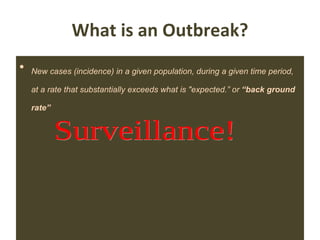
What is an Outbreak? New cases (incidence) in a given population, during a given time period, at a rate that substantially exceeds what is "expected.” or  “back ground rate” Investigation of Outbreaks by William R Jarvis Chapter 7. Hospital Epidemiology and Infection Control by C.Glen mayhall 3 rd  Edn Lippincott Williams & Wilkins  Surveillance!
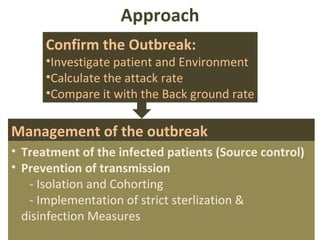
Approach Confirm the Outbreak: Investigate patient and Environment Calculate the attack rate Compare it with the Back ground rate Management of the outbreak Treatment of the infected patients (Source control) Prevention of transmission - Isolation and Cohorting - Implementation of strict sterlization &  disinfection Measures
Outbreak Investigation Resources: Personnel a)Lead Investigator, b)Statistician c) support staff Supplies Laboratory Hospital Epidemiology and Infection Control by C.Glen mayhall 3 rd  Edn Lippincott Williams & Wilkins
Microbiological aspects Most of the times, it is the Microbiology which identifies an outbreak. Typing of the organisms related to the outbreak, to determine if the infected patient is indeed the part of the outbreak Other methods of typing are.. phage typing, serotyping, iso-enzyme electrophoresis, plasmid analysis, etc
Case Definition should include.. Time, place, person, Clinical and Lab parameters ( date of onset of illness, symptoms, signs, specific Lab or diagnostic finding) Epidemiological parameters (e.g. a patient’s presence in a specific ward, during a specific timing) Hospital Epidemiology and Infection Control by C.Glen mayhall 3 rd  Edn Lippincott Williams & Wilkins
Example of case definitions "A case of  multidrug-resistant tuberculosis during an outbreak between 2009-2011  can be defined as.. any patient diagnosed with active tuberculosis from January 2009 through Oct 2011 whose M.  tuberculosis  isolate is resistant to at least isoniazid and rifampin,"  Hospital Epidemiology and Infection Control by C.Glen mayhall 3 rd  Edn Lippincott Williams & Wilkins
Patient and Environmental Investigation Passive Surveillence Active surveillence-  - Screening of patients (Universal or focused) - Screening of health care workers who are  symptomatic or suspected to be part of  outbreak - Surveillence swabs from the patient  environment keeping in mind the target  organism (e.g. for Aspergillus spp, target the air handling units and AC ducts)
Comparison of the outbreak period arrack rate to the background rate can be performed using the rate ratio:  Attack rate during epidemic period  Attack rate during background period
The Action Plan
Patient education  Displaying posters and distributing hand outs to patients attendants about minimizing visits, and other relevant care
Education & Increased Awareness amongst health care workers Educational Presentations   for leaders to share with staff Updating the PICU nurses and doctors about “unit specific rates” of the target infection. This will keep everybody working in the unit “aware” and “motivated”
 
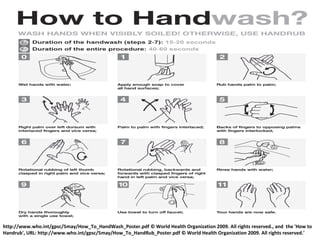
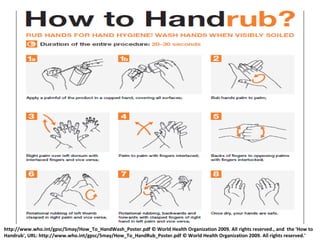
Hand Hygeine: There is conclusive evidence of a temporal relationship between improved hand hygiene practices and decreased infection rates. Prevention and Treatment of Health Care–Acquired Infections Leanne B. Gasink, MD, MSCE, Ebbing Lautenbach,  Med Clin N Am 92 (2008) 295–313 In more than 30 observational studies between 1980 and 2000 the rates of appropriate hand hygiene were reported to range from 5% to 81%, with an average rate of 40%. Boyce JM, Pittet D.  Et al.Am J Infect Control 2002;30(8):S1–46
There is increasing evidence that the level of bedside nurse-staffing influences the quality of patient care. The association of nursing staff shortages with increased rates of infection outbreaks in ICUs has been demonstrated in several studies.  Jane D. Siegel, Emily Rhinehart,et al.   2007 Guideline for Isolation Precautions:  Preventing Transmission of Infectious Agents in Healthcare Settings .CDC
http://www.who.int/gpsc/5may/How_To_HandWash_Poster.pdf © World Health Organization 2009. All rights reserved., and  the 'How to Handrub', URL: http://www.who.int/gpsc/5may/How_To_HandRub_Poster.pdf © World Health Organization 2009. All rights reserved.'
Masks Only recommended when performing splash generating procedures (e.g., wound irrigation, oral suctioning, intubation); contaminated wounds (e.g. Burns) When the HCP has infection e.g. sinusitis Jane D. Siegel, MD; et alManagement of Multidrug-Resistant Organisms In Healthcare Settings, 2006 CDC
Gowning There is no significant difference in the infection rate between the use or non-use of cover gowns in an intensive care unit.  Nathan L. Belkin,  Association for Professionals in Infection Control and Epidemiology. AJIC Am J Infect Control 1997;25:401-4 “ Routine” use of Gown in ICUs depends on the problems of each setting and priorities. Smith CD. Cover gowns, surgical hand scrubs, smoke evacuators, operative record abbreviations; open sterile setupsclinical issues. AORN J 1995;61:753
Due to the nature of care provided in the ICUs, 80% of the ICU infections come under..  Burke JP. Infection control a problem for patient safety. N Engl J Med 2003;348(7):651–6. National Nosocomial Infections Surveillance S. National Nosocomial Infections Surveillance (NNIS) System Report, data summary from January 1992 through June 2004, issuedOctober 2004.  Am J Infect Control 2004;32(8):470–85. bloodstream infections (BSI), and  Nosocomial Pneumonia (NP or VAP) urinary tract infections (UTIs),  surgical site infections (SSIs),
Great material available online from reputed sites (IDSA,CDC, SCCM, etc) VAP prevention  guidelines CR-BSI prevention  guidelines CA-UTI prevention  guidelines SSI prevention  guidelines Remembering and implementing the guidelines is the biggest challenge!
Airline Industry Safest mode of transportation (one accident for every 1.6 million flights) A person is more likely to die on the way to the airport than in a plane crash Airline Industry Records 2010 as Safest Year in Aviation History FEBRUARY 24TH, 2011 • BY AVIATION NEWS
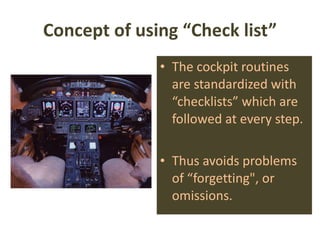
Concept of using “Check list” The cockpit routines are standardized with “checklists” which are followed at every step. Thus avoids problems of “forgetting", or omissions.
Concept of using “Bundles” A bundle is a structured set of evidence-based practices for improving the processes of care and patient outcomes.  It is a small, straightforward set of practices (elements)— generally three to five — that, when performed collectively and reliably, have been proven to improve patient outcomes. Resar R, Pronovost P, Haraden C, Simmonds T, et al.  Using a bundle approach to improve  ventilator careprocesses and reduce ventilator-associated pneumonia . Joint Commission Journal on Quality and Patient Safety. 2005; 31(5):243-248
The elements are all based on randomized controlled trials (i.e.  Level 1 evidence—  obtained from at least one properly designed RCT). The elements are  all necessary and all sufficient.  If any one element is removed, the desired results would not be achieved.  
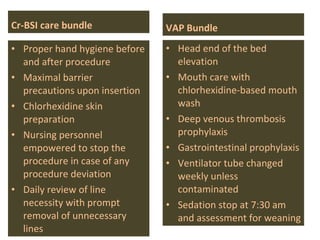
Cr-BSI care bundle Proper hand hygiene before and after procedure Maximal barrier precautions upon insertion Chlorhexidine skin preparation Nursing personnel empowered to stop the procedure in case of any procedure deviation Daily review of line necessity with prompt removal of unnecessary lines VAP Bundle Head end of the bed elevation Mouth care with chlorhexidine-based mouth wash Deep venous thrombosis prophylaxis Gastrointestinal prophylaxis Ventilator tube changed weekly unless contaminated Sedation stop at 7:30 am and assessment for weaning
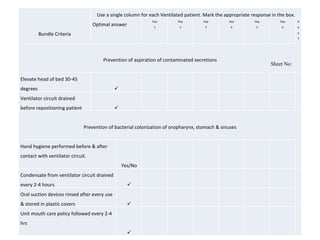
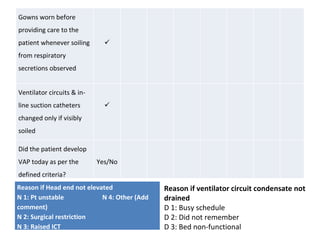
Sheet No:     Bundle Criteria Use a single column for each Ventilated patient. Mark the appropriate response in the box. Optimal answer Day 1 Day 2 Day 3 Day 4 Day 5 Day 6 Day 7   Prevention of aspiration of contaminated secretions   Elevate head of bed 30-45 degrees                  Ventilator circuit drained before repositioning patient                    Prevention of bacterial colonization of oropharynx, stomach & sinuses   Hand hygiene performed before & after contact with ventilator circuit.      Yes/No               Condensate from ventilator circuit drained every 2-4 hours                  Oral suction devices rinsed after every use & stored in plastic covers                  Unit mouth care policy followed every 2-4 hrs                    
Reason if ventilator circuit condensate not drained D 1: Busy schedule D 2: Did not remember D 3: Bed non-functional Gowns worn before providing care to the patient whenever soiling from respiratory secretions observed                    Ventilator circuits & in-line suction catheters changed only if visibly soiled                  Did the patient develop VAP today as per the defined criteria?   Yes/No               Reason if Head end not elevated N 1: Pt unstable  N 4: Other (Add comment) N 2: Surgical restriction N 3: Raised ICT
Environmental and Infection Control Supports
Several outbreaks have occurred as a result of improper disinfection and sterilization. Controlling Antimicrobial Resistance in the Hospital. DeverickJ.et al. Infect Dis Clin N Am 23 (2009) 847-864 Complete item wise discussion is beyond the scope of this talk, but can be downloaded from .. Guideline for Disinfection and Sterilization in Healthcare Facilities, 2008  William A. Rutala, Ph.D., M.P.H.1,2, David J. Weber, M.D., M.P.H.1,2, and the Healthcare Infection Control Practices Advisory Committee (HICPAC) on the CDC website.
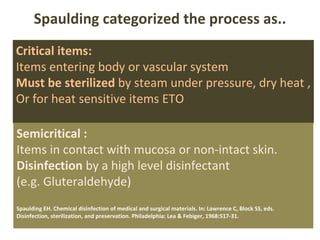
Spaulding categorized the process as.. Critical items: Items entering body or vascular system Must be sterilized  by steam under pressure, dry heat , Or for heat sensitive items ETO  Semicritical :   Items in contact with mucosa or non-intact skin. Disinfection  by a high level disinfectant  (e.g. Gluteraldehyde) Spaulding EH. Chemical disinfection of medical and surgical materials. In: Lawrence C, Block SS, eds.  Disinfection, sterilization, and preservation. Philadelphia: Lea & Febiger, 1968:517-31.
Noncritical items  come in contact with intact skin but not mucous membranes.  Noncritical items are .. noncritical patient care items  e.g. bedpans,  blood pressure cuffs, crutches, bed rails  noncritical environmental surfaces  e.g., bedside tables, patient furniture, computers and floors etc.  Spaulding EH. Chemical disinfection of medical and surgical materials. In: Lawrence C, Block SS, eds.  Disinfection, sterilization, and preservation. Philadelphia: Lea & Febiger, 1968:517-31.
FUMIGATION NOT RECOMMMENDED Besides being ineffective, the agents are  toxic and irritating to the eyes and mucous membranes.  makes rooms unavailable for use,  leading to disruption services Garner JS. Guideline for isolation precautions in hospitals. The Hospital Infection Control Practices Advisory Committee. Infect. Control Hosp. Epidemiol. 1996;17:53-80.  Centers for Disease Control. Guidelines for Environmental Infection Control in Health-Care Facilities, 2003. MMWR 2003;52 (No. RR-10):1-44 .
Mop-clean the surfaces (e.g., floors, bed rails , incubators,warmers,table tops) on a regular basis (3 to 5 times a day),  The walls, of the ICU to be mopped when visibly soiled and at least once every week. William A. Rutala, Ph.D., M.P.H.1,2, David J. Weber, M.D., M.P.H.1,2, and the Healthcare Infection Control Practices Advisory Committee (HICPAC) Guideline for Disinfection and Sterilization in Healthcare Facilities, 2008 .CDC
Prepare fresh disinfecting solutions with or without a tuberculocidal activity Fresh solution in every area or one solution for three rooms, change no less often than at 60-minute intervals) Decontaminate mop heads by immersing in 1% NaOCl for 3 minutes every 30 minutes to prevent contamination  William A. Rutala, Ph.D., M.P.H.1,2, David J. Weber, M.D., M.P.H.1,2, and the Healthcare Infection Control Practices Advisory Committee (HICPAC) Guideline for Disinfection and Sterilization in Healthcare Facilities, 2008 .CDC
Isolation and Cohorting
Isolation and Cohorting Selective placement of patients by keeping the child in a single room with separate hand washing facilities if single rooms are not available, or if there is a shortage of single rooms, patients infected or colonized by the same organism can be  cohorted  (sharing of room/s).
Transmission based Precautions Contact precautions Airborne precautions and Droplet precautions. Practical Guidelines for Infection Control in Health Care Facilities. SEARO Regional Publication No. 41 WPRO Regional Publication.WHO.2004
Contact precautions Current guidelines recommend implementing contact precautions routinely for all patients colonized or infected with a target MDRO.  E.g. MRSA, VRE, ESBL-producing organisms, Acinetobacter. and Pseudomonas (including colonization) Siegel JD, RhinehartE, Jackson M, et al. Management of multidrug-resistant organ- isms in health care settings, 2006. Am J Infect Control 2007;35(10 Suppl 2): S165-93. Practical Guidelines for Infection Control in Health Care Facilities. SEARO Regional Publication No. 41 WPRO Regional Publication.WHO.2004
Implement standard precautions. Wear a clean, gown  before  entering the room and remove it before coming out of the room. Strict hand washing and hand hygiene practices Strict mopping and cleaning schedule of the room to be maintained No sharing of any equipment from this place with anybody outside the isolation
Implement standard precautions. All bed sheets and pillow covers to be kept in yellow bag and sent to Central solucing unit where NaOCl treatment for 30 mins and then washing and sending to laundry
Airborne precautions When droplet nuclei (evaporated droplets) <5 micron in size are disseminated in the air. E.g. H1N1 pneumonia, measles, chicken pox, pulmonary plague etc Practical Guidelines for Infection Control in Health Care Facilities.  SEARO Regional Publication No. 41 WPRO Regional Publication.WHO.2004
Airborne precautions Implement standard precautions. Place patient in a “negative pressure room” (6-12 air exchanges with separate air exit through separate filters) Anyone who enters the room must wear a special, high filtration, mask (e.g. N 95). If transport of patient is necessary, minimize dispersal of droplet nuclei by masking the patient with a N95 mask.
Droplet precautions Droplets (>5 microns) are usually generated from the infected person during coughing, sneezing, talking or tracheal suctioning. E.g. MRSA or Acinetobacter pneumonias, pertussis, diphtheria, influenza type B, mumps, and meningitis.  Practical Guidelines for Infection Control in Health Care Facilities. SEARO Regional Publication No. 41 WPRO Regional Publication.WHO.2004
Droplet precautions  Implement standard precautions. No need of N95 masks or Negative pressure room Wear a surgical mask when working within 1-2 meters of the patient.
Antimicrobial stewardship It is a program providing a standard, evidence-based approach to judicious antimicrobial use. Preparation of unit specific Antibiogram Antibiotic use monitoring Nurse empowerment De-escalation Antibiotic Cycling Controlling Antimicrobial Resistance in the Hospital DeverickJ. Anderson et al. Infect Dis Clin N Am 23 (2009) 847-864 .  Jane D. Siegel, MD; et al  Management of Multidrug-Resistant Organisms In Healthcare Settings, 2006.CDC
Universal Screening Advantages: Screen every patient admitting in the PICU No need to “flag” patients Disadvantages: More costly Jane D. Siegel, MD; et al Management of Multidrug-Resistant Organisms In Healthcare  Settings, 2006 CDC
Focused Screening Whom to screen ? Previous admission within 6 m. Transfer from area known to have MDRO ICU length of stay LOS > 4 d. H/O use of multiple antibiotics Advantages: Cheaper Disadvantage: May miss patients with other risk factors Jane D. Siegel, MD; et al Management of Multidrug-Resistant Organisms In Healthcare  Settings, 2006 CDC
Routine screening of the health care workers (nurses and doctors) is not recommended. Done if the HCP is symptomatic or suspected to be epidemiologically related in the outbreak. E.g. If a new case of H1N1 detected, screen the doctors and nurses who are un-immunized and were in close contact of the patient Haley, R. W., Cushion, N. B., Tenover, F. C., Bannerman, T. L., Dryer, D., Ross, J., Sanchez, P. J., & Siegel, J. D. (1995)  J Infect Dis  171, 614-624 Jane D. Siegel, MD; et al Management of Multidrug-Resistant Organisms In Healthcare Settings, 2006 CDC
Decolonization Done usually for MRSA, of only those colonized Health care workers, who are  symptomatic  or  are linked epidemiologically to the outbreak Controlling Antimicrobial Resistance in the Hospital DeverickJ. Anderson et al. Infect Dis Clin N Am 23 (2009) 847-864 Boyce, J. M. (2001)  J Hosp Infect  48 Suppl A, S9-14.
topical mupirocin alone or.. ..in combination with oral antibiotics (e.g., rifampin in with trimethoprim- sulfamethoxazole or ciprofloxacin) plus..  ..an antimicrobial (chlorhexidine) soap bathing Jane D. Siegel, MD; et al Management of Multidrug-Resistant Organisms In Healthcare Settings, 2006 CDC
Scenario
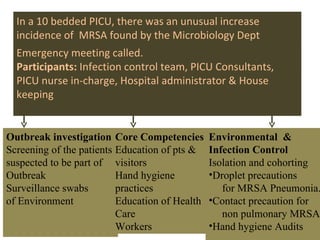
In a 10 bedded PICU, there was an unusual increase incidence of  MRSA found by the Microbiology Dept  Outbreak investigation Screening of the patients  suspected to be part of  Outbreak Surveillance swabs  of Environment Core Competencies Education of pts & visitors Hand hygiene practices Education of Health Care  Workers Environmental  &  Infection Control Isolation and cohorting Droplet precautions  for MRSA Pneumonia. Contact precaution for non pulmonary MRSA Hand hygiene Audits Emergency meeting called. Participants:  Infection control team, PICU Consultants, PICU nurse in-charge, Hospital administrator & House keeping
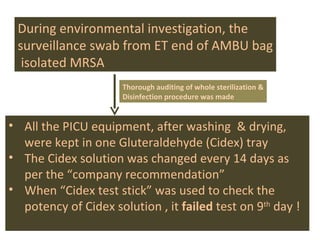
During environmental investigation, the  surveillance swab from ET end of AMBU bag isolated MRSA All the PICU equipment, after washing  & drying, were kept in one Gluteraldehyde (Cidex) tray The Cidex solution was changed every 14 days as per the “company recommendation” When “Cidex test stick” was used to check the potency of Cidex solution , it  failed  test on 9 th  day ! Thorough auditing of whole sterilization & Disinfection procedure was made
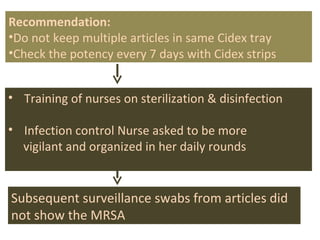
Recommendation: Do not keep multiple articles in same Cidex tray Check the potency every 7 days with Cidex strips Subsequent surveillance swabs from articles did not show the MRSA Training of nurses on sterilization & disinfection Infection control Nurse asked to be more vigilant and organized in her daily rounds
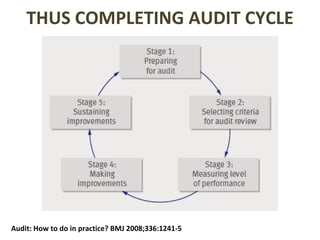
THUS COMPLETING AUDIT CYCLE Audit: How to do in practice? BMJ 2008;336:1241-5
Administrative support In several reports, administrative support and involvement were important for the successful control of Infection Outbreaks. Haley, R. W., Cushion, N. B., Tenover, F. C., Bannerman, T. L., Dryer, D., Ross, J., Sanchez, P. J., & Siegel, J. D. (1995)  J Infect Dis  171, 614-624 “ without the support of the top management, the infection control team is a bunch of jokers”
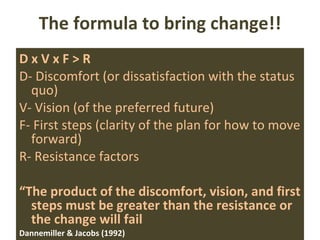
The formula to bring change!! D x V x F > R D- Discomfort (or dissatisfaction with the status quo) V- Vision (of the preferred future) F- First steps (clarity of the plan for how to move forward) R- Resistance factors  “ The product of the discomfort, vision, and first steps must be greater than the resistance or the change will fail Dannemiller & Jacobs (1992)
THANK YOU

approaching infection outbreak in picu

  • 1.
    How do Iapproach Infection Outbreak in PICU? Dr Farhan Shaikh Consultant Pediatric Intensivist Internal assessor for Quality Standards Rainbow Children’s Hospital Hyderabad
  • 2.
    Infection control Nurseinforms the PICU consultant that there are two children with MDR Acinetobacter (one in Blood culture and the other in the ET secretion) in the PICU Is this an “ Acinetobacter outbreak”?
  • 3.
    What is anOutbreak? New cases (incidence) in a given population, during a given time period, at a rate that substantially exceeds what is &quot;expected.” or “back ground rate” Investigation of Outbreaks by William R Jarvis Chapter 7. Hospital Epidemiology and Infection Control by C.Glen mayhall 3 rd Edn Lippincott Williams & Wilkins Surveillance!
  • 4.
    Approach Confirm theOutbreak: Investigate patient and Environment Calculate the attack rate Compare it with the Back ground rate Management of the outbreak Treatment of the infected patients (Source control) Prevention of transmission - Isolation and Cohorting - Implementation of strict sterlization & disinfection Measures
  • 5.
    Outbreak Investigation Resources:Personnel a)Lead Investigator, b)Statistician c) support staff Supplies Laboratory Hospital Epidemiology and Infection Control by C.Glen mayhall 3 rd Edn Lippincott Williams & Wilkins
  • 6.
    Microbiological aspects Mostof the times, it is the Microbiology which identifies an outbreak. Typing of the organisms related to the outbreak, to determine if the infected patient is indeed the part of the outbreak Other methods of typing are.. phage typing, serotyping, iso-enzyme electrophoresis, plasmid analysis, etc
  • 7.
    Case Definition shouldinclude.. Time, place, person, Clinical and Lab parameters ( date of onset of illness, symptoms, signs, specific Lab or diagnostic finding) Epidemiological parameters (e.g. a patient’s presence in a specific ward, during a specific timing) Hospital Epidemiology and Infection Control by C.Glen mayhall 3 rd Edn Lippincott Williams & Wilkins
  • 8.
    Example of casedefinitions &quot;A case of multidrug-resistant tuberculosis during an outbreak between 2009-2011 can be defined as.. any patient diagnosed with active tuberculosis from January 2009 through Oct 2011 whose M. tuberculosis isolate is resistant to at least isoniazid and rifampin,&quot; Hospital Epidemiology and Infection Control by C.Glen mayhall 3 rd Edn Lippincott Williams & Wilkins
  • 9.
    Patient and EnvironmentalInvestigation Passive Surveillence Active surveillence- - Screening of patients (Universal or focused) - Screening of health care workers who are symptomatic or suspected to be part of outbreak - Surveillence swabs from the patient environment keeping in mind the target organism (e.g. for Aspergillus spp, target the air handling units and AC ducts)
  • 10.
    Comparison of theoutbreak period arrack rate to the background rate can be performed using the rate ratio: Attack rate during epidemic period Attack rate during background period
  • 11.
  • 12.
    Patient education Displaying posters and distributing hand outs to patients attendants about minimizing visits, and other relevant care
  • 13.
    Education & IncreasedAwareness amongst health care workers Educational Presentations for leaders to share with staff Updating the PICU nurses and doctors about “unit specific rates” of the target infection. This will keep everybody working in the unit “aware” and “motivated”
  • 14.
  • 15.
    Hand Hygeine: Thereis conclusive evidence of a temporal relationship between improved hand hygiene practices and decreased infection rates. Prevention and Treatment of Health Care–Acquired Infections Leanne B. Gasink, MD, MSCE, Ebbing Lautenbach, Med Clin N Am 92 (2008) 295–313 In more than 30 observational studies between 1980 and 2000 the rates of appropriate hand hygiene were reported to range from 5% to 81%, with an average rate of 40%. Boyce JM, Pittet D. Et al.Am J Infect Control 2002;30(8):S1–46
  • 16.
    There is increasingevidence that the level of bedside nurse-staffing influences the quality of patient care. The association of nursing staff shortages with increased rates of infection outbreaks in ICUs has been demonstrated in several studies. Jane D. Siegel, Emily Rhinehart,et al. 2007 Guideline for Isolation Precautions: Preventing Transmission of Infectious Agents in Healthcare Settings .CDC
  • 17.
    http://www.who.int/gpsc/5may/How_To_HandWash_Poster.pdf © WorldHealth Organization 2009. All rights reserved., and  the 'How to Handrub', URL: http://www.who.int/gpsc/5may/How_To_HandRub_Poster.pdf © World Health Organization 2009. All rights reserved.'
  • 18.
    http://www.who.int/gpsc/5may/How_To_HandWash_Poster.pdf © WorldHealth Organization 2009. All rights reserved., and  the 'How to Handrub', URL: http://www.who.int/gpsc/5may/How_To_HandRub_Poster.pdf © World Health Organization 2009. All rights reserved.'
  • 19.
    Masks Only recommendedwhen performing splash generating procedures (e.g., wound irrigation, oral suctioning, intubation); contaminated wounds (e.g. Burns) When the HCP has infection e.g. sinusitis Jane D. Siegel, MD; et alManagement of Multidrug-Resistant Organisms In Healthcare Settings, 2006 CDC
  • 20.
    Gowning There isno significant difference in the infection rate between the use or non-use of cover gowns in an intensive care unit. Nathan L. Belkin, Association for Professionals in Infection Control and Epidemiology. AJIC Am J Infect Control 1997;25:401-4 “ Routine” use of Gown in ICUs depends on the problems of each setting and priorities. Smith CD. Cover gowns, surgical hand scrubs, smoke evacuators, operative record abbreviations; open sterile setupsclinical issues. AORN J 1995;61:753
  • 21.
    Due to thenature of care provided in the ICUs, 80% of the ICU infections come under.. Burke JP. Infection control a problem for patient safety. N Engl J Med 2003;348(7):651–6. National Nosocomial Infections Surveillance S. National Nosocomial Infections Surveillance (NNIS) System Report, data summary from January 1992 through June 2004, issuedOctober 2004. Am J Infect Control 2004;32(8):470–85. bloodstream infections (BSI), and Nosocomial Pneumonia (NP or VAP) urinary tract infections (UTIs), surgical site infections (SSIs),
  • 22.
    Great material availableonline from reputed sites (IDSA,CDC, SCCM, etc) VAP prevention guidelines CR-BSI prevention guidelines CA-UTI prevention guidelines SSI prevention guidelines Remembering and implementing the guidelines is the biggest challenge!
  • 23.
    Airline Industry Safestmode of transportation (one accident for every 1.6 million flights) A person is more likely to die on the way to the airport than in a plane crash Airline Industry Records 2010 as Safest Year in Aviation History FEBRUARY 24TH, 2011 • BY AVIATION NEWS
  • 24.
    Concept of using“Check list” The cockpit routines are standardized with “checklists” which are followed at every step. Thus avoids problems of “forgetting&quot;, or omissions.
  • 25.
    Concept of using“Bundles” A bundle is a structured set of evidence-based practices for improving the processes of care and patient outcomes. It is a small, straightforward set of practices (elements)— generally three to five — that, when performed collectively and reliably, have been proven to improve patient outcomes. Resar R, Pronovost P, Haraden C, Simmonds T, et al. Using a bundle approach to improve ventilator careprocesses and reduce ventilator-associated pneumonia . Joint Commission Journal on Quality and Patient Safety. 2005; 31(5):243-248
  • 26.
    The elements areall based on randomized controlled trials (i.e. Level 1 evidence— obtained from at least one properly designed RCT). The elements are all necessary and all sufficient. If any one element is removed, the desired results would not be achieved.  
  • 27.
    Cr-BSI care bundleProper hand hygiene before and after procedure Maximal barrier precautions upon insertion Chlorhexidine skin preparation Nursing personnel empowered to stop the procedure in case of any procedure deviation Daily review of line necessity with prompt removal of unnecessary lines VAP Bundle Head end of the bed elevation Mouth care with chlorhexidine-based mouth wash Deep venous thrombosis prophylaxis Gastrointestinal prophylaxis Ventilator tube changed weekly unless contaminated Sedation stop at 7:30 am and assessment for weaning
  • 28.
    Sheet No:    Bundle Criteria Use a single column for each Ventilated patient. Mark the appropriate response in the box. Optimal answer Day 1 Day 2 Day 3 Day 4 Day 5 Day 6 Day 7   Prevention of aspiration of contaminated secretions   Elevate head of bed 30-45 degrees                  Ventilator circuit drained before repositioning patient                    Prevention of bacterial colonization of oropharynx, stomach & sinuses   Hand hygiene performed before & after contact with ventilator circuit.     Yes/No               Condensate from ventilator circuit drained every 2-4 hours                  Oral suction devices rinsed after every use & stored in plastic covers                  Unit mouth care policy followed every 2-4 hrs                   
  • 29.
    Reason if ventilatorcircuit condensate not drained D 1: Busy schedule D 2: Did not remember D 3: Bed non-functional Gowns worn before providing care to the patient whenever soiling from respiratory secretions observed                    Ventilator circuits & in-line suction catheters changed only if visibly soiled                  Did the patient develop VAP today as per the defined criteria?   Yes/No               Reason if Head end not elevated N 1: Pt unstable N 4: Other (Add comment) N 2: Surgical restriction N 3: Raised ICT
  • 30.
  • 31.
    Several outbreaks haveoccurred as a result of improper disinfection and sterilization. Controlling Antimicrobial Resistance in the Hospital. DeverickJ.et al. Infect Dis Clin N Am 23 (2009) 847-864 Complete item wise discussion is beyond the scope of this talk, but can be downloaded from .. Guideline for Disinfection and Sterilization in Healthcare Facilities, 2008 William A. Rutala, Ph.D., M.P.H.1,2, David J. Weber, M.D., M.P.H.1,2, and the Healthcare Infection Control Practices Advisory Committee (HICPAC) on the CDC website.
  • 32.
    Spaulding categorized theprocess as.. Critical items: Items entering body or vascular system Must be sterilized by steam under pressure, dry heat , Or for heat sensitive items ETO Semicritical : Items in contact with mucosa or non-intact skin. Disinfection by a high level disinfectant (e.g. Gluteraldehyde) Spaulding EH. Chemical disinfection of medical and surgical materials. In: Lawrence C, Block SS, eds. Disinfection, sterilization, and preservation. Philadelphia: Lea & Febiger, 1968:517-31.
  • 33.
    Noncritical items come in contact with intact skin but not mucous membranes. Noncritical items are .. noncritical patient care items e.g. bedpans, blood pressure cuffs, crutches, bed rails noncritical environmental surfaces e.g., bedside tables, patient furniture, computers and floors etc. Spaulding EH. Chemical disinfection of medical and surgical materials. In: Lawrence C, Block SS, eds. Disinfection, sterilization, and preservation. Philadelphia: Lea & Febiger, 1968:517-31.
  • 34.
    FUMIGATION NOT RECOMMMENDEDBesides being ineffective, the agents are toxic and irritating to the eyes and mucous membranes. makes rooms unavailable for use, leading to disruption services Garner JS. Guideline for isolation precautions in hospitals. The Hospital Infection Control Practices Advisory Committee. Infect. Control Hosp. Epidemiol. 1996;17:53-80. Centers for Disease Control. Guidelines for Environmental Infection Control in Health-Care Facilities, 2003. MMWR 2003;52 (No. RR-10):1-44 .
  • 35.
    Mop-clean the surfaces(e.g., floors, bed rails , incubators,warmers,table tops) on a regular basis (3 to 5 times a day), The walls, of the ICU to be mopped when visibly soiled and at least once every week. William A. Rutala, Ph.D., M.P.H.1,2, David J. Weber, M.D., M.P.H.1,2, and the Healthcare Infection Control Practices Advisory Committee (HICPAC) Guideline for Disinfection and Sterilization in Healthcare Facilities, 2008 .CDC
  • 36.
    Prepare fresh disinfectingsolutions with or without a tuberculocidal activity Fresh solution in every area or one solution for three rooms, change no less often than at 60-minute intervals) Decontaminate mop heads by immersing in 1% NaOCl for 3 minutes every 30 minutes to prevent contamination William A. Rutala, Ph.D., M.P.H.1,2, David J. Weber, M.D., M.P.H.1,2, and the Healthcare Infection Control Practices Advisory Committee (HICPAC) Guideline for Disinfection and Sterilization in Healthcare Facilities, 2008 .CDC
  • 37.
  • 38.
    Isolation and CohortingSelective placement of patients by keeping the child in a single room with separate hand washing facilities if single rooms are not available, or if there is a shortage of single rooms, patients infected or colonized by the same organism can be cohorted (sharing of room/s).
  • 39.
    Transmission based PrecautionsContact precautions Airborne precautions and Droplet precautions. Practical Guidelines for Infection Control in Health Care Facilities. SEARO Regional Publication No. 41 WPRO Regional Publication.WHO.2004
  • 40.
    Contact precautions Currentguidelines recommend implementing contact precautions routinely for all patients colonized or infected with a target MDRO. E.g. MRSA, VRE, ESBL-producing organisms, Acinetobacter. and Pseudomonas (including colonization) Siegel JD, RhinehartE, Jackson M, et al. Management of multidrug-resistant organ- isms in health care settings, 2006. Am J Infect Control 2007;35(10 Suppl 2): S165-93. Practical Guidelines for Infection Control in Health Care Facilities. SEARO Regional Publication No. 41 WPRO Regional Publication.WHO.2004
  • 41.
    Implement standard precautions.Wear a clean, gown before entering the room and remove it before coming out of the room. Strict hand washing and hand hygiene practices Strict mopping and cleaning schedule of the room to be maintained No sharing of any equipment from this place with anybody outside the isolation
  • 42.
    Implement standard precautions.All bed sheets and pillow covers to be kept in yellow bag and sent to Central solucing unit where NaOCl treatment for 30 mins and then washing and sending to laundry
  • 43.
    Airborne precautions Whendroplet nuclei (evaporated droplets) <5 micron in size are disseminated in the air. E.g. H1N1 pneumonia, measles, chicken pox, pulmonary plague etc Practical Guidelines for Infection Control in Health Care Facilities. SEARO Regional Publication No. 41 WPRO Regional Publication.WHO.2004
  • 44.
    Airborne precautions Implementstandard precautions. Place patient in a “negative pressure room” (6-12 air exchanges with separate air exit through separate filters) Anyone who enters the room must wear a special, high filtration, mask (e.g. N 95). If transport of patient is necessary, minimize dispersal of droplet nuclei by masking the patient with a N95 mask.
  • 45.
    Droplet precautions Droplets(>5 microns) are usually generated from the infected person during coughing, sneezing, talking or tracheal suctioning. E.g. MRSA or Acinetobacter pneumonias, pertussis, diphtheria, influenza type B, mumps, and meningitis. Practical Guidelines for Infection Control in Health Care Facilities. SEARO Regional Publication No. 41 WPRO Regional Publication.WHO.2004
  • 46.
    Droplet precautions Implement standard precautions. No need of N95 masks or Negative pressure room Wear a surgical mask when working within 1-2 meters of the patient.
  • 47.
    Antimicrobial stewardship Itis a program providing a standard, evidence-based approach to judicious antimicrobial use. Preparation of unit specific Antibiogram Antibiotic use monitoring Nurse empowerment De-escalation Antibiotic Cycling Controlling Antimicrobial Resistance in the Hospital DeverickJ. Anderson et al. Infect Dis Clin N Am 23 (2009) 847-864 . Jane D. Siegel, MD; et al Management of Multidrug-Resistant Organisms In Healthcare Settings, 2006.CDC
  • 48.
    Universal Screening Advantages:Screen every patient admitting in the PICU No need to “flag” patients Disadvantages: More costly Jane D. Siegel, MD; et al Management of Multidrug-Resistant Organisms In Healthcare Settings, 2006 CDC
  • 49.
    Focused Screening Whomto screen ? Previous admission within 6 m. Transfer from area known to have MDRO ICU length of stay LOS > 4 d. H/O use of multiple antibiotics Advantages: Cheaper Disadvantage: May miss patients with other risk factors Jane D. Siegel, MD; et al Management of Multidrug-Resistant Organisms In Healthcare Settings, 2006 CDC
  • 50.
    Routine screening ofthe health care workers (nurses and doctors) is not recommended. Done if the HCP is symptomatic or suspected to be epidemiologically related in the outbreak. E.g. If a new case of H1N1 detected, screen the doctors and nurses who are un-immunized and were in close contact of the patient Haley, R. W., Cushion, N. B., Tenover, F. C., Bannerman, T. L., Dryer, D., Ross, J., Sanchez, P. J., & Siegel, J. D. (1995) J Infect Dis 171, 614-624 Jane D. Siegel, MD; et al Management of Multidrug-Resistant Organisms In Healthcare Settings, 2006 CDC
  • 51.
    Decolonization Done usuallyfor MRSA, of only those colonized Health care workers, who are symptomatic or are linked epidemiologically to the outbreak Controlling Antimicrobial Resistance in the Hospital DeverickJ. Anderson et al. Infect Dis Clin N Am 23 (2009) 847-864 Boyce, J. M. (2001) J Hosp Infect 48 Suppl A, S9-14.
  • 52.
    topical mupirocin aloneor.. ..in combination with oral antibiotics (e.g., rifampin in with trimethoprim- sulfamethoxazole or ciprofloxacin) plus.. ..an antimicrobial (chlorhexidine) soap bathing Jane D. Siegel, MD; et al Management of Multidrug-Resistant Organisms In Healthcare Settings, 2006 CDC
  • 53.
  • 54.
    In a 10bedded PICU, there was an unusual increase incidence of MRSA found by the Microbiology Dept Outbreak investigation Screening of the patients suspected to be part of Outbreak Surveillance swabs of Environment Core Competencies Education of pts & visitors Hand hygiene practices Education of Health Care Workers Environmental & Infection Control Isolation and cohorting Droplet precautions for MRSA Pneumonia. Contact precaution for non pulmonary MRSA Hand hygiene Audits Emergency meeting called. Participants: Infection control team, PICU Consultants, PICU nurse in-charge, Hospital administrator & House keeping
  • 55.
    During environmental investigation,the surveillance swab from ET end of AMBU bag isolated MRSA All the PICU equipment, after washing & drying, were kept in one Gluteraldehyde (Cidex) tray The Cidex solution was changed every 14 days as per the “company recommendation” When “Cidex test stick” was used to check the potency of Cidex solution , it failed test on 9 th day ! Thorough auditing of whole sterilization & Disinfection procedure was made
  • 56.
    Recommendation: Do notkeep multiple articles in same Cidex tray Check the potency every 7 days with Cidex strips Subsequent surveillance swabs from articles did not show the MRSA Training of nurses on sterilization & disinfection Infection control Nurse asked to be more vigilant and organized in her daily rounds
  • 57.
    THUS COMPLETING AUDITCYCLE Audit: How to do in practice? BMJ 2008;336:1241-5
  • 58.
    Administrative support Inseveral reports, administrative support and involvement were important for the successful control of Infection Outbreaks. Haley, R. W., Cushion, N. B., Tenover, F. C., Bannerman, T. L., Dryer, D., Ross, J., Sanchez, P. J., & Siegel, J. D. (1995) J Infect Dis 171, 614-624 “ without the support of the top management, the infection control team is a bunch of jokers”
  • 59.
    The formula tobring change!! D x V x F > R D- Discomfort (or dissatisfaction with the status quo) V- Vision (of the preferred future) F- First steps (clarity of the plan for how to move forward) R- Resistance factors “ The product of the discomfort, vision, and first steps must be greater than the resistance or the change will fail Dannemiller & Jacobs (1992)
  • 60.

Editor's Notes

  • #7 E.g. During outbreak of Surgical Site Infection (SSIs) caused by MRSA, a patient who is growing MSSA will be excluded
  • #8 One of the first task of the investigative team is to develop a working case definition based on the known facts of the outbreak.
  • #10 Any outbreak investigation must include close inspection of the environment mainly the inanimate objects.
  • #17 With adequate nursing staff, it is more likely that infection control practices will be given appropriate attention and applied correctly and consistently
  • #33 More than 30 years ago, Earle H. Spaulding devised a rational approach to disinfection and sterilization of patient-care items and equipment.14 This classification scheme is so clear and logical that it has been retained, refined, and successfully used by infection control professionals and others when planning methods for disinfection or sterilization. 1, 13, 15, 17, 19, 20
  • #34 Intact skin acts as an effective barrier to most microorganisms; therefore, the sterility of items coming in contact with intact skin is &amp;quot;not critical.&amp;quot;
  • #42 patients should be moved for essential purposes only. If transportation is required, use precautions to minimize the risk of transmission.
  • #51 MRSA: Cultures of the nares identify most patients with MRSA and peri-rectal and wound cultures can identify additional carriers MDRO-GNB: peri-rectal or rectal swabs alone or in combination with oro-pharyngeal, endotracheal, inguinal, or wound cultures.
  • #53 Decolonization regimens are not sufficiently effective to warrant routine use. Therefore, most healthcare facilities have limited the use of decolonization to MRSA outbreaks, or other high prevalence situations, especially those affecting special-care units. Several factors limit the utility of this control measure on a widespread basis: 1) identification of candidates for decolonization requires surveillance cultures; 2) candidates receiving decolonization treatment must receive follow-up cultures to ensure eradication; and 3) recolonization with the same strain, initial colonization with a mupirocin-resistant strain, and emergence of resistance to mupirocin during treatment can occur(289, 303, 308-310). HCP implicated in transmission of MRSA are candidates for decolonization and should be treated and culture negative before returning to direct patient care. In contrast, HCP who are colonized with MRSA, but are asymptomatic, and have not been linked epidemiologically to transmission, do not require decolonization.