ANTIBIOTIC Stewardship Program
ESSENTIAL LEARNING FOR MEDICAL GRADUATES
Dr.T.V.Rao MD
7/5/2017 Dr.T.V.Rao MD @gmail.com 1
WHY WE NEED ANTIBIOTIC STEWARDSHIP
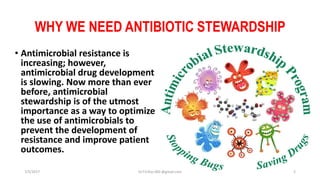
• Antimicrobial resistance is
increasing; however,
antimicrobial drug development
is slowing. Now more than ever
before, antimicrobial
stewardship is of the utmost
importance as a way to optimize
the use of antimicrobials to
prevent the development of
resistance and improve patient
outcomes.
7/5/2017 Dr.T.V.Rao MD @gmail.com 2
Antibiotic Resistance is a emerging challenges in human care –
Making the matters understand need a coordinated approach
THE COMPONETNS INCLUDE ATTENTION
•Antimicrobial Stewardship (AS)
•The components of a high functioning AS program
•Why infection prevention is essential to efforts to
improve AS
•Ways in which Infection Perfectionists (IPs) can
collaborate with key stakeholders to improve AS
efforts despite the degree of implementation of the
program
7/5/2017 Dr.T.V.Rao MD @gmail.com 3
➔ Misuse and over-use
of antibiotics
• The last 50 years have witnessed
the golden age of antibiotic
discovery and their widespread
use in hospital and community
settings. Regarded as very
effective, safe and relatively
inexpensive, antibiotics have
saved millions of lives. However,
this has led to their misuse
through huse without a
prescription and overuse for self-
limiting infections
7/5/2017 Dr.T.V.Rao MD @gmail.com 4
Combating antimicrobial resistance
• To overcome the threat of antimicrobial resistance, a
three-pillar
• approach has been advocated:
• 1 Optimise the use of existing antimicrobial agents
• 2 Prevent the transmission of drug-resistant
organisms through
• infection control
• 3 Improve environmental decontamination
7/5/2017 Dr.T.V.Rao MD @gmail.com 5
“Need for Antimicrobial stewardship:
• is an inter-professional effort, across
• the continuum of care
• ➤ involves timely and optimal selection, dose and
• duration of an antimicrobial
• ➤ for the best clinical outcome for the treatment or
• prevention of infection
• ➤ with minimal toxicity to the patient
• ➤ and minimal impact on resistance and other
• ecological adverse events such as C. difficile”
7/5/2017 Dr.T.V.Rao MD @gmail.com 6
The greater Initiation to
stop the misuse of
Antibiotics
• Hospitals today straggle the
demands of increasing
regulation, changing
technology requirements,
more stringent reporting
requirements and a rising
number of quality initiatives
in an already challenging
economic environment.
7/5/2017 Dr.T.V.Rao MD @gmail.com 7
Need for Antibiotic
Steward ship
• With competition for
time, attention and
financial resources, why
does your hospital need
an antimicrobial
stewardship program
(ASP)?7/5/2017 Dr.T.V.Rao MD @gmail.com 8
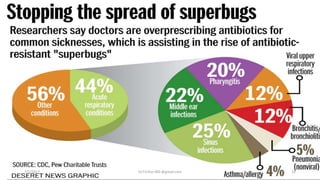
Overprescribing of
antibiotics wastes
money:
• Worldwide monitoring
shows an alarming
increase in antibiotics
prescriptions, often for
conditions that do not
warrant them. In U.S.
hospitals, studies indicate
that up to 50% of
antibiotic prescriptions
are inappropriate.
7/5/2017 Dr.T.V.Rao MD @gmail.com 9
Inappropriate
Treatments costs
life and economy
• Not only are those
inappropriate
prescriptions
dangerous, they drive
up costs for hospitals,
payers and patients. In
fact, overuse and
inappropriate use of
antibiotics costs the
healthcare system
7/5/2017 Dr.T.V.Rao MD @gmail.com 10
Inappropriate use of
antibiotics increases
resistance in infectious
organisms:
• The improper use of
antibiotics directly
contributes to the rising
number of strains of
multidrug resistant
organisms (MDROs) in
communities across the
country, posing a
significant risk to patient
health.
7/5/2017 Dr.T.V.Rao MD @gmail.com 11
Poor prescribing
practices endanger
patients
• Receiving a broad-
spectrum antibiotic
triples a patient’s
subsequent risk of
infection with a more
resistant organism,
according to the
Centers for Disease
Control and
Prevention (CDC).
7/5/2017 Dr.T.V.Rao MD @gmail.com 12
7/5/2017 Dr.T.V.Rao MD @gmail.com 13
7/5/2017 Dr.T.V.Rao MD @gmail.com 14
MDROs increase morbidity and mortality
• Infections lead to more
than eight million
additional hospital days
and are responsible for
23,000 deaths each year.
According to the CDC,
improved antibiotic
prescription reduces rates
of MDROs in hospitals and
improves clinical outcomes
for patients.
7/5/2017 Dr.T.V.Rao MD @gmail.com 15
MDROs increase
hospital costs:
• Approximately 70% of healthcare
associated infections (HAIs) involve
organisms resistant to at least one drug. As
Medicare and other payers do not
reimburse for HAIs, every hospital has a
significant interest in reducing the number
of MDROs present in the facility and in the
broader community
7/5/2017 Dr.T.V.Rao MD @gmail.com 16
Few new antibiotics
are in development:
• In the last 20 years, the number of
antibiotics in development has
dropped sharply. Since 2008,
pharmaceutical companies have
introduced four new antibiotics,
compared to 16 approved from 1983 to
1987—and no new classes of
antibiotics to treat gram-negative
bacilli have been released in more than
40 years.
7/5/2017 Dr.T.V.Rao MD @gmail.com 17
How stewardship program helps
• Consequently, hospitals must do
everything possible to maintain
the efficacy and extend the useful
life of the antibiotics currently
available. An antimicrobial
stewardship program helps ensure
that the narrowest spectrum
antimicrobial known to be
effective is used for each infection,
reducing the development of
resistant strains.
7/5/2017 Dr.T.V.Rao MD @gmail.com 18
Point-of-care interventions can include:
• appropriate use of guidance,
• ➤ indication for antibiotic,
• ➤ choice of agent,
• ➤ route [IV vs. oral] of administration of treatment,
• ➤ timeliness of treatment,
• ➤ likelihood of on-going infection or not,
• ➤ use of investigation,
• ➤ interpretation of microbiology with a view tode-escalation or stopping
therapy,
• ➤ duration of therapy.
7/5/2017 Dr.T.V.Rao MD @gmail.com 19
Data collection for quality
improvement
• Antimicrobial stewardship is part of many patient safety
programs. To measure the performance of these programs, data is
primarily used for 3 purposes [Solberg et al., 1997]:
• l Accountability (e.g. targets)
• l Improvement
• l Research.
• A range of such measures for antimicrobial stewardship programs
have been proposed. They can be summarized as four types
structural, process, outcomes and balancing (are the changes
causing new problems?)
7/5/2017 Dr.T.V.Rao MD @gmail.com 20
. Who should receive education
in hospitals?
• Prescribers and other healthcare staff with modules
adapted to their background including:
• l Undergraduate curriculum
• l Internship
• l Professional training for new staff
• l Continuing professional development for all
prescribers
• l Postgraduate education
7/5/2017 Dr.T.V.Rao MD @gmail.com 21
The content of education should be adapted to each
profession
and include
• Basic knowledge of infection management,
• l Basic microbiology
• l Importance of prudent prescribing in tackling
antimicrobial resistance.
• l Best practices for prescribing to support safe and effective
prescribing, administration and monitoring of antimicrobial
therapy.
• The training is usually delivered by the antimicrobial
management team and may include competency
assessment
7/5/2017 Dr.T.V.Rao MD @gmail.com 22
THE KEYS TO
SUCCESS
• A number of interventions
are key to the success of a
hospital-based Antimicrobial
Stewardship Program.
• ➤ Establish a clear
aim/vision that is shared by
all the stakeholders and that
conveys a sense of urgency.
• Stewardship should be a
patient safety priority.
7/5/2017 Dr.T.V.Rao MD @gmail.com 23
THE KEYS TO
SUCCESS
• Seek management
support, accountability
and secure funding.
• ➤ Assemble a strong
coalition including a
multi-professional
antimicrobial
stewardship team with a
strong influential clinical
leader.
7/5/2017 Dr.T.V.Rao MD @gmail.com 24
THE KEYS TO
SUCCESS
• Establish effective
communication structures
within your hospital.
• ➤ Start with core evidence-
based stewardship
interventions depending on
local needs, geography and
resources and plan
measurement to demonstrate
their impact.
7/5/2017 Dr.T.V.Rao MD @gmail.com 25
THE KEYS TO SUCCESS
• Ensure all healthcare
staff are aware of the
importance of
stewardship. Empower
them to act and support
with education using a
range of effective
strategies.
• ➤ Ensure early or short
term wins and then
consolidate
success/gains while
progressing with more
change or innovation.
7/5/2017 Dr.T.V.Rao MD @gmail.com 26
7/5/2017 Dr.T.V.Rao MD @gmail.com 27
References
• Why Your Hospital Needs an Antimicrobial Stewardship Program
Pharmacy OneSource Blog
• Practical Guide TO ANTIMICROBIAL STEWARDSHIP IN HOSPITALS
BioMérieux
7/5/2017 Dr.T.V.Rao MD @gmail.com 28
•Program Created by Dr.T.V.Rao MD for benefit of
Medical and Paramedical Professionals on Universal
education on Antibiotic Stewardship
• Email.com
• doctortvrao@gmail.com
7/5/2017 Dr.T.V.Rao MD @gmail.com 29

Antibiotic stewardship program

  • 1.
    ANTIBIOTIC Stewardship Program ESSENTIALLEARNING FOR MEDICAL GRADUATES Dr.T.V.Rao MD 7/5/2017 Dr.T.V.Rao MD @gmail.com 1
  • 2.
    WHY WE NEEDANTIBIOTIC STEWARDSHIP • Antimicrobial resistance is increasing; however, antimicrobial drug development is slowing. Now more than ever before, antimicrobial stewardship is of the utmost importance as a way to optimize the use of antimicrobials to prevent the development of resistance and improve patient outcomes. 7/5/2017 Dr.T.V.Rao MD @gmail.com 2
  • 3.
    Antibiotic Resistance isa emerging challenges in human care – Making the matters understand need a coordinated approach THE COMPONETNS INCLUDE ATTENTION •Antimicrobial Stewardship (AS) •The components of a high functioning AS program •Why infection prevention is essential to efforts to improve AS •Ways in which Infection Perfectionists (IPs) can collaborate with key stakeholders to improve AS efforts despite the degree of implementation of the program 7/5/2017 Dr.T.V.Rao MD @gmail.com 3
  • 4.
    ➔ Misuse andover-use of antibiotics • The last 50 years have witnessed the golden age of antibiotic discovery and their widespread use in hospital and community settings. Regarded as very effective, safe and relatively inexpensive, antibiotics have saved millions of lives. However, this has led to their misuse through huse without a prescription and overuse for self- limiting infections 7/5/2017 Dr.T.V.Rao MD @gmail.com 4
  • 5.
    Combating antimicrobial resistance •To overcome the threat of antimicrobial resistance, a three-pillar • approach has been advocated: • 1 Optimise the use of existing antimicrobial agents • 2 Prevent the transmission of drug-resistant organisms through • infection control • 3 Improve environmental decontamination 7/5/2017 Dr.T.V.Rao MD @gmail.com 5
  • 6.
    “Need for Antimicrobialstewardship: • is an inter-professional effort, across • the continuum of care • ➤ involves timely and optimal selection, dose and • duration of an antimicrobial • ➤ for the best clinical outcome for the treatment or • prevention of infection • ➤ with minimal toxicity to the patient • ➤ and minimal impact on resistance and other • ecological adverse events such as C. difficile” 7/5/2017 Dr.T.V.Rao MD @gmail.com 6
  • 7.
    The greater Initiationto stop the misuse of Antibiotics • Hospitals today straggle the demands of increasing regulation, changing technology requirements, more stringent reporting requirements and a rising number of quality initiatives in an already challenging economic environment. 7/5/2017 Dr.T.V.Rao MD @gmail.com 7
  • 8.
    Need for Antibiotic Stewardship • With competition for time, attention and financial resources, why does your hospital need an antimicrobial stewardship program (ASP)?7/5/2017 Dr.T.V.Rao MD @gmail.com 8
  • 9.
    Overprescribing of antibiotics wastes money: •Worldwide monitoring shows an alarming increase in antibiotics prescriptions, often for conditions that do not warrant them. In U.S. hospitals, studies indicate that up to 50% of antibiotic prescriptions are inappropriate. 7/5/2017 Dr.T.V.Rao MD @gmail.com 9
  • 10.
    Inappropriate Treatments costs life andeconomy • Not only are those inappropriate prescriptions dangerous, they drive up costs for hospitals, payers and patients. In fact, overuse and inappropriate use of antibiotics costs the healthcare system 7/5/2017 Dr.T.V.Rao MD @gmail.com 10
  • 11.
    Inappropriate use of antibioticsincreases resistance in infectious organisms: • The improper use of antibiotics directly contributes to the rising number of strains of multidrug resistant organisms (MDROs) in communities across the country, posing a significant risk to patient health. 7/5/2017 Dr.T.V.Rao MD @gmail.com 11
  • 12.
    Poor prescribing practices endanger patients •Receiving a broad- spectrum antibiotic triples a patient’s subsequent risk of infection with a more resistant organism, according to the Centers for Disease Control and Prevention (CDC). 7/5/2017 Dr.T.V.Rao MD @gmail.com 12
  • 13.
  • 14.
  • 15.
    MDROs increase morbidityand mortality • Infections lead to more than eight million additional hospital days and are responsible for 23,000 deaths each year. According to the CDC, improved antibiotic prescription reduces rates of MDROs in hospitals and improves clinical outcomes for patients. 7/5/2017 Dr.T.V.Rao MD @gmail.com 15
  • 16.
    MDROs increase hospital costs: •Approximately 70% of healthcare associated infections (HAIs) involve organisms resistant to at least one drug. As Medicare and other payers do not reimburse for HAIs, every hospital has a significant interest in reducing the number of MDROs present in the facility and in the broader community 7/5/2017 Dr.T.V.Rao MD @gmail.com 16
  • 17.
    Few new antibiotics arein development: • In the last 20 years, the number of antibiotics in development has dropped sharply. Since 2008, pharmaceutical companies have introduced four new antibiotics, compared to 16 approved from 1983 to 1987—and no new classes of antibiotics to treat gram-negative bacilli have been released in more than 40 years. 7/5/2017 Dr.T.V.Rao MD @gmail.com 17
  • 18.
    How stewardship programhelps • Consequently, hospitals must do everything possible to maintain the efficacy and extend the useful life of the antibiotics currently available. An antimicrobial stewardship program helps ensure that the narrowest spectrum antimicrobial known to be effective is used for each infection, reducing the development of resistant strains. 7/5/2017 Dr.T.V.Rao MD @gmail.com 18
  • 19.
    Point-of-care interventions caninclude: • appropriate use of guidance, • ➤ indication for antibiotic, • ➤ choice of agent, • ➤ route [IV vs. oral] of administration of treatment, • ➤ timeliness of treatment, • ➤ likelihood of on-going infection or not, • ➤ use of investigation, • ➤ interpretation of microbiology with a view tode-escalation or stopping therapy, • ➤ duration of therapy. 7/5/2017 Dr.T.V.Rao MD @gmail.com 19
  • 20.
    Data collection forquality improvement • Antimicrobial stewardship is part of many patient safety programs. To measure the performance of these programs, data is primarily used for 3 purposes [Solberg et al., 1997]: • l Accountability (e.g. targets) • l Improvement • l Research. • A range of such measures for antimicrobial stewardship programs have been proposed. They can be summarized as four types structural, process, outcomes and balancing (are the changes causing new problems?) 7/5/2017 Dr.T.V.Rao MD @gmail.com 20
  • 21.
    . Who shouldreceive education in hospitals? • Prescribers and other healthcare staff with modules adapted to their background including: • l Undergraduate curriculum • l Internship • l Professional training for new staff • l Continuing professional development for all prescribers • l Postgraduate education 7/5/2017 Dr.T.V.Rao MD @gmail.com 21
  • 22.
    The content ofeducation should be adapted to each profession and include • Basic knowledge of infection management, • l Basic microbiology • l Importance of prudent prescribing in tackling antimicrobial resistance. • l Best practices for prescribing to support safe and effective prescribing, administration and monitoring of antimicrobial therapy. • The training is usually delivered by the antimicrobial management team and may include competency assessment 7/5/2017 Dr.T.V.Rao MD @gmail.com 22
  • 23.
    THE KEYS TO SUCCESS •A number of interventions are key to the success of a hospital-based Antimicrobial Stewardship Program. • ➤ Establish a clear aim/vision that is shared by all the stakeholders and that conveys a sense of urgency. • Stewardship should be a patient safety priority. 7/5/2017 Dr.T.V.Rao MD @gmail.com 23
  • 24.
    THE KEYS TO SUCCESS •Seek management support, accountability and secure funding. • ➤ Assemble a strong coalition including a multi-professional antimicrobial stewardship team with a strong influential clinical leader. 7/5/2017 Dr.T.V.Rao MD @gmail.com 24
  • 25.
    THE KEYS TO SUCCESS •Establish effective communication structures within your hospital. • ➤ Start with core evidence- based stewardship interventions depending on local needs, geography and resources and plan measurement to demonstrate their impact. 7/5/2017 Dr.T.V.Rao MD @gmail.com 25
  • 26.
    THE KEYS TOSUCCESS • Ensure all healthcare staff are aware of the importance of stewardship. Empower them to act and support with education using a range of effective strategies. • ➤ Ensure early or short term wins and then consolidate success/gains while progressing with more change or innovation. 7/5/2017 Dr.T.V.Rao MD @gmail.com 26
  • 27.
  • 28.
    References • Why YourHospital Needs an Antimicrobial Stewardship Program Pharmacy OneSource Blog • Practical Guide TO ANTIMICROBIAL STEWARDSHIP IN HOSPITALS BioMérieux 7/5/2017 Dr.T.V.Rao MD @gmail.com 28
  • 29.
    •Program Created byDr.T.V.Rao MD for benefit of Medical and Paramedical Professionals on Universal education on Antibiotic Stewardship • Email.com • doctortvrao@gmail.com 7/5/2017 Dr.T.V.Rao MD @gmail.com 29