11 June 2024 1
HI, I AM A SPECIAL ONE, YOU MIGHT HAVE HEARD OF ME BY NOW
I HAVE BEEN TRAVELLING ACROSS CONTINENTS AND NATIONS
CATCH THE WEAK, AND VULNERABLE PEOPLE WITH CHRONIC DISEASE MAKE MY JOB EASIER
I NEED YOU METRE CLOSE TO CATCH YOU
I ACT INSIDE YOUR NOSE, MOUTH AND EYES
I RIDE THROUGH DROPLETS
THEN I MAKE YOU SNEEZE AND COUGH. THUS I TRAVEL AND MULTIPLY AND I HAVE A BIG EGO
AM AFRAID OF SOAPS AND SANITIZERS BECAUUSE SOAP MOLECULES WILL PENETRATE MY OILY
LIPID MEMBRANE LAYER AND DISMEMBER ME
WHEN YOU EAT A UNCOVERED FOOD AND NOT MAINTAIN STERILITY THAT TIME I AM SO HAPPY.
SO, TELL ME WHO AM I?
11 June 2024 2
11 June 2024 3
At the end of the session the students will be able to-
 Define infection and infection control
 State the basic of infection control
 Enlist the principle of infection control
 Classify the types of infection
 Illustrate the chain of infection
 Describe medical and surgical asepsis
11 June 2024 4
 Enlisted the steps of prevention of cross infection
 Discuss the hospital waste management
 Follow the policy related to infection control
 Explain the hospital infection control programme
11 June 2024 5
11 June 2024 6
The invasion and
growth of germs in the
body. The germs may
be bacteria, viruses,
yeast, fungi, or other
microorganisms.
01 02 03
A nosocomial
infection is contracted
because of
an infection or toxin that
exists in a certain
location, such as a
hospital.
An agent that
destroy
microorganism
TERMINOLOGIES
Infection Nosocominal Germicide
11 June 2024 7
FUMIGATION ISOLATION
Fumigation is a method
of pest control/ removal of
harmful micro-organisms
that completely fills an area
with gaseous pesticides
or fumigants to suffocate or
poison the pests within.
The complete separation
from others of a person
suffering from contagious or
infectious disease.
11 June 2024 8
An infection is the entry and
multiplication of an infectious
agent in the tissues of the
host. Infectious agent may be
bacteria, viruses, fungus,
spirochete or other
microorganisms capable of
producing infection under
favourable circumstances of
host, and the environment.
11 June 2024 9
02
02
03
01 Prevention of
Nosocomial
To practice
good asepsis
Hospital policies &
procedures
11 June 2024 10
PRINCIPLES OF
INFECTION
CONTROL
11 June 2024 11
1.
2.
• Primary and secondary infection
• Local and systemic infection
3.
4.
• Acute infection
• chronic infection
5.
6.
• Nosocomial infection
• Iatrogenic infection
11 June 2024 12
11 June 2024 13
11 June 2024 14
11 June 2024 15
• Rapid and accurate identification of organisms
• Control or elimination of infectious agents
11 June 2024 16
Measures to control/eliminate
reservoir for Infection-
 Employee health
 Environmental cleaning
 Handling of linen
 Visitors control
 Pest control
11 June 2024 17
Aseptic precautions
Use PPE
Careful handling of
waste
11 June 2024 18
 Airborne/Droplet precautions
 Contact precautions
11 June 2024 19
 Maintain integrity of skin and mucus
membranes.
 Proper positioning of tubing
 Personal hygiene
 Dispose of contaminated syringes and
needles properly
 Care should be taken while collecting
and handling specimen.
11 June 2024 20
Protecting normal defense
mechanisms
 Oral hygiene
 Adequate intake
Maintaining healing
processes
 Well-balanced diet
 Institution of measures to
improve appetite
11 June 2024 21
MEDICALSURGICALASEPSIS
11 June 2024 22
Medical asepsis also known as
“clean technique” is aimed at
controlling the number of
microorganisms. Medical asepsis is
used for all clinical patient care
activities.
MEDICAL
ASEPSIS
11 June 2024 23
Perform
hand hygiene
Use of personal
protective equipment
Clean and disinfect
shared patient
equipment Clean and disinfect
the environment
Principles of Medical Asepsis
11 June 2024 24
Surgical asepsis also ,known as “sterile
technique” is aimed at removing all
microorganisms. Surgical asepsis is used
for all surgical/sterile procedures.
SURGICAL ASEPSIS
11 June 2024 25
Principles of surgical
asepsis
•The patient should not be the source of contamination
•The operating room (OR) team should not be the source of
contamination
•The surgical scrub should be done meticulously
•The OR technique of the surgeon is very important
•Recognize potential environmental contamination
11 June 2024 26
DISINFECTION STERILIZATION
11 June 2024 27
Lorem Ipsum is simply dummy text of the
printing and typesetting industry.
2
3
4
5
CLEANING
HAND
WASHING
CAPING AND MASKING
GOWNING AND GLOVING
BAGGING
TYPES OF ASEPTIC PRACTICES
1
11 June 2024 28
FUMIGATION ISOLATION
HANDWASHING
BARRIER
PROTECTION
PREVENTION
OF CROSS
INFECTION
11 June 2024 29
1. FUMIGATION
Fumigation is a method
of pest control/ removal
of harmful micro-
oganisms that completely
fills an area with gaseous
pesticides or fumigants
to suffocate or poison the
pests within.
11 June 2024 30
11 June 2024 31
2. ISOLATION
Isolation technique is intended to
confine the microorganisms
within a given and organized
area.
11 June 2024 32
Wound and
skin
isolation
Enteric
isolation
Respiratory
isolation
Blood
isolation
11 June 2024 33
BARRIER
PROTECTION
Gloves
Mask
Apron
Eyewear
Footwear
11 June 2024 34
HAND
WASHING
Surgical
hand dis-
infection
Social hand
washing
Hygiene
&
disinfection
11 June 2024 35
 Hospital waste is “Any waste which is generated in the diagnosis,
treatment or immunization of human beings or animals or in
research” in a hospital. This is also called ‘Bio-Medical Waste’
(BMW).
 Hospital Waste Management means the management of waste
produced by hospitals using such techniques that will help to check
the spread of diseases through.
11 June 2024 36
11 June 2024 37
11 June 2024 38
11 June 2024 39
The main aim of the hospital infection programme is to lower the risk
of an infection during the period of hospitalization.
Aspects
 Development of an effective surveillance system to know the risk of
nosocomial infection.
 Development of policies and procedures to reduce risk of nosocomial
infection.
 Maintenance of continuing education programme from hospital
11 June 2024 40
Basic elements
 Providing a system of identification and reporting of infections and
providing a system for keeping records of infection.
 Providing for good hospital hygiene, aseptic technique and
sterilization and disinfection practices.
 Providing for co-ordination with all departments and medical/ nursing
audit committee in quality assurance.
11 June 2024 41
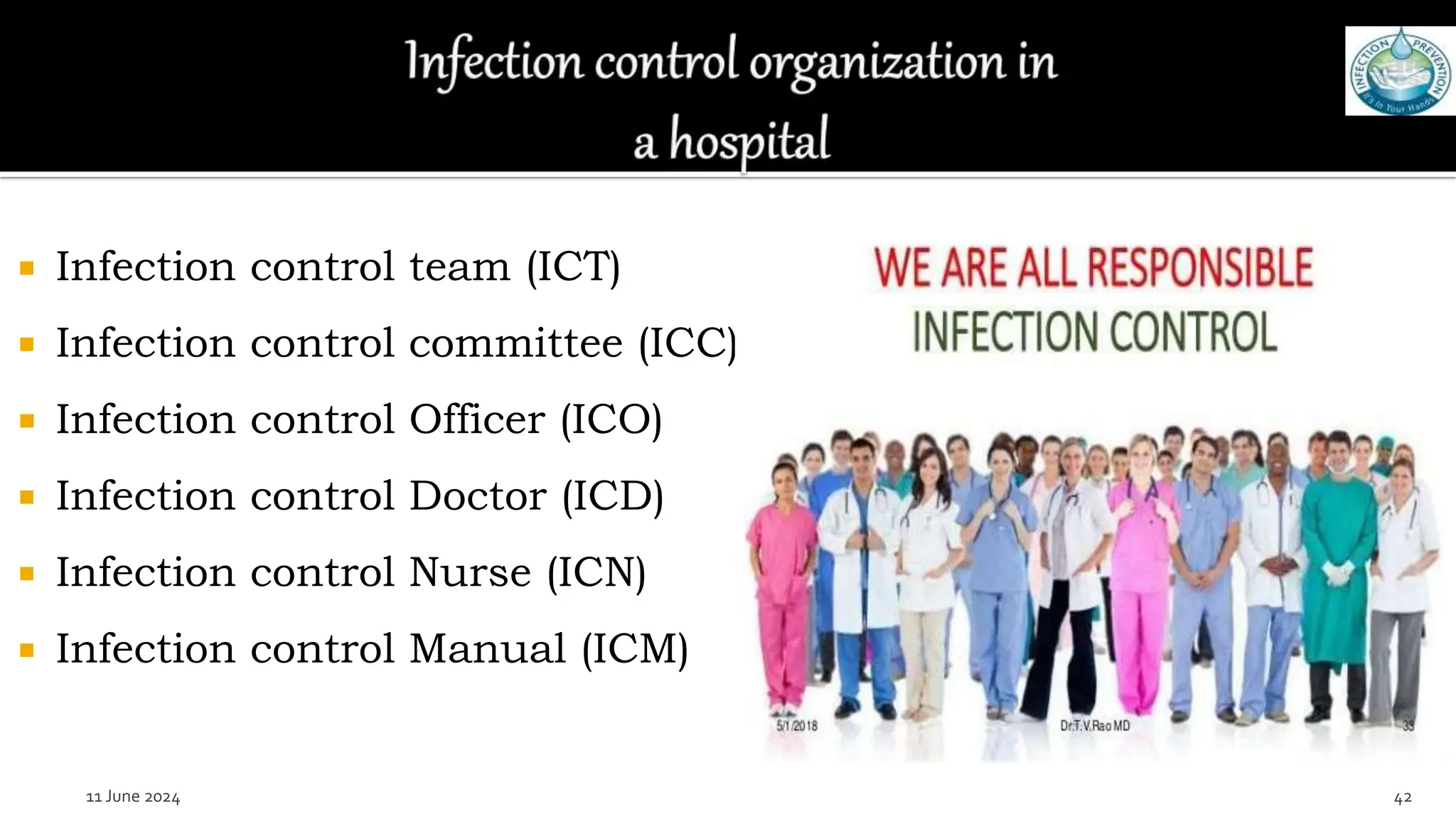
 Infection control team (ICT)
 Infection control committee (ICC)
 Infection control Officer (ICO)
 Infection control Doctor (ICD)
 Infection control Nurse (ICN)
 Infection control Manual (ICM)
11 June 2024 42
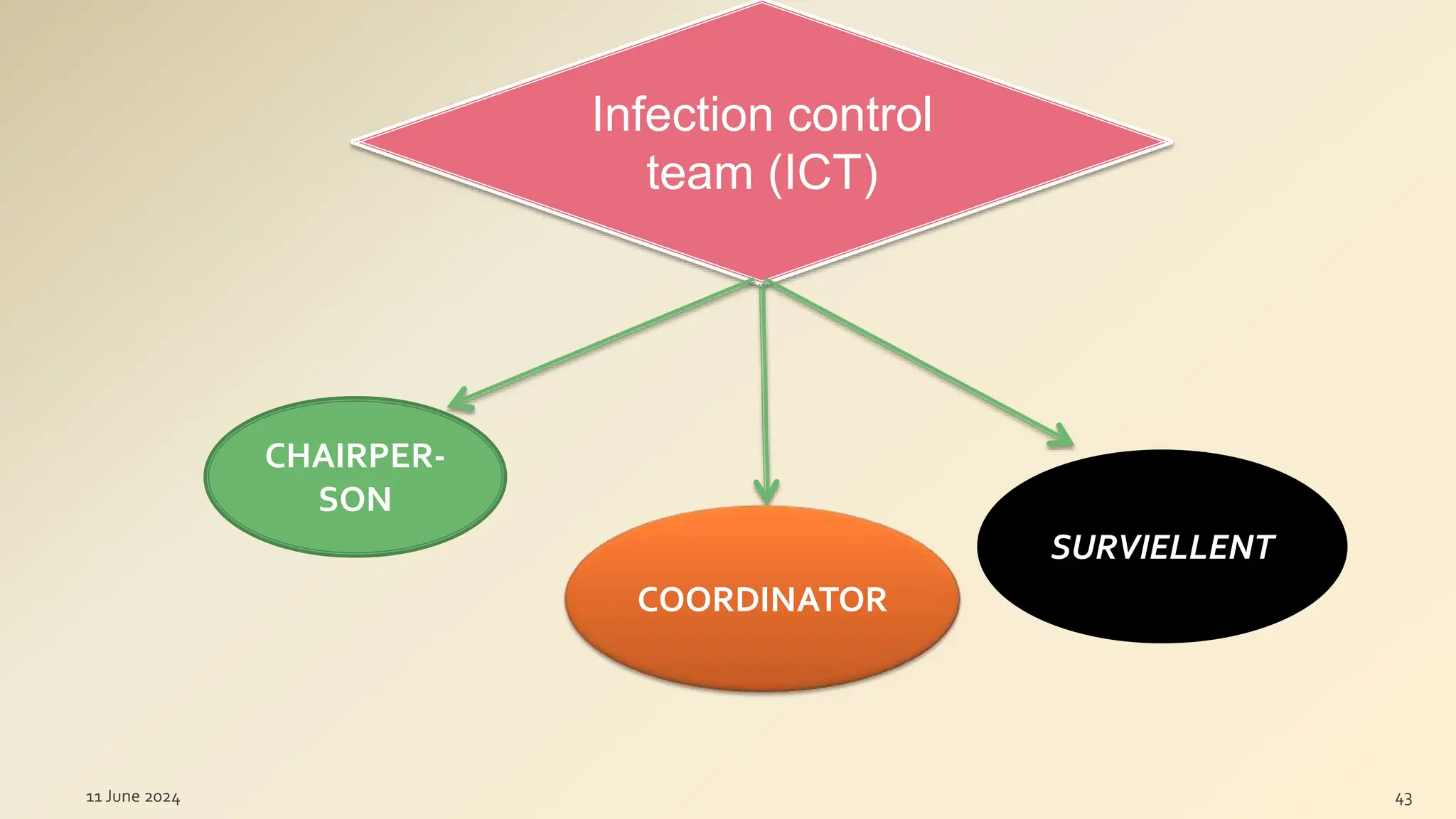
Infection control
team (ICT)
CHAIRPER-
SON
COORDINATOR
SURVIELLENT
11 June 2024 43
FUNCTION OF ICT
11 June 2024 44
11 June 2024 45
Infection control officer (ICO)
The infection control officer
is usually a medical
microbiologist or any other
physician with an interest
in hospital associated
infections.
11 June 2024 46
 The ICD must be a registered medical practitioner
 In the other majority of countries, the role is performed either
by a medical microbiologist or hospital epidemiologist.
 One ICD is required for 1,000 beds.
11 June 2024 47
 The day –to-day activities
of surveillance can be best
handled by a sufficiently
senior & experienced full-
time nurse, with special
training in hospital
infection control activities.
 1 ICN for every 250 beds.
11 June 2024 48
11 June 2024 49
 It is recommended that each hospital develops its own
infection control manual based upon existing documents but
modified, for local circumstances and risks.
11 June 2024 50
 Practical methods for preventing nosocomial infection.
 Hand washing as often as possible use of alcoholic hand spray while
hand washing, removing jewellery before washing.
 Stethoscope: cleaning with an alcohol swab at least daily.
 Gloves: supplement rather than replace hand washing.
11 June 2024 51
 Intravenous catheter: thorough disinfection of skin before insertion
changing administration sets every 72 h.
 Gowning: routine use in neonatal units
 White coats: enforced use in clinical units
11 June 2024 52
11 June 2024 53
11 June 2024 54
11 June 2024 55
Infection Control Link Nurse Program: An
interdisciplinary approach on targeting health care-
acquired infection
Published in-American journal of infection control, April 14 2020
Authors-Madhuri M, Sopirala et.al
Background: a successful interdisciplinary liaison program that effectively reduced health
care-acquired (HCA), methicillin-resistant Staphylococcus aureus (MRSA) in a university
hospital setting.
methods: Staff nurses were trained to be liaisons (link nurses) to infection prevention (IP)
personnel with clearly defined goals assigned and with ongoing monthly education. HCA-
MRSA incidence per 1,000 patient-days (PD) was compared between-
11 June 2024 56
baseline and intervention period along with total and non-HCA-MRSA, HCA
and non-HCA-MRSA bacteremia, and hand soap/sanitizer usage.
• Hand hygiene compliance was assessed. The study results showed that total
MRSA rate and MRSA bacteremia rate also showed significant reduction with
nonsignificant reductions in overall non-HCA-MRSA and non-HCA-MRSA
bacteremia.
• Hand soap/sanitizer usage and compliance with hand hygiene also increased
significantly during IP.
• The study concluded that Link nurse program effectively reduced HCA-
MRSA. Goal-defined metrics with ongoing reeducation for the nurses by IP
personnel helped drive these results.
11 June 2024 57
Infection prevention and control research priorities: what do we need to
combat healthcare-associated infections and antimicrobial resistance?
Results of a narrative literature review and survey analysis
 Published in- Antimicrobial Resistance & Infection Control
 Authors- Lacotte Y, Årdal C, Ploy MC.
Background: Infection prevention and control (IPC) is one of the most cost-effective
interventions against antimicrobial resistance (AMR). Yet, IPC knowledge gaps often
receive little prominence in AMR research agendas. In this article, we construct IPC
research priorities, in order to draw attention to these critical research needs. Methods: We
developed a 4-step framework to identify IPC knowledge gaps from literature (narrative
review).
11 June 2024 58
 It also integrates the process with the organization to maintain and improve
the effectiveness of clinical services.
 It was evident that infection control measures and practices were not up to
the mark because of so many factors such as inadequate biomedical waste
management practices, inadequate practices in spill management,
inadequate practices in usage of sodium hypo chloride, recapping of the
needle and document regarding the needle stick injury and inadequate
practices on the hand washing before touching the patient.
 From the study concluded that there was an inadequate infection control
practice among the health care workers and also compliance percent.
Hence there is a need for continuous and mandatory training, surveillance,
infection control program.
11 June 2024 59
11 June 2024 60
Does infection control link nurse
program is necessary for
infection control in hospital?
11 June 2024 61
Books
 K.Deepak, C.sarath chandran, B.P mithun kumar. A comprehensive Text book on
Nursing Mnagement, Emmess Medical Publishers, Bangalore; 2nd edition (2019).
Page no: 513-525.
 Baveja C.P. Textbook of Microbiology, arya publication New Delhi; 5th edition
(2015).page no: 605-608.
 Clement I. Textbook of Nursing foundation, Jaypee Brothers medical publishers (p)
Ltd, Bangladesh; 2nd edition (2017). Page no-572-595.
 Brar Navdeep kaur,Rawat HC,Textbook of Advanced Nursing Practice;1st
edition;New Delhi;Jaypee Brothers Medical publishers;2015,pg no-.
 Murgan Arun Kumar,Textbook of Microbiology for Nurses. Emeses Medical
Publisher, Bangalore: 2nd Edition pg no- 156-187.
 Dhir Anju. Textbook of Microbiology CBS Publisher & Distributors private limited
New Delhi pg no-166-176.
11 June 2024 62
 Zingg W, Holmes A, Dettenkofer M, Goetting T, Secci F, Clack L, Allegranzi B,
Magiorakos AP, Pittet D. Hospital organisation, management, and structure for
prevention of health-care-associated infection: a systematic review and expert
consensus.The Lancet Infectious Diseases. 2015 Feb 1;15(2):212-24.
 Roy I, Bains L, Mishra A, Kaur D, Lal P, Gupta L, Malhotra V, Vinayakumar AN, John
R, Ezeuko AY, Nnebue CC. Audit on hand hygiene and use of personal protective
equipment: Prevention of nosocomial transmission of COVID-19... p. 37.
 Evans RP. Surgical site infection prevention and control: an emerging paradigm. JBJS.
2009 Nov 1; 91(Supplement_6):2-9.
 Barghout N, Al Habashneh R, Ryalat ST, Asa'ad FA, Marashdeh M. Patients' perception
of cross-infection prevention in dentistry in Jordan. Oral Health and Preventive
Dentistry. 2012 Jan 1;10(1):9.
Journals
11 June 2024 63
 Stelfox HT, Bates DW, Redelmeier DA. Safety of patients isolated for infection
control. Jama. 2003 Oct 8;290(14):1899-905.
 Richards MJ, Edwards JR, Culver DH, Gaynes RP, National Nosocomial Infections
Surveillance System. Nosocomial infections in combined medical-surgical intensive
care units in the United States.Infection Control & Hospital Epidemiology. 2010
Aug;21(8):510-5.
 Chenoweth C, Saint S. Preventing catheter-associated urinary tract infections in the
intensive care unit. Critical care clinics. 2013 Jan 1;29(1):19-32.
11 June 2024 64
 Patidar Jayesh . Infection control.pdf; universal precaution.
www.drjayeshpatidar.blogspot.in (accessed Jul 14, 2014).
 Nisrine Haddad, Ashley Weeks. HIV Surveillance Report.
https://www.canada.ca/en/public-health/services/reports-publications/accelerating-
our-response-five-year-action-plan-sexually-transmitted-blood-borne-
infections.html (accessed 01 January 2021).
 Robert A. Weinstein, Michele L. Pearson, MD. Guidelines for Environmental
Infection Control in Health-Care Facilities.
https://www.cdc.gov/infectioncontrol/guidelines/environmental/index.html
(accessed July 2019).
Websites
11 June 2024 65
11 June 2024 66

PPT NURSING MANAGEMENT presentation in detail

  • 1.
  • 2.
    HI, I AMA SPECIAL ONE, YOU MIGHT HAVE HEARD OF ME BY NOW I HAVE BEEN TRAVELLING ACROSS CONTINENTS AND NATIONS CATCH THE WEAK, AND VULNERABLE PEOPLE WITH CHRONIC DISEASE MAKE MY JOB EASIER I NEED YOU METRE CLOSE TO CATCH YOU I ACT INSIDE YOUR NOSE, MOUTH AND EYES I RIDE THROUGH DROPLETS THEN I MAKE YOU SNEEZE AND COUGH. THUS I TRAVEL AND MULTIPLY AND I HAVE A BIG EGO AM AFRAID OF SOAPS AND SANITIZERS BECAUUSE SOAP MOLECULES WILL PENETRATE MY OILY LIPID MEMBRANE LAYER AND DISMEMBER ME WHEN YOU EAT A UNCOVERED FOOD AND NOT MAINTAIN STERILITY THAT TIME I AM SO HAPPY. SO, TELL ME WHO AM I? 11 June 2024 2
  • 3.
  • 4.
    At the endof the session the students will be able to-  Define infection and infection control  State the basic of infection control  Enlist the principle of infection control  Classify the types of infection  Illustrate the chain of infection  Describe medical and surgical asepsis 11 June 2024 4
  • 5.
     Enlisted thesteps of prevention of cross infection  Discuss the hospital waste management  Follow the policy related to infection control  Explain the hospital infection control programme 11 June 2024 5
  • 6.
  • 7.
    The invasion and growthof germs in the body. The germs may be bacteria, viruses, yeast, fungi, or other microorganisms. 01 02 03 A nosocomial infection is contracted because of an infection or toxin that exists in a certain location, such as a hospital. An agent that destroy microorganism TERMINOLOGIES Infection Nosocominal Germicide 11 June 2024 7
  • 8.
    FUMIGATION ISOLATION Fumigation isa method of pest control/ removal of harmful micro-organisms that completely fills an area with gaseous pesticides or fumigants to suffocate or poison the pests within. The complete separation from others of a person suffering from contagious or infectious disease. 11 June 2024 8
  • 9.
    An infection isthe entry and multiplication of an infectious agent in the tissues of the host. Infectious agent may be bacteria, viruses, fungus, spirochete or other microorganisms capable of producing infection under favourable circumstances of host, and the environment. 11 June 2024 9
  • 10.
    02 02 03 01 Prevention of Nosocomial Topractice good asepsis Hospital policies & procedures 11 June 2024 10
  • 11.
  • 12.
    1. 2. • Primary andsecondary infection • Local and systemic infection 3. 4. • Acute infection • chronic infection 5. 6. • Nosocomial infection • Iatrogenic infection 11 June 2024 12
  • 13.
  • 14.
  • 15.
  • 16.
    • Rapid andaccurate identification of organisms • Control or elimination of infectious agents 11 June 2024 16
  • 17.
    Measures to control/eliminate reservoirfor Infection-  Employee health  Environmental cleaning  Handling of linen  Visitors control  Pest control 11 June 2024 17
  • 18.
    Aseptic precautions Use PPE Carefulhandling of waste 11 June 2024 18
  • 19.
     Airborne/Droplet precautions Contact precautions 11 June 2024 19
  • 20.
     Maintain integrityof skin and mucus membranes.  Proper positioning of tubing  Personal hygiene  Dispose of contaminated syringes and needles properly  Care should be taken while collecting and handling specimen. 11 June 2024 20
  • 21.
    Protecting normal defense mechanisms Oral hygiene  Adequate intake Maintaining healing processes  Well-balanced diet  Institution of measures to improve appetite 11 June 2024 21
  • 22.
  • 23.
    Medical asepsis alsoknown as “clean technique” is aimed at controlling the number of microorganisms. Medical asepsis is used for all clinical patient care activities. MEDICAL ASEPSIS 11 June 2024 23
  • 24.
    Perform hand hygiene Use ofpersonal protective equipment Clean and disinfect shared patient equipment Clean and disinfect the environment Principles of Medical Asepsis 11 June 2024 24
  • 25.
    Surgical asepsis also,known as “sterile technique” is aimed at removing all microorganisms. Surgical asepsis is used for all surgical/sterile procedures. SURGICAL ASEPSIS 11 June 2024 25
  • 26.
    Principles of surgical asepsis •Thepatient should not be the source of contamination •The operating room (OR) team should not be the source of contamination •The surgical scrub should be done meticulously •The OR technique of the surgeon is very important •Recognize potential environmental contamination 11 June 2024 26
  • 27.
  • 28.
    Lorem Ipsum issimply dummy text of the printing and typesetting industry. 2 3 4 5 CLEANING HAND WASHING CAPING AND MASKING GOWNING AND GLOVING BAGGING TYPES OF ASEPTIC PRACTICES 1 11 June 2024 28
  • 29.
  • 30.
    1. FUMIGATION Fumigation isa method of pest control/ removal of harmful micro- oganisms that completely fills an area with gaseous pesticides or fumigants to suffocate or poison the pests within. 11 June 2024 30
  • 31.
  • 32.
    2. ISOLATION Isolation techniqueis intended to confine the microorganisms within a given and organized area. 11 June 2024 32
  • 33.
  • 34.
  • 35.
  • 36.
     Hospital wasteis “Any waste which is generated in the diagnosis, treatment or immunization of human beings or animals or in research” in a hospital. This is also called ‘Bio-Medical Waste’ (BMW).  Hospital Waste Management means the management of waste produced by hospitals using such techniques that will help to check the spread of diseases through. 11 June 2024 36
  • 37.
  • 38.
  • 39.
  • 40.
    The main aimof the hospital infection programme is to lower the risk of an infection during the period of hospitalization. Aspects  Development of an effective surveillance system to know the risk of nosocomial infection.  Development of policies and procedures to reduce risk of nosocomial infection.  Maintenance of continuing education programme from hospital 11 June 2024 40
  • 41.
    Basic elements  Providinga system of identification and reporting of infections and providing a system for keeping records of infection.  Providing for good hospital hygiene, aseptic technique and sterilization and disinfection practices.  Providing for co-ordination with all departments and medical/ nursing audit committee in quality assurance. 11 June 2024 41
  • 42.
     Infection controlteam (ICT)  Infection control committee (ICC)  Infection control Officer (ICO)  Infection control Doctor (ICD)  Infection control Nurse (ICN)  Infection control Manual (ICM) 11 June 2024 42
  • 43.
  • 44.
    FUNCTION OF ICT 11June 2024 44
  • 45.
  • 46.
    Infection control officer(ICO) The infection control officer is usually a medical microbiologist or any other physician with an interest in hospital associated infections. 11 June 2024 46
  • 47.
     The ICDmust be a registered medical practitioner  In the other majority of countries, the role is performed either by a medical microbiologist or hospital epidemiologist.  One ICD is required for 1,000 beds. 11 June 2024 47
  • 48.
     The day–to-day activities of surveillance can be best handled by a sufficiently senior & experienced full- time nurse, with special training in hospital infection control activities.  1 ICN for every 250 beds. 11 June 2024 48
  • 49.
  • 50.
     It isrecommended that each hospital develops its own infection control manual based upon existing documents but modified, for local circumstances and risks. 11 June 2024 50
  • 51.
     Practical methodsfor preventing nosocomial infection.  Hand washing as often as possible use of alcoholic hand spray while hand washing, removing jewellery before washing.  Stethoscope: cleaning with an alcohol swab at least daily.  Gloves: supplement rather than replace hand washing. 11 June 2024 51
  • 52.
     Intravenous catheter:thorough disinfection of skin before insertion changing administration sets every 72 h.  Gowning: routine use in neonatal units  White coats: enforced use in clinical units 11 June 2024 52
  • 53.
  • 54.
  • 55.
  • 56.
    Infection Control LinkNurse Program: An interdisciplinary approach on targeting health care- acquired infection Published in-American journal of infection control, April 14 2020 Authors-Madhuri M, Sopirala et.al Background: a successful interdisciplinary liaison program that effectively reduced health care-acquired (HCA), methicillin-resistant Staphylococcus aureus (MRSA) in a university hospital setting. methods: Staff nurses were trained to be liaisons (link nurses) to infection prevention (IP) personnel with clearly defined goals assigned and with ongoing monthly education. HCA- MRSA incidence per 1,000 patient-days (PD) was compared between- 11 June 2024 56
  • 57.
    baseline and interventionperiod along with total and non-HCA-MRSA, HCA and non-HCA-MRSA bacteremia, and hand soap/sanitizer usage. • Hand hygiene compliance was assessed. The study results showed that total MRSA rate and MRSA bacteremia rate also showed significant reduction with nonsignificant reductions in overall non-HCA-MRSA and non-HCA-MRSA bacteremia. • Hand soap/sanitizer usage and compliance with hand hygiene also increased significantly during IP. • The study concluded that Link nurse program effectively reduced HCA- MRSA. Goal-defined metrics with ongoing reeducation for the nurses by IP personnel helped drive these results. 11 June 2024 57
  • 58.
    Infection prevention andcontrol research priorities: what do we need to combat healthcare-associated infections and antimicrobial resistance? Results of a narrative literature review and survey analysis  Published in- Antimicrobial Resistance & Infection Control  Authors- Lacotte Y, Årdal C, Ploy MC. Background: Infection prevention and control (IPC) is one of the most cost-effective interventions against antimicrobial resistance (AMR). Yet, IPC knowledge gaps often receive little prominence in AMR research agendas. In this article, we construct IPC research priorities, in order to draw attention to these critical research needs. Methods: We developed a 4-step framework to identify IPC knowledge gaps from literature (narrative review). 11 June 2024 58
  • 59.
     It alsointegrates the process with the organization to maintain and improve the effectiveness of clinical services.  It was evident that infection control measures and practices were not up to the mark because of so many factors such as inadequate biomedical waste management practices, inadequate practices in spill management, inadequate practices in usage of sodium hypo chloride, recapping of the needle and document regarding the needle stick injury and inadequate practices on the hand washing before touching the patient.  From the study concluded that there was an inadequate infection control practice among the health care workers and also compliance percent. Hence there is a need for continuous and mandatory training, surveillance, infection control program. 11 June 2024 59
  • 60.
  • 61.
    Does infection controllink nurse program is necessary for infection control in hospital? 11 June 2024 61
  • 62.
    Books  K.Deepak, C.sarathchandran, B.P mithun kumar. A comprehensive Text book on Nursing Mnagement, Emmess Medical Publishers, Bangalore; 2nd edition (2019). Page no: 513-525.  Baveja C.P. Textbook of Microbiology, arya publication New Delhi; 5th edition (2015).page no: 605-608.  Clement I. Textbook of Nursing foundation, Jaypee Brothers medical publishers (p) Ltd, Bangladesh; 2nd edition (2017). Page no-572-595.  Brar Navdeep kaur,Rawat HC,Textbook of Advanced Nursing Practice;1st edition;New Delhi;Jaypee Brothers Medical publishers;2015,pg no-.  Murgan Arun Kumar,Textbook of Microbiology for Nurses. Emeses Medical Publisher, Bangalore: 2nd Edition pg no- 156-187.  Dhir Anju. Textbook of Microbiology CBS Publisher & Distributors private limited New Delhi pg no-166-176. 11 June 2024 62
  • 63.
     Zingg W,Holmes A, Dettenkofer M, Goetting T, Secci F, Clack L, Allegranzi B, Magiorakos AP, Pittet D. Hospital organisation, management, and structure for prevention of health-care-associated infection: a systematic review and expert consensus.The Lancet Infectious Diseases. 2015 Feb 1;15(2):212-24.  Roy I, Bains L, Mishra A, Kaur D, Lal P, Gupta L, Malhotra V, Vinayakumar AN, John R, Ezeuko AY, Nnebue CC. Audit on hand hygiene and use of personal protective equipment: Prevention of nosocomial transmission of COVID-19... p. 37.  Evans RP. Surgical site infection prevention and control: an emerging paradigm. JBJS. 2009 Nov 1; 91(Supplement_6):2-9.  Barghout N, Al Habashneh R, Ryalat ST, Asa'ad FA, Marashdeh M. Patients' perception of cross-infection prevention in dentistry in Jordan. Oral Health and Preventive Dentistry. 2012 Jan 1;10(1):9. Journals 11 June 2024 63
  • 64.
     Stelfox HT,Bates DW, Redelmeier DA. Safety of patients isolated for infection control. Jama. 2003 Oct 8;290(14):1899-905.  Richards MJ, Edwards JR, Culver DH, Gaynes RP, National Nosocomial Infections Surveillance System. Nosocomial infections in combined medical-surgical intensive care units in the United States.Infection Control & Hospital Epidemiology. 2010 Aug;21(8):510-5.  Chenoweth C, Saint S. Preventing catheter-associated urinary tract infections in the intensive care unit. Critical care clinics. 2013 Jan 1;29(1):19-32. 11 June 2024 64
  • 65.
     Patidar Jayesh. Infection control.pdf; universal precaution. www.drjayeshpatidar.blogspot.in (accessed Jul 14, 2014).  Nisrine Haddad, Ashley Weeks. HIV Surveillance Report. https://www.canada.ca/en/public-health/services/reports-publications/accelerating- our-response-five-year-action-plan-sexually-transmitted-blood-borne- infections.html (accessed 01 January 2021).  Robert A. Weinstein, Michele L. Pearson, MD. Guidelines for Environmental Infection Control in Health-Care Facilities. https://www.cdc.gov/infectioncontrol/guidelines/environmental/index.html (accessed July 2019). Websites 11 June 2024 65
  • 66.