NATIONAL VECTOR BORNE
DISEASE CONTROL
PROGRAMME
DR MOHINI JOGDAND
Assistant professor,
Dept of Community Medicine
NVBDCP: Introduction
 Implemented in India among all ST/UT s for the control of SIX
vector borne diseases
 Started in 2002-2003
1. Malaria
2. Dengue
3. Filariasis
4. Kala azar
5. JE
6. Chikungunya
MALARIA
 Malaria is a potentially life threatening parasitic disease caused by parasites known as
Plasmodium viviax (P.vivax), Plasmodium falciparum (P.falciparum), Plasmodium
malariae (P.malariae) and Plasmodium ovale (P.ovale)
 It is transmitted by the infective bite of Anopheles mosquito
 Man develops disease after 10 to 14 days of being bitten by an infective mosquito
 There are two types of parasites of human malaria, Plasmodium vivax, P. falciparum,
which are commonly reported from India.
 Inside the human host, the parasite undergoes a series of changes as part of its
complex life cycle. (Plasmodium is a protozoan parasite)
 The parasite completes life cycle in liver cells (pre-erythrocytic schizogony) and red
blood cells (erythrocytic schizogony
 Infection with P.falciparum is the most deadly form of malaria
The Main activities of the programme
1) Formulating policies and guidelines
2) Technical guidance
3) Planning
4) Logistics
5) Monitoring and evaluation
6) Coordination of activities through state/UTs and in consultation with National Centre
for disease control (NCDC),National Institute of Malarial Research (NIMR)
7) Collabaoration with intl agencies
8) Training
9) Facilitating research through NCDC, NIMR, Regional medical research centers
10) Coordinating control activities in the inter-state and inter country border areas.
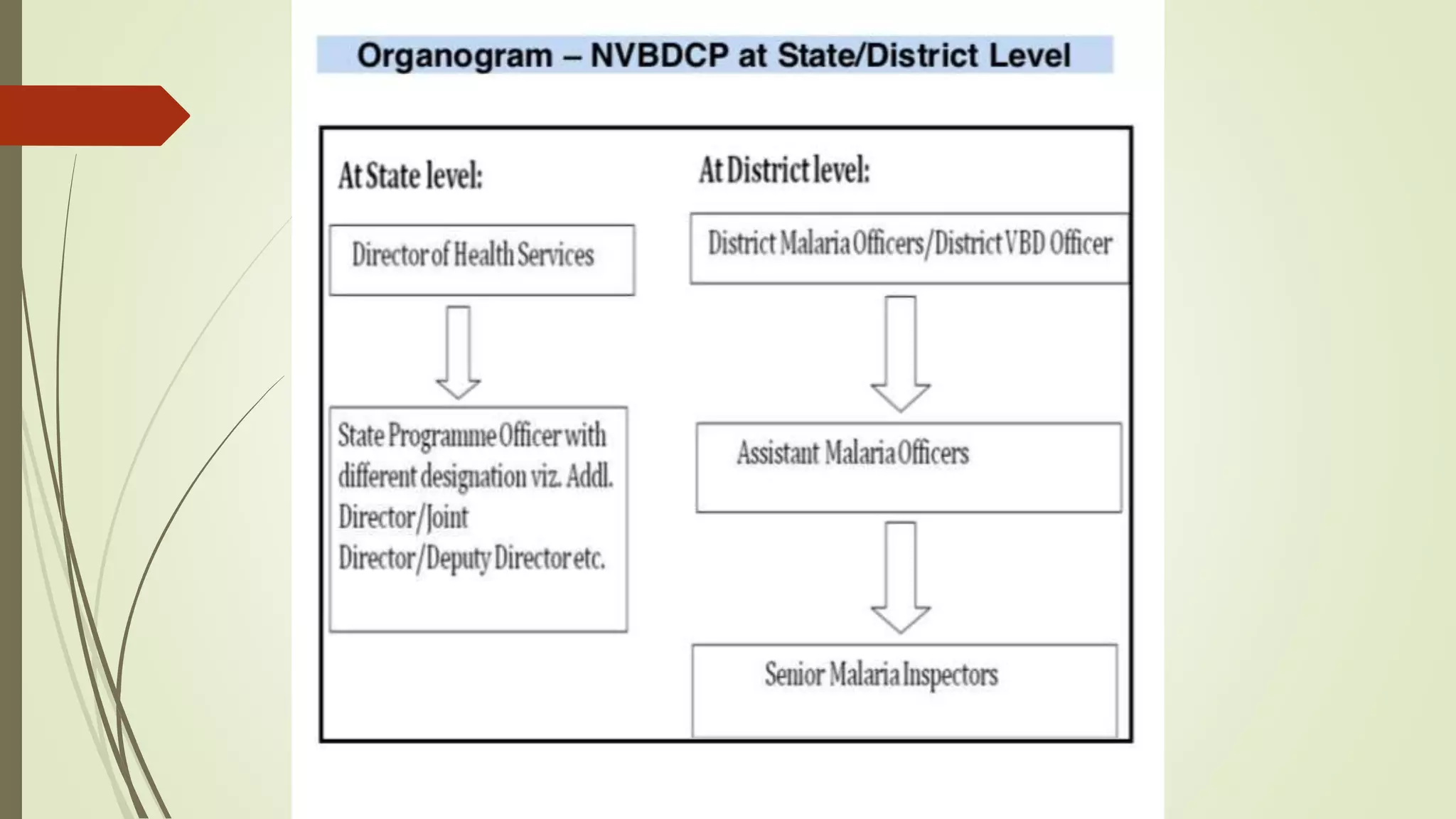
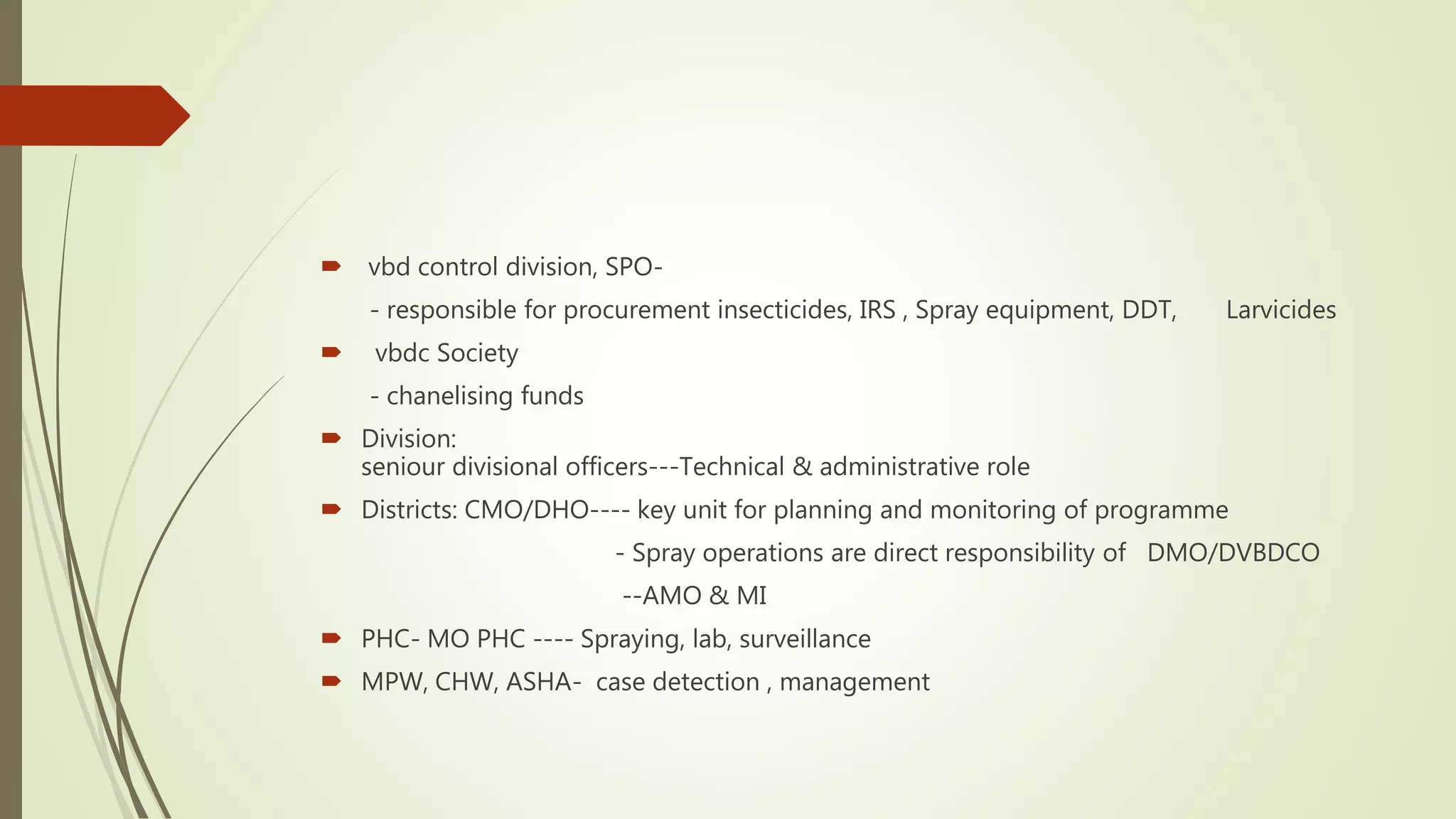
 vbd control division, SPO-
- responsible for procurement insecticides, IRS , Spray equipment, DDT, Larvicides
 vbdc Society
- chanelising funds
 Division:
seniour divisional officers---Technical & administrative role
 Districts: CMO/DHO---- key unit for planning and monitoring of programme
- Spray operations are direct responsibility of DMO/DVBDCO
--AMO & MI
 PHC- MO PHC ---- Spraying, lab, surveillance
 MPW, CHW, ASHA- case detection , management
Drug Distribution Centre (DDC)
 If it is not possible to have FTD, the medical officer should establish DDC.
 The function of DDCs are the same as those of FTDs, except that the DDcs do not
take blood slides but administer drugs to fever cases.
 Volunteers identified for running DDCs should be imported one-two day
induction/ orientation training in identification of fever cases, administration of
treatment, promotion of preventive measures like distribution & impregnation of
bed nets, larvivorous fish, source reduction etc. for vector control.
Urban Malaria Scheme (UMS)
 1971
 7 % cases , 10 % deaths from urabn areas
 MAN MADE SOURCES
 Strategy: intensified vector control by antilarval measures & treatment
: implementation of civic by laws
 In this scheme all the towns having more than 50,000 population and showing
more than 2 API in last 3 years are to be covered. At present 131 towns and cities
in 19 states and union territories are under the UMS.
National Framework for Malaria
Elimination In India ( 2016- 2030)
 Feb 2016
 Control--→Elimination
 Goals: 1. Eliminate malaria ---2030
2. Maintain malaria free status
 Objectives:
1. 2022- transmission interrupted, zero indigenous cases ( 26 ST/UT with cat 1 and 2)
2. 2024—all ST/UT – incidence less than 1/1000
3. 2027- indigenous transmission zero
4. 2030- elimination , prevention of re establishment
Program phasing
Milestones and Targets
 By the end of 2016
All States and UTs have included malaria elimination in their broader health policies and
planning framework
 By 2020
 All 15 States/UTs that were under category 1 (elimination phase) in 2014 have
completely interrupted malaria transmission and achieved zero indigenous cases and
deaths due to malaria;
 All 11 States/UTs under category 2 (pre-elimination phase) in 2014 have entered into
category 1 (elimination phase);
 5 States/UTs under category 3 (intensified control phase) in 2014 have entered into
category 2 (pre-elimination phase);
 5 States/UTs under category 3 (intensified control phase) in 2014 have reduced disease
burden but continue to remain in category 3; and
 Estimated malaria burden at national level has reduced by 15-20% as compared to
2014.
 By 2022
 All 26 States/UTs that were under categories 1 and 2 in 2014 have interrupted
malaria transmission and achieved zero indigenous cases and deaths due to
malaria;
 5 States/UTs which were under category 3 (intensified control phase) in 2014 have
entered into category 1 (elimination phase);
 5 States/UTs which were under category 3 (intensified control phase) in 2014 have
entered into category 2 (pre-elimination phase); and
 Estimated malaria burden at national level has reduced by 30-35% as compared to
2014.
 By 2024
 All States and UTs and their districts have reduced API to less than 1 case per 1000
population at risk, sustain zero deaths due to malaria and establish fully functional
malaria surveillance to track, investigate and respond to each case.
 31 States/UTs have interrupted transmission of malaria and zero indigenous cases
and deaths attained.
 5 States/UTs which were under Category 3 (intensified control phase) in 2014
have entered into elimination phase.
 By 2027
 Indigenous transmission of malaria interrupted, and the entire country has no
indigenous cases and no deaths due to malaria
 By 2030
 The entire country sustained status of zero indigenous cases and deaths due to
malaria for 3 consecutive years; and India has initiated the processes for
certification of malaria elimination status
Special mentions
 Focus on High-Endemic Areas and Tribal Population
 Special Strategy for P. vivax Elimination
 District as the Unit of Planning and Implementation
STRATEGY
broad strategies of the malaria elimination framework are:
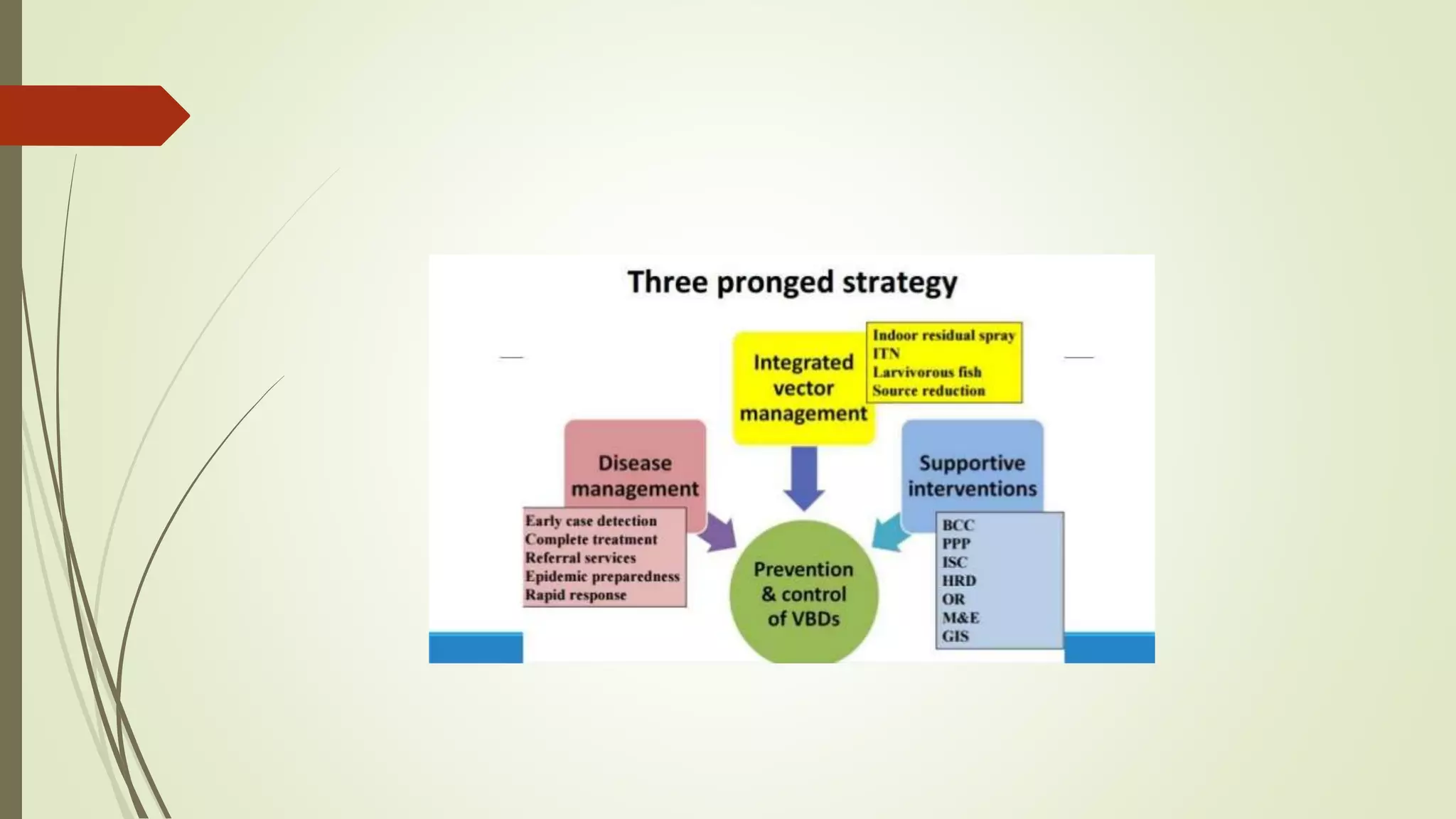
 Early diagnosis and radical treatment
 Case-based surveillance and rapid response
 Integrated vector management (IVM)
 • Indoor residual spray (IRS)
• Long-lasting insecticidal nets (LLINs) / Insecticide treated bed nets (ITNs)
• Larval source management (LSM)
 Epidemic preparedness and early response
 Monitoring and evaluation
 Advocacy, coordination and partnerships
 Behaviour change communication and community mobilization
 Programme planning and management
Category 3 (Intensified control phase: States/UTs with API ≥ 1)
1. Massive scaling up
2. Screening
3. Intersectoral coordination, special groups
4. One stop centers/ mobile clinics
5. Referral treatment
6. Diagnostics
7. Equipments,injectables
Category 2 (Pre-elimination phase: States/UTs with API < 1, but some of their districts
reporting API ≥ 1)
 The states/UTs in pre-elimination phase are those close to entering the elimination
phase. Therefore, malaria elimination interventions will be introduced with
particular focus on setting up an elimination surveillance system and initiating
elimination phase activities in those districts where the API has been reduced to
less than 1 case per 1000 population at risk per year. The planning of elimination
measures will be based on epidemiological investigation and classification of each
malaria case and focus.
Category 1 (Elimination phase: States/UTs with API < 1, and all their districts reporting
API < 1)
1. Interruption of local foci
2. Notification
3. Case based surveillance
4. Vector control
5. EDRT
6. STATE LEVEL DATA
7. Prevention, detection of malaria in migrant/ mobile population
8. Epidemic forecasting
9. Quality assurance
Surveillance
ongoing, systematic collection, analysis and interpretation of disease-specific data for
use in planning, implementing and evaluating the public health practice.
ACD
PCD
Case based surveillance
sentinel
 Case management
 IVM
 Malaria paradigm/ecosystems
 BCC
 Anti malaria month
 Interaction with other health programs_ IDSP,RCH,Other vbds
 Funds- GF IMCP II,WORD BANK
Category 0 (Prevention of Re-establishment Phase)
 Detect
 Notify
 Underlying cause
 Cure
 Prevent
 maintain

nvbdcp2019-200717045608.pdf

  • 1.
    NATIONAL VECTOR BORNE DISEASECONTROL PROGRAMME DR MOHINI JOGDAND Assistant professor, Dept of Community Medicine
  • 2.
    NVBDCP: Introduction  Implementedin India among all ST/UT s for the control of SIX vector borne diseases  Started in 2002-2003 1. Malaria 2. Dengue 3. Filariasis 4. Kala azar 5. JE 6. Chikungunya
  • 4.
    MALARIA  Malaria isa potentially life threatening parasitic disease caused by parasites known as Plasmodium viviax (P.vivax), Plasmodium falciparum (P.falciparum), Plasmodium malariae (P.malariae) and Plasmodium ovale (P.ovale)  It is transmitted by the infective bite of Anopheles mosquito  Man develops disease after 10 to 14 days of being bitten by an infective mosquito  There are two types of parasites of human malaria, Plasmodium vivax, P. falciparum, which are commonly reported from India.  Inside the human host, the parasite undergoes a series of changes as part of its complex life cycle. (Plasmodium is a protozoan parasite)  The parasite completes life cycle in liver cells (pre-erythrocytic schizogony) and red blood cells (erythrocytic schizogony  Infection with P.falciparum is the most deadly form of malaria
  • 7.
    The Main activitiesof the programme 1) Formulating policies and guidelines 2) Technical guidance 3) Planning 4) Logistics 5) Monitoring and evaluation 6) Coordination of activities through state/UTs and in consultation with National Centre for disease control (NCDC),National Institute of Malarial Research (NIMR) 7) Collabaoration with intl agencies 8) Training 9) Facilitating research through NCDC, NIMR, Regional medical research centers 10) Coordinating control activities in the inter-state and inter country border areas.
  • 10.
     vbd controldivision, SPO- - responsible for procurement insecticides, IRS , Spray equipment, DDT, Larvicides  vbdc Society - chanelising funds  Division: seniour divisional officers---Technical & administrative role  Districts: CMO/DHO---- key unit for planning and monitoring of programme - Spray operations are direct responsibility of DMO/DVBDCO --AMO & MI  PHC- MO PHC ---- Spraying, lab, surveillance  MPW, CHW, ASHA- case detection , management
  • 11.
    Drug Distribution Centre(DDC)  If it is not possible to have FTD, the medical officer should establish DDC.  The function of DDCs are the same as those of FTDs, except that the DDcs do not take blood slides but administer drugs to fever cases.  Volunteers identified for running DDCs should be imported one-two day induction/ orientation training in identification of fever cases, administration of treatment, promotion of preventive measures like distribution & impregnation of bed nets, larvivorous fish, source reduction etc. for vector control.
  • 12.
    Urban Malaria Scheme(UMS)  1971  7 % cases , 10 % deaths from urabn areas  MAN MADE SOURCES  Strategy: intensified vector control by antilarval measures & treatment : implementation of civic by laws  In this scheme all the towns having more than 50,000 population and showing more than 2 API in last 3 years are to be covered. At present 131 towns and cities in 19 states and union territories are under the UMS.
  • 13.
    National Framework forMalaria Elimination In India ( 2016- 2030)
  • 14.
     Feb 2016 Control--→Elimination  Goals: 1. Eliminate malaria ---2030 2. Maintain malaria free status  Objectives: 1. 2022- transmission interrupted, zero indigenous cases ( 26 ST/UT with cat 1 and 2) 2. 2024—all ST/UT – incidence less than 1/1000 3. 2027- indigenous transmission zero 4. 2030- elimination , prevention of re establishment
  • 15.
  • 16.
    Milestones and Targets By the end of 2016 All States and UTs have included malaria elimination in their broader health policies and planning framework  By 2020  All 15 States/UTs that were under category 1 (elimination phase) in 2014 have completely interrupted malaria transmission and achieved zero indigenous cases and deaths due to malaria;  All 11 States/UTs under category 2 (pre-elimination phase) in 2014 have entered into category 1 (elimination phase);  5 States/UTs under category 3 (intensified control phase) in 2014 have entered into category 2 (pre-elimination phase);  5 States/UTs under category 3 (intensified control phase) in 2014 have reduced disease burden but continue to remain in category 3; and  Estimated malaria burden at national level has reduced by 15-20% as compared to 2014.
  • 17.
     By 2022 All 26 States/UTs that were under categories 1 and 2 in 2014 have interrupted malaria transmission and achieved zero indigenous cases and deaths due to malaria;  5 States/UTs which were under category 3 (intensified control phase) in 2014 have entered into category 1 (elimination phase);  5 States/UTs which were under category 3 (intensified control phase) in 2014 have entered into category 2 (pre-elimination phase); and  Estimated malaria burden at national level has reduced by 30-35% as compared to 2014.
  • 18.
     By 2024 All States and UTs and their districts have reduced API to less than 1 case per 1000 population at risk, sustain zero deaths due to malaria and establish fully functional malaria surveillance to track, investigate and respond to each case.  31 States/UTs have interrupted transmission of malaria and zero indigenous cases and deaths attained.  5 States/UTs which were under Category 3 (intensified control phase) in 2014 have entered into elimination phase.
  • 19.
     By 2027 Indigenous transmission of malaria interrupted, and the entire country has no indigenous cases and no deaths due to malaria  By 2030  The entire country sustained status of zero indigenous cases and deaths due to malaria for 3 consecutive years; and India has initiated the processes for certification of malaria elimination status
  • 20.
    Special mentions  Focuson High-Endemic Areas and Tribal Population  Special Strategy for P. vivax Elimination  District as the Unit of Planning and Implementation
  • 21.
    STRATEGY broad strategies ofthe malaria elimination framework are:  Early diagnosis and radical treatment  Case-based surveillance and rapid response  Integrated vector management (IVM)  • Indoor residual spray (IRS) • Long-lasting insecticidal nets (LLINs) / Insecticide treated bed nets (ITNs) • Larval source management (LSM)  Epidemic preparedness and early response  Monitoring and evaluation  Advocacy, coordination and partnerships  Behaviour change communication and community mobilization  Programme planning and management
  • 22.
    Category 3 (Intensifiedcontrol phase: States/UTs with API ≥ 1) 1. Massive scaling up 2. Screening 3. Intersectoral coordination, special groups 4. One stop centers/ mobile clinics 5. Referral treatment 6. Diagnostics 7. Equipments,injectables
  • 23.
    Category 2 (Pre-eliminationphase: States/UTs with API < 1, but some of their districts reporting API ≥ 1)  The states/UTs in pre-elimination phase are those close to entering the elimination phase. Therefore, malaria elimination interventions will be introduced with particular focus on setting up an elimination surveillance system and initiating elimination phase activities in those districts where the API has been reduced to less than 1 case per 1000 population at risk per year. The planning of elimination measures will be based on epidemiological investigation and classification of each malaria case and focus.
  • 24.
    Category 1 (Eliminationphase: States/UTs with API < 1, and all their districts reporting API < 1) 1. Interruption of local foci 2. Notification 3. Case based surveillance 4. Vector control 5. EDRT 6. STATE LEVEL DATA 7. Prevention, detection of malaria in migrant/ mobile population 8. Epidemic forecasting 9. Quality assurance
  • 25.
    Surveillance ongoing, systematic collection,analysis and interpretation of disease-specific data for use in planning, implementing and evaluating the public health practice. ACD PCD Case based surveillance sentinel
  • 26.
     Case management IVM  Malaria paradigm/ecosystems  BCC  Anti malaria month  Interaction with other health programs_ IDSP,RCH,Other vbds  Funds- GF IMCP II,WORD BANK
  • 28.
    Category 0 (Preventionof Re-establishment Phase)  Detect  Notify  Underlying cause  Cure  Prevent  maintain