MATRIX
        New Multi-Hazard and Multi-Risk Assessment
                    Methods for Europe


   Multi-hazard and multi-risk
assessment methods for Europe:
      the MATRIX project
                  Kevin Fleming
       Earthquake Risk and Early Warning
Helmholtz Centre Potsdam GeoForschungsZentrum

            4th IDRC Davos, Switzerland, 26th - 30th August, 2012
Multiple-single- versus Multi-type
              assessment
Multiple-single type hazard and risk assessments
considers any number of hazards and risks individually,
i.e., spatial and temporal relationships are neglected.
e.g., DFNK project, Germany, the risks to Cologne due to
earthquakes, floods and windstorms were treated separately
(Grünthal et al., Natural Hazards, 2006).

Multi-type hazard and risk assessment also considers
different types of hazards and risks, but, their spatial and
temporal relationships are explicitly considered.
e.g., MATRIX project, the flood risk to Cologne may increase
due to the dykes being damaged by earthquakes.
.
                4th IDRC Davos, Switzerland, 26th - 30th August, 2012
Some issues in multi-type assessments
Interaction and amplification of risks
● One event may trigger (cascade effects) others.
● Multi-type is therefore more than the simple
   aggregation of single-types.
          Not only does perhaps 1 + 1 ≠ 2,
               but possibly 1 + 1 >> 2

Dynamic vulnerability
● One event changes the vulnerability of a system to
  future or conjoint events.
● Ageing of structures/infrastructure, accumulated
  effects of hazards.
● Changes in human populations
  (expansion of mega-cities, rural depopulation).
                4th IDRC Davos, Switzerland, 26th - 30th August, 2012
Main issues in multi-type assessments

Application of multi-risk assessments
● Complexity leads to greater difficulties in decision
  making.
● Ranges from individual to institutional decision
  making.
  e.g., People respond poorly when risks result from
  the interaction of a number of factors.
  How would this impact upon “community programs”?
● Need for clear communication pathways AND
  formal accountability.


              4th IDRC Davos, Switzerland, 26th - 30th August, 2012
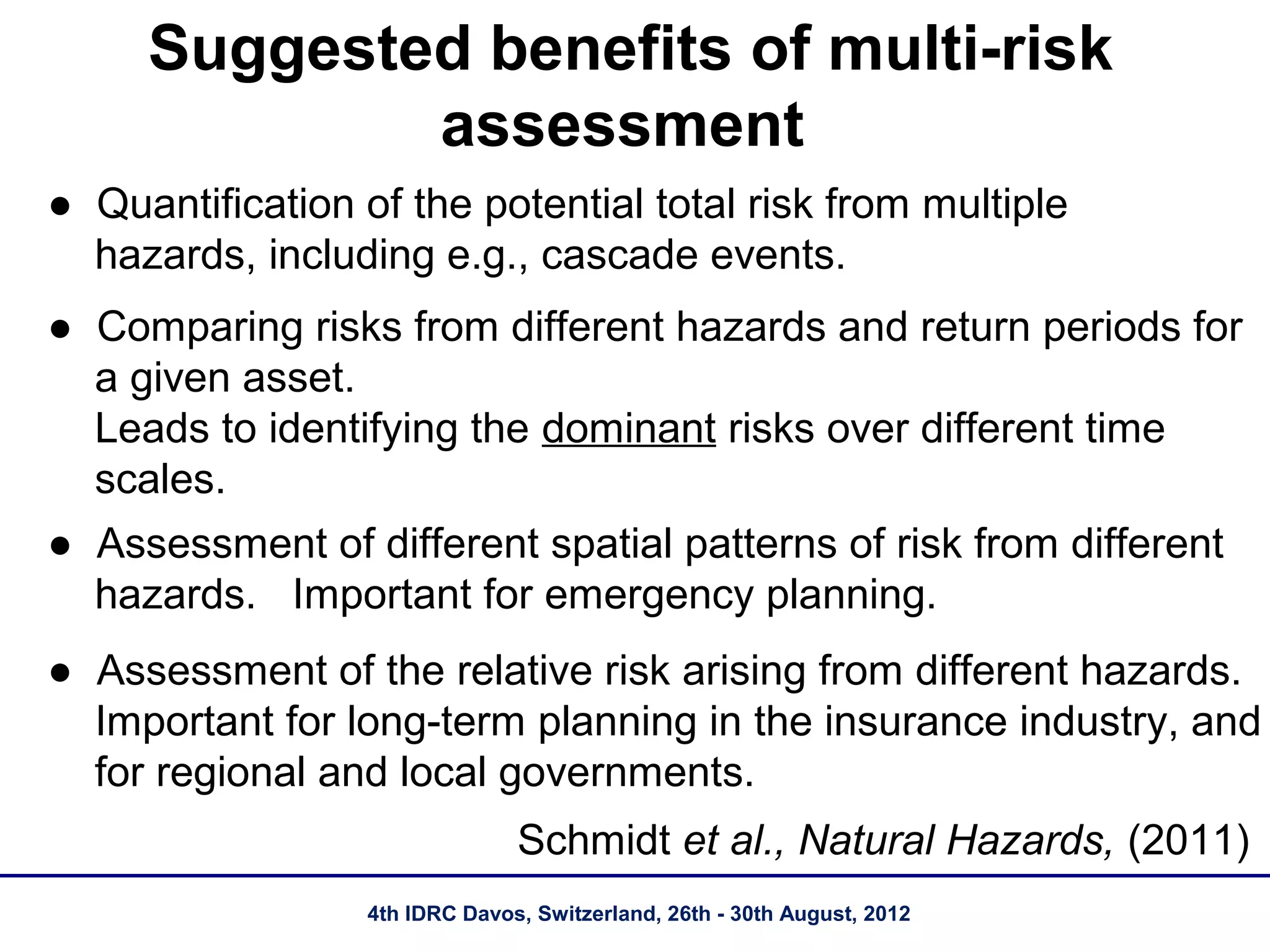
Suggested benefits of multi-risk
             assessment
● Quantification of the potential total risk from multiple
  hazards, including e.g., cascade events.
● Comparing risks from different hazards and return periods for
  a given asset.
  Leads to identifying the dominant risks over different time
  scales.
● Assessment of different spatial patterns of risk from different
  hazards. Important for emergency planning.
● Assessment of the relative risk arising from different hazards.
  Important for long-term planning in the insurance industry, and
  for regional and local governments.
                                Schmidt et al., Natural Hazards, (2011)
                  4th IDRC Davos, Switzerland, 26th - 30th August, 2012
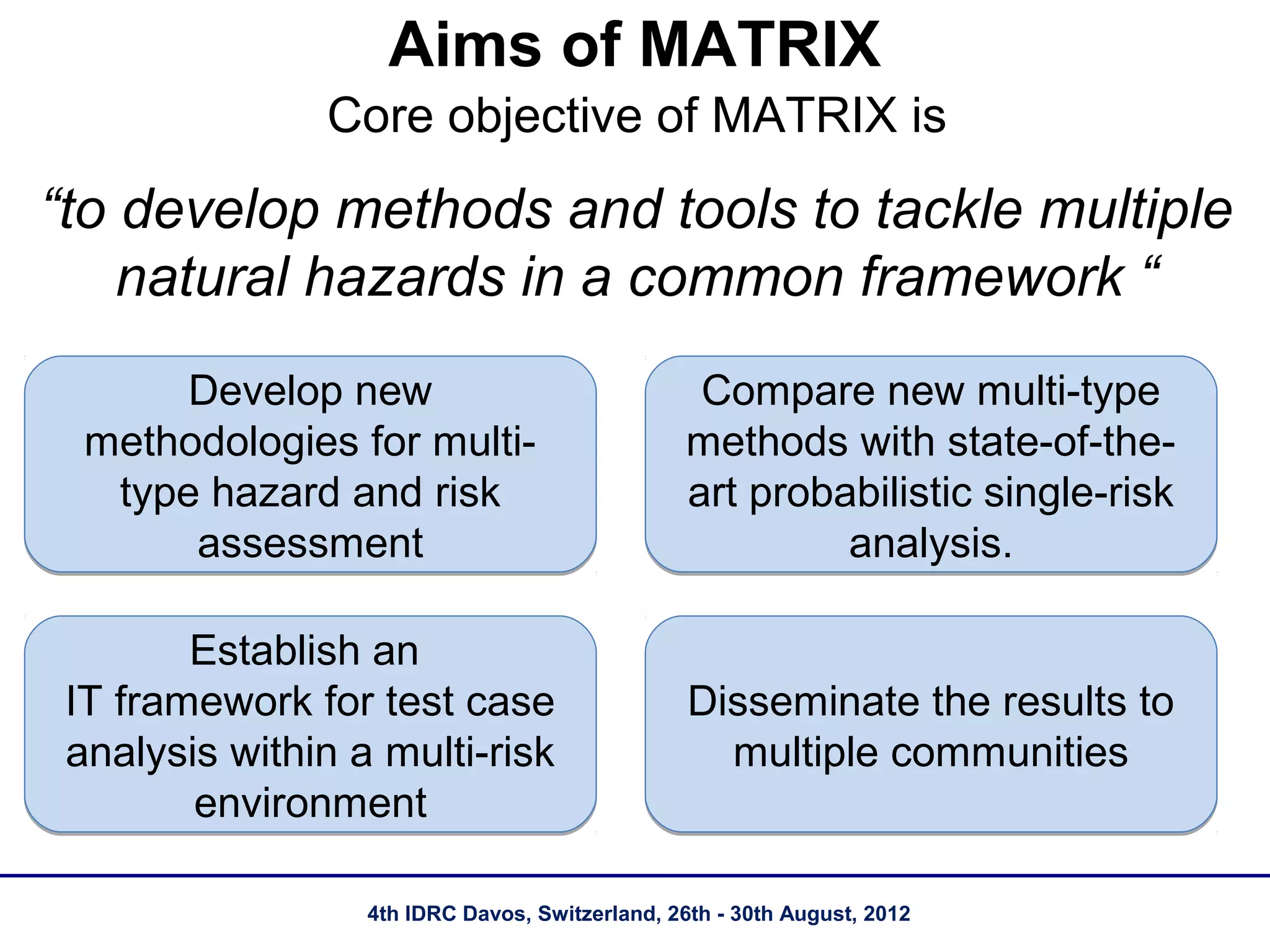
Aims of MATRIX
               Core objective of MATRIX is
“to develop methods and tools to tackle multiple
    natural hazards in a common framework “
       Develop new                                Compare new multi-type
  methodologies for multi-                       methods with state-of-the-
   type hazard and risk                          art probabilistic single-risk
       assessment                                         analysis.

        Establish an
 IT framework for test case                      Disseminate the results to
 analysis within a multi-risk                      multiple communities
        environment

                  4th IDRC Davos, Switzerland, 26th - 30th August, 2012
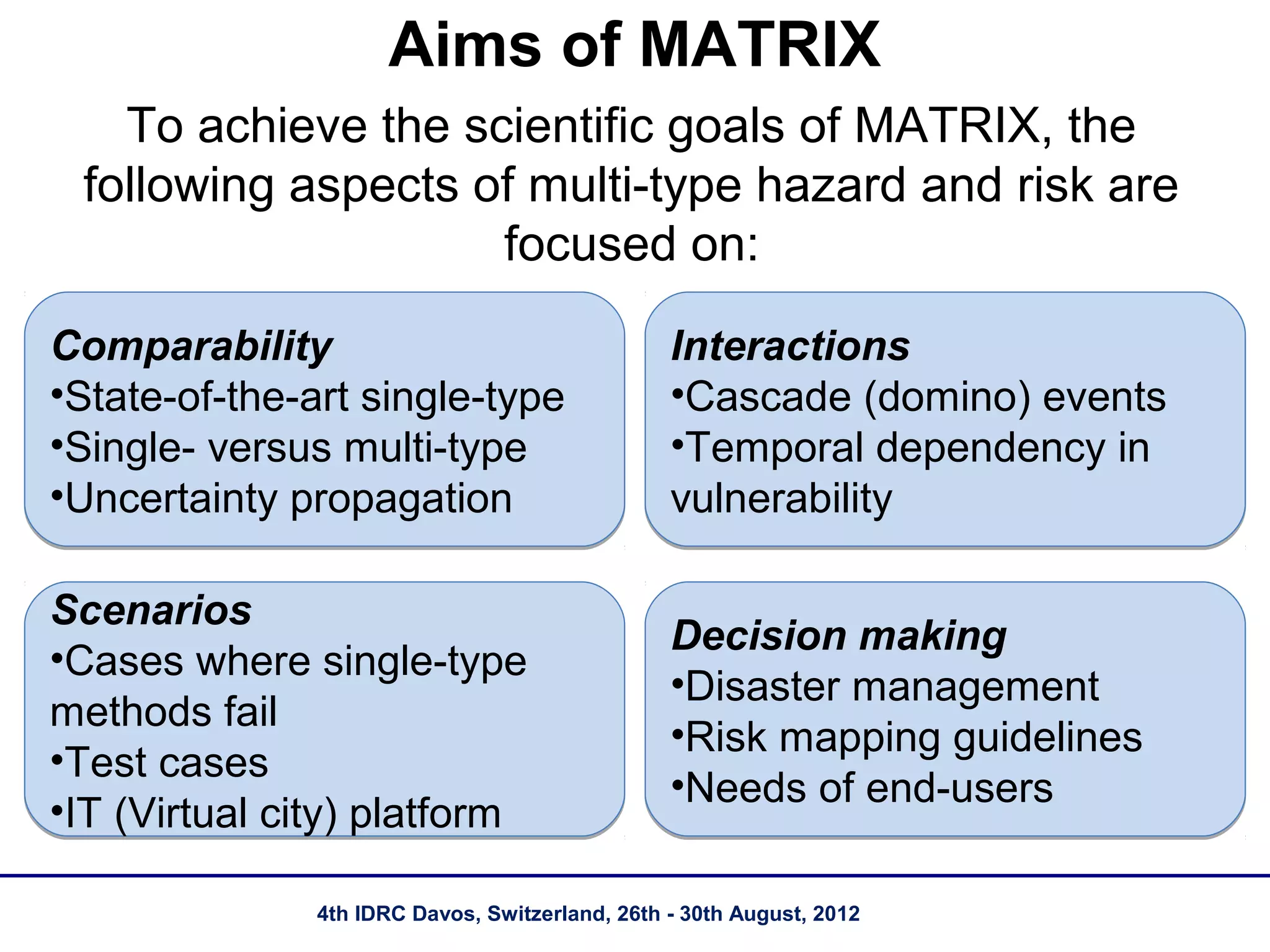
Aims of MATRIX
   To achieve the scientific goals of MATRIX, the
 following aspects of multi-type hazard and risk are
                    focused on:

Comparability                                    Interactions
•State-of-the-art single-type                    •Cascade (domino) events
•Single- versus multi-type                       •Temporal dependency in
•Uncertainty propagation                         vulnerability

Scenarios
                                                 Decision making
•Cases where single-type
                                                 •Disaster management
methods fail
                                                 •Risk mapping guidelines
•Test cases
                                                 •Needs of end-users
•IT (Virtual city) platform

               4th IDRC Davos, Switzerland, 26th - 30th August, 2012
Hazards of interest
The “usual suspects” for Europe.
         Earthquakes
          Landslides
     Volcanic eruptions
          Tsunamis
           Wildfires
        Winter storms
    Cold and heat waves
 Fluvial and coastal flooding
      4th IDRC Davos, Switzerland, 26th - 30th August, 2012
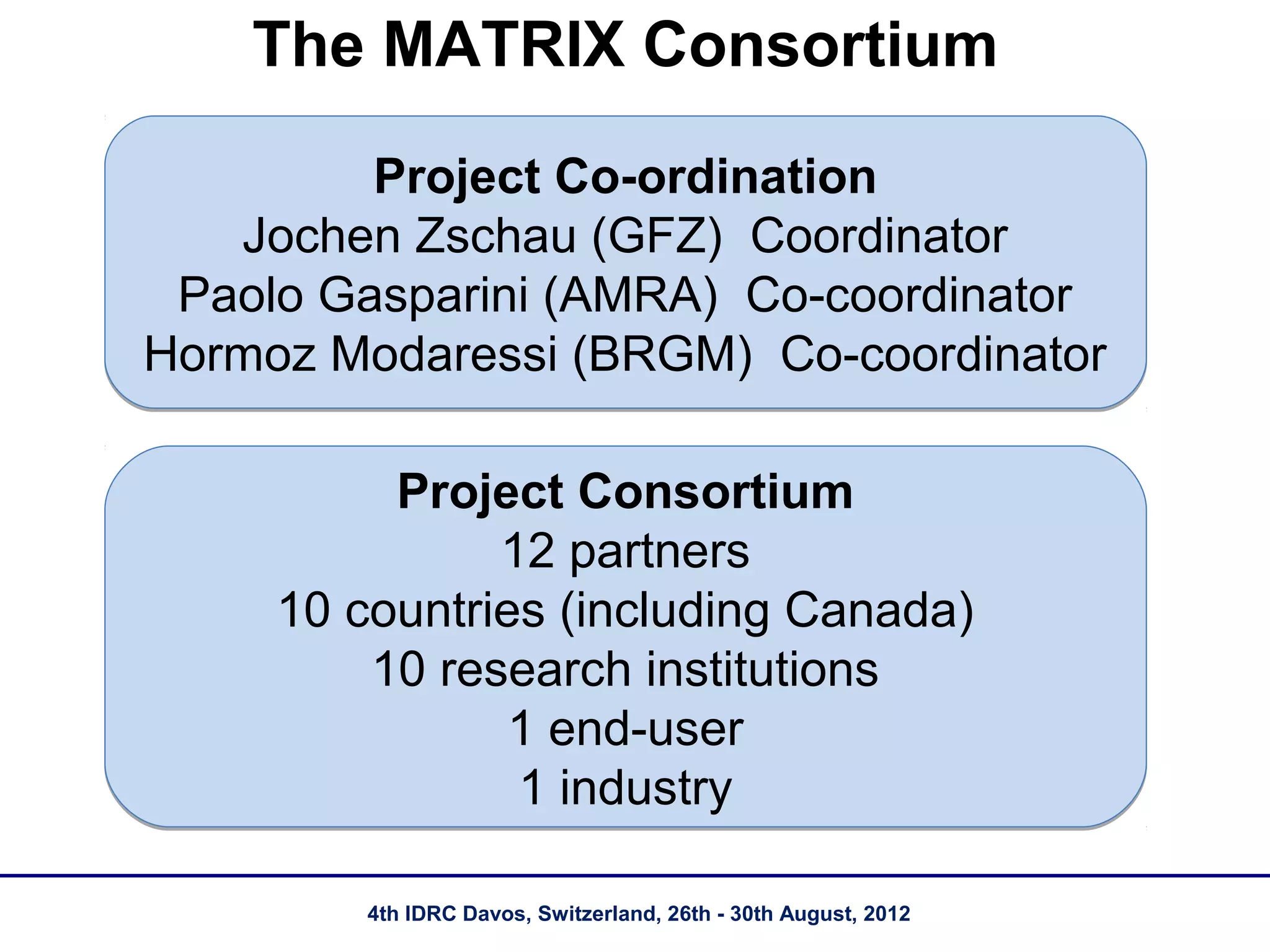
The MATRIX Consortium

         Project Co-ordination
   Jochen Zschau (GFZ) Coordinator
 Paolo Gasparini (AMRA) Co-coordinator
Hormoz Modaressi (BRGM) Co-coordinator

          Project Consortium
               12 partners
     10 countries (including Canada)
         10 research institutions
                1 end-user
                1 industry

         4th IDRC Davos, Switzerland, 26th - 30th August, 2012
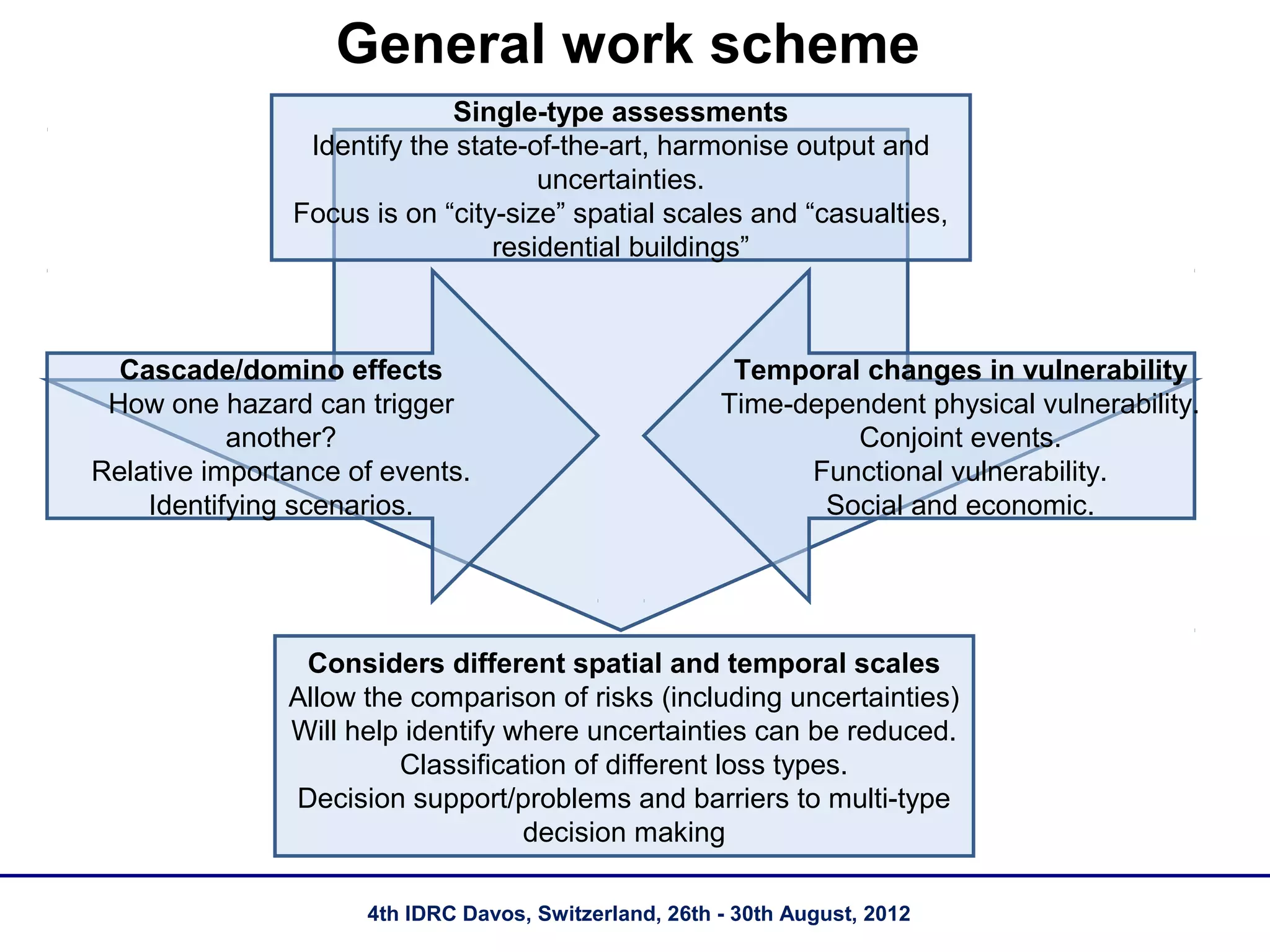
General work scheme
                             Single-type assessments
                Identify the state-of-the-art, harmonise output and
                                    uncertainties.
               Focus is on “city-size” spatial scales and “casualties,
                                residential buildings”


  Cascade/domino effects                                Temporal changes in vulnerability
 How one hazard can trigger                            Time-dependent physical vulnerability.
           another?                                             Conjoint events.
Relative importance of events.                               Functional vulnerability.
    Identifying scenarios.                                    Social and economic.


                Considers different spatial and temporal scales
               Allow the comparison of risks (including uncertainties)
               Will help identify where uncertainties can be reduced.
                        Classification of different loss types.
               Decision support/problems and barriers to multi-type
                                   decision making

                     4th IDRC Davos, Switzerland, 26th - 30th August, 2012
Uncertainties in multi-type assessment
● Aleatory (randomness) versus epistemic (ignorance).
  Quantifiable and unquantifiable.
● First question to end-users . . .
                      “Do you really care?”
  First question back (I imagine) . . .
         “How can this help my decision making?”
● Is a hierarchy of uncertainty required? Is there one now?
  How would this influence decision making?

● How willing are you to spend money to reduce
  uncertainty?
  (cost effectiveness of acquiring additional information)
                4th IDRC Davos, Switzerland, 26th - 30th August, 2012
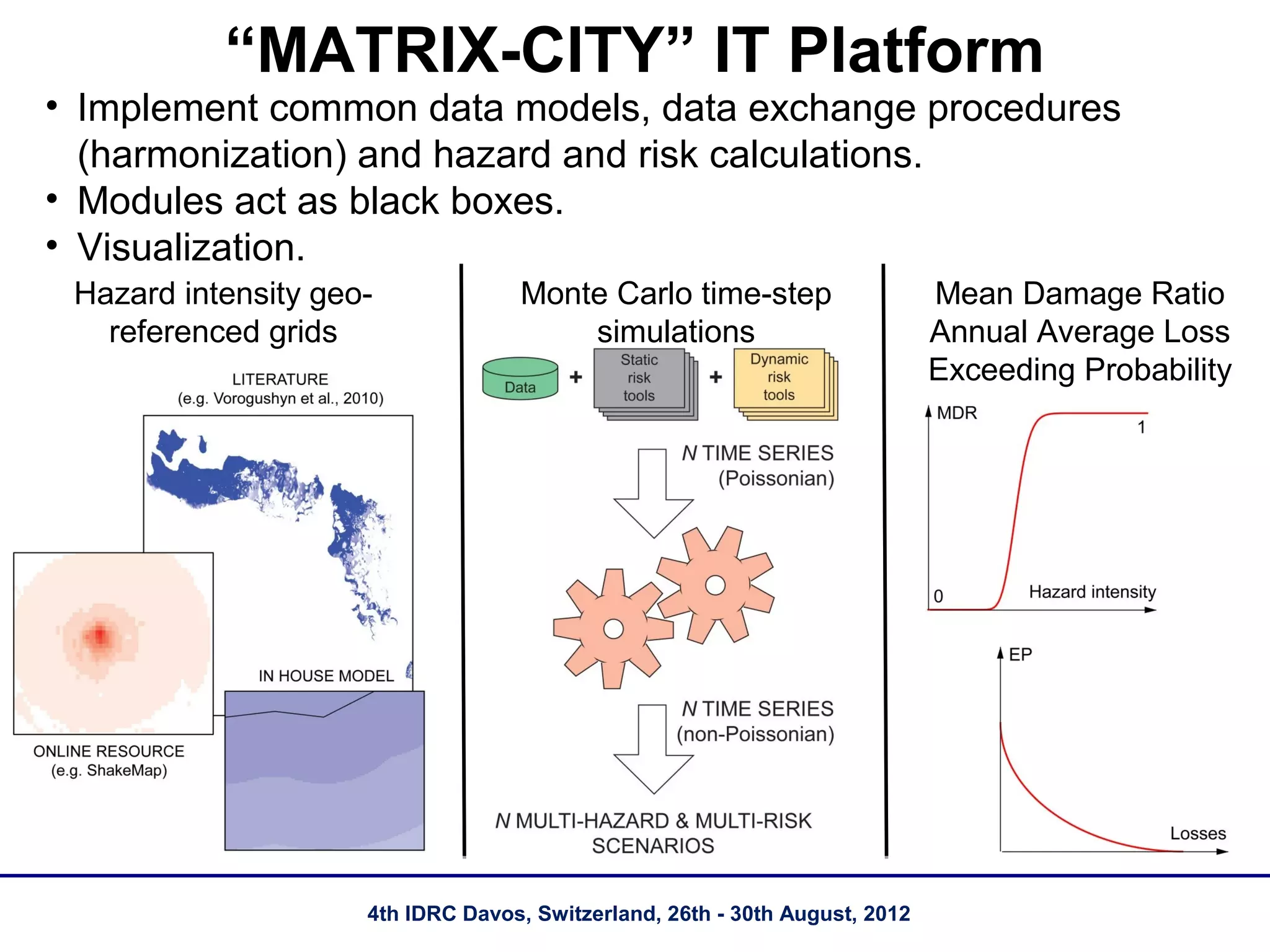
“MATRIX-CITY” IT Platform
• Implement common data models, data exchange procedures
  (harmonization) and hazard and risk calculations.
• Modules act as black boxes.
• Visualization.
 Hazard intensity geo-             Monte Carlo time-step                     Mean Damage Ratio
   referenced grids                    simulations                           Annual Average Loss
                                                                             Exceeding Probability


                     4th IDRC Davos, Switzerland, 26th - 30th August, 2012
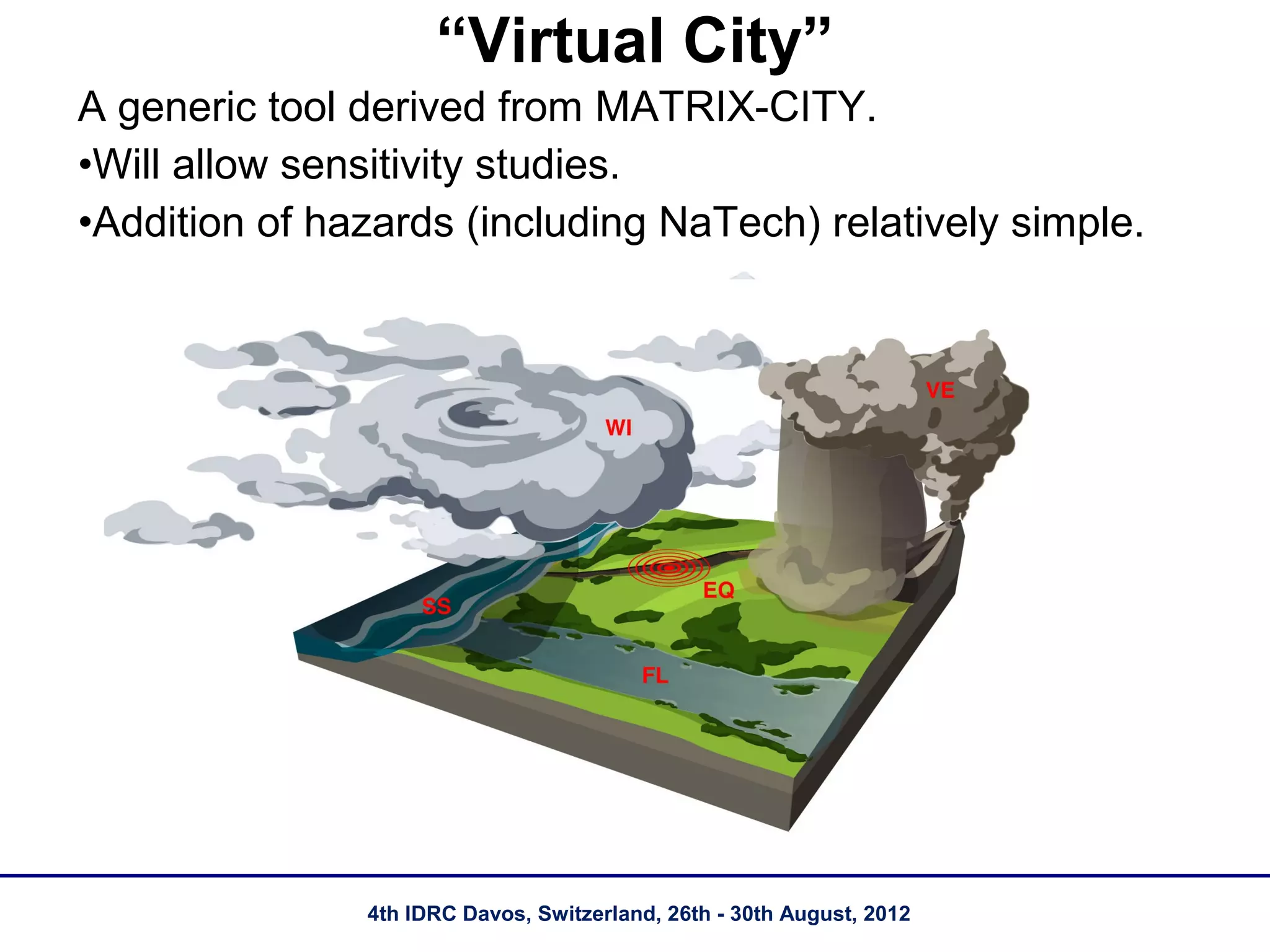
“Virtual City”
A generic tool derived from MATRIX-CITY.
•Will allow sensitivity studies.
•Addition of hazards (including NaTech) relatively simple.


 100 × 100 km
 Volcano (NE corner), fault system (N sector),
 river basin (S sector), coast (W boundary)
 Virtual City can be located anywhere in the
 Virtual Region


                     4th IDRC Davos, Switzerland, 26th - 30th August, 2012
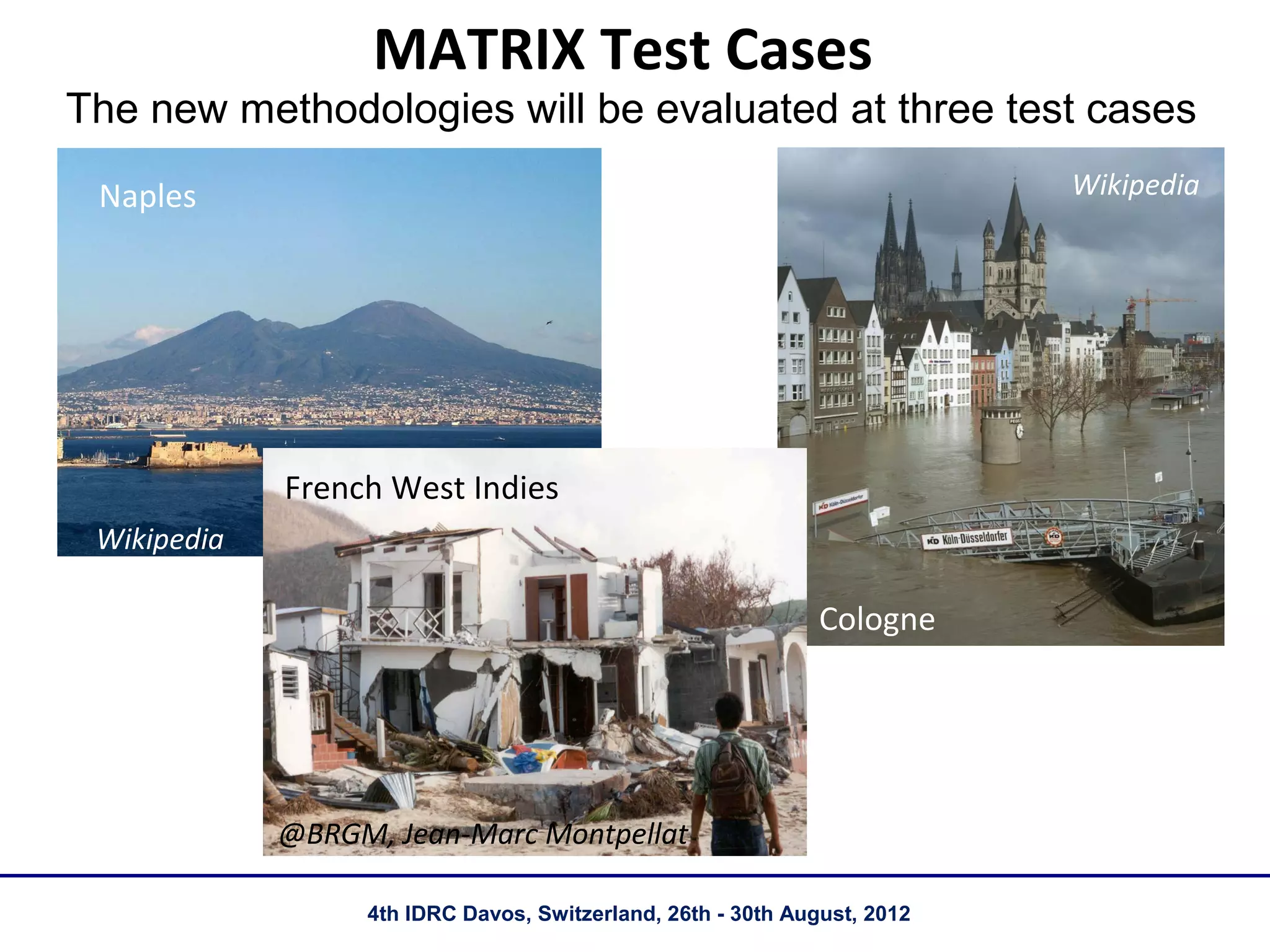
MATRIX Test Cases
The new methodologies will be evaluated at three test cases
 Naples                                                                   Wikipedia


             French West Indies
 Wikipedia

                                                              Cologne


             @BRGM, Jean-Marc Montpellat

                  4th IDRC Davos, Switzerland, 26th - 30th August, 2012
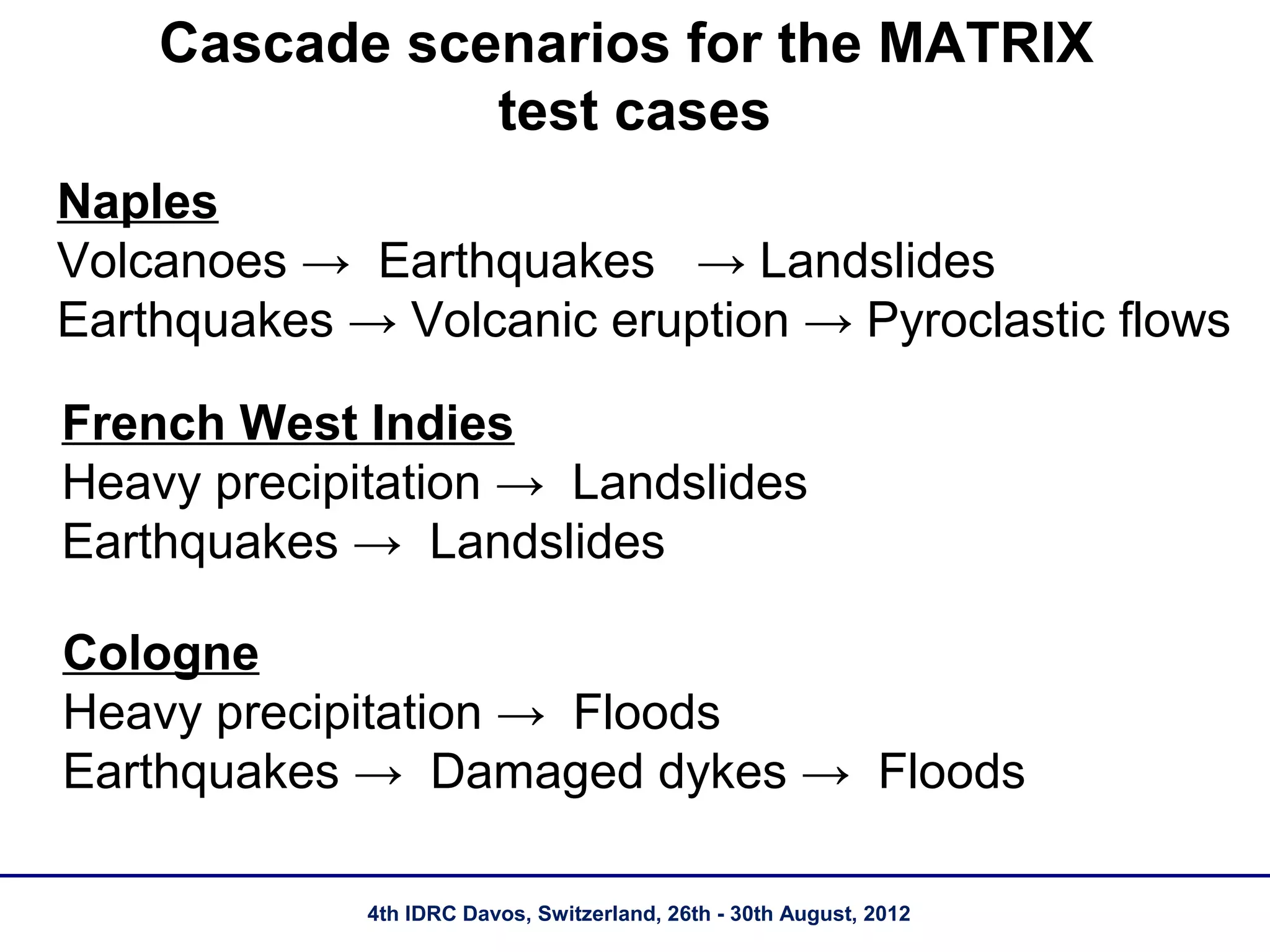
Cascade scenarios for the MATRIX
               test cases
Naples
Volcanoes → Earthquakes → Landslides
Earthquakes → Volcanic eruption → Pyroclastic flows

French West Indies
Heavy precipitation → Landslides
Earthquakes → Landslides

Cologne
Heavy precipitation → Floods
Earthquakes → Damaged dykes → Floods

             4th IDRC Davos, Switzerland, 26th - 30th August, 2012
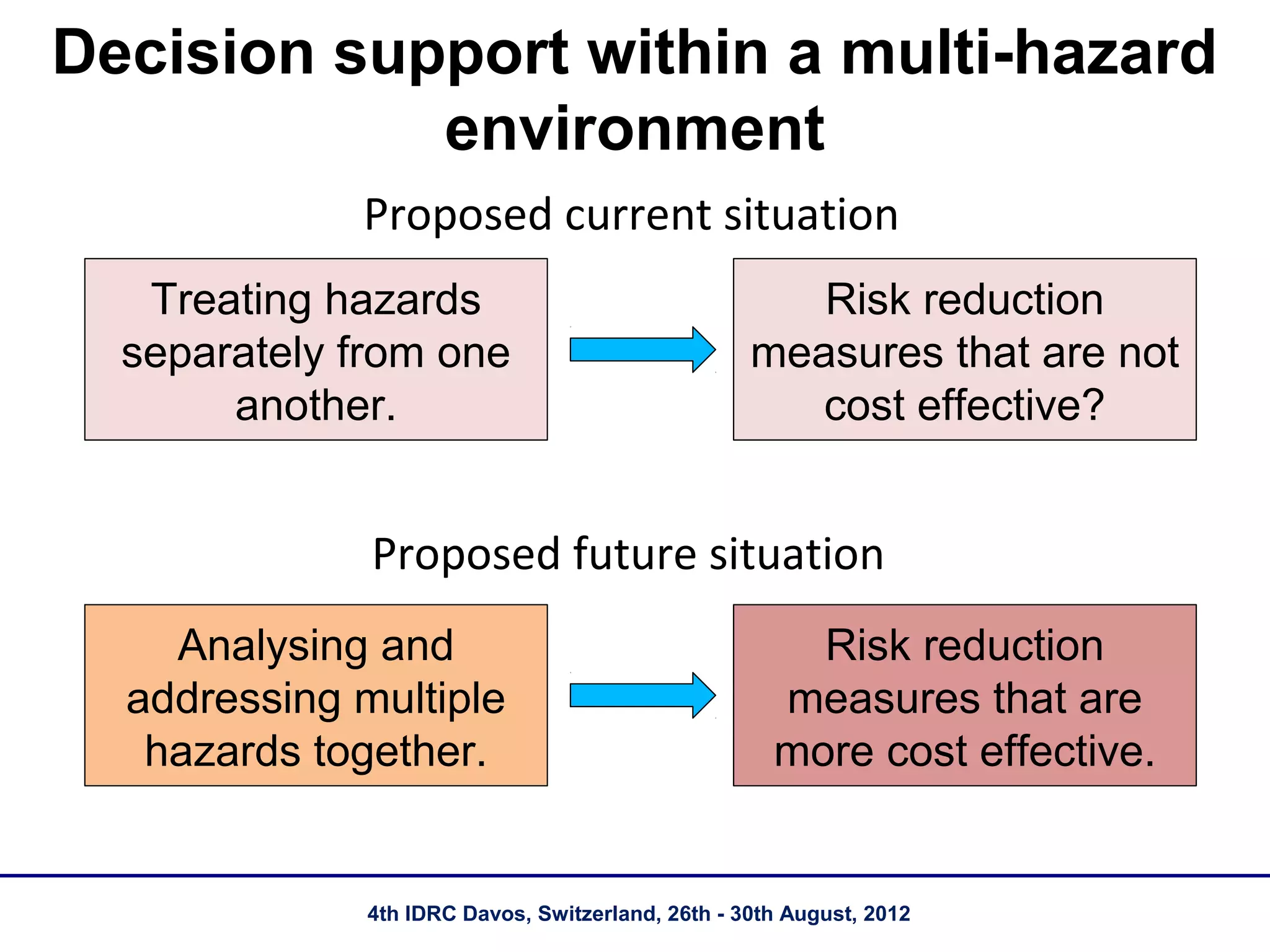
Decision support within a multi-hazard
            environment
             Proposed current situation
   Treating hazards                                   Risk reduction
  separately from one                              measures that are not
       another.                                       cost effective?


              Proposed future situation
    Analysing and                                      Risk reduction
  addressing multiple                                measures that are
   hazards together.                                 more cost effective.


              4th IDRC Davos, Switzerland, 26th - 30th August, 2012
Dissemination and end users
Outreach to European Civil Protection authorities
and National Platforms for DRR is of great interest.

• Inform experts and decision makers
  e.g., MATRIX was invited to present itself at an
  “Experts meeting” in Brussels last year.
• Integrate their expertise, demands and visions
  into the scientific research design of the project.

• Ensure active participation of Civil Protection
  experts at project workshops and meetings.

               4th IDRC Davos, Switzerland, 26th - 30th August, 2012
In Summary
        MATRIX is setting out to . . .
• Determine/demonstrate when multi-type methods provide
  better (or worse) results compared with single-type
  methods (scenarios).
• Provide tools for analysing multi-type risk problems within a
  European context.

• Establish a knowledge base on multi-type risk in Europe.


• Provide support for decision-making actions carried out by
  civil protection and disaster management authorities.

             4th IDRC Davos, Switzerland, 26th - 30th August, 2012
MATRIX is supported by
             the European Union's
              Seventh Framework
                Program (FP7).
MATRIX began on 1.10.2010, and will run until 30.09.2013.
                      MATRIX website
                   http://matrix.gpi.kit.edu/
         Prof. Dr. Jochen Zschau (coordinator)
     GFZ German Research Centre for Geosciences
               (zschau@gfz-potsdam.de)
                 Mr. Roger Mrzyglocki
        Deutsches Komitee Katastrophenvorsorge
                (mrzyglocki@dkkv.org)

              4th IDRC Davos, Switzerland, 26th - 30th August, 2012

Multi-hazard and multi-risk assessment methods for Europe: the MATRIX project

  • 1.
    MATRIX New Multi-Hazard and Multi-Risk Assessment Methods for Europe Multi-hazard and multi-risk assessment methods for Europe: the MATRIX project Kevin Fleming Earthquake Risk and Early Warning Helmholtz Centre Potsdam GeoForschungsZentrum 4th IDRC Davos, Switzerland, 26th - 30th August, 2012
  • 2.
    Multiple-single- versus Multi-type assessment Multiple-single type hazard and risk assessments considers any number of hazards and risks individually, i.e., spatial and temporal relationships are neglected. e.g., DFNK project, Germany, the risks to Cologne due to earthquakes, floods and windstorms were treated separately (Grünthal et al., Natural Hazards, 2006). Multi-type hazard and risk assessment also considers different types of hazards and risks, but, their spatial and temporal relationships are explicitly considered. e.g., MATRIX project, the flood risk to Cologne may increase due to the dykes being damaged by earthquakes. . 4th IDRC Davos, Switzerland, 26th - 30th August, 2012
  • 3.
    Some issues inmulti-type assessments Interaction and amplification of risks ● One event may trigger (cascade effects) others. ● Multi-type is therefore more than the simple aggregation of single-types. Not only does perhaps 1 + 1 ≠ 2, but possibly 1 + 1 >> 2 Dynamic vulnerability ● One event changes the vulnerability of a system to future or conjoint events. ● Ageing of structures/infrastructure, accumulated effects of hazards. ● Changes in human populations (expansion of mega-cities, rural depopulation). 4th IDRC Davos, Switzerland, 26th - 30th August, 2012
  • 4.
    Main issues inmulti-type assessments Application of multi-risk assessments ● Complexity leads to greater difficulties in decision making. ● Ranges from individual to institutional decision making. e.g., People respond poorly when risks result from the interaction of a number of factors. How would this impact upon “community programs”? ● Need for clear communication pathways AND formal accountability. 4th IDRC Davos, Switzerland, 26th - 30th August, 2012
  • 5.
    Suggested benefits ofmulti-risk assessment ● Quantification of the potential total risk from multiple hazards, including e.g., cascade events. ● Comparing risks from different hazards and return periods for a given asset. Leads to identifying the dominant risks over different time scales. ● Assessment of different spatial patterns of risk from different hazards. Important for emergency planning. ● Assessment of the relative risk arising from different hazards. Important for long-term planning in the insurance industry, and for regional and local governments. Schmidt et al., Natural Hazards, (2011) 4th IDRC Davos, Switzerland, 26th - 30th August, 2012
  • 6.
    Aims of MATRIX Core objective of MATRIX is “to develop methods and tools to tackle multiple natural hazards in a common framework “ Develop new Compare new multi-type methodologies for multi- methods with state-of-the- type hazard and risk art probabilistic single-risk assessment analysis. Establish an IT framework for test case Disseminate the results to analysis within a multi-risk multiple communities environment 4th IDRC Davos, Switzerland, 26th - 30th August, 2012
  • 7.
    Aims of MATRIX To achieve the scientific goals of MATRIX, the following aspects of multi-type hazard and risk are focused on: Comparability Interactions •State-of-the-art single-type •Cascade (domino) events •Single- versus multi-type •Temporal dependency in •Uncertainty propagation vulnerability Scenarios Decision making •Cases where single-type •Disaster management methods fail •Risk mapping guidelines •Test cases •Needs of end-users •IT (Virtual city) platform 4th IDRC Davos, Switzerland, 26th - 30th August, 2012
  • 8.
    Hazards of interest The“usual suspects” for Europe. Earthquakes Landslides Volcanic eruptions Tsunamis Wildfires Winter storms Cold and heat waves Fluvial and coastal flooding 4th IDRC Davos, Switzerland, 26th - 30th August, 2012
  • 9.
    The MATRIX Consortium Project Co-ordination Jochen Zschau (GFZ) Coordinator Paolo Gasparini (AMRA) Co-coordinator Hormoz Modaressi (BRGM) Co-coordinator Project Consortium 12 partners 10 countries (including Canada) 10 research institutions 1 end-user 1 industry 4th IDRC Davos, Switzerland, 26th - 30th August, 2012
  • 10.
    General work scheme Single-type assessments Identify the state-of-the-art, harmonise output and uncertainties. Focus is on “city-size” spatial scales and “casualties, residential buildings” Cascade/domino effects Temporal changes in vulnerability How one hazard can trigger Time-dependent physical vulnerability. another? Conjoint events. Relative importance of events. Functional vulnerability. Identifying scenarios. Social and economic. Considers different spatial and temporal scales Allow the comparison of risks (including uncertainties) Will help identify where uncertainties can be reduced. Classification of different loss types. Decision support/problems and barriers to multi-type decision making 4th IDRC Davos, Switzerland, 26th - 30th August, 2012
  • 11.
    Uncertainties in multi-typeassessment ● Aleatory (randomness) versus epistemic (ignorance). Quantifiable and unquantifiable. ● First question to end-users . . . “Do you really care?” First question back (I imagine) . . . “How can this help my decision making?” ● Is a hierarchy of uncertainty required? Is there one now? How would this influence decision making? ● How willing are you to spend money to reduce uncertainty? (cost effectiveness of acquiring additional information) 4th IDRC Davos, Switzerland, 26th - 30th August, 2012
  • 12.
    “MATRIX-CITY” IT Platform •Implement common data models, data exchange procedures (harmonization) and hazard and risk calculations. • Modules act as black boxes. • Visualization. Hazard intensity geo- Monte Carlo time-step Mean Damage Ratio referenced grids simulations Annual Average Loss Exceeding Probability 4th IDRC Davos, Switzerland, 26th - 30th August, 2012
  • 13.
    “Virtual City” A generictool derived from MATRIX-CITY. •Will allow sensitivity studies. •Addition of hazards (including NaTech) relatively simple. 100 × 100 km Volcano (NE corner), fault system (N sector), river basin (S sector), coast (W boundary) Virtual City can be located anywhere in the Virtual Region 4th IDRC Davos, Switzerland, 26th - 30th August, 2012
  • 14.
    MATRIX Test Cases Thenew methodologies will be evaluated at three test cases Naples Wikipedia French West Indies Wikipedia Cologne @BRGM, Jean-Marc Montpellat 4th IDRC Davos, Switzerland, 26th - 30th August, 2012
  • 15.
    Cascade scenarios forthe MATRIX test cases Naples Volcanoes → Earthquakes → Landslides Earthquakes → Volcanic eruption → Pyroclastic flows French West Indies Heavy precipitation → Landslides Earthquakes → Landslides Cologne Heavy precipitation → Floods Earthquakes → Damaged dykes → Floods 4th IDRC Davos, Switzerland, 26th - 30th August, 2012
  • 16.
    Decision support withina multi-hazard environment Proposed current situation Treating hazards Risk reduction separately from one measures that are not another. cost effective? Proposed future situation Analysing and Risk reduction addressing multiple measures that are hazards together. more cost effective. 4th IDRC Davos, Switzerland, 26th - 30th August, 2012
  • 17.
    Dissemination and endusers Outreach to European Civil Protection authorities and National Platforms for DRR is of great interest. • Inform experts and decision makers e.g., MATRIX was invited to present itself at an “Experts meeting” in Brussels last year. • Integrate their expertise, demands and visions into the scientific research design of the project. • Ensure active participation of Civil Protection experts at project workshops and meetings. 4th IDRC Davos, Switzerland, 26th - 30th August, 2012
  • 18.
    In Summary MATRIX is setting out to . . . • Determine/demonstrate when multi-type methods provide better (or worse) results compared with single-type methods (scenarios). • Provide tools for analysing multi-type risk problems within a European context. • Establish a knowledge base on multi-type risk in Europe. • Provide support for decision-making actions carried out by civil protection and disaster management authorities. 4th IDRC Davos, Switzerland, 26th - 30th August, 2012
  • 19.
    MATRIX is supportedby the European Union's Seventh Framework Program (FP7). MATRIX began on 1.10.2010, and will run until 30.09.2013. MATRIX website http://matrix.gpi.kit.edu/ Prof. Dr. Jochen Zschau (coordinator) GFZ German Research Centre for Geosciences (zschau@gfz-potsdam.de) Mr. Roger Mrzyglocki Deutsches Komitee Katastrophenvorsorge (mrzyglocki@dkkv.org) 4th IDRC Davos, Switzerland, 26th - 30th August, 2012

Editor's Notes

  • #2 This is my first IDRC meeting and I have heard quite often mention of multi-hazard and risk, in talks and in reference to various conventions. For examples, many of you would be familiar with the EU Risk Mapping Guidelines document from early last year. SO MATRIX may well be seen as a step in the general direction so many people believe should be followed. I won’t give a detailed outline of ALL aspects of the MATRIX work, but I hopefully will raise a few questions relevant to the different levels of disaster management and mitigation.
  • #3 A few points about terminology. At a session Monday, a comment was made about a lack of maturity in terminology. SO I will outline quickly what we really mean by multi-type hazard and risk. I thought this was undercontrol a few months ago after we completed a glossary for our project BUT we had a meeting in Bonn with end users a few weeks ago and I realise it is still a very fluid situation. I emphasise this because often in the literature, even when one sees the term “multi-risk” it really seems to refer to what I think of as “multiple-single risks” For example, some works I come across use the term “multi-risk” and even in the text outline a view/perspective that is consistent with the MATRIX one (e.g., the need to consider cascade events) BUT they have not dealt with it. e.g., Carpignano et al. (2009) Piedmont Region, Italy. The definition or view we are following is in line with the definitions for multi-risk and multi-hazard outlined in EC working paper I just mentioned on “Risk Assessment and Mapping Guidelines for Disaster Management”
  • #4 I originally had “Main” but I am not so sure now. From the DoW of the project. These were recognised as the main issues. Cascade-interactions: Especially 1+1 >> 2 e.g., induced effect may be much worse, examples are the tsunami and landslides from earthquakes. Dynamic vulnerability: Even countries like Germany have trouble keeping up/having access to appropriate information. Application: The last point was specified for the use of data. Would also include legal issues (a potential serious issue, even my students recognised this). Have not even started to include “social” or “economic” issues, which would fit into all of these.
  • #5 Application: The last point was specified for the use of data. Would also include legal issues (a potential serious issue, even my students recognised this). Have not even started to include “social” or “economic” issues, which would fit into all of these.
  • #6 For different time scales, i.e., rare-extreme, appears to be a need for different methodologies.
  • #7 Aims of MATRIX in the broadest sense. Emphasis on NATURAL hazards. NaTech will NOT be dealt with ALTHOUGH we do acknowledge that it does add a serious complicating part. e.g., a document we are working on (deliverable) concerning uncertainties discusses pollutants and flooding. FOCUS is on “urban scales” and time scales of years although we acknowledge the importance of “slow” cascade events as spoken about by the Ugandan minister on Monday.
  • #8 COMPARABILITY Where spatial and temporal scales come into it, especially return periods. Uncertainties are currently something of a focus for us at this point. INTERACTIONS The most obvious difference between MATRIX and previous projects in that We are explicitly considering them. SCENARIOS Out IT system and test cases. DECISION MAKING Been in contact with end users. My original thoughts were that the results here were more for the “philosopher kings” in ministries BUT am thinking that the coal face workers have the imagination e.g., what sort of cascade events Can happen, even if they had not pondered this before.
  • #9 The usual suspects for Europe. Tsunamis are discussed within a single assessment context as we have one deliverable summarising the state-of-the-art in single type, but we will not deal with it in detail. BUT in the IT platform I will discuss, could be incorporable easily.
  • #10 DKKV German Committee for Disaster Reduction ASPINAL in England risk consultants
  • #11 I hav WP2 Considers single types. WP3 Cascade events WP4 Temporal changes, including not just structural behaviour but also system functions (tool from UBC) WP5 Putting them all together. Include issues such as different loss types (tangibles, in tangibles) WP6 Decision support/problems and barriers to multi-type decision making WP7 IT platform and test cases. WP8 Dissemination but also input from end-users. Training and reference materials will also be produced. e been warned about too much detail about work packages
  • #12 Gordon Woo commented that simply acquiring information is amongst the most cost efficient things to do. May be relatively simple and cheap, e.g., superior digital elevation models, houses with respect to a river But we appreciate is also potentially very expensive and time consuming, especially when considering vulnerability. e.g., nature of a towns buildings, especially an old city. Even the likes of Germany has trouble.
  • #16 A non-exhaustive series of examples for the test cases. Several documents are being formulated. We are also examining (e.g., Naples) more than one trigger . . . . e.g., Earthquake – Volcanoes – Tephra These are just some examples, of course with a good imagination one can come up with many more. Cascade events may also be over longer time periods. e.g., dry conditions (drought) are conducive to wild fires which in turn may create a situation where erosion is more prevalent.
  • #17 Shamelessly copied from a presentation of Tony Patt (IIASA) Question also arises as to whether individuals or institutions can cope with multi-type issues OR do they actually do this without explicitly stating so. DO you all expect this is possible/feasible/yes or too hard. Comment made from the expert meeting was that “yes all well and fine but we are having trouble doing single type, let alone multi” (my paraphrasing) Perhaps too hard from “philosopher kings” BUT could “local” authorities deal with it better?
  • #18 A meeting in Bonn was held in July, and to be honest there was, at least at first, some skepticism, which is not a bad thing. However by the end we were coming to a common agreement that this was a useful approach, And a document is currently in preparation.
  • #19 Knowledge base is based on SOBOLEO