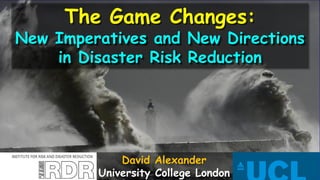
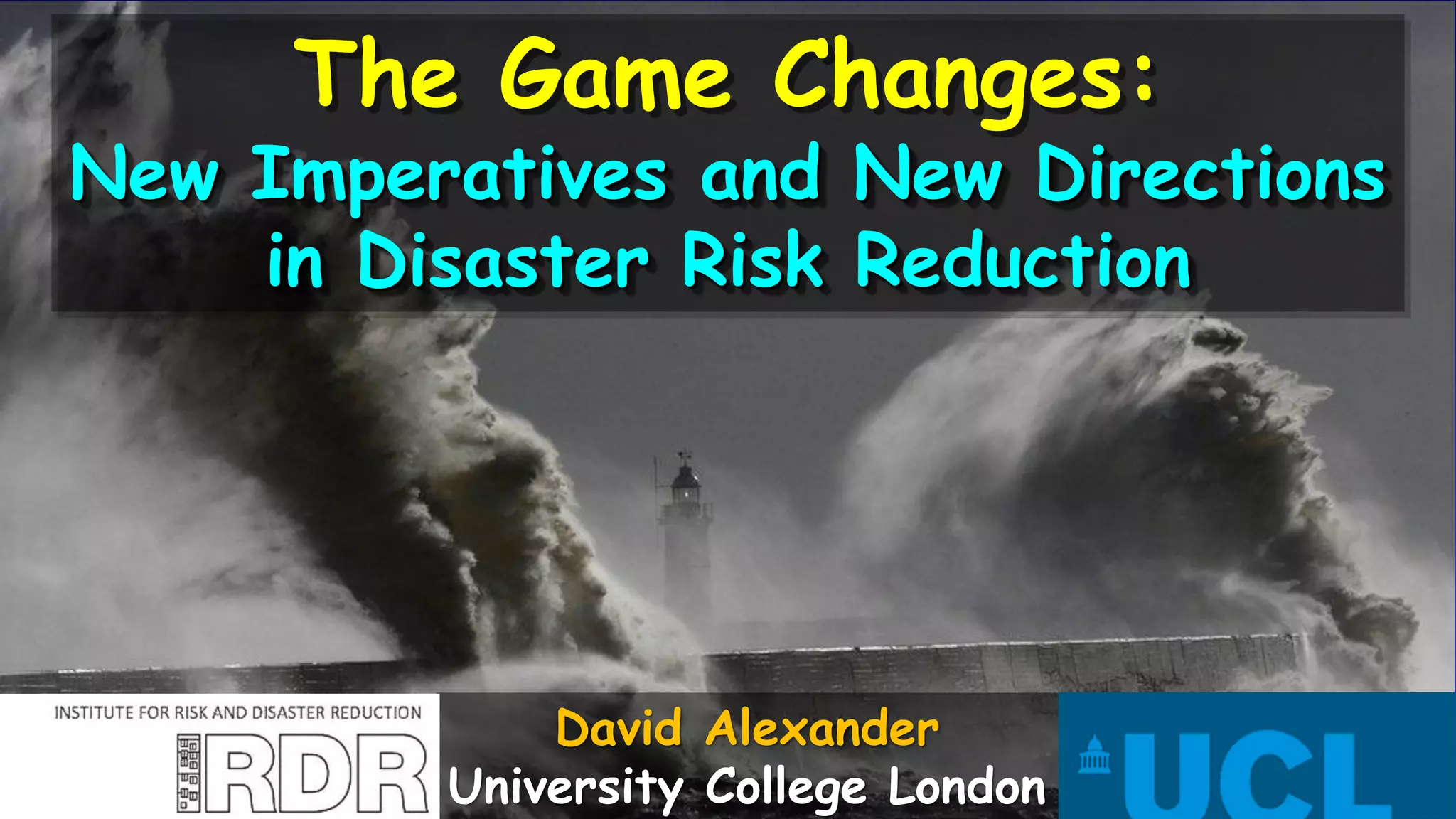
The Game Changes:
New Imperatives and New Directions
in Disaster Risk Reduction
David Alexander
University College London
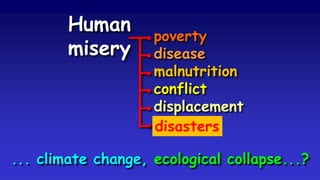
Human
misery
●poverty
●disease
●malnutrition
●conflict
●displacement
●
... climate change, ecological collapse...?
disasters
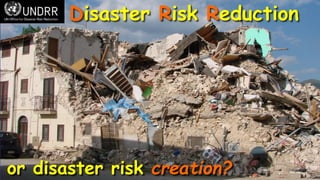
Disaster Risk Reduction
or disaster risk creation?
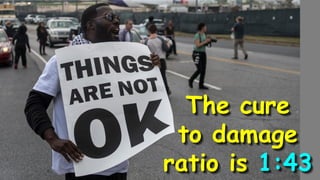
The cure
to damage
ratio is 1:43
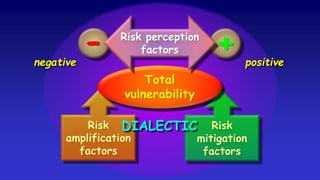
Risk
amplification
factors
Risk
mitigation
factors
Total
vulnerability
Risk perception
factors- + positivenegative
DIALECTIC
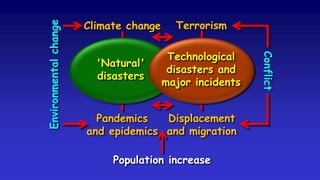
Climate change Terrorism
Displacement
and migration
Pandemics
and epidemics
Population increase
Environmentalchange
Conflict
Technological
disasters and
major incidents
'Natural'
disasters
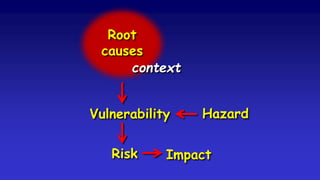
Root
causes
Vulnerability Hazard
Risk Impact
context
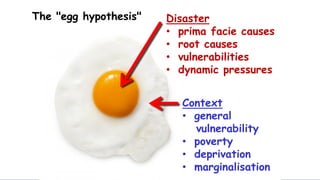
The "egg hypothesis" Disaster
• prima facie causes
• root causes
• vulnerabilities
• dynamic pressures
Context
• general
vulnerability
• poverty
• deprivation
• marginalisation
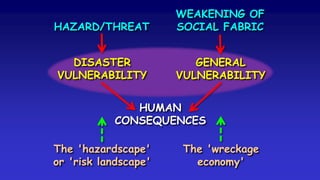
HAZARD/THREAT
DISASTER
VULNERABILITY
WEAKENING OF
SOCIAL FABRIC
GENERAL
VULNERABILITY
HUMAN
CONSEQUENCES
The 'hazardscape'
or 'risk landscape'
The 'wreckage
economy'
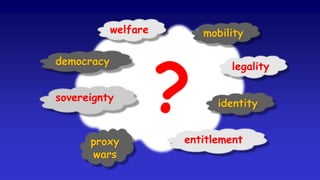
welfare mobility
sovereignty
identity
entitlementproxy
wars
?
democracy legality
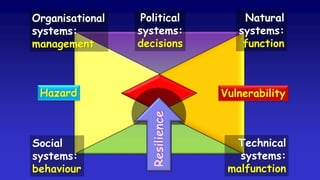
Organisational
systems:
management
Social
systems:
behaviour
Natural
systems:
function
Technical
systems:
malfunction
VulnerabilityHazard
Resilience
Political
systems:
decisions
HUMAN
CONSEQUENCES
OF DISASTER
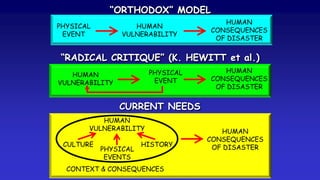
“ORTHODOX” MODEL
PHYSICAL
EVENT
HUMAN
VULNERABILITY
“RADICAL CRITIQUE” (K. HEWITT et al.)
HUMAN
CONSEQUENCES
OF DISASTER
HUMAN
VULNERABILITY
PHYSICAL
EVENT
CURRENT NEEDS
HUMAN
CONSEQUENCES
OF DISASTER
HUMAN
VULNERABILITY
CULTURE HISTORY
PHYSICAL
EVENTS
CONTEXT & CONSEQUENCES
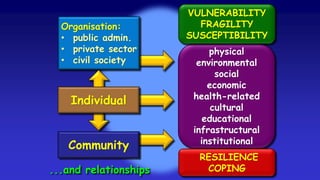
physical
environmental
social
economic
health-related
cultural
educational
infrastructural
institutional
RESILIENCE
COPING
VULNERABILITY
FRAGILITY
SUSCEPTIBILITY
Organisation:
• public admin.
• private sector
• civil society
Community
Individual
...and relationships
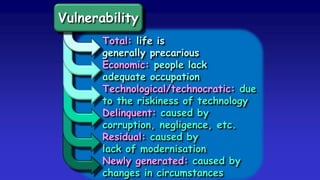
Vulnerability
Total: life is
generally precarious
Economic: people lack
adequate occupation
Technological/technocratic: due
to the riskiness of technology
Delinquent: caused by
corruption, negligence, etc.
Residual: caused by
lack of modernisation
Newly generated: caused by
changes in circumstances
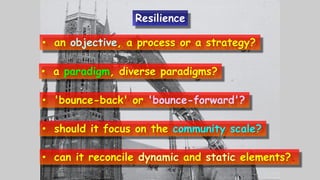
• an objective, a process or a strategy?
• a paradigm, diverse paradigms?
• 'bounce-back' or 'bounce-forward'?
• should it focus on the community scale?
• can it reconcile dynamic and static elements?.
Resilience
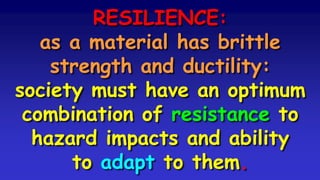
RESILIENCE:
as a material has brittle
strength and ductility:
society must have an optimum
combination of resistance to
hazard impacts and ability
to adapt to them.
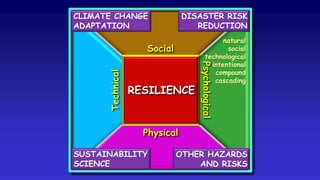
RESILIENCE
Social
Technical
Physical
Psychological
natural
social
technological
intentional
compound
cascading
CLIMATE CHANGE
ADAPTATION
DISASTER RISK
REDUCTION
SUSTAINABILITY
SCIENCE
OTHER HAZARDS
AND RISKS
`
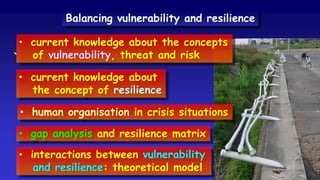
• current knowledge about the concepts
of vulnerability, threat and risk
• current knowledge about
the concept of resilience
• human organisation in crisis situations
• gap analysis and resilience matrix
• interactions between vulnerability
and resilience: theoretical model.
Balancing vulnerability and resilience
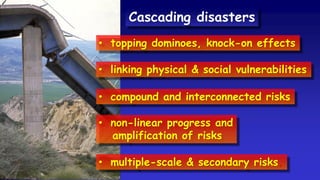
Cascading
disasters
• topping dominoes, knock-on effects
• linking physical & social vulnerabilities
• compound and interconnected risks
• non-linear progress and
amplification of risks
• multiple-scale & secondary risks.
Cascading disasters
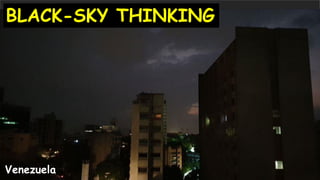
BLACK-SKY THINKING
Venezuela
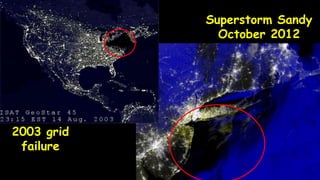
2003 grid
failure
Superstorm Sandy
October 2012
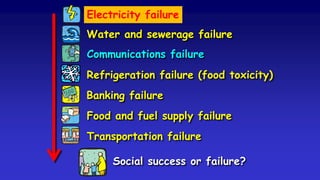
Electricity failure
Water and sewerage failure
Refrigeration failure (food toxicity)
Banking failure
Food and fuel supply failure
Transportation failure
Social success or failure?
Communications failure
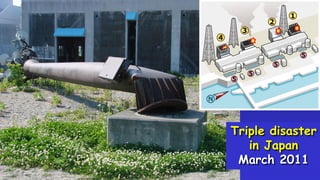
Triple disaster
in Japan
March 2011
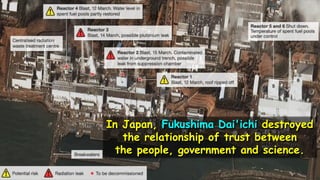
In Japan, Fukushima Dai'ichi destroyed
the relationship of trust between
the people, government and science.
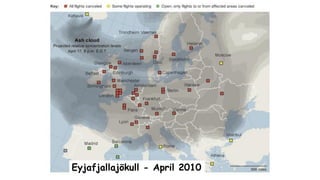
Eyjafjallajökull - April 2010
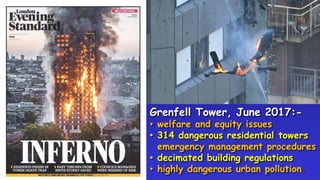
Grenfell Tower, June 2017:-
• welfare and equity issues
• 314 dangerous residential towers
emergency management procedures
• decimated building regulations
• highly dangerous urban pollution.
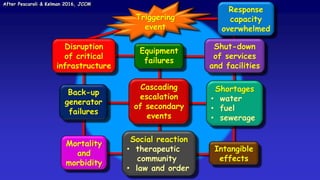
Triggering
event
Response
capacity
overwhelmed
Disruption
of critical
infrastructure
Cascading
escalation
of secondary
events
Intangible
effects
Shut-down
of services
and facilities
Equipment
failures
Social reaction
• therapeutic
community
• law and order
Back-up
generator
failures
Mortality
and
morbidity
Shortages
• water
• fuel
• sewerage
After Pescaroli & Kelman 2016, JCCM
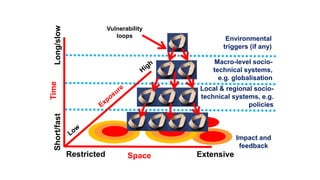
Time
Short/fastLong/slow
SpaceRestricted Extensive
CAS & critical
infrastructure
Macro-level socio-
technical systems,
e.g. globalisation
Local & regional socio-
technical systems, e.g.
policies
Environmental
triggers (if any)
Impact and
feedback
Vulnerability
loops
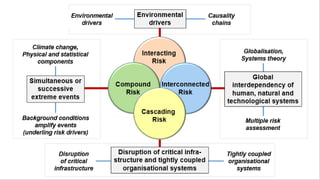
RISK
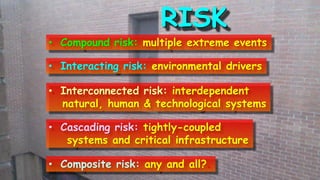
• Compound risk: multiple extreme events
• Interacting risk: environmental drivers
• Interconnected risk: interdependent
natural, human & technological systems
• Cascading risk: tightly-coupled
systems and critical infrastructure
• Composite risk: any and all?.
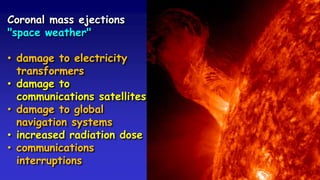
Coronal mass ejections
"space weather"
• damage to electricity
transformers
• damage to
communications satellites
• damage to global
navigation systems
• increased radiation dose
• communications
interruptions
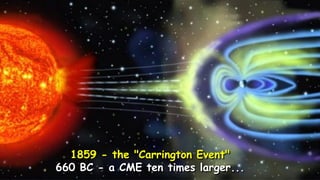
1859 - the "Carrington Event"
660 BC - a CME ten times larger...
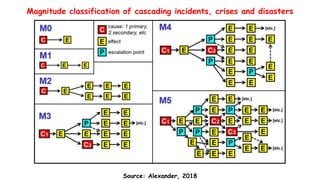
Magnitude classification of cascading incidents, crises and disasters
Source: Alexander, 2018
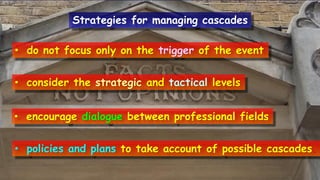
• do not focus only on the trigger of the event
• consider the strategic and tactical levels
• encourage dialogue between professional fields
• policies and plans to take account of possible cascades.
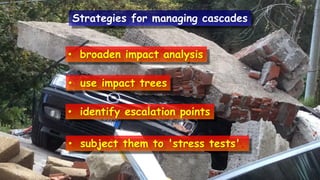
Strategies for managing cascades
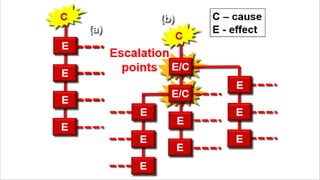
• broaden impact analysis
• use impact trees
• identify escalation points
• subject them to 'stress tests'.
Ishinomaki, 2014
The Sendai Framework
for Disaster
Risk Reduction, 2015-2030
a critique
• signing up to a non-binding agreement
does not necessarily mean DRR action
• unscrupulous politicians can be
legitimised at home and abroad
• good DRR is not exactly a top-down process
• collects evidence but uses it at best selectively
• accountability remains weak.
Deficiencies of the UN process
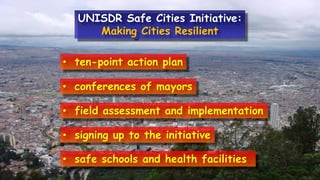
• ten-point action plan
• conferences of mayors
• field assessment and implementation
• signing up to the initiative
• safe schools and health facilities.
UNISDR Safe Cities Initiative:
Making Cities Resilient
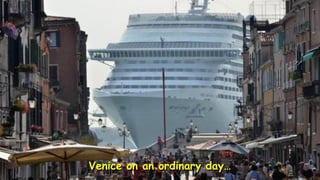
"The City of Venice joined the
[UNISDR Safe Cities] Campaign
as a Role Model for cultural heritage
protection and climate change adaptation."
Venice on an ordinary day…
Twelve awkward questions about the SFDRR
1. Do we need this document, and why?
2. Whether it is a good or bad
instrument, will it have an impact
on losses caused by disasters?
3. What are the alternatives to
having a Sendai Declaration?
Is there a better way?
4. Who will hold governments
to account, and how?.
Twelve awkward questions about the SFDRR
5. Would changing the wording of
the SFDRR affect disaster losses?
6. Can a document like the SFDRR
ever be anything but "top-down",
and does this matter?
7. The word 'should' appears 21 times in
the SFDRR: does it have real meaning?
8. In the face of 'disaster risk creation',
do targets have any meaning?.
Twelve awkward questions about the SFDRR
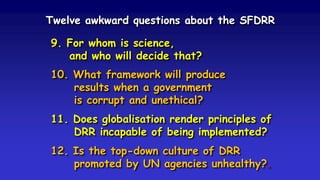
9. For whom is science,
and who will decide that?
10. What framework will produce
results when a government
is corrupt and unethical?
11. Does globalisation render principles of
DRR incapable of being implemented?
12. Is the top-down culture of DRR
promoted by UN agencies unhealthy?.
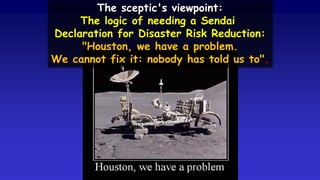
The sceptic's viewpoint:
The logic of needing a Sendai
Declaration for Disaster Risk Reduction:
"Houston, we have a problem.
We cannot fix it: nobody has told us to".
Conclusions
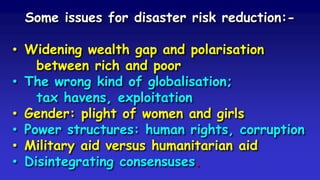
Some issues for disaster risk reduction:-
• Widening wealth gap and polarisation
between rich and poor
• The wrong kind of globalisation;
tax havens, exploitation
• Gender: plight of women and girls
• Power structures: human rights, corruption
• Military aid versus humanitarian aid
• Disintegrating consensuses.
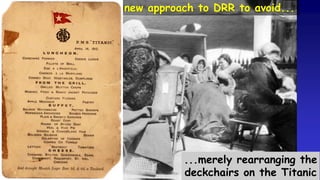
...merely rearranging the
deckchairs on the Titanic
It is time for a new approach to DRR to avoid...
Thank you for listening!
david.alexander@ucl.ac.uk
emergency-planning.blogspot.com
slideshare.net/dealexander

New Directions in Disaster Risk Reduction