DISASTER MITIGATION
LANDSLIDES
SUBMITTED BY – JANUMI RATHOD
PARTH SADARIA
MASTERS OF URBAN AND REGIONAL PLANNING
Department of Architecture,
Faculty of Technology & Engineering
The Maharaja Sayajirao University of Baroda,
Vadodara, India
SEPTEMBER 2015
Understanding Disaster
CRED (The Centre for
Research on the Epidemiology
of Disasters)
“A situation or event which overwhelms local capacity,
necessitating a request to a national or international level for
external assistance; an unforeseen and often sudden event
that causes great damage, destruction and human suffering.”
International Federation of
Red Cross and Red Crescent
Societies
A disaster occurs when a hazard impacts on vulnerable
people.
(VULNERABILITY+ HAZARD ) / CAPACITY = DISASTER
Natural Disasters – Categories, Types
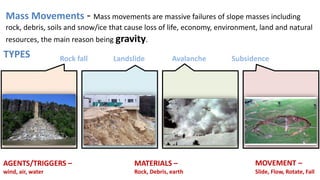
Mass Movements - Mass movements are massive failures of slope masses including
rock, debris, soils and snow/ice that cause loss of life, economy, environment, land and natural
resources, the main reason being gravity.
TYPES Rock fall Landslide Avalanche Subsidence
AGENTS/TRIGGERS –
wind, air, water
MOVEMENT –
Slide, Flow, Rotate, Fall
MATERIALS –
Rock, Debris, earth
Characteristics landslide landforms
Soil and rock
fragments slide
down the slope
The wet ground
breaks up and
falls down the
hillside
Rotational slide
of loose
materials or rock
fragment
The falling of a
newly detached
mass of rock
from a cliff or
down a very
steep slope.Source - British Geological Survey and Eastern Illinois University
Causes
Man- made Causes
•Excavation (particularly at the toe of
slope)
•Loading of slope crest
•Draw -down (of reservoir)
•Deforestation
•Irrigation
•Mining
•Artificial vibrations
•Water impoundment and leakage from
utilities
Physical Causes
•Prolonged precipitation
•Rapid draw- down
•Earthquake
•Volcanic eruption
•Thawing
•Shrink and swell
•Artesian pressure
Morphological Causes
•Ground uplift (volcanic, tectonic etc)
•Erosion (wind, water)
•Scour Deposition loading in the slope
crest
•Vegetation removal
(by forest fire, drought etc)
Source - American Geophysical Union, Nick Rosser
Landslide Fatalities, 2007
Existing large dams UN large dam database (2012)
• Each red dot is a large dam on the database
• Existing dams are concentrated in mountainous areas, but not in very high mountains
Source - Dave Petley, American Geophysical Union, Vajont Conference, 2013
Large dam density UN large dam database (2012)
• Contour map of the density of existing large dams
Source - Dave Petley, American Geophysical Union, Vajont Conference, 2013
Large dams and fatality-inducing landslide events (2004-2011)
• The distribution of fatal landslides and large existing dams does not overlap, specifically
in the Himalayas
Source - Dave Petley, American Geophysical Union, Vajont Conference, 2013
Distribution of landslides associated with large dams
• Each dot is a landslide associated with a large dams in the period 2003-2012
• NOTE- Almost all are in Asia, Hotspots are in Himalayas and China
Source - Dave Petley, American Geophysical Union, Vajont Conference, 2013
Proposed dams and dam related landslides in Himalayan region
• Dam: planned or under construction
• Fatal landslide associated with a dam
Source - Dave Petley, American Geophysical Union, Vajont Conference, 2013
Scenario
• Landslides rank third in terms of
number of deaths due to natural
disasters.
• Himalayan Landslides kill 1 person /
100 Km² / yr.
• Estimated average losses due to
landslides in Himalaya costs > Rs. 550
crores / yr. & > 200 deaths.
• The hazard affects over 0.49 million km²,
over 15 % of our country's area
Top countries affected by landslides
Scenario
Case study - Malin landslide-Pune – 30th July, 2014, 0300 hours
Major causes (Geological Survey of India study) -
Immediate trigger –
 Intense rainfall - 10.8 cm (4 in) of rain on
29 July and continuing the next day
Long term –
 Agricultural practice –paddy cultivation,
which required levelling of steep areas
in the upslope, which contributed to
instability
 Deforestation
 Large scale land use modifications
 Construction activities – stone
quarrying, etc.
 1.5 km from Dimbhe dam
Causalities –
 more than 160 deaths
• Malin village, Ambegaon Taluka, 110 km from Pune,
West Maharashtra,
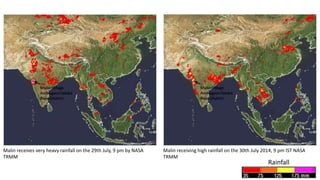
Malin receives very heavy rainfall on the 29th July, 9 pm by NASA
TRMM
Malin receiving high rainfall on the 30th July 2014, 9 pm IST NASA
TRMM
Rainfall
Mass movement events in the Himalaya: The impact of landslides
on Ladakh, India.
Case – Landslide Hazard Mitigation in Nilgiris district,
Tamil Nadu
• Severe to very high landslide hazard prone area
- (Building Materials and Technology Promotion Council (BMTPC), Government of India
• GSI and State Geology Branch of Government of Tamil Nadu studied 300 landslides
from 1978-1979 in the densely populated and developed area of 200 sq.km between
Ooty and Coonoor.
• OUTCOMES –
a. The main causes of landslides
b. The role played by excessive deforestation, obstruction to the normal
drainage channels and changes in land use were studies by the team.
From 10th to 15th November, 2009
Landslides/Landslips Lives lost Damage
1150 80
3785 huts damaged, parts
of railway and road line
damaged
Case – Landslide Hazard Mitigation in Nilgiris district,
Tamil Nadu
Issues identified by the study –
• The possibility of occurrence of
landslide will increase from 70% to
100% in the Next 10 – 20 years
• Urban areas where buildings are
constructed on or close to landslide
• Improper drainage system
• Lack of awareness
• No early warning system
Recommendations –
• Avoid further development in high-risk
landslide prone areas, limit existing-use rights
to rebuild, and limit the use of buildings
• As suggested by National Disaster
Management Authority (NDMA),
Government of India in the National Disaster
Management Guidelines for landslides, from
the funds available with the District Planning
and development Council in landslide prone
areas, a part will be allocated for the
implementation of landslide management
schemes in the Nilgiri district.
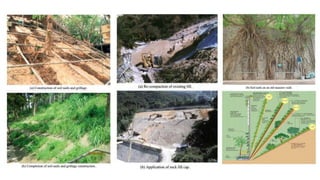
• Landslide Hazard Mitigation Through Cost
Effective Technology – Soil bio-engineering
Soil bio-engineering - the use of plant material,
living or dead, as building material to reduce
environmental problems such as shallow, rapid
landslides and eroding slopes and stream banks
Preventive Engineering Measures
• The main factors which contribute to landslides are Slope, water content, geological
structure, unconsolidated or loose sediments, lithology and human interference.
a) Slope: Retaining wall may be constructed against the slopes, which can prevents rolling
down of material. Terracing of the slope is an effective measure.
b) Effect of water: Make proper drainage network for quick removal of percolating moisture
or rain water by constructing ditches and water ways along the slope
c) Geological structures: Weak planes or zones may covered or grouted to prevent
percolation of water, this increases the compaction of loose material.
Source – International Council For Science, Science Plan for Hazards and disasters
NATIONAL DISASTER MANAGEMENT GUIDELINES, MANAGEMENT OF LANDSLIDES AND SNOW
AVALANCHES,
GOVERNMENT OF INDIA
Mission - To minimise the impact of landslides and snow avalanches on life, property
and economic activity
The following nine major areas have been identified for systematic and coordinated management of landslide
hazards:
• Landslide hazard, vulnerability, and risk assessment.
• Multi-hazard conceptualisation.
• Landslide remediation practice.
• Research and development; monitoring and early warning.
• Knowledge network and management.
• Capacity building and training.
• Public awareness and education.
• Emergency preparedness and response.
• Regulation and enforcement.
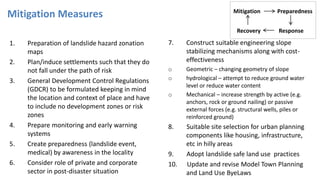
1. Preparation of landslide hazard zonation
maps
2. Plan/induce settlements such that they do
not fall under the path of risk
3. General Development Control Regulations
(GDCR) to be formulated keeping in mind
the location and context of place and have
to include no development zones or risk
zones
4. Prepare monitoring and early warning
systems
5. Create preparedness (landslide event,
medical) by awareness in the locality
6. Consider role of private and corporate
sector in post-disaster situation
Mitigation Measures
7. Construct suitable engineering slope
stabilizing mechanisms along with cost-
effectiveness
o Geometric – changing geometry of slope
o hydrological – attempt to reduce ground water
level or reduce water content
o Mechanical – increase strength by active (e.g.
anchors, rock or ground nailing) or passive
external forces (e.g. structural wells, piles or
reinforced ground)
8. Suitable site selection for urban planning
components like housing, infrastructure,
etc in hilly areas
9. Adopt landslide safe land use practices
10. Update and revise Model Town Planning
and Land Use ByeLaws
Mitigation Preparedness
ResponseRecovery
Landslide Hazard Zonation Map
1. Parameters for Slope Instability
1.Lithology
2.Structure
3.Slope Morphology
4.Relative Relief
5.Land Cover
6.Land Use
7.Hydrological Conditions
8.Slope Erosion
9.Rainfall
10.Landslide Activity
11.Material / Overburden Properties
12.Seismicity
2. Finally, prepare Landslide Hazard
Management Plan and hence publish
Landslide Atlas
3. Example of a corridor in Himachal
Pradesh -
Source - Defence Terrain Research Laboratory
References
• Landslide Mapping and Vulnerability Assessment, Defence Terrain Research
Laboratory
• International Journal of Environmental Science and Development, Vol. 3, No. 5,
October 2012, G. P. Ganapathy and C. L. Hada, Landslide Hazard Mitigation in the
Nilgiris District, India–Environmental and Societal Issues
• Dave Petley, American Geophysical Union, Vajont Conference, 2013
• www.agritech.tnau.ac.in/agriculture/agri_majorareas_disastermgt_landslide.html
• www.portal.gsi.gov.in/portal/page?_pageid=127,671647&_dad=portal&_schema=
PORTAL&1200
• www.prezi.com/agxieocrjbr4/mass-movement-management-case-studies-
definitions
• www.dnaindia.com
• www.sandrp.wordpress.com
Thank you

Disaster mitigation - land slide

  • 1.
    DISASTER MITIGATION LANDSLIDES SUBMITTED BY– JANUMI RATHOD PARTH SADARIA MASTERS OF URBAN AND REGIONAL PLANNING Department of Architecture, Faculty of Technology & Engineering The Maharaja Sayajirao University of Baroda, Vadodara, India SEPTEMBER 2015
  • 2.
    Understanding Disaster CRED (TheCentre for Research on the Epidemiology of Disasters) “A situation or event which overwhelms local capacity, necessitating a request to a national or international level for external assistance; an unforeseen and often sudden event that causes great damage, destruction and human suffering.” International Federation of Red Cross and Red Crescent Societies A disaster occurs when a hazard impacts on vulnerable people. (VULNERABILITY+ HAZARD ) / CAPACITY = DISASTER
  • 3.
    Natural Disasters –Categories, Types
  • 4.
    Mass Movements -Mass movements are massive failures of slope masses including rock, debris, soils and snow/ice that cause loss of life, economy, environment, land and natural resources, the main reason being gravity. TYPES Rock fall Landslide Avalanche Subsidence AGENTS/TRIGGERS – wind, air, water MOVEMENT – Slide, Flow, Rotate, Fall MATERIALS – Rock, Debris, earth
  • 5.
    Characteristics landslide landforms Soiland rock fragments slide down the slope The wet ground breaks up and falls down the hillside Rotational slide of loose materials or rock fragment The falling of a newly detached mass of rock from a cliff or down a very steep slope.Source - British Geological Survey and Eastern Illinois University
  • 6.
    Causes Man- made Causes •Excavation(particularly at the toe of slope) •Loading of slope crest •Draw -down (of reservoir) •Deforestation •Irrigation •Mining •Artificial vibrations •Water impoundment and leakage from utilities Physical Causes •Prolonged precipitation •Rapid draw- down •Earthquake •Volcanic eruption •Thawing •Shrink and swell •Artesian pressure Morphological Causes •Ground uplift (volcanic, tectonic etc) •Erosion (wind, water) •Scour Deposition loading in the slope crest •Vegetation removal (by forest fire, drought etc)
  • 7.
    Source - AmericanGeophysical Union, Nick Rosser Landslide Fatalities, 2007
  • 8.
    Existing large damsUN large dam database (2012) • Each red dot is a large dam on the database • Existing dams are concentrated in mountainous areas, but not in very high mountains Source - Dave Petley, American Geophysical Union, Vajont Conference, 2013
  • 9.
    Large dam densityUN large dam database (2012) • Contour map of the density of existing large dams Source - Dave Petley, American Geophysical Union, Vajont Conference, 2013
  • 10.
    Large dams andfatality-inducing landslide events (2004-2011) • The distribution of fatal landslides and large existing dams does not overlap, specifically in the Himalayas Source - Dave Petley, American Geophysical Union, Vajont Conference, 2013
  • 11.
    Distribution of landslidesassociated with large dams • Each dot is a landslide associated with a large dams in the period 2003-2012 • NOTE- Almost all are in Asia, Hotspots are in Himalayas and China Source - Dave Petley, American Geophysical Union, Vajont Conference, 2013
  • 12.
    Proposed dams anddam related landslides in Himalayan region • Dam: planned or under construction • Fatal landslide associated with a dam Source - Dave Petley, American Geophysical Union, Vajont Conference, 2013
  • 13.
    Scenario • Landslides rankthird in terms of number of deaths due to natural disasters. • Himalayan Landslides kill 1 person / 100 Km² / yr. • Estimated average losses due to landslides in Himalaya costs > Rs. 550 crores / yr. & > 200 deaths. • The hazard affects over 0.49 million km², over 15 % of our country's area Top countries affected by landslides
  • 14.
  • 16.
    Case study -Malin landslide-Pune – 30th July, 2014, 0300 hours Major causes (Geological Survey of India study) - Immediate trigger –  Intense rainfall - 10.8 cm (4 in) of rain on 29 July and continuing the next day Long term –  Agricultural practice –paddy cultivation, which required levelling of steep areas in the upslope, which contributed to instability  Deforestation  Large scale land use modifications  Construction activities – stone quarrying, etc.  1.5 km from Dimbhe dam Causalities –  more than 160 deaths • Malin village, Ambegaon Taluka, 110 km from Pune, West Maharashtra,
  • 18.
    Malin receives veryheavy rainfall on the 29th July, 9 pm by NASA TRMM Malin receiving high rainfall on the 30th July 2014, 9 pm IST NASA TRMM Rainfall
  • 19.
    Mass movement eventsin the Himalaya: The impact of landslides on Ladakh, India.
  • 20.
    Case – LandslideHazard Mitigation in Nilgiris district, Tamil Nadu • Severe to very high landslide hazard prone area - (Building Materials and Technology Promotion Council (BMTPC), Government of India • GSI and State Geology Branch of Government of Tamil Nadu studied 300 landslides from 1978-1979 in the densely populated and developed area of 200 sq.km between Ooty and Coonoor. • OUTCOMES – a. The main causes of landslides b. The role played by excessive deforestation, obstruction to the normal drainage channels and changes in land use were studies by the team. From 10th to 15th November, 2009 Landslides/Landslips Lives lost Damage 1150 80 3785 huts damaged, parts of railway and road line damaged
  • 21.
    Case – LandslideHazard Mitigation in Nilgiris district, Tamil Nadu Issues identified by the study – • The possibility of occurrence of landslide will increase from 70% to 100% in the Next 10 – 20 years • Urban areas where buildings are constructed on or close to landslide • Improper drainage system • Lack of awareness • No early warning system Recommendations – • Avoid further development in high-risk landslide prone areas, limit existing-use rights to rebuild, and limit the use of buildings • As suggested by National Disaster Management Authority (NDMA), Government of India in the National Disaster Management Guidelines for landslides, from the funds available with the District Planning and development Council in landslide prone areas, a part will be allocated for the implementation of landslide management schemes in the Nilgiri district. • Landslide Hazard Mitigation Through Cost Effective Technology – Soil bio-engineering Soil bio-engineering - the use of plant material, living or dead, as building material to reduce environmental problems such as shallow, rapid landslides and eroding slopes and stream banks
  • 22.
    Preventive Engineering Measures •The main factors which contribute to landslides are Slope, water content, geological structure, unconsolidated or loose sediments, lithology and human interference. a) Slope: Retaining wall may be constructed against the slopes, which can prevents rolling down of material. Terracing of the slope is an effective measure. b) Effect of water: Make proper drainage network for quick removal of percolating moisture or rain water by constructing ditches and water ways along the slope c) Geological structures: Weak planes or zones may covered or grouted to prevent percolation of water, this increases the compaction of loose material. Source – International Council For Science, Science Plan for Hazards and disasters
  • 24.
    NATIONAL DISASTER MANAGEMENTGUIDELINES, MANAGEMENT OF LANDSLIDES AND SNOW AVALANCHES, GOVERNMENT OF INDIA Mission - To minimise the impact of landslides and snow avalanches on life, property and economic activity The following nine major areas have been identified for systematic and coordinated management of landslide hazards: • Landslide hazard, vulnerability, and risk assessment. • Multi-hazard conceptualisation. • Landslide remediation practice. • Research and development; monitoring and early warning. • Knowledge network and management. • Capacity building and training. • Public awareness and education. • Emergency preparedness and response. • Regulation and enforcement.
  • 25.
    1. Preparation oflandslide hazard zonation maps 2. Plan/induce settlements such that they do not fall under the path of risk 3. General Development Control Regulations (GDCR) to be formulated keeping in mind the location and context of place and have to include no development zones or risk zones 4. Prepare monitoring and early warning systems 5. Create preparedness (landslide event, medical) by awareness in the locality 6. Consider role of private and corporate sector in post-disaster situation Mitigation Measures 7. Construct suitable engineering slope stabilizing mechanisms along with cost- effectiveness o Geometric – changing geometry of slope o hydrological – attempt to reduce ground water level or reduce water content o Mechanical – increase strength by active (e.g. anchors, rock or ground nailing) or passive external forces (e.g. structural wells, piles or reinforced ground) 8. Suitable site selection for urban planning components like housing, infrastructure, etc in hilly areas 9. Adopt landslide safe land use practices 10. Update and revise Model Town Planning and Land Use ByeLaws Mitigation Preparedness ResponseRecovery
  • 26.
    Landslide Hazard ZonationMap 1. Parameters for Slope Instability 1.Lithology 2.Structure 3.Slope Morphology 4.Relative Relief 5.Land Cover 6.Land Use 7.Hydrological Conditions 8.Slope Erosion 9.Rainfall 10.Landslide Activity 11.Material / Overburden Properties 12.Seismicity 2. Finally, prepare Landslide Hazard Management Plan and hence publish Landslide Atlas 3. Example of a corridor in Himachal Pradesh - Source - Defence Terrain Research Laboratory
  • 27.
    Source - DefenceTerrain Research Laboratory
  • 28.
    Source - DefenceTerrain Research Laboratory
  • 29.
    References • Landslide Mappingand Vulnerability Assessment, Defence Terrain Research Laboratory • International Journal of Environmental Science and Development, Vol. 3, No. 5, October 2012, G. P. Ganapathy and C. L. Hada, Landslide Hazard Mitigation in the Nilgiris District, India–Environmental and Societal Issues • Dave Petley, American Geophysical Union, Vajont Conference, 2013 • www.agritech.tnau.ac.in/agriculture/agri_majorareas_disastermgt_landslide.html • www.portal.gsi.gov.in/portal/page?_pageid=127,671647&_dad=portal&_schema= PORTAL&1200 • www.prezi.com/agxieocrjbr4/mass-movement-management-case-studies- definitions • www.dnaindia.com • www.sandrp.wordpress.com
  • 30.