“Ecological Footprint” as a Sustainability Indicator
                                          
                                  Presented by
                          Shahadat Hossain Shakil
                              Research Assistant
  BUET Climate Change Study Cell & Department of Urban and Regional Planning
          Bangladesh University of Engineering and Technology, Dhaka-1000


                                              National Research Conference – 2012
                             Organized by: Bangladesh Peace and Development Mission
                   In Association With: National Academy for Educational Management

                                                                                  1
Content


 Introduction

 Concepts and Definition of Ecological Footprint and Biocapacity

 Ecological Overshoot (Global and National Context)

 Ecological Footprint as a Sustainability Indicator


                                                                    2
Introduction

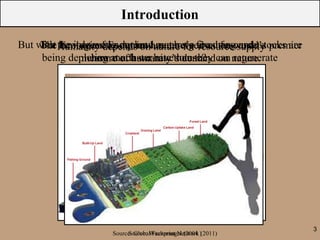
But with Humanity depends onhas emerged as the world’s premier
     The the increasing demand,much we fixed resource stocks are
     But how do we Footprint nature for are using supply
          Ecological know how nature’s resource and
     being depleting at offaster havethan they can nature.
               measure a humanity’s demand on regenerate
                 how much we rate to use?


                                          Demand = ?

                                          Supply = ?

                                          Deficit or
                                         Reserve = ?


                                                                   3
                     Source: Global Footprint Network )(2011)
                          Source: Wackernagel (2004
Introduction (cont...)

Ecological Footprint
- is a Resource Accounting Tool for the Ecological Resources
- developed in 1990 by Mathis Wackernagel and William Rees
- has been started to be used as a tool of measuring sustainability in the
developed countries from the last decade.
for example: UK – Cardiff, 2005 ; Canada - Calgary, 2007 ;
                     Australia – Victoria, 2008; USA - Minnesota, 2010
- UNDP recently began including the Ecological Footprint in its annual
Human Development Report

Source: Global Footprint Network (2011)                                      4
Concepts and Definition


Footprint accounts are divided into two parts:

- Ecological supply (Bioproductive Area or Biocapacity) and

- Human demand on nature (Ecological Footprint)


                                                              5
Ecological Footprint
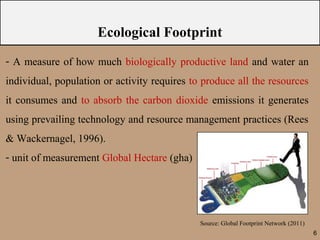
- A measure of how much biologically productive land and water an
individual, population or activity requires to produce all the resources
it consumes and to absorb the carbon dioxide emissions it generates
using prevailing technology and resource management practices (Rees
& Wackernagel, 1996).
- unit of measurement Global Hectare (gha)


                                              Source: Global Footprint Network (2011)
                                                                                        6
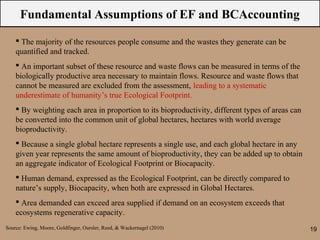
Footprint Components

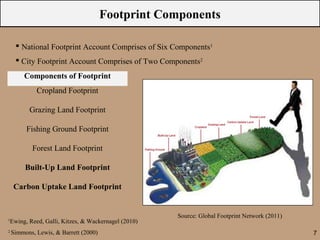
       National Footprint Account Comprises of Six Components1
       City Footprint Account Comprises of Two Components2
         Components of Footprint
              Cropland Footprint

           Grazing Land Footprint

          Fishing Ground Footprint

            Forest Land Footprint

         Built-Up Land Footprint

     Carbon Uptake Land Footprint


                                                       Source: Global Footprint Network (2011)
1
    Ewing, Reed, Galli, Kitzes, & Wackernagel (2010)
2
    Simmons, Lewis, & Barrett (2000)                                                             7
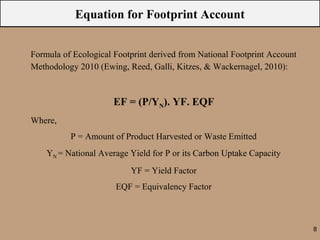
Equation for Footprint Account


Formula of Ecological Footprint derived from National Footprint Account
Methodology 2010 (Ewing, Reed, Galli, Kitzes, & Wackernagel, 2010):


                      EF = (P/YN). YF. EQF
Where,
          P = Amount of Product Harvested or Waste Emitted
    YN = National Average Yield for P or its Carbon Uptake Capacity
                          YF = Yield Factor
                      EQF = Equivalency Factor


                                                                          8
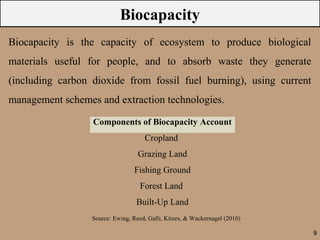
Biocapacity
Biocapacity is the capacity of ecosystem to produce biological
materials useful for people, and to absorb waste they generate
(including carbon dioxide from fossil fuel burning), using current
management schemes and extraction technologies.

                  Components of Biocapacity Account
                                     Cropland
                                   Grazing Land
                                 Fishing Ground
                                    Forest Land
                                  Built-Up Land
                  Source: Ewing, Reed, Galli, Kitzes, & Wackernagel (2010)

                                                                             9
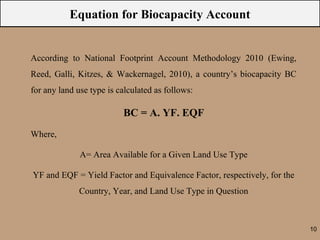
Equation for Biocapacity Account


According to National Footprint Account Methodology 2010 (Ewing,
Reed, Galli, Kitzes, & Wackernagel, 2010), a country’s biocapacity BC
for any land use type is calculated as follows:

                          BC = A. YF. EQF
Where,

              A= Area Available for a Given Land Use Type

YF and EQF = Yield Factor and Equivalence Factor, respectively, for the
              Country, Year, and Land Use Type in Question


                                                                          10
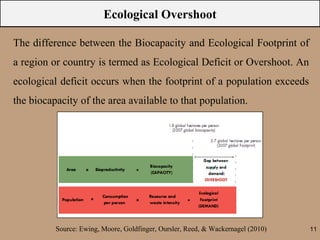
Ecological Overshoot

The difference between the Biocapacity and Ecological Footprint of
a region or country is termed as Ecological Deficit or Overshoot. An
ecological deficit occurs when the footprint of a population exceeds
the biocapacity of the area available to that population.


          Source: Ewing, Moore, Goldfinger, Oursler, Reed, & Wackernagel (2010)   11
Global context

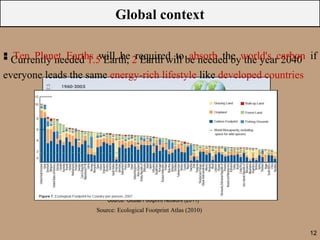
 Currently needed 1.5 Earth, 2required to be needed byworld's carbon if
 Ten Planet Earths will be Earth will absorb the the year 2040
everyone leads the same energy-rich lifestyle like developed countries


                         Source: Global Footprint Network (2011)
                     Source: Ecological Footprint Atlas (2010)


                                                                         12
Why Ecological Footprint is a
                Sustainability Indicator ?
 Ecological Footprint attempts to answer one central sustainability question: “How
much of the bioproductive capacity of the biosphere is used by human activities?”
 Such a measure of the supply and human demand on natural capital is
indispensable for tracking progress, setting targets and driving policies for
sustainability.
 Ecological footprint accounts allow governments to track a city or region’s
demand on natural capital and to compare this demand with the amount of natural
capital actually available.
 Ecological footprint figure confirms us about the degree of sustainability of our
lifestyle from the environmental perspective.
 It illustrates whether we are on right track by maintaining the balance or we are
living on ecological credits, borrowing resources from our future generations.
 Unit of measurement gha/capita is very effective to personalize sustainability

                                                                                      13
Bangladesh Context


 Lowest National Footprint in Global Context but in prominent cities

unsustainable urban development causes destruction of natural resource

 Capital Dhaka is unplanned and unsustainable in terms of resource use


    Dhaka city’s Ecological Footprint figure can be effectively used
                                  for
                Sustainable Planning and Development


                                                                         14
References
Ewing, B., Moore, D., Goldfinger, S., Oursler, A., Reed, A., & Wackernagel, M. (2010). Ecological Footprint Atlas 2010.
      Oakland: Global Footprint Network.
Ewing, B., Reed, A., Galli, A., Kitzes, J., & Wackernagel, M. (2010). Calculation Methodology for the National Footprint
      Accoounts, 2010 Edition. Oakland: Global Footprint Network.
Global Footprint Network. (2011). Foorprint Basics-Overview. Retrieved May 10, 2011, from Global Footprint Network :
      Advancing the Science of Sustainability:
      http://www.footprintnetwork.org/en/index.php/GFN/page/footprint_basics_overview/
Global Footprint Network. (2011). Footprint For Cities . Retrieved May 10, 2011, from Global Footprint Network :
      Advancing the Science of Sustainability :
      http://www.footprintnetwork.org/en/index.php/GFN/page/footprint_for_cities/
Global Footprint Network. (2011). Glossary. Retrieved May 10, 2011, from Global Footprint Network : Advancing the
      Science of Sustainability: http://www.footprintnetwork.org/en/index.php/GFN/

McIntyre, S. A., & Peters, H. M. (2007, June 26). The Ecological Footprint of Utah. Retrieved April 4, 2011, from Utah
      Vital Sign: http://www.utahpop.org/vitalsigns/research/report_2007.htm
WWF. (2010). Living Planet Report 2010. Switzerland: World Wide Fund For Nature International.
Xu, S., & Martin, I. S. (2010). Ecological Footprint for The Twin Cities: Impacts of the Consumption in the 7-County Metro
      Area. Minneapolis: Metropolitan Design Centre, College of Design, University of Minnesota.
                                                                                                                          15
Thanks for your patience….


                         16
Definition of Ecological Footprint Components
Crop Land                                Calculated from the area used to produce food and fiber for human
                                         consumption, feed for livestock, oil crops and rubber

Grazing Land                             Calculated from the area used to raise livestock for meat, dairy, hide
                                         and wool products

Forest land                              Calculated from the amount of lumber, pulp, timber products and fuel
                                         wood consumed by a country each year

Fishing Grounds                          Calculated from the estimated primary production required to support
                                         the fish and seafood caught, based on catch data for 1,439 different
                                         marine species and more than 268 freshwater species

Carbon Uptake Land                       Calculated as the amount of forest land required to absorb CO 2
                                         emissions from burning fossil fuels, land-use change and chemical
                                         processes, other than the portion absorbed by oceans

Built-up-Land                            Calculated from the area of land covered by human infrastructure,
                                         including transportation, housing, industrial structures, and reservoirs
                                         for hydropower

Source: WWF. (2010). Living Planet Report 2010. Switzerland: WWF (World Wide Fund For Nature) International.
                                                                                                                    17
Ecological Footprint Components


Source: WWF. (2010). Living Planet Report 2010. Switzerland: WWF (World Wide Fund For Nature) International.
                                                                                                               18
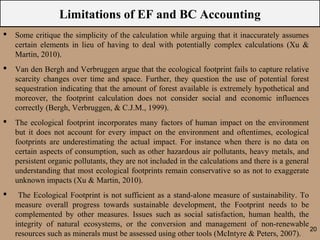
Fundamental Assumptions of EF and BCAccounting

     The majority of the resources people consume and the wastes they generate can be
    quantified and tracked.
     An important subset of these resource and waste flows can be measured in terms of the
    biologically productive area necessary to maintain flows. Resource and waste flows that
    cannot be measured are excluded from the assessment, leading to a systematic
    underestimate of humanity’s true Ecological Footprint.
     By weighting each area in proportion to its bioproductivity, different types of areas can
    be converted into the common unit of global hectares, hectares with world average
    bioproductivity.
     Because a single global hectare represents a single use, and each global hectare in any
    given year represents the same amount of bioproductivity, they can be added up to obtain
    an aggregate indicator of Ecological Footprint or Biocapacity.
     Human demand, expressed as the Ecological Footprint, can be directly compared to
    nature’s supply, Biocapacity, when both are expressed in Global Hectares.
     Area demanded can exceed area supplied if demand on an ecosystem exceeds that
    ecosystems regenerative capacity.
Source: Ewing, Moore, Goldfinger, Oursler, Reed, & Wackernagel (2010)                             19
Limitations of EF and BC Accounting
   Some critique the simplicity of the calculation while arguing that it inaccurately assumes
    certain elements in lieu of having to deal with potentially complex calculations (Xu &
    Martin, 2010).
   Van den Bergh and Verbruggen argue that the ecological footprint fails to capture relative
    scarcity changes over time and space. Further, they question the use of potential forest
    sequestration indicating that the amount of forest available is extremely hypothetical and
    moreover, the footprint calculation does not consider social and economic influences
    correctly (Bergh, Verbruggen, & C.J.M., 1999).
   The ecological footprint incorporates many factors of human impact on the environment
    but it does not account for every impact on the environment and oftentimes, ecological
    footprints are underestimating the actual impact. For instance when there is no data on
    certain aspects of consumption, such as other hazardous air pollutants, heavy metals, and
    persistent organic pollutants, they are not included in the calculations and there is a general
    understanding that most ecological footprints remain conservative so as not to exaggerate
    unknown impacts (Xu & Martin, 2010).
    The Ecological Footprint is not sufficient as a stand-alone measure of sustainability. To
    measure overall progress towards sustainable development, the Footprint needs to be
    complemented by other measures. Issues such as social satisfaction, human health, the
    integrity of natural ecosystems, or the conversion and management of non-renewable
                                                                                               20
    resources such as minerals must be assessed using other tools (McIntyre & Peters, 2007).
Limitations of EF and BC Accounting
 The footprint and biocapacity accounts also do not directly account for freshwater use and
availability, since withdrawal of a cubic meter of freshwater affects biocapacity differently
depending on local conditions. Removing one cubic meter from a wet area may make little
difference to the local environment, while in arid areas every cubic meter removed can directly
compromise ecosystem production (Ewing, Reed, Galli, Kitzes, & Wackernagel, 2010).

 Also, while the Footprint analysis measures biocapacity, it does not determine how much of
the total biocapacity is available to meet non-human demand. For example, if humans consume
100% of the Earth’s biocapacity, then there is nothing remaining to support wildlife. The
Footprint does not consider how much biodiversity is essential for human life on this planet.
The methodology is therefore fundamentally anthropocentric (McIntyre & Peters, 2007).

 Finally, it is important to remember that the Ecological Footprint is only a snapshot in time.
The Footprint Accounts are based on the actual consumption and production data reported by
United Nations statistical agencies for a specified year. They reflect the analyzed year’s
consumption, land management and harvesting practices, without a forecast of future
technologies, energy supply mixes, consumption patterns, or changes in land management
practices, all of which will affect the Footprint in future years (McIntyre & Peters, 2007).


                                                                                                   21
Sequestration Factor

 Processes that remove CO2 from the atmosphere

 Used for conversion of CO2 values back into land areas needed


 1.6175 tons-C/ha-yr (GFN,2005)

Source: Global Footprint Network, 2011


                                                                  22
Equivalency Factor
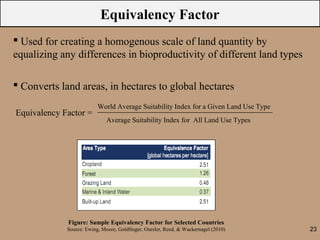
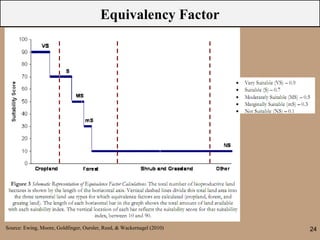
 Used for creating a homogenous scale of land quantity by
equalizing any differences in bioproductivity of different land types

 Converts land areas, in hectares to global hectares
                          World Average Suitability Index for a Given Land Use Type
Equivalency Factor =
                              Average Suitability Index for All Land Use Types


             Figure: Sample Equivalency Factor for Selected Countries
             Source: Ewing, Moore, Goldfinger, Oursler, Reed, & Wackernagel (2010)    23
Equivalency Factor


Source: Ewing, Moore, Goldfinger, Oursler, Reed, & Wackernagel (2010)   24
Yield Factor

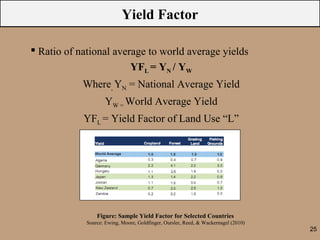
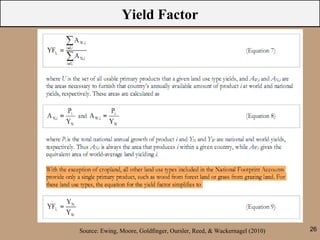
 Ratio of national average to world average yields
                                YFL = YN / YW
            Where, YN = National Average Yield
                     YW = World Average Yield
            YFL = Yield Factor of Land Use “L”


                 Figure: Sample Yield Factor for Selected Countries
             Source: Ewing, Moore, Goldfinger, Oursler, Reed, & Wackernagel (2010)
                                                                                     25
Yield Factor


Source: Ewing, Moore, Goldfinger, Oursler, Reed, & Wackernagel (2010)   26
Global Hectare

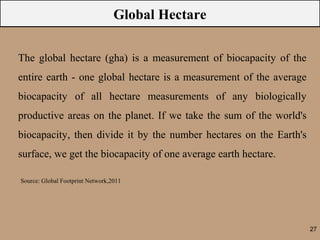
The global hectare (gha) is a measurement of biocapacity of the
entire earth - one global hectare is a measurement of the average
biocapacity of all hectare measurements of any biologically
productive areas on the planet. If we take the sum of the world's
biocapacity, then divide it by the number hectares on the Earth's
surface, we get the biocapacity of one average earth hectare.

Source: Global Footprint Network,2011


                                                                    27
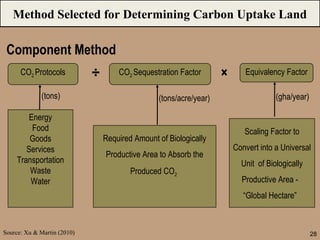
Method Selected for Determining Carbon Uptake Land

 Component Method
      CO2 Protocols          ÷       CO2 Sequestration Factor       ×      Equivalency Factor

             (tons)                              (tons/acre/year)                    (gha/year)

         Energy
          Food                                                             Scaling Factor to
         Goods                   Required Amount of Biologically
        Services                                                        Convert into a Universal
                                 Productive Area to Absorb the
     Transportation                                                       Unit of Biologically
         Waste                           Produced CO2
         Water                                                            Productive Area -
                                                                           “Global Hectare”


Source: Xu & Martin (2010)                                                                        28

Ecological Footprint as a Sustainability Indicator

  • 1.
    “Ecological Footprint” asa Sustainability Indicator   Presented by Shahadat Hossain Shakil Research Assistant BUET Climate Change Study Cell & Department of Urban and Regional Planning Bangladesh University of Engineering and Technology, Dhaka-1000 National Research Conference – 2012 Organized by: Bangladesh Peace and Development Mission In Association With: National Academy for Educational Management 1
  • 2.
    Content  Introduction  Conceptsand Definition of Ecological Footprint and Biocapacity  Ecological Overshoot (Global and National Context)  Ecological Footprint as a Sustainability Indicator 2
  • 3.
    Introduction But with Humanitydepends onhas emerged as the world’s premier The the increasing demand,much we fixed resource stocks are But how do we Footprint nature for are using supply Ecological know how nature’s resource and being depleting at offaster havethan they can nature. measure a humanity’s demand on regenerate how much we rate to use? Demand = ? Supply = ? Deficit or Reserve = ? 3 Source: Global Footprint Network )(2011) Source: Wackernagel (2004
  • 4.
    Introduction (cont...) Ecological Footprint -is a Resource Accounting Tool for the Ecological Resources - developed in 1990 by Mathis Wackernagel and William Rees - has been started to be used as a tool of measuring sustainability in the developed countries from the last decade. for example: UK – Cardiff, 2005 ; Canada - Calgary, 2007 ; Australia – Victoria, 2008; USA - Minnesota, 2010 - UNDP recently began including the Ecological Footprint in its annual Human Development Report Source: Global Footprint Network (2011) 4
  • 5.
    Concepts and Definition Footprintaccounts are divided into two parts: - Ecological supply (Bioproductive Area or Biocapacity) and - Human demand on nature (Ecological Footprint) 5
  • 6.
    Ecological Footprint - Ameasure of how much biologically productive land and water an individual, population or activity requires to produce all the resources it consumes and to absorb the carbon dioxide emissions it generates using prevailing technology and resource management practices (Rees & Wackernagel, 1996). - unit of measurement Global Hectare (gha) Source: Global Footprint Network (2011) 6
  • 7.
    Footprint Components  National Footprint Account Comprises of Six Components1  City Footprint Account Comprises of Two Components2 Components of Footprint Cropland Footprint Grazing Land Footprint Fishing Ground Footprint Forest Land Footprint Built-Up Land Footprint Carbon Uptake Land Footprint Source: Global Footprint Network (2011) 1 Ewing, Reed, Galli, Kitzes, & Wackernagel (2010) 2 Simmons, Lewis, & Barrett (2000) 7
  • 8.
    Equation for FootprintAccount Formula of Ecological Footprint derived from National Footprint Account Methodology 2010 (Ewing, Reed, Galli, Kitzes, & Wackernagel, 2010): EF = (P/YN). YF. EQF Where, P = Amount of Product Harvested or Waste Emitted YN = National Average Yield for P or its Carbon Uptake Capacity YF = Yield Factor EQF = Equivalency Factor 8
  • 9.
    Biocapacity Biocapacity is thecapacity of ecosystem to produce biological materials useful for people, and to absorb waste they generate (including carbon dioxide from fossil fuel burning), using current management schemes and extraction technologies. Components of Biocapacity Account Cropland Grazing Land Fishing Ground Forest Land Built-Up Land Source: Ewing, Reed, Galli, Kitzes, & Wackernagel (2010) 9
  • 10.
    Equation for BiocapacityAccount According to National Footprint Account Methodology 2010 (Ewing, Reed, Galli, Kitzes, & Wackernagel, 2010), a country’s biocapacity BC for any land use type is calculated as follows: BC = A. YF. EQF Where, A= Area Available for a Given Land Use Type YF and EQF = Yield Factor and Equivalence Factor, respectively, for the Country, Year, and Land Use Type in Question 10
  • 11.
    Ecological Overshoot The differencebetween the Biocapacity and Ecological Footprint of a region or country is termed as Ecological Deficit or Overshoot. An ecological deficit occurs when the footprint of a population exceeds the biocapacity of the area available to that population. Source: Ewing, Moore, Goldfinger, Oursler, Reed, & Wackernagel (2010) 11
  • 12.
    Global context  Currentlyneeded 1.5 Earth, 2required to be needed byworld's carbon if  Ten Planet Earths will be Earth will absorb the the year 2040 everyone leads the same energy-rich lifestyle like developed countries Source: Global Footprint Network (2011) Source: Ecological Footprint Atlas (2010) 12
  • 13.
    Why Ecological Footprintis a Sustainability Indicator ?  Ecological Footprint attempts to answer one central sustainability question: “How much of the bioproductive capacity of the biosphere is used by human activities?”  Such a measure of the supply and human demand on natural capital is indispensable for tracking progress, setting targets and driving policies for sustainability.  Ecological footprint accounts allow governments to track a city or region’s demand on natural capital and to compare this demand with the amount of natural capital actually available.  Ecological footprint figure confirms us about the degree of sustainability of our lifestyle from the environmental perspective.  It illustrates whether we are on right track by maintaining the balance or we are living on ecological credits, borrowing resources from our future generations.  Unit of measurement gha/capita is very effective to personalize sustainability 13
  • 14.
    Bangladesh Context  LowestNational Footprint in Global Context but in prominent cities unsustainable urban development causes destruction of natural resource  Capital Dhaka is unplanned and unsustainable in terms of resource use Dhaka city’s Ecological Footprint figure can be effectively used for Sustainable Planning and Development 14
  • 15.
    References Ewing, B., Moore,D., Goldfinger, S., Oursler, A., Reed, A., & Wackernagel, M. (2010). Ecological Footprint Atlas 2010. Oakland: Global Footprint Network. Ewing, B., Reed, A., Galli, A., Kitzes, J., & Wackernagel, M. (2010). Calculation Methodology for the National Footprint Accoounts, 2010 Edition. Oakland: Global Footprint Network. Global Footprint Network. (2011). Foorprint Basics-Overview. Retrieved May 10, 2011, from Global Footprint Network : Advancing the Science of Sustainability: http://www.footprintnetwork.org/en/index.php/GFN/page/footprint_basics_overview/ Global Footprint Network. (2011). Footprint For Cities . Retrieved May 10, 2011, from Global Footprint Network : Advancing the Science of Sustainability : http://www.footprintnetwork.org/en/index.php/GFN/page/footprint_for_cities/ Global Footprint Network. (2011). Glossary. Retrieved May 10, 2011, from Global Footprint Network : Advancing the Science of Sustainability: http://www.footprintnetwork.org/en/index.php/GFN/ McIntyre, S. A., & Peters, H. M. (2007, June 26). The Ecological Footprint of Utah. Retrieved April 4, 2011, from Utah Vital Sign: http://www.utahpop.org/vitalsigns/research/report_2007.htm WWF. (2010). Living Planet Report 2010. Switzerland: World Wide Fund For Nature International. Xu, S., & Martin, I. S. (2010). Ecological Footprint for The Twin Cities: Impacts of the Consumption in the 7-County Metro Area. Minneapolis: Metropolitan Design Centre, College of Design, University of Minnesota. 15
  • 16.
    Thanks for yourpatience…. 16
  • 17.
    Definition of EcologicalFootprint Components Crop Land Calculated from the area used to produce food and fiber for human consumption, feed for livestock, oil crops and rubber Grazing Land Calculated from the area used to raise livestock for meat, dairy, hide and wool products Forest land Calculated from the amount of lumber, pulp, timber products and fuel wood consumed by a country each year Fishing Grounds Calculated from the estimated primary production required to support the fish and seafood caught, based on catch data for 1,439 different marine species and more than 268 freshwater species Carbon Uptake Land Calculated as the amount of forest land required to absorb CO 2 emissions from burning fossil fuels, land-use change and chemical processes, other than the portion absorbed by oceans Built-up-Land Calculated from the area of land covered by human infrastructure, including transportation, housing, industrial structures, and reservoirs for hydropower Source: WWF. (2010). Living Planet Report 2010. Switzerland: WWF (World Wide Fund For Nature) International. 17
  • 18.
    Ecological Footprint Components Source:WWF. (2010). Living Planet Report 2010. Switzerland: WWF (World Wide Fund For Nature) International. 18
  • 19.
    Fundamental Assumptions ofEF and BCAccounting  The majority of the resources people consume and the wastes they generate can be quantified and tracked.  An important subset of these resource and waste flows can be measured in terms of the biologically productive area necessary to maintain flows. Resource and waste flows that cannot be measured are excluded from the assessment, leading to a systematic underestimate of humanity’s true Ecological Footprint.  By weighting each area in proportion to its bioproductivity, different types of areas can be converted into the common unit of global hectares, hectares with world average bioproductivity.  Because a single global hectare represents a single use, and each global hectare in any given year represents the same amount of bioproductivity, they can be added up to obtain an aggregate indicator of Ecological Footprint or Biocapacity.  Human demand, expressed as the Ecological Footprint, can be directly compared to nature’s supply, Biocapacity, when both are expressed in Global Hectares.  Area demanded can exceed area supplied if demand on an ecosystem exceeds that ecosystems regenerative capacity. Source: Ewing, Moore, Goldfinger, Oursler, Reed, & Wackernagel (2010) 19
  • 20.
    Limitations of EFand BC Accounting  Some critique the simplicity of the calculation while arguing that it inaccurately assumes certain elements in lieu of having to deal with potentially complex calculations (Xu & Martin, 2010).  Van den Bergh and Verbruggen argue that the ecological footprint fails to capture relative scarcity changes over time and space. Further, they question the use of potential forest sequestration indicating that the amount of forest available is extremely hypothetical and moreover, the footprint calculation does not consider social and economic influences correctly (Bergh, Verbruggen, & C.J.M., 1999).  The ecological footprint incorporates many factors of human impact on the environment but it does not account for every impact on the environment and oftentimes, ecological footprints are underestimating the actual impact. For instance when there is no data on certain aspects of consumption, such as other hazardous air pollutants, heavy metals, and persistent organic pollutants, they are not included in the calculations and there is a general understanding that most ecological footprints remain conservative so as not to exaggerate unknown impacts (Xu & Martin, 2010).  The Ecological Footprint is not sufficient as a stand-alone measure of sustainability. To measure overall progress towards sustainable development, the Footprint needs to be complemented by other measures. Issues such as social satisfaction, human health, the integrity of natural ecosystems, or the conversion and management of non-renewable 20 resources such as minerals must be assessed using other tools (McIntyre & Peters, 2007).
  • 21.
    Limitations of EFand BC Accounting  The footprint and biocapacity accounts also do not directly account for freshwater use and availability, since withdrawal of a cubic meter of freshwater affects biocapacity differently depending on local conditions. Removing one cubic meter from a wet area may make little difference to the local environment, while in arid areas every cubic meter removed can directly compromise ecosystem production (Ewing, Reed, Galli, Kitzes, & Wackernagel, 2010).  Also, while the Footprint analysis measures biocapacity, it does not determine how much of the total biocapacity is available to meet non-human demand. For example, if humans consume 100% of the Earth’s biocapacity, then there is nothing remaining to support wildlife. The Footprint does not consider how much biodiversity is essential for human life on this planet. The methodology is therefore fundamentally anthropocentric (McIntyre & Peters, 2007).  Finally, it is important to remember that the Ecological Footprint is only a snapshot in time. The Footprint Accounts are based on the actual consumption and production data reported by United Nations statistical agencies for a specified year. They reflect the analyzed year’s consumption, land management and harvesting practices, without a forecast of future technologies, energy supply mixes, consumption patterns, or changes in land management practices, all of which will affect the Footprint in future years (McIntyre & Peters, 2007). 21
  • 22.
    Sequestration Factor  Processesthat remove CO2 from the atmosphere  Used for conversion of CO2 values back into land areas needed  1.6175 tons-C/ha-yr (GFN,2005) Source: Global Footprint Network, 2011 22
  • 23.
    Equivalency Factor  Usedfor creating a homogenous scale of land quantity by equalizing any differences in bioproductivity of different land types  Converts land areas, in hectares to global hectares World Average Suitability Index for a Given Land Use Type Equivalency Factor = Average Suitability Index for All Land Use Types Figure: Sample Equivalency Factor for Selected Countries Source: Ewing, Moore, Goldfinger, Oursler, Reed, & Wackernagel (2010) 23
  • 24.
    Equivalency Factor Source: Ewing,Moore, Goldfinger, Oursler, Reed, & Wackernagel (2010) 24
  • 25.
    Yield Factor  Ratioof national average to world average yields YFL = YN / YW Where, YN = National Average Yield YW = World Average Yield YFL = Yield Factor of Land Use “L” Figure: Sample Yield Factor for Selected Countries Source: Ewing, Moore, Goldfinger, Oursler, Reed, & Wackernagel (2010) 25
  • 26.
    Yield Factor Source: Ewing,Moore, Goldfinger, Oursler, Reed, & Wackernagel (2010) 26
  • 27.
    Global Hectare The globalhectare (gha) is a measurement of biocapacity of the entire earth - one global hectare is a measurement of the average biocapacity of all hectare measurements of any biologically productive areas on the planet. If we take the sum of the world's biocapacity, then divide it by the number hectares on the Earth's surface, we get the biocapacity of one average earth hectare. Source: Global Footprint Network,2011 27
  • 28.
    Method Selected forDetermining Carbon Uptake Land Component Method CO2 Protocols ÷ CO2 Sequestration Factor × Equivalency Factor (tons) (tons/acre/year) (gha/year) Energy Food Scaling Factor to Goods Required Amount of Biologically Services Convert into a Universal Productive Area to Absorb the Transportation Unit of Biologically Waste Produced CO2 Water Productive Area - “Global Hectare” Source: Xu & Martin (2010) 28