Disaster Management Dr. Gopalrao, M.D. Ph.D. Professor & Head, Community Medicine Deptt.
Definition Any occurrence that causes damage, ecological disruption, loss of human life or deterioration of health and health services on a scale sufficient to warrant extraordinary response from outside the affected community or area.
Types of Disasters Earth quakes. Land slides. Volcanic eruptions. Tsunamis. Tidal waves. Floods. Snow storms.
Continued…. Manmade Disasters . Wars: Conventional, nuclear, chemical & biological. . Famines.   Fires. Toxicological accidents. Nuclear accidents.
Some recent disasters ….. Earthquake in Pakistan – 2005 Earthquake and tsunami in the Indian coast - 2004  Gujarat Earthquake - 2001  Floods in Mumbai, West Bengal Cyclone: Rita, Wilma etc….. Fire: Kumbakonam, Dabewali Terrorist attack: Chechnya And the list goes on and on……………
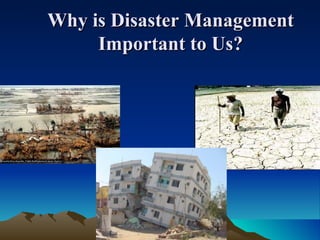
Why is Disaster Management Important to Us?
57% of the land area is prone to Earthquakes 12% to Floods 8% to Cyclones 70% of the cultivable land is prone to drought 85% of the land area is vulnerable to number of natural hazards 22 states are prone to multiple hazards.
Fig: 2.1.6
 
 
Impact of a disaster Mortality: Always very high in the absence of preparedness. Morbidity: Injuries, situation specific. Emotional stress. Emergence of epidemics. Increase in indigenous diseases.
Management Techniques Disaster impact and response. Relief phase. Epidemiologic surveillance & disease control. Vaccination. Nutrition. Rehabilitation.
Disaster impact & response Search, rescue and first aid. Field care. Triage. Tagging of casualties. Identification of the dead.
Relief phase The relief operations will depend on:- A) The type of disaster and it’s magnitude. B) The type and quantity of supplies  available locally. Most critical supplies in the initial emergency phase:- Food, blankets, clothing, shelter, sanitary engineering equipments.
Thank You Email: drgsj123@gmail.com

Disaster management

  • 1.
    Disaster Management Dr.Gopalrao, M.D. Ph.D. Professor & Head, Community Medicine Deptt.
  • 2.
    Definition Any occurrencethat causes damage, ecological disruption, loss of human life or deterioration of health and health services on a scale sufficient to warrant extraordinary response from outside the affected community or area.
  • 3.
    Types of DisastersEarth quakes. Land slides. Volcanic eruptions. Tsunamis. Tidal waves. Floods. Snow storms.
  • 4.
    Continued…. Manmade Disasters. Wars: Conventional, nuclear, chemical & biological. . Famines. Fires. Toxicological accidents. Nuclear accidents.
  • 5.
    Some recent disasters….. Earthquake in Pakistan – 2005 Earthquake and tsunami in the Indian coast - 2004 Gujarat Earthquake - 2001 Floods in Mumbai, West Bengal Cyclone: Rita, Wilma etc….. Fire: Kumbakonam, Dabewali Terrorist attack: Chechnya And the list goes on and on……………
  • 6.
    Why is DisasterManagement Important to Us?
  • 7.
    57% of theland area is prone to Earthquakes 12% to Floods 8% to Cyclones 70% of the cultivable land is prone to drought 85% of the land area is vulnerable to number of natural hazards 22 states are prone to multiple hazards.
  • 8.
  • 9.
  • 10.
  • 11.
    Impact of adisaster Mortality: Always very high in the absence of preparedness. Morbidity: Injuries, situation specific. Emotional stress. Emergence of epidemics. Increase in indigenous diseases.
  • 12.
    Management Techniques Disasterimpact and response. Relief phase. Epidemiologic surveillance & disease control. Vaccination. Nutrition. Rehabilitation.
  • 13.
    Disaster impact &response Search, rescue and first aid. Field care. Triage. Tagging of casualties. Identification of the dead.
  • 14.
    Relief phase Therelief operations will depend on:- A) The type of disaster and it’s magnitude. B) The type and quantity of supplies available locally. Most critical supplies in the initial emergency phase:- Food, blankets, clothing, shelter, sanitary engineering equipments.
  • 15.
    Thank You Email:drgsj123@gmail.com