RASHID.NS
S5 CT
ROLL NO:47
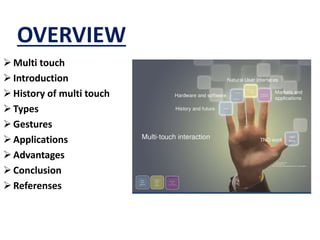
OVERVIEW
Multi touch
Introduction
History of multi touch
Types
Gestures
Applications
Advantages
Conclusion
Referenses
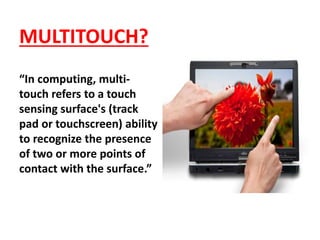
MULTITOUCH?
“In computing, multi-
touch refers to a touch
sensing surface's (track
pad or touchscreen) ability
to recognize the presence
of two or more points of
contact with the surface.”
Introduction
• Multi-touch technology presents a wide
range of new opportunities for interaction
with graphical user interfaces, allowing
expressive gestural control and fluid multi-
user collaboration through relatively simple
and inexpensive hardware and software
configurations.
•Multi-touch technology dates back to 1982, when the
University of Toronto developed the first finger pressure
multi-touch.
•In 1984 Bell Labs engineered a multi-touch screen that
could manipulate images with more than one hand.
•In1991 Wellner published a paper on his multi-touch
“Digital Desk”, which supported multi-finger and pinching
motions.
History of Multi Touch…
Types
a) Capacitive Touch Technologies
b) Resistive Touch Technologies
c) Optical Touch Technologies
d) Infrared Technologies
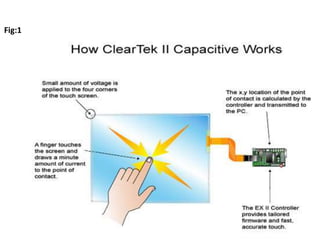
Capacitive Touch Screen Technology
A capacitive touch screen consists of a glass panel with a capacitive
(charge storing) material coating its surface. Circuits located at
corners of the screen measure the capacitance of a person touching
the overlay.
Eg:(fig:1)
Fig:1
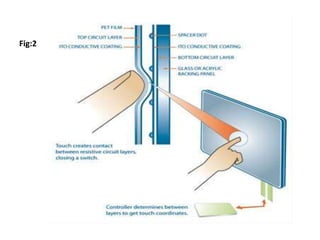
Resistive Touch Screen Technology
Resistive touch screen technology consists of a glass panel that is
coated with electrically conductive and resistive layers.
The thin layers are separated by invisible separator dots. When
operating, an electrical current moves through the screen. When
pressure is applied to the screen the layers are pressed together,
causing a change in the electrical current and a touch is registered.
Eg:(fig:2)
Fig:2
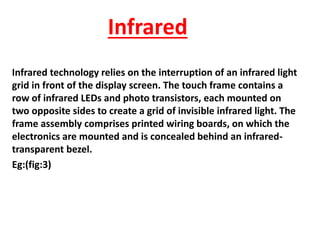
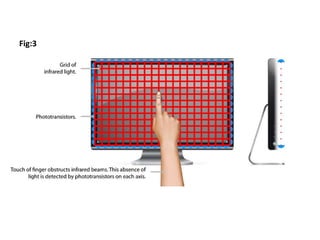
Infrared
Infrared technology relies on the interruption of an infrared light
grid in front of the display screen. The touch frame contains a
row of infrared LEDs and photo transistors, each mounted on
two opposite sides to create a grid of invisible infrared light. The
frame assembly comprises printed wiring boards, on which the
electronics are mounted and is concealed behind an infrared-
transparent bezel.
Eg:(fig:3)
Fig:3
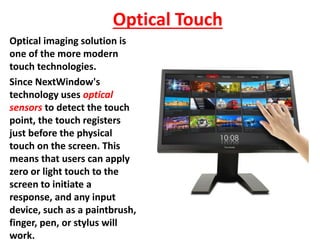
Optical Touch
Optical imaging solution is
one of the more modern
touch technologies.
Since NextWindow's
technology uses optical
sensors to detect the touch
point, the touch registers
just before the physical
touch on the screen. This
means that users can apply
zero or light touch to the
screen to initiate a
response, and any input
device, such as a paintbrush,
finger, pen, or stylus will
work.
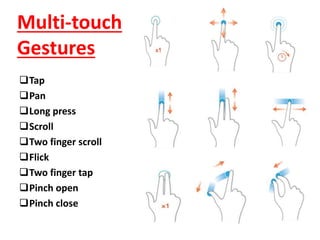
Multi-touch
Gestures
Tap
Pan
Long press
Scroll
Two finger scroll
Flick
Two finger tap
Pinch open
Pinch close
Applications
• Our technique is force-sensitive, and provides
unprecedented resolution and scalability, allowing
us to create sophisticated multi-point widgets for
applications large enough to accommodate both
hands and multiple users.
A New Approach
Frustrated Total Internal Reflection (FTIR):
• If another material touches that within
which the light is reflecting, the reflection is
frustrated, causing the light to escape.
• This has been used in the past:
• fingerprint imaging
• early touch sensors (1970s!)
• tactile sensors for robotic grips
Using FTIR for Touch Sensitivity
• A clear acrylic sheet is used as the touch surface.
– 16 inches x 12 inches in prototype
• Edges of surface lit by infra-red LEDs to produce total
internal reflection.
• A video camera is mounted under the surface and facing it.
• When the surface is touched, the light escapes and registers
on the camera.
Advantages to this Approach
• High capture rate and resolution
– 30 frames per second
– 640x480
• True zero-force touch sensitivity
• Inexpensive to construct
• Scalable to much larger (even wall-sized!)
surfaces
• Transparent: can be combined with rear-
projection display
In more recent work we focus on new multi-touch paradigms
and interactions that combine both traditional 2D interaction
and novel 3D interaction on a touch surface to form a new class
of multi-touch systems, which we refer to as interscopic multi-
touch surfaces (iMUTS). We discuss iMUTS-based user
interfaces that support interaction with 2D content displayed in
monoscopic mode and 3D content usually displayed
stereoscopically.
Enhancement in Technology
• Touch screens are the interface for the 21st century.
• Multi touch technique using FTIR is simple and easy to
implement.
• It provides any resolution displays supported with high
graphics.
• A drawback of the approach is that, being camera-
based, it requires a significant amount of space.
CONCLUSIONS
REFERENCES
1) Low-cost Multi-Touch Sensing through FTIR by Jefferson Y.
Han.
2) Touch-Sensitive Tablet input.
3) Pearson Education, 2003.
4) Buxton, Bill. 2008. Multi-Touch Systems that I Have Known
and Loved.
5)http://www.billbuxton.com/multitouchOverview.html
6) http://www.technologyreview.com/Infotec
multitouch screen

multitouch screen

  • 1.
  • 3.
    OVERVIEW Multi touch Introduction History ofmulti touch Types Gestures Applications Advantages Conclusion Referenses
  • 4.
    MULTITOUCH? “In computing, multi- touchrefers to a touch sensing surface's (track pad or touchscreen) ability to recognize the presence of two or more points of contact with the surface.”
  • 5.
    Introduction • Multi-touch technologypresents a wide range of new opportunities for interaction with graphical user interfaces, allowing expressive gestural control and fluid multi- user collaboration through relatively simple and inexpensive hardware and software configurations.
  • 6.
    •Multi-touch technology datesback to 1982, when the University of Toronto developed the first finger pressure multi-touch. •In 1984 Bell Labs engineered a multi-touch screen that could manipulate images with more than one hand. •In1991 Wellner published a paper on his multi-touch “Digital Desk”, which supported multi-finger and pinching motions. History of Multi Touch…
  • 7.
    Types a) Capacitive TouchTechnologies b) Resistive Touch Technologies c) Optical Touch Technologies d) Infrared Technologies
  • 8.
    Capacitive Touch ScreenTechnology A capacitive touch screen consists of a glass panel with a capacitive (charge storing) material coating its surface. Circuits located at corners of the screen measure the capacitance of a person touching the overlay. Eg:(fig:1)
  • 9.
  • 10.
    Resistive Touch ScreenTechnology Resistive touch screen technology consists of a glass panel that is coated with electrically conductive and resistive layers. The thin layers are separated by invisible separator dots. When operating, an electrical current moves through the screen. When pressure is applied to the screen the layers are pressed together, causing a change in the electrical current and a touch is registered. Eg:(fig:2)
  • 11.
  • 12.
    Infrared Infrared technology relieson the interruption of an infrared light grid in front of the display screen. The touch frame contains a row of infrared LEDs and photo transistors, each mounted on two opposite sides to create a grid of invisible infrared light. The frame assembly comprises printed wiring boards, on which the electronics are mounted and is concealed behind an infrared- transparent bezel. Eg:(fig:3)
  • 13.
  • 14.
    Optical Touch Optical imagingsolution is one of the more modern touch technologies. Since NextWindow's technology uses optical sensors to detect the touch point, the touch registers just before the physical touch on the screen. This means that users can apply zero or light touch to the screen to initiate a response, and any input device, such as a paintbrush, finger, pen, or stylus will work.
  • 15.
    Multi-touch Gestures Tap Pan Long press Scroll Two fingerscroll Flick Two finger tap Pinch open Pinch close
  • 16.
    Applications • Our techniqueis force-sensitive, and provides unprecedented resolution and scalability, allowing us to create sophisticated multi-point widgets for applications large enough to accommodate both hands and multiple users.
  • 17.
    A New Approach FrustratedTotal Internal Reflection (FTIR): • If another material touches that within which the light is reflecting, the reflection is frustrated, causing the light to escape. • This has been used in the past: • fingerprint imaging • early touch sensors (1970s!) • tactile sensors for robotic grips
  • 18.
    Using FTIR forTouch Sensitivity • A clear acrylic sheet is used as the touch surface. – 16 inches x 12 inches in prototype • Edges of surface lit by infra-red LEDs to produce total internal reflection. • A video camera is mounted under the surface and facing it. • When the surface is touched, the light escapes and registers on the camera.
  • 19.
    Advantages to thisApproach • High capture rate and resolution – 30 frames per second – 640x480 • True zero-force touch sensitivity • Inexpensive to construct • Scalable to much larger (even wall-sized!) surfaces • Transparent: can be combined with rear- projection display
  • 20.
    In more recentwork we focus on new multi-touch paradigms and interactions that combine both traditional 2D interaction and novel 3D interaction on a touch surface to form a new class of multi-touch systems, which we refer to as interscopic multi- touch surfaces (iMUTS). We discuss iMUTS-based user interfaces that support interaction with 2D content displayed in monoscopic mode and 3D content usually displayed stereoscopically. Enhancement in Technology
  • 21.
    • Touch screensare the interface for the 21st century. • Multi touch technique using FTIR is simple and easy to implement. • It provides any resolution displays supported with high graphics. • A drawback of the approach is that, being camera- based, it requires a significant amount of space. CONCLUSIONS
  • 22.
    REFERENCES 1) Low-cost Multi-TouchSensing through FTIR by Jefferson Y. Han. 2) Touch-Sensitive Tablet input. 3) Pearson Education, 2003. 4) Buxton, Bill. 2008. Multi-Touch Systems that I Have Known and Loved. 5)http://www.billbuxton.com/multitouchOverview.html 6) http://www.technologyreview.com/Infotec