SURFACE COMPUTING
         &
    MULTI-TOUCH
  DISPLAY DEVICES
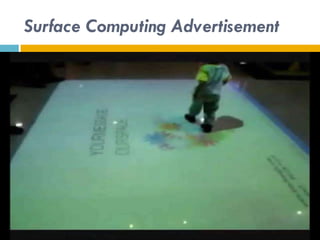
Surface Computing Advertisement
Contents

 Introduction to Surface Computing
 Description of MT Display Devices

 Various Sub Systems

 H/W & S/W Required

 Usage areas of MT Devices

 Practical approach to multi-touch devices.
Introduction
   Surface computing is the term for the
    use of a specialized computer GUI in
    which traditional GUI elements are
    replaced by intuitive, everyday objects.
    Instead of a keyboard and mouse, the
    user interacts directly with a touch-
    sensitive screen.
Description
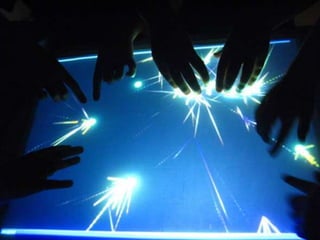
   The multi-touch device is a user interface
    device that will allow a user to interact with
    a computer through use of a multi-touch
    display. Thus, it is a substitute to the
    keyboard and mouse. In this user can
    directly interact with the system with their
    fingers and not only this but with multiple
    touches at the same instant.
How Does a Touchscreen Work?

A basic touch-screen has three main
  components:
1. Touch sensor;
2. Controller;
3. Software driver.
The touch-screen is an input device, so it needs
  to be combined with a display and a PC or
  other device to make a complete touch input
  system.
Touchscreen Technology


    Resistive
    Capacitive
    Optical
Resistive touchscreen

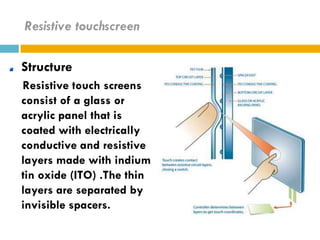
Structure
Resistive touch screens
consist of a glass or
acrylic panel that is
coated with electrically
conductive and resistive
layers made with indium
tin oxide (ITO) .The thin
layers are separated by
invisible spacers.
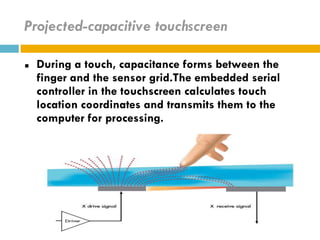
Projected-capacitive touchscreen

   During a touch, capacitance forms between the
    finger and the sensor grid.The embedded serial
    controller in the touchscreen calculates touch
    location coordinates and transmits them to the
    computer for processing.
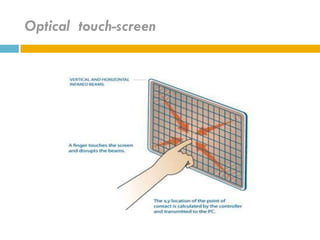
Optical touch-screen
TERMINOLOGY
   Diffuser: Screen surface for projection.
   IR Lasers: Laser emitting IR Beam.
   IR Led: Led emitting IR.
   Blob - A bright luminescent object
   Blob tracking - Assigning each blob an ID (identifier).
   TUIO - A protocol used for communicating the
    position, size, and relative velocity of blobs. (Tangible
    User Interface Object)
   CCV: An open source software for blob tracking.
    (Community Core Vision)
   MT: Multitouch
TECHNIQUES
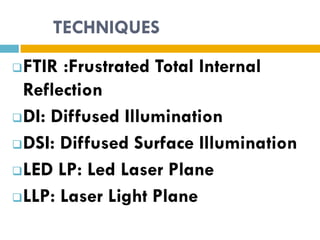
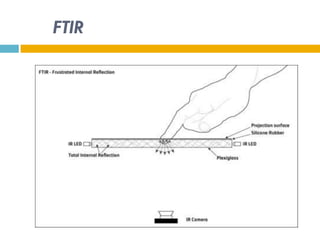
 FTIR :Frustrated Total Internal
  Reflection
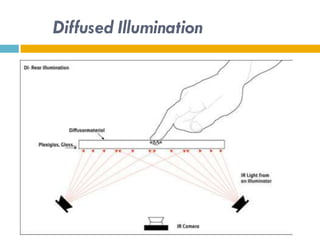
 DI: Diffused Illumination

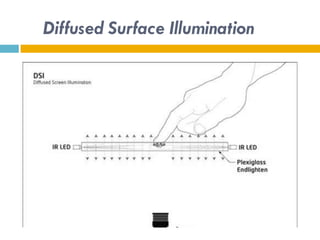
 DSI: Diffused Surface Illumination

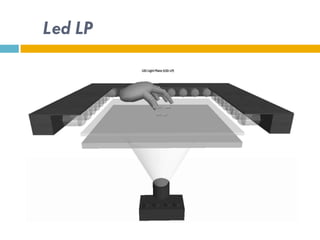
 LED LP: Led Laser Plane

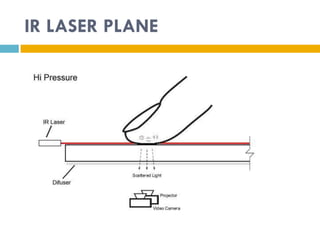
 LLP: Laser Light Plane
PRINCIPLE OF WORKING
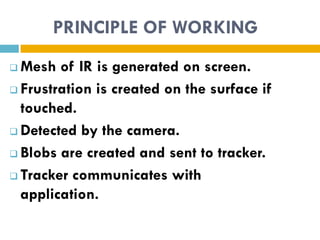
 Mesh of IR is generated on screen.
 Frustration is created on the surface if

  touched.
 Detected by the camera.

 Blobs are created and sent to tracker.

 Tracker communicates with

  application.
FTIR
Diffused Illumination
Diffused Surface Illumination
Led LP
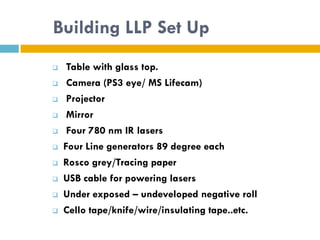
Building LLP Set Up
    Table with glass top.
    Camera (PS3 eye/ MS Lifecam)
    Projector
    Mirror
    Four 780 nm IR lasers
   Four Line generators 89 degree each
   Rosco grey/Tracing paper
   USB cable for powering lasers
   Under exposed – undeveloped negative roll
   Cello tape/knife/wire/insulating tape..etc.
IR LASER PLANE
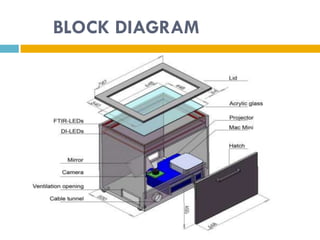
BLOCK DIAGRAM
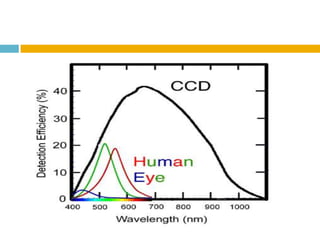
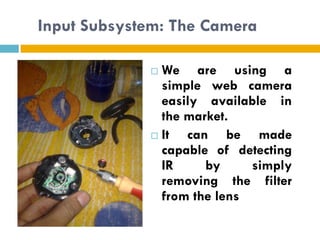
Input Subsystem: The Camera

              We are using a
               simple web camera
               easily available in
               the market.
              It  can be made
               capable of detecting
               IR     by     simply
               removing the filter
               from the lens
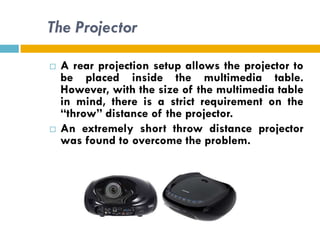
The Projector

   A rear projection setup allows the projector to
    be placed inside the multimedia table.
    However, with the size of the multimedia table
    in mind, there is a strict requirement on the
    “throw” distance of the projector.
   An extremely short throw distance projector
    was found to overcome the problem.
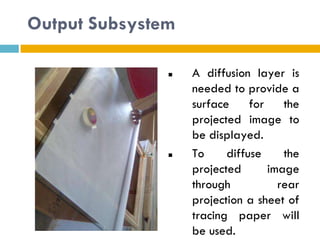
Output Subsystem

                  A diffusion layer is
                   needed to provide a
                   surface     for    the
                   projected image to
                   be displayed.
                  To     diffuse     the
                   projected       image
                   through           rear
                   projection a sheet of
                   tracing paper will
                   be used.
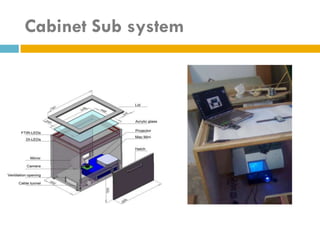
Cabinet Sub system
Computer Subsystem
   A personal computer with 20 GB free hard disk
    space, 1GB RAM and PIV + processor can be
    efficient enough.

   The Windows Vista operating system was chosen
    because the CCV package is highly supported in
    Windows.
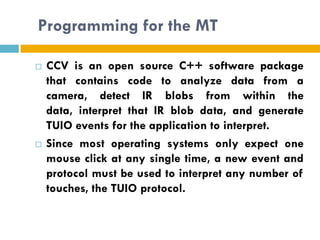
Programming for the MT

   CCV is an open source C++ software package
    that contains code to analyze data from a
    camera, detect IR blobs from within the
    data, interpret that IR blob data, and generate
    TUIO events for the application to interpret.
   Since most operating systems only expect one
    mouse click at any single time, a new event and
    protocol must be used to interpret any number of
    touches, the TUIO protocol.
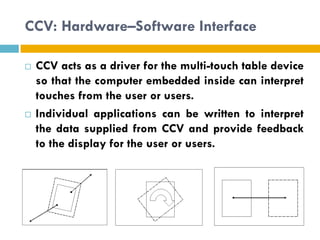
CCV: Hardware–Software Interface

   CCV acts as a driver for the multi-touch table device
    so that the computer embedded inside can interpret
    touches from the user or users.
   Individual applications can be written to interpret
    the data supplied from CCV and provide feedback
    to the display for the user or users.
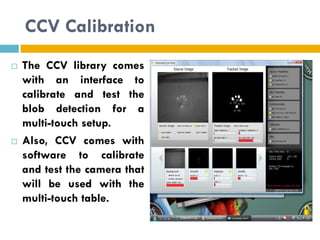
CCV Calibration
   The CCV library comes
    with an interface to
    calibrate and test the
    blob detection for a
    multi-touch setup.
   Also, CCV comes with
    software to calibrate
    and test the camera that
    will be used with the
    multi-touch table.
Application Development
    Many different platforms can be used to
     develop multi-touch applications utilizing
     TUIO events. Such platforms include:
      Adobe    Flash
      Java

      C++

      Python

    Our demo application has been developed
     with ADOBE FLASH and is an open source
     s/w.
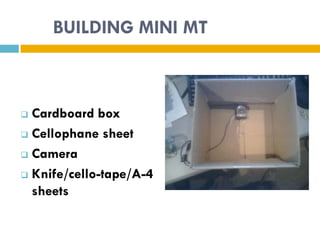
BUILDING MINI MT


 Cardboard box
 Cellophane sheet

 Camera

 Knife/cello-tape/A-4
  sheets
APPLICATIONS OF MT
 Personal Computing
 Graphics

 Audio Mixing

 Video Playing

 Computer Gaming

 Slide Presentations

……and many more!
India’s first Multi-Touch Device
           “ZUGARD”
QUESTIONS
That’s All….
Thank you…
 For any assistance in building your own setup
  or for any other help feel free to contact:
      www.facebook.com/princejerry06
      www.facebook.com/technicabar
      www.twitter.com/princejerry06
      www.twitter.com/technicabar
      rishabha.garg06@gmail.com

MultiTouch

  • 1.
    SURFACE COMPUTING & MULTI-TOUCH DISPLAY DEVICES
  • 2.
  • 3.
    Contents  Introduction toSurface Computing  Description of MT Display Devices  Various Sub Systems  H/W & S/W Required  Usage areas of MT Devices  Practical approach to multi-touch devices.
  • 4.
    Introduction  Surface computing is the term for the use of a specialized computer GUI in which traditional GUI elements are replaced by intuitive, everyday objects. Instead of a keyboard and mouse, the user interacts directly with a touch- sensitive screen.
  • 5.
    Description  The multi-touch device is a user interface device that will allow a user to interact with a computer through use of a multi-touch display. Thus, it is a substitute to the keyboard and mouse. In this user can directly interact with the system with their fingers and not only this but with multiple touches at the same instant.
  • 6.
    How Does aTouchscreen Work? A basic touch-screen has three main components: 1. Touch sensor; 2. Controller; 3. Software driver. The touch-screen is an input device, so it needs to be combined with a display and a PC or other device to make a complete touch input system.
  • 7.
    Touchscreen Technology Resistive Capacitive Optical
  • 8.
    Resistive touchscreen Structure Resistive touchscreens consist of a glass or acrylic panel that is coated with electrically conductive and resistive layers made with indium tin oxide (ITO) .The thin layers are separated by invisible spacers.
  • 9.
    Projected-capacitive touchscreen  During a touch, capacitance forms between the finger and the sensor grid.The embedded serial controller in the touchscreen calculates touch location coordinates and transmits them to the computer for processing.
  • 10.
  • 11.
    TERMINOLOGY  Diffuser: Screen surface for projection.  IR Lasers: Laser emitting IR Beam.  IR Led: Led emitting IR.  Blob - A bright luminescent object  Blob tracking - Assigning each blob an ID (identifier).  TUIO - A protocol used for communicating the position, size, and relative velocity of blobs. (Tangible User Interface Object)  CCV: An open source software for blob tracking. (Community Core Vision)  MT: Multitouch
  • 12.
    TECHNIQUES  FTIR :FrustratedTotal Internal Reflection  DI: Diffused Illumination  DSI: Diffused Surface Illumination  LED LP: Led Laser Plane  LLP: Laser Light Plane
  • 13.
    PRINCIPLE OF WORKING Mesh of IR is generated on screen.  Frustration is created on the surface if touched.  Detected by the camera.  Blobs are created and sent to tracker.  Tracker communicates with application.
  • 14.
  • 15.
  • 16.
  • 17.
  • 18.
    Building LLP SetUp  Table with glass top.  Camera (PS3 eye/ MS Lifecam)  Projector  Mirror  Four 780 nm IR lasers  Four Line generators 89 degree each  Rosco grey/Tracing paper  USB cable for powering lasers  Under exposed – undeveloped negative roll  Cello tape/knife/wire/insulating tape..etc.
  • 19.
  • 20.
  • 23.
    Input Subsystem: TheCamera  We are using a simple web camera easily available in the market.  It can be made capable of detecting IR by simply removing the filter from the lens
  • 24.
    The Projector  A rear projection setup allows the projector to be placed inside the multimedia table. However, with the size of the multimedia table in mind, there is a strict requirement on the “throw” distance of the projector.  An extremely short throw distance projector was found to overcome the problem.
  • 25.
    Output Subsystem  A diffusion layer is needed to provide a surface for the projected image to be displayed.  To diffuse the projected image through rear projection a sheet of tracing paper will be used.
  • 26.
  • 27.
    Computer Subsystem  A personal computer with 20 GB free hard disk space, 1GB RAM and PIV + processor can be efficient enough.  The Windows Vista operating system was chosen because the CCV package is highly supported in Windows.
  • 28.
    Programming for theMT  CCV is an open source C++ software package that contains code to analyze data from a camera, detect IR blobs from within the data, interpret that IR blob data, and generate TUIO events for the application to interpret.  Since most operating systems only expect one mouse click at any single time, a new event and protocol must be used to interpret any number of touches, the TUIO protocol.
  • 29.
    CCV: Hardware–Software Interface  CCV acts as a driver for the multi-touch table device so that the computer embedded inside can interpret touches from the user or users.  Individual applications can be written to interpret the data supplied from CCV and provide feedback to the display for the user or users.
  • 30.
    CCV Calibration  The CCV library comes with an interface to calibrate and test the blob detection for a multi-touch setup.  Also, CCV comes with software to calibrate and test the camera that will be used with the multi-touch table.
  • 31.
    Application Development  Many different platforms can be used to develop multi-touch applications utilizing TUIO events. Such platforms include:  Adobe Flash  Java  C++  Python  Our demo application has been developed with ADOBE FLASH and is an open source s/w.
  • 32.
    BUILDING MINI MT Cardboard box  Cellophane sheet  Camera  Knife/cello-tape/A-4 sheets
  • 33.
    APPLICATIONS OF MT Personal Computing  Graphics  Audio Mixing  Video Playing  Computer Gaming  Slide Presentations ……and many more!
  • 34.
    India’s first Multi-TouchDevice “ZUGARD”
  • 35.
  • 36.
    That’s All…. Thank you… For any assistance in building your own setup or for any other help feel free to contact: www.facebook.com/princejerry06 www.facebook.com/technicabar www.twitter.com/princejerry06 www.twitter.com/technicabar rishabha.garg06@gmail.com