T E C H N O L O G Y | Touchscreens
Touchscreens have become inescapable in our daily lives in a very short space of time.
Steve Montgomery looks at the different types of touchscreen technology available on the market.
T
hhroughout the world we expect to
interact with screens far more regularlynteract with screens far more regularly
than ever before. From the phones in
our pockets to the ticket counters at a
railway station or check-in desks at the
airport, we are used to touching screens and expecting
them to respond. Watch any young person now to see
their reaction to a screen that doesn’t respond to touch,
it ranges from boredom to surprise and disbelief.
Touch screen displays are being used in thousands
of applications. “We’re seeing innovative use of multi-
touch technology particularly in automotive, retail,
gaming and entertainment,” says Paolo Pedrazzoli,
EMEA marketing operations manager for 3M display
materials and systems division. “But this is just the
beginning: expect to see it in every walk of life in the
future.”
Screen suppliers and their third-party manufacturing
partners have developed interactive touch technology to
make screens of any size respond to touch. There are
several well-established technologies available that allow
any flat screen display in any location to be turned into
a single- or multi-touch display to provide an interactive
experience to users, with new technologies appearing
regularly. The correct choice of technology must be
made for each individual application.
“It is critical that system builders and integrators
evaluate the environment in which the touchscreen will
be used together with functional requirements, says Ian
Crosby, Zytronic sales and marketing director. “Each
type of technology has its own set of characteristics,
advantages and disadvantages that will affect suitability
for a specific task. They need to decide whether single-
or dual-touch is adequate or whether multi-touch
operation is necessary or may be a requirement in the
future. Crucially the location in which a touch screen
will be deployed will greatly affect the construction and
choice: will it be subject to extremes of weather, heavy
usage or rough treatment.”
Traditional Infrared or ‘beam-break’ touch detection is
the most common method for large screens and is simple
to implement in both OEM and retro-fit applications. IR
transmitters and receivers are mounted in a frame around
the screen and detect when a finger breaks the beams.
This method requires a bezel to protect the transceivers
which can trap dust, liquid and dirt, impairing the touch
performance and can be activated by any object falling
in front of the optics, making them prone to false
touches. The sensors are also prone to interference
from ambient light. Consequently they are not suited to
unattended or outdoor or highly lit applications. They
do though remain popular, becuase they are reliable and
are the cheapest way to deploy large touchscreens of
85in and above. The reduction in bezel size and issues
of warranty support are, however, limiting the ability
of third-parties to integrate touch capability within a
standard display, leading to a resurgence of overlays.
The cheaper, resistive, method uses two ITO-coated
polymer layers with the touch position identified
through changing resistance at the point of pressure.
It is abundant on screens up to 20in, and has some
protection to liquid spillage but is easily damaged. Very
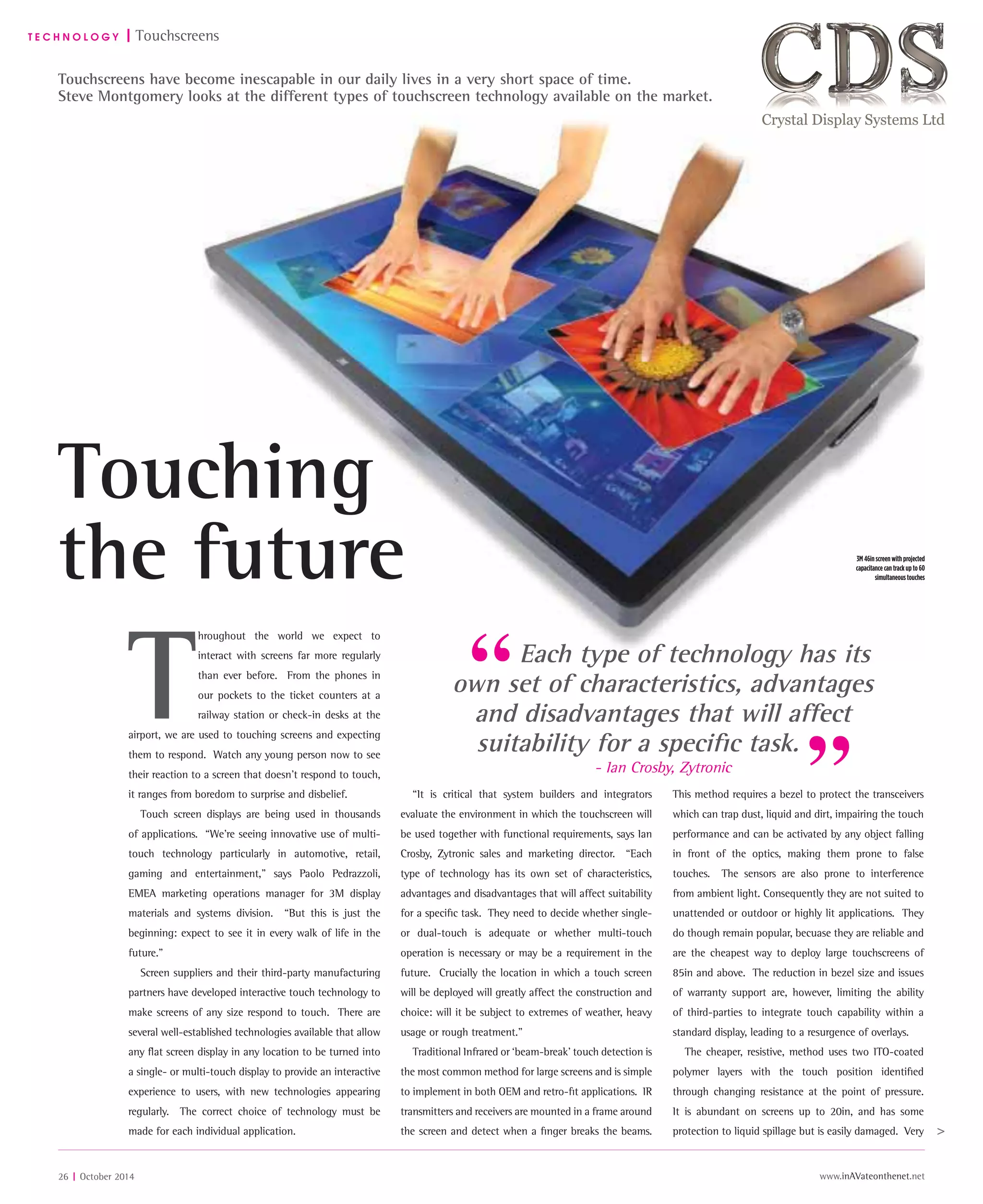
3M 46in screen with projected
capacitance can track up to 60
simultaneous touches
26 | October 2014 www.inAVateonthenet.net
Touc
the f
>
Each type of technology has its
own set of characteristics, advantages
and disadvantages that will affect
suitability for a specific task.
- Ian Crosby, Zytronic
T E C H N O L O G Y | Touchscreens
often seen on tills in bars and restaurants it works with
gloves and rigid pointers as well as fingers, although
repeated touching of the same point can dull the top
layer and adversely affect its opacity.
Capacitive technology uses a change in capacitance
caused by close proximity of a finger to detect a touch
position. This has benefit in retail applications as
Christian Jeske, marketing director, Pyramid Computer,
points out: “Capacitive touch technology is ideal for
retail and POS applications as it provides the highest level
of accuracy. Customers soon get bored and frustrated if
they have to press a button on a touch screen a couple
of times before the command is recognised. One of the
biggest benefits of capacitive touch is palm detection.
On larger screens, especially those above 32in, users
sometimes lean one hand on the screen or the edges.”
Surface capacitance (s-cap) and projected capacitance
(p-cap) incorporate an additional sheet of glass over
the screen which also serves to protect it against the
elements and vandalism; so is ideal for outdoor kiosks,
ticketing machines and ATMs.
Capacitive systems provide familiar effect and response
experiences to users and is most likely to dominate in
the future on all sizes of screen, including the largest;
but has disadvantages in requiring a second sheet of
glass which can degrade the image because of the
embedded wiring. Processing electronics is quite often
linked to the LCD panel refresh rate (normally 60Hz) so
tracking can be sluggish, although manufacturers, such
as Displax have developed capacitive systems with 5ms
(200Hz) response.
Surface acoustic wave (SAW) touch devices use sound
waves to detect touches and are the preferred choice of
kiosk manufacturer Protouch. “Most of our kiosks have
personal-transaction screens of up to 20in and single-
touch response using SAW technology that allows a very
clear image and is very reliable and accurate for customer
interaction,” says Tom Quarry, MD. “Ultimately however,
p-cap is likely to be the dominant method, not least
because of its smartphone feel and ability to create
bezel-less screens.”
This is a trend that Jeremy Stewart, director of
U-Touch agrees with: “Not many manufacturers
are producing it at the moment because of patent
protection, however it is starting to scale up. The extra
protective glass layer and absence of a bezel gives it a
high-end, high-quality feel akin to an iPhone and allows
touch tables and screens to be built with totally flat
surfaces. We add a toughened anti-glare screen to the
face of the SyncTable to protect against damage and cut
out sunlight or overhead lighting.”
Zytronic’s proprietary projected capacitive technology
(PCT) and multi-touch (MPCT) technology uses a copper
metal mesh matrix, rather than an ITO layer. Ian Crosby:
“The mesh is embedded into a laminated substrate of
either glass up to 12 or 20mm thick or a flexible film
construction, so it is possible to make touch sensors
for the new range of curved displays. The sensors can
be deployed into all-glass fronted designs providing 40
point detection on displays of up to 85” even if the user
is wearing gloves. A palm rejection feature contained
within the touch controller can differentiate between
true touch events and accidental ones such customer
leaning on the touch sensor.”
A new IR based concept has been developed further by
Baanto with its ShadowSense technology. Rather than
fit large numbers of transmitters and receivers all around
the frame, ShadowSense uses just six, or fewer, receivers
along the top to interact with transmitters around the
remainder. Anthony Gussin, Baanto director of marketing
explains: “The advantage of this technique is that we can
deploy expensive signal processing and filtering on each
of the receivers, dramatically improving the touchscreen
performance. For example, ShadowSense will track an
object moving at over five metres per second, a feature
which allows for very accurate and consistent tracking of
a marker or stylus in a writing application. In addition,
with ShadowSense we calculate additional information
about the touch object, for example reporting the size,
material, or hover distance as well as the position of
a finger or pointer. Palm rejection is achievable using
the object size, but more interesting applications can be
created that reflect the size of the pointer; for example
a painting programme can detect the thickness of a
brush and apply colour on-screen allowing sessions that
don’t involve the mess and preparation of real paint.
ShadowSense employs a differential sensing method
that compares the shadow cast by a pointer against
ambient light and will operate in extremely high light
levels experienced in brightly lite atriums or classrooms,
TV studios, in fact up to and including the equivalent of
desert sunlight at noon.”
A unique approach has been taken by MultiTouch
with its MultiTaction Computer Vision Through Screen
(CVTS) method that uses infrared cameras behind the
LCD glass to detect objects on the surface. Hannu
Anttila, vice president of business development explains
that the system: “supports any number of simultaneous
users and facilitates tangible user interface: interaction
with physical objects such as product samples or user
identification through their ID badges. Simultaneous
pen, finger, hand and object recognition is also possible,
adding to its versatility.”
In the past the deployment of touch screens has
been plagued by problems with driver and software
installation and the need to calibrate screens against
the touch sensing matrix. These have generally been
resolved with the adoption of the HID (human interface
device) protocol which allows computers to interact with
peripheral devices without additional drivers. Touch
screens can now be added to systems simply and easily,
widening their appeal and usability. It also allows
advanced applications, such as gaming kiosks to be
simply upgraded from single- to multi-touch operation
without major reconfiguration.
There are occasions where the option to adjust
the response of the touchscreen is an advantage and
made possible by additional control software or Baanto
Dashboard. False triggering of selections can have dire
consequences, for example in financial market trading
and gambling applications where a shirt cuff or tie
brushing over a transactional button could trigger an
inadvertent action. The effect of rain or spillages on the
surface can also affect the performance of traditional
touch technologies. “ShadowSense sensors operate
in the analogue domain which allows the response
to shadow density, touch area and touch delay to be
28 | October 2014 www.inAVateonthenet.net
>
>
[Top to bottom]
Sky Sports F1 uses a Displax Skin Multitouch
touch screen to explain the finer points of F1 racingtouch screen to explain the finer points of F1 racing
The retail sector is very interested in touchscreens, like this offering from Pyramid
Skin Multitouch from Displax provides a display with 5ms respnonse time and 100 points of touch
T E C H N O L O G Y | Touchscreens
adjusted,” says Gussin: “The control dashboard allows
the touch gate to be adjusted to define the size limits
associated with expected touch objects to reduce or
even eliminate false touch reporting. It allows raindrops
and even localised spillage to be ignored. The amount
of time a pointer needs to be present on the screen to
cause a response can also be adjusted to guard against
instantaneous, fleeting contact from cuffs or jewellery
and hovering or dragging fingers.”
Haptic mechanisms are also emerging that provide
feedback to users through small piezo vibrators: a
technique drawn from the mobile phone industry.
Whilst the number of simultaneous touches that a
screen can deal with has risen rapidly from one and two in
the early days to 40 or even up to 100, there is still some
doubt about the overall need for such a large number.
Transactional kiosks rarely need more than single-touch
to operate effectively, however the ability to manage two
touches means that they can eliminate the tendency for
people to rest another finger or object on the screen
whilst operating it. Larger screens up to around 42in can
only realistically interact with one user at a time without
people impinging on others’ personal space. Above that
it is viable to create multi-user experiences for wall and
table-mounted screens. However there are currently
very few applications that can cope with more than a
few touches at once. It is often a case of purchasers
buying a feature they don’t need. Stewart: “We are at
the early stage of touch interaction and only a handful
of software houses are capable of creating immersive
experiences that appeal to multiple users.”
This is a fast-evolving industry, as Miguel Fonseca,
CEO of Displax points out: “The size of touch
displays is growing and what started as a smartphone
revolution has been quickly expanding into bigger
devices. Laptops with touch are increasingly common
and soon the technology will be so affordable that it
will make no sense to manufacture laptops without
integrated touch. The same goes for large displays. We
are just a few years away from the day that all displays
will be touch-enabled: the TV in our living room, the
large display in the office and conference room, in the
shopping centre, stores, museums, airports and even on
the street.”
>
The size of touch displays is
growing and what started as a
smartphone revolution has been quickly
expanding into bigger devices.
- Miguel Fonseca, Displax
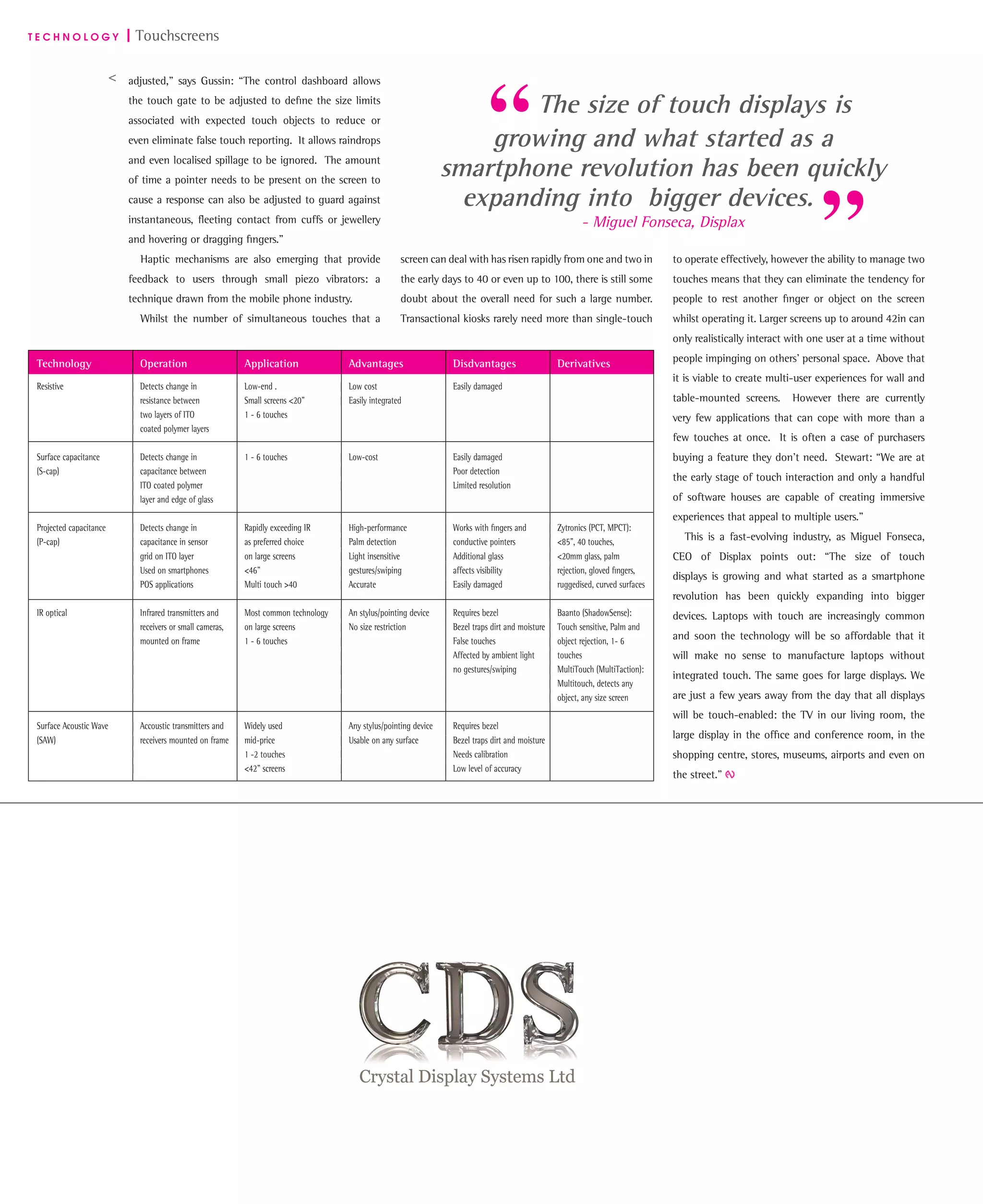
Technology Operation Application Advantages Disdvantages Derivatives
Resistive Detects change in Low-end . Low cost Easily damaged
resistance between Small screens <20” Easily integrated
two layers of ITO 1 - 6 touches
coated polymer layers
Surface capacitance Detects change in 1 - 6 touches Low-cost Easily damaged
(S-cap) capacitance between Poor detection
ITO coated polymer Limited resolution
layer and edge of glass
Projected capacitance Detects change in Rapidly exceeding IR High-performance Works with fingers and Zytronics (PCT, MPCT):
(P-cap) capacitance in sensor as preferred choice Palm detection conductive pointers <85”, 40 touches,
grid on ITO layer on large screens Light insensitive Additional glass <20mm glass, palm
Used on smartphones <46” gestures/swiping affects visibility rejection, gloved fingers,
POS applications Multi touch >40 Accurate Easily damaged ruggedised, curved surfaces
IR optical Infrared transmitters and Most common technology An stylus/pointing device Requires bezel Baanto (ShadowSense):
receivers or small cameras, on large screens No size restriction Bezel traps dirt and moisture Touch sensitive, Palm and
mounted on frame 1 - 6 touches False touches object rejection, 1- 6
Affected by ambient light touches
no gestures/swiping MultiTouch (MultiTaction):
Multitouch, detects any
object, any size screen
Surface Acoustic Wave Accoustic transmitters and Widely used Any stylus/pointing device Requires bezel
(SAW) receivers mounted on frame mid-price Usable on any surface Bezel traps dirt and moisture
1 -2 touches Needs calibration
<42” screens Low level of accuracy
www.crystal-display.com
info@crystal-display.com

Cds touchscreens – the different technologies

  • 1.
    T E CH N O L O G Y | Touchscreens Touchscreens have become inescapable in our daily lives in a very short space of time. Steve Montgomery looks at the different types of touchscreen technology available on the market. T hhroughout the world we expect to interact with screens far more regularlynteract with screens far more regularly than ever before. From the phones in our pockets to the ticket counters at a railway station or check-in desks at the airport, we are used to touching screens and expecting them to respond. Watch any young person now to see their reaction to a screen that doesn’t respond to touch, it ranges from boredom to surprise and disbelief. Touch screen displays are being used in thousands of applications. “We’re seeing innovative use of multi- touch technology particularly in automotive, retail, gaming and entertainment,” says Paolo Pedrazzoli, EMEA marketing operations manager for 3M display materials and systems division. “But this is just the beginning: expect to see it in every walk of life in the future.” Screen suppliers and their third-party manufacturing partners have developed interactive touch technology to make screens of any size respond to touch. There are several well-established technologies available that allow any flat screen display in any location to be turned into a single- or multi-touch display to provide an interactive experience to users, with new technologies appearing regularly. The correct choice of technology must be made for each individual application. “It is critical that system builders and integrators evaluate the environment in which the touchscreen will be used together with functional requirements, says Ian Crosby, Zytronic sales and marketing director. “Each type of technology has its own set of characteristics, advantages and disadvantages that will affect suitability for a specific task. They need to decide whether single- or dual-touch is adequate or whether multi-touch operation is necessary or may be a requirement in the future. Crucially the location in which a touch screen will be deployed will greatly affect the construction and choice: will it be subject to extremes of weather, heavy usage or rough treatment.” Traditional Infrared or ‘beam-break’ touch detection is the most common method for large screens and is simple to implement in both OEM and retro-fit applications. IR transmitters and receivers are mounted in a frame around the screen and detect when a finger breaks the beams. This method requires a bezel to protect the transceivers which can trap dust, liquid and dirt, impairing the touch performance and can be activated by any object falling in front of the optics, making them prone to false touches. The sensors are also prone to interference from ambient light. Consequently they are not suited to unattended or outdoor or highly lit applications. They do though remain popular, becuase they are reliable and are the cheapest way to deploy large touchscreens of 85in and above. The reduction in bezel size and issues of warranty support are, however, limiting the ability of third-parties to integrate touch capability within a standard display, leading to a resurgence of overlays. The cheaper, resistive, method uses two ITO-coated polymer layers with the touch position identified through changing resistance at the point of pressure. It is abundant on screens up to 20in, and has some protection to liquid spillage but is easily damaged. Very 3M 46in screen with projected capacitance can track up to 60 simultaneous touches 26 | October 2014 www.inAVateonthenet.net Touc the f > Each type of technology has its own set of characteristics, advantages and disadvantages that will affect suitability for a specific task. - Ian Crosby, Zytronic
  • 2.
    T E CH N O L O G Y | Touchscreens often seen on tills in bars and restaurants it works with gloves and rigid pointers as well as fingers, although repeated touching of the same point can dull the top layer and adversely affect its opacity. Capacitive technology uses a change in capacitance caused by close proximity of a finger to detect a touch position. This has benefit in retail applications as Christian Jeske, marketing director, Pyramid Computer, points out: “Capacitive touch technology is ideal for retail and POS applications as it provides the highest level of accuracy. Customers soon get bored and frustrated if they have to press a button on a touch screen a couple of times before the command is recognised. One of the biggest benefits of capacitive touch is palm detection. On larger screens, especially those above 32in, users sometimes lean one hand on the screen or the edges.” Surface capacitance (s-cap) and projected capacitance (p-cap) incorporate an additional sheet of glass over the screen which also serves to protect it against the elements and vandalism; so is ideal for outdoor kiosks, ticketing machines and ATMs. Capacitive systems provide familiar effect and response experiences to users and is most likely to dominate in the future on all sizes of screen, including the largest; but has disadvantages in requiring a second sheet of glass which can degrade the image because of the embedded wiring. Processing electronics is quite often linked to the LCD panel refresh rate (normally 60Hz) so tracking can be sluggish, although manufacturers, such as Displax have developed capacitive systems with 5ms (200Hz) response. Surface acoustic wave (SAW) touch devices use sound waves to detect touches and are the preferred choice of kiosk manufacturer Protouch. “Most of our kiosks have personal-transaction screens of up to 20in and single- touch response using SAW technology that allows a very clear image and is very reliable and accurate for customer interaction,” says Tom Quarry, MD. “Ultimately however, p-cap is likely to be the dominant method, not least because of its smartphone feel and ability to create bezel-less screens.” This is a trend that Jeremy Stewart, director of U-Touch agrees with: “Not many manufacturers are producing it at the moment because of patent protection, however it is starting to scale up. The extra protective glass layer and absence of a bezel gives it a high-end, high-quality feel akin to an iPhone and allows touch tables and screens to be built with totally flat surfaces. We add a toughened anti-glare screen to the face of the SyncTable to protect against damage and cut out sunlight or overhead lighting.” Zytronic’s proprietary projected capacitive technology (PCT) and multi-touch (MPCT) technology uses a copper metal mesh matrix, rather than an ITO layer. Ian Crosby: “The mesh is embedded into a laminated substrate of either glass up to 12 or 20mm thick or a flexible film construction, so it is possible to make touch sensors for the new range of curved displays. The sensors can be deployed into all-glass fronted designs providing 40 point detection on displays of up to 85” even if the user is wearing gloves. A palm rejection feature contained within the touch controller can differentiate between true touch events and accidental ones such customer leaning on the touch sensor.” A new IR based concept has been developed further by Baanto with its ShadowSense technology. Rather than fit large numbers of transmitters and receivers all around the frame, ShadowSense uses just six, or fewer, receivers along the top to interact with transmitters around the remainder. Anthony Gussin, Baanto director of marketing explains: “The advantage of this technique is that we can deploy expensive signal processing and filtering on each of the receivers, dramatically improving the touchscreen performance. For example, ShadowSense will track an object moving at over five metres per second, a feature which allows for very accurate and consistent tracking of a marker or stylus in a writing application. In addition, with ShadowSense we calculate additional information about the touch object, for example reporting the size, material, or hover distance as well as the position of a finger or pointer. Palm rejection is achievable using the object size, but more interesting applications can be created that reflect the size of the pointer; for example a painting programme can detect the thickness of a brush and apply colour on-screen allowing sessions that don’t involve the mess and preparation of real paint. ShadowSense employs a differential sensing method that compares the shadow cast by a pointer against ambient light and will operate in extremely high light levels experienced in brightly lite atriums or classrooms, TV studios, in fact up to and including the equivalent of desert sunlight at noon.” A unique approach has been taken by MultiTouch with its MultiTaction Computer Vision Through Screen (CVTS) method that uses infrared cameras behind the LCD glass to detect objects on the surface. Hannu Anttila, vice president of business development explains that the system: “supports any number of simultaneous users and facilitates tangible user interface: interaction with physical objects such as product samples or user identification through their ID badges. Simultaneous pen, finger, hand and object recognition is also possible, adding to its versatility.” In the past the deployment of touch screens has been plagued by problems with driver and software installation and the need to calibrate screens against the touch sensing matrix. These have generally been resolved with the adoption of the HID (human interface device) protocol which allows computers to interact with peripheral devices without additional drivers. Touch screens can now be added to systems simply and easily, widening their appeal and usability. It also allows advanced applications, such as gaming kiosks to be simply upgraded from single- to multi-touch operation without major reconfiguration. There are occasions where the option to adjust the response of the touchscreen is an advantage and made possible by additional control software or Baanto Dashboard. False triggering of selections can have dire consequences, for example in financial market trading and gambling applications where a shirt cuff or tie brushing over a transactional button could trigger an inadvertent action. The effect of rain or spillages on the surface can also affect the performance of traditional touch technologies. “ShadowSense sensors operate in the analogue domain which allows the response to shadow density, touch area and touch delay to be 28 | October 2014 www.inAVateonthenet.net > > [Top to bottom] Sky Sports F1 uses a Displax Skin Multitouch touch screen to explain the finer points of F1 racingtouch screen to explain the finer points of F1 racing The retail sector is very interested in touchscreens, like this offering from Pyramid Skin Multitouch from Displax provides a display with 5ms respnonse time and 100 points of touch
  • 3.
    T E CH N O L O G Y | Touchscreens adjusted,” says Gussin: “The control dashboard allows the touch gate to be adjusted to define the size limits associated with expected touch objects to reduce or even eliminate false touch reporting. It allows raindrops and even localised spillage to be ignored. The amount of time a pointer needs to be present on the screen to cause a response can also be adjusted to guard against instantaneous, fleeting contact from cuffs or jewellery and hovering or dragging fingers.” Haptic mechanisms are also emerging that provide feedback to users through small piezo vibrators: a technique drawn from the mobile phone industry. Whilst the number of simultaneous touches that a screen can deal with has risen rapidly from one and two in the early days to 40 or even up to 100, there is still some doubt about the overall need for such a large number. Transactional kiosks rarely need more than single-touch to operate effectively, however the ability to manage two touches means that they can eliminate the tendency for people to rest another finger or object on the screen whilst operating it. Larger screens up to around 42in can only realistically interact with one user at a time without people impinging on others’ personal space. Above that it is viable to create multi-user experiences for wall and table-mounted screens. However there are currently very few applications that can cope with more than a few touches at once. It is often a case of purchasers buying a feature they don’t need. Stewart: “We are at the early stage of touch interaction and only a handful of software houses are capable of creating immersive experiences that appeal to multiple users.” This is a fast-evolving industry, as Miguel Fonseca, CEO of Displax points out: “The size of touch displays is growing and what started as a smartphone revolution has been quickly expanding into bigger devices. Laptops with touch are increasingly common and soon the technology will be so affordable that it will make no sense to manufacture laptops without integrated touch. The same goes for large displays. We are just a few years away from the day that all displays will be touch-enabled: the TV in our living room, the large display in the office and conference room, in the shopping centre, stores, museums, airports and even on the street.” > The size of touch displays is growing and what started as a smartphone revolution has been quickly expanding into bigger devices. - Miguel Fonseca, Displax Technology Operation Application Advantages Disdvantages Derivatives Resistive Detects change in Low-end . Low cost Easily damaged resistance between Small screens <20” Easily integrated two layers of ITO 1 - 6 touches coated polymer layers Surface capacitance Detects change in 1 - 6 touches Low-cost Easily damaged (S-cap) capacitance between Poor detection ITO coated polymer Limited resolution layer and edge of glass Projected capacitance Detects change in Rapidly exceeding IR High-performance Works with fingers and Zytronics (PCT, MPCT): (P-cap) capacitance in sensor as preferred choice Palm detection conductive pointers <85”, 40 touches, grid on ITO layer on large screens Light insensitive Additional glass <20mm glass, palm Used on smartphones <46” gestures/swiping affects visibility rejection, gloved fingers, POS applications Multi touch >40 Accurate Easily damaged ruggedised, curved surfaces IR optical Infrared transmitters and Most common technology An stylus/pointing device Requires bezel Baanto (ShadowSense): receivers or small cameras, on large screens No size restriction Bezel traps dirt and moisture Touch sensitive, Palm and mounted on frame 1 - 6 touches False touches object rejection, 1- 6 Affected by ambient light touches no gestures/swiping MultiTouch (MultiTaction): Multitouch, detects any object, any size screen Surface Acoustic Wave Accoustic transmitters and Widely used Any stylus/pointing device Requires bezel (SAW) receivers mounted on frame mid-price Usable on any surface Bezel traps dirt and moisture 1 -2 touches Needs calibration <42” screens Low level of accuracy www.crystal-display.com info@crystal-display.com