

LESLEY.S
Reg. No.SBAG10183781
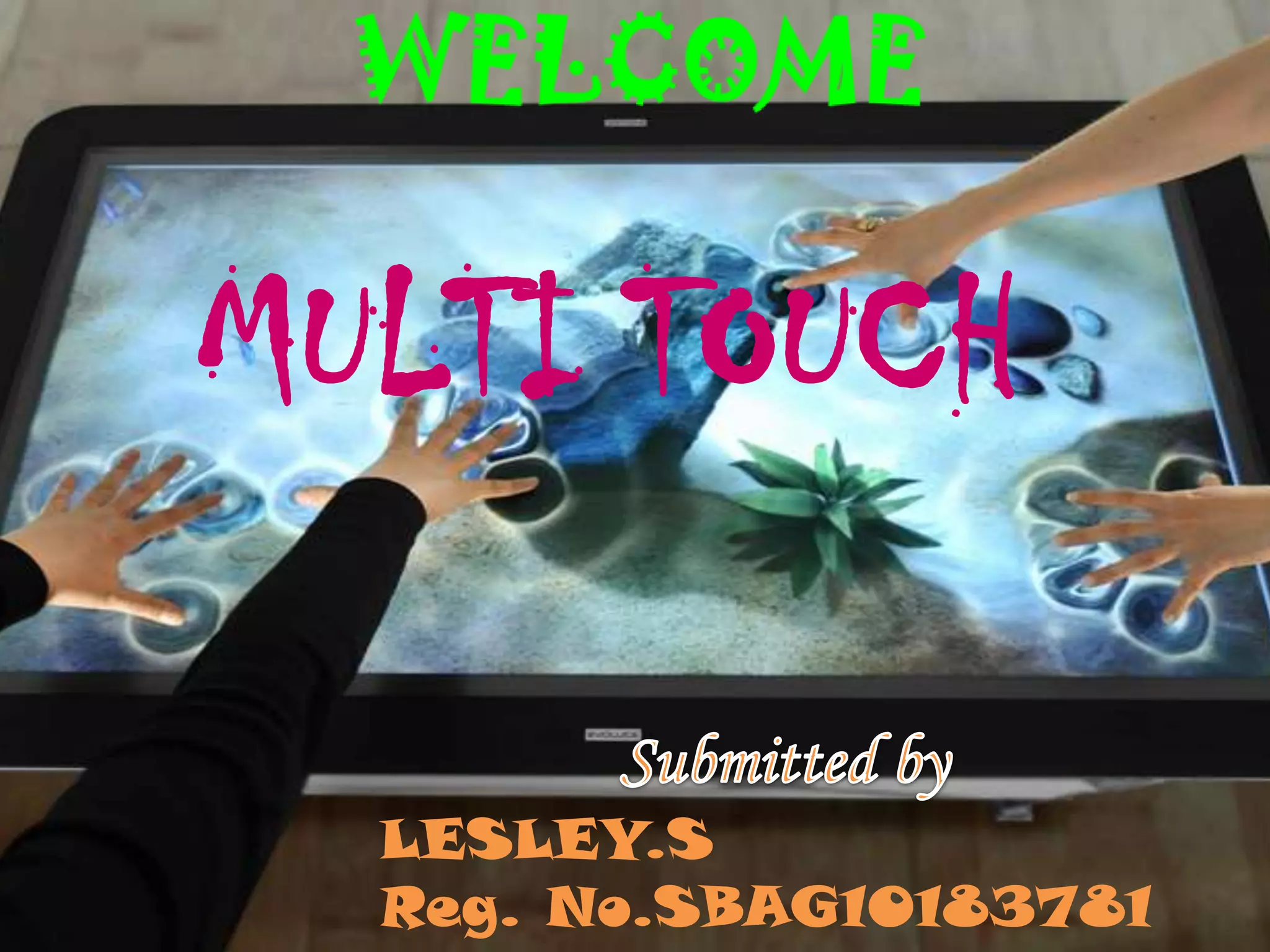
MULTI TOUCH
• A touch screen is a display
which can detect the presence
and location of a touch
within the display area.
• One point of contact at a
time.
• Multi-touch technology is an advanced
human-computer interaction technique
that recognises multiple touch points and
also includes the hardware devices that
implement it.
• which allow users to compute without
conventional input devices .
• Multi-touch technology dates back to 1982, when
the University of Toronto developed the first
finger pressure multi-touch.
• In 1984 Bell Labs engineered a multi-touch
screen that could manipulate images with more
than one hand.
• In1991 Wellner published a paper on his multi-
touch “Digital Desk”, which supported multi-
finger and pinching motions.
History of Multi Touch…
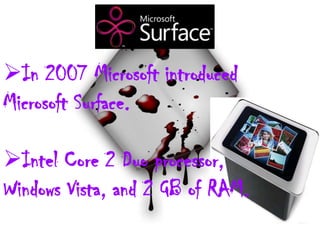
In 2007 Microsoft introduced
Microsoft Surface.
Intel Core 2 Duo processor,
Windows Vista, and 2 GB of RAM.
• PP is a company founded by New York
University consulting research
scientist Jefferson Y. Han that creates
wall displays and tables.
• It can accommodate up to 20 fingers.
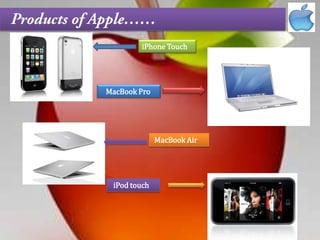
In 2007 they introduced the iPhone, marking
the first time multi-touch technology was used on
a phone.
Later on this technology was introduced in iPod
touch, MacBook Air, and MacBook Pro.
MacBook Pro
iPhone Touch
iPod touch
MacBook Air
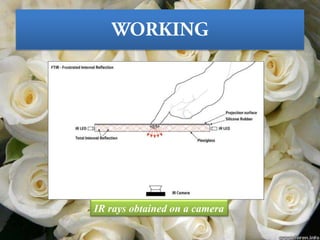
IR rays obtained on a camera
F T I R
F R U S T R A T E D T O T A L I N T E R N A L
R E F L E C T I O N
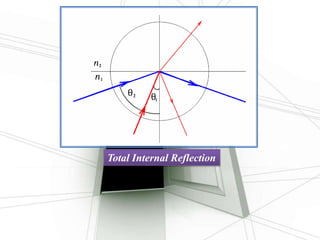
• Total internal reflection is an optical phenomenon that occurs when a ray
of light strikes a medium boundary at an angle larger than the critical
angle with respect to the normal to the surface.
• The critical angle is the angle of incidence above which total internal
reflection occurs.
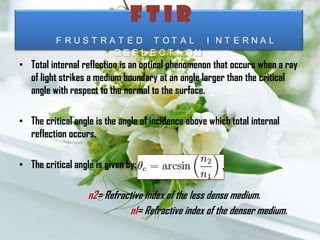
• The critical angle is given by:
n2= Refractive index of the less dense medium.
n1= Refractive index of the denser medium.
Total Internal Reflection
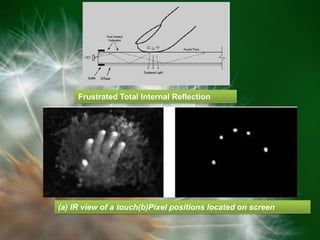
(a) IR view of a touch(b)Pixel positions located on screen
Frustrated Total Internal Reflection
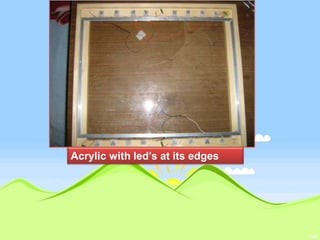
Acrylic with led’s at its edges
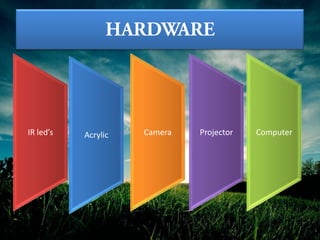
IR led’s Acrylic Camera Projector Computer
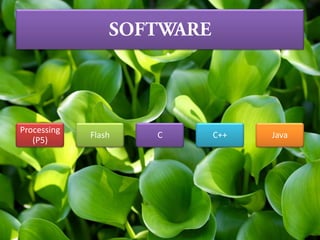
Processing
(P5)
Flash C C++ Java
ADVANTAGES
• Low cost factor.
• Support high-resolution graphics.
• Larger shared-display systems.
• It acquires true touch image
information at high spatial and
temporal resolutions.
APPLICATION
• Personal computers, Laptops ,Tabletops ,
Graphics Tablets .
• It supports both LCD and CRT monitors .
• Telephones ,Watches ,PDAs, Mobile phones.
• Advanced multi touch Gaming with high graphics
support.
• Governmental, office and business purposes.
• Multi-touch technology is an advanced human-computer
interaction technique, which allow users to compute without
conventional input devices .
THANK
YOU

Multi touch

  • 1.
  • 2.
    • A touchscreen is a display which can detect the presence and location of a touch within the display area. • One point of contact at a time.
  • 3.
    • Multi-touch technologyis an advanced human-computer interaction technique that recognises multiple touch points and also includes the hardware devices that implement it. • which allow users to compute without conventional input devices .
  • 4.
    • Multi-touch technologydates back to 1982, when the University of Toronto developed the first finger pressure multi-touch. • In 1984 Bell Labs engineered a multi-touch screen that could manipulate images with more than one hand. • In1991 Wellner published a paper on his multi- touch “Digital Desk”, which supported multi- finger and pinching motions. History of Multi Touch…
  • 5.
    In 2007 Microsoftintroduced Microsoft Surface. Intel Core 2 Duo processor, Windows Vista, and 2 GB of RAM.
  • 7.
    • PP isa company founded by New York University consulting research scientist Jefferson Y. Han that creates wall displays and tables. • It can accommodate up to 20 fingers.
  • 8.
    In 2007 theyintroduced the iPhone, marking the first time multi-touch technology was used on a phone. Later on this technology was introduced in iPod touch, MacBook Air, and MacBook Pro.
  • 9.
  • 10.
    IR rays obtainedon a camera
  • 11.
    F T IR F R U S T R A T E D T O T A L I N T E R N A L R E F L E C T I O N • Total internal reflection is an optical phenomenon that occurs when a ray of light strikes a medium boundary at an angle larger than the critical angle with respect to the normal to the surface. • The critical angle is the angle of incidence above which total internal reflection occurs. • The critical angle is given by: n2= Refractive index of the less dense medium. n1= Refractive index of the denser medium.
  • 12.
  • 13.
    (a) IR viewof a touch(b)Pixel positions located on screen Frustrated Total Internal Reflection
  • 14.
  • 15.
    IR led’s AcrylicCamera Projector Computer
  • 16.
  • 17.
    ADVANTAGES • Low costfactor. • Support high-resolution graphics. • Larger shared-display systems. • It acquires true touch image information at high spatial and temporal resolutions.
  • 18.
    APPLICATION • Personal computers,Laptops ,Tabletops , Graphics Tablets . • It supports both LCD and CRT monitors . • Telephones ,Watches ,PDAs, Mobile phones. • Advanced multi touch Gaming with high graphics support. • Governmental, office and business purposes.
  • 19.
    • Multi-touch technologyis an advanced human-computer interaction technique, which allow users to compute without conventional input devices .
  • 21.