PRESENTED BY :
RAYASHA DAHAL
1317120
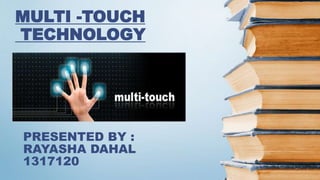
MULTI -TOUCH
TECHNOLOGY
CONTENTS
• INTRODUCTION
• HISTORY
• WORKING MODEL
• ADVANTAGES
• DISADVANTAGES
• APPLICATIONS
• FUTURE SCOPE
• PRESENT SCENARIO
• CONCLUSION
• REFERENCES
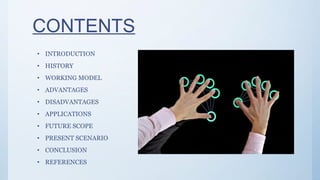
Multi-touch technology is an advanced
human computer interaction technique
that recognizes multiple touch points.
Multi-touch consists of a touch screen
or touch pad, as well as software
that recognizes multiple touch points
at a time.
Multi-touch using Total internal
reflection is simple, inexpensive and
scalable technique for enabling high
resolution multi-touch sensing.
The use of multi-touch technology has
rapidly grown in recent past years.
INTRODUCTION
Multi-touch technology dates back to
1982, when the University of Toronto
developed the first finger pressure
multi-touch. In 1984 Bell Labs
engineered a multi-touch screen that
could manipulate images with more
than one hand. In1991 Wellner
published a paper on his multitouch
“Digital Desk”, which supported
multifinger and pinching motions.
HISTORY
WORKING MODEL
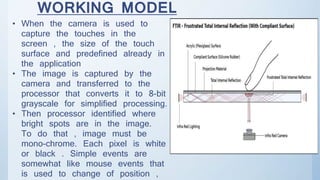
• When the camera is used to
capture the touches in the
screen , the size of the touch
surface and predefined already in
the application
• The image is captured by the
camera and transferred to the
processor that converts it to 8-bit
grayscale for simplified processing.
• Then processor identified where
bright spots are in the image.
To do that , image must be
mono-chrome. Each pixel is white
or black . Simple events are
somewhat like mouse events that
is used to change of position ,
Gestures
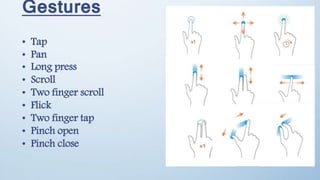
• Tap
• Pan
• Long press
• Scroll
• Two finger scroll
• Flick
• Two finger tap
• Pinch open
• Pinch close
ADVANTAGES
• Support high-resolution graphics.
• Larger shared-display systems.
• Three time faster than traditional touchscreens.
• More versatile than single - touch interfaces
• High accuracy
Having a big bright screen and needing
massive computing power to run this
means a very low battery life
The screens will get very dirty
They can suffer from the problem of
fingerprints on display
It is complex system
DISADVANTAGES
APPLICATIONS
• Personal computers, Laptops, Tabletops, Graphics Tablets.
• It supports both LCD and CRT monitors.
• Telephones, Watches, Mobile Phones.
• Advanced multi touch Gaming with high graphics support.
• An enhanced multimedia experience including audio, video and photo
sharing.
• Governmental, office and business purposes.
The current use of multi-touch
technology enables users to easily
interact with various devices by
simply using a touch screen and
navigate through interactive content
with ease, ensuring great flexibility
and speed.
Nowadays, users have the opportunity
to use multi-touch display panels,
multi-touch displays windows, but also
multi-touch tables and notebooks
PRESENT
SCENARIO
The multi-touch solutions will continue
to evolve in complexity and ease of
use, and we will be main
beneficiaries of such multi-touch
achievements.
While the next generation of touch
screen is yet not ready to be
released, we can easily see where
the changes are beneficial. And it will
be interesting to see the next
developments.
FUTURE SCOPE
Multi-touch technology is an
advanced human-computer
interaction technique, which
allow users to compute
without conventional input
devices .
CONCLUSION
REFERENCES
• www.slideshare.net
• www.blogoureducation.com
• www.en-touch.com
THANK YOU

Multi Touch Technology

  • 1.
    PRESENTED BY : RAYASHADAHAL 1317120 MULTI -TOUCH TECHNOLOGY
  • 2.
    CONTENTS • INTRODUCTION • HISTORY •WORKING MODEL • ADVANTAGES • DISADVANTAGES • APPLICATIONS • FUTURE SCOPE • PRESENT SCENARIO • CONCLUSION • REFERENCES
  • 3.
    Multi-touch technology isan advanced human computer interaction technique that recognizes multiple touch points. Multi-touch consists of a touch screen or touch pad, as well as software that recognizes multiple touch points at a time. Multi-touch using Total internal reflection is simple, inexpensive and scalable technique for enabling high resolution multi-touch sensing. The use of multi-touch technology has rapidly grown in recent past years. INTRODUCTION
  • 4.
    Multi-touch technology datesback to 1982, when the University of Toronto developed the first finger pressure multi-touch. In 1984 Bell Labs engineered a multi-touch screen that could manipulate images with more than one hand. In1991 Wellner published a paper on his multitouch “Digital Desk”, which supported multifinger and pinching motions. HISTORY
  • 5.
    WORKING MODEL • Whenthe camera is used to capture the touches in the screen , the size of the touch surface and predefined already in the application • The image is captured by the camera and transferred to the processor that converts it to 8-bit grayscale for simplified processing. • Then processor identified where bright spots are in the image. To do that , image must be mono-chrome. Each pixel is white or black . Simple events are somewhat like mouse events that is used to change of position ,
  • 6.
    Gestures • Tap • Pan •Long press • Scroll • Two finger scroll • Flick • Two finger tap • Pinch open • Pinch close
  • 7.
    ADVANTAGES • Support high-resolutiongraphics. • Larger shared-display systems. • Three time faster than traditional touchscreens. • More versatile than single - touch interfaces • High accuracy
  • 8.
    Having a bigbright screen and needing massive computing power to run this means a very low battery life The screens will get very dirty They can suffer from the problem of fingerprints on display It is complex system DISADVANTAGES
  • 9.
    APPLICATIONS • Personal computers,Laptops, Tabletops, Graphics Tablets. • It supports both LCD and CRT monitors. • Telephones, Watches, Mobile Phones. • Advanced multi touch Gaming with high graphics support. • An enhanced multimedia experience including audio, video and photo sharing. • Governmental, office and business purposes.
  • 10.
    The current useof multi-touch technology enables users to easily interact with various devices by simply using a touch screen and navigate through interactive content with ease, ensuring great flexibility and speed. Nowadays, users have the opportunity to use multi-touch display panels, multi-touch displays windows, but also multi-touch tables and notebooks PRESENT SCENARIO
  • 11.
    The multi-touch solutionswill continue to evolve in complexity and ease of use, and we will be main beneficiaries of such multi-touch achievements. While the next generation of touch screen is yet not ready to be released, we can easily see where the changes are beneficial. And it will be interesting to see the next developments. FUTURE SCOPE
  • 12.
    Multi-touch technology isan advanced human-computer interaction technique, which allow users to compute without conventional input devices . CONCLUSION
  • 13.
  • 14.