*Haptic , is the technology of adding the sensation of touch
and feeling
to computers.
*When virtual objects are touched, they seem real and
tangible.
*Haptic senses links to the brain's sensing position and
movement of the body by means of sensory nerves within
the muscles and joints.
HAPTICS…???
Derived from Greek word
‘haptikos’ meaning “ABLE TO
COME INTO CONTACT WITH”
Hap tics = Touch = Connection
Touch is at the core of personal experience.
Of the five senses, touch is the most
proficient, the only one capable of
simultaneous input and output
HISTORY OF
HAPTICSScientists used term hap tics to label the subfield of their
studies that addressed human touch-based perception and
manipulation
By 70’s and 80’s research efforts in a completely
different field, robotics also began to focus on
manipulation and perception by touch building a dexterous
robotic hand
In the early 1990s a new usage of the word hap tics
began to emerge
The confluence of several emerging technologies made
virtualized hap tics, or computer hap tics possible
BASIC SYSTEM
CONFIGURATION
4
3
2
4 3
2
1
1
End effector
Hand
Actuators
Muscles
Sensors
Virtual object
MachineHuman
Computer
hapticsSensors
Combination Of :
 Tactile Information
 Refers to the information acquired by the sensors
connected to the body
 Kinesthetic Information
Refers to the information acquired by the sensors in the joints
CREATION OF VIRTUAL
ENVIRONMENT
Virtual Reality
 allows user to interact with a computer-simulated
environment
Users interact with a VR either through input devices
or through multimodal devices
Simulated environment can be either similar or different
from reality
Very difficult to create a high fidelity VR experience due
to technical limitations
Used to describe a wide variety of applications
TYPES OF HAPTIC
DEVICES1) VIRTUAL REALITY/ TELEROBOTICS BASED DEVICES
 EXOSKELETONS AND STATIONARY DEVICES
 GLOVES AND WEARABLE DEVICES
 POINT SOURCES AND SPECIFIC TASK DEVICES
 LOCOMOTION INTERFACES
2) FEEDBACK DEVICES
 FORCE FEEDBACK DEVICES
 TACTILE DISPLAY DEVICES
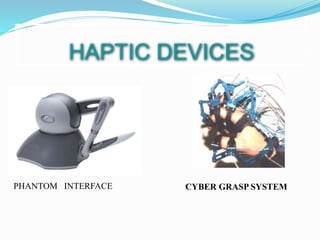
CYBER GRASP SYSTEM
HAPTIC DEVICES
PHANTOM INTERFACE
1. PHANTOM
• providing a 3D touch to the virtual
objects
• provides 6 doff
• when the user move his finger,
then he could really feel the shape
and size of the virtual 3D object
that has been already
programmed
• virtual 3 dimensional space in
which the phantom operates is
called haptic scene
COMMONLY USED HAPTIC
DEVICES
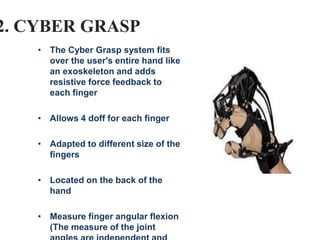
2. CYBER GRASP
• The Cyber Grasp system fits
over the user's entire hand like
an exoskeleton and adds
resistive force feedback to
each finger
• Allows 4 doff for each finger
• Adapted to different size of the
fingers
• Located on the back of the
hand
• Measure finger angular flexion
(The measure of the joint
HAPTIC RENDERING
PRINCIPLE OF HAPTIC INTERFACE
Interaction occurs at an interaction tool that mechanically couples two controlled
dynamical systems :
a) haptic interface with a computer
b) human user with a central nervous system
CHARACTERISTICS
Low back-drive inertia and friction
Balanced range, resolution and bandwidth of position sensing and force reflection,
minimal constraints on motion
Symmetric inertia,friction,stiffness and resonant frequency properties, proper
ergonomics
APPLICATIONS OF
HAPTICS
MEDICAL
APPLICATIONS
•sense of touch is crucial for medical training
•various haptic interfaces for medical simulation may prove
especially useful for training
MILITARY
APPLICATIONS
*For certain applications, for example where terrain or texture
information needs to be conveyed, hap tics may be the most
efficient communication channel.
CONTD…
*feel maps that are displayed on the internet and also learn mathematics by tracing
touchable mathematical course
*most haptic systems still rely heavily on a combined visual/haptic interface
 MUSEUM DISPLAY
for 3D digitization of priceless artifacts and objects from their sculpture and
decorative arts collections, making the images available via CD-ROM
 ASSISTIVE TECHNOLOGY FOR THE BLIND AND
VISUALLY IMPAIRED
* CONTD…
 ENTERTAINMENT
oHap tics is used to enhance gaming experience
osoftware also allows you to program force feedback sensations to your game
controller button press
o"Submarines" is a PHANTOM variant of the well known battleship game
 HOLOGRAPHIC INTERACTION
The feedback allows the user to interact with a hologram and receive tactile response
as if the holographic object were real
Ultrasound waves to create a phenomenon called acoustic radiation pressure which
provides tactile feedback as users interact with the holographic object.
LIMITATIONS
*High cost involved
*Large weight and size of haptic devices (especially wearable
ones)
*Haptic interfaces can only exert forces with limited magnitude
and not equally well in all directions
*haptic-rendering algorithms operate in discrete time whereas
users operate in continuous time
FUTURE VISION
1.Holographic Interaction
The feedback allows the user to interact with a hologram and
actually receive tactile response using acoustic radiation
pressure
2.Medical Application
Use of a central workstation from which surgeons would
perform operations in various locations; with machine setup
and patient preparation performed by local nursing staff
3. Textile Industry
User could study and feel the texture and quality of material
during the sale of cloth through internet
CONCLUSION
*Continued implementation of tactile devices to aid people with
disabilities will advance further
*Currently limited to consumers
*Future generations of mobile devices and game console
accessories will implement more haptic feedback
*Perhaps also in desktop computers and laptops
*Still embryonic when compared to full fledged VR simulations
*
QUERI
ES
AN
Y

Haptic Technology

  • 2.
    *Haptic , isthe technology of adding the sensation of touch and feeling to computers. *When virtual objects are touched, they seem real and tangible. *Haptic senses links to the brain's sensing position and movement of the body by means of sensory nerves within the muscles and joints.
  • 3.
    HAPTICS…??? Derived from Greekword ‘haptikos’ meaning “ABLE TO COME INTO CONTACT WITH” Hap tics = Touch = Connection Touch is at the core of personal experience. Of the five senses, touch is the most proficient, the only one capable of simultaneous input and output
  • 4.
    HISTORY OF HAPTICSScientists usedterm hap tics to label the subfield of their studies that addressed human touch-based perception and manipulation By 70’s and 80’s research efforts in a completely different field, robotics also began to focus on manipulation and perception by touch building a dexterous robotic hand In the early 1990s a new usage of the word hap tics began to emerge The confluence of several emerging technologies made virtualized hap tics, or computer hap tics possible
  • 5.
    BASIC SYSTEM CONFIGURATION 4 3 2 4 3 2 1 1 Endeffector Hand Actuators Muscles Sensors Virtual object MachineHuman Computer hapticsSensors
  • 6.
    Combination Of : Tactile Information  Refers to the information acquired by the sensors connected to the body  Kinesthetic Information Refers to the information acquired by the sensors in the joints
  • 7.
    CREATION OF VIRTUAL ENVIRONMENT VirtualReality  allows user to interact with a computer-simulated environment Users interact with a VR either through input devices or through multimodal devices Simulated environment can be either similar or different from reality Very difficult to create a high fidelity VR experience due to technical limitations Used to describe a wide variety of applications
  • 8.
    TYPES OF HAPTIC DEVICES1)VIRTUAL REALITY/ TELEROBOTICS BASED DEVICES  EXOSKELETONS AND STATIONARY DEVICES  GLOVES AND WEARABLE DEVICES  POINT SOURCES AND SPECIFIC TASK DEVICES  LOCOMOTION INTERFACES 2) FEEDBACK DEVICES  FORCE FEEDBACK DEVICES  TACTILE DISPLAY DEVICES
  • 9.
    CYBER GRASP SYSTEM HAPTICDEVICES PHANTOM INTERFACE
  • 10.
    1. PHANTOM • providinga 3D touch to the virtual objects • provides 6 doff • when the user move his finger, then he could really feel the shape and size of the virtual 3D object that has been already programmed • virtual 3 dimensional space in which the phantom operates is called haptic scene COMMONLY USED HAPTIC DEVICES
  • 12.
    2. CYBER GRASP •The Cyber Grasp system fits over the user's entire hand like an exoskeleton and adds resistive force feedback to each finger • Allows 4 doff for each finger • Adapted to different size of the fingers • Located on the back of the hand • Measure finger angular flexion (The measure of the joint
  • 13.
    HAPTIC RENDERING PRINCIPLE OFHAPTIC INTERFACE Interaction occurs at an interaction tool that mechanically couples two controlled dynamical systems : a) haptic interface with a computer b) human user with a central nervous system CHARACTERISTICS Low back-drive inertia and friction Balanced range, resolution and bandwidth of position sensing and force reflection, minimal constraints on motion Symmetric inertia,friction,stiffness and resonant frequency properties, proper ergonomics
  • 14.
  • 15.
    MEDICAL APPLICATIONS •sense of touchis crucial for medical training •various haptic interfaces for medical simulation may prove especially useful for training MILITARY APPLICATIONS *For certain applications, for example where terrain or texture information needs to be conveyed, hap tics may be the most efficient communication channel.
  • 16.
    CONTD… *feel maps thatare displayed on the internet and also learn mathematics by tracing touchable mathematical course *most haptic systems still rely heavily on a combined visual/haptic interface  MUSEUM DISPLAY for 3D digitization of priceless artifacts and objects from their sculpture and decorative arts collections, making the images available via CD-ROM  ASSISTIVE TECHNOLOGY FOR THE BLIND AND VISUALLY IMPAIRED
  • 17.
    * CONTD…  ENTERTAINMENT oHaptics is used to enhance gaming experience osoftware also allows you to program force feedback sensations to your game controller button press o"Submarines" is a PHANTOM variant of the well known battleship game  HOLOGRAPHIC INTERACTION The feedback allows the user to interact with a hologram and receive tactile response as if the holographic object were real Ultrasound waves to create a phenomenon called acoustic radiation pressure which provides tactile feedback as users interact with the holographic object.
  • 18.
    LIMITATIONS *High cost involved *Largeweight and size of haptic devices (especially wearable ones) *Haptic interfaces can only exert forces with limited magnitude and not equally well in all directions *haptic-rendering algorithms operate in discrete time whereas users operate in continuous time
  • 19.
    FUTURE VISION 1.Holographic Interaction Thefeedback allows the user to interact with a hologram and actually receive tactile response using acoustic radiation pressure 2.Medical Application Use of a central workstation from which surgeons would perform operations in various locations; with machine setup and patient preparation performed by local nursing staff 3. Textile Industry User could study and feel the texture and quality of material during the sale of cloth through internet
  • 20.
    CONCLUSION *Continued implementation oftactile devices to aid people with disabilities will advance further *Currently limited to consumers *Future generations of mobile devices and game console accessories will implement more haptic feedback *Perhaps also in desktop computers and laptops *Still embryonic when compared to full fledged VR simulations
  • 21.
  • 22.