Sardar Patel Memorial Society’s (Trust)
RAJIV GANDHI COLLEGE OF ENGINEERING,
RESEARCH AND TECHNOLOGY,
CHANDRAPUR
Department of Computer Science and Engineering
SEMESTER- III
SESSION-2022-23
A SEMINAR ON
BIOMETRIC TECHNOLOGY
Under the guidance of
Prof. MINAKSHI GETKAR
AND
SEMINAR IN-CHARGE
Prof. RUPATAI LICHODE
Presented By-
GAURAV MANOHAR WANKAR[CSEC322]
CONTENTS:-
 History
 Introduction(What is Biometrics?)
 Role of biometric technology
 Modes of biometric system
 Block Diagram
 Types of biometrics
 Biometrics Devices
 Benefits
 Advantages and Disadvantages
 Applications
 Conclusion
 References
HISTORY:-
 The first real biometric system was created in 1870 by
French anthropologist Alphonse Bertillion and turned
biometrics a distinguished field of study.
 The first classification method for fingerprints was
developed in 1892 by Sir. Francis Galton.
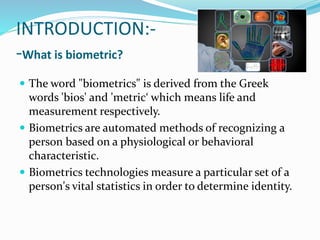
INTRODUCTION:-
-What is biometric?
 The word "biometrics" is derived from the Greek
words 'bios' and 'metric‘ which means life and
measurement respectively.
 Biometrics are automated methods of recognizing a
person based on a physiological or behavioral
characteristic.
 Biometrics technologies measure a particular set of a
person's vital statistics in order to determine identity.
ROLE OF BIOMETRICS TECHNOLOGIES
IN INFORMATION SECURITY:-
• Effective way to prove the true identity of individual
users
• Biometric devices create a more ambiguous and user
friendly environment
• Biometric devices measure unique characteristic of
each person
MODES OF BIOMETRIC SYSTEM:-
 Verification mode:- The system performs a one-to-
one comparison of a captured biometric with a specific
template stored in a biometric database in order to verify
the individual is the person they claim to be.
 Identification mode:- The system performs a one-to-
many comparison against a biometric database in an
attempt to establish the identity of an unknown
individual.
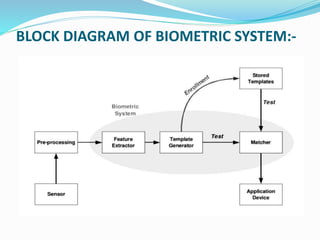
BLOCK DIAGRAM OF BIOMETRIC SYSTEM:-
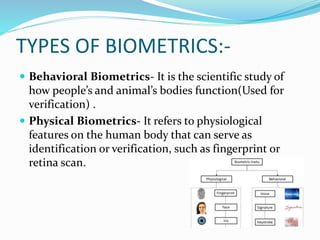
TYPES OF BIOMETRICS:-
 Behavioral Biometrics- It is the scientific study of
how people’s and animal’s bodies function(Used for
verification) .
 Physical Biometrics- It refers to physiological
features on the human body that can serve as
identification or verification, such as fingerprint or
retina scan.
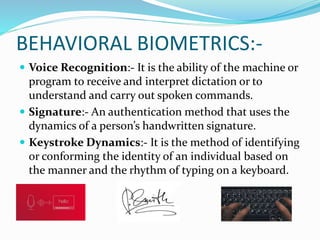
BEHAVIORAL BIOMETRICS:-
 Voice Recognition:- It is the ability of the machine or
program to receive and interpret dictation or to
understand and carry out spoken commands.
 Signature:- An authentication method that uses the
dynamics of a person’s handwritten signature.
 Keystroke Dynamics:- It is the method of identifying
or conforming the identity of an individual based on
the manner and the rhythm of typing on a keyboard.
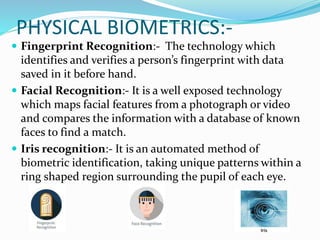
PHYSICAL BIOMETRICS:-
 Fingerprint Recognition:- The technology which
identifies and verifies a person’s fingerprint with data
saved in it before hand.
 Facial Recognition:- It is a well exposed technology
which maps facial features from a photograph or video
and compares the information with a database of known
faces to find a match.
 Iris recognition:- It is an automated method of
biometric identification, taking unique patterns within a
ring shaped region surrounding the pupil of each eye.
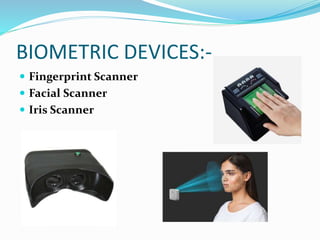
BIOMETRIC DEVICES:-
 Fingerprint Scanner
 Facial Scanner
 Iris Scanner
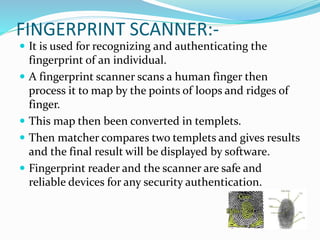
FINGERPRINT SCANNER:-
 It is used for recognizing and authenticating the
fingerprint of an individual.
 A fingerprint scanner scans a human finger then
process it to map by the points of loops and ridges of
finger.
 This map then been converted in templets.
 Then matcher compares two templets and gives results
and the final result will be displayed by software.
 Fingerprint reader and the scanner are safe and
reliable devices for any security authentication.
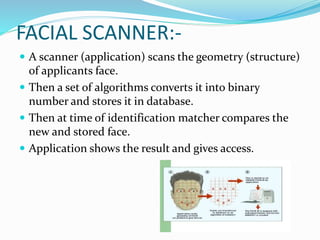
FACIAL SCANNER:-
 A scanner (application) scans the geometry (structure)
of applicants face.
 Then a set of algorithms converts it into binary
number and stores it in database.
 Then at time of identification matcher compares the
new and stored face.
 Application shows the result and gives access.
IRIS SCANNER:-
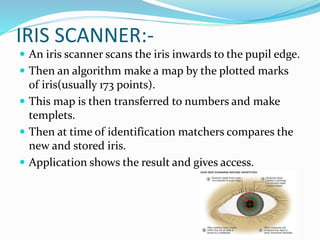
 An iris scanner scans the iris inwards to the pupil edge.
 Then an algorithm make a map by the plotted marks
of iris(usually 173 points).
 This map is then transferred to numbers and make
templets.
 Then at time of identification matchers compares the
new and stored iris.
 Application shows the result and gives access.
BENEFITS OF USING BIOMETRIC SYSTEM OVER
TRADITIONAL AUTHENTICATION SYSTEMS:-
• Invariant: Biometric traits are invariant over time as smart
cards get damaged over time but biometric traits doesn’t.
• Accountability: If there is a security breach, then
biometric ensures who can be the responsible person for
the breach but in traditional methods, smart cards can be
stolen and used by someone else. Hence, accountable
person is easily identifiable now days by using biometric.
• Easy to use: Biometric systems are easy to use.
• Convenient: User doesn’t have to remember passwords,
pins and keep safe the smart cards like before.
• More secure: Biometric trait can’t be stolen or copied.
ADVANTAGES AND DISADVANTAGES
OF BIOMETRIC TECHNOLOGY:-
Advantages:- Disadvantages:-
 High security and assurance –
Biometric identification
provides the answers to
“something a person has and is”
and helps verify identity
 User Experience – Convenient
and fast
 Non-transferrable – Everyone
has access to a unique set of
biometrics
 Spoof-proof – Biometrics are
hard to fake or steal
 Costs – Significant investment
needed in biometrics for
security
 Data breaches – Biometric
databases can still be hacked
 Tracking and data – Biometric
devices like facial recognition
systems can limit privacy for
users
 False positives and inaccuracy –
False rejects and false accepts
can still occur preventing select
users from accessing systems
APPLICATIONS:-
• Banking/Credit
• Computer/ Network Security
• Mobile Phone Security
• Business and Residential Access Control
• Law Enforcement
• Automobile Security/ Access Control
• Military ID
• Hotel Access Control
• Time and Attendance
CONCLUSION:-
 Biometrics can only be limited by limiting one's
imagination.
 Biometric technology is now being used in almost
every area.
 Biometric is a emerging area with many opportunities
for growth.
 Possible in the near future you will not have to
remember PINs and PASSWORD and keys in your
bags or pockets will be things of the past.
REFERENCES:-
www.geeksforgeeks.org/biometric-system-architecture
www.slideshare.net
www.academia.edu
www.studymafia.org
www.javatpoint.com
THANK YOU!!

SEMINAR ON BIOMETRIC TECHNOLOGY.1pptx.pptx

  • 1.
    Sardar Patel MemorialSociety’s (Trust) RAJIV GANDHI COLLEGE OF ENGINEERING, RESEARCH AND TECHNOLOGY, CHANDRAPUR Department of Computer Science and Engineering SEMESTER- III SESSION-2022-23 A SEMINAR ON BIOMETRIC TECHNOLOGY Under the guidance of Prof. MINAKSHI GETKAR AND SEMINAR IN-CHARGE Prof. RUPATAI LICHODE Presented By- GAURAV MANOHAR WANKAR[CSEC322]
  • 2.
    CONTENTS:-  History  Introduction(Whatis Biometrics?)  Role of biometric technology  Modes of biometric system  Block Diagram  Types of biometrics  Biometrics Devices  Benefits  Advantages and Disadvantages  Applications  Conclusion  References
  • 3.
    HISTORY:-  The firstreal biometric system was created in 1870 by French anthropologist Alphonse Bertillion and turned biometrics a distinguished field of study.  The first classification method for fingerprints was developed in 1892 by Sir. Francis Galton.
  • 4.
    INTRODUCTION:- -What is biometric? The word "biometrics" is derived from the Greek words 'bios' and 'metric‘ which means life and measurement respectively.  Biometrics are automated methods of recognizing a person based on a physiological or behavioral characteristic.  Biometrics technologies measure a particular set of a person's vital statistics in order to determine identity.
  • 5.
    ROLE OF BIOMETRICSTECHNOLOGIES IN INFORMATION SECURITY:- • Effective way to prove the true identity of individual users • Biometric devices create a more ambiguous and user friendly environment • Biometric devices measure unique characteristic of each person
  • 6.
    MODES OF BIOMETRICSYSTEM:-  Verification mode:- The system performs a one-to- one comparison of a captured biometric with a specific template stored in a biometric database in order to verify the individual is the person they claim to be.  Identification mode:- The system performs a one-to- many comparison against a biometric database in an attempt to establish the identity of an unknown individual.
  • 7.
    BLOCK DIAGRAM OFBIOMETRIC SYSTEM:-
  • 8.
    TYPES OF BIOMETRICS:- Behavioral Biometrics- It is the scientific study of how people’s and animal’s bodies function(Used for verification) .  Physical Biometrics- It refers to physiological features on the human body that can serve as identification or verification, such as fingerprint or retina scan.
  • 9.
    BEHAVIORAL BIOMETRICS:-  VoiceRecognition:- It is the ability of the machine or program to receive and interpret dictation or to understand and carry out spoken commands.  Signature:- An authentication method that uses the dynamics of a person’s handwritten signature.  Keystroke Dynamics:- It is the method of identifying or conforming the identity of an individual based on the manner and the rhythm of typing on a keyboard.
  • 10.
    PHYSICAL BIOMETRICS:-  FingerprintRecognition:- The technology which identifies and verifies a person’s fingerprint with data saved in it before hand.  Facial Recognition:- It is a well exposed technology which maps facial features from a photograph or video and compares the information with a database of known faces to find a match.  Iris recognition:- It is an automated method of biometric identification, taking unique patterns within a ring shaped region surrounding the pupil of each eye.
  • 11.
    BIOMETRIC DEVICES:-  FingerprintScanner  Facial Scanner  Iris Scanner
  • 12.
    FINGERPRINT SCANNER:-  Itis used for recognizing and authenticating the fingerprint of an individual.  A fingerprint scanner scans a human finger then process it to map by the points of loops and ridges of finger.  This map then been converted in templets.  Then matcher compares two templets and gives results and the final result will be displayed by software.  Fingerprint reader and the scanner are safe and reliable devices for any security authentication.
  • 13.
    FACIAL SCANNER:-  Ascanner (application) scans the geometry (structure) of applicants face.  Then a set of algorithms converts it into binary number and stores it in database.  Then at time of identification matcher compares the new and stored face.  Application shows the result and gives access.
  • 14.
    IRIS SCANNER:-  Aniris scanner scans the iris inwards to the pupil edge.  Then an algorithm make a map by the plotted marks of iris(usually 173 points).  This map is then transferred to numbers and make templets.  Then at time of identification matchers compares the new and stored iris.  Application shows the result and gives access.
  • 15.
    BENEFITS OF USINGBIOMETRIC SYSTEM OVER TRADITIONAL AUTHENTICATION SYSTEMS:- • Invariant: Biometric traits are invariant over time as smart cards get damaged over time but biometric traits doesn’t. • Accountability: If there is a security breach, then biometric ensures who can be the responsible person for the breach but in traditional methods, smart cards can be stolen and used by someone else. Hence, accountable person is easily identifiable now days by using biometric. • Easy to use: Biometric systems are easy to use. • Convenient: User doesn’t have to remember passwords, pins and keep safe the smart cards like before. • More secure: Biometric trait can’t be stolen or copied.
  • 16.
    ADVANTAGES AND DISADVANTAGES OFBIOMETRIC TECHNOLOGY:- Advantages:- Disadvantages:-  High security and assurance – Biometric identification provides the answers to “something a person has and is” and helps verify identity  User Experience – Convenient and fast  Non-transferrable – Everyone has access to a unique set of biometrics  Spoof-proof – Biometrics are hard to fake or steal  Costs – Significant investment needed in biometrics for security  Data breaches – Biometric databases can still be hacked  Tracking and data – Biometric devices like facial recognition systems can limit privacy for users  False positives and inaccuracy – False rejects and false accepts can still occur preventing select users from accessing systems
  • 17.
    APPLICATIONS:- • Banking/Credit • Computer/Network Security • Mobile Phone Security • Business and Residential Access Control • Law Enforcement • Automobile Security/ Access Control • Military ID • Hotel Access Control • Time and Attendance
  • 18.
    CONCLUSION:-  Biometrics canonly be limited by limiting one's imagination.  Biometric technology is now being used in almost every area.  Biometric is a emerging area with many opportunities for growth.  Possible in the near future you will not have to remember PINs and PASSWORD and keys in your bags or pockets will be things of the past.
  • 19.
  • 20.