Vol-1 Issue-4 2015 IJARIIE-ISSN(O)-2395-4396
1295 www.ijariie.com 143
TRIOBIOMETRIC SYSTEM: EFFECTIVE
AND EFFICIENT IDENTITY RECOGNITION
Anooja A
Department of Computer Science
NIMS University, Jaipur
ABSTRACT
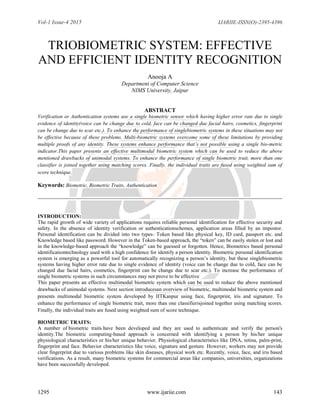
Verification or Authentication systems use a single biometric sensor which having higher error rate due to single
evidence of identity(voice can be change due to cold, face can be changed due facial hairs, cosmetics, fingerprint
can be change due to scar etc.). To enhance the performance of singlebiometric systems in these situations may not
be effective because of these problems. Multi-biometric systems overcome some of these limitations by providing
multiple proofs of any identity. These systems enhance performance that’s not possible using a single bio-metric
indicator.This paper presents an effective multimodal biometric system which can be used to reduce the above
mentioned drawbacks of unimodal systems. To enhance the performance of single biometric trait, more than one
classifier is joined together using matching scores. Finally, the individual traits are fused using weighted sum of
score technique.
Keywords: Biometric, Biometric Traits, Authentication
INTRODUCTION:
The rapid growth of wide variety of applications requires reliable personal identification for effective security and
safety. In the absence of identity verification or authenticationschemes, application areas filled by an impostor.
Personal identification can be divided into two types- Token based like physical key, ID card, passport etc. and
Knowledge based like password. However in the Token-based approach, the “token” can be easily stolen or lost and
in the knowledge-based approach the “knowledge” can be guessed or forgotten. Hence, Biometrics based personal
identificationtechnology used with a high confidence for identify a person identity. Biometric personal identification
system is emerging as a powerful tool for automatically recognizing a person’s identity, but these singlebiometric
systems having higher error rate due to single evidence of identity (voice can be change due to cold, face can be
changed due facial hairs, cosmetics, fingerprint can be change due to scar etc.). To increase the performance of
single biometric systems in such circumstances may not prove to be effective
This paper presents an effective multimodal biometric system which can be used to reduce the above mentioned
drawbacks of unimodal systems. Next section introducesan overview of biometric, multimodal biometric system and
presents multimodal biometric system developed by IITKanpur using face, fingerprint, iris and signature. To
enhance the performance of single biometric trait, more than one classifierisjoined together using matching scores.
Finally, the individual traits are fused using weighted sum of score technique.
BIOMETRIC TRAITS:
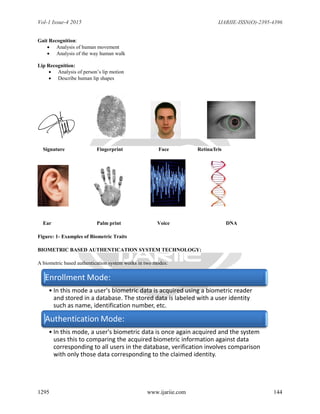
A number of biometric traits have been developed and they are used to authenticate and verify the person's
identity.The biometric computing-based approach is concerned with identifying a person by his/her unique
physiological characteristics or his/her unique behavior. Physiological characteristics like DNA, retina, palm-print,
fingerprint and face. Behavior characteristics like voice, signature and gesture. However, workers may not provide
clear fingerprint due to various problems like skin diseases, physical work etc. Recently, voice, face, and iris based
verifications. As a result, many biometric systems for commercial areas like companies, universities, organizations
have been successfully developed.
Vol-1 Issue-4 2015 IJARIIE-ISSN(O)-2395-4396
1295 www.ijariie.com 144
Gait Recognition:
 Analysis of human movement
 Analysis of the way human walk
Lip Recognition:
 Analysis of person’s lip motion
 Describe human lip shapes
Signature Fingerprint Face Retina/Iris
Ear Palm print Voice DNA
Figure: 1- Examples of Biometric Traits
BIOMETRIC BASED AUTHENTICATION SYSTEM TECHNOLOGY:
A biometric based authentication system works in two modes:
Enrollment Mode:
• In this mode a user's biometric data is acquired using a biometric reader
and stored in a database. The stored data is labeled with a user identity
such as name, identification number, etc.
Authentication Mode:
• In this mode, a user's biometric data is once again acquired and the system
uses this to comparing the acquired biometric information against data
corresponding to all users in the database, verification involves comparison
with only those data corresponding to the claimed identity.
Vol-1 Issue-4 2015 IJARIIE-ISSN(O)-2395-4396
1295 www.ijariie.com 145
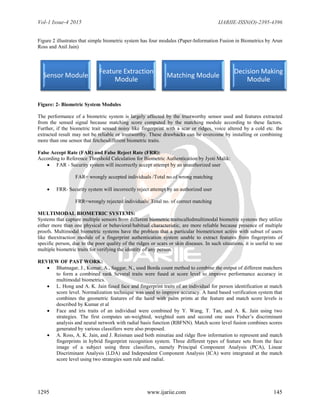
Figure 2 illustrates that simple biometric system has four modules (Paper-Information Fusion in Biometrics by Arun
Ross and Anil Jain)
Figure: 2- Biometric System Modules
The performance of a biometric system is largely affected by the trustworthy sensor used and features extracted
from the sensed signal because matching score computed by the matching module according to these factors.
Further, if the biometric trait sensed noisy like fingerprint with a scar or ridges, voice altered by a cold etc. the
extracted result may not be reliable or trustworthy. These drawbacks can be overcome by installing or combining
more than one sensor that fetchesdifferent biometric traits.
False Accept Rate (FAR) and False Reject Rate (FRR):
According to Reference Threshold Calculation for Biometric Authentication by Jyoti Malik:
 FAR - Security system will incorrectly accept attempt by an unauthorized user
FAR= wrongly accepted individuals /Total no.of wrong matching
 FRR- Security system will incorrectly reject attempt by an authorized user
FRR=wrongly rejected individuals/ Total no. of correct matching
MULTIMODAL BIOMETRIC SYSTEMS:
Systems that capture multiple sensors from different biometric traitscalledmultimodal biometric systems they utilize
either more than one physical or behavioral/habitual characteristic, are more reliable because presence of multiple
proofs. Multimodal biometric systems have the problem that a particular biometricnot active with subset of users
like theextraction module of a fingerprint authentication system unable to extract features from fingerprints of
specific person, due to the poor quality of the ridges or scars or skin diseases. In such situations, it is useful to use
multiple biometric traits for verifying the identity of any person.
REVIEW OF PAST WORK:
 Bhatnagar, J., Kumar, A., Saggar, N., used Borda count method to combine the output of different matchers
to form a combined rank Several traits were fused at score level to improve performance accuracy in
multimodal biometrics.
 L. Hong and A. K. Jain fused face and fingerprint traits of an individual for person identification at match
score level. Normalization technique was used to improve accuracy. A hand based verification system that
combines the geometric features of the hand with palm prints at the feature and match score levels is
described by Kumar et al
 Face and iris traits of an individual were combined by Y. Wang, T. Tan, and A. K. Jain using two
strategies. The first computes un-weighted, weighted sum and second one uses Fisher’s discriminant
analysis and neural network with radial basis function (RBFNN). Match score level fusion combines scores
generated by various classifiers were also proposed.
 A. Ross, A. K. Jain, and J. Reisman used both minutiae and ridge flow information to represent and match
fingerprints in hybrid fingerprint recognition system. Three different types of feature sets from the face
image of a subject using three classifiers, namely Principal Component Analysis (PCA), Linear
Discriminant Analysis (LDA) and Independent Component Analysis (ICA) were integrated at the match
score level using two strategies sum rule and radial.
Sensor Module
Feature Extraction
Module
Matching Module
Decision Making
Module
Vol-1 Issue-4 2015 IJARIIE-ISSN(O)-2395-4396
1295 www.ijariie.com 146
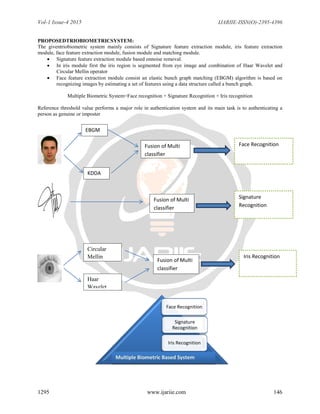
PROPOSEDTRIOBIOMETRICSYSTEM:
The giventriobiometric system mainly consists of Signature feature extraction module, iris feature extraction
module, face feature extraction module, fusion module and matching module.
 Signature feature extraction module based onnoise removal.
 In iris module first the iris region is segmented from eye image and combination of Haar Wavelet and
Circular Mellin operator
 Face feature extraction module consist an elastic bunch graph matching (EBGM) algorithm is based on
recognizing images by estimating a set of features using a data structure called a bunch graph.
Multiple Biometric System=Face recognition + Signature Recognition + Iris recognition
Reference threshold value performs a major role in authentication system and its main task is to authenticating a
person as genuine or imposter
Face Recognition
Signature
Recognition
Iris Recognition
EBGM
KDDA
Fusion of Multi
classifier
Fusion of Multi
classifier
Circular
Mellin
Haar
Wavelet
Fusion of Multi
classifier
Multiple Biometric Based System
Face Recognition
Signature
Recognition
Iris Recognition
Vol-1 Issue-4 2015 IJARIIE-ISSN(O)-2395-4396
1295 www.ijariie.com 147
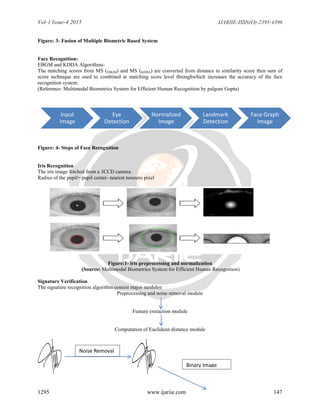
Figure: 3- Fusion of Multiple Biometric Based System
Face Recognition:
EBGM and KDDA Algorithms-
The matching scores from MS (EBGM) and MS (KDDA) are converted from distance to similarity score then sum of
score technique are used to combined at matching score level throughwhich increases the accuracy of the face
recognition system.
(Reference: Multimodal Biometrics System for Efficient Human Recognition by palguni Gupta)
Figure: 4- Steps of Face Recognition
Iris Recognition
The iris image fetched from a 3CCD camera.
Radius of the pupil= pupil center- nearest nonzero pixel
Figure:1- iris preprocessing and normalization
(Source: Multimodal Biometrics System for Efficient Human Recognition)
Signature Verification
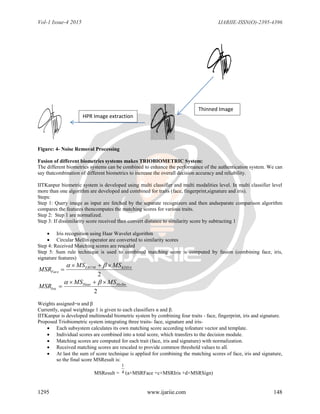
The signature recognition algorithm consist major modules:
Preprocessing and noise removal module
Feature extraction module
Computation of Euclidean distance module
Input
Image
Eye
Detection
Normalized
Image
Landmark
Detection
Face Graph
Image
Noise Removal
Binary Image
Vol-1 Issue-4 2015 IJARIIE-ISSN(O)-2395-4396
1295 www.ijariie.com 148
Figure: 4- Noise Removal Processing
Fusion of different biometrics systems makes TRIOBIOMETRIC System:
The different biometrics systems can be combined to enhance the performance of the authentication system. We can
say thatcombination of different biometrics to increase the overall decision accuracy and reliability.
IITKanpur biometric system is developed using multi classifier and multi modalities level. In multi classifier level
more than one algorithm are developed and combined for traits (face, fingerprint,signature and iris).
Steps:
Step 1: Query image as input are fetched by the separate recognizers and then andseparate comparison algorithm
compares the features thencomputes the matching scores for various traits.
Step 2: Step 1 are normalized.
Step 3: If dissimilarity score received then convert distance to similarity score by subtracting 1
 Iris recognition using Haar Wavelet algorithm
 Circular Mellin operator are converted to similarity scores
Step 4: Received Matching scores are rescaled
Step 5: Sum rule technique is used to combined matching score is computed by fusion (combining face, iris,
signature features)
2
KDDAEBGM
Face
MSMS
MSR



2
MellinHaar
Iris
MSMS
MSR



Weights assigned=α and β
Currently, equal weightage 1 is given to each classifiers α and β.
IITKanpur is developed multimodal biometric system by combining four traits - face, fingerprint, iris and signature.
Proposed Triobiometric system integrating three traits- face, signature and iris-
 Each subsystem calculates its own matching score according tofeature vector and template.
 Individual scores are combined into a total score, which transfers to the decision module.
 Matching scores are computed for each trait (face, iris and signature) with normalization.
 Received matching scores are rescaled to provide common threshold values to all.
 At last the sum of score technique is applied for combining the matching scores of face, iris and signature,
so the final score MSResult is:
MSResult = 4
1
(a×MSRFace +c×MSRIris +d×MSRSign)
Thinned Image
HPR Image extraction
Vol-1 Issue-4 2015 IJARIIE-ISSN(O)-2395-4396
1295 www.ijariie.com 149
MSRFace = matching score of face recognition,
MSRIris = matching score of iris recognition
MSRSign = matching score of signature recognition and a, c and d are the weights assigned to the various traits. At
present, equal weighta one is assigned to each trait a, c and d.
Result:
Table: 1-FAR, FRR and Accuracy Rate (Reference: Multimodal Biometrics System for Efficient Human
Recognition by Phalguni Gupta, aAjita Rattani, aHunny Mehrotra, bAnil Kumar Kaushik)
Multiple classifiers are combined at matching score level for face signature and iris traits. The results are given in
Table 1.
CONCLUSION AND FUTURE IMPLEMENTATIONS:
This paper gives initial results obtained by triobiometric system that uses face, iris and signature features for
biometric verification and authentication which also indicates sum rule performs better than others.Triobiometric
system combines signature, face and iris in terms of good performance, speed and accuracy. Biometrics systems are
used to overcome the problems arise in traditional techniques of authentication. but the single biometric system fails
in various cases. Hence the separate scores of three traits (face, iris and signature) are combined at both levels
classifier and trait to develop a triobiometric system. The table shows that triobiometricsystem effective better
thansingle biometrics with accuracy .However results by assigning different weightage to different traits or User
specific weights helps to solve the problem of traditional techniques or single biometric systems.
REFERENCES:
1. C. H. Daouk, L. A. El-Esber, F. D. Kammoun & M. A. Al-Alaoui, Iris Recognition, Proceedings of the 2nd
IEEE International Symposium on Signal Processing and Information Technology, pp. 558-562, 2002.
2. G. Ravichandran & M. M. Trivedi, Circular-Mellin Features for Texture Segmentation, IEEE Transactions
on Image Processing Vol. 4, pp. 1629-1640, 1995
3. http://www.iitk.ac.in/infocell/iitk/newhtml/storyoftheweek24.html
4. L. Hong, A. Jain & S. Pankanti, Can Multibiometrics Improve performance, Proceedings of AutoID 99, pp.
59-64, 1999.
5. A. Ross & A. K. Jain, Information Fusion in Biometrics, Pattern Recognition Letters, 24 (13), pp. 2115-
2125, 2003.
6. A.S. Tolba & A. A. Rezq, Combined Classifier for Invariant Face Recognition, Pattern Analysis and
Applications, 3(4), pp. 289-302, 2000
7. W. Yunhong, T. Tan & A. K. Jain, Combining Face and Iris Biometrics for Identity Verification,
Proceedings of Fourth International Conference on AVBPA, pp. 805-813, 2003
8. S. C. Dass, K. Nandakumar & A. K. Jain, A principal approach to score level fusion in Multimodal
Biometrics System, Proceedings of ABVPA, 2005
9. D. S. Bolme, J. R. Beveridge, M. L. Teixeira & B. A. Draper, The CSU Face Identification Evaluation
System: Its Purpose, Features and Structure, Proceedings 3rd International Conference on Computer Vision
Systems, 2003.
10. N.K.Ratha, K.Karu, S.Chen & A.K.Jain, A Real-time Matching System for Large Fingerprint Database,
IEEE Transactions on Pattern Analysis and Machine Intelligence, 18 (8), pp. 799-813, 1996
11. J. G. Daugman, High confidence visual recognition of persons by a test of statistical independence, IEEE
Transactions on Pattern Analysis and Machine Intelligence Vol. 15, pp. 1148–1161, 1993
Traits Algorithm FAR (%) FRR (%) Accuracy (%)
Face EBGM and KDDA 0.59 11.49 93.82
Signature Global and Local Features 10 8 91.00
Iris Haar and Circular Mellin
Operator
8.49 0.87 95.37

Biometric systems

  • 1.
    Vol-1 Issue-4 2015IJARIIE-ISSN(O)-2395-4396 1295 www.ijariie.com 143 TRIOBIOMETRIC SYSTEM: EFFECTIVE AND EFFICIENT IDENTITY RECOGNITION Anooja A Department of Computer Science NIMS University, Jaipur ABSTRACT Verification or Authentication systems use a single biometric sensor which having higher error rate due to single evidence of identity(voice can be change due to cold, face can be changed due facial hairs, cosmetics, fingerprint can be change due to scar etc.). To enhance the performance of singlebiometric systems in these situations may not be effective because of these problems. Multi-biometric systems overcome some of these limitations by providing multiple proofs of any identity. These systems enhance performance that’s not possible using a single bio-metric indicator.This paper presents an effective multimodal biometric system which can be used to reduce the above mentioned drawbacks of unimodal systems. To enhance the performance of single biometric trait, more than one classifier is joined together using matching scores. Finally, the individual traits are fused using weighted sum of score technique. Keywords: Biometric, Biometric Traits, Authentication INTRODUCTION: The rapid growth of wide variety of applications requires reliable personal identification for effective security and safety. In the absence of identity verification or authenticationschemes, application areas filled by an impostor. Personal identification can be divided into two types- Token based like physical key, ID card, passport etc. and Knowledge based like password. However in the Token-based approach, the “token” can be easily stolen or lost and in the knowledge-based approach the “knowledge” can be guessed or forgotten. Hence, Biometrics based personal identificationtechnology used with a high confidence for identify a person identity. Biometric personal identification system is emerging as a powerful tool for automatically recognizing a person’s identity, but these singlebiometric systems having higher error rate due to single evidence of identity (voice can be change due to cold, face can be changed due facial hairs, cosmetics, fingerprint can be change due to scar etc.). To increase the performance of single biometric systems in such circumstances may not prove to be effective This paper presents an effective multimodal biometric system which can be used to reduce the above mentioned drawbacks of unimodal systems. Next section introducesan overview of biometric, multimodal biometric system and presents multimodal biometric system developed by IITKanpur using face, fingerprint, iris and signature. To enhance the performance of single biometric trait, more than one classifierisjoined together using matching scores. Finally, the individual traits are fused using weighted sum of score technique. BIOMETRIC TRAITS: A number of biometric traits have been developed and they are used to authenticate and verify the person's identity.The biometric computing-based approach is concerned with identifying a person by his/her unique physiological characteristics or his/her unique behavior. Physiological characteristics like DNA, retina, palm-print, fingerprint and face. Behavior characteristics like voice, signature and gesture. However, workers may not provide clear fingerprint due to various problems like skin diseases, physical work etc. Recently, voice, face, and iris based verifications. As a result, many biometric systems for commercial areas like companies, universities, organizations have been successfully developed.
  • 2.
    Vol-1 Issue-4 2015IJARIIE-ISSN(O)-2395-4396 1295 www.ijariie.com 144 Gait Recognition:  Analysis of human movement  Analysis of the way human walk Lip Recognition:  Analysis of person’s lip motion  Describe human lip shapes Signature Fingerprint Face Retina/Iris Ear Palm print Voice DNA Figure: 1- Examples of Biometric Traits BIOMETRIC BASED AUTHENTICATION SYSTEM TECHNOLOGY: A biometric based authentication system works in two modes: Enrollment Mode: • In this mode a user's biometric data is acquired using a biometric reader and stored in a database. The stored data is labeled with a user identity such as name, identification number, etc. Authentication Mode: • In this mode, a user's biometric data is once again acquired and the system uses this to comparing the acquired biometric information against data corresponding to all users in the database, verification involves comparison with only those data corresponding to the claimed identity.
  • 3.
    Vol-1 Issue-4 2015IJARIIE-ISSN(O)-2395-4396 1295 www.ijariie.com 145 Figure 2 illustrates that simple biometric system has four modules (Paper-Information Fusion in Biometrics by Arun Ross and Anil Jain) Figure: 2- Biometric System Modules The performance of a biometric system is largely affected by the trustworthy sensor used and features extracted from the sensed signal because matching score computed by the matching module according to these factors. Further, if the biometric trait sensed noisy like fingerprint with a scar or ridges, voice altered by a cold etc. the extracted result may not be reliable or trustworthy. These drawbacks can be overcome by installing or combining more than one sensor that fetchesdifferent biometric traits. False Accept Rate (FAR) and False Reject Rate (FRR): According to Reference Threshold Calculation for Biometric Authentication by Jyoti Malik:  FAR - Security system will incorrectly accept attempt by an unauthorized user FAR= wrongly accepted individuals /Total no.of wrong matching  FRR- Security system will incorrectly reject attempt by an authorized user FRR=wrongly rejected individuals/ Total no. of correct matching MULTIMODAL BIOMETRIC SYSTEMS: Systems that capture multiple sensors from different biometric traitscalledmultimodal biometric systems they utilize either more than one physical or behavioral/habitual characteristic, are more reliable because presence of multiple proofs. Multimodal biometric systems have the problem that a particular biometricnot active with subset of users like theextraction module of a fingerprint authentication system unable to extract features from fingerprints of specific person, due to the poor quality of the ridges or scars or skin diseases. In such situations, it is useful to use multiple biometric traits for verifying the identity of any person. REVIEW OF PAST WORK:  Bhatnagar, J., Kumar, A., Saggar, N., used Borda count method to combine the output of different matchers to form a combined rank Several traits were fused at score level to improve performance accuracy in multimodal biometrics.  L. Hong and A. K. Jain fused face and fingerprint traits of an individual for person identification at match score level. Normalization technique was used to improve accuracy. A hand based verification system that combines the geometric features of the hand with palm prints at the feature and match score levels is described by Kumar et al  Face and iris traits of an individual were combined by Y. Wang, T. Tan, and A. K. Jain using two strategies. The first computes un-weighted, weighted sum and second one uses Fisher’s discriminant analysis and neural network with radial basis function (RBFNN). Match score level fusion combines scores generated by various classifiers were also proposed.  A. Ross, A. K. Jain, and J. Reisman used both minutiae and ridge flow information to represent and match fingerprints in hybrid fingerprint recognition system. Three different types of feature sets from the face image of a subject using three classifiers, namely Principal Component Analysis (PCA), Linear Discriminant Analysis (LDA) and Independent Component Analysis (ICA) were integrated at the match score level using two strategies sum rule and radial. Sensor Module Feature Extraction Module Matching Module Decision Making Module
  • 4.
    Vol-1 Issue-4 2015IJARIIE-ISSN(O)-2395-4396 1295 www.ijariie.com 146 PROPOSEDTRIOBIOMETRICSYSTEM: The giventriobiometric system mainly consists of Signature feature extraction module, iris feature extraction module, face feature extraction module, fusion module and matching module.  Signature feature extraction module based onnoise removal.  In iris module first the iris region is segmented from eye image and combination of Haar Wavelet and Circular Mellin operator  Face feature extraction module consist an elastic bunch graph matching (EBGM) algorithm is based on recognizing images by estimating a set of features using a data structure called a bunch graph. Multiple Biometric System=Face recognition + Signature Recognition + Iris recognition Reference threshold value performs a major role in authentication system and its main task is to authenticating a person as genuine or imposter Face Recognition Signature Recognition Iris Recognition EBGM KDDA Fusion of Multi classifier Fusion of Multi classifier Circular Mellin Haar Wavelet Fusion of Multi classifier Multiple Biometric Based System Face Recognition Signature Recognition Iris Recognition
  • 5.
    Vol-1 Issue-4 2015IJARIIE-ISSN(O)-2395-4396 1295 www.ijariie.com 147 Figure: 3- Fusion of Multiple Biometric Based System Face Recognition: EBGM and KDDA Algorithms- The matching scores from MS (EBGM) and MS (KDDA) are converted from distance to similarity score then sum of score technique are used to combined at matching score level throughwhich increases the accuracy of the face recognition system. (Reference: Multimodal Biometrics System for Efficient Human Recognition by palguni Gupta) Figure: 4- Steps of Face Recognition Iris Recognition The iris image fetched from a 3CCD camera. Radius of the pupil= pupil center- nearest nonzero pixel Figure:1- iris preprocessing and normalization (Source: Multimodal Biometrics System for Efficient Human Recognition) Signature Verification The signature recognition algorithm consist major modules: Preprocessing and noise removal module Feature extraction module Computation of Euclidean distance module Input Image Eye Detection Normalized Image Landmark Detection Face Graph Image Noise Removal Binary Image
  • 6.
    Vol-1 Issue-4 2015IJARIIE-ISSN(O)-2395-4396 1295 www.ijariie.com 148 Figure: 4- Noise Removal Processing Fusion of different biometrics systems makes TRIOBIOMETRIC System: The different biometrics systems can be combined to enhance the performance of the authentication system. We can say thatcombination of different biometrics to increase the overall decision accuracy and reliability. IITKanpur biometric system is developed using multi classifier and multi modalities level. In multi classifier level more than one algorithm are developed and combined for traits (face, fingerprint,signature and iris). Steps: Step 1: Query image as input are fetched by the separate recognizers and then andseparate comparison algorithm compares the features thencomputes the matching scores for various traits. Step 2: Step 1 are normalized. Step 3: If dissimilarity score received then convert distance to similarity score by subtracting 1  Iris recognition using Haar Wavelet algorithm  Circular Mellin operator are converted to similarity scores Step 4: Received Matching scores are rescaled Step 5: Sum rule technique is used to combined matching score is computed by fusion (combining face, iris, signature features) 2 KDDAEBGM Face MSMS MSR    2 MellinHaar Iris MSMS MSR    Weights assigned=α and β Currently, equal weightage 1 is given to each classifiers α and β. IITKanpur is developed multimodal biometric system by combining four traits - face, fingerprint, iris and signature. Proposed Triobiometric system integrating three traits- face, signature and iris-  Each subsystem calculates its own matching score according tofeature vector and template.  Individual scores are combined into a total score, which transfers to the decision module.  Matching scores are computed for each trait (face, iris and signature) with normalization.  Received matching scores are rescaled to provide common threshold values to all.  At last the sum of score technique is applied for combining the matching scores of face, iris and signature, so the final score MSResult is: MSResult = 4 1 (a×MSRFace +c×MSRIris +d×MSRSign) Thinned Image HPR Image extraction
  • 7.
    Vol-1 Issue-4 2015IJARIIE-ISSN(O)-2395-4396 1295 www.ijariie.com 149 MSRFace = matching score of face recognition, MSRIris = matching score of iris recognition MSRSign = matching score of signature recognition and a, c and d are the weights assigned to the various traits. At present, equal weighta one is assigned to each trait a, c and d. Result: Table: 1-FAR, FRR and Accuracy Rate (Reference: Multimodal Biometrics System for Efficient Human Recognition by Phalguni Gupta, aAjita Rattani, aHunny Mehrotra, bAnil Kumar Kaushik) Multiple classifiers are combined at matching score level for face signature and iris traits. The results are given in Table 1. CONCLUSION AND FUTURE IMPLEMENTATIONS: This paper gives initial results obtained by triobiometric system that uses face, iris and signature features for biometric verification and authentication which also indicates sum rule performs better than others.Triobiometric system combines signature, face and iris in terms of good performance, speed and accuracy. Biometrics systems are used to overcome the problems arise in traditional techniques of authentication. but the single biometric system fails in various cases. Hence the separate scores of three traits (face, iris and signature) are combined at both levels classifier and trait to develop a triobiometric system. The table shows that triobiometricsystem effective better thansingle biometrics with accuracy .However results by assigning different weightage to different traits or User specific weights helps to solve the problem of traditional techniques or single biometric systems. REFERENCES: 1. C. H. Daouk, L. A. El-Esber, F. D. Kammoun & M. A. Al-Alaoui, Iris Recognition, Proceedings of the 2nd IEEE International Symposium on Signal Processing and Information Technology, pp. 558-562, 2002. 2. G. Ravichandran & M. M. Trivedi, Circular-Mellin Features for Texture Segmentation, IEEE Transactions on Image Processing Vol. 4, pp. 1629-1640, 1995 3. http://www.iitk.ac.in/infocell/iitk/newhtml/storyoftheweek24.html 4. L. Hong, A. Jain & S. Pankanti, Can Multibiometrics Improve performance, Proceedings of AutoID 99, pp. 59-64, 1999. 5. A. Ross & A. K. Jain, Information Fusion in Biometrics, Pattern Recognition Letters, 24 (13), pp. 2115- 2125, 2003. 6. A.S. Tolba & A. A. Rezq, Combined Classifier for Invariant Face Recognition, Pattern Analysis and Applications, 3(4), pp. 289-302, 2000 7. W. Yunhong, T. Tan & A. K. Jain, Combining Face and Iris Biometrics for Identity Verification, Proceedings of Fourth International Conference on AVBPA, pp. 805-813, 2003 8. S. C. Dass, K. Nandakumar & A. K. Jain, A principal approach to score level fusion in Multimodal Biometrics System, Proceedings of ABVPA, 2005 9. D. S. Bolme, J. R. Beveridge, M. L. Teixeira & B. A. Draper, The CSU Face Identification Evaluation System: Its Purpose, Features and Structure, Proceedings 3rd International Conference on Computer Vision Systems, 2003. 10. N.K.Ratha, K.Karu, S.Chen & A.K.Jain, A Real-time Matching System for Large Fingerprint Database, IEEE Transactions on Pattern Analysis and Machine Intelligence, 18 (8), pp. 799-813, 1996 11. J. G. Daugman, High confidence visual recognition of persons by a test of statistical independence, IEEE Transactions on Pattern Analysis and Machine Intelligence Vol. 15, pp. 1148–1161, 1993 Traits Algorithm FAR (%) FRR (%) Accuracy (%) Face EBGM and KDDA 0.59 11.49 93.82 Signature Global and Local Features 10 8 91.00 Iris Haar and Circular Mellin Operator 8.49 0.87 95.37