ACHPER CONFERENCE BRISBANE 15/08/2014
Dr Mark McKean ‐ USC 1
Dr Mark McKean PhD CSCS AEP RSCC*E
SEVEN COMMON MOVEMENTS AS A SCREENING
TOOL FOR MOVEMENT COMPETENCY
RESEARCH TEAM
Dr Mark McKean (USC)
Claire Tompsett (Honours student)
Professor Brendan Burkett (USC)
Chris Turner
Kelvin Giles (Adjunct Sports Scientist USC, Movement 
Dynamics UK)
BACKGROUND
Over the last decade there has been a noticeable 
increase in the obesity levels of Australian children
Many children are showing risk factors associated with 
heart disease such as high blood pressure, increased 
cholesterol and obesity
These risk factors were previously only apparent in 
middle aged Australians
PHYSICAL LITERACY
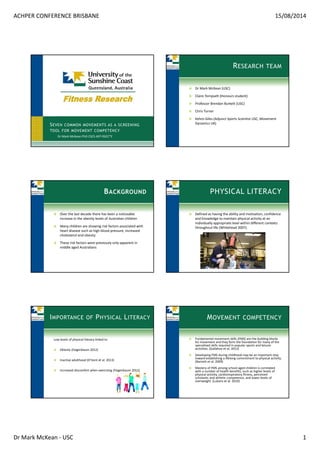
Defined as having the ability and motivation, confidence 
and knowledge to maintain physical activity at an 
individually appropriate level within different contexts 
throughout life (Whitehead 2007). 
IMPORTANCE OF PHYSICAL LITERACY
Low levels of physical literacy linked to
Obesity (Faigenbaum 2012) 
Inactive adulthood (D’Hont et al. 2013) 
Increased discomfort when exercising (Faigenbaum 2012) 
MOVEMENT COMPETENCY
Fundamental movement skills (FMS) are the building blocks 
for movement and they form the foundation for many of the 
specialised skills required in popular sports and leisure 
activities. (Gallahue et al. 2012)
Developing FMS during childhood may be an important step 
toward establishing a lifelong commitment to physical activity. 
(Barnett et al. 2009)
Mastery of FMS among school‐aged children is correlated 
with a number of health benefits, such as higher levels of 
physical activity, cardiorespiratory fitness, perceived 
scholastic and athletic competence, and lower levels of 
overweight. (Lubans et al. 2010)
ACHPER CONFERENCE BRISBANE 15/08/2014
Dr Mark McKean ‐ USC 2
BACKGROUND
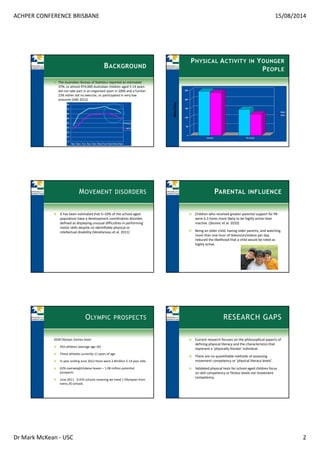
The Australian Bureau of Statistics reported an estimated 
37%, or almost 974,000 Australian children aged 5‐14 years 
did not take part in an organised sport in 2006 and a further 
23% either did no exercise, or participated in very low 
amounts (ABS 2012)
PHYSICAL ACTIVITY IN YOUNGER
PEOPLE
Mins/day
MOVEMENT DISORDERS
It has been estimated that 5–10% of the school‐aged 
population have a development coordination disorder, 
defined as displaying unusual difficulties in performing 
motor skills despite no identifiable physical or 
intellectual disability (Venetansou et al. 2011)
PARENTAL INFLUENCE
Children who received greater parental support for PA 
were 6.3 times more likely to be highly active than 
inactive. (Zecevic et al. 2010)
Being an older child, having older parents, and watching 
more than one hour of television/videos per day 
reduced the likelihood that a child would be rated as 
highly active.
OLYMPIC PROSPECTS
2028 Olympic Games team
450 athletes (average age 26)
These athletes currently 11 years of age
In year ending June 2012 there were 2.8million 5‐14 year olds 
63% overweight/obese leaves – 1.08 million potential 
prospects
June 2011 ‐ 9,435 schools meaning we need 1 Olympian from 
every 20 schools
RESEARCH GAPS
Current research focuses on the philosophical aspects of 
defining physical literacy and the characteristics that 
represent a ‘physically literate’ individual.
There are no quantifiable methods of assessing 
movement competency or ‘physical literacy levels’.
Validated physical tests for school‐aged children focus 
on skill competency or fitness levels not movement 
competency. 
ACHPER CONFERENCE BRISBANE 15/08/2014
Dr Mark McKean ‐ USC 3
MULTI-LAYERED PROJECT
Assessing movement competency in primary school 
aged children
Comparing movement competency with Skill 
competency
Determining reliability of screening criteria 
Assess movement competency in children using a 
range of tests
7 movements
Get Active skills 
What is correlation between movement 
competency and skill literacy
Can performance in these movement competency 
tests be related to certain lifestyle factors such as 
level of physical activity
AIMS AND OBJECTIVES
METHODS
Included
1200 primary school participants ‐ Qld 
150 primary school participants in NSW
Collection of anthropometric data including height 
and weight to determine BMI. 
Objective measurement of the  7 movement 
competencies’ and other tests
Survey ascertaining lifestyle factors 
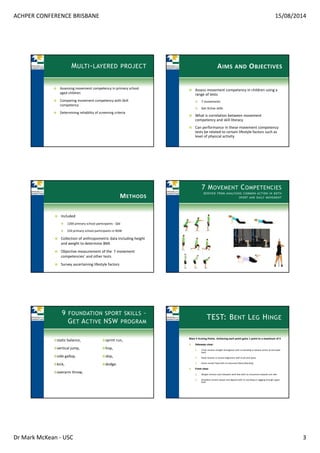
7 MOVEMENT COMPETENCIES
DERIVED FROM ANALYSING COMMON ACTION IN BOTH
SPORT AND DAILY MOVEMENT
9 FOUNDATION SPORT SKILLS –
GET ACTIVE NSW PROGRAM
static balance, 
vertical jump, 
side gallop, 
kick, 
overarm throw, 
sprint run, 
hop, 
skip, 
dodge. 
TEST: BENT LEG HINGE
Main 5 Scoring Points. Achieving each point gains 1 point to a maximum of 5 
Sideways view:
Trunk remains straight throughout with no bending or banana action at the lower 
back. 
Head remains in neutral alignment with trunk and spine. 
Knees remain fixed with no excessive flexion/bending
Front view:
Weight remains even between both feet with no movement towards one side
Shoulders remain square and aligned with no rounding or sagging through upper 
back
ACHPER CONFERENCE BRISBANE 15/08/2014
Dr Mark McKean ‐ USC 4
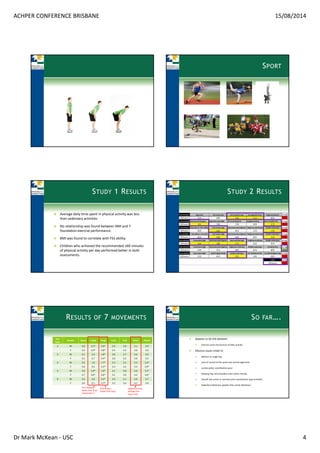
SPORT
STUDY 1 RESULTS
Average daily time spent in physical activity was less 
than sedentary activities
No relationship was found between BMI and 7 
foundation exercise performance.
BMI was found to correlate with FSS ability. 
Children who achieved the recommended ≥60 minutes 
of physical activity per day performed better in both 
assessments. 
STUDY 2 RESULTS
RESULTS OF 7 MOVEMENTS
Year 
level
Gender Squat Lunge Hinge Push Pull Brace  Rotate
2 M 3.0 3.1* 2.0* 2.6 2.0 3.1 2.9
F 3.3 2.2* 2.8* 2.5 2.3 3.0 2.9
3 M 3.1 2.4 1.8* 3.0 2.7 3.6 2.0
F 3.1 2.7 2.4* 2.9 2.5 3.9 2.5
4 M 2.6 1.9 1.7* 2.3 2.2 3.3 2.2*
F 2.6 2.2 2.3* 2.3 2.2 3.3 2.9*
5 M 3.0 1.8* 1.9* 3.1 3.0 4.0 3.1*
F 2.7 2.6* 2.6* 3.1 3.0 4.2 3.6*
6 M 3.3 3.0 2.2* 3.4 3.1 4.0 3.7
F 3.0 3.1 2.7* 3.2 3.0 4.1 3.9
Girls always 
better than boys
Highest scoring 
perhaps too 
easy a test
Girls always 
better than boys 
except year 2
SO FAR….
Appears to be link between 
Exercise score and amount of daily activity
Obvious issues relate to
Balance on single leg
Lack of control of the spine and normal alignment
Lumbo‐pelvic coordination poor
Keeping hips and shoulders even when moving
Overall low scores in common joint coordination type activities. 
Sedentary behaviour greater than active behaviour
ACHPER CONFERENCE BRISBANE 15/08/2014
Dr Mark McKean ‐ USC 5
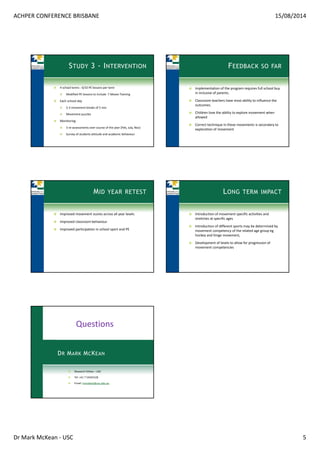
STUDY 3 - INTERVENTION
4 school terms ‐ 6/10 PE lessons per term
Modified PE lessons to include  7 Moves Training
Each school day
2‐3 movement breaks of 5 min
Movement puzzles
Monitoring 
3 re‐assessments over course of the year (Feb, July, Nov)
Survey of students attitude and academic behaviour
FEEDBACK SO FAR
Implementation of the program requires full school buy 
in inclusive of parents.
Classroom teachers have most ability to influence the 
outcomes.
Children love the ability to explore movement when 
allowed
Correct technique in these movements is secondary to 
exploration of movement
MID YEAR RETEST
Improved movement scores across all year levels
Improved classroom behaviour
Improved participation in school sport and PE
LONG TERM IMPACT
Introduction of movement specific activities and 
stretches at specific ages
Introduction of different sports may be determined by 
movement competency of the related age group eg 
hockey and hinge movement, 
Development of levels to allow for progression of 
movement competencies 
DR MARK MCKEAN
Research Fellow – USC
Tel: +61 7 54565528
Email: mmckean@usc.edu.au
Questions

Movement competency presentation ACHPER 2014 conference

  • 1.
    ACHPER CONFERENCE BRISBANE 15/08/2014 Dr Mark McKean ‐ USC1 Dr Mark McKean PhD CSCS AEP RSCC*E SEVEN COMMON MOVEMENTS AS A SCREENING TOOL FOR MOVEMENT COMPETENCY RESEARCH TEAM Dr Mark McKean (USC) Claire Tompsett (Honours student) Professor Brendan Burkett (USC) Chris Turner Kelvin Giles (Adjunct Sports Scientist USC, Movement  Dynamics UK) BACKGROUND Over the last decade there has been a noticeable  increase in the obesity levels of Australian children Many children are showing risk factors associated with  heart disease such as high blood pressure, increased  cholesterol and obesity These risk factors were previously only apparent in  middle aged Australians PHYSICAL LITERACY Defined as having the ability and motivation, confidence  and knowledge to maintain physical activity at an  individually appropriate level within different contexts  throughout life (Whitehead 2007).  IMPORTANCE OF PHYSICAL LITERACY Low levels of physical literacy linked to Obesity (Faigenbaum 2012)  Inactive adulthood (D’Hont et al. 2013)  Increased discomfort when exercising (Faigenbaum 2012)  MOVEMENT COMPETENCY Fundamental movement skills (FMS) are the building blocks  for movement and they form the foundation for many of the  specialised skills required in popular sports and leisure  activities. (Gallahue et al. 2012) Developing FMS during childhood may be an important step  toward establishing a lifelong commitment to physical activity.  (Barnett et al. 2009) Mastery of FMS among school‐aged children is correlated  with a number of health benefits, such as higher levels of  physical activity, cardiorespiratory fitness, perceived  scholastic and athletic competence, and lower levels of  overweight. (Lubans et al. 2010)
  • 2.
    ACHPER CONFERENCE BRISBANE 15/08/2014 Dr Mark McKean ‐ USC2 BACKGROUND The Australian Bureau of Statistics reported an estimated  37%, or almost 974,000 Australian children aged 5‐14 years  did not take part in an organised sport in 2006 and a further  23% either did no exercise, or participated in very low  amounts (ABS 2012) PHYSICAL ACTIVITY IN YOUNGER PEOPLE Mins/day MOVEMENT DISORDERS It has been estimated that 5–10% of the school‐aged  population have a development coordination disorder,  defined as displaying unusual difficulties in performing  motor skills despite no identifiable physical or  intellectual disability (Venetansou et al. 2011) PARENTAL INFLUENCE Children who received greater parental support for PA  were 6.3 times more likely to be highly active than  inactive. (Zecevic et al. 2010) Being an older child, having older parents, and watching  more than one hour of television/videos per day  reduced the likelihood that a child would be rated as  highly active. OLYMPIC PROSPECTS 2028 Olympic Games team 450 athletes (average age 26) These athletes currently 11 years of age In year ending June 2012 there were 2.8million 5‐14 year olds  63% overweight/obese leaves – 1.08 million potential  prospects June 2011 ‐ 9,435 schools meaning we need 1 Olympian from  every 20 schools RESEARCH GAPS Current research focuses on the philosophical aspects of  defining physical literacy and the characteristics that  represent a ‘physically literate’ individual. There are no quantifiable methods of assessing  movement competency or ‘physical literacy levels’. Validated physical tests for school‐aged children focus  on skill competency or fitness levels not movement  competency. 
  • 3.
    ACHPER CONFERENCE BRISBANE 15/08/2014 Dr Mark McKean ‐ USC3 MULTI-LAYERED PROJECT Assessing movement competency in primary school  aged children Comparing movement competency with Skill  competency Determining reliability of screening criteria  Assess movement competency in children using a  range of tests 7 movements Get Active skills  What is correlation between movement  competency and skill literacy Can performance in these movement competency  tests be related to certain lifestyle factors such as  level of physical activity AIMS AND OBJECTIVES METHODS Included 1200 primary school participants ‐ Qld  150 primary school participants in NSW Collection of anthropometric data including height  and weight to determine BMI.  Objective measurement of the  7 movement  competencies’ and other tests Survey ascertaining lifestyle factors  7 MOVEMENT COMPETENCIES DERIVED FROM ANALYSING COMMON ACTION IN BOTH SPORT AND DAILY MOVEMENT 9 FOUNDATION SPORT SKILLS – GET ACTIVE NSW PROGRAM static balance,  vertical jump,  side gallop,  kick,  overarm throw,  sprint run,  hop,  skip,  dodge.  TEST: BENT LEG HINGE Main 5 Scoring Points. Achieving each point gains 1 point to a maximum of 5  Sideways view: Trunk remains straight throughout with no bending or banana action at the lower  back.  Head remains in neutral alignment with trunk and spine.  Knees remain fixed with no excessive flexion/bending Front view: Weight remains even between both feet with no movement towards one side Shoulders remain square and aligned with no rounding or sagging through upper  back
  • 4.
    ACHPER CONFERENCE BRISBANE 15/08/2014 Dr Mark McKean ‐ USC4 SPORT STUDY 1 RESULTS Average daily time spent in physical activity was less  than sedentary activities No relationship was found between BMI and 7  foundation exercise performance. BMI was found to correlate with FSS ability.  Children who achieved the recommended ≥60 minutes  of physical activity per day performed better in both  assessments.  STUDY 2 RESULTS RESULTS OF 7 MOVEMENTS Year  level Gender Squat Lunge Hinge Push Pull Brace  Rotate 2 M 3.0 3.1* 2.0* 2.6 2.0 3.1 2.9 F 3.3 2.2* 2.8* 2.5 2.3 3.0 2.9 3 M 3.1 2.4 1.8* 3.0 2.7 3.6 2.0 F 3.1 2.7 2.4* 2.9 2.5 3.9 2.5 4 M 2.6 1.9 1.7* 2.3 2.2 3.3 2.2* F 2.6 2.2 2.3* 2.3 2.2 3.3 2.9* 5 M 3.0 1.8* 1.9* 3.1 3.0 4.0 3.1* F 2.7 2.6* 2.6* 3.1 3.0 4.2 3.6* 6 M 3.3 3.0 2.2* 3.4 3.1 4.0 3.7 F 3.0 3.1 2.7* 3.2 3.0 4.1 3.9 Girls always  better than boys Highest scoring  perhaps too  easy a test Girls always  better than boys  except year 2 SO FAR…. Appears to be link between  Exercise score and amount of daily activity Obvious issues relate to Balance on single leg Lack of control of the spine and normal alignment Lumbo‐pelvic coordination poor Keeping hips and shoulders even when moving Overall low scores in common joint coordination type activities.  Sedentary behaviour greater than active behaviour
  • 5.
    ACHPER CONFERENCE BRISBANE 15/08/2014 Dr Mark McKean ‐ USC5 STUDY 3 - INTERVENTION 4 school terms ‐ 6/10 PE lessons per term Modified PE lessons to include  7 Moves Training Each school day 2‐3 movement breaks of 5 min Movement puzzles Monitoring  3 re‐assessments over course of the year (Feb, July, Nov) Survey of students attitude and academic behaviour FEEDBACK SO FAR Implementation of the program requires full school buy  in inclusive of parents. Classroom teachers have most ability to influence the  outcomes. Children love the ability to explore movement when  allowed Correct technique in these movements is secondary to  exploration of movement MID YEAR RETEST Improved movement scores across all year levels Improved classroom behaviour Improved participation in school sport and PE LONG TERM IMPACT Introduction of movement specific activities and  stretches at specific ages Introduction of different sports may be determined by  movement competency of the related age group eg  hockey and hinge movement,  Development of levels to allow for progression of  movement competencies  DR MARK MCKEAN Research Fellow – USC Tel: +61 7 54565528 Email: mmckean@usc.edu.au Questions