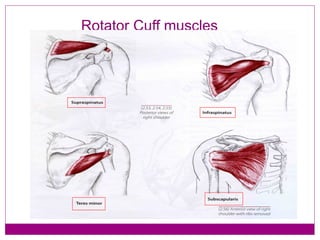
Rotator Cuff muscles
Rotator cuff
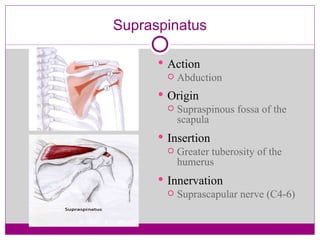
Supraspinatus Action Abduction Origin Supraspinous fossa of the scapula Insertion Greater tuberosity of the humerus Innervation Suprascapular nerve (C4-6)
Supraspinatus Prone Locate the  spine of scapula Slide fingers up into the  supraspinous fossa Palpate through the trapezius  Follow the belly laterally until it tucks under the  acromion Ask pt. alternately abducting slightly and relaxing the shoulder.
Rotator cuff tendons - supraspinatus Supine or seated with the arm at the side of the body Locate the  acromion  and slide inferiorly onto the surface of the  greater tubercle Sink your thumb tip through the deltoid fibeers
Rotator cuff tendons - supraspinatus Seated  Place pt’s  arm behind her back Passively  extend the arm  as far as is comfortable This position brings the supraspinatus tendon out from under acromion,  just anterior and inferior to the AC joint
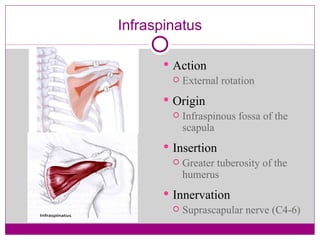
Infraspinatus Action External rotation Origin Infraspinous fossa of the scapula Insertion Greater tuberosity of the humerus Innervation Suprascapular nerve (C4-6)
Infraspinatus Prone with forearm off the side of the table Locate the  spine, med. border  and  lat. border of the scapula Form a triangle around the infraspinatus Palpate in the triangle Follow laterally to the humerus Ask pt. to raise his elbow toward ceiling and relax.
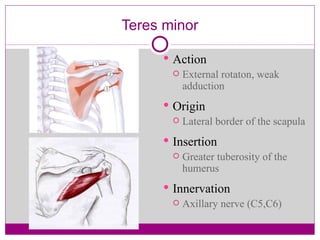
Teres minor Action External rotaton, weak adduction Origin Lateral border of the scapula Insertion Greater tuberosity of the humerus Innervation Axillary nerve (C5,C6)
Teres minor Prone with the arm off the side of the table Locate the  lat. border of the scapula ; specifically its  superior half .   Slide laterally off the lat. border onto the surface of the teres minor Reach your thumb up into the axilla and grasp the belly of the teres minor Ask pt. to laterlly rotate his shouder.
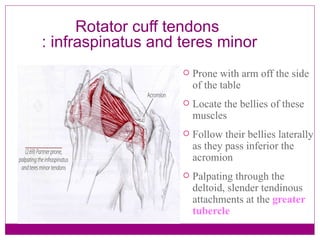
Rotator cuff tendons   : infraspinatus and teres minor  Prone with arm off the side of the table Locate the bellies of these muscles Follow their bellies laterally as they pass inferior the acromion Palpating through the deltoid, slender tendinous attachments at the  greater tubercle
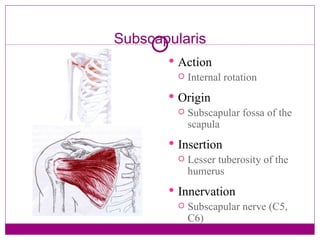
Subscapularis Action Internal rotation Origin Subscapular fossa of the scapula Insertion Lesser tuberosity of the humerus Innervation Subscapular nerve (C5, C6)
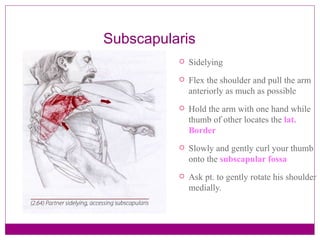
Subscapularis Sidelying Flex the shoulder and pull the arm anteriorly as much as possible Hold the arm with one hand while thumb of other locates the  lat. Border Slowly and gently curl your thumb onto the  subscapular fossa Ask pt. to gently rotate his shoulder medially.
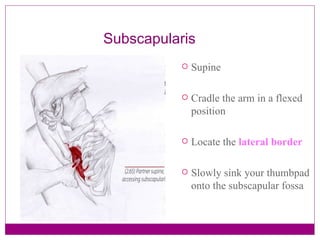
Subscapularis Supine  Cradle the arm in a flexed position Locate the  lateral border Slowly sink your thumbpad onto the subscapular fossa
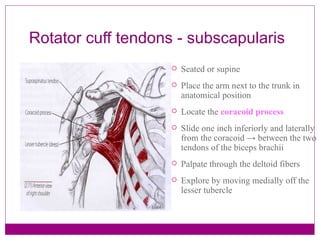
Rotator cuff tendons - subscapularis Seated or supine Place the arm next to the trunk in anatomical position Locate the  coracoid process   Slide one inch inferiorly and laterally from the coracoid -> between the two tendons of the biceps brachii Palpate through the deltoid fibers Explore by moving medially off the lesser tubercle
Ligaments of shoulder and glenohumeral joint
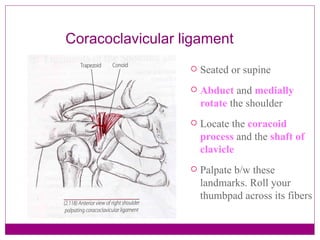
Coracoclavicular ligament Seated or supine Abduct  and  medially rotate  the shoulder Locate the  coracoid process   and the  shaft of clavicle Palpate b/w these landmarks. Roll your thumbpad across its fibers
Coracoacromial ligament Supine or seated  Locate  coracoid process . Then locate the  ant. edge of the acromion Palpating deep to the deltoid fibers, explore b/w these landmarks for the wide band of the coracoacromial ligament To bring the ligament closer to the surface, try  extending the arm
Subacromial bursa With pt seated,  stand behind  him and locate the acromion Drop your fingers off the  ant. edge of the acromion Slowly  extend  the pt’s shoulder by pulling the elbow posteriorly You will palpate at the depth b/w the deltoid and rotator cuff tendons Palpate gently. Bursae are delicate structures and best accessed with a soft touch

Shoulder & Arm 3

  • 1.
  • 2.
  • 3.
    Supraspinatus Action AbductionOrigin Supraspinous fossa of the scapula Insertion Greater tuberosity of the humerus Innervation Suprascapular nerve (C4-6)
  • 4.
    Supraspinatus Prone Locatethe spine of scapula Slide fingers up into the supraspinous fossa Palpate through the trapezius Follow the belly laterally until it tucks under the acromion Ask pt. alternately abducting slightly and relaxing the shoulder.
  • 5.
    Rotator cuff tendons- supraspinatus Supine or seated with the arm at the side of the body Locate the acromion and slide inferiorly onto the surface of the greater tubercle Sink your thumb tip through the deltoid fibeers
  • 6.
    Rotator cuff tendons- supraspinatus Seated Place pt’s arm behind her back Passively extend the arm as far as is comfortable This position brings the supraspinatus tendon out from under acromion, just anterior and inferior to the AC joint
  • 7.
    Infraspinatus Action Externalrotation Origin Infraspinous fossa of the scapula Insertion Greater tuberosity of the humerus Innervation Suprascapular nerve (C4-6)
  • 8.
    Infraspinatus Prone withforearm off the side of the table Locate the spine, med. border and lat. border of the scapula Form a triangle around the infraspinatus Palpate in the triangle Follow laterally to the humerus Ask pt. to raise his elbow toward ceiling and relax.
  • 9.
    Teres minor ActionExternal rotaton, weak adduction Origin Lateral border of the scapula Insertion Greater tuberosity of the humerus Innervation Axillary nerve (C5,C6)
  • 10.
    Teres minor Pronewith the arm off the side of the table Locate the lat. border of the scapula ; specifically its superior half . Slide laterally off the lat. border onto the surface of the teres minor Reach your thumb up into the axilla and grasp the belly of the teres minor Ask pt. to laterlly rotate his shouder.
  • 11.
    Rotator cuff tendons : infraspinatus and teres minor Prone with arm off the side of the table Locate the bellies of these muscles Follow their bellies laterally as they pass inferior the acromion Palpating through the deltoid, slender tendinous attachments at the greater tubercle
  • 12.
    Subscapularis Action Internalrotation Origin Subscapular fossa of the scapula Insertion Lesser tuberosity of the humerus Innervation Subscapular nerve (C5, C6)
  • 13.
    Subscapularis Sidelying Flexthe shoulder and pull the arm anteriorly as much as possible Hold the arm with one hand while thumb of other locates the lat. Border Slowly and gently curl your thumb onto the subscapular fossa Ask pt. to gently rotate his shoulder medially.
  • 14.
    Subscapularis Supine Cradle the arm in a flexed position Locate the lateral border Slowly sink your thumbpad onto the subscapular fossa
  • 15.
    Rotator cuff tendons- subscapularis Seated or supine Place the arm next to the trunk in anatomical position Locate the coracoid process Slide one inch inferiorly and laterally from the coracoid -> between the two tendons of the biceps brachii Palpate through the deltoid fibers Explore by moving medially off the lesser tubercle
  • 16.
    Ligaments of shoulderand glenohumeral joint
  • 17.
    Ligaments of shoulderand glenohumeral joint
  • 18.
    Coracoclavicular ligament Seatedor supine Abduct and medially rotate the shoulder Locate the coracoid process and the shaft of clavicle Palpate b/w these landmarks. Roll your thumbpad across its fibers
  • 19.
    Coracoacromial ligament Supineor seated Locate coracoid process . Then locate the ant. edge of the acromion Palpating deep to the deltoid fibers, explore b/w these landmarks for the wide band of the coracoacromial ligament To bring the ligament closer to the surface, try extending the arm
  • 20.
    Subacromial bursa Withpt seated, stand behind him and locate the acromion Drop your fingers off the ant. edge of the acromion Slowly extend the pt’s shoulder by pulling the elbow posteriorly You will palpate at the depth b/w the deltoid and rotator cuff tendons Palpate gently. Bursae are delicate structures and best accessed with a soft touch