PATHFIT 1
PHYSICAL ACTIVITY
TOWARDS HEALTH
AND FITNESS
How do you define:
 PHYSICAL EDUCATION-Physical Education is "education
through the physical".
PHYSICAL FITNESS -Physical fitness means the body is healthy,
flexible, strong, and doesn't get tired easily. Fitness affects the entire
body - heart, lungs, bones, muscles - each body function works
together.
HEALTH - The World Health Organization (WHO) defines health
as a state of complete physical, mental and social wellbeing
and not merely the absence of disease or infirmity'.
What is the relationship between PHYSICAL
FITNESS and HEALTH?
 Regular physical activity is proven
to help prevent and manage non-
communicable diseases such as
heart disease, stroke, diabetes, and
several cancers. It also improves
mental health, quality of life, and
well-being.
The importance of PATHFIT?
 Regular exercise and physical
activity promotes strong muscles and bones.
 It improves respiratory, cardiovascular health
and overall health.
 Staying active can also help you maintain a
healthy weight, reduce your risk for type 2
diabetes, heart disease, and reduce your risk
for some cancers.
Components of PHYSICAL
EDUCATION:
• MASCULAR STRENGTH
• CARDIOVASCULAR ENDURANCE
• MASCULAR ENDURANCE
• FLEXIBILITY
• BODY COMPOSITION
Importance of
components of PE.
 In the short term, the 5 components of physical
fitness can help improve our quality of life.

In the long term, we can support healthy living
and disease control.
 It helps us to stay in shape, reduce the risk of
illness, and increase our energy levels.
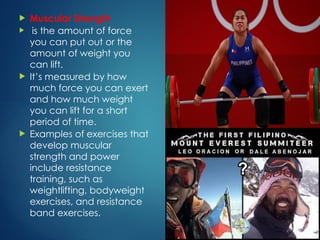
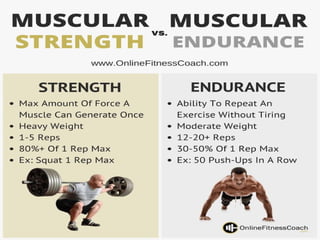
 Muscular Strength
 is the amount of force
you can put out or the
amount of weight you
can lift.
 It’s measured by how
much force you can exert
and how much weight
you can lift for a short
period of time.
 Examples of exercises that
develop muscular
strength and power
include resistance
training, such as
weightlifting, bodyweight
exercises, and resistance
band exercises.
 Cardiovascular
Endurance - is a
measure of how well
you can do exercises
that involve your
whole body at
moderate to high
intensity for an
extended time
 The ability to
exercise without
becoming overly
tired because your
heart, lungs and
blood vessels are
healthy.
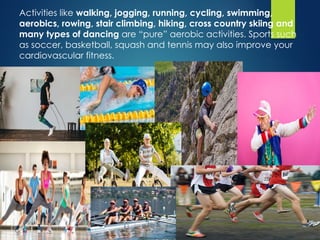
Activities like walking, jogging, running, cycling, swimming,
aerobics, rowing, stair climbing, hiking, cross country skiing and
many types of dancing are “pure” aerobic activities. Sports such
as soccer, basketball, squash and tennis may also improve your
cardiovascular fitness.
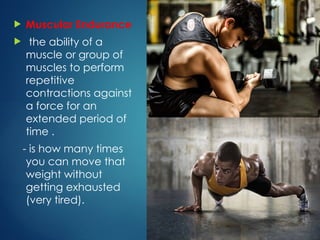
 Muscular Endurance
 the ability of a
muscle or group of
muscles to perform
repetitive
contractions against
a force for an
extended period of
time .
- is how many times
you can move that
weight without
getting exhausted
(very tired).
 Flexibility
 "the absolute range of
movement in a joint or series of
joints that is attainable in a
momentary effort with the help of
a partner or a piece of
equipment.“
 The range of movement possible
at various joints
 Flexibility refers to the ability
of each joint to express its
full range of motion.
 Flexibility can be tested by
stretching individual
muscles or by performing
exercises such as the lunge
or the sit and reach
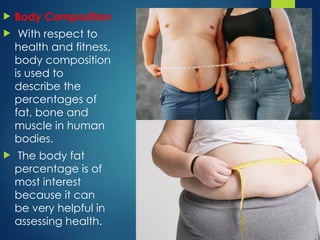
 Body Composition
 With respect to
health and fitness,
body composition
is used to
describe the
percentages of
fat, bone and
muscle in human
bodies.
 The body fat
percentage is of
most interest
because it can
be very helpful in
assessing health.
PHYSICAL EDUCATION AND HEALTH SAFETY GUIDELINE:
These guidelines include procedures that include procedures that
help prevent accidents or injury in Physical Education classes and
activities. It should be recognized that many safety guidelines and
cooperation to all class activities. Some such commonalities are as
follows:
 Exercise carefully at all times.
 Listen carefully and follow directions.
 Always participate and give the best effort in every activity.
 Consideration should be given first to the safety of the student.
 Provide a pleasant atmosphere in which the students can work out.
 Teachers need to be aware of the medical backgrounds and physical limitations
of every student.
 Teachers must inform their students the locations of the fire chains, fire exits, and
alternative routes from the beginning of the semester.
 Consideration must also be given to informing parents of activities that take
students off the immediate school proper( e.g. fun run, camping)
 Teachers are not only looking at activities that include contact but the issues
surrounding body contact.
 Teachers must demonstrate that all proper precautions will be taken in the interest
of student safety.
 A fully stocked first-aid kit must be readily accessible to the gymnasium.
 Teachers must inform their students to use clean, comfortable clothes and
shoes.
 Exercise either in the morning or late in the afternoon when it is not so hot.
 Teachers have the recommended qualification and experience for sport
education.
 Teachers recommended to supervising student first aid training.
 All records of inspections, using the facilities regularly inspected.
 Equipment and facilities are safe measures minimize any potential risk to
students.
 Severe exercise must be avoided unless the individual young and athletic.
 There is no best form of exercise. It depends on what the individual wants to
achieve.
 Medical information of the student is communicated through school medical
clinic with the supervision of the teacher.
COMPUTING BODY MASS
INDEX (BMI)
 Multiply the provided feet value by 30.48 cm to
convert feet to cm. For instance, 5 ft = 5 x 30.48
equals 152.4 cm.
Physical Fitness & Health
 A healthy person
exhibits certain
characteristics which
are the key traits
reflecting sound health
of that person.
- No microscopic
examination is essential
to identify most of them
as these characteristics
can be seen very clear
as external features
with our naked eyes.
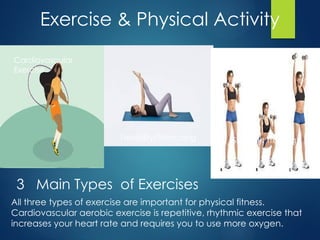
Exercise & Physical Activity
Cardiovascular
Exercise
Flexibility/Stretching Strength Training
3 Main Types of Exercises
All three types of exercise are important for physical fitness.
Cardiovascular aerobic exercise is repetitive, rhythmic exercise that
increases your heart rate and requires you to use more oxygen.
CARDIOVASCULAR EXERCISES
What cardiovascular
exercise means?
Cardiovascular
exercise is any
vigorous activity that
increases heart rate
and respiration and
raises oxygen and
blood flow throughout
the body while using
large muscle groups
of the body
repetitively and
rhythmically.
These exercises work to improve your endurance
by increasing your heart rate and breathing
rate. It also boosts your blood circulation.
- helps strengthen your heart and lungs.
- It contributes to weight loss and
- weight maintenance, helps decrease body fat,
reduces stress levels and decreases daily fatigue
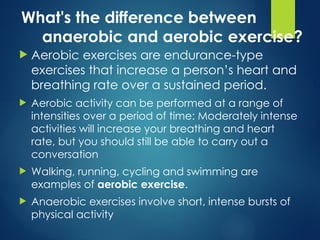
What's the difference between
anaerobic and aerobic exercise?
 Aerobic exercises are endurance-type
exercises that increase a person’s heart and
breathing rate over a sustained period.
 Aerobic activity can be performed at a range of
intensities over a period of time: Moderately intense
activities will increase your breathing and heart
rate, but you should still be able to carry out a
conversation
 Walking, running, cycling and swimming are
examples of aerobic exercise.
 Anaerobic exercises involve short, intense bursts of
physical activity
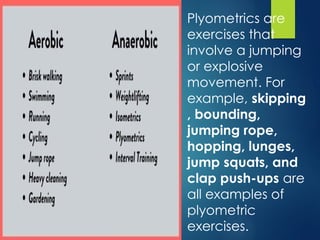
Plyometrics are
exercises that
involve a jumping
or explosive
movement. For
example, skipping
, bounding,
jumping rope,
hopping, lunges,
jump squats, and
clap push-ups are
all examples of
plyometric
exercises.
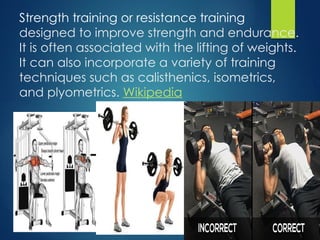
Strength training or resistance training
designed to improve strength and endurance.
It is often associated with the lifting of weights.
It can also incorporate a variety of training
techniques such as calisthenics, isometrics,
and plyometrics. Wikipedia
strength training is any physical movement in which
you use your body weight or equipment (e.g.,
dumbbells and resistance bands) to
build muscle mass, strength, and endurance
 Body weight: using your own body weight and the force of gravity to
perform various movements (e.g., pushups, squats, planks, pullups, and
lunges)
 Free weights: equipment not bound to the floor or a machine, such as
dumbbells, barbells, kettlebells, medicine balls, or objects around the
house
 Resistance bands/loop bands: rubber bands that provide resistance
when stretched
 Weight machines: machines with adjustable weights or hydraulics
attached to provide resistance and stress to the muscles
 Suspension equipment: consists of ropes or straps that are anchored to a
sturdy point in which a person uses their body weight and gravity to There
are many benefits to strength training that can improve your health.
 various equipment (or none at all), such as
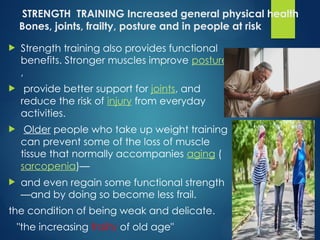
STRENGTH TRAINING Increased general physical health
Bones, joints, frailty, posture and in people at risk
 Strength training also provides functional
benefits. Stronger muscles improve posture
,
 provide better support for joints, and
reduce the risk of injury from everyday
activities.
 Older people who take up weight training
can prevent some of the loss of muscle
tissue that normally accompanies aging (
sarcopenia)—
 and even regain some functional strength
—and by doing so become less frail.
the condition of being weak and delicate.
"the increasing frailty of old age"
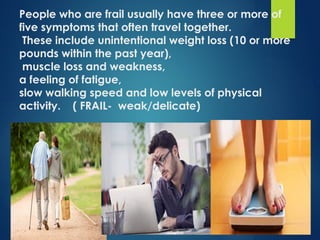
People who are frail usually have three or more of
five symptoms that often travel together.
These include unintentional weight loss (10 or more
pounds within the past year),
muscle loss and weakness,
a feeling of fatigue,
slow walking speed and low levels of physical
activity. ( FRAIL- weak/delicate)
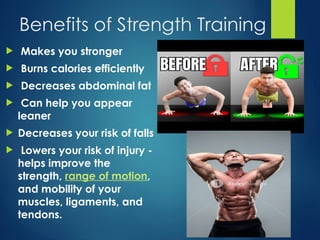
Benefits of Strength Training
 Makes you stronger
 Burns calories efficiently
 Decreases abdominal fat
 Can help you appear
leaner
 Decreases your risk of falls
 Lowers your risk of injury -
helps improve the
strength, range of motion,
and mobility of your
muscles, ligaments, and
tendons.
- can decrease blood pressure,
-lower total and LDL (bad) cholesterol, and
-improve blood circulation by strengthening the heart and blood
vessels
- Helps manage your blood sugar levels –
-lower your risk of developing diabetes and can help those with the
condition manage it better.
Promotes greater mobility and flexibility - Strength training increases
joint range of motion (ROM), allowing for greater
mobility and flexibility.
.
 Makes your bones stronger
Boosts your self-esteem-
12. Boosts your mood
Regular weight training may boost
your mood and improve your mental
health.
Improves brain health
 Promotes a better quality of life
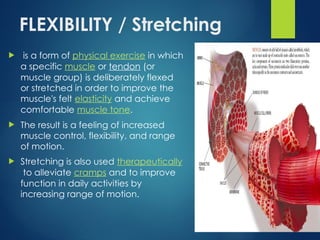
FLEXIBILITY / Stretching
 is a form of physical exercise in which
a specific muscle or tendon (or
muscle group) is deliberately flexed
or stretched in order to improve the
muscle's felt elasticity and achieve
comfortable muscle tone.
 The result is a feeling of increased
muscle control, flexibility, and range
of motion.
 Stretching is also used therapeutically
to alleviate cramps and to improve
function in daily activities by
increasing range of motion.
Stretching keeps the muscles flexible, strong, and
healthy, and we need that flexibility to maintain a
range of motion in the joints. Without it, the muscles
shorten and become tight. Then, when you call on the
muscles for activity, they are weak and unable to
extend all the way.
The different types of stretching
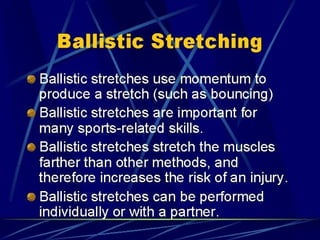
 BALLISTIC -similar to dynamic
stretching in that it's movement-
based.
 Ballistic stretching involves
continuous bouncing
movements at the end ROM
where the muscle is at maximal
length.
 you attempt to go beyond this
range. These stretches often
require uncontrolled movements
that may result in injury.
Dynamic stretches, meanwhile, involve moving rather
than holding a position. A walking lunge, for example, is
a dynamic stretch. Ex: arm circles, squats, hip rotation
Benefits of Dynamic stretching
 Dynamic stretching opens up your muscles, and
prepares them for a difficult or sustained workout.
 By completing a full range of motion with your joints
and muscles, your body can achieve more, and is
better prepared for activities that involve a lot of
movement, such as football or running.
 it allows muscles to loosen up, whilst also increasing
flexibility and range of motion, as well as helping
reduce feelings of stiffness and soreness.
 increase your body temperature. This way, your
body is ready to perform at a high intensity level.
Dynamic
 NOT THE SAFEST FORM OF
STRETCHING
 Injury risk might increase
since the movements are
performed dynamically
and at a moderate to
high pace.
 You can also take the
stretch to far which can in
turn lead to injuries.
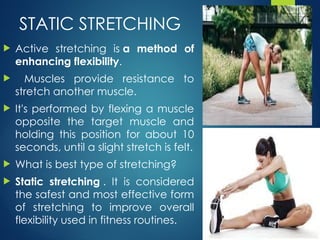
STATIC STRETCHING
 Active stretching is a method of
enhancing flexibility.
 Muscles provide resistance to
stretch another muscle.
 It's performed by flexing a muscle
opposite the target muscle and
holding this position for about 10
seconds, until a slight stretch is felt.
 What is best type of stretching?
 Static stretching . It is considered
the safest and most effective form
of stretching to improve overall
flexibility used in fitness routines.
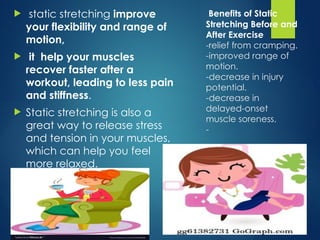
Benefits of Static
Stretching Before and
After Exercise
-relief from cramping.
-improved range of
motion.
-decrease in injury
potential.
-decrease in
delayed-onset
muscle soreness.
-
 static stretching improve
your flexibility and range of
motion,
 it help your muscles
recover faster after a
workout, leading to less pain
and stiffness.
 Static stretching is also a
great way to release stress
and tension in your muscles,
which can help you feel
more relaxed.
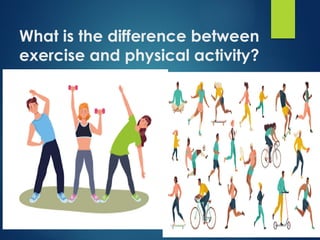
What is the difference between
exercise and physical activity?
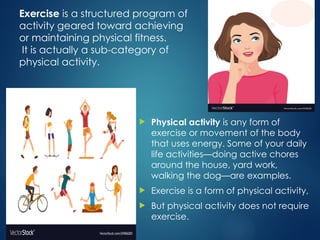
Exercise is a structured program of
activity geared toward achieving
or maintaining physical fitness.
It is actually a sub-category of
physical activity.
 Physical activity is any form of
exercise or movement of the body
that uses energy. Some of your daily
life activities—doing active chores
around the house, yard work,
walking the dog—are examples.
 Exercise is a form of physical activity,
 But physical activity does not require
exercise.
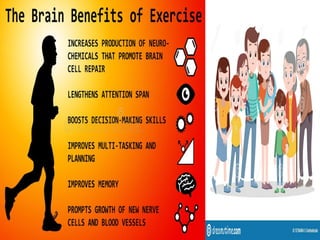
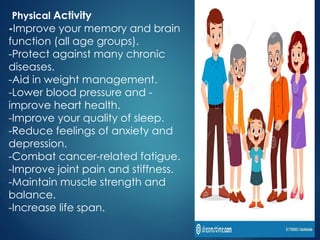
Physical Activity
-Improve your memory and brain
function (all age groups).
-Protect against many chronic
diseases.
-Aid in weight management.
-Lower blood pressure and -
improve heart health.
-Improve your quality of sleep.
-Reduce feelings of anxiety and
depression.
-Combat cancer-related fatigue.
-Improve joint pain and stiffness.
-Maintain muscle strength and
balance.
-Increase life span.
- controls weight.
can help
-prevent excess weight
gain or help maintain
weight loss. ...
- combats health
conditions and
diseases. ...
- improves mood. ...
- boosts energy. ...
-promotes better
sleep. ...
puts the spark back into
your sex life. ...
- can be fun … and
social!
BENEFIT OF EXERCISES
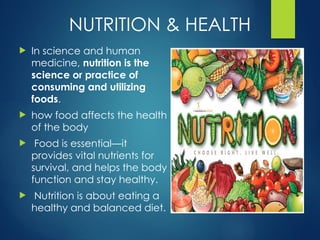
NUTRITION & HEALTH
 In science and human
medicine, nutrition is the
science or practice of
consuming and utilizing
foods.
 how food affects the health
of the body
 Food is essential—it
provides vital nutrients for
survival, and helps the body
function and stay healthy.
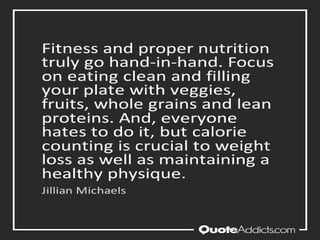
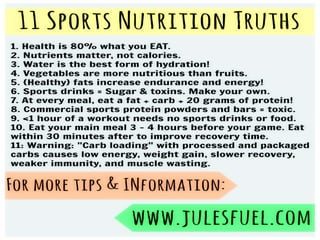
 Nutrition is about eating a
healthy and balanced diet.
Healthy just means a
food that stops you
from getting sick and
keeps you living
longer.
Nutritious means a
food that fills you with
the sufficient amount
of nutrients (vitamins,
carbohydrates,
proteins) your body
requires to survive
A balanced diet will
not exclude any one
food group.
Serving Portion
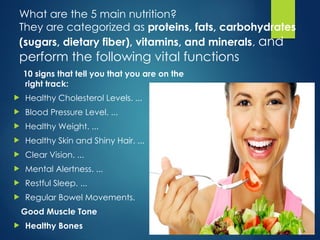
What are the 5 main nutrition?
They are categorized as proteins, fats, carbohydrates
(sugars, dietary fiber), vitamins, and minerals, and
perform the following vital functions
10 signs that tell you that you are on the
right track:
 Healthy Cholesterol Levels. ...
 Blood Pressure Level. ...
 Healthy Weight. ...
 Healthy Skin and Shiny Hair. ...
 Clear Vision. ...
 Mental Alertness. ...
 Restful Sleep. ...
 Regular Bowel Movements.
Good Muscle Tone
 Healthy Bones
DETERMINING CALORIE NEEDS
Activity Rating Calories per pound
Men Women
 Sedentary –limited physical act. 13.0 12.0
 Moderate Physical Activity 14.0 13.5
 Vigorous Physical Activity 17.0 15.0
Multiply your rating (calories per pound) by your actual weight
Example: weight in pounds X activity rating = the calories you need
per day. If you consistently eat more than the calories computed,
you will gain weight.
144 pounds X 12.0 = 1.728 calories/day (0f you eat more than the
calories based on the computation = weight gain)
ACTIVITY: 15 DAYS CHALLENGE
 Compute your calorie needs base on
the activity rating
 List down all your food intake
everyday:
Breakfast/snacks/Lunch/Snacks/Dinner
/Midnight snacks
 Check on the Calorie Chart
 Compute the total calories per day
(intake)
Total fitness is defined by how well your body performs in
all the components of physical fitness
 The Health-Related Components of Physical Fitness-
 involves exercise activities that you do in order to try to
improve your physical health and stay healthy.
 It strengthens immunity, metabolism, enhances good mental
and physical health.
 It focuses on the health of all major organs of the body.
 Relating fitness with health ensures that the focus is on
improving the overall health of the body.
 The Skills – Related Components of Physical Fitness - are
important to success in skillful activities and athletic events,
and may not be as crucial to improved health.
The SKILL-RELATED Components Of Physical Fitness
 Power -it is the ability
of muscles to exert
maximum force in
the shortest amount
of time, like when
you run or swim.

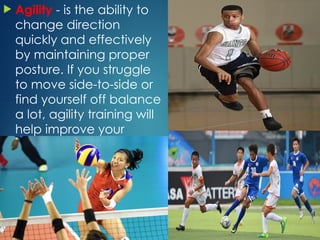
 Agility - is the ability to
change direction
quickly and effectively
by maintaining proper
posture. If you struggle
to move side-to-side or
find yourself off balance
a lot, agility training will
help improve your
performance.
 Speed - refers
to the ability to
move upper
and lower
limbs on the
ground fast,
like grabbing,
pulling, or
throwing
objects.
 Reaction time-
refers to the time
taken to respond
to external stimuli
that are constantly
changing, like in
football, boxing,
and such sports.
 Accuracy
 This component is
the body’s ability to
direct itself and it’s
a force towards a
particular point.
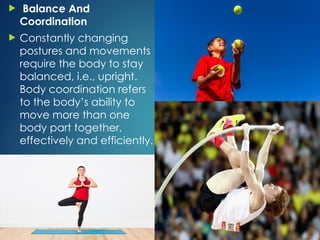
 Balance And
Coordination
 Constantly changing
postures and movements
require the body to stay
balanced, i.e., upright.
Body coordination refers
to the body’s ability to
move more than one
body part together,
effectively and efficiently.
Nutrition, Body Needs and
Physical Activity
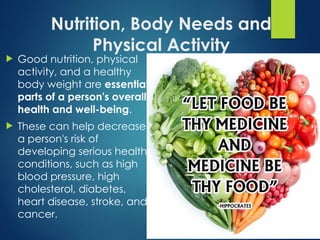
 Good nutrition, physical
activity, and a healthy
body weight are essential
parts of a person's overall
health and well-being.
 These can help decrease
a person's risk of
developing serious health
conditions, such as high
blood pressure, high
cholesterol, diabetes,
heart disease, stroke, and
cancer.
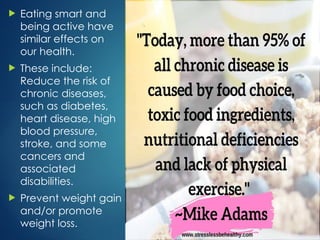
 Eating smart and
being active have
similar effects on
our health.
 These include:
Reduce the risk of
chronic diseases,
such as diabetes,
heart disease, high
blood pressure,
stroke, and some
cancers and
associated
disabilities.
 Prevent weight gain
and/or promote
weight loss.
 Nutrition is a critical
part of health and
development.
 Better nutrition is
related to improved
infant, child and
maternal health,
stronger immune
systems, safer
pregnancy and
childbirth, lower risk of
non-communicable
diseases (such as
diabetes and
cardiovascular
disease), and longevity.
 Healthy children learn
better.
 Nutrition can help
enhance athletic
performance. An active
lifestyle and exercise
routine, along with
eating well, is the best
way to stay healthy.
Eating a good diet can
help provide the energy
you need to finish a
race, or just enjoy a
casual sport or activity.
 Eating well helps to
reduce the risk of
physical health
problems like heart
disease and
diabetes. It also helps
with sleeping
patterns, energy
levels, and your
general health. You
may have noticed
that your mood often
affects the types of
food you choose, as
well as how much
you eat.
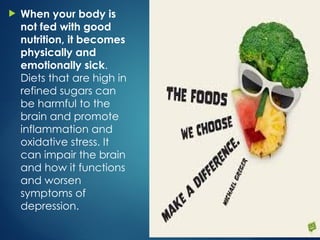
 When your body is
not fed with good
nutrition, it becomes
physically and
emotionally sick.
Diets that are high in
refined sugars can
be harmful to the
brain and promote
inflammation and
oxidative stress. It
can impair the brain
and how it functions
and worsen
symptoms of
depression.
 From vitamins and
minerals to healthy
fats and fiber, all
nutrients play a role
in brain health and
function.
 Following a healthy
pattern of eating is
linked with better
stress management ,
improved sleep
quality, increased
concentration , and
better mental
wellbeing in general
PATHFIT 1 (MOVEMENT COMPETENCY TRAINING).pptx

PATHFIT 1 (MOVEMENT COMPETENCY TRAINING).pptx

  • 1.
  • 3.
    How do youdefine:  PHYSICAL EDUCATION-Physical Education is "education through the physical". PHYSICAL FITNESS -Physical fitness means the body is healthy, flexible, strong, and doesn't get tired easily. Fitness affects the entire body - heart, lungs, bones, muscles - each body function works together. HEALTH - The World Health Organization (WHO) defines health as a state of complete physical, mental and social wellbeing and not merely the absence of disease or infirmity'.
  • 4.
    What is therelationship between PHYSICAL FITNESS and HEALTH?  Regular physical activity is proven to help prevent and manage non- communicable diseases such as heart disease, stroke, diabetes, and several cancers. It also improves mental health, quality of life, and well-being.
  • 5.
    The importance ofPATHFIT?  Regular exercise and physical activity promotes strong muscles and bones.  It improves respiratory, cardiovascular health and overall health.  Staying active can also help you maintain a healthy weight, reduce your risk for type 2 diabetes, heart disease, and reduce your risk for some cancers.
  • 6.
    Components of PHYSICAL EDUCATION: •MASCULAR STRENGTH • CARDIOVASCULAR ENDURANCE • MASCULAR ENDURANCE • FLEXIBILITY • BODY COMPOSITION
  • 7.
    Importance of components ofPE.  In the short term, the 5 components of physical fitness can help improve our quality of life.  In the long term, we can support healthy living and disease control.  It helps us to stay in shape, reduce the risk of illness, and increase our energy levels.
  • 8.
     Muscular Strength is the amount of force you can put out or the amount of weight you can lift.  It’s measured by how much force you can exert and how much weight you can lift for a short period of time.  Examples of exercises that develop muscular strength and power include resistance training, such as weightlifting, bodyweight exercises, and resistance band exercises.
  • 9.
     Cardiovascular Endurance -is a measure of how well you can do exercises that involve your whole body at moderate to high intensity for an extended time  The ability to exercise without becoming overly tired because your heart, lungs and blood vessels are healthy.
  • 10.
    Activities like walking,jogging, running, cycling, swimming, aerobics, rowing, stair climbing, hiking, cross country skiing and many types of dancing are “pure” aerobic activities. Sports such as soccer, basketball, squash and tennis may also improve your cardiovascular fitness.
  • 11.
     Muscular Endurance the ability of a muscle or group of muscles to perform repetitive contractions against a force for an extended period of time . - is how many times you can move that weight without getting exhausted (very tired).
  • 13.
     Flexibility  "theabsolute range of movement in a joint or series of joints that is attainable in a momentary effort with the help of a partner or a piece of equipment.“  The range of movement possible at various joints  Flexibility refers to the ability of each joint to express its full range of motion.  Flexibility can be tested by stretching individual muscles or by performing exercises such as the lunge or the sit and reach
  • 14.
     Body Composition With respect to health and fitness, body composition is used to describe the percentages of fat, bone and muscle in human bodies.  The body fat percentage is of most interest because it can be very helpful in assessing health.
  • 15.
    PHYSICAL EDUCATION ANDHEALTH SAFETY GUIDELINE: These guidelines include procedures that include procedures that help prevent accidents or injury in Physical Education classes and activities. It should be recognized that many safety guidelines and cooperation to all class activities. Some such commonalities are as follows:  Exercise carefully at all times.  Listen carefully and follow directions.  Always participate and give the best effort in every activity.  Consideration should be given first to the safety of the student.  Provide a pleasant atmosphere in which the students can work out.  Teachers need to be aware of the medical backgrounds and physical limitations of every student.  Teachers must inform their students the locations of the fire chains, fire exits, and alternative routes from the beginning of the semester.  Consideration must also be given to informing parents of activities that take students off the immediate school proper( e.g. fun run, camping)  Teachers are not only looking at activities that include contact but the issues surrounding body contact.  Teachers must demonstrate that all proper precautions will be taken in the interest of student safety.
  • 16.
     A fullystocked first-aid kit must be readily accessible to the gymnasium.  Teachers must inform their students to use clean, comfortable clothes and shoes.  Exercise either in the morning or late in the afternoon when it is not so hot.  Teachers have the recommended qualification and experience for sport education.  Teachers recommended to supervising student first aid training.  All records of inspections, using the facilities regularly inspected.  Equipment and facilities are safe measures minimize any potential risk to students.  Severe exercise must be avoided unless the individual young and athletic.  There is no best form of exercise. It depends on what the individual wants to achieve.  Medical information of the student is communicated through school medical clinic with the supervision of the teacher.
  • 17.
    COMPUTING BODY MASS INDEX(BMI)  Multiply the provided feet value by 30.48 cm to convert feet to cm. For instance, 5 ft = 5 x 30.48 equals 152.4 cm.
  • 19.
    Physical Fitness &Health  A healthy person exhibits certain characteristics which are the key traits reflecting sound health of that person. - No microscopic examination is essential to identify most of them as these characteristics can be seen very clear as external features with our naked eyes.
  • 20.
    Exercise & PhysicalActivity Cardiovascular Exercise Flexibility/Stretching Strength Training 3 Main Types of Exercises All three types of exercise are important for physical fitness. Cardiovascular aerobic exercise is repetitive, rhythmic exercise that increases your heart rate and requires you to use more oxygen.
  • 21.
    CARDIOVASCULAR EXERCISES What cardiovascular exercisemeans? Cardiovascular exercise is any vigorous activity that increases heart rate and respiration and raises oxygen and blood flow throughout the body while using large muscle groups of the body repetitively and rhythmically.
  • 22.
    These exercises workto improve your endurance by increasing your heart rate and breathing rate. It also boosts your blood circulation. - helps strengthen your heart and lungs. - It contributes to weight loss and - weight maintenance, helps decrease body fat, reduces stress levels and decreases daily fatigue
  • 23.
    What's the differencebetween anaerobic and aerobic exercise?  Aerobic exercises are endurance-type exercises that increase a person’s heart and breathing rate over a sustained period.  Aerobic activity can be performed at a range of intensities over a period of time: Moderately intense activities will increase your breathing and heart rate, but you should still be able to carry out a conversation  Walking, running, cycling and swimming are examples of aerobic exercise.  Anaerobic exercises involve short, intense bursts of physical activity
  • 24.
    Plyometrics are exercises that involvea jumping or explosive movement. For example, skipping , bounding, jumping rope, hopping, lunges, jump squats, and clap push-ups are all examples of plyometric exercises.
  • 26.
    Strength training orresistance training designed to improve strength and endurance. It is often associated with the lifting of weights. It can also incorporate a variety of training techniques such as calisthenics, isometrics, and plyometrics. Wikipedia
  • 27.
    strength training isany physical movement in which you use your body weight or equipment (e.g., dumbbells and resistance bands) to build muscle mass, strength, and endurance  Body weight: using your own body weight and the force of gravity to perform various movements (e.g., pushups, squats, planks, pullups, and lunges)  Free weights: equipment not bound to the floor or a machine, such as dumbbells, barbells, kettlebells, medicine balls, or objects around the house  Resistance bands/loop bands: rubber bands that provide resistance when stretched  Weight machines: machines with adjustable weights or hydraulics attached to provide resistance and stress to the muscles  Suspension equipment: consists of ropes or straps that are anchored to a sturdy point in which a person uses their body weight and gravity to There are many benefits to strength training that can improve your health.  various equipment (or none at all), such as
  • 28.
    STRENGTH TRAINING Increasedgeneral physical health Bones, joints, frailty, posture and in people at risk  Strength training also provides functional benefits. Stronger muscles improve posture ,  provide better support for joints, and reduce the risk of injury from everyday activities.  Older people who take up weight training can prevent some of the loss of muscle tissue that normally accompanies aging ( sarcopenia)—  and even regain some functional strength —and by doing so become less frail. the condition of being weak and delicate. "the increasing frailty of old age"
  • 29.
    People who arefrail usually have three or more of five symptoms that often travel together. These include unintentional weight loss (10 or more pounds within the past year), muscle loss and weakness, a feeling of fatigue, slow walking speed and low levels of physical activity. ( FRAIL- weak/delicate)
  • 30.
    Benefits of StrengthTraining  Makes you stronger  Burns calories efficiently  Decreases abdominal fat  Can help you appear leaner  Decreases your risk of falls  Lowers your risk of injury - helps improve the strength, range of motion, and mobility of your muscles, ligaments, and tendons.
  • 31.
    - can decreaseblood pressure, -lower total and LDL (bad) cholesterol, and -improve blood circulation by strengthening the heart and blood vessels - Helps manage your blood sugar levels – -lower your risk of developing diabetes and can help those with the condition manage it better. Promotes greater mobility and flexibility - Strength training increases joint range of motion (ROM), allowing for greater mobility and flexibility. .  Makes your bones stronger Boosts your self-esteem- 12. Boosts your mood Regular weight training may boost your mood and improve your mental health. Improves brain health  Promotes a better quality of life
  • 32.
    FLEXIBILITY / Stretching is a form of physical exercise in which a specific muscle or tendon (or muscle group) is deliberately flexed or stretched in order to improve the muscle's felt elasticity and achieve comfortable muscle tone.  The result is a feeling of increased muscle control, flexibility, and range of motion.  Stretching is also used therapeutically to alleviate cramps and to improve function in daily activities by increasing range of motion.
  • 33.
    Stretching keeps themuscles flexible, strong, and healthy, and we need that flexibility to maintain a range of motion in the joints. Without it, the muscles shorten and become tight. Then, when you call on the muscles for activity, they are weak and unable to extend all the way.
  • 34.
    The different typesof stretching  BALLISTIC -similar to dynamic stretching in that it's movement- based.  Ballistic stretching involves continuous bouncing movements at the end ROM where the muscle is at maximal length.  you attempt to go beyond this range. These stretches often require uncontrolled movements that may result in injury.
  • 36.
    Dynamic stretches, meanwhile,involve moving rather than holding a position. A walking lunge, for example, is a dynamic stretch. Ex: arm circles, squats, hip rotation
  • 37.
    Benefits of Dynamicstretching  Dynamic stretching opens up your muscles, and prepares them for a difficult or sustained workout.  By completing a full range of motion with your joints and muscles, your body can achieve more, and is better prepared for activities that involve a lot of movement, such as football or running.  it allows muscles to loosen up, whilst also increasing flexibility and range of motion, as well as helping reduce feelings of stiffness and soreness.  increase your body temperature. This way, your body is ready to perform at a high intensity level.
  • 38.
    Dynamic  NOT THESAFEST FORM OF STRETCHING  Injury risk might increase since the movements are performed dynamically and at a moderate to high pace.  You can also take the stretch to far which can in turn lead to injuries.
  • 39.
    STATIC STRETCHING  Activestretching is a method of enhancing flexibility.  Muscles provide resistance to stretch another muscle.  It's performed by flexing a muscle opposite the target muscle and holding this position for about 10 seconds, until a slight stretch is felt.  What is best type of stretching?  Static stretching . It is considered the safest and most effective form of stretching to improve overall flexibility used in fitness routines.
  • 40.
    Benefits of Static StretchingBefore and After Exercise -relief from cramping. -improved range of motion. -decrease in injury potential. -decrease in delayed-onset muscle soreness. -  static stretching improve your flexibility and range of motion,  it help your muscles recover faster after a workout, leading to less pain and stiffness.  Static stretching is also a great way to release stress and tension in your muscles, which can help you feel more relaxed.
  • 41.
    What is thedifference between exercise and physical activity?
  • 42.
    Exercise is astructured program of activity geared toward achieving or maintaining physical fitness. It is actually a sub-category of physical activity.  Physical activity is any form of exercise or movement of the body that uses energy. Some of your daily life activities—doing active chores around the house, yard work, walking the dog—are examples.  Exercise is a form of physical activity,  But physical activity does not require exercise.
  • 44.
    Physical Activity -Improve yourmemory and brain function (all age groups). -Protect against many chronic diseases. -Aid in weight management. -Lower blood pressure and - improve heart health. -Improve your quality of sleep. -Reduce feelings of anxiety and depression. -Combat cancer-related fatigue. -Improve joint pain and stiffness. -Maintain muscle strength and balance. -Increase life span.
  • 45.
    - controls weight. canhelp -prevent excess weight gain or help maintain weight loss. ... - combats health conditions and diseases. ... - improves mood. ... - boosts energy. ... -promotes better sleep. ... puts the spark back into your sex life. ... - can be fun … and social! BENEFIT OF EXERCISES
  • 48.
    NUTRITION & HEALTH In science and human medicine, nutrition is the science or practice of consuming and utilizing foods.  how food affects the health of the body  Food is essential—it provides vital nutrients for survival, and helps the body function and stay healthy.  Nutrition is about eating a healthy and balanced diet.
  • 49.
    Healthy just meansa food that stops you from getting sick and keeps you living longer. Nutritious means a food that fills you with the sufficient amount of nutrients (vitamins, carbohydrates, proteins) your body requires to survive A balanced diet will not exclude any one food group.
  • 50.
  • 52.
    What are the5 main nutrition? They are categorized as proteins, fats, carbohydrates (sugars, dietary fiber), vitamins, and minerals, and perform the following vital functions 10 signs that tell you that you are on the right track:  Healthy Cholesterol Levels. ...  Blood Pressure Level. ...  Healthy Weight. ...  Healthy Skin and Shiny Hair. ...  Clear Vision. ...  Mental Alertness. ...  Restful Sleep. ...  Regular Bowel Movements. Good Muscle Tone  Healthy Bones
  • 53.
    DETERMINING CALORIE NEEDS ActivityRating Calories per pound Men Women  Sedentary –limited physical act. 13.0 12.0  Moderate Physical Activity 14.0 13.5  Vigorous Physical Activity 17.0 15.0 Multiply your rating (calories per pound) by your actual weight Example: weight in pounds X activity rating = the calories you need per day. If you consistently eat more than the calories computed, you will gain weight. 144 pounds X 12.0 = 1.728 calories/day (0f you eat more than the calories based on the computation = weight gain)
  • 54.
    ACTIVITY: 15 DAYSCHALLENGE  Compute your calorie needs base on the activity rating  List down all your food intake everyday: Breakfast/snacks/Lunch/Snacks/Dinner /Midnight snacks  Check on the Calorie Chart  Compute the total calories per day (intake)
  • 55.
    Total fitness isdefined by how well your body performs in all the components of physical fitness  The Health-Related Components of Physical Fitness-  involves exercise activities that you do in order to try to improve your physical health and stay healthy.  It strengthens immunity, metabolism, enhances good mental and physical health.  It focuses on the health of all major organs of the body.  Relating fitness with health ensures that the focus is on improving the overall health of the body.  The Skills – Related Components of Physical Fitness - are important to success in skillful activities and athletic events, and may not be as crucial to improved health.
  • 57.
    The SKILL-RELATED ComponentsOf Physical Fitness  Power -it is the ability of muscles to exert maximum force in the shortest amount of time, like when you run or swim. 
  • 58.
     Agility -is the ability to change direction quickly and effectively by maintaining proper posture. If you struggle to move side-to-side or find yourself off balance a lot, agility training will help improve your performance.
  • 59.
     Speed -refers to the ability to move upper and lower limbs on the ground fast, like grabbing, pulling, or throwing objects.
  • 60.
     Reaction time- refersto the time taken to respond to external stimuli that are constantly changing, like in football, boxing, and such sports.
  • 61.
     Accuracy  Thiscomponent is the body’s ability to direct itself and it’s a force towards a particular point.
  • 62.
     Balance And Coordination Constantly changing postures and movements require the body to stay balanced, i.e., upright. Body coordination refers to the body’s ability to move more than one body part together, effectively and efficiently.
  • 63.
    Nutrition, Body Needsand Physical Activity  Good nutrition, physical activity, and a healthy body weight are essential parts of a person's overall health and well-being.  These can help decrease a person's risk of developing serious health conditions, such as high blood pressure, high cholesterol, diabetes, heart disease, stroke, and cancer.
  • 64.
     Eating smartand being active have similar effects on our health.  These include: Reduce the risk of chronic diseases, such as diabetes, heart disease, high blood pressure, stroke, and some cancers and associated disabilities.  Prevent weight gain and/or promote weight loss.
  • 65.
     Nutrition isa critical part of health and development.  Better nutrition is related to improved infant, child and maternal health, stronger immune systems, safer pregnancy and childbirth, lower risk of non-communicable diseases (such as diabetes and cardiovascular disease), and longevity.  Healthy children learn better.
  • 66.
     Nutrition canhelp enhance athletic performance. An active lifestyle and exercise routine, along with eating well, is the best way to stay healthy. Eating a good diet can help provide the energy you need to finish a race, or just enjoy a casual sport or activity.
  • 67.
     Eating wellhelps to reduce the risk of physical health problems like heart disease and diabetes. It also helps with sleeping patterns, energy levels, and your general health. You may have noticed that your mood often affects the types of food you choose, as well as how much you eat.
  • 68.
     When yourbody is not fed with good nutrition, it becomes physically and emotionally sick. Diets that are high in refined sugars can be harmful to the brain and promote inflammation and oxidative stress. It can impair the brain and how it functions and worsen symptoms of depression.
  • 69.
     From vitaminsand minerals to healthy fats and fiber, all nutrients play a role in brain health and function.  Following a healthy pattern of eating is linked with better stress management , improved sleep quality, increased concentration , and better mental wellbeing in general