Movement Education
An approach to teaching
Primary Physical Education in 4C
Movement Education
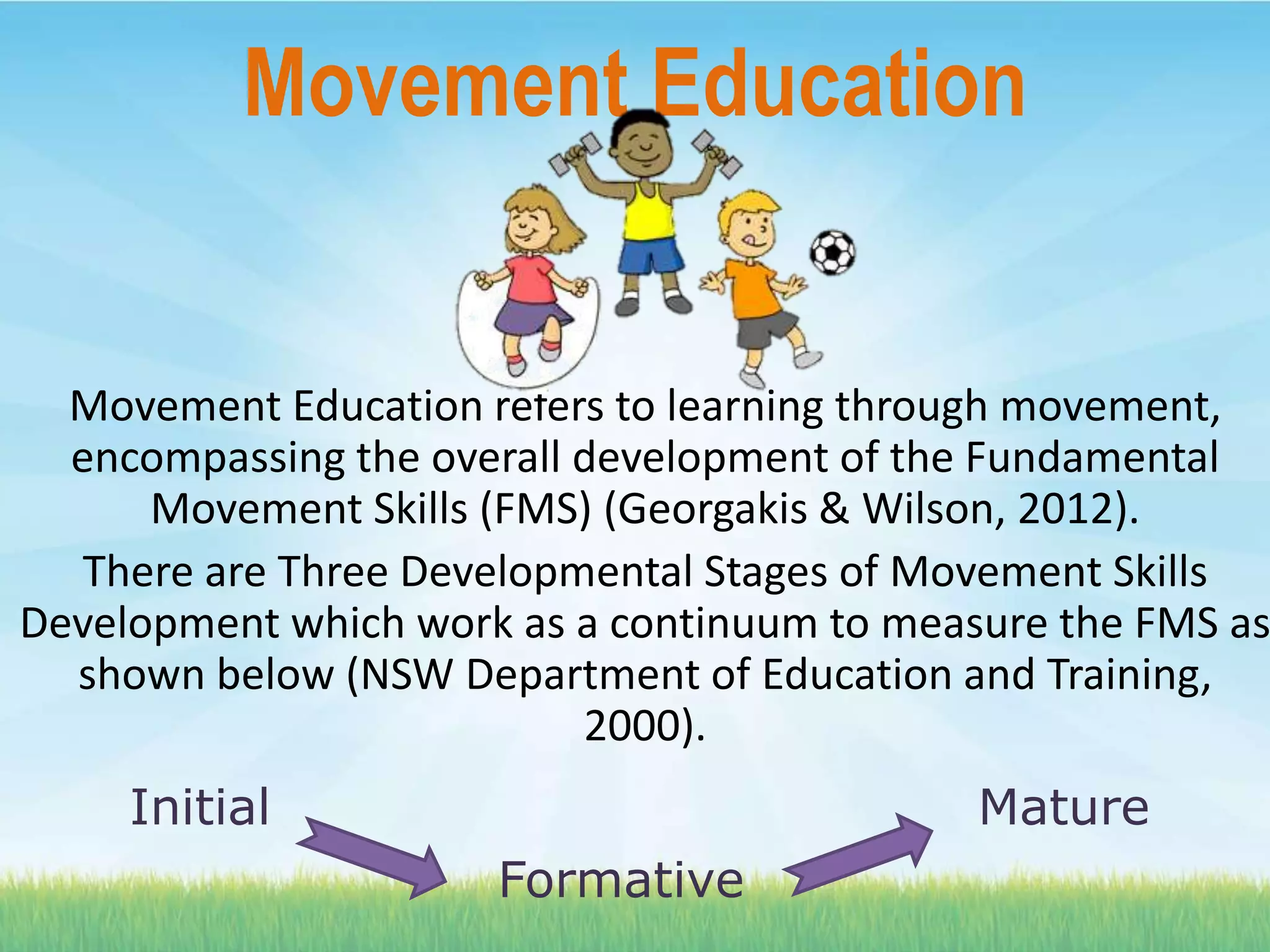
Movement Education refers to learning through movement,
encompassing the overall development of the Fundamental
Movement Skills (FMS) (Georgakis & Wilson, 2012).
There are Three Developmental Stages of Movement Skills
Development which work as a continuum to measure the FMS as
shown below (NSW Department of Education and Training,
2000).
Initial
Formative
Mature
Movement Education
In order to enjoy a wider range of physical
activities and sports, students need to work
through the initial and formative development
stages to master Fundamental Movement
Skills (FMS) (Wright & Burrows, 2006).
The FMS shown on this slide are considered to
be the building blocks of movement
(Achterstraat, 2012)
Skip
Catch
Side Gallop
Overarm Throw
Dodge
Movement Education
Implementing Movement Education and developing
the mastery of the FMS contributes positively to
children’s physical, cognitive and social development.
Thus, when Movement Education is taught effectively,
it creates the necessary foundation for students to
lead active lifestyles (Lubans, Morgan, Cliff, Barnett, &
Okely, 2010).
Movement Education as a Teaching
Approach
Using Movement Education in our class will provide the
students in 4C with the opportunity to improve FMS
proficiency which has vital positive health implications,
such as high aerobic fitness and lower body weight
(Achterstraat, 2012). Movement Education also supports
the student development in three key PDHPE Strands
(Board of Studies, 2007) including:
Active Lifestyle
Games and Sports Personal Health Choices
Movement Education as a Teaching Approach
Failing to teach Movement Education can result in
students experiencing difficultly participating in
physical activities both as students and later in life
(Lubans et al., 2010).
In NSW alone, less than 40% of Year 4 students
have a mastery of FMS (Achterstraat, 2012). This
potentially limits students’ ability to participate in
physical activities, consequently also limiting their
ability to adopt an active lifestyle and develop
fundamental movement patterns and skills that
enable action for better health as per the NSW
PDHPE Syllabus Rationale (Board of Studies, 2007).
It takes ten instructional hours for most students
to master one FMS.
Movement Education as a Teaching
Approach
The paramount message from this presentation is
that using Movement Education as a teaching
approach in 4C will provide our children with the
greatest opportunity to lead healthy, active lives
through the successful and enjoyable participation
in physical activities, aligning with the NSW PDHPE
Syllabus Rationale (Board of Studies, 2007).
References
Achterstraat, P. (2012). Physical activity in government primary schools. Sydney,
Australia: Audit Office of New South Wales, Department of Education and
Communities.
Board of Studies, NSW. (2007). Personal development, health and physical education
K-6: Syllabus. Sydney, Australia: Author.
Georgakis, S., & Wilson, R. (2012). Australian Physical Education and School Sport: An
Exploration into Contemporary Assessment. Asian Journal of Exercise &
Sports Science, 9(1).
Lubans, D. R., Morgan, P. J., Cliff, D. P., Barnett, L. M., & Okely, A. D. (2010).
Fundamental movement skills in children and adolescents: Review of
associated health benefits. Sports Medicine, 40(12), 1019-1035.
NSW Department of Education and Training. (2000). Get skilled: Get active: A K-6
resource to support the teaching of fundamental movement skills. Ryde,
Australia: Author
Wright, J., & Burrows, L. (2006). Re-conceiving ability in physical education: a social
analysis. Sport, Education and Society, 11(3), 275-291.

Movement Education

  • 1.
    Movement Education An approachto teaching Primary Physical Education in 4C
  • 2.
    Movement Education Movement Educationrefers to learning through movement, encompassing the overall development of the Fundamental Movement Skills (FMS) (Georgakis & Wilson, 2012). There are Three Developmental Stages of Movement Skills Development which work as a continuum to measure the FMS as shown below (NSW Department of Education and Training, 2000). Initial Formative Mature
  • 3.
    Movement Education In orderto enjoy a wider range of physical activities and sports, students need to work through the initial and formative development stages to master Fundamental Movement Skills (FMS) (Wright & Burrows, 2006). The FMS shown on this slide are considered to be the building blocks of movement (Achterstraat, 2012) Skip Catch Side Gallop Overarm Throw Dodge
  • 4.
    Movement Education Implementing MovementEducation and developing the mastery of the FMS contributes positively to children’s physical, cognitive and social development. Thus, when Movement Education is taught effectively, it creates the necessary foundation for students to lead active lifestyles (Lubans, Morgan, Cliff, Barnett, & Okely, 2010).
  • 5.
    Movement Education asa Teaching Approach Using Movement Education in our class will provide the students in 4C with the opportunity to improve FMS proficiency which has vital positive health implications, such as high aerobic fitness and lower body weight (Achterstraat, 2012). Movement Education also supports the student development in three key PDHPE Strands (Board of Studies, 2007) including: Active Lifestyle Games and Sports Personal Health Choices
  • 6.
    Movement Education asa Teaching Approach Failing to teach Movement Education can result in students experiencing difficultly participating in physical activities both as students and later in life (Lubans et al., 2010). In NSW alone, less than 40% of Year 4 students have a mastery of FMS (Achterstraat, 2012). This potentially limits students’ ability to participate in physical activities, consequently also limiting their ability to adopt an active lifestyle and develop fundamental movement patterns and skills that enable action for better health as per the NSW PDHPE Syllabus Rationale (Board of Studies, 2007). It takes ten instructional hours for most students to master one FMS.
  • 7.
    Movement Education asa Teaching Approach The paramount message from this presentation is that using Movement Education as a teaching approach in 4C will provide our children with the greatest opportunity to lead healthy, active lives through the successful and enjoyable participation in physical activities, aligning with the NSW PDHPE Syllabus Rationale (Board of Studies, 2007).
  • 8.
    References Achterstraat, P. (2012).Physical activity in government primary schools. Sydney, Australia: Audit Office of New South Wales, Department of Education and Communities. Board of Studies, NSW. (2007). Personal development, health and physical education K-6: Syllabus. Sydney, Australia: Author. Georgakis, S., & Wilson, R. (2012). Australian Physical Education and School Sport: An Exploration into Contemporary Assessment. Asian Journal of Exercise & Sports Science, 9(1). Lubans, D. R., Morgan, P. J., Cliff, D. P., Barnett, L. M., & Okely, A. D. (2010). Fundamental movement skills in children and adolescents: Review of associated health benefits. Sports Medicine, 40(12), 1019-1035. NSW Department of Education and Training. (2000). Get skilled: Get active: A K-6 resource to support the teaching of fundamental movement skills. Ryde, Australia: Author Wright, J., & Burrows, L. (2006). Re-conceiving ability in physical education: a social analysis. Sport, Education and Society, 11(3), 275-291.