RESEARCH
Dr. Mark McKean PhD
POSTURE & MOVEMENT
FROM 4 LEGS TO 2
RESEARCH
WHAT YOU WILL LEARN
SESSION 1
Evolution of posture
Correct alignment for posture
Why we need good posture
Muscle Balance
EVOLUTION OF POSTUREEVOLUTION OF POSTURE
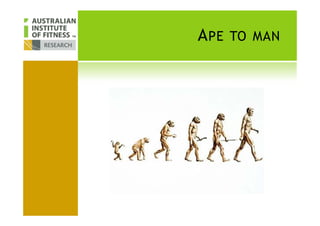
APE TO MAN
DISTANT RELATIVES
Upright posture may date back as far as 4.4 million
years ago
Footprints preserved in hardened volcanic ash datedFootprints preserved in hardened volcanic ash dated
3.6 million years in Tanzania
Homo sapiens started evolving 500,000 years ago
Intellectual capacity caused brain to enlarge which
allowed us to climb, lift, carry, throw, and dig
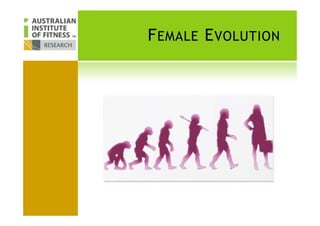
Female pelvis evolved to allow larger diameter heads
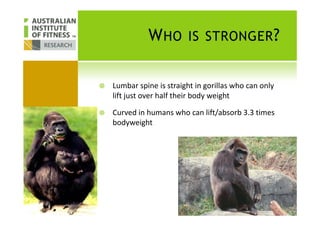
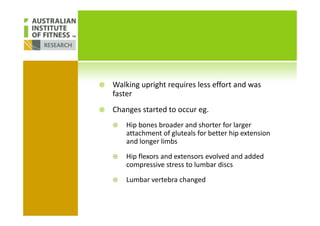
WHO IS STRONGER?
Lumbar spine is straight in gorillas who can only
lift just over half their body weight
Curved in humans who can lift/absorb 3.3 timesCurved in humans who can lift/absorb 3.3 times
bodyweight
Walking upright requires less effort and was
faster
Changes started to occur eg.Changes started to occur eg.
Hip bones broader and shorter for larger
attachment of gluteals for better hip extension
and longer limbs
Hip flexors and extensors evolved and added
compressive stress to lumbar discs
Lumbar vertebra changed
Not all evolutionary changes are positive
Fallen arches – lower limb muscle weakness
Disc problems of lower backDisc problems of lower back
Low back pain – lumbar arch instability
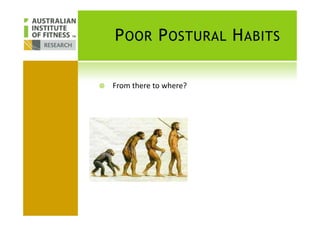
POOR POSTURAL HABITS
From there to where?
FEMALE EVOLUTION
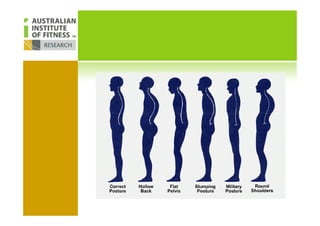
IDEAL ALIGNMENT FOR POSTUREIDEAL ALIGNMENT FOR POSTURE
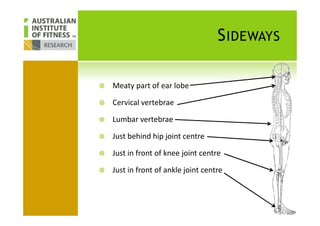
SIDEWAYS
Meaty part of ear lobe
Cervical vertebrae
Lumbar vertebrae
Just behind hip joint centre
Just in front of knee joint centre
Just in front of ankle joint centre
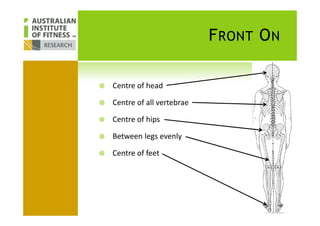
FRONT ON
Centre of head
Centre of all vertebrae
Centre of hips
Between legs evenly
Centre of feet
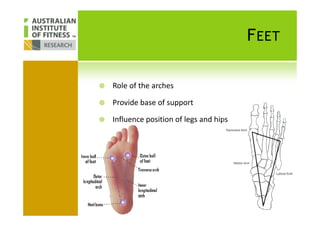
FEET
Role of the arches
Provide base of support
Influence position of legs and hips
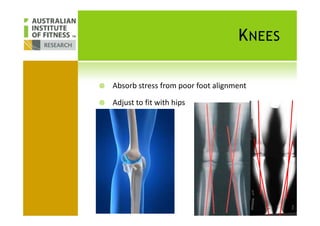
KNEES
Absorb stress from poor foot alignment
Adjust to fit with hips
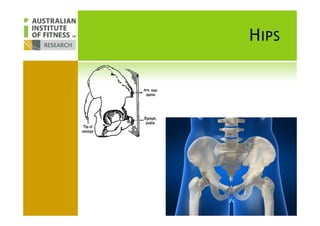
HIPS
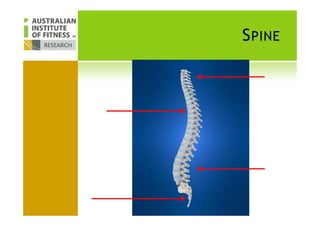
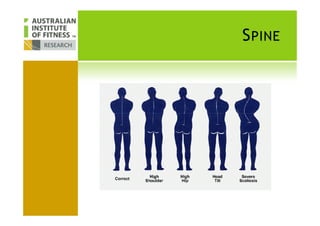
SPINE
SPINE
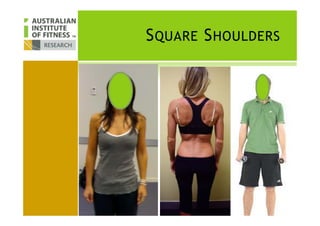
SQUARE SHOULDERS
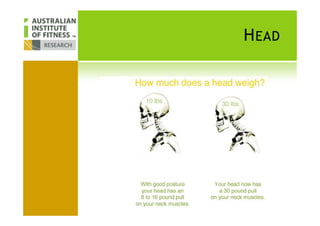
HEAD
WHY WE NEED GOOD POSTUREWHY WE NEED GOOD POSTURE
HEALTH
Good posture improves
Digestion – less congestion in abdominal cavity
and nerve functionand nerve function
Breathing – greater lung capacity and mobile rib
cage
Concentration – more blood flow to brain and
return
Heart health – more space in cavity and better
blood flow from circulation
STRENGTH
Muscles move easier in chains
Nerve messages more effective
Normal length and tension in muscles
Body coordinates segments more efficiently
FLEXIBILITY
Muscles work in groups and not in isolation
Less tension in muscles that hold you upright
Fascia and connective tissue more able to
stretch
MOVEMENT
Joint work better together
Looks smoother
Moves easier
More fluid
WHAT YOU WILL LEARN
SESSION 2
Watch people move
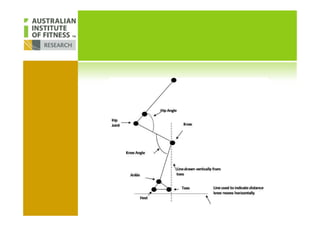
Seeing movement problems
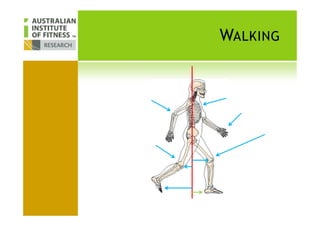
Walking
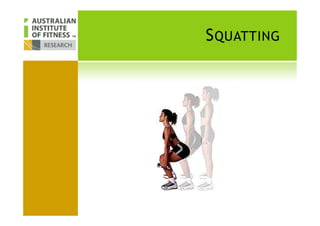
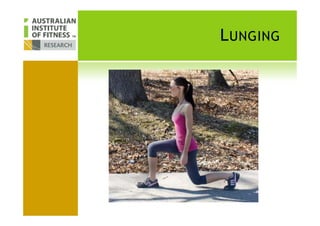
Squatting and lunging
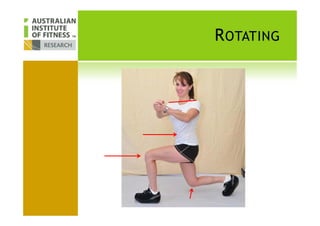
Rotation
HOW PEOPLE MOVEHOW PEOPLE MOVE
GOOD MOVEMENTS
Walking
Running
Squatting
POOR MOVEMENTS
John Wayne
Marilyn Monroe
MOVEMENT PROBLEMS
Shortened actions
Compensations before moving
Compensations after movement
Poor stability
Poor flexibility
WALKING
SQUATTING
LUNGING
ROTATING
MARK MCKEAN PHDMARK MCKEAN PHD
Post Doctoral Research Fellow
Australian Institute of Fitness Research
University of Sunshine Coast
mmckean@usc.edu.au

Ape to man