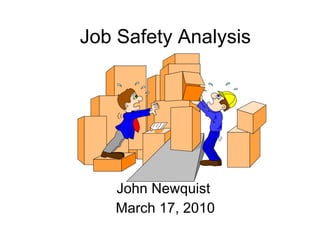
Job Safety Analysis John Newquist  March 17, 2010
Training Objectives Explain the  need  for JSAs Explain the  benefits  of JSAs Provide the  information  necessary to properly complete JSAs Provide the  tools  necessary to properly complete JSAs
What Is Job Safety Analysis? Method used to break a job task into separate and distinct steps Evaluate the hazards associated with each step Determine the appropriate controls needed to control each of the identified hazards
Benefits of Job Safety Analysis Identifies unsafe work practices  before  an accident occurs Decreases injury rates Increases quality Increases productivity Alternative to using rates as an Incentive only!!!
Uses Of Job Safety Analyses Evaluate existing jobs Set up new jobs Training and re-training tool Prioritize jobs needing re-design  Ties in closely with other job analyses (quality & productivity studies, RTW) Reference in accident investigations
No JSA = Bad The report found that risk assessment was “often incomplete,” that business units did not understand or address major hazards, and that competency in risk and hazard assessment was poor. BP March 2004 audit finding.  “Many [people] reported errors due to a lack of time for job analysis, lack of adequate staffing, a lack of supervisor staffing, or a lack of resident knowledge of the unit in the supervisory staff.” 2005 Telus survey
Definition Of Key Words Job task Job step Hazard Exposure Control Accident / Incident
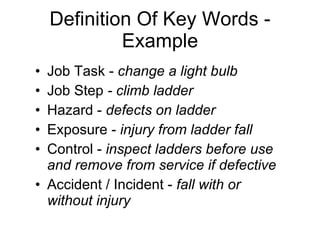
Definition Of Key Words - Example Job Task -  change a light bulb Job Step  - climb ladder Hazard -  defects on ladder Exposure -  injury from ladder fall Control -  inspect ladders before use and remove from service if defective Accident / Incident -  fall with or  without injury
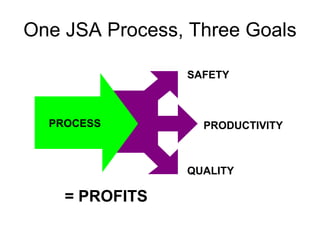
One JSA Process, Three Goals PRODUCTIVITY SAFETY QUALITY = PROFITS PROCESS
Where To Start? Pick 3! Accident history Employee complaints Jobs with close calls Potential Jobs with serious injuries What else?
Involve Employees Discuss what you are going to do and why Explain that you are studying the task, not employee performance Involve the employees in the entire process
Important Tips Evaluate all aspects of the job task, even if performed infrequently Observe more than one employee doing a specific job task Observe more than one shift Take enough time observing the job Observe a worker actually doing the job, not just describing job
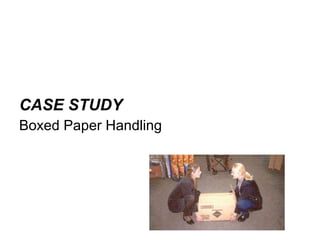
CASE STUDY  Boxed Paper Handling
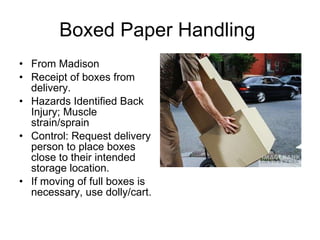
Boxed Paper Handling  From Madison Receipt of boxes from delivery.  Hazards Identified Back Injury; Muscle strain/sprain  Control: Request delivery person to place boxes close to their intended storage location. If moving of full boxes is necessary, use dolly/cart.
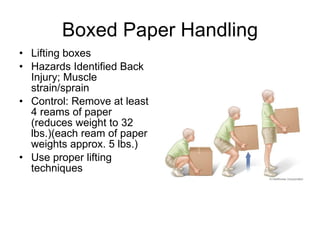
Boxed Paper Handling Lifting boxes  Hazards Identified Back Injury; Muscle strain/sprain Control: Remove at least 4 reams of paper (reduces weight to 32 lbs.)(each ream of paper weights approx. 5 lbs.) Use proper lifting techniques
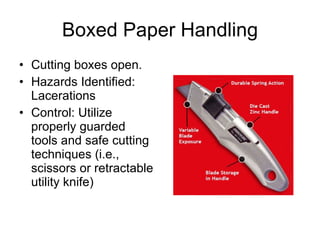
Boxed Paper Handling Cutting boxes open.  Hazards Identified: Lacerations Control: Utilize properly guarded tools and safe cutting techniques (i.e., scissors or retractable utility knife)
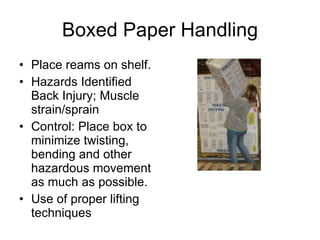
Boxed Paper Handling Place reams on shelf.  Hazards Identified Back Injury; Muscle strain/sprain Control: Place box to minimize twisting, bending and other hazardous movement as much as possible. Use of proper lifting techniques
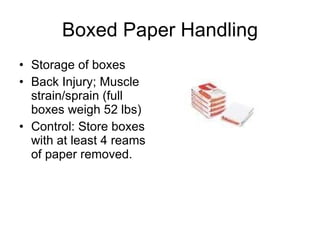
Boxed Paper Handling Storage of boxes  Back Injury; Muscle strain/sprain (full boxes weigh 52 lbs)  Control: Store boxes with at least 4 reams of paper removed.
Do you Critique JSA’s? My attitude is, if someone's going to criticize me, tell me to my face.  Simon  Cowell
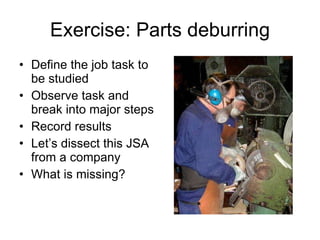
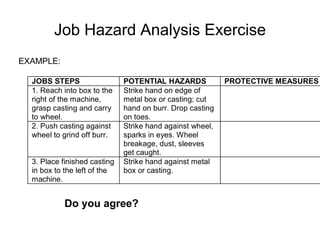
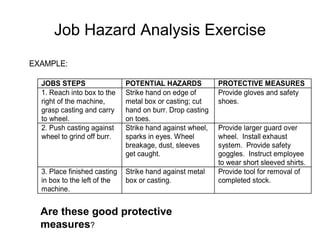
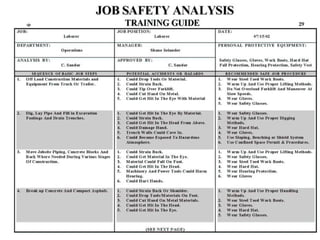
Exercise: Parts deburring Define the job task to be studied Observe task and break into major steps Record results Let’s dissect this JSA from a company What is missing?
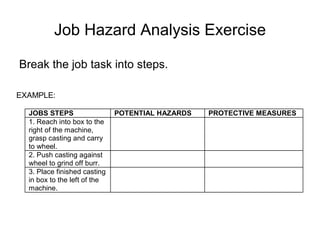
Job Hazard Analysis Exercise Break the job task into steps.
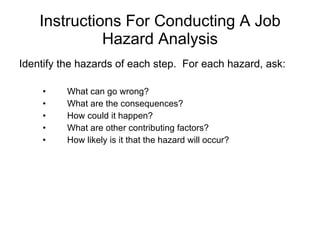
Instructions For Conducting A Job Hazard Analysis Identify the hazards of each step.  For each hazard, ask: What can go wrong? What are the consequences? How could it happen? What are other contributing factors? How likely is it that the hazard will occur?
Job Hazard Analysis Exercise Do you agree?
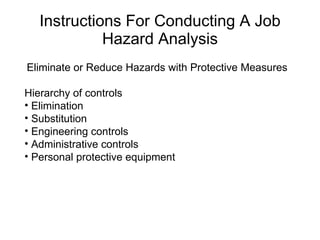
Instructions For Conducting A Job Hazard Analysis Eliminate or Reduce Hazards with Protective Measures Hierarchy of controls Elimination  Substitution  Engineering controls  Administrative controls  Personal protective equipment
Job Hazard Analysis Exercise Are these good protective measures ?
BRAINSTORM! Change a Light Bulb Exercise
Three Step Procedure & Exercise Identify each major step of the job task List the hazard(s) to each major step Determine the control(s) that would prevent an accident for each hazard identified Break into groups List only three steps, hazards, control for changing a light bulb Go!!!
Changing A Light Bulb Event Date: 08/19/2009  An employee was on an aluminum ladder over twenty five feet from the ground when working on replacing a ballast for a 400 watt mercury light bulb.  The power supply line was energized.  The circuit breaker for the lighting fixture was tripped.  The employee fell off the ladder.  The employee was taken to a hospital where he was pronounced dead.
Changing A Light Bulb Event Date: 01/31/2008  Changing 277/480v light bulbs in the parking lot lamps  Outside the store using an aerial lift.  The lamps had been energized to discover which bulbs needed to be replaced.  The lamps were not de-energized prior to the deceased working on it.  The deceased was using a screw driver (a 8.5-inch phillips head screw driver) that was not insulated, and he was not using any type of electrical protective equipment.  The deceased was having difficulty in opening the light housing on the lamp because the lid to the housing had two stripped screws.  The deceased apparently reached into the light housing to replace the light bulb and was electrocuted.  The bulb was found broken after the accident.  According to the medical examiner's report, the deceased died from cardiac ventricular dysrhythmia due to electrocution.  He had an electrical burn on his right palm.
Post Job Hazard Analysis What do I do next ? Correct the unsafe conditions and processes. Train all employees who do the job on the changes Make sure they understand the changes Assign additional needed actions/follow-ups
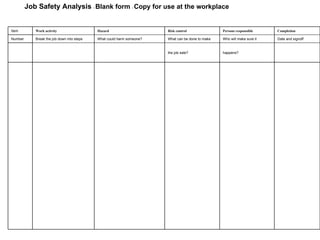
Job Safety Analysis  -  Blank form  -  Copy for use at the workplace happens? the job sale? Date and signoff Who will make sure it What can be done to make What could harm someone? Break the job down into steps Number Completion Persons responsible Risk control Hazard Work activity Item
 
Summary – JSA Training Steps Define meaning of JSA Benefits and why JSAs are important Select the job to be analyzed Prepare the JSA form Break the job task into steps Identify the hazards Identify the controls Correct unsafe conditions and processes Assign additional needed actions/follow-ups Review JSAs Use JSAs for training and accident investigation
Training Objectives? Explain the  need  for JSAs? Explain the  benefits  of JSAs? Provide the  information  necessary to properly complete JSAs? Provide the  tools  necessary to properly complete JSAs?
Contact John Newquist 230 S Dearborn, Ste 3244, Chicago IL 60604 [email_address] 312-353-5977

Job Safety Analysis

  • 1.
    Job Safety AnalysisJohn Newquist March 17, 2010
  • 2.
    Training Objectives Explainthe need for JSAs Explain the benefits of JSAs Provide the information necessary to properly complete JSAs Provide the tools necessary to properly complete JSAs
  • 3.
    What Is JobSafety Analysis? Method used to break a job task into separate and distinct steps Evaluate the hazards associated with each step Determine the appropriate controls needed to control each of the identified hazards
  • 4.
    Benefits of JobSafety Analysis Identifies unsafe work practices before an accident occurs Decreases injury rates Increases quality Increases productivity Alternative to using rates as an Incentive only!!!
  • 5.
    Uses Of JobSafety Analyses Evaluate existing jobs Set up new jobs Training and re-training tool Prioritize jobs needing re-design Ties in closely with other job analyses (quality & productivity studies, RTW) Reference in accident investigations
  • 6.
    No JSA =Bad The report found that risk assessment was “often incomplete,” that business units did not understand or address major hazards, and that competency in risk and hazard assessment was poor. BP March 2004 audit finding. “Many [people] reported errors due to a lack of time for job analysis, lack of adequate staffing, a lack of supervisor staffing, or a lack of resident knowledge of the unit in the supervisory staff.” 2005 Telus survey
  • 7.
    Definition Of KeyWords Job task Job step Hazard Exposure Control Accident / Incident
  • 8.
    Definition Of KeyWords - Example Job Task - change a light bulb Job Step - climb ladder Hazard - defects on ladder Exposure - injury from ladder fall Control - inspect ladders before use and remove from service if defective Accident / Incident - fall with or without injury
  • 9.
    One JSA Process,Three Goals PRODUCTIVITY SAFETY QUALITY = PROFITS PROCESS
  • 10.
    Where To Start?Pick 3! Accident history Employee complaints Jobs with close calls Potential Jobs with serious injuries What else?
  • 11.
    Involve Employees Discusswhat you are going to do and why Explain that you are studying the task, not employee performance Involve the employees in the entire process
  • 12.
    Important Tips Evaluateall aspects of the job task, even if performed infrequently Observe more than one employee doing a specific job task Observe more than one shift Take enough time observing the job Observe a worker actually doing the job, not just describing job
  • 13.
    CASE STUDY Boxed Paper Handling
  • 14.
    Boxed Paper Handling From Madison Receipt of boxes from delivery. Hazards Identified Back Injury; Muscle strain/sprain Control: Request delivery person to place boxes close to their intended storage location. If moving of full boxes is necessary, use dolly/cart.
  • 15.
    Boxed Paper HandlingLifting boxes Hazards Identified Back Injury; Muscle strain/sprain Control: Remove at least 4 reams of paper (reduces weight to 32 lbs.)(each ream of paper weights approx. 5 lbs.) Use proper lifting techniques
  • 16.
    Boxed Paper HandlingCutting boxes open. Hazards Identified: Lacerations Control: Utilize properly guarded tools and safe cutting techniques (i.e., scissors or retractable utility knife)
  • 17.
    Boxed Paper HandlingPlace reams on shelf. Hazards Identified Back Injury; Muscle strain/sprain Control: Place box to minimize twisting, bending and other hazardous movement as much as possible. Use of proper lifting techniques
  • 18.
    Boxed Paper HandlingStorage of boxes Back Injury; Muscle strain/sprain (full boxes weigh 52 lbs) Control: Store boxes with at least 4 reams of paper removed.
  • 19.
    Do you CritiqueJSA’s? My attitude is, if someone's going to criticize me, tell me to my face. Simon Cowell
  • 20.
    Exercise: Parts deburringDefine the job task to be studied Observe task and break into major steps Record results Let’s dissect this JSA from a company What is missing?
  • 21.
    Job Hazard AnalysisExercise Break the job task into steps.
  • 22.
    Instructions For ConductingA Job Hazard Analysis Identify the hazards of each step. For each hazard, ask: What can go wrong? What are the consequences? How could it happen? What are other contributing factors? How likely is it that the hazard will occur?
  • 23.
    Job Hazard AnalysisExercise Do you agree?
  • 24.
    Instructions For ConductingA Job Hazard Analysis Eliminate or Reduce Hazards with Protective Measures Hierarchy of controls Elimination Substitution Engineering controls Administrative controls Personal protective equipment
  • 25.
    Job Hazard AnalysisExercise Are these good protective measures ?
  • 26.
    BRAINSTORM! Change aLight Bulb Exercise
  • 27.
    Three Step Procedure& Exercise Identify each major step of the job task List the hazard(s) to each major step Determine the control(s) that would prevent an accident for each hazard identified Break into groups List only three steps, hazards, control for changing a light bulb Go!!!
  • 28.
    Changing A LightBulb Event Date: 08/19/2009 An employee was on an aluminum ladder over twenty five feet from the ground when working on replacing a ballast for a 400 watt mercury light bulb. The power supply line was energized. The circuit breaker for the lighting fixture was tripped. The employee fell off the ladder. The employee was taken to a hospital where he was pronounced dead.
  • 29.
    Changing A LightBulb Event Date: 01/31/2008 Changing 277/480v light bulbs in the parking lot lamps Outside the store using an aerial lift. The lamps had been energized to discover which bulbs needed to be replaced. The lamps were not de-energized prior to the deceased working on it. The deceased was using a screw driver (a 8.5-inch phillips head screw driver) that was not insulated, and he was not using any type of electrical protective equipment. The deceased was having difficulty in opening the light housing on the lamp because the lid to the housing had two stripped screws. The deceased apparently reached into the light housing to replace the light bulb and was electrocuted. The bulb was found broken after the accident. According to the medical examiner's report, the deceased died from cardiac ventricular dysrhythmia due to electrocution. He had an electrical burn on his right palm.
  • 30.
    Post Job HazardAnalysis What do I do next ? Correct the unsafe conditions and processes. Train all employees who do the job on the changes Make sure they understand the changes Assign additional needed actions/follow-ups
  • 31.
    Job Safety Analysis - Blank form - Copy for use at the workplace happens? the job sale? Date and signoff Who will make sure it What can be done to make What could harm someone? Break the job down into steps Number Completion Persons responsible Risk control Hazard Work activity Item
  • 32.
  • 33.
    Summary – JSATraining Steps Define meaning of JSA Benefits and why JSAs are important Select the job to be analyzed Prepare the JSA form Break the job task into steps Identify the hazards Identify the controls Correct unsafe conditions and processes Assign additional needed actions/follow-ups Review JSAs Use JSAs for training and accident investigation
  • 34.
    Training Objectives? Explainthe need for JSAs? Explain the benefits of JSAs? Provide the information necessary to properly complete JSAs? Provide the tools necessary to properly complete JSAs?
  • 35.
    Contact John Newquist230 S Dearborn, Ste 3244, Chicago IL 60604 [email_address] 312-353-5977

Editor's Notes

  • #3 Explain each objective of the training and that the supervisors will be expected to take this information and tools and complete JSAs on selected job tasks at the direction of the Safety Director or other manager. Further explain that we will come back to this slide at the end of the course and all present will be able to comment on whether each of the objectives was met.
  • #4 Review each point individually and explain that key words used in the presentation such as “hazards” and “controls “ will be clearly defined in just a few minutes, so that we all mean exactly the same thing when we use these key words. (These definitions are also contained in the reference guide that all supervisors will receive for future reference and use). TRANSITION: “Now that we have an idea of what JSAs are about, let’s review the benefits of applying the use of JSAs in a systematic way...”
  • #5 Review the benefits of completing JSAs. If we can identify unsafe work practices before an accident occurs, we can take the steps necessary to decrease injury rates and, in many instances, re-design the job process, equipment or tools to also boost quality and productivity rates. We will return to the concept of how safety, quality and productivity interact in just a few minutes. TRANSITION: Now that we have discussed the primary benefits of utilizing JSAs, let’s review the various ways that JSA information can be used...
  • #6 These are the primary ways in which JSA information is typically used. Review each in turn. Emphasize that the regular and proper completion of JSAs will help to design and manage the manufacturing process not from just a safety standpoint, but from a productivity, quality and compliance standpoint as well. As a trainer, you are selling the benefits and usefulness of JSAs so that attendees realize and “buy in” to the need for completing them. Take as much time as you need to make sure supervisors understand the importance and benefits of JSAs and why they are seen as the primary source of information in completing and using JSAs (because they are the closest level of management to the work process, they are heavily involved in setting up and modifying jobs, they are the primary trainers of employees, they are aware of past accidents in their respective areas, and they observe employee job performance every day).
  • #8 The audience will find definitions of each term in their reference guides. Refer supervisors to their reference guides for the first time. Explain that this contains a number of tools that are designed to assist them in the JSA process. Ask them to turn to the definitions page and review the key definitions with them. To help them understand the terms hazard, exposure and control, give them the following situation of driving a car. A situation we can all relate to is driving our car on a wet, slick road surface. Ask the audience to name a hazard (slippery road) Ask them to list a corresponding exposure (collision or run off the road accident due to loss of steering control or loss of braking control). List a corresponding control (reduce speed to account for the slick conditions and reduce the degree of the exposure). TRANSITION: “Let’s review another example of these key terms as applied to the workplace so that we all fully understand them...”
  • #9 Review this quick example of a defective ladder. Explain that it is possible to have more than one exposure for each hazard and also possible to have more than one control for each hazard. Make sure that all are comfortable with the terms before moving on. TRANSITION: “Some people feel that safety is not compatible with production efforts and/or quality efforts. Actually, in most cases, these three work hand in hand. Let’s see why...”
  • #10 Safety isn’t a person or thing. It is not your Safety Coordinator and it is not a written safety manual. It is a process, specifically the way our workers perform their jobs collectively each day. At times, they have the proper equipment, tools, job instruction, training and attitude to perform their jobs safely. At other times however, one or more of these elements may be lacking. Similarly, productivity and quality are the results of the same process as workers complete their jobs each day. Either they have and use the prerequisites to perform the job successfully or they don’t. Frequently, the method that is the safest way to perform a specific job task is also a highly productive one that results in a high level of quality as well. (Provide an example). Occasionally, this is not true and a compromise solution may be needed to balance the three goals. (Provide example). All three of these ingredients are intertwined in the same process and all three directly and collectively impact the company’s bottom line results. Therefore studying and improving job methods is extremely important to us all. Make sure this point is understood & accepted.
  • #11 Review each of these as sources of information in prioritizing job tasks that need to studied immediately. Initially, the job tasks being studied will be high exposure tasks. Over time, the exposure from job tasks being studied should continually decrease. However, other factors such as new accidents, equipment changes, and process re-design are likely to continually shuffle the priorities of job tasks to be studied. Job Safety Analysis is a continual process that does not carry a completion date. TRANSITION: If, after using all of the above information it’s still not clear as to which jobs should be prioritized for JSA usage...
  • #13 Introduce these important tips on overall completion of JSAs. Failure to follow each of these tips can result incomplete information within the JSAs, limiting their effectiveness. Make sure that attendees understand the “why” behind each of these tips. Examples may be useful here. TRANSITION: After we’ve selected a job task to be evaluated, we’re ready to begin the first step of the JSA...
  • #14 Introduce a case study to the class and, as a group, complete Step 1 of the JSA, listing the major steps of a job task. A videotaped job task is a good method to visually introduce and evaluate this case study. As a class exercise, list the major job steps on a blank JSA form. This exercise will only produce Step 1 of the JSA. The other two steps will be completed by the class after some additional instruction. You may want to list the major job steps on a flip chart for all to refer to. TRANSITION: Before moving into completion of JSA Step 2, we need to cover some pointers on identifying hazards in the workplace...
  • #21 The first step is to list the major job steps. The idea is not to make the job steps either too broad or too narrow in scope. We’ll run through a few examples that will give you a good feel for what we mean here. After recording the initial results, take the time to ensure that the information obtained is accurate and complete. Let’s discuss a few additional tips on how to do that.
  • #27 ...it’s best just to use our own best judgement and common sense. TRANSITION: Now that we’ve covered the benefits, uses and need for a Job Safety Analysis program, let's talk about the actual process of completing a JSA. It consists of three basic steps...
  • #28 Briefly describe the 3 steps that comprise all JSAs. (Don’t spend a lot of time here unless questions develop. Details and tips for completing each of these three steps will be developed later in the presentation). TRANSITION: Let’s now cover several important tips on the proper completion of all JSAs...
  • #35 As indicated earlier, review our initial training objectives to make sure all have been satisfactorily met. Ask the class if the four listed objectives, in a one-by-one fashion, have been met. If a negative response is raised, determine if it is a class-wide opinion or an individual’s opinion. Discuss what other information and/or tools need to be introduced and then come to an understanding of when that information will provided and in what form. Thank all for attending and re-emphasize that all present are the keys to successfully implementation and continuation of a JSA program that will benefit the entire facility. Make sure that expectations for this group are clearly understood by all.