MOTOR NEURON
DISEASES
‫הולצמן‬ ‫מיכל‬,‫נוירולוגיה‬ ‫מחלקת‬,‫בי‬"‫מערבי‬ ‫לגליל‬ ‫ח‬‫נהריה‬
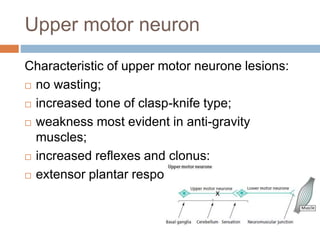
Upper motor neuron
Characteristic of upper motor neurone lesions:
 no wasting;
 increased tone of clasp-knife type;
 weakness most evident in anti-gravity
muscles;
 increased reflexes and clonus;
 extensor plantar responses.
Upper motor neuron
 Lesion situated peripherally in the cerebral
hemisphere produces weakness of part of
the contralateral side of the body
 Lesion of the internal capsule, are much
more likely to produce weakness of the whole
of the contralateral side of the body & visual
loss
 Lesion in the spinal cord in high cervical level
will cause ipsilateral hemiparessis, below
the neck level ipsilateral monoparessis
Lower motor neuron
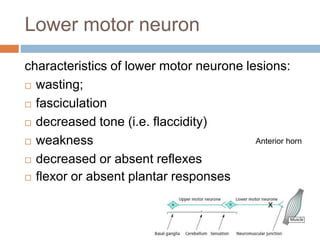
characteristics of lower motor neurone lesions:
 wasting;
 fasciculation
 decreased tone (i.e. flaccidity)
 weakness
 decreased or absent reflexes
 flexor or absent plantar responses
Anterior horn
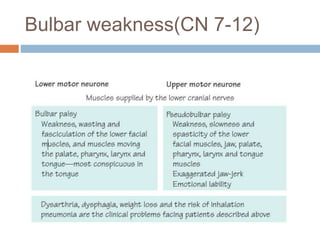
Bulbar weakness(CN 7-12)
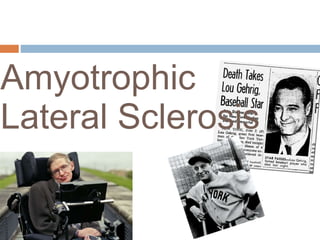
Amyotrophic
Lateral Sclerosis
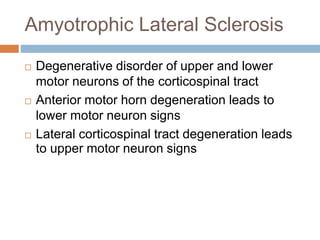
Amyotrophic Lateral Sclerosis
 Degenerative disorder of upper and lower
motor neurons of the corticospinal tract
 Anterior motor horn degeneration leads to
lower motor neuron signs
 Lateral corticospinal tract degeneration leads
to upper motor neuron signs
Amyotrophic Lateral Sclerosis
 The process is remarkably selective, leaving
special senses, and cerebellar, sensory and
autonomic functions intact
 Tends to start either as a problem in the bulbar
muscles, or as a problem in the limbs
 Initially the involvement tends to be either
lower motor neurone or upper motor neurone
in nature
 the coexistence of both, in the absence of
sensory signs, is the hallmark of motor
neurone disease
pathogenesis
 Most cases are sporadic, arising in middle age
adults.
 Zinc-copper superoxide dismutase mutation
(SOD1) is present in some familial cases;
leads to free radical injury in neurons
 Prior to their destruction, motor neurons
develop protein-rich inclusions in their cell
bodies and axons containing ubiquitin
Clinical presentation
In 75-80% of patients, symptoms begin with limb
involvement.
Initial complaints in patients with lower limb onset are often
as follows:
 Tripping, stumbling, or awkwardness when running
 Foot drop; patients may report a "slapping" gait
Initial complaints with upper limb onset include the
following:
 Reduced finger dexterity, cramping, stiffness, and
weakness or wasting of intrinsic hand muscles
 Wrist drop interfering with work performance
With bulbar onset (20-25%), initial complaints are as
follows:
 Slurred speech, hoarseness, or decreased volume of
speech
Clinical presentation
Emotional and special cognitive difficulties in some
ALS patients are as follows:
 Involuntary laughing or crying
 Depression
 Impaired executive function
 Maladaptive social behavior
Features of more-advanced disease are as follows:
 Muscle atrophy becomes more apparent
 Spasticity may compromise gait and manual
dexterity
 Muscle cramps are common
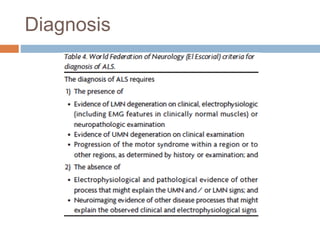
Diagnosis
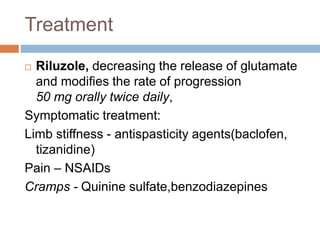
Treatment
 Riluzole, decreasing the release of glutamate
and modifies the rate of progression
50 mg orally twice daily,
Symptomatic treatment:
Limb stiffness - antispasticity agents(baclofen,
tizanidine)
Pain – NSAIDs
Cramps - Quinine sulfate,benzodiazepines
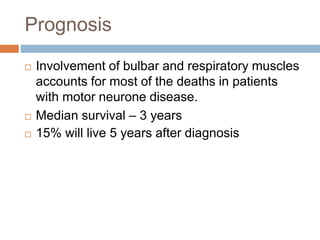
Prognosis
 Involvement of bulbar and respiratory muscles
accounts for most of the deaths in patients
with motor neurone disease.
 Median survival – 3 years
 15% will live 5 years after diagnosis
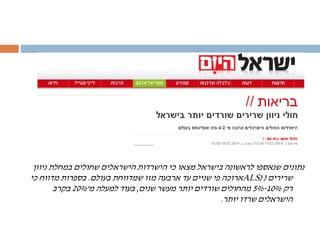
‫ניוון‬ ‫במחלת‬ ‫שחולים‬ ‫הישראלים‬ ‫הישרדות‬ ‫כי‬ ‫מצאו‬ ‫בישראל‬ ‫לראשונה‬ ‫שנאספו‬ ‫נתונים‬
‫שרירים‬(ALS)‫בעולם‬ ‫שמדווחת‬ ‫מזו‬ ‫ארבעה‬ ‫עד‬ ‫שניים‬ ‫פי‬ ‫ארוכה‬.‫כי‬ ‫מדווח‬ ‫בספרות‬
‫רק‬10%-5%‫שנים‬ ‫מעשר‬ ‫יותר‬ ‫שורדים‬ ‫מהחולים‬,‫מ־‬ ‫למעלה‬ ‫בעוד‬20%‫בקרב‬
‫יותר‬ ‫שרדו‬ ‫הישראלים‬.
Primary lateral sclerosis
 Disease of the voluntary muscle due to UMN
lesion
 Symptoms: spasticity, weakness and stiffness
of legs, drop foot.
 occurs spontaneously after age 50 and
progresses gradually over a number of year
Spinal Muscular Atrophy
 autosomal-recessive disorders, characterized by
progressive weakness of the lower motor
neurons.
 Related to defect on SMN1 gene on chromosome
5q
 characterized by loss of anterior horn cells
 Patients usually presenting with muscle weakness
and wasting in the limbs, respiratory, and bulbar
or brainstem muscles
 The most common types are acute infantile (SMA
type I, or Werdnig-Hoffman disease), chronic
infantile (SMA type II), chronic juvenile (SMA type
III or Kugelberg-Welander disease), and adult
onset (SMA type IV) forms.
Thank you for listening…

motor neuron disease

  • 1.
    MOTOR NEURON DISEASES ‫הולצמן‬ ‫מיכל‬,‫נוירולוגיה‬‫מחלקת‬,‫בי‬"‫מערבי‬ ‫לגליל‬ ‫ח‬‫נהריה‬
  • 2.
    Upper motor neuron Characteristicof upper motor neurone lesions:  no wasting;  increased tone of clasp-knife type;  weakness most evident in anti-gravity muscles;  increased reflexes and clonus;  extensor plantar responses.
  • 3.
    Upper motor neuron Lesion situated peripherally in the cerebral hemisphere produces weakness of part of the contralateral side of the body  Lesion of the internal capsule, are much more likely to produce weakness of the whole of the contralateral side of the body & visual loss  Lesion in the spinal cord in high cervical level will cause ipsilateral hemiparessis, below the neck level ipsilateral monoparessis
  • 4.
    Lower motor neuron characteristicsof lower motor neurone lesions:  wasting;  fasciculation  decreased tone (i.e. flaccidity)  weakness  decreased or absent reflexes  flexor or absent plantar responses Anterior horn
  • 5.
  • 6.
  • 7.
    Amyotrophic Lateral Sclerosis Degenerative disorder of upper and lower motor neurons of the corticospinal tract  Anterior motor horn degeneration leads to lower motor neuron signs  Lateral corticospinal tract degeneration leads to upper motor neuron signs
  • 8.
    Amyotrophic Lateral Sclerosis The process is remarkably selective, leaving special senses, and cerebellar, sensory and autonomic functions intact  Tends to start either as a problem in the bulbar muscles, or as a problem in the limbs  Initially the involvement tends to be either lower motor neurone or upper motor neurone in nature  the coexistence of both, in the absence of sensory signs, is the hallmark of motor neurone disease
  • 9.
    pathogenesis  Most casesare sporadic, arising in middle age adults.  Zinc-copper superoxide dismutase mutation (SOD1) is present in some familial cases; leads to free radical injury in neurons  Prior to their destruction, motor neurons develop protein-rich inclusions in their cell bodies and axons containing ubiquitin
  • 10.
    Clinical presentation In 75-80%of patients, symptoms begin with limb involvement. Initial complaints in patients with lower limb onset are often as follows:  Tripping, stumbling, or awkwardness when running  Foot drop; patients may report a "slapping" gait Initial complaints with upper limb onset include the following:  Reduced finger dexterity, cramping, stiffness, and weakness or wasting of intrinsic hand muscles  Wrist drop interfering with work performance With bulbar onset (20-25%), initial complaints are as follows:  Slurred speech, hoarseness, or decreased volume of speech
  • 11.
    Clinical presentation Emotional andspecial cognitive difficulties in some ALS patients are as follows:  Involuntary laughing or crying  Depression  Impaired executive function  Maladaptive social behavior Features of more-advanced disease are as follows:  Muscle atrophy becomes more apparent  Spasticity may compromise gait and manual dexterity  Muscle cramps are common
  • 12.
  • 13.
    Treatment  Riluzole, decreasingthe release of glutamate and modifies the rate of progression 50 mg orally twice daily, Symptomatic treatment: Limb stiffness - antispasticity agents(baclofen, tizanidine) Pain – NSAIDs Cramps - Quinine sulfate,benzodiazepines
  • 14.
    Prognosis  Involvement ofbulbar and respiratory muscles accounts for most of the deaths in patients with motor neurone disease.  Median survival – 3 years  15% will live 5 years after diagnosis
  • 15.
    ‫ניוון‬ ‫במחלת‬ ‫שחולים‬‫הישראלים‬ ‫הישרדות‬ ‫כי‬ ‫מצאו‬ ‫בישראל‬ ‫לראשונה‬ ‫שנאספו‬ ‫נתונים‬ ‫שרירים‬(ALS)‫בעולם‬ ‫שמדווחת‬ ‫מזו‬ ‫ארבעה‬ ‫עד‬ ‫שניים‬ ‫פי‬ ‫ארוכה‬.‫כי‬ ‫מדווח‬ ‫בספרות‬ ‫רק‬10%-5%‫שנים‬ ‫מעשר‬ ‫יותר‬ ‫שורדים‬ ‫מהחולים‬,‫מ־‬ ‫למעלה‬ ‫בעוד‬20%‫בקרב‬ ‫יותר‬ ‫שרדו‬ ‫הישראלים‬.
  • 16.
    Primary lateral sclerosis Disease of the voluntary muscle due to UMN lesion  Symptoms: spasticity, weakness and stiffness of legs, drop foot.  occurs spontaneously after age 50 and progresses gradually over a number of year
  • 17.
    Spinal Muscular Atrophy autosomal-recessive disorders, characterized by progressive weakness of the lower motor neurons.  Related to defect on SMN1 gene on chromosome 5q  characterized by loss of anterior horn cells  Patients usually presenting with muscle weakness and wasting in the limbs, respiratory, and bulbar or brainstem muscles  The most common types are acute infantile (SMA type I, or Werdnig-Hoffman disease), chronic infantile (SMA type II), chronic juvenile (SMA type III or Kugelberg-Welander disease), and adult onset (SMA type IV) forms.
  • 18.
    Thank you forlistening…