HIV INFECTION - ENCEPHALITIS
Mrs. M. Pradeepa MPT (Neuro)
Vice Principal
PPG College of Physiotherapy
Coimbatore, Tamilnadu, India
INTRODUCTION
• The human immunodeficiency virus (HIV) is an
enveloped retrovirus that contains 2 copies of a
single-stranded RNA genome. It causes the acquired
immunodeficiency syndrome (AIDS) that is the last
stage of HIV disease.
• AIDS was first clinically observed in 1981 in the
United States.
• Both HIV-1 and HIV-2 are believed to have
originated in non-human primates in West-central
Africa, and are believed to have transferred to
humans a process known as zoonosis in the early
20th century
HIV AND NERVOUS SYSTEM EFFECTS
• Direct Or Primary Effect
• HIV virus and its products
• Indirect or Secondary Effect
• Opportunistic infection
• HIV associated neoplasms
HIV AND CNS
• Neurological features develop in 80% of infected
individuals manifesting as either direct effects of
the HIV virus or infections, tumours and
associated vascular disorders due to
immunodeficiency.
• In a minority of patients, CNS HIV-1 infection
evolves into encephalitis during the late stages of
systemic infection, which compromises brain
function and presents clinically as acquired
immunodeficiency syndrome dementia complex
(ADC)
HIV AND CNS
• Potential site of involvement:
• Meninges
• Brain
• Spinal cord
• Cranial and spinal nerves
• ANS
• Muscle
HIV AND CNS CLINICAL SYNDROMES
• Dementia
• Infection – Encephalitis, cerebral abcess,
Meningitis
• Cerebral tumors
• Retinopathy
• Myelopathy
• Vascular disorders
• Peripheral neuropathies
DEFINITION
• HIV encephalitis refers to cognitive impairment
resulting from productive cerebral infection by
the human immunodeficiency virus
• It does not apply to opportunistic infections
resulting from generalized cell mediated
immunodeficiency
TERMINOLOGY
• Severe cognitive impairment related to HIV
encephalitis was also referred to as HIV
associated dementia (HAD) or the AIDS
dementia complex
• Currently, other terms used to describe this
illness include HIV associated neurocognitive
disorder (HAND) and HIV associated
neurocognitive impairment
EPIDEMIOLOGY
• Prevalence estimates for HIV associated
neurocognitive disorder range from 35 to 100%
• Upto 50% of HIV patients have clinically apparent
neurological disease.
• Upto 20% of HIV patients present for the first time
with neurological manifestations.
• Upto 90% of HIV patients have neuropathological
changes on autopsy.
• India has the second largest burden of HIV related
pathology next to sub-Saharan Africa.
• Neurological complications associated to HIV-1
infections, are very common in our clinical setting.
TYPES
• HIV neurocognitive impairment be divided into:
• Type I - corresponding to neurocognitive
disability resulting from active HIV encephalitis
• Type II - corresponding to mild cognitive
impairment, for which the neuropathological
substrate has not been established
SITES
• Although HIV encephalitis may occur anywhere
within the nervous system, there is a distinct
predilection for pathologic changes to be found
predominantly within subcortical white
matter and basal ganglia
PATHOPHYSIOLOGY
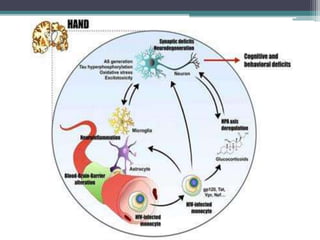
• HIV enters the CNS by a mechanism called “Trojan horse” that
consists of the migration of infected monocytes through the BBB.
• Infected monocytes then fuse with resident microglial cells,
perivascular macrophages and potentially adult neural precursors
• Viral replication is also seen in a restrictive manner in astrocytes
• This results in direct and indirect effects of HIV infection will lead to
neuronal dysfunction
• DE: Infected astrocytes and microglia release factors inducing
neurotoxicity such as cytokines, chemokine and reactive oxygen
species (ROS).
• IE: This may also contribute to the disruption of the BBB and result
in further entry/exit of virions and viral proteins
• In addition, HIV associated glycoproteins may interfere with
synaptic activity
• However, neurons are not productively infected by the virus
CLINICAL PRESENTATION
• Symptoms may develop over weeks to months
• Cognition:
• Decreased concentration
• Forgetfulness particularly daily or recent events
• Slowing of thought process
• Global dementia
• Psychomotor slowing: verbal response delayed, near
or absolute mutism, vacant stare
• Unwareness of illness or disinhibition
• Confusion, disorientation
• Organic psychosis
CLINICAL PRESENTATION
• Motor symptoms:
• Poor balance
• Gait instability – slow and rigid gait
• Slowness of movements
• Tremors
• Other involuntary movements – choreoathetoid
movements
• Myoclonic jerks
• Bladder and bowel incontinence
DIAGNOSIS
• Currently, the diagnosis is made through the neuropsychometric
performance testing, in combination with neuroimaging
• Laboratory
• Classical HIV disease biomarkers (low CD4 count, high viral load)
are no longer closely associated with neurological impairment
although markers of systemic inflammation appear to correlate with
cognitive impairment
• ELISA test, Saliva test, Viral load test, Western blot test (HIV tests)
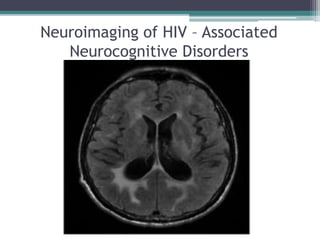
• Radiology description
• Increased white matter signal on fluid level attenuated inversion
recovery (FLAIR) images although these are only apparent in the
more advanced stages of cognitive impairment
• Symmetric patchy periventricular regions
Neuroimaging of HIV – Associated
Neurocognitive Disorders
DIFFERENTIAL DIAGNOSIS
• Superimposed opportunistic infections or
neoplasms - the presence of subcortical
microglial nodule encephalitis with
multinucleated microglial cells is virtually
pathognomonic for HIV encephalitis
MANAGEMENT
• Although implementation of combined
antiretroviral therapy has reduced the
prevalence of severe neurocognitive impairment,
optimized HIV therapy is not sufficient to avert
cognitive impairment
• It is believed that in addition to combined
antiretroviral therapy, treatments that
will address inflammation and
cardiovascular risks may provide benefit
MANAGEMENT
• HAART (Highly active antiretroviral therapy)
management comprises two nucleoside reverse
transcriptase inhibitors (e.g. zidovudine and
didanosine) and a protease inhibitor (e.g.
ritonavir or indinavir), or a nonnucleoside
reverse transcriptase inhibitor (nevirapine).
• Opportunistic infection – treatment of specific
infection
THANK YOU

HIV Infection Encephalitis

  • 1.
    HIV INFECTION -ENCEPHALITIS Mrs. M. Pradeepa MPT (Neuro) Vice Principal PPG College of Physiotherapy Coimbatore, Tamilnadu, India
  • 2.
    INTRODUCTION • The humanimmunodeficiency virus (HIV) is an enveloped retrovirus that contains 2 copies of a single-stranded RNA genome. It causes the acquired immunodeficiency syndrome (AIDS) that is the last stage of HIV disease. • AIDS was first clinically observed in 1981 in the United States. • Both HIV-1 and HIV-2 are believed to have originated in non-human primates in West-central Africa, and are believed to have transferred to humans a process known as zoonosis in the early 20th century
  • 3.
    HIV AND NERVOUSSYSTEM EFFECTS • Direct Or Primary Effect • HIV virus and its products • Indirect or Secondary Effect • Opportunistic infection • HIV associated neoplasms
  • 4.
    HIV AND CNS •Neurological features develop in 80% of infected individuals manifesting as either direct effects of the HIV virus or infections, tumours and associated vascular disorders due to immunodeficiency. • In a minority of patients, CNS HIV-1 infection evolves into encephalitis during the late stages of systemic infection, which compromises brain function and presents clinically as acquired immunodeficiency syndrome dementia complex (ADC)
  • 5.
    HIV AND CNS •Potential site of involvement: • Meninges • Brain • Spinal cord • Cranial and spinal nerves • ANS • Muscle
  • 6.
    HIV AND CNSCLINICAL SYNDROMES • Dementia • Infection – Encephalitis, cerebral abcess, Meningitis • Cerebral tumors • Retinopathy • Myelopathy • Vascular disorders • Peripheral neuropathies
  • 7.
    DEFINITION • HIV encephalitisrefers to cognitive impairment resulting from productive cerebral infection by the human immunodeficiency virus • It does not apply to opportunistic infections resulting from generalized cell mediated immunodeficiency
  • 8.
    TERMINOLOGY • Severe cognitiveimpairment related to HIV encephalitis was also referred to as HIV associated dementia (HAD) or the AIDS dementia complex • Currently, other terms used to describe this illness include HIV associated neurocognitive disorder (HAND) and HIV associated neurocognitive impairment
  • 9.
    EPIDEMIOLOGY • Prevalence estimatesfor HIV associated neurocognitive disorder range from 35 to 100% • Upto 50% of HIV patients have clinically apparent neurological disease. • Upto 20% of HIV patients present for the first time with neurological manifestations. • Upto 90% of HIV patients have neuropathological changes on autopsy. • India has the second largest burden of HIV related pathology next to sub-Saharan Africa. • Neurological complications associated to HIV-1 infections, are very common in our clinical setting.
  • 10.
    TYPES • HIV neurocognitiveimpairment be divided into: • Type I - corresponding to neurocognitive disability resulting from active HIV encephalitis • Type II - corresponding to mild cognitive impairment, for which the neuropathological substrate has not been established
  • 11.
    SITES • Although HIVencephalitis may occur anywhere within the nervous system, there is a distinct predilection for pathologic changes to be found predominantly within subcortical white matter and basal ganglia
  • 12.
    PATHOPHYSIOLOGY • HIV entersthe CNS by a mechanism called “Trojan horse” that consists of the migration of infected monocytes through the BBB. • Infected monocytes then fuse with resident microglial cells, perivascular macrophages and potentially adult neural precursors • Viral replication is also seen in a restrictive manner in astrocytes • This results in direct and indirect effects of HIV infection will lead to neuronal dysfunction • DE: Infected astrocytes and microglia release factors inducing neurotoxicity such as cytokines, chemokine and reactive oxygen species (ROS). • IE: This may also contribute to the disruption of the BBB and result in further entry/exit of virions and viral proteins • In addition, HIV associated glycoproteins may interfere with synaptic activity • However, neurons are not productively infected by the virus
  • 14.
    CLINICAL PRESENTATION • Symptomsmay develop over weeks to months • Cognition: • Decreased concentration • Forgetfulness particularly daily or recent events • Slowing of thought process • Global dementia • Psychomotor slowing: verbal response delayed, near or absolute mutism, vacant stare • Unwareness of illness or disinhibition • Confusion, disorientation • Organic psychosis
  • 15.
    CLINICAL PRESENTATION • Motorsymptoms: • Poor balance • Gait instability – slow and rigid gait • Slowness of movements • Tremors • Other involuntary movements – choreoathetoid movements • Myoclonic jerks • Bladder and bowel incontinence
  • 16.
    DIAGNOSIS • Currently, thediagnosis is made through the neuropsychometric performance testing, in combination with neuroimaging • Laboratory • Classical HIV disease biomarkers (low CD4 count, high viral load) are no longer closely associated with neurological impairment although markers of systemic inflammation appear to correlate with cognitive impairment • ELISA test, Saliva test, Viral load test, Western blot test (HIV tests) • Radiology description • Increased white matter signal on fluid level attenuated inversion recovery (FLAIR) images although these are only apparent in the more advanced stages of cognitive impairment • Symmetric patchy periventricular regions
  • 17.
    Neuroimaging of HIV– Associated Neurocognitive Disorders
  • 18.
    DIFFERENTIAL DIAGNOSIS • Superimposedopportunistic infections or neoplasms - the presence of subcortical microglial nodule encephalitis with multinucleated microglial cells is virtually pathognomonic for HIV encephalitis
  • 19.
    MANAGEMENT • Although implementationof combined antiretroviral therapy has reduced the prevalence of severe neurocognitive impairment, optimized HIV therapy is not sufficient to avert cognitive impairment • It is believed that in addition to combined antiretroviral therapy, treatments that will address inflammation and cardiovascular risks may provide benefit
  • 20.
    MANAGEMENT • HAART (Highlyactive antiretroviral therapy) management comprises two nucleoside reverse transcriptase inhibitors (e.g. zidovudine and didanosine) and a protease inhibitor (e.g. ritonavir or indinavir), or a nonnucleoside reverse transcriptase inhibitor (nevirapine). • Opportunistic infection – treatment of specific infection
  • 21.