1/30/2015 1
GUILLAIN –BARRE SYNDROME
Presented by:
RABEIYA TAZEEM
B.S.P.T (Final yr)
Batch-2007
College of Physiotherapy-JPMC
1/30/2015 2
PRESENTATION FLOW
Introduction
Epidemiology
Sub-types
Pathology
Medical treatment
Rehabilitation
Prognosis
1/30/2015 3
Introduction
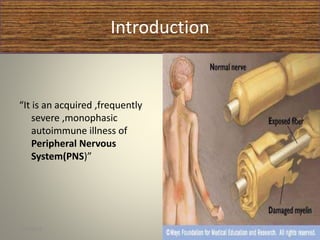
“It is an acquired ,frequently
severe ,monophasic
autoimmune illness of
Peripheral Nervous
System(PNS)”
1/30/2015 4
Alternative Names

•Landry-Guillain-Barre-Strohl Syndrome
•Post-Infectious Polyneuropathy
•Acute Idiopathic Polyneuropathy
After the advent of OPV ,today GBS is almost the only
inflammatory Polyneuropathy and most frequent cause
of acute flaccid paralysis in general medical practice
1/30/2015 6
 Approximately 85% patients recover
spontaneously while 10% patients need
hospitalization
Its prevalence has been reported to vary from
region to region
1/30/2015 7
Epidemiology
According to more recent study ,GBS occurs
throughout the world with a medium incidence of 1.3
cases per 100,000 population
Males are more commonly affected than females
Peaks in young adults and in elderly
1/30/2015 9
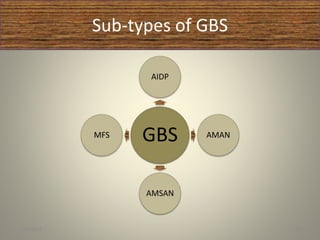
Sub-types of GBS
GBS
AIDP
AMAN
AMSAN
MFS
1/30/2015 10
Acute Inflammatory Demyelinating
Polyneuropathy(AIDP)
Prevalent in western countries (90% of the GBS
cases)
Adults are affected more than the children
First attack appears directed against a component
of Schwann cell
AIDP cont’d…
Cause of flaccid paralysis & sensory disturbances is the
block of conduction ,whereas axonal connection remains
intact
Recovery is most often rapid as remyelination occurs
In the severe forms of AIDP ,when axonal damage
occurs , the rate of recovery is slower ,& the degree of
residual disability greater
AIDP cont’d…
Usual Electro diagnostic features;
Prolonged distal latencies
Conduction velocity slowing
Evidence of conduction block
Primary Acute Motor Axonal Neuropathy
(AMAN)
Prevalent in China & Mexico with seasonal
prevalence
Children and young subjects are affected more than
adults
First attack appears directed against the axolemma
& Nodes of Ranvier
AMAN cont’d…
Axonal damage is the prominent pathological
alteration
Recovery takes place when axon regeneration is
complete and it is rapid when lesion is localized
1/30/2015 15
AMAN cont’d…
Usual Electro diagnostic features;
In case of primary axonal damage there is reduced
amplitude of compound action potential (without
conduction slowing or prolongation of distal latencies)
Acute Motor-Sensory Axonal
Neuropathy(AMSAN)
Very rare
Closely related to AMAN
 Adults are mostly affected
AMSAN cont’d..
First attack is directed at motor nodes of Ranvier
,but also affects Sensory nerve and roots
Axonal damage is severe
Recovery is slow and often incomplete
Miller-Fisher Syndrome
Adults ,young subjects and children are affected
Involves PNS & CNS structures
Pathological features resemble that of AIDP
MFS cont’d…
 Characterized by rapidly evolving of Triad;
1) Variable opthalmoplegia(often withpupillary paralysis)
2) Ataxia
3) Tendon areflexia (withoutweakness)
Recovery can be rapid
Etiology (Predisposing or Antecedent
events in GBS )
Preceding vaccination
Bacterial infection
Viral infection
Protozoan infection
Surgeries
Blood Transfusion & Transplantation
Anesthesia & Analgesia
Preceding heat stroke
Several drugs
Pregnancy and GBS
Even though maternal GBS is very rare there may be
approximately 6% chances of GBS development
during pregnancy
Cause is idiopathic
Malignancy and GBS
GBS has also been described in association with
malignancy ,in these instances GBS may be
considered in a secondary event
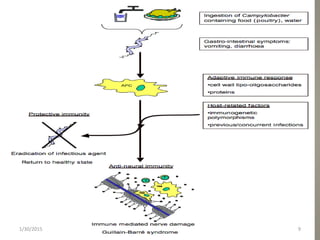
Pathogenesis
Classic studies in man and experimental animals and
several lines of evidence support on immunological
basis for demyelination of peripheral nerves in GBS
patients
Pathology
DEMYELINATION is the main type of
pathophysiological lesion
Characteristics of GBS is the “Segmental
Demyelination” with mononuclear cell infiltration in
spinal roots ,proximal nerve trunks ,distal nerves and
autonomic ganglia
Pattern of re-myelination
In GBS primary demyelination of CNS is not found.
Other changes such as degeneration of spinal
posterior tract are secondary to pathology in the PNS
1/30/2015 27
Clinical features
Rapidly evolving areflexic ascending motor
paralysis of the extremities ,up to the
tetraparesis
Reduced or absent deep tendon reflexes
Mild sensory symptoms
Clinical features cont’d…
Fever
Fatigue
Pain
Bilateral facial palsy
Antecedent symptoms
Clinical features cont’d…
Involvement of autonomic nervous system
a. Taste loss(initial symptom)
b. Swallowing dysfunction
c. Sweat gland alterations
d. Urinary retention
e. Cardio-respiratory arrest
f. Postural hypotension
Differential Diagnosis
• Poliomyelitis
• Botulism
• Infantile spinal muscular atrophy
• Neurosarcoidosis
• Sub-dural spinal granuloma from Candida albicans
• Severe anaemia
• Diphtheric neuropathy
1/30/2015 31
Diagnosis
• Observation of the patients symptoms and
evaluation of the medical history provide the basis
for the diagnosis of GBS ,although no single
observation is suitable to make the diagnosis
1/30/2015 32
Diagnosis cont’d…
1. Past medical history
2. Laboratory findings
a. Lumbar puncture an elevated level of protein without an in the no.
of WBC in the CSF is he characteristic of GBS
b. Electromyogram show the loss of individual nerve impulses due to
the disease ‘s characteristic slowing of nerve responses
c. NCS these signals are characteristically slowed in GBS
1/30/2015 33
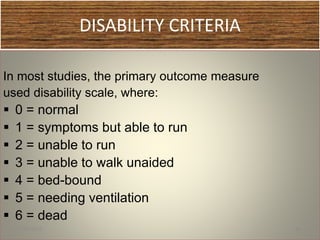
DISABILITY CRITERIA
In most studies, the primary outcome measure
used disability scale, where:
 0 = normal
 1 = symptoms but able to run
 2 = unable to run
 3 = unable to walk unaided
 4 = bed-bound
 5 = needing ventilation
 6 = dead
1/30/2015 34
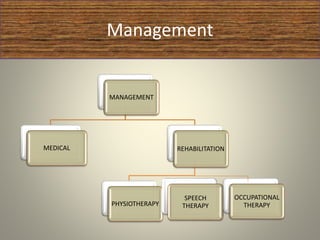
Management
MANAGEMENT
MEDICAL REHABILITATION
PHYSIOTHERAPY
SPEECH
THERAPY
OCCUPATIONAL
THERAPY
MEDICATION
1/30/2015 36
Medical management
a) IVIg
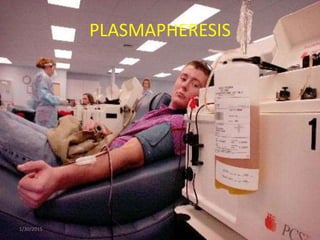
a) Plasmapheresis
1/30/2015 37
PLASMAPHERESIS
1/30/2015 38
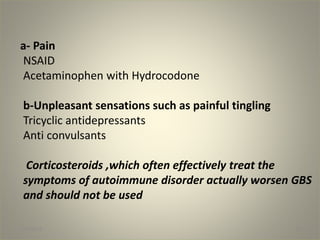
a- Pain
NSAID
Acetaminophen with Hydrocodone
b-Unpleasant sensations such as painful tingling
Tricyclic antidepressants
Anti convulsants
Corticosteroids ,which often effectively treat the
symptoms of autoimmune disorder actually worsen GBS
and should not be used
1/30/2015 39
1/30/2015 40
1/30/2015 41
“The physiotherapist was a most welcome person ,as
,despite the discomfort endured to have ‘dead’
limbs stretched and repositioned ,this left me
comfortable for several hours.”
Clark,1985
1/30/2015 42
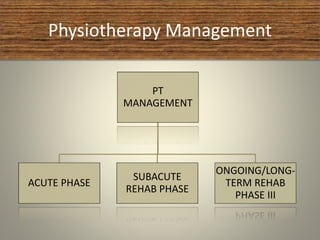
Physiotherapy Management
PT
MANAGEMENT
ACUTE PHASE
SUBACUTE
REHAB PHASE
ONGOING/LONG-
TERM REHAB
PHASE III
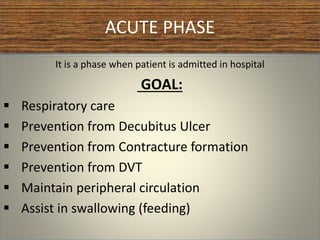
ACUTE PHASE
It is a phase when patient is admitted in hospital
GOAL:
 Respiratory care
 Prevention from Decubitus Ulcer
 Prevention from Contracture formation
 Prevention from DVT
 Maintain peripheral circulation
 Assist in swallowing (feeding)
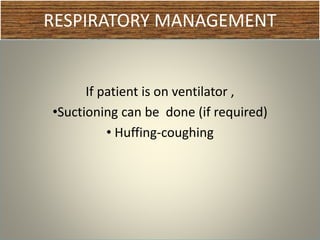
RESPIRATORY MANAGEMENT
If patient is on ventilator ,
•Suctioning can be done (if required)
• Huffing-coughing
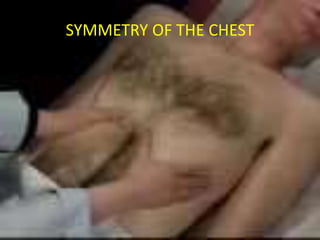
SYMMETRY OF THE CHEST
1/30/2015 46
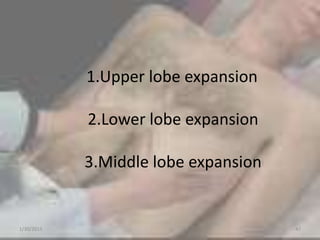
1.Upper lobe expansion
2.Lower lobe expansion
3.Middle lobe expansion
1/30/2015 47
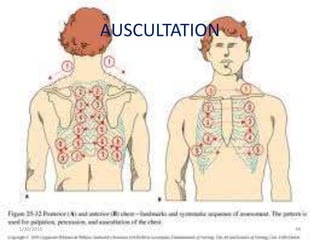
AUSCULTATION
1/30/2015 48
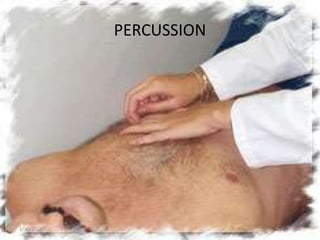
PERCUSSION
1/30/2015 49
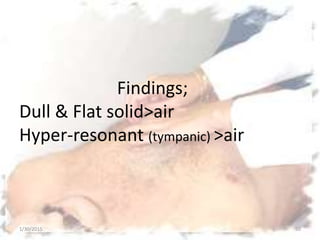
Findings;
Dull & Flat solid>air
Hyper-resonant (tympanic) >air
1/30/2015 50
EXERCISES
Diaphragmatic breathing
Incentive spirometery
Glossophayrengeal breathing
Chest mobilization ex’s
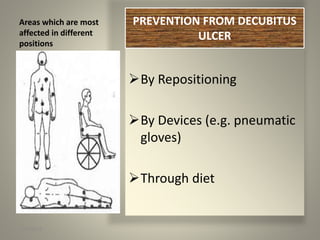
Areas which are most
affected in different
positions
PREVENTION FROM
DECUBITUS ULCER
By Repositioning
By Devices (e.g. pneumatic
gloves)
Through diet
1/30/2015 52
PREVENTION FROM DECUBITUS
ULCER
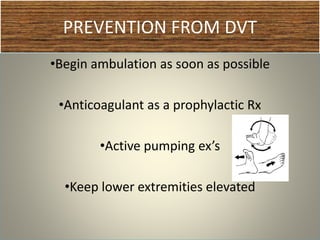
PREVENTION FROM DVT
•Begin ambulation as soon as possible
•Anticoagulant as a prophylactic Rx
•Active pumping ex’s
•Keep lower extremities elevated
FROM CONTRACTURES
• Generalized ROM ex’s
• Spinal movements should be included e.g.
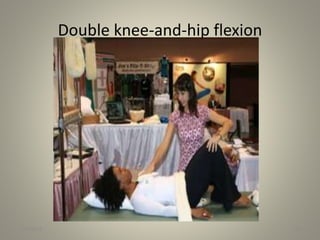
a. Double knee-and-hip flexion,
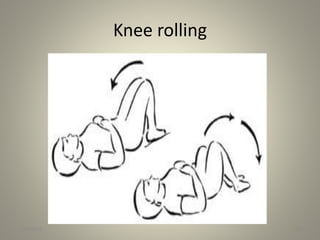
b. Knee rolling and
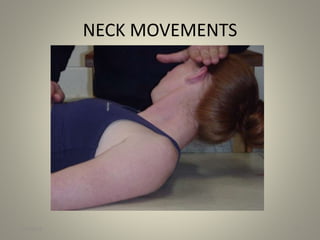
c. Neck movements with due care of tracheal
tubes
1/30/2015 54
Double knee-and-hip flexion
1/30/2015 55
Knee rolling
1/30/2015 56
NECK MOVEMENTS
1/30/2015 57
1/30/2015 58
• Risk of hypotension is reduced by ;
Ensuring that turning is gentle
Avoiding any intervention if CVP is below
5cmH2O
Acclimatization to the upright posture with a tilt
table
Risk of bradycardia is reduced by oxygenation
before and after suction
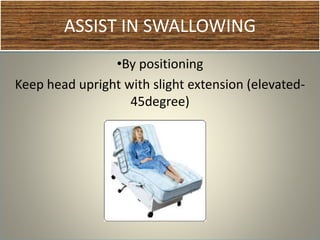
ASSIST IN SWALLOWING
•By positioning
Keep head upright with slight extension (elevated-
45degree)
PHASE II
(when patient maintain his respiration)
1/30/2015 60
• Pain management-TENS
• ACBT’S
• Stretching
• Strengthening and endurance ex’s
• Paced breathing
• Aerobic ex’s
• Energy conservation
• Improve swallowing
1/30/2015 61
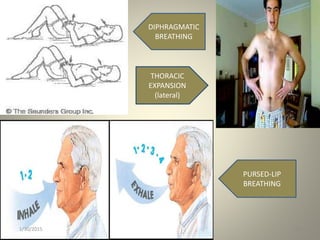
DIPHRAGMATIC
BREATHING
THORACIC
EXPANSION
(lateral)
PURSED-LIP
BREATHING
1/30/2015 62
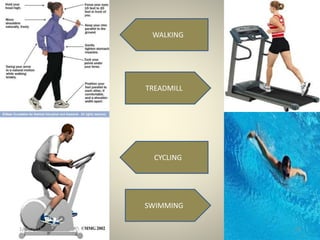
TREADMILL
SWIMMING
CYCLING
WALKING
1/30/2015 63
Interventions for Strengthening may
include;
PROM AAROM AROM ARROM
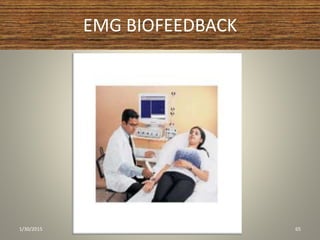
By means of EMG biofeedback
PNF
Rhythmic Initiation
Rhythmic Stabilization
Repeated contractions
Hold Relax
1/30/2015 64
EMG BIOFEEDBACK
1/30/2015 65
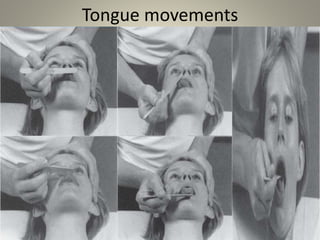
position for ex’s: sitting or prone on elbow
To keep the chewed food inside the mouth patient
must be able to hold their lips closed ,can improved
by ex’s of facial muscles & tongue movements
Improve Swallowing
1/30/2015 66
Tongue movements
1/30/2015 67
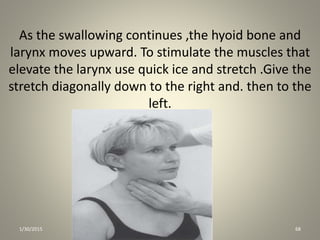
As the swallowing continues ,the hyoid bone and
larynx moves upward. To stimulate the muscles that
elevate the larynx use quick ice and stretch .Give the
stretch diagonally down to the right and. then to the
left.
1/30/2015 68
PHASE III
(when patient have good strength of
muscles)
1/30/2015 69
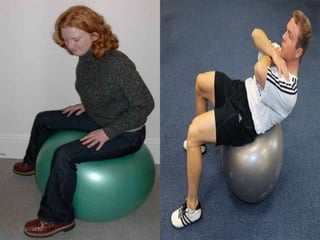
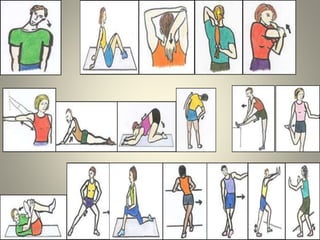
• Strengthening
• Stretching
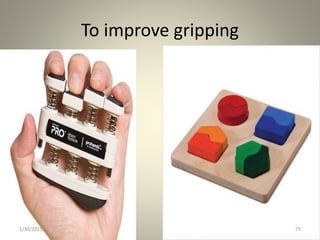
• Improve gripping
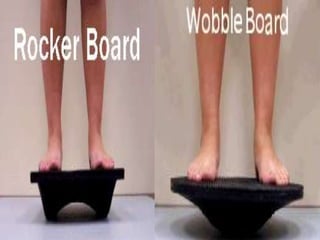
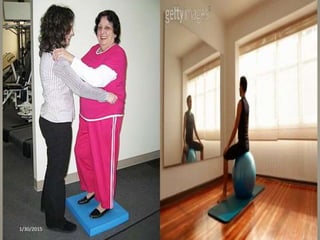
• Balancing (Tai chi)
• Hydrotherapy
• Gait training
• Prevention from medical complications
and sequlae
1/30/2015 70
1/30/2015 71
1/30/2015 72
1/30/2015 73
T
A
I
C
H
I
1/30/2015 74
To improve gripping
1/30/2015 75
SPEECH THERAPY
Stimulation of the laryngeal muscles with quick ice
followed by stretch and resistance to the motion of
laryngeal elevation
Promote controlled exhalation during speech with
resisted breathing exercises
1/30/2015 76
HOME PROGRAM
Breathing ex’s
Stretching ex’s
Walking Jogging
1/30/2015 78
SEQUELAE
•GBS may leave sequelae that are unpredictable
•Most serious residual disability was found distally in
the legs
Residual severe neurological deficits
Muscle aches and cramps
PROGNOSIS
 The length of time and the amount of effort required to bring
about the best possible recovery varies among individuals and
is related primarily to the severity of the symptoms.
About 30% of persons affected with GBS have some degree of
residual weakness after three years.
3 - 5% may suffer a relapse many years later.
1- 5% of cases are fatal, usually due to respiratory or cardiac
complications.
Most people, however, are able to recover completely and lead
normal lives.
REFRENCES
Guillain-Barre syndrome: pathological, clinical, and
therapeutical aspects
By Silvia Iannello
PNF in practice –An illustrated guide
Adler ,Beckers ,Buck
Therapeutic exercises
Kisner
http://neurologychannel.com/guillain
http://en.wikipedia.org/wiki/guillain-barre-syndrome/
1/30/2015 81
GOLDEN WORDS
“Your main occupation should be — in fairness
to yourself, in fairness to your parents, in
fairness to the state – to devote your attention
to your studies.”
(Mohammad Ali Jinnah-March 21 ,1948)
1/30/2015 82
1/30/2015 83
1/30/2015 84
ACKNOWLEDGEMENT
1/30/2015 85

Guillain-Barre-Syndrome