DR.PRAVEEN NAGULA
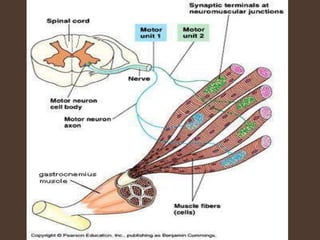
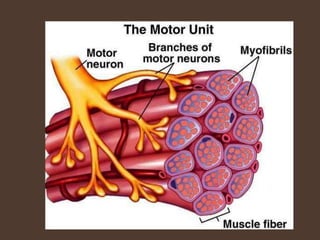
⚫ Each single motor neuron and the muscle fibers it
innervates constitute a MOTOR UNIT.
⚫ No .of muscle fibers in a motor unitvaries.
⚫ HAND,MOTION OF EYE – 3-6 muscle fibers.
⚫ LEG MUSCLES – 600 muscle fibers.
⚫ Groupof muscle fibers (forming a motor unit ) can be
intermixed in a muscle.
⚫ ALL THE MUSCLE FIBERS IN A MOTOR UNIT ARE OF
SAME TYPE.
⚫Based on typeof muscle fibers innervated ,durationof
twitchcontraction
Motorunitsare divided into
⚫S- slow -- small units
⚫FR – fast resistant to fatigue
⚫FF fast fatiguable --- large units
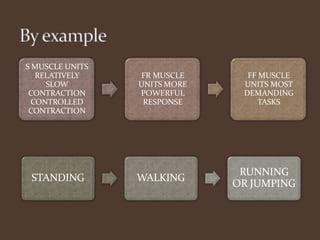
⚫RECRUITMENTof motorunits followssize principle:
⚫S muscle units – relatively slow contraction,controlled
contraction ---FR more powerful response –FF muscle
units mostdemanding tasks..
S MUSCLE UNITS
RELATIVELY
SLOW
CONTRACTION
CONTROLLED
CONTRACTION
FR MUSCLE
UNITS MORE
POWERFUL
RESPONSE
FF MUSCLE
UNITS MOST
DEMANDING
TASKS
STANDING WALKING
RUNNING
OR JUMPING
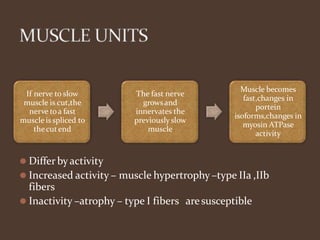
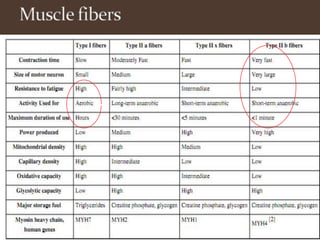
⚫ Differ byactivity
⚫ Increased activity – muscle hypertrophy –type IIa ,IIb
fibers
⚫ Inactivity –atrophy – type I fibers aresusceptible
If nerve to slow
muscle is cut,the
nerve toa fast
muscle is spliced to
thecutend
The fast nerve
growsand
innervates the
previously slow
muscle
Muscle becomes
fast,changes in
portein
isoforms,changes in
myosin ATPase
activity
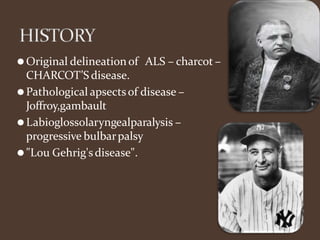
⚫Original delineation of ALS – charcot –
CHARCOT’S disease.
⚫Pathological apsectsof disease –
Joffroy,gambault
⚫Labioglossolaryngealparalysis –
progressive bulbarpalsy
⚫"Lou Gehrig'sdisease".
⚫ Amyotrophic comes from thegreek language:
A- means "no", myo refers to "muscle", and trophic means
"nourishment"; amyotrophic therefore means "no muscle
nourishment," which describes the
characteristic atrophicationof thesufferer'sdisused
muscle tissue.
⚫ Lateral identifies theareas in a person's spinal cord where
portions of the nervecells thatareaffected are located.
⚫ As thisarea degenerates it leads to scarring or hardening
(“sclerosis") in the region.
⚫Heterogenousgroupof neurodegenerativedisorders.
⚫Unknown etiology
⚫Selective lossof motor neuronscontrolling voluntary
movements.
⚫Weakness
⚫Nosensory loss
⚫Nosphincterdisturbances
⚫Progressivecourse
⚫No identifiable underlying cause
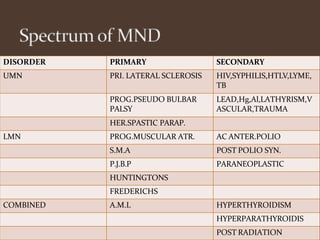
DISORDER PRIMARY SECONDARY
UMN PRI. LATERAL SCLEROSIS HIV,SYPHILIS,HTLV,LYME,
TB
PROG.PSEUDO BULBAR
PALSY
LEAD,Hg,Al,LATHYRISM,V
ASCULAR,TRAUMA
HER.SPASTIC PARAP.
LMN PROG.MUSCULAR ATR. AC ANTER.POLIO
S.M.A POST POLIO SYN.
P.J.B.P PARANEOPLASTIC
HUNTINGTONS
FREDERICHS
COMBINED A.M.L HYPERTHYROIDISM
HYPERPARATHYROIDIS
POST RADIATION
⚫M.C formof progressive motor neuron disease.
⚫Primeex. of neurodegenerativedisease.
⚫Mostdevastating of the neurodegenerativedisorders.
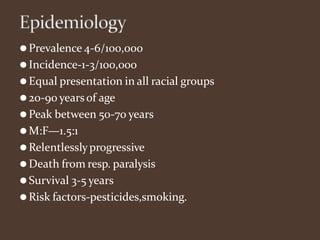
⚫Prevalence 4-6/100,000
⚫Incidence-1-3/100,000
⚫Equal presentation in all racial groups
⚫20-90 yearsof age
⚫Peak between 50-70 years
⚫M:F—1.5:1
⚫Relentlesslyprogressive
⚫Death from resp. paralysis
⚫Survival 3-5 years
⚫Risk factors-pesticides,smoking.
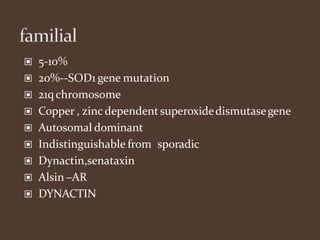
▣ 5-10%
▣ 20%--SOD1 gene mutation
▣ 21qchromosome
▣ Copper , zinc dependentsuperoxidedismutasegene
▣ Autosomal dominant
▣ Indistinguishable from sporadic
▣ Dynactin,senataxin
▣ Alsin –AR
▣ DYNACTIN
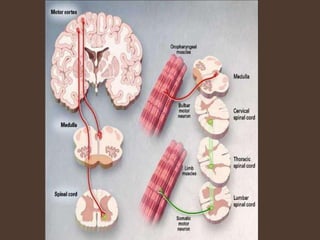
⚫HALLMARK-deathof LMN ,.UMN
⚫LMN-ant.horncellsof spinal cord,bulbar muscles
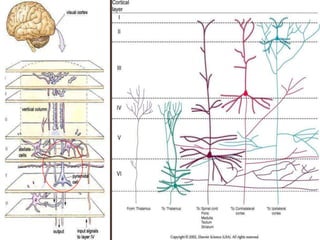
⚫UMN—layer 5 of motorcortex,descending via
pyramidal tracts.
⚫Other motor neuron disease involvesonly subsetof
motor neurons.
⚫Onset-----UMN or LMN-----Involves both---absence
of them ?diagnosis.
⚫Accof lipid pigmented—LIPOFUSCHIN.
⚫Normallyseen in aged cells.
⚫Focal enlargementsare frequent –SPHEROID—accof
neurofilamentproteins.
⚫Proliferation of astrocytes,microglia.
⚫Combined grey and white matterdisease.
⚫Motorcellsand motorfibre tracts.
⚫ATROPHY,DEGENERATION.LOSS OF MOTOR
NEURONS OF CN..
Death of the peripheral motor neurons in brainstem,spinal
cord.
Denervation
Consequentatrophyof the muscle fibres
Histo chemical,electrophysiological
Earlystages
Reinnervation
Less than poliomyelitis.peripheral neuropathy
⚫Progressivedegeneration –muscleatrophy is readily
recognised in muscle biopsiesand on clinical exam,---
AMYOTROPHY.
⚫Thinning of corticospinal tracts
⚫Lossof fibers in the Lateral columns—fibrillary
gliosis-LATERAL SCLEROSIS.
⚫SELECTIVITY OF NEURONAL CELL DEATH.
⚫UBIQUITIN-marker fordegeneration is seen.
⚫Nucleusof Onuf –innervates bowel ,bladder is not
involved.
⚫Max involvement in cervical spinal cord
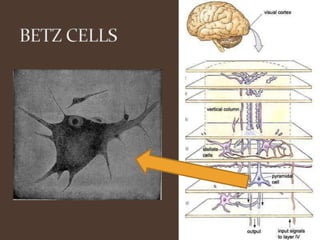
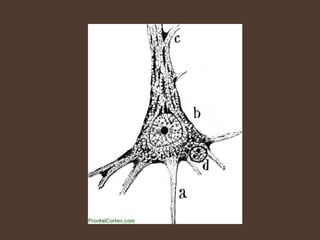
⚫Lossof large pyramidal cells BETZ cells in motor
,premotorcerebral cortex.
⚫Gliosisof lateral cords
⚫NONE ARE PATHOGNOMONIC.
⚫Cause notwell defined..
⚫Excitatory neurotransmitters.
⚫Glutamateparticipate in death of motor neurons in
ALS.
⚫EAAT2.
⚫SOD1—cellulardefenseagainstexcitotoxicity
⚫When mutated—catalytic.
⚫Non neuronal cells –influences thediseasecourse.
⚫Variable on motor neurons involved.
⚫Asymmetricweakness ,usuallydistally in one of the
limbs.
⚫Insidiousonset
⚫Developmentof cramps with volitional movements in
early hoursof morning.
⚫Weakness
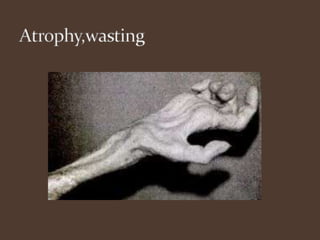
⚫Wasting
⚫ Atrophy
▣ Spontaneus twitching of motorunitsor fasciculation
▣ EXTENSORS >FLEXORS in upper limbs
▣ Difficulty in chewing ,swallowing,movementsof face
and tongue.
▣ Early involvementof resp.muscles—death
▣ Hyperactivityof musclestretch reflexes
▣ Spasticresponse topassive movements
▣ Musclestiffnessoutof proportion
▣ Exaggeration of motorexpression of emotion—
weeping,laughing—pseudobulbareffect
⚫Asymmetric—symmetric
⚫Whether UMN or LMN atonset—both later
⚫Sensory,bowel,bladder–not involved.
⚫Cognitive function,ocularmotility –preserved
⚫Dementia is nota componentof sporadic ALS
⚫Familial—ALS+ FRONTO TEMPORAL DEMENTIA.
▣ Fatigue
▣ Weight loss
▣ Widespread musclepains
▣ Experience fear,anxiety,depression
▣ Limbsymptoms>bulbar
▣ Proximal weakness—limbs,trunks,neck
▣ Hemiplegia
▣ Spasticparaparesis
▣ Footdrop
▣ Pes cavus
⚫Upper limb> lowerlimb
⚫Distal> proximal
⚫Extensor>flexor
⚫Clawing of hands
⚫Asymmetricatonset
⚫Spontaneusclonus
⚫DTR—inc
⚫Babinski—postive
⚫Abd. Reflexes –preserved
⚫Bed soresare uncommon—collagen
⚫Dysphagia worse for liquids > solids
⚫Choking
⚫Flaccid dysarthria
⚫Inability topurse lips
⚫THE ENTIRE SENSORYAPPARATUS
⚫REG. MECH. FOR CONTROL AND COORDINATION
OF MOVEMENTS
⚫COGNITION
⚫SEXUAL FUNCTION
⚫OCULAR MUSCLES
▣ WORLD FEDERATION OF NEUROLOGY
▣ Simultaneous inv. Of UMN,LMN
▣ PROGRESSIVE WEAKNESS
▣ EXCLUSION OF ALTERNATE DIAGNOSIS
▣ DEFINITE ALS-3 or 4 ---
bulbar,cervical,thoracic,lumbosacral
▣ 2sites—probable
▣ 1 site-possible
▣ exception –mutation in geneencoding SOD1-21q
⚫MUSCLE BIOPSY
⚫ELECTROMYOGRAPHY
⚫NERVE CONDUCTION STUDIES
⚫MRI
⚫OTHER ROUTINE INVESTIGATIONS
⚫ATYPICAL—only UMN or LMN
⚫Inv. of neuronsother than motor neurons
⚫Motor neuronal conduction block
⚫1.cervical
⚫2.MFMN CB
⚫3.lead poisoning
⚫4.thyrotoxicosis
⚫5.recoveryfrom poliomyelitis
⚫6. parkinsonism
⚫No treatmentarrests the progression.
⚫RILUZOLE—100mg/day
⚫ Increases survival,18 months
⚫ M.O.A- not known
⚫ Decreasesglutamate release
⚫ well tolerated
⚫IGF –1
⚫Ceftriaxone—anti excitotoxic
⚫Inhibitory RNA
⚫Footdropsplints
⚫Fingerextension splints
⚫Respiratory support
⚫Respiratorydevices
⚫Cough assistdevices
⚫Gastrostomy
⚫Speech synthesizers
⚫1.KENNEDY DISEASE—X LINKED SPINOBULBAR
MUSCLE ATROPHY
⚫ Males
⚫ Androgen receptor insensitivity
⚫ Gynaecomastia
⚫ Absenceof pyramidal tract signs
⚫ Sensory symptomspresent
⚫ CAG
⚫2.TAY SACHS—hexosaminidase
⚫ Cerebellaratrophy
⚫ Absentspasticity
⚫ Dysarthria
⚫3.SMA-5q
⚫ Floppy infant
⚫ Infantile—werding hoffmandisease
⚫4.MMNCB—
⚫ Improved on immunoglobulins,chemotherapy.
⚫1.primary lateral sclerosis
⚫ Sporadic
⚫ No fasciculations
⚫ Nodenervation
⚫ Selective l oss of pyramidal cells
⚫2.familial spasticparaplegia
⚫ AD
⚫ Respiratory function spared
⚫1.what is a motorunit?differentiate UMN and LMN
signs? Add a noteon ALS ?
Thank
you
motorneuron-diseases-1313085650-phpapp02-110811130324-phpapp02.pptx

motorneuron-diseases-1313085650-phpapp02-110811130324-phpapp02.pptx

  • 2.
  • 3.
    ⚫ Each singlemotor neuron and the muscle fibers it innervates constitute a MOTOR UNIT. ⚫ No .of muscle fibers in a motor unitvaries. ⚫ HAND,MOTION OF EYE – 3-6 muscle fibers. ⚫ LEG MUSCLES – 600 muscle fibers. ⚫ Groupof muscle fibers (forming a motor unit ) can be intermixed in a muscle. ⚫ ALL THE MUSCLE FIBERS IN A MOTOR UNIT ARE OF SAME TYPE.
  • 4.
    ⚫Based on typeofmuscle fibers innervated ,durationof twitchcontraction Motorunitsare divided into ⚫S- slow -- small units ⚫FR – fast resistant to fatigue ⚫FF fast fatiguable --- large units ⚫RECRUITMENTof motorunits followssize principle: ⚫S muscle units – relatively slow contraction,controlled contraction ---FR more powerful response –FF muscle units mostdemanding tasks..
  • 8.
    S MUSCLE UNITS RELATIVELY SLOW CONTRACTION CONTROLLED CONTRACTION FRMUSCLE UNITS MORE POWERFUL RESPONSE FF MUSCLE UNITS MOST DEMANDING TASKS STANDING WALKING RUNNING OR JUMPING
  • 9.
    ⚫ Differ byactivity ⚫Increased activity – muscle hypertrophy –type IIa ,IIb fibers ⚫ Inactivity –atrophy – type I fibers aresusceptible If nerve to slow muscle is cut,the nerve toa fast muscle is spliced to thecutend The fast nerve growsand innervates the previously slow muscle Muscle becomes fast,changes in portein isoforms,changes in myosin ATPase activity
  • 11.
    ⚫Original delineation ofALS – charcot – CHARCOT’S disease. ⚫Pathological apsectsof disease – Joffroy,gambault ⚫Labioglossolaryngealparalysis – progressive bulbarpalsy ⚫"Lou Gehrig'sdisease".
  • 13.
    ⚫ Amyotrophic comesfrom thegreek language: A- means "no", myo refers to "muscle", and trophic means "nourishment"; amyotrophic therefore means "no muscle nourishment," which describes the characteristic atrophicationof thesufferer'sdisused muscle tissue. ⚫ Lateral identifies theareas in a person's spinal cord where portions of the nervecells thatareaffected are located. ⚫ As thisarea degenerates it leads to scarring or hardening (“sclerosis") in the region.
  • 14.
  • 15.
  • 16.
    DISORDER PRIMARY SECONDARY UMNPRI. LATERAL SCLEROSIS HIV,SYPHILIS,HTLV,LYME, TB PROG.PSEUDO BULBAR PALSY LEAD,Hg,Al,LATHYRISM,V ASCULAR,TRAUMA HER.SPASTIC PARAP. LMN PROG.MUSCULAR ATR. AC ANTER.POLIO S.M.A POST POLIO SYN. P.J.B.P PARANEOPLASTIC HUNTINGTONS FREDERICHS COMBINED A.M.L HYPERTHYROIDISM HYPERPARATHYROIDIS POST RADIATION
  • 18.
    ⚫M.C formof progressivemotor neuron disease. ⚫Primeex. of neurodegenerativedisease. ⚫Mostdevastating of the neurodegenerativedisorders.
  • 19.
    ⚫Prevalence 4-6/100,000 ⚫Incidence-1-3/100,000 ⚫Equal presentationin all racial groups ⚫20-90 yearsof age ⚫Peak between 50-70 years ⚫M:F—1.5:1 ⚫Relentlesslyprogressive ⚫Death from resp. paralysis ⚫Survival 3-5 years ⚫Risk factors-pesticides,smoking.
  • 20.
    ▣ 5-10% ▣ 20%--SOD1gene mutation ▣ 21qchromosome ▣ Copper , zinc dependentsuperoxidedismutasegene ▣ Autosomal dominant ▣ Indistinguishable from sporadic ▣ Dynactin,senataxin ▣ Alsin –AR ▣ DYNACTIN
  • 21.
    ⚫HALLMARK-deathof LMN ,.UMN ⚫LMN-ant.horncellsofspinal cord,bulbar muscles ⚫UMN—layer 5 of motorcortex,descending via pyramidal tracts. ⚫Other motor neuron disease involvesonly subsetof motor neurons.
  • 25.
    ⚫Onset-----UMN or LMN-----Involvesboth---absence of them ?diagnosis. ⚫Accof lipid pigmented—LIPOFUSCHIN. ⚫Normallyseen in aged cells. ⚫Focal enlargementsare frequent –SPHEROID—accof neurofilamentproteins. ⚫Proliferation of astrocytes,microglia. ⚫Combined grey and white matterdisease. ⚫Motorcellsand motorfibre tracts. ⚫ATROPHY,DEGENERATION.LOSS OF MOTOR NEURONS OF CN..
  • 26.
    Death of theperipheral motor neurons in brainstem,spinal cord. Denervation Consequentatrophyof the muscle fibres Histo chemical,electrophysiological Earlystages Reinnervation Less than poliomyelitis.peripheral neuropathy
  • 28.
    ⚫Progressivedegeneration –muscleatrophy isreadily recognised in muscle biopsiesand on clinical exam,--- AMYOTROPHY. ⚫Thinning of corticospinal tracts ⚫Lossof fibers in the Lateral columns—fibrillary gliosis-LATERAL SCLEROSIS. ⚫SELECTIVITY OF NEURONAL CELL DEATH.
  • 29.
    ⚫UBIQUITIN-marker fordegeneration isseen. ⚫Nucleusof Onuf –innervates bowel ,bladder is not involved. ⚫Max involvement in cervical spinal cord ⚫Lossof large pyramidal cells BETZ cells in motor ,premotorcerebral cortex. ⚫Gliosisof lateral cords ⚫NONE ARE PATHOGNOMONIC.
  • 30.
    ⚫Cause notwell defined.. ⚫Excitatoryneurotransmitters. ⚫Glutamateparticipate in death of motor neurons in ALS. ⚫EAAT2. ⚫SOD1—cellulardefenseagainstexcitotoxicity ⚫When mutated—catalytic. ⚫Non neuronal cells –influences thediseasecourse.
  • 31.
    ⚫Variable on motorneurons involved. ⚫Asymmetricweakness ,usuallydistally in one of the limbs. ⚫Insidiousonset ⚫Developmentof cramps with volitional movements in early hoursof morning. ⚫Weakness ⚫Wasting ⚫ Atrophy
  • 32.
    ▣ Spontaneus twitchingof motorunitsor fasciculation ▣ EXTENSORS >FLEXORS in upper limbs ▣ Difficulty in chewing ,swallowing,movementsof face and tongue. ▣ Early involvementof resp.muscles—death ▣ Hyperactivityof musclestretch reflexes ▣ Spasticresponse topassive movements ▣ Musclestiffnessoutof proportion ▣ Exaggeration of motorexpression of emotion— weeping,laughing—pseudobulbareffect
  • 33.
    ⚫Asymmetric—symmetric ⚫Whether UMN orLMN atonset—both later ⚫Sensory,bowel,bladder–not involved. ⚫Cognitive function,ocularmotility –preserved ⚫Dementia is nota componentof sporadic ALS ⚫Familial—ALS+ FRONTO TEMPORAL DEMENTIA.
  • 34.
    ▣ Fatigue ▣ Weightloss ▣ Widespread musclepains ▣ Experience fear,anxiety,depression ▣ Limbsymptoms>bulbar ▣ Proximal weakness—limbs,trunks,neck ▣ Hemiplegia ▣ Spasticparaparesis ▣ Footdrop ▣ Pes cavus
  • 35.
    ⚫Upper limb> lowerlimb ⚫Distal>proximal ⚫Extensor>flexor ⚫Clawing of hands ⚫Asymmetricatonset
  • 36.
    ⚫Spontaneusclonus ⚫DTR—inc ⚫Babinski—postive ⚫Abd. Reflexes –preserved ⚫Bedsoresare uncommon—collagen ⚫Dysphagia worse for liquids > solids ⚫Choking ⚫Flaccid dysarthria ⚫Inability topurse lips
  • 37.
    ⚫THE ENTIRE SENSORYAPPARATUS ⚫REG.MECH. FOR CONTROL AND COORDINATION OF MOVEMENTS ⚫COGNITION ⚫SEXUAL FUNCTION ⚫OCULAR MUSCLES
  • 38.
    ▣ WORLD FEDERATIONOF NEUROLOGY ▣ Simultaneous inv. Of UMN,LMN ▣ PROGRESSIVE WEAKNESS ▣ EXCLUSION OF ALTERNATE DIAGNOSIS ▣ DEFINITE ALS-3 or 4 --- bulbar,cervical,thoracic,lumbosacral ▣ 2sites—probable ▣ 1 site-possible ▣ exception –mutation in geneencoding SOD1-21q
  • 39.
    ⚫MUSCLE BIOPSY ⚫ELECTROMYOGRAPHY ⚫NERVE CONDUCTIONSTUDIES ⚫MRI ⚫OTHER ROUTINE INVESTIGATIONS
  • 40.
    ⚫ATYPICAL—only UMN orLMN ⚫Inv. of neuronsother than motor neurons ⚫Motor neuronal conduction block ⚫1.cervical ⚫2.MFMN CB ⚫3.lead poisoning ⚫4.thyrotoxicosis ⚫5.recoveryfrom poliomyelitis ⚫6. parkinsonism
  • 41.
    ⚫No treatmentarrests theprogression. ⚫RILUZOLE—100mg/day ⚫ Increases survival,18 months ⚫ M.O.A- not known ⚫ Decreasesglutamate release ⚫ well tolerated ⚫IGF –1 ⚫Ceftriaxone—anti excitotoxic ⚫Inhibitory RNA
  • 42.
  • 43.
    ⚫1.KENNEDY DISEASE—X LINKEDSPINOBULBAR MUSCLE ATROPHY ⚫ Males ⚫ Androgen receptor insensitivity ⚫ Gynaecomastia ⚫ Absenceof pyramidal tract signs ⚫ Sensory symptomspresent ⚫ CAG
  • 44.
    ⚫2.TAY SACHS—hexosaminidase ⚫ Cerebellaratrophy ⚫Absentspasticity ⚫ Dysarthria ⚫3.SMA-5q ⚫ Floppy infant ⚫ Infantile—werding hoffmandisease ⚫4.MMNCB— ⚫ Improved on immunoglobulins,chemotherapy.
  • 45.
    ⚫1.primary lateral sclerosis ⚫Sporadic ⚫ No fasciculations ⚫ Nodenervation ⚫ Selective l oss of pyramidal cells ⚫2.familial spasticparaplegia ⚫ AD ⚫ Respiratory function spared
  • 47.
    ⚫1.what is amotorunit?differentiate UMN and LMN signs? Add a noteon ALS ?
  • 48.