Neuromuscular Diseases
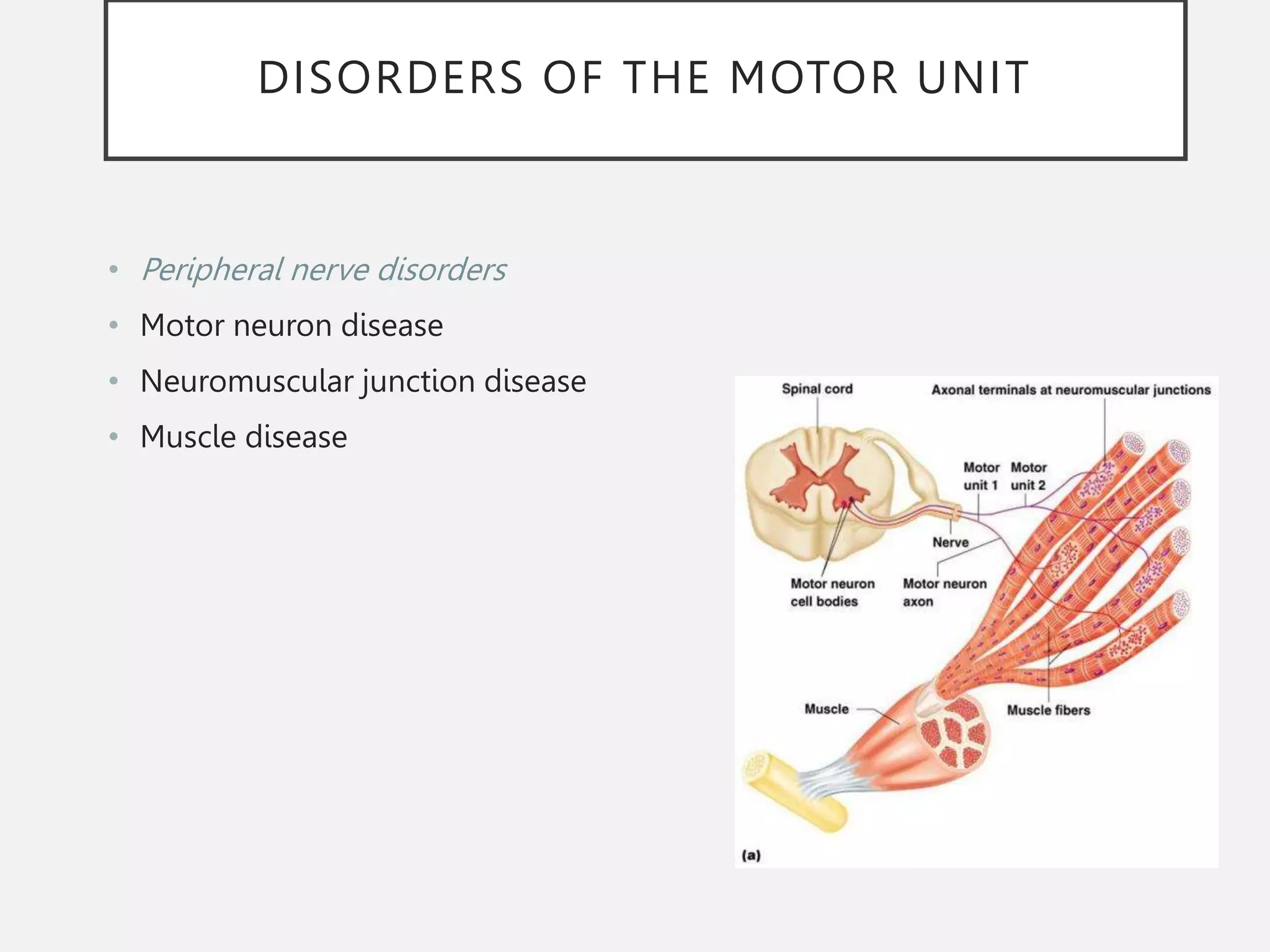
DISORDERS OF THE MOTOR UNIT
• Peripheral nerve disorders
• Motor neuron disease
• Neuromuscular junction disease
• Muscle disease
PERIPHERAL NERVE DISORDERS
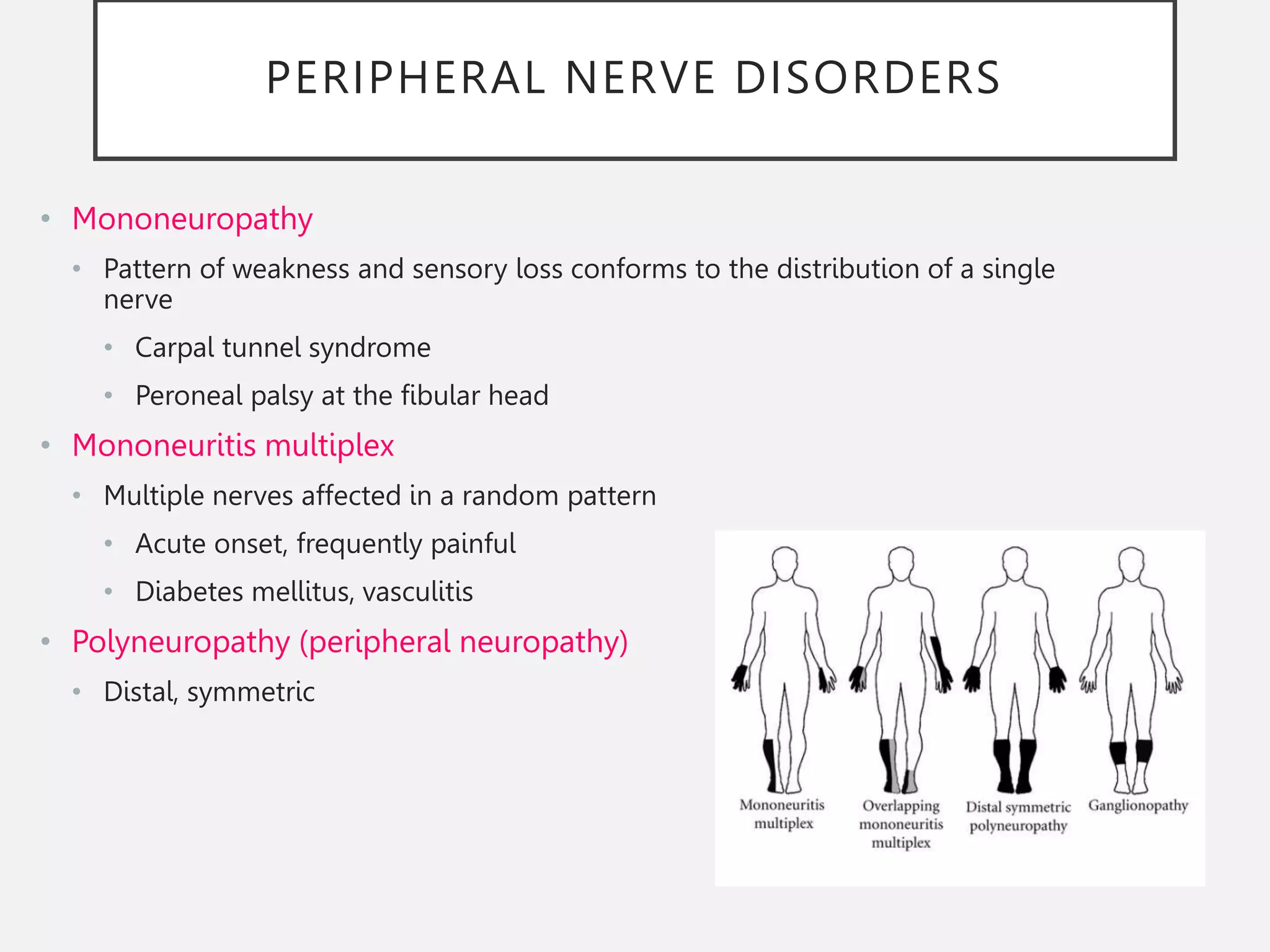
• Mononeuropathy
• Pattern of weakness and sensory loss conforms to the distribution of a single
nerve
• Carpal tunnel syndrome
• Peroneal palsy at the fibular head
• Mononeuritis multiplex
• Multiple nerves affected in a random pattern
• Acute onset, frequently painful
• Diabetes mellitus, vasculitis
• Polyneuropathy (peripheral neuropathy)
• Distal, symmetric
POLYNEUROPATHIES
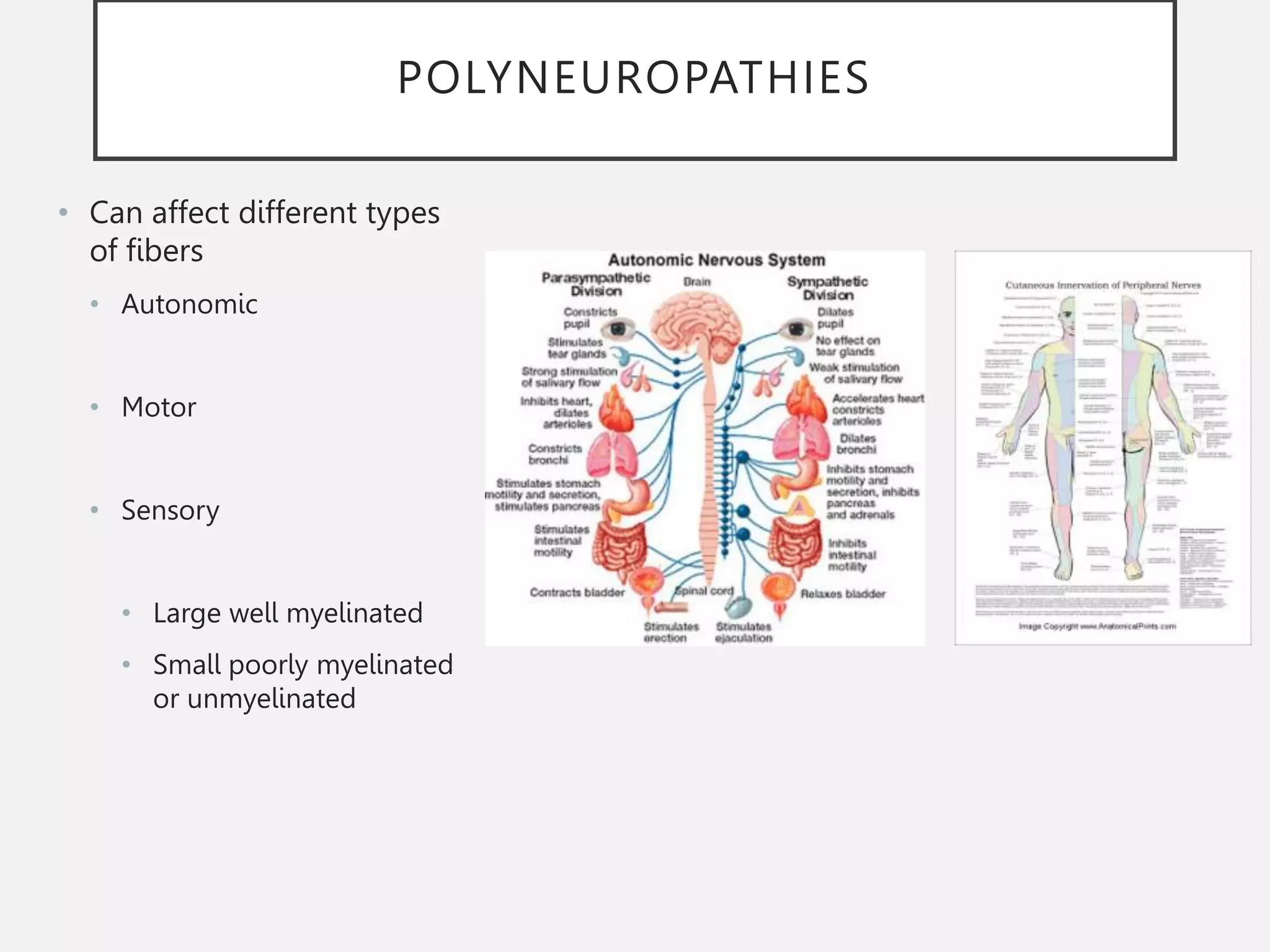
• Can affect different types
of fibers
• Autonomic
• Motor
• Sensory
• Large well myelinated
• Small poorly myelinated
or unmyelinated
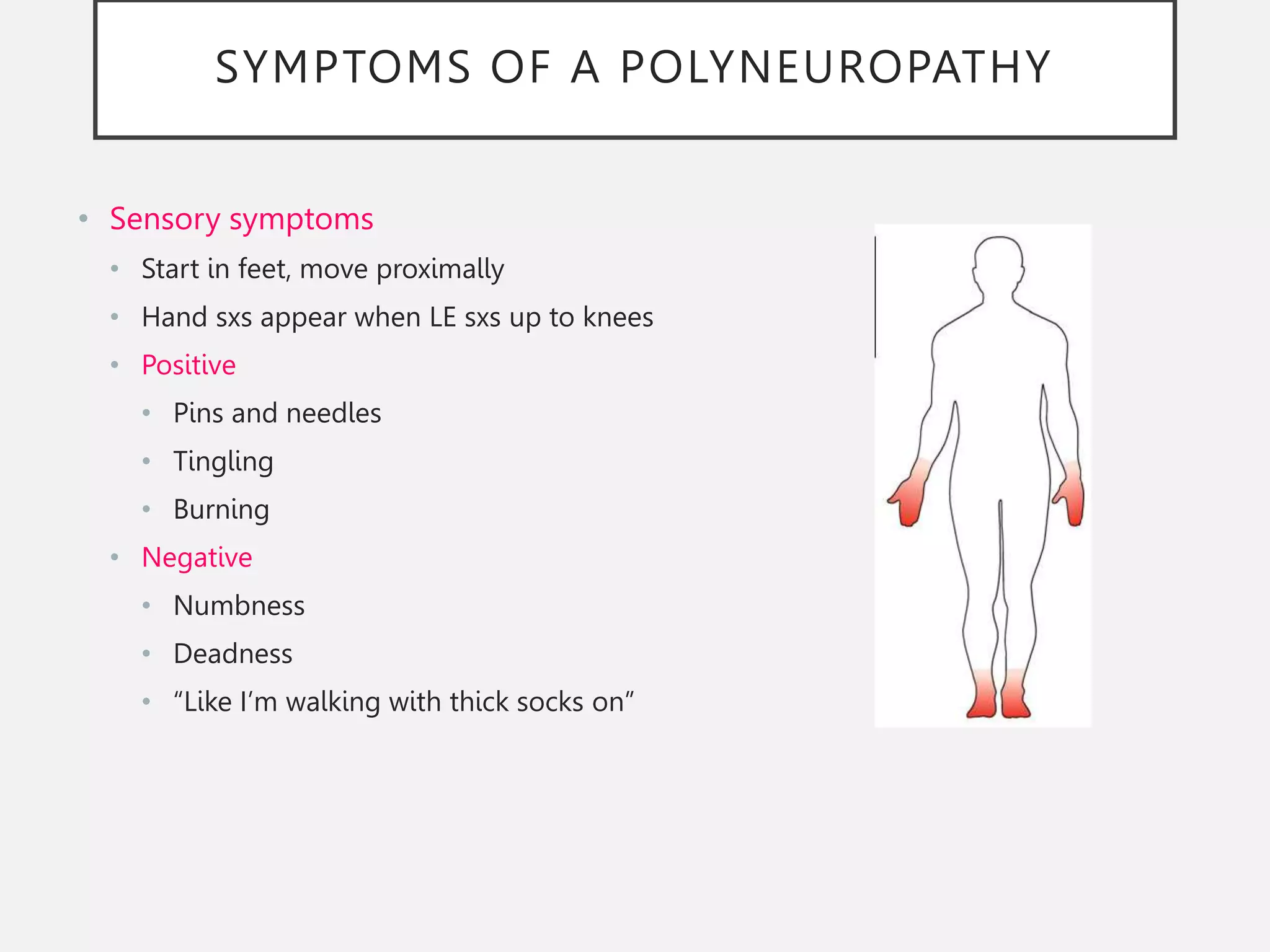
SYMPTOMS OF A POLYNEUROPATHY
• Sensory symptoms
• Start in feet, move proximally
• Hand sxs appear when LE sxs up to knees
• Positive
• Pins and needles
• Tingling
• Burning
• Negative
• Numbness
• Deadness
• “Like I’m walking with thick socks on”
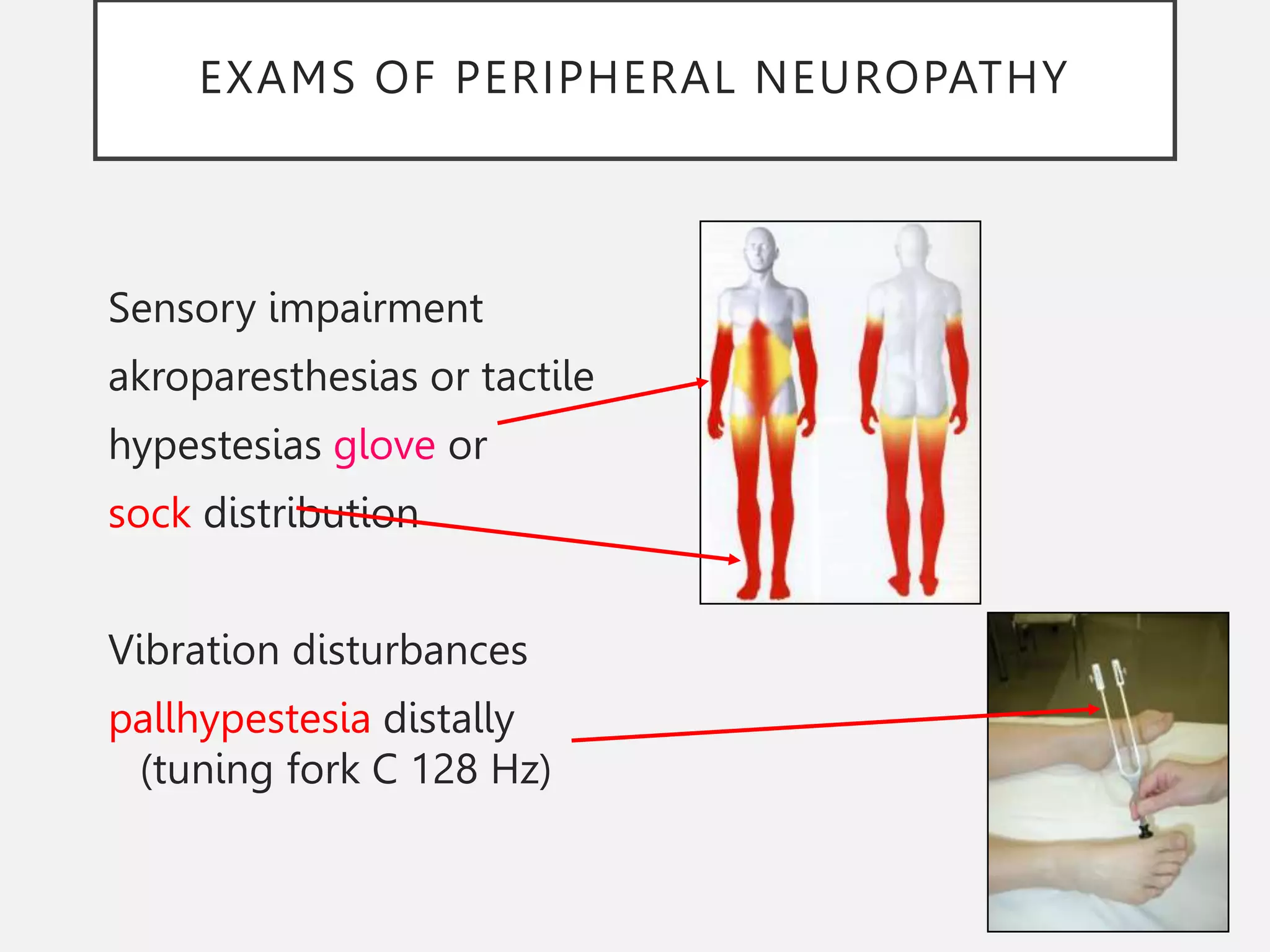
EXAMS OF PERIPHERAL NEUROPATHY
Sensory impairment
akroparesthesias or tactile
hypestesias glove or
sock distribution
Vibration disturbances
pallhypestesia distally
(tuning fork C 128 Hz)
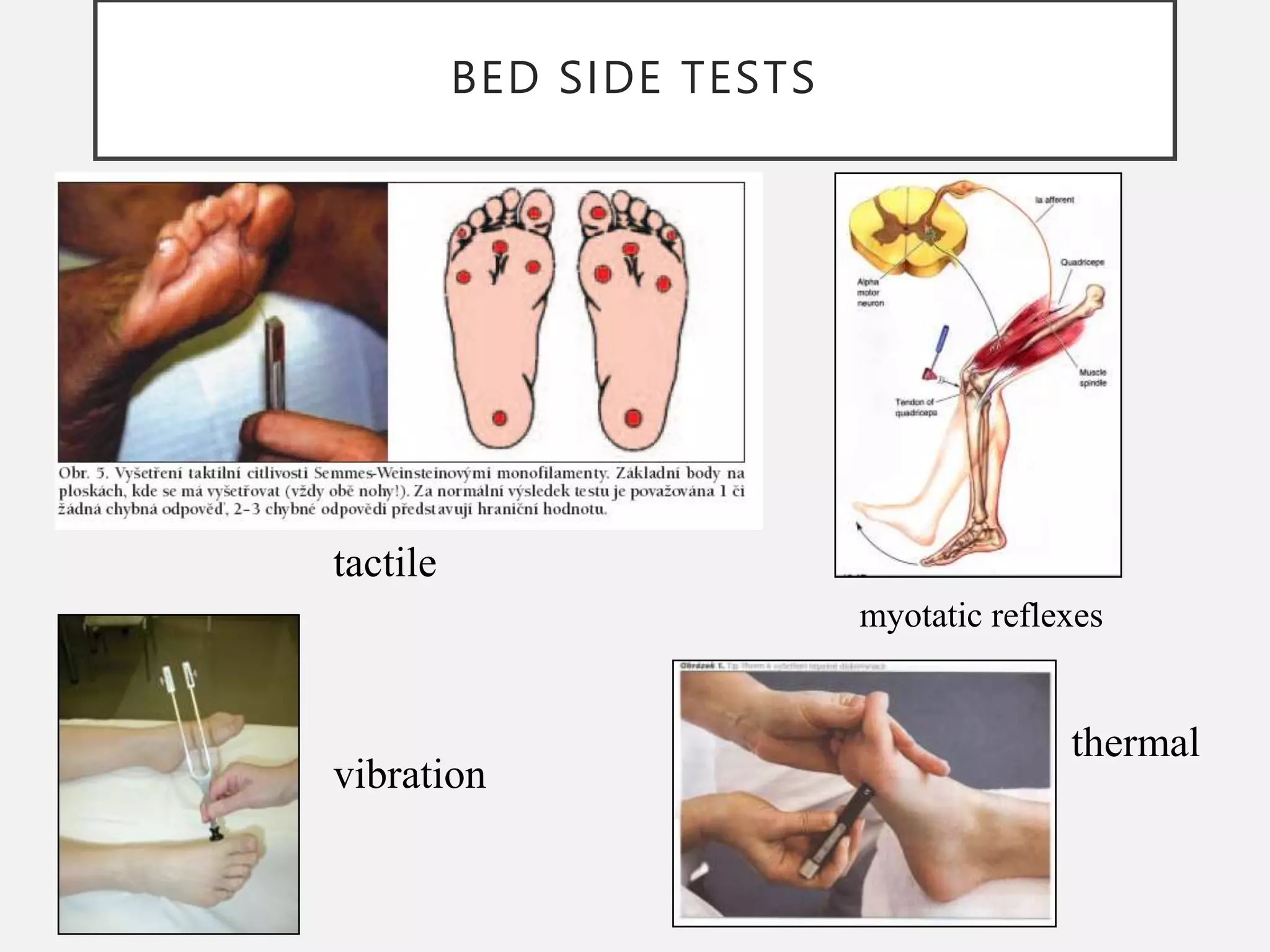
BED SIDE TESTS
tactile
vibration
thermal
myotatic reflexes
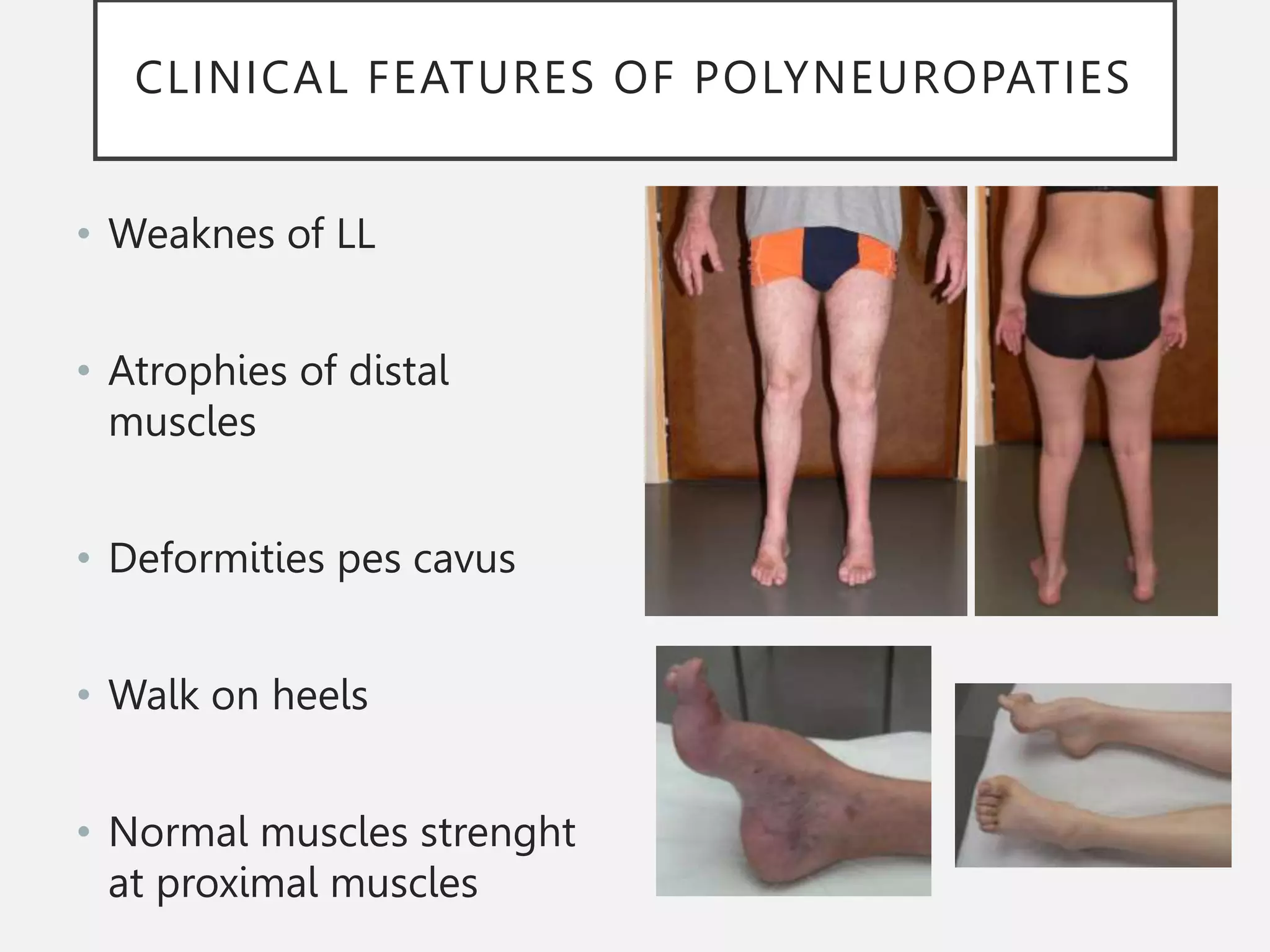
CLINICAL FEATURES OF POLYNEUROPATIES
• Weaknes of LL
• Atrophies of distal
muscles
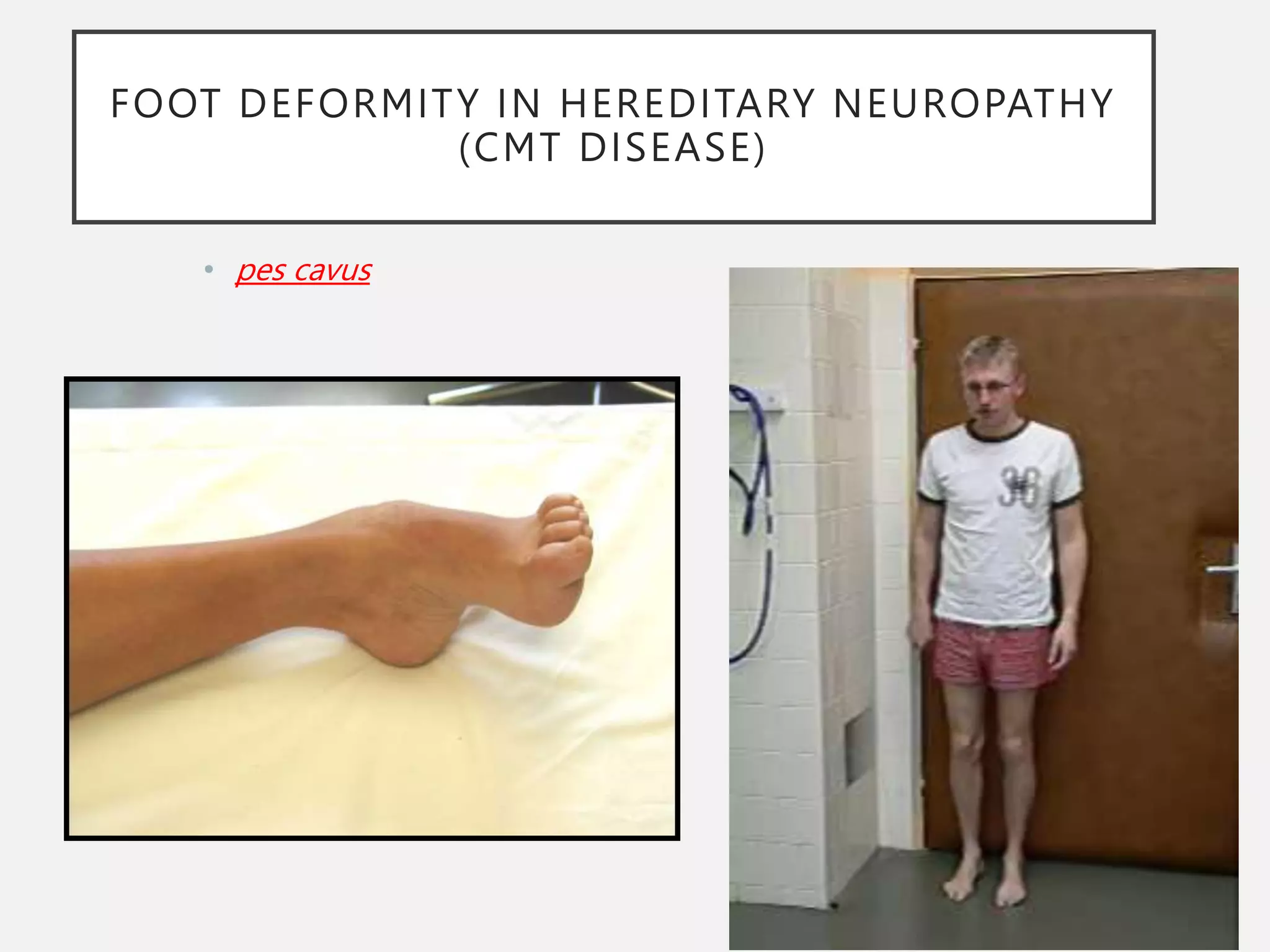
• Deformities pes cavus
• Walk on heels
• Normal muscles strenght
at proximal muscles
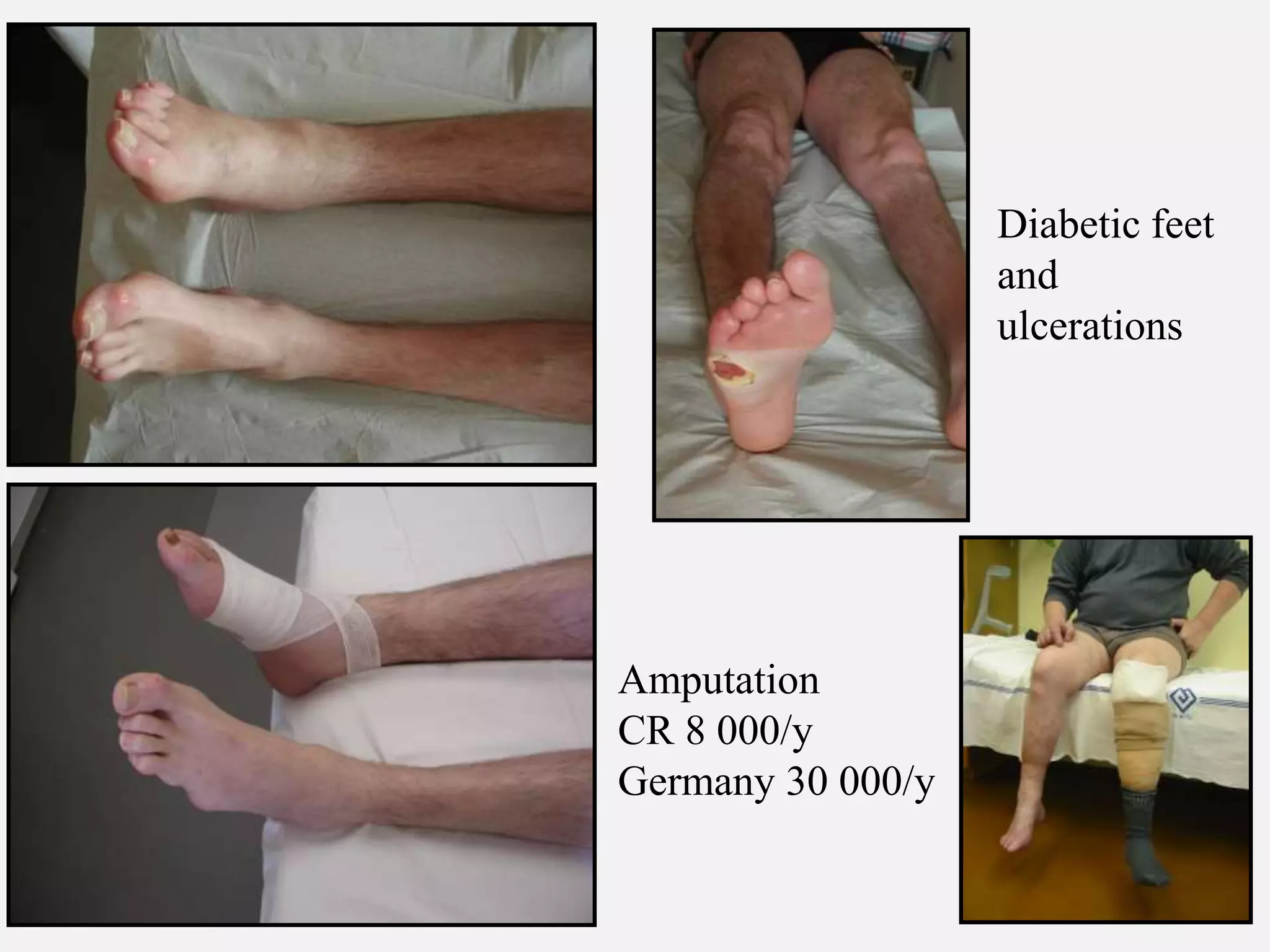
Diabetic feet
and
ulcerations
Amputation
CR 8 000/y
Germany 30 000/y
FOOT DEFORMITY IN HEREDITARY NEUROPATHY
(CMT DISEASE)
• pes cavus
CLASSIFICATION OF POLYNEUROPATHIES
• By types of fibers involved
• Pure sensory
• Sensory motor
• Pure motor
• Autonomic
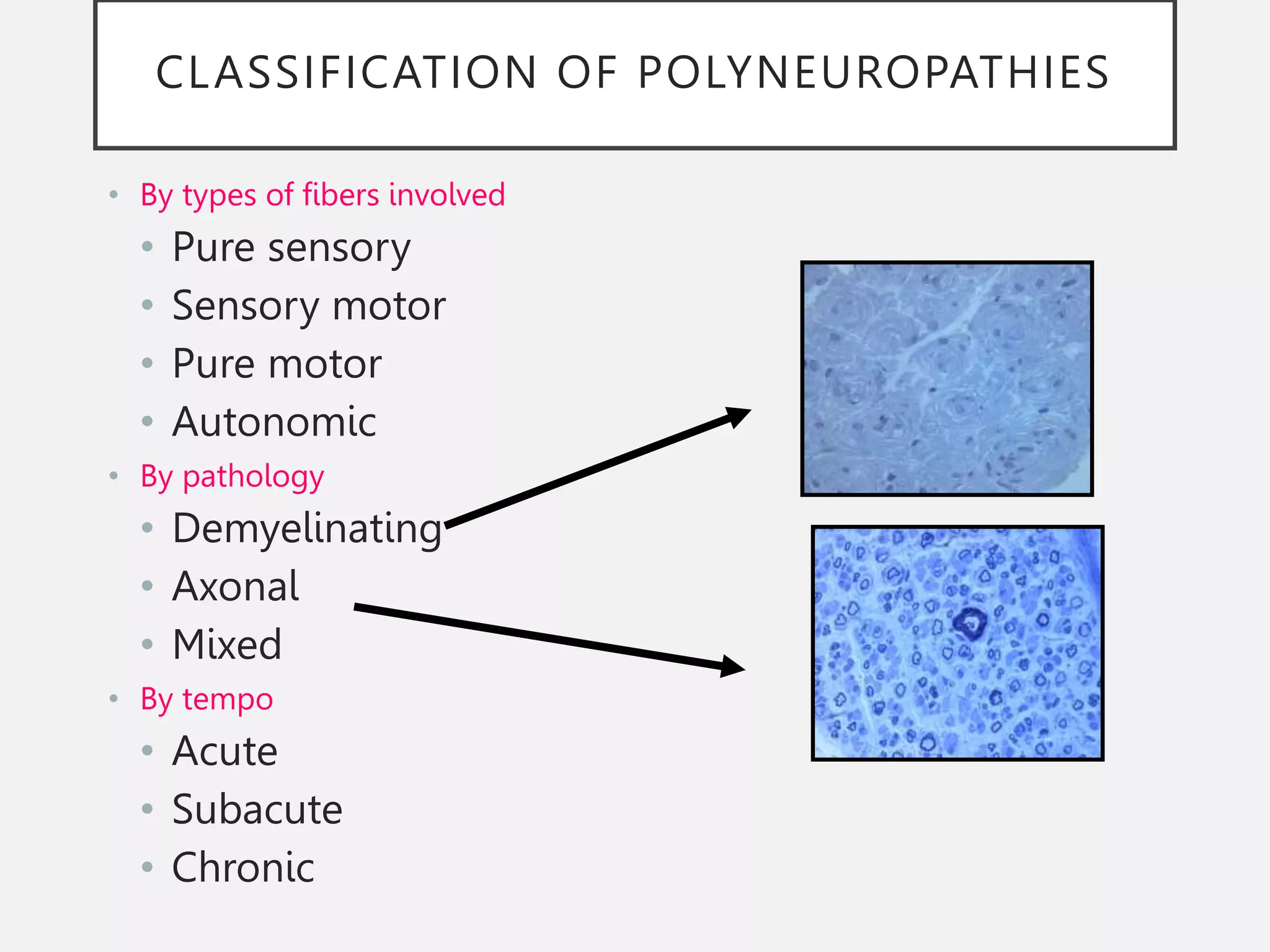
• By pathology
• Demyelinating
• Axonal
• Mixed
• By tempo
• Acute
• Subacute
• Chronic
ACUTE POLYNEUROPATHIES
• Guillain Barre Syndrome
• Porphyria
• Neuropathy, psychiatric disorder, unexplained GI
complaints
• Toxins
• Glue sniffing (n-hexane)
• Arsenic
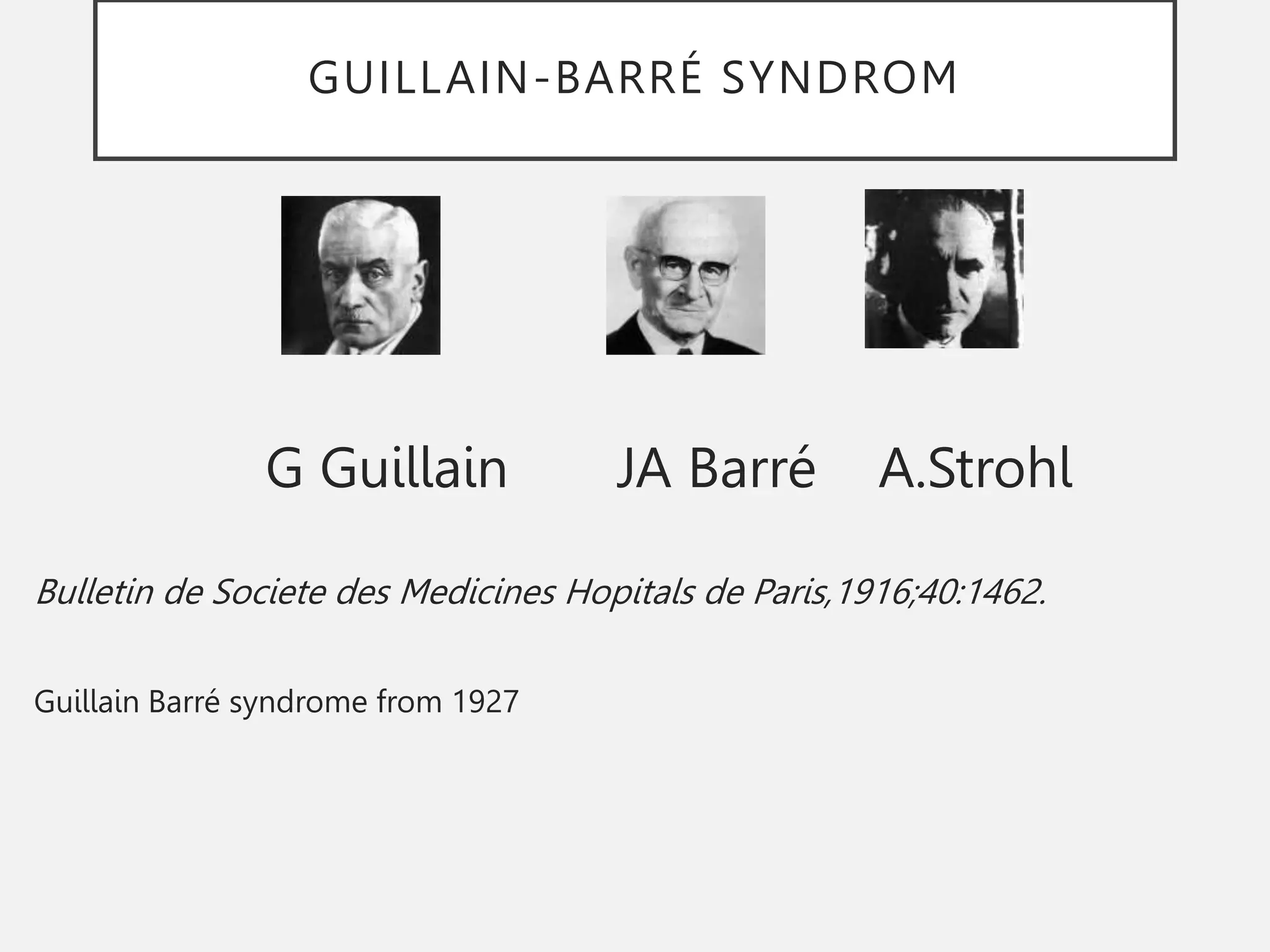
GUILLAIN-BARRÉ SYNDROM
G Guillain JA Barré A.Strohl
Bulletin de Societe des Medicines Hopitals de Paris,1916;40:1462.
Guillain Barré syndrome from 1927
GUILLAIN BARRE SYNDROME
• Most common cause of rapidly progressive weakness
• Demyelinating neuropathy
• Ascending weakness which may include cranial
neuropathies
• Exam reveals symmetric weakness with areflexia and
large fiber sensory loss
• Bowel and bladder usually preserved
GUILLAIN BARRE SYNDROME,
CONT
• Respiratory failure can be precipitous
• Other causes of morbidity and mortality
• Autonomic instability
• DVT
• Infection
• Immune mediated, may be post infectious
• Treatment
• Plasma exchange
• Intravenous immunoglobulin
SUBACUTE POLYNEUROPATHIES
• Vasculitis
• Can be isolated to peripheral nerves or part of a more systemic process
• Paraneoplastic
• May be presenting symptom of the cancer
• Chronic inflammatory demyelinating polyneuropathy
• With or without a gammopathy
• Toxins
• Drug
CHRONIC POLYNEUROPATHIES
• Metabolic
• Diabetes mellitus
• Chronic renal failure
• Chronic liver failure
• Thyroid disease
• Nutritional
• B12 deficiency
• Infections
• HIV
• Leprosy
• Inherited – Charcot Marie Tooth disease since 1886
EVALUATION OF A
POLYNEUROPATHY
• Lab work
• Nerve conduction study/electromyography
• Distinguishes between axonal and demyelinating
• Helps ascertain severity
• Nerve biopsy
• Frequently non-diagnostic
• Can establish the dx in certain disorders, such as vasculitis and amyloidosis
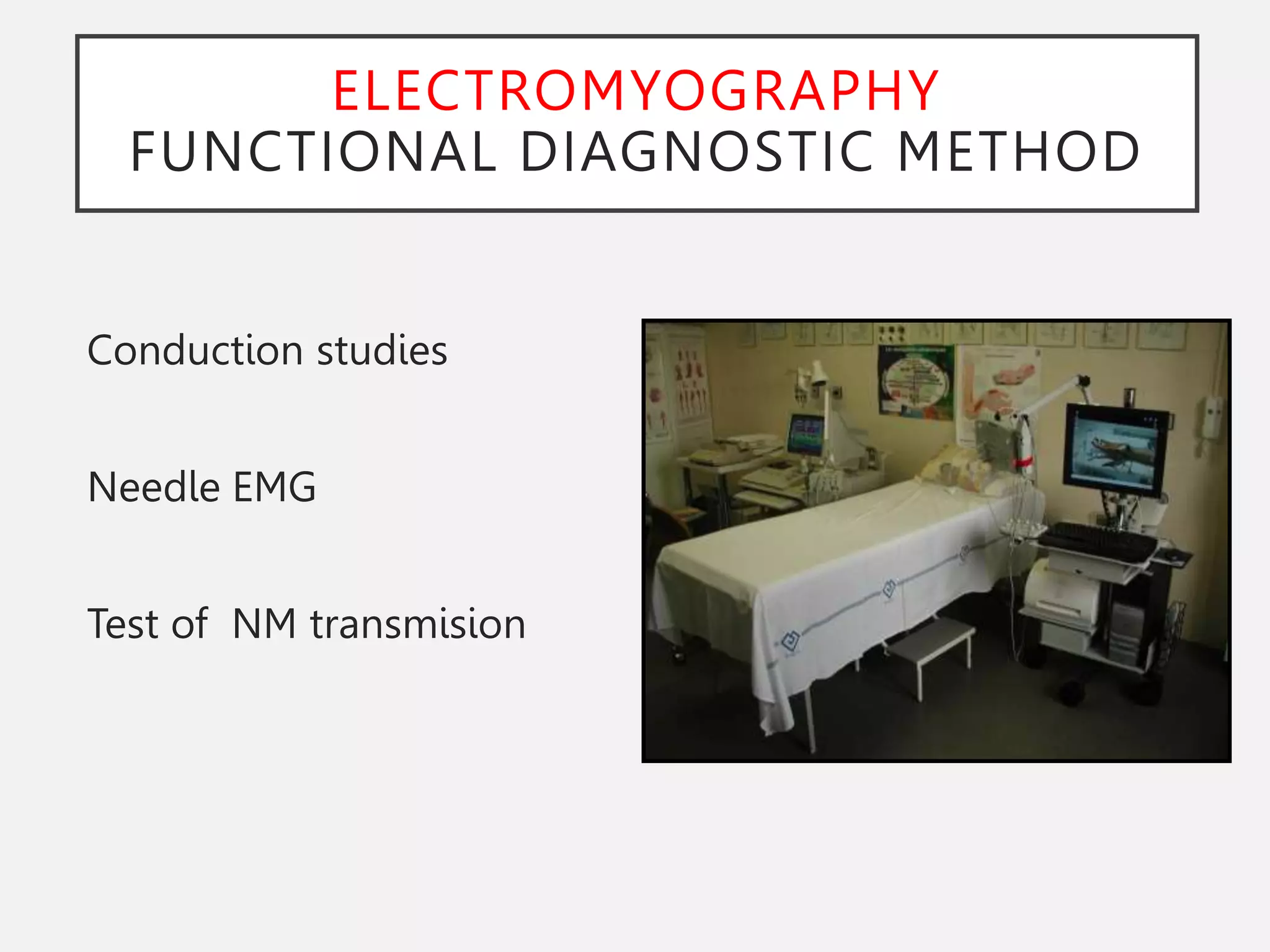
ELECTROMYOGRAPHY
FUNCTIONAL DIAGNOSTIC METHOD
Conduction studies
Needle EMG
Test of NM transmision
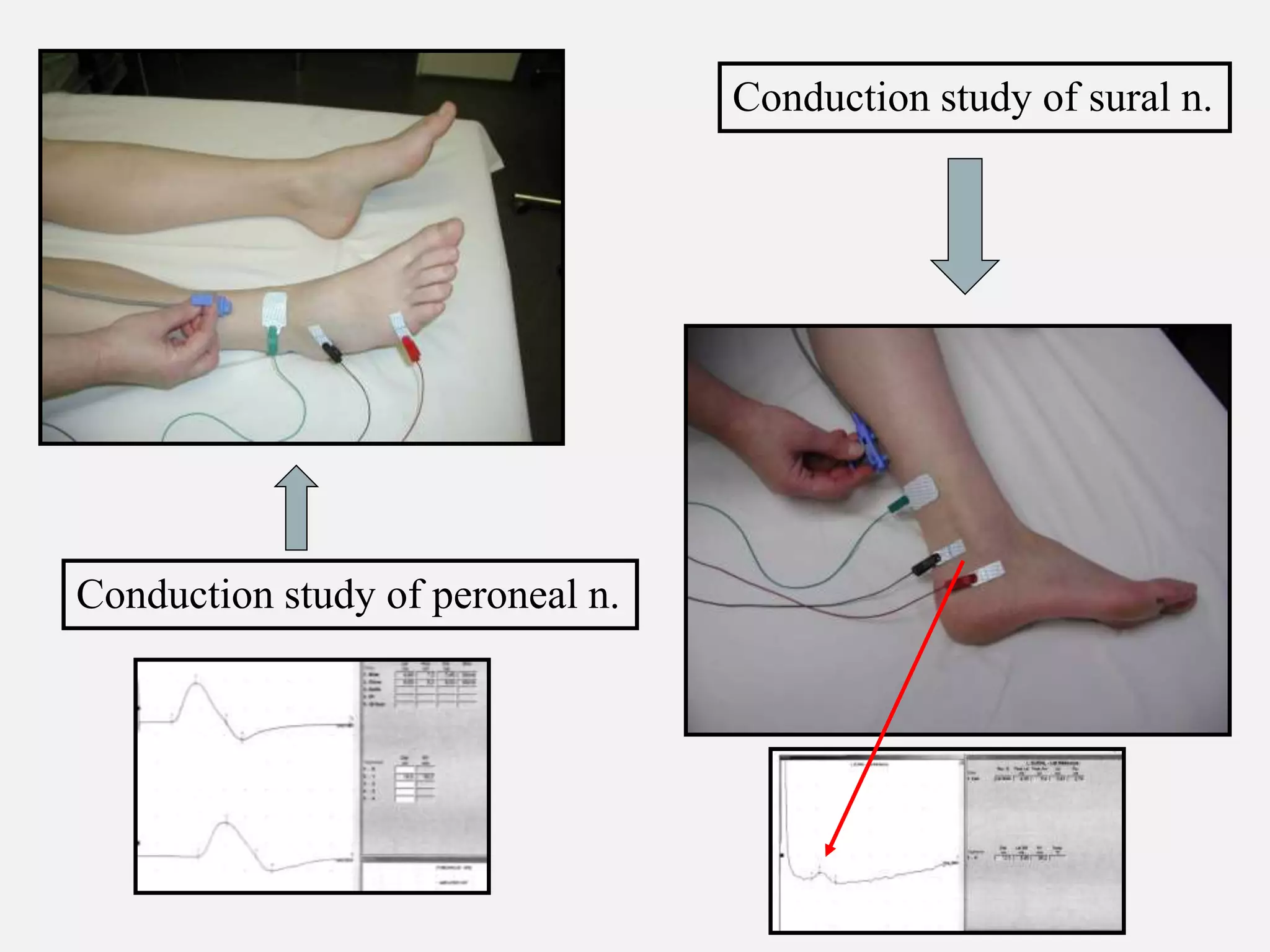
Conduction study of peroneal n.
Conduction study of sural n.
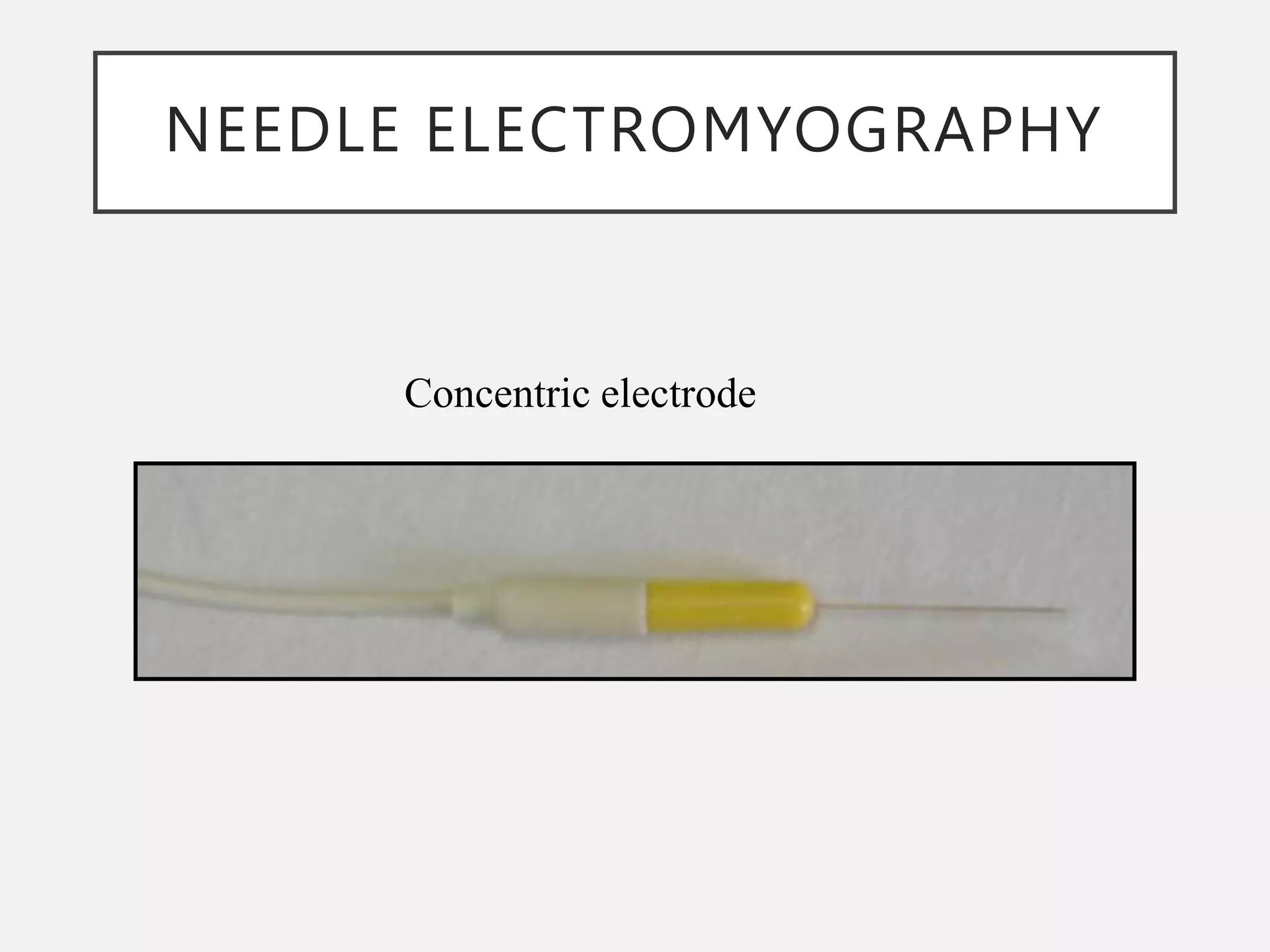
NEEDLE ELECTROMYOGRAPHY
Concentric electrode
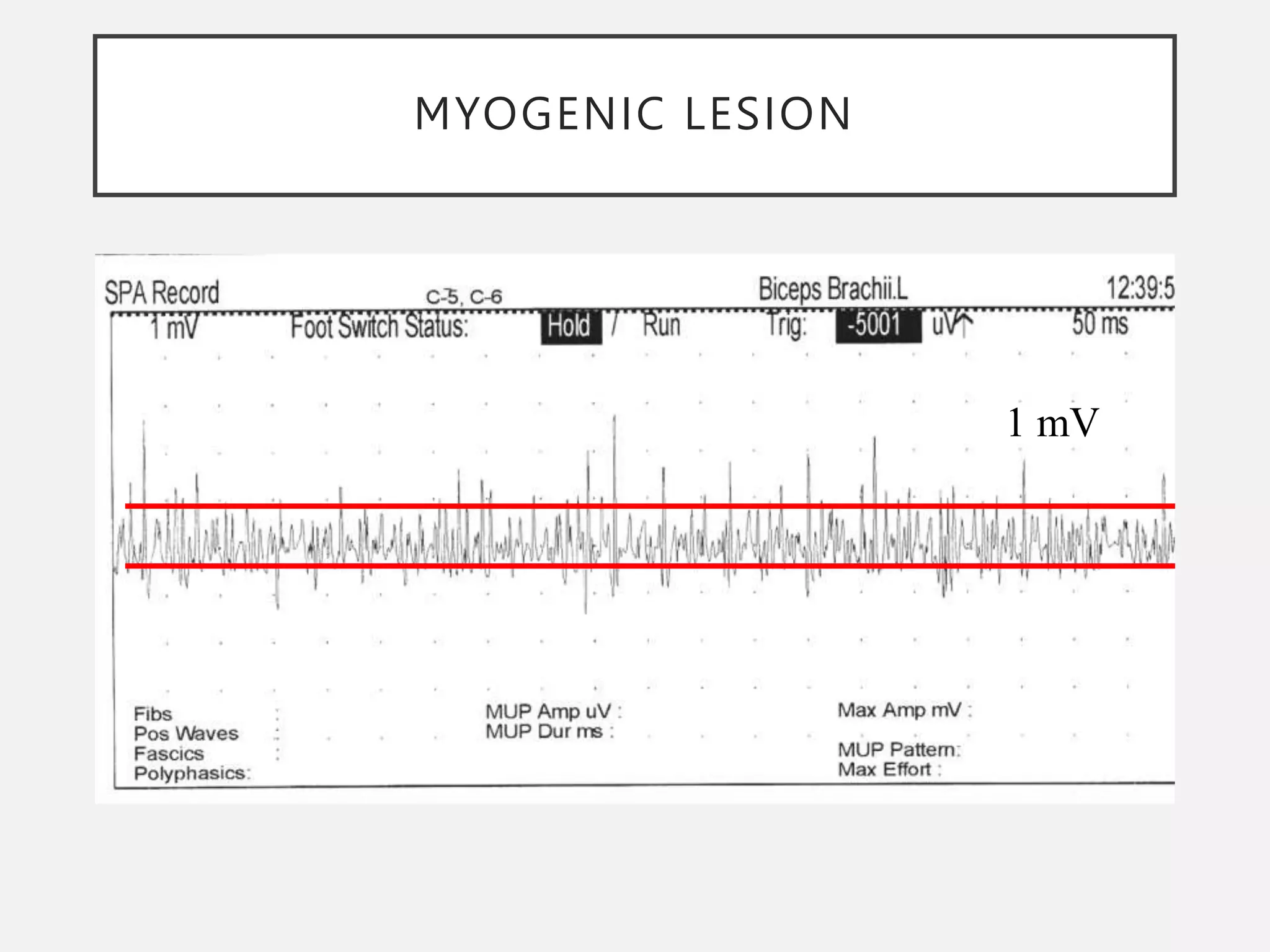
MYOGENIC LESION
1 mV
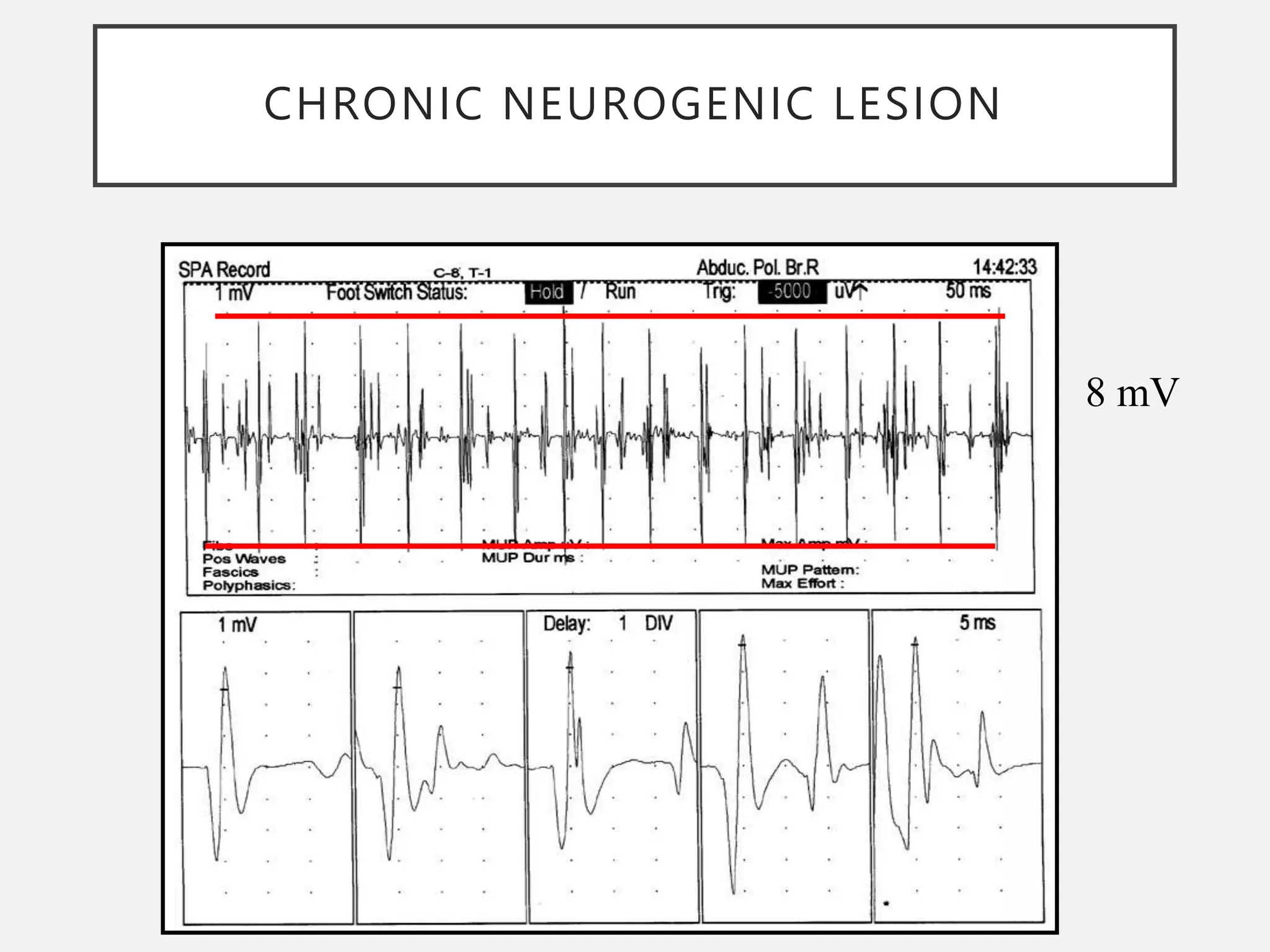
CHRONIC NEUROGENIC LESION
8 mV
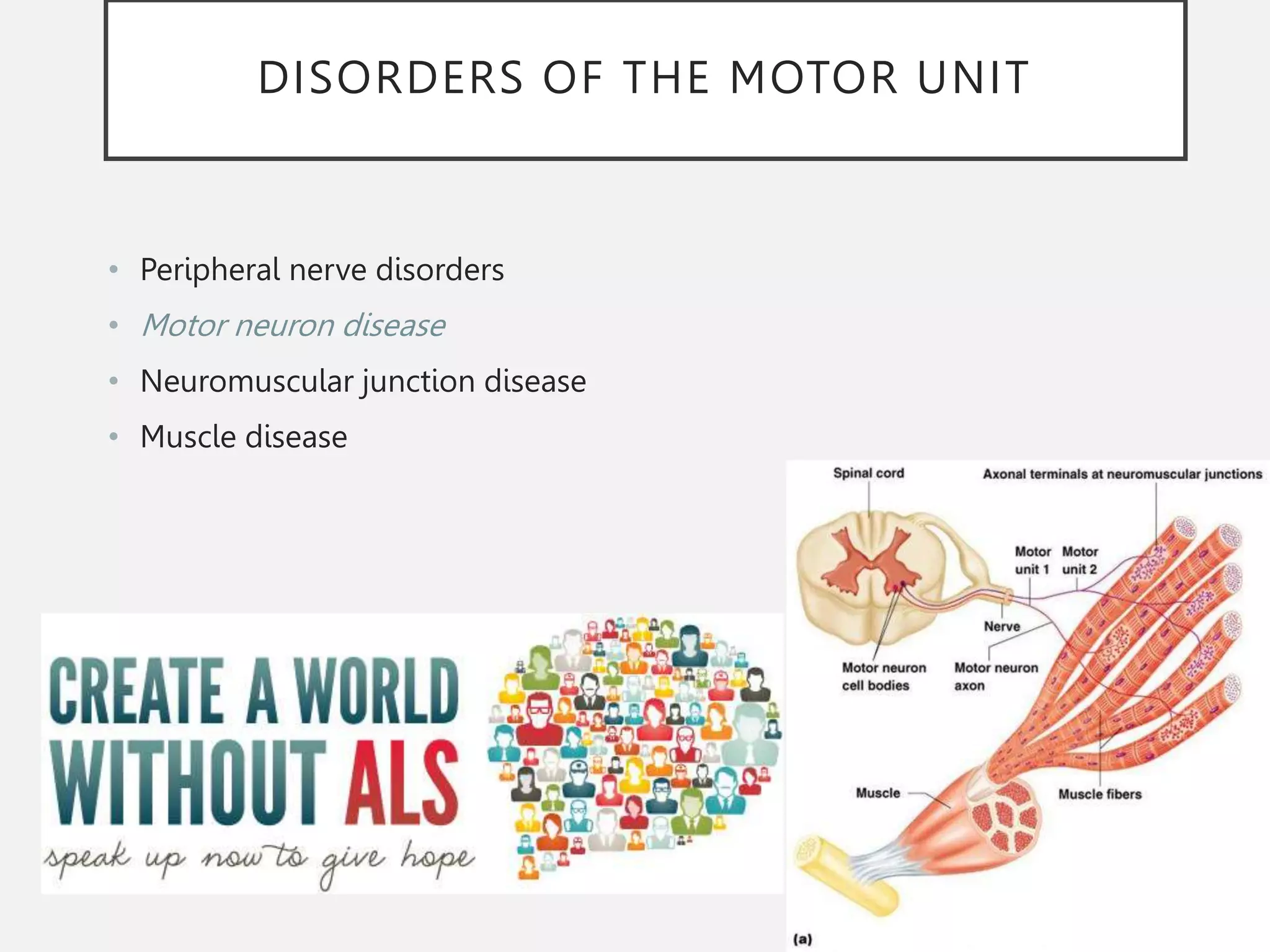
DISORDERS OF THE MOTOR UNIT
• Peripheral nerve disorders
• Motor neuron disease
• Neuromuscular junction disease
• Muscle disease
MOTOR NEURON DISEASE
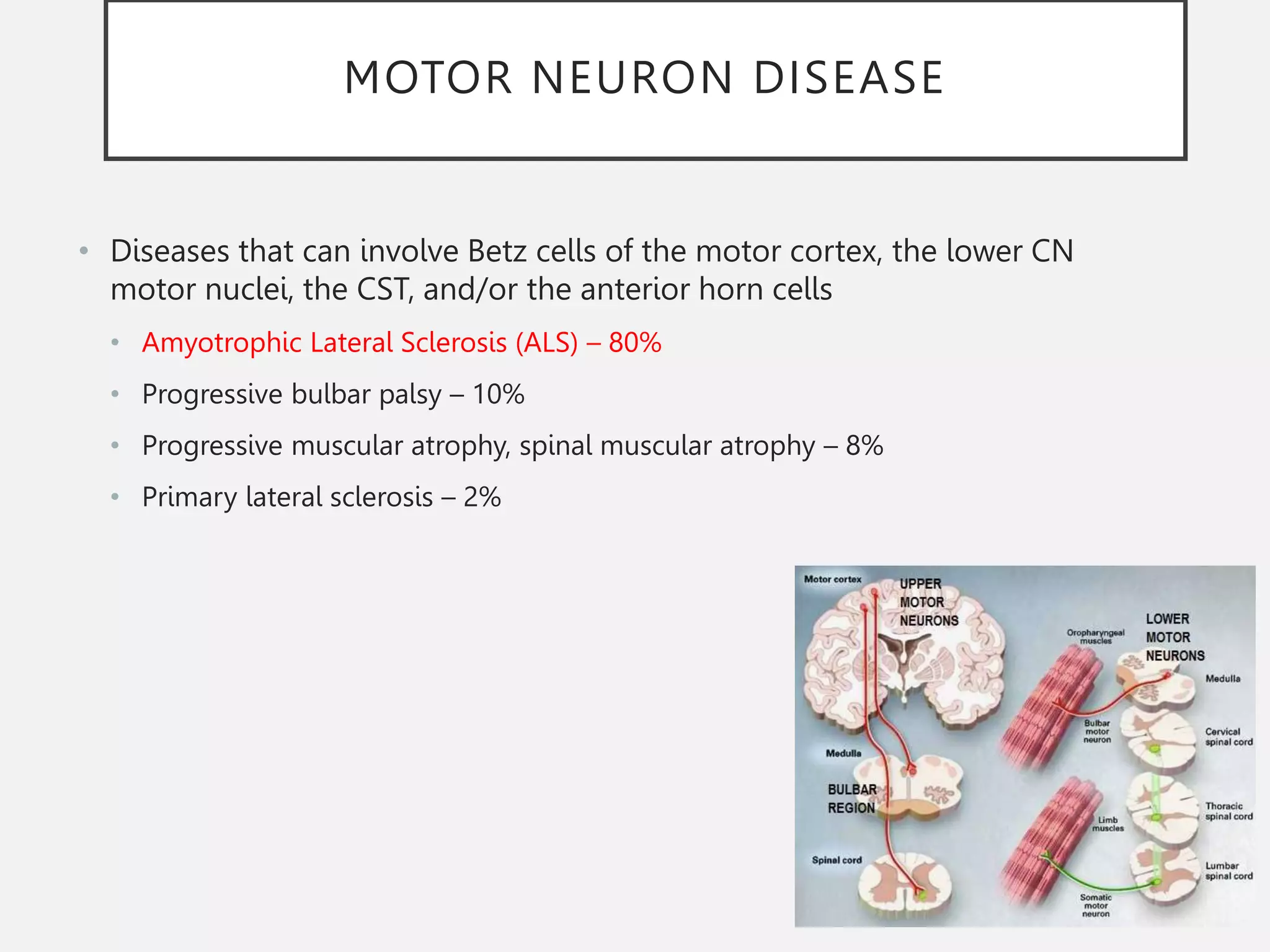
• Diseases that can involve Betz cells of the motor cortex, the lower CN
motor nuclei, the CST, and/or the anterior horn cells
• Amyotrophic Lateral Sclerosis (ALS) – 80%
• Progressive bulbar palsy – 10%
• Progressive muscular atrophy, spinal muscular atrophy – 8%
• Primary lateral sclerosis – 2%
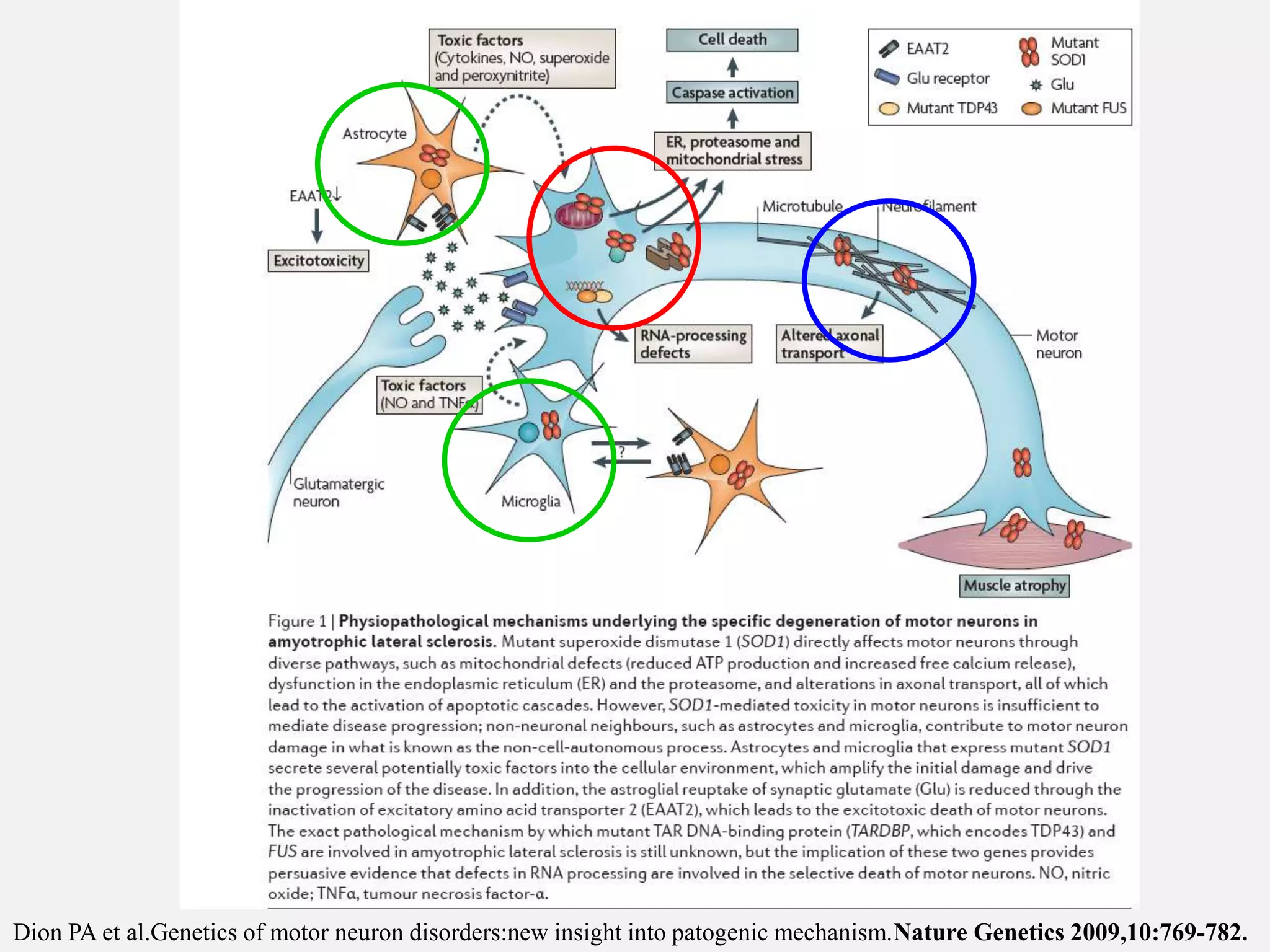
Dion PA et al.Genetics of motor neuron disorders:new insight into patogenic mechanism.Nature Genetics 2009,10:769-782.
EPIDEMIOLOGY OF ALS
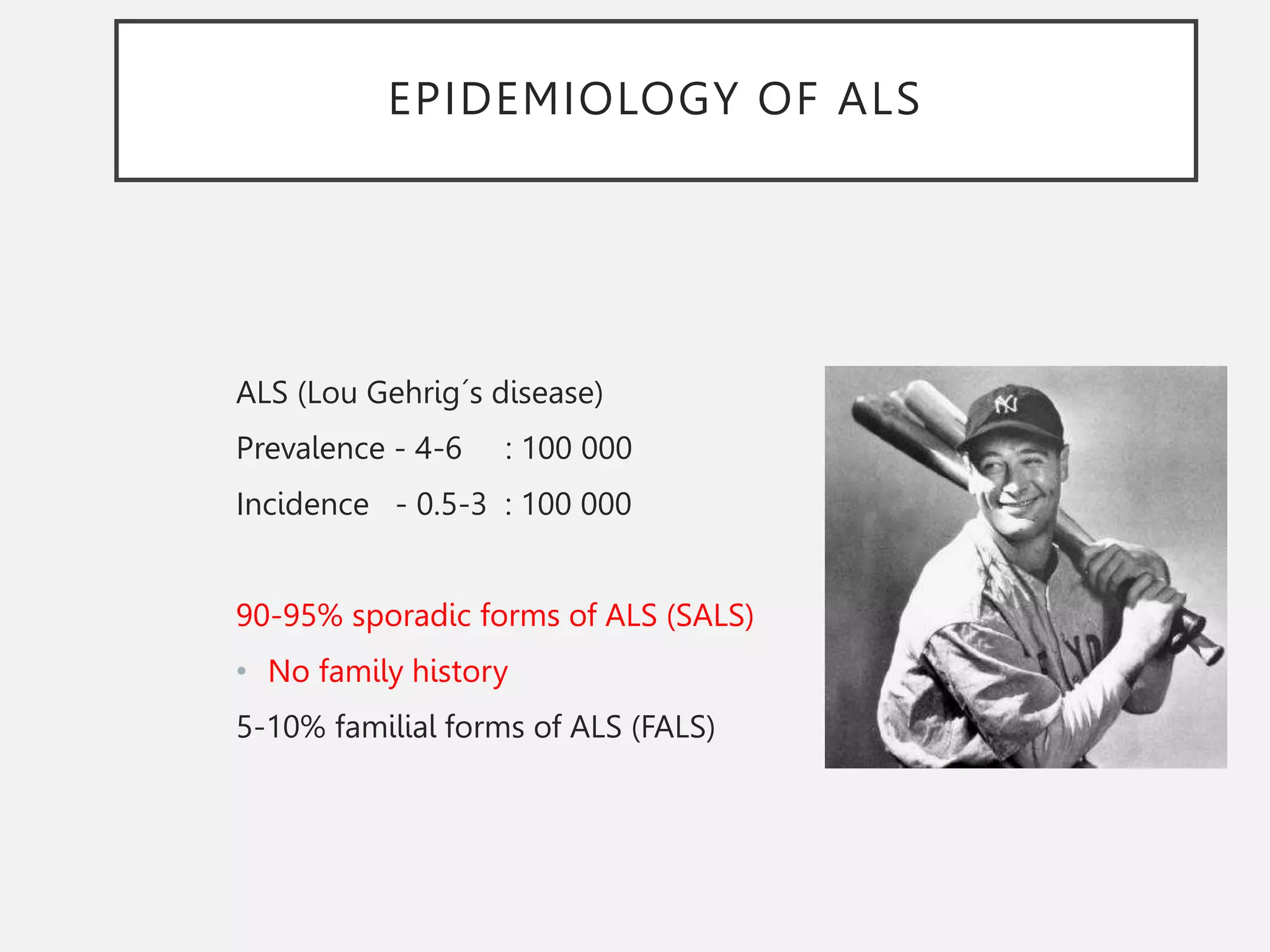
ALS (Lou Gehrig´s disease)
Prevalence - 4-6 : 100 000
Incidence - 0.5-3 : 100 000
90-95% sporadic forms of ALS (SALS)
• No family history
5-10% familial forms of ALS (FALS)
CLASSICAL ALS
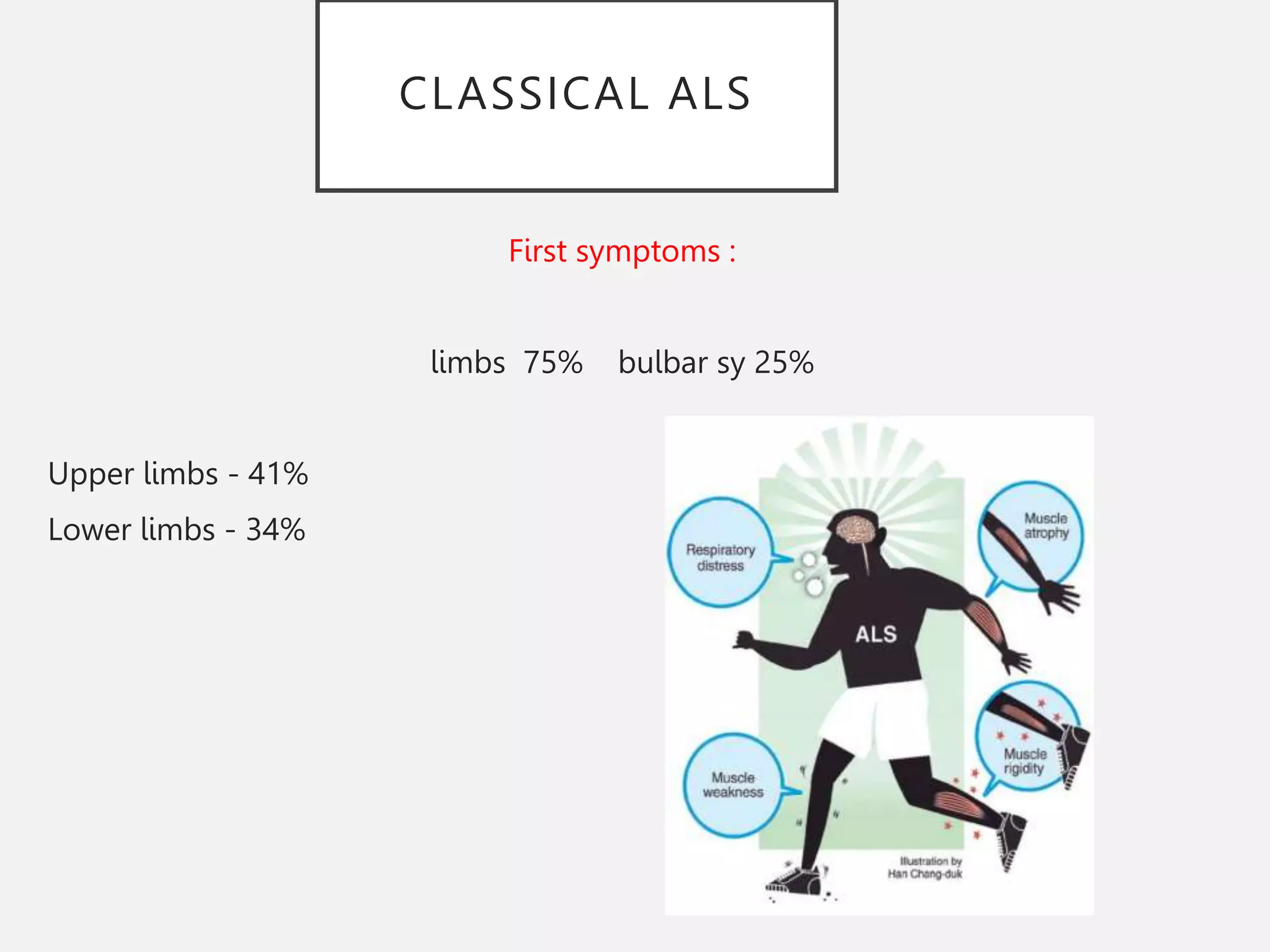
First symptoms :
limbs 75% bulbar sy 25%
Upper limbs - 41%
Lower limbs - 34%
ALS – CLINICAL FEATURES
• Loss of motor neurons in the cortex, brainstem and spinal cord
• Mix of upper motor neuron and lower motor neuron findings
• Weakness, atrophy, fasciculations
• Slurred speech, difficulty swallowing, shortness of breath
• Can start in any extremity or the bulbar musculature
• Relentlessly progressive
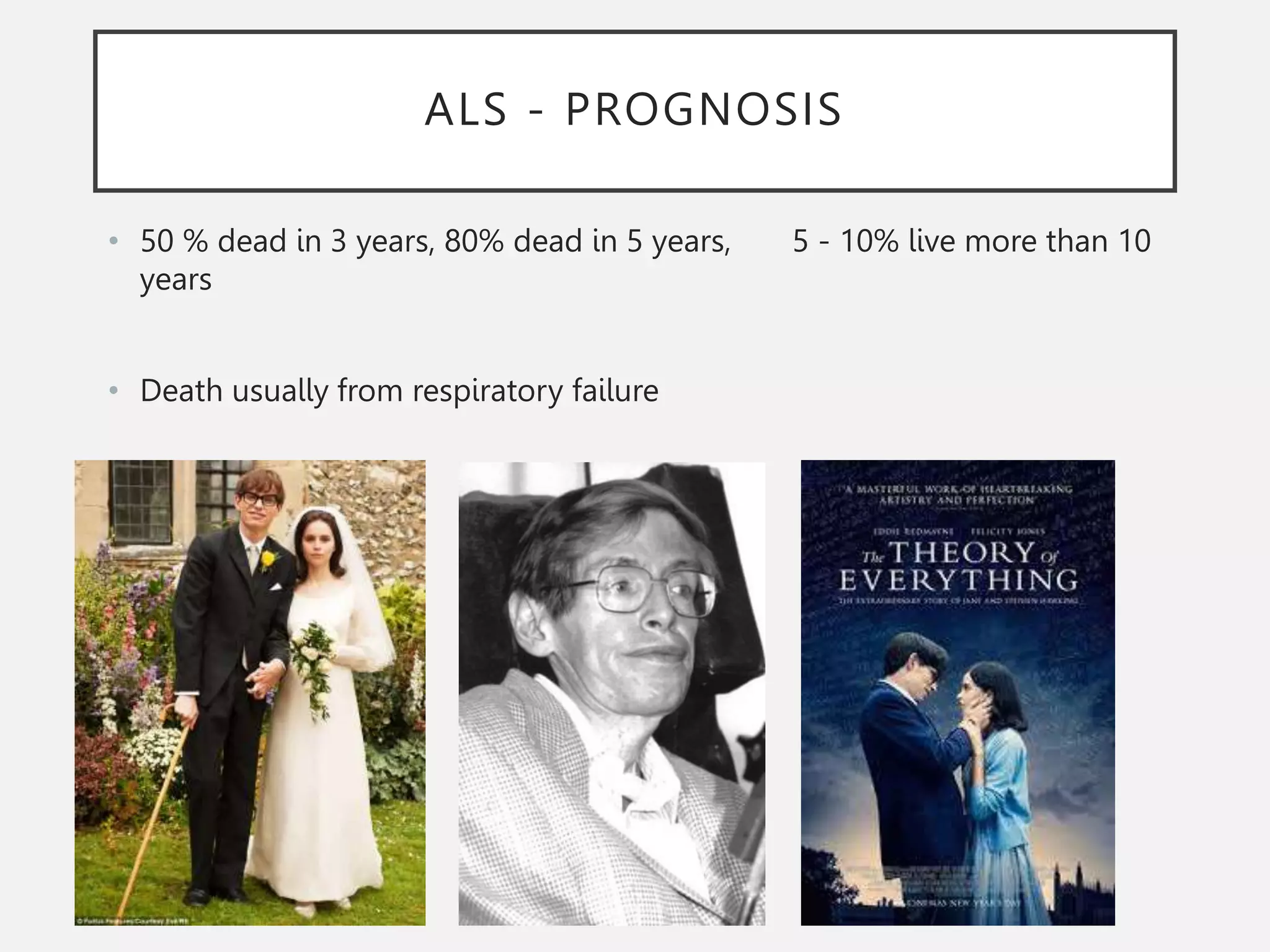
ALS - PROGNOSIS
• 50 % dead in 3 years, 80% dead in 5 years, 5 - 10% live more than 10
years
• Death usually from respiratory failure
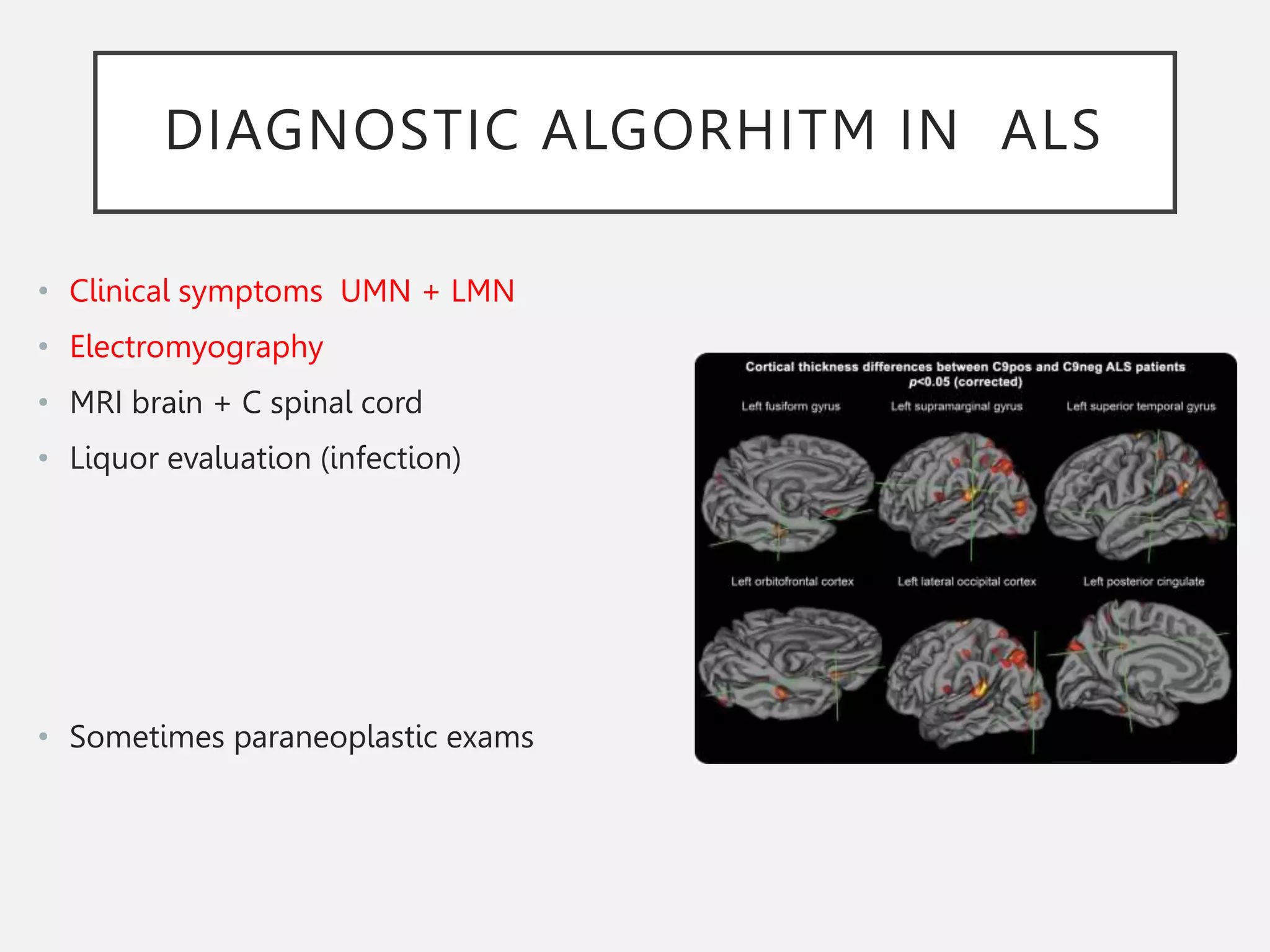
DIAGNOSTIC ALGORHITM IN ALS
• Clinical symptoms UMN + LMN
• Electromyography
• MRI brain + C spinal cord
• Liquor evaluation (infection)
• Sometimes paraneoplastic exams
How to slow down Progression of
ALS
TREATMENT OF ALS
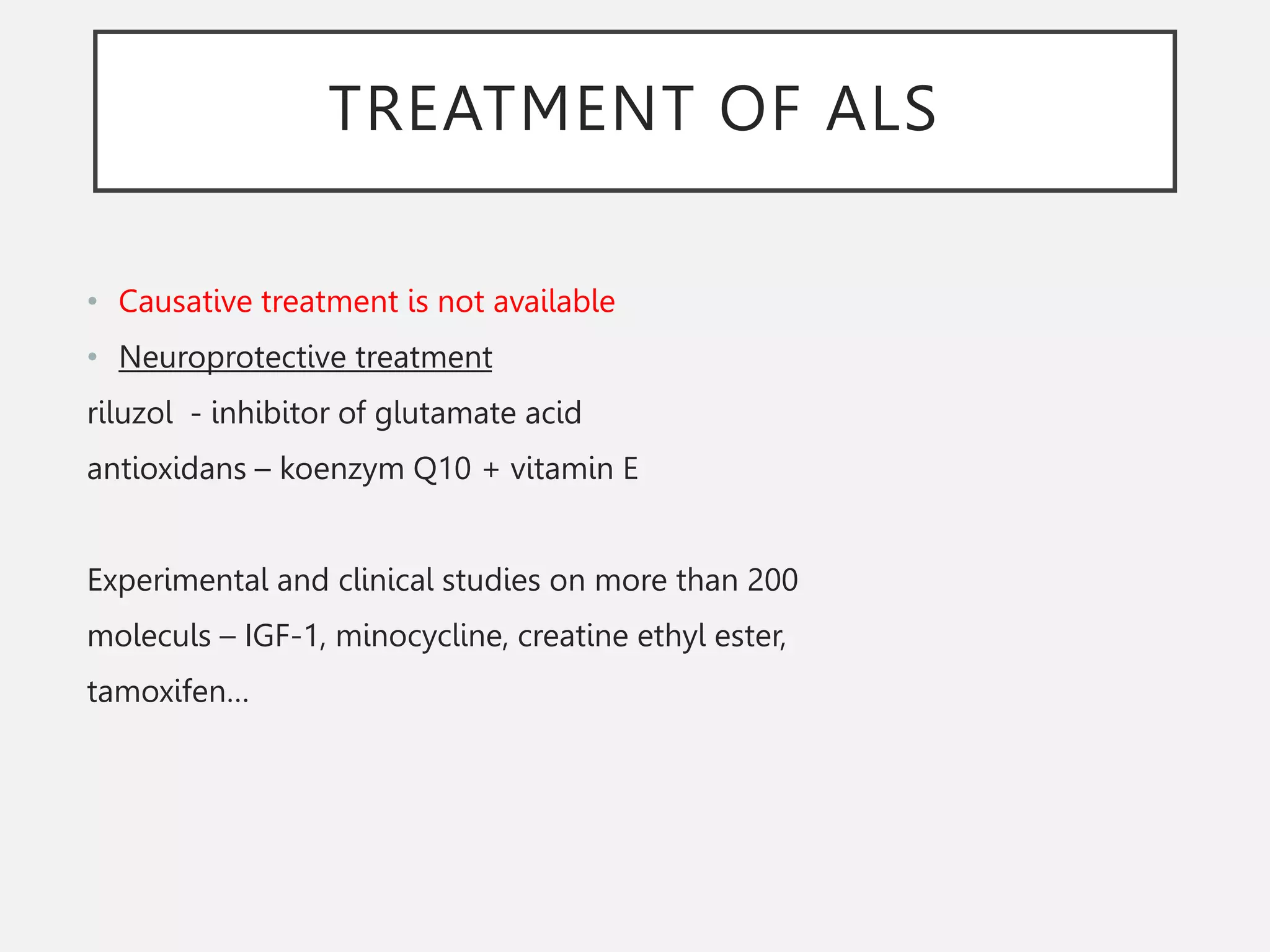
• Causative treatment is not available
• Neuroprotective treatment
riluzol - inhibitor of glutamate acid
antioxidans – koenzym Q10 + vitamin E
Experimental and clinical studies on more than 200
moleculs – IGF-1, minocycline, creatine ethyl ester,
tamoxifen…
TREATMENT OF ALS
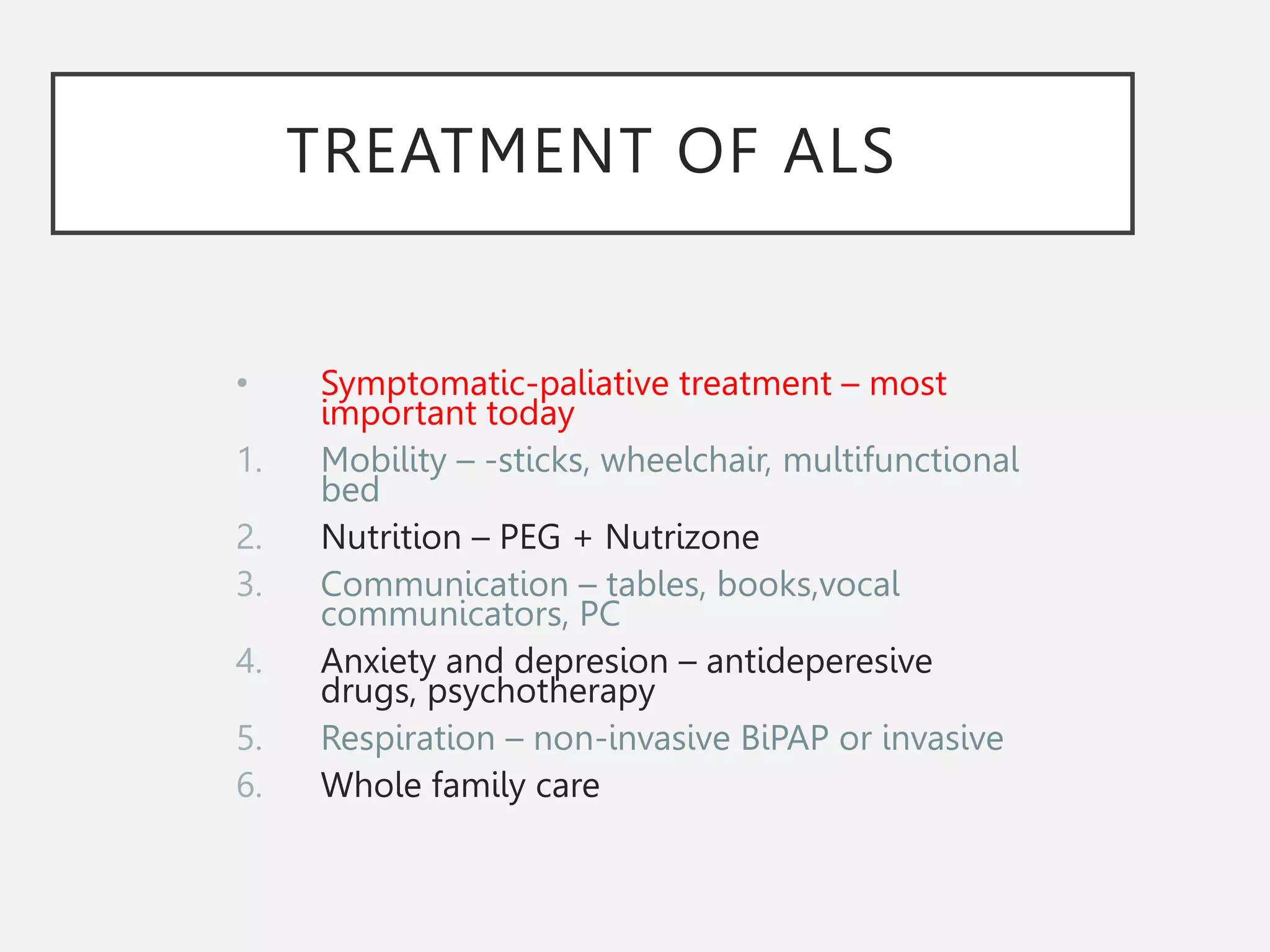
• Symptomatic-paliative treatment – most
important today
1. Mobility – -sticks, wheelchair, multifunctional
bed
2. Nutrition – PEG + Nutrizone
3. Communication – tables, books,vocal
communicators, PC
4. Anxiety and depresion – antideperesive
drugs, psychotherapy
5. Respiration – non-invasive BiPAP or invasive
6. Whole family care
TREATMENT OF ALS
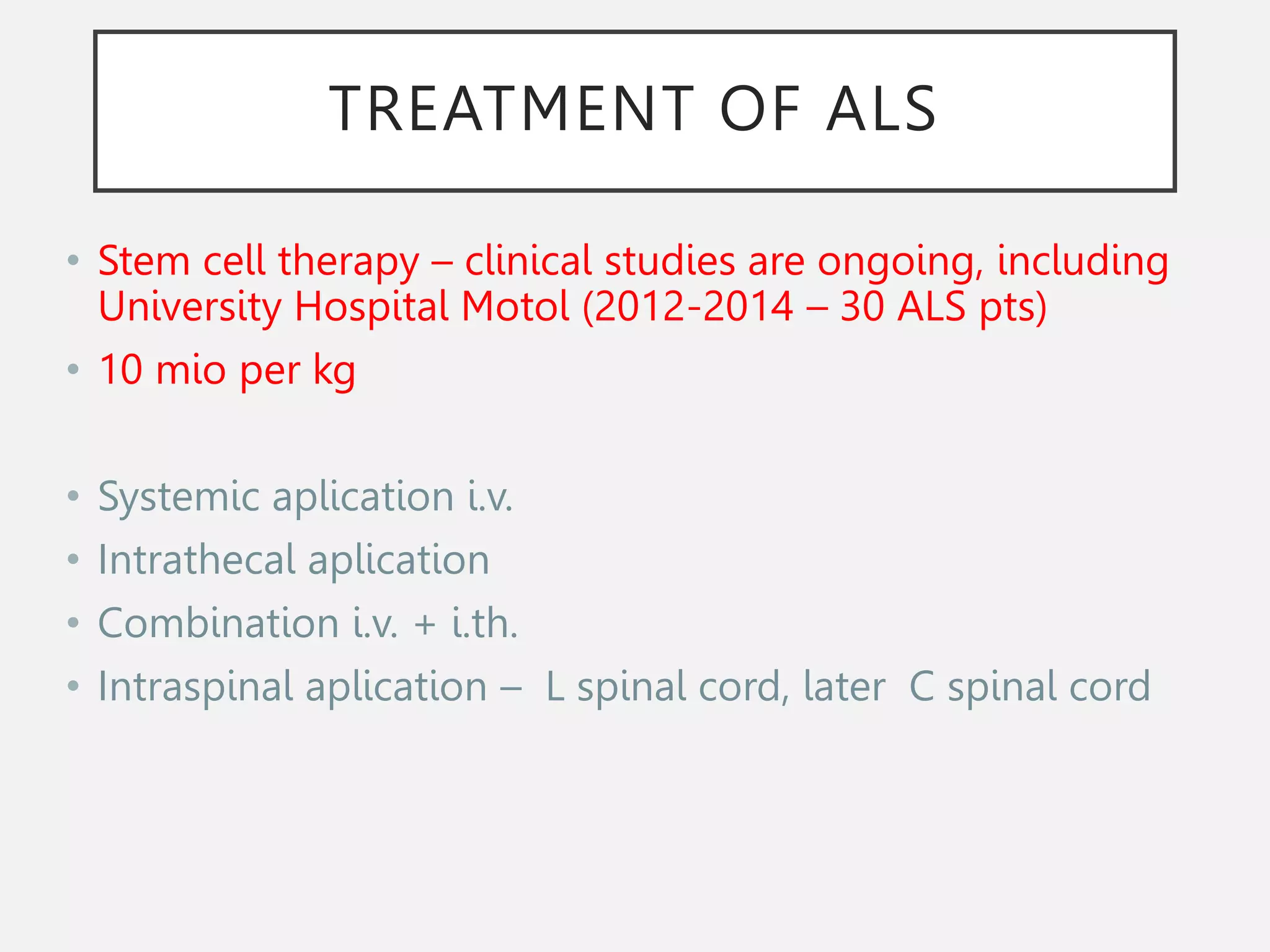
• Stem cell therapy – clinical studies are ongoing, including
University Hospital Motol (2012-2014 – 30 ALS pts)
• 10 mio per kg
• Systemic aplication i.v.
• Intrathecal aplication
• Combination i.v. + i.th.
• Intraspinal aplication – L spinal cord, later C spinal cord

NMD.ppt

  • 1.
  • 2.
    DISORDERS OF THEMOTOR UNIT • Peripheral nerve disorders • Motor neuron disease • Neuromuscular junction disease • Muscle disease
  • 3.
    PERIPHERAL NERVE DISORDERS •Mononeuropathy • Pattern of weakness and sensory loss conforms to the distribution of a single nerve • Carpal tunnel syndrome • Peroneal palsy at the fibular head • Mononeuritis multiplex • Multiple nerves affected in a random pattern • Acute onset, frequently painful • Diabetes mellitus, vasculitis • Polyneuropathy (peripheral neuropathy) • Distal, symmetric
  • 4.
    POLYNEUROPATHIES • Can affectdifferent types of fibers • Autonomic • Motor • Sensory • Large well myelinated • Small poorly myelinated or unmyelinated
  • 5.
    SYMPTOMS OF APOLYNEUROPATHY • Sensory symptoms • Start in feet, move proximally • Hand sxs appear when LE sxs up to knees • Positive • Pins and needles • Tingling • Burning • Negative • Numbness • Deadness • “Like I’m walking with thick socks on”
  • 6.
    EXAMS OF PERIPHERALNEUROPATHY Sensory impairment akroparesthesias or tactile hypestesias glove or sock distribution Vibration disturbances pallhypestesia distally (tuning fork C 128 Hz)
  • 7.
  • 8.
    CLINICAL FEATURES OFPOLYNEUROPATIES • Weaknes of LL • Atrophies of distal muscles • Deformities pes cavus • Walk on heels • Normal muscles strenght at proximal muscles
  • 9.
  • 10.
    FOOT DEFORMITY INHEREDITARY NEUROPATHY (CMT DISEASE) • pes cavus
  • 11.
    CLASSIFICATION OF POLYNEUROPATHIES •By types of fibers involved • Pure sensory • Sensory motor • Pure motor • Autonomic • By pathology • Demyelinating • Axonal • Mixed • By tempo • Acute • Subacute • Chronic
  • 12.
    ACUTE POLYNEUROPATHIES • GuillainBarre Syndrome • Porphyria • Neuropathy, psychiatric disorder, unexplained GI complaints • Toxins • Glue sniffing (n-hexane) • Arsenic
  • 13.
    GUILLAIN-BARRÉ SYNDROM G GuillainJA Barré A.Strohl Bulletin de Societe des Medicines Hopitals de Paris,1916;40:1462. Guillain Barré syndrome from 1927
  • 14.
    GUILLAIN BARRE SYNDROME •Most common cause of rapidly progressive weakness • Demyelinating neuropathy • Ascending weakness which may include cranial neuropathies • Exam reveals symmetric weakness with areflexia and large fiber sensory loss • Bowel and bladder usually preserved
  • 15.
    GUILLAIN BARRE SYNDROME, CONT •Respiratory failure can be precipitous • Other causes of morbidity and mortality • Autonomic instability • DVT • Infection • Immune mediated, may be post infectious • Treatment • Plasma exchange • Intravenous immunoglobulin
  • 16.
    SUBACUTE POLYNEUROPATHIES • Vasculitis •Can be isolated to peripheral nerves or part of a more systemic process • Paraneoplastic • May be presenting symptom of the cancer • Chronic inflammatory demyelinating polyneuropathy • With or without a gammopathy • Toxins • Drug
  • 17.
    CHRONIC POLYNEUROPATHIES • Metabolic •Diabetes mellitus • Chronic renal failure • Chronic liver failure • Thyroid disease • Nutritional • B12 deficiency • Infections • HIV • Leprosy • Inherited – Charcot Marie Tooth disease since 1886
  • 18.
    EVALUATION OF A POLYNEUROPATHY •Lab work • Nerve conduction study/electromyography • Distinguishes between axonal and demyelinating • Helps ascertain severity • Nerve biopsy • Frequently non-diagnostic • Can establish the dx in certain disorders, such as vasculitis and amyloidosis
  • 19.
    ELECTROMYOGRAPHY FUNCTIONAL DIAGNOSTIC METHOD Conductionstudies Needle EMG Test of NM transmision
  • 20.
    Conduction study ofperoneal n. Conduction study of sural n.
  • 21.
  • 22.
  • 23.
  • 24.
    DISORDERS OF THEMOTOR UNIT • Peripheral nerve disorders • Motor neuron disease • Neuromuscular junction disease • Muscle disease
  • 25.
    MOTOR NEURON DISEASE •Diseases that can involve Betz cells of the motor cortex, the lower CN motor nuclei, the CST, and/or the anterior horn cells • Amyotrophic Lateral Sclerosis (ALS) – 80% • Progressive bulbar palsy – 10% • Progressive muscular atrophy, spinal muscular atrophy – 8% • Primary lateral sclerosis – 2%
  • 26.
    Dion PA etal.Genetics of motor neuron disorders:new insight into patogenic mechanism.Nature Genetics 2009,10:769-782.
  • 27.
    EPIDEMIOLOGY OF ALS ALS(Lou Gehrig´s disease) Prevalence - 4-6 : 100 000 Incidence - 0.5-3 : 100 000 90-95% sporadic forms of ALS (SALS) • No family history 5-10% familial forms of ALS (FALS)
  • 28.
    CLASSICAL ALS First symptoms: limbs 75% bulbar sy 25% Upper limbs - 41% Lower limbs - 34%
  • 29.
    ALS – CLINICALFEATURES • Loss of motor neurons in the cortex, brainstem and spinal cord • Mix of upper motor neuron and lower motor neuron findings • Weakness, atrophy, fasciculations • Slurred speech, difficulty swallowing, shortness of breath • Can start in any extremity or the bulbar musculature • Relentlessly progressive
  • 30.
    ALS - PROGNOSIS •50 % dead in 3 years, 80% dead in 5 years, 5 - 10% live more than 10 years • Death usually from respiratory failure
  • 31.
    DIAGNOSTIC ALGORHITM INALS • Clinical symptoms UMN + LMN • Electromyography • MRI brain + C spinal cord • Liquor evaluation (infection) • Sometimes paraneoplastic exams
  • 32.
    How to slowdown Progression of ALS
  • 36.
    TREATMENT OF ALS •Causative treatment is not available • Neuroprotective treatment riluzol - inhibitor of glutamate acid antioxidans – koenzym Q10 + vitamin E Experimental and clinical studies on more than 200 moleculs – IGF-1, minocycline, creatine ethyl ester, tamoxifen…
  • 37.
    TREATMENT OF ALS •Symptomatic-paliative treatment – most important today 1. Mobility – -sticks, wheelchair, multifunctional bed 2. Nutrition – PEG + Nutrizone 3. Communication – tables, books,vocal communicators, PC 4. Anxiety and depresion – antideperesive drugs, psychotherapy 5. Respiration – non-invasive BiPAP or invasive 6. Whole family care
  • 38.
    TREATMENT OF ALS •Stem cell therapy – clinical studies are ongoing, including University Hospital Motol (2012-2014 – 30 ALS pts) • 10 mio per kg • Systemic aplication i.v. • Intrathecal aplication • Combination i.v. + i.th. • Intraspinal aplication – L spinal cord, later C spinal cord