Motor Neuron Diseases
Prepared by:
Orlando A. Pistan, MAEd
Psychology Instructor
Motor Neuron Diseases
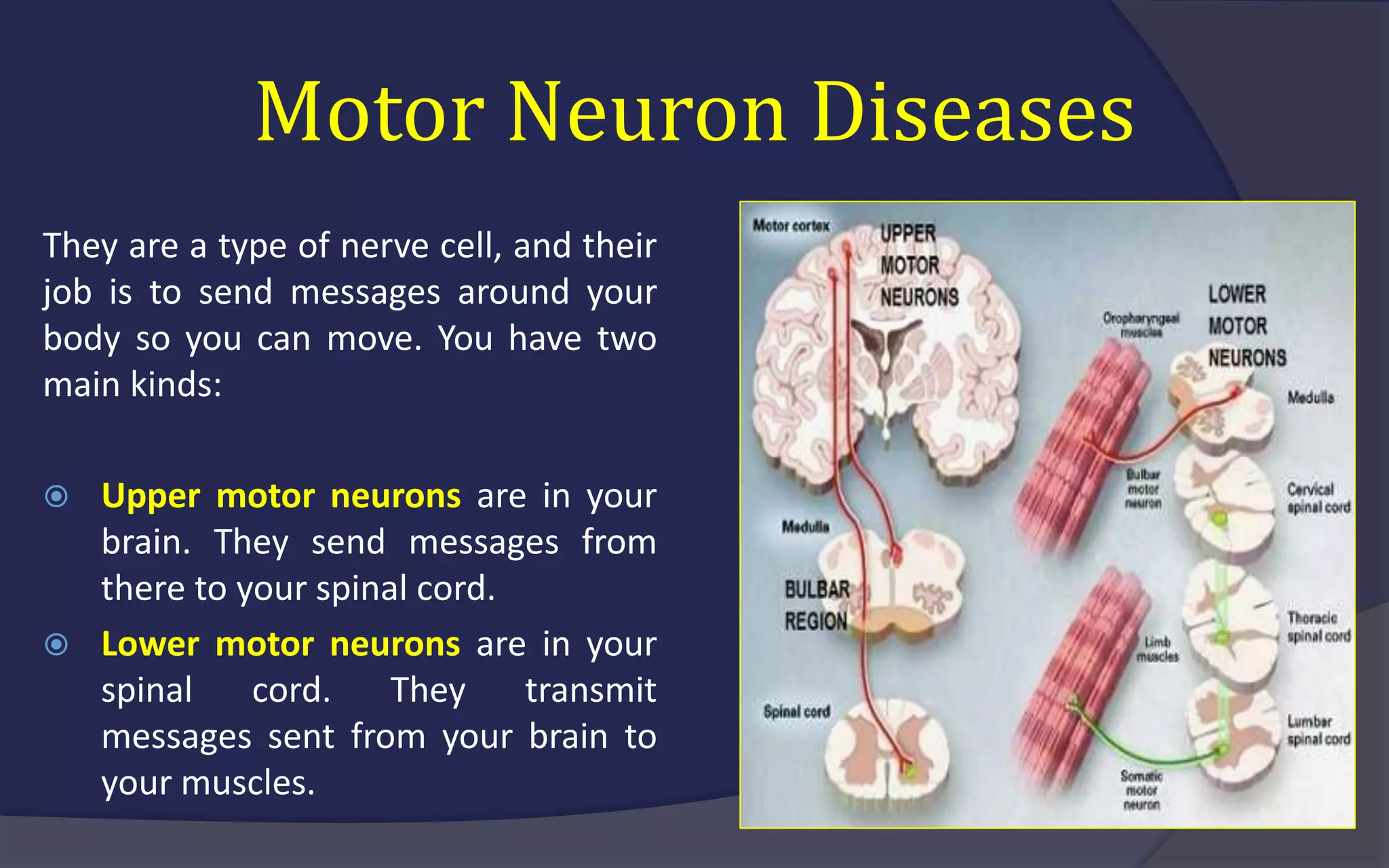
They are a type of nerve cell, and their
job is to send messages around your
body so you can move. You have two
main kinds:
 Upper motor neurons are in your
brain. They send messages from
there to your spinal cord.
 Lower motor neurons are in your
spinal cord. They transmit
messages sent from your brain to
your muscles.
Atrophy
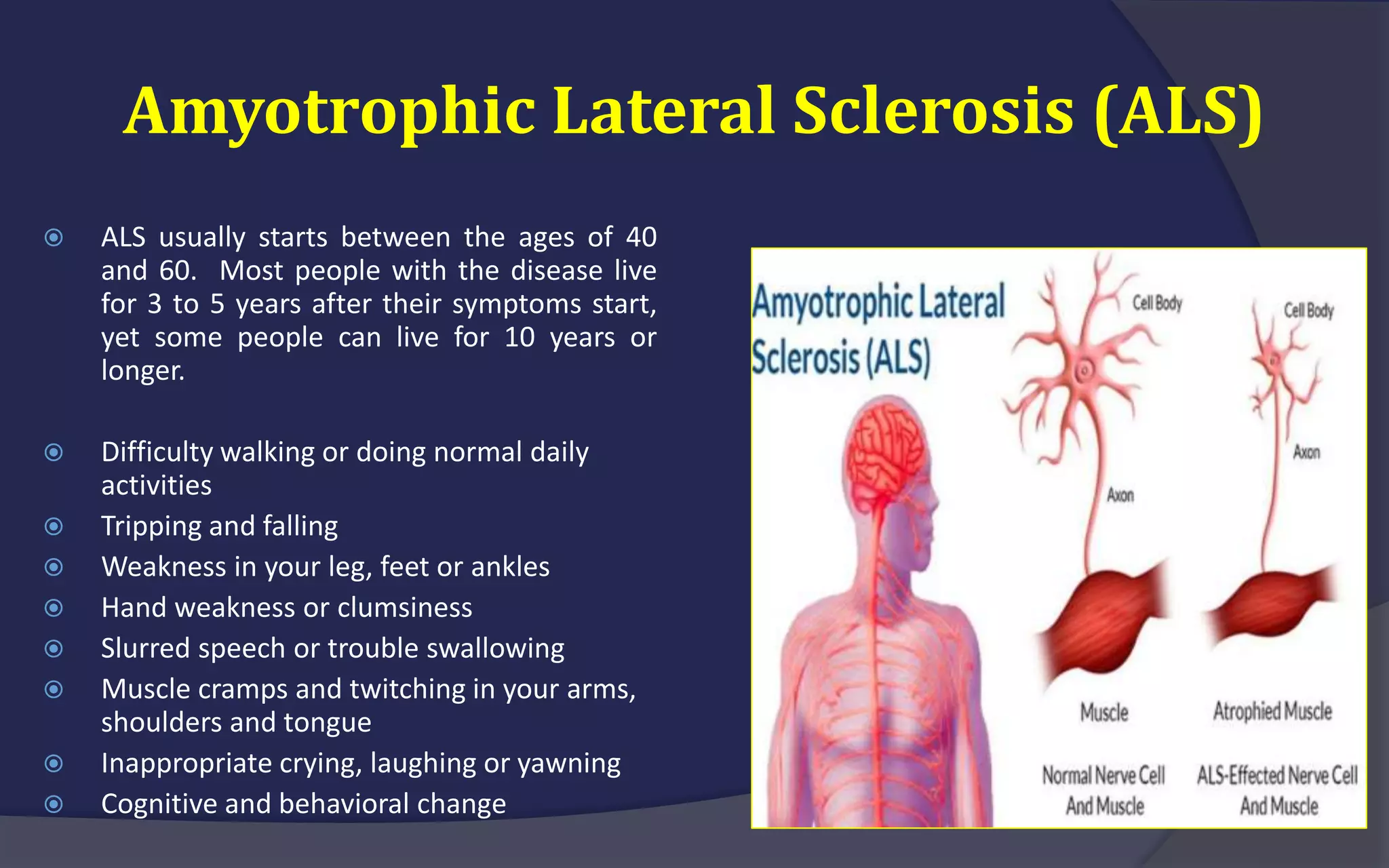
As nerve cells die when you have a
motor neuron disease, electrical
messages can't get from your brain to
your muscles. Over time, your muscles
waste away.
When this happens, you lose control
over movements. It gets harder to
walk, talk, swallow, and breathe.
Muscle atrophy is the wasting or loss
of muscle tissue, especially as a result
of the degeneration of cells.
Amyotrophic Lateral Sclerosis (ALS)
 ALS affects both your upper and lower
motor neurons. With ALS, you
gradually lose control over the muscles
that help you walk, talk, chew, swallow,
and breathe. Over time, they weaken
and waste away. You may also have
stiffness and twitches in your muscles.
 It’s commonly known as Lou Gehrig’s
disease, after the baseball player
whose diagnosis and eventual death
brought wide public attention to the
illness.
 Most of the time, ALS is what doctors
call “sporadic.” This means anyone can
get it.
Amyotrophic Lateral Sclerosis (ALS)
 ALS usually starts between the ages of 40
and 60. Most people with the disease live
for 3 to 5 years after their symptoms start,
yet some people can live for 10 years or
longer.
 Difficulty walking or doing normal daily
activities
 Tripping and falling
 Weakness in your leg, feet or ankles
 Hand weakness or clumsiness
 Slurred speech or trouble swallowing
 Muscle cramps and twitching in your arms,
shoulders and tongue
 Inappropriate crying, laughing or yawning
 Cognitive and behavioral change
Primary Lateral Sclerosis (PLS)
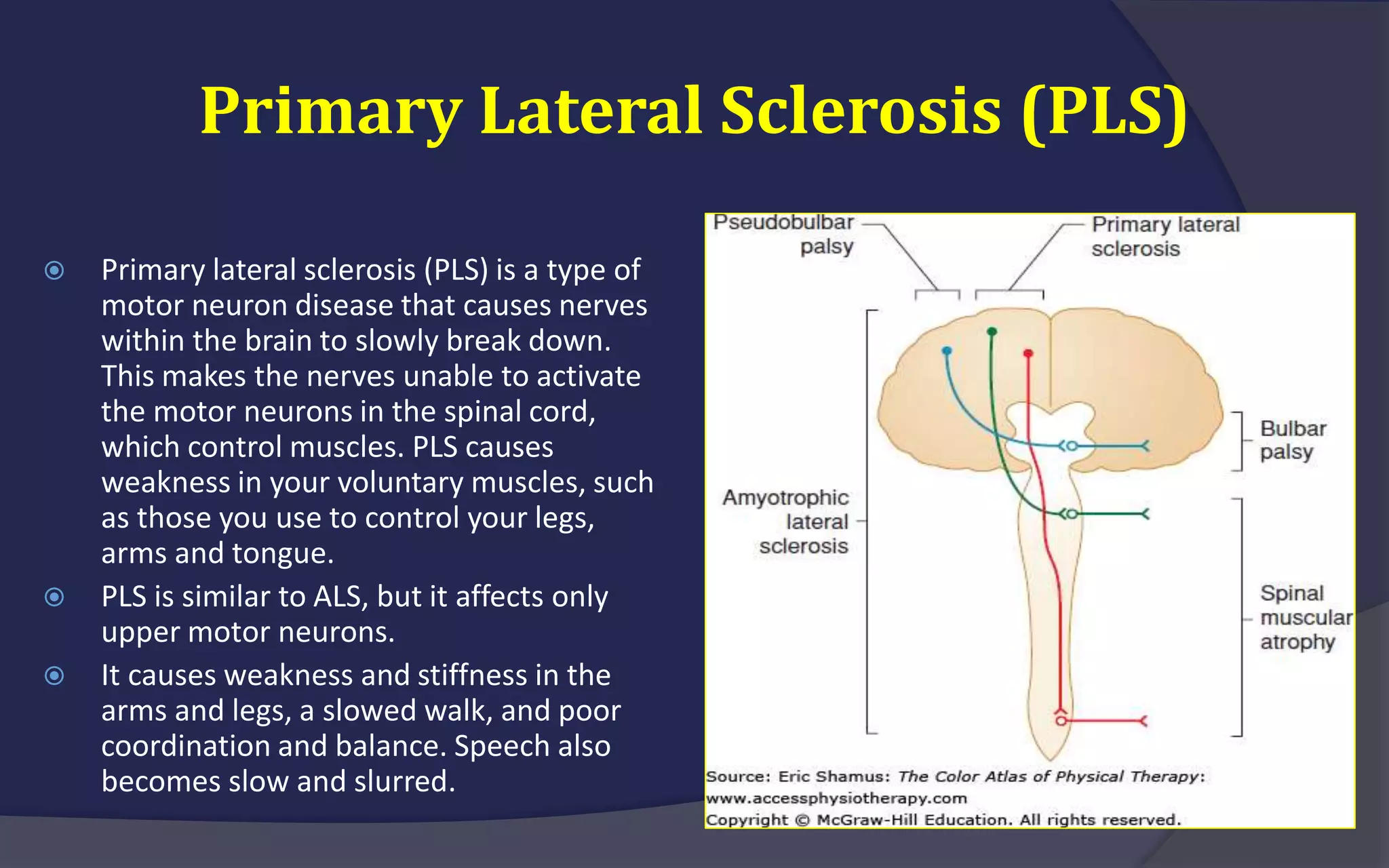
 Primary lateral sclerosis (PLS) is a type of
motor neuron disease that causes nerves
within the brain to slowly break down.
This makes the nerves unable to activate
the motor neurons in the spinal cord,
which control muscles. PLS causes
weakness in your voluntary muscles, such
as those you use to control your legs,
arms and tongue.
 PLS is similar to ALS, but it affects only
upper motor neurons.
 It causes weakness and stiffness in the
arms and legs, a slowed walk, and poor
coordination and balance. Speech also
becomes slow and slurred.
Primary Lateral Sclerosis (PLS)
 Like ALS, it usually starts in people 40 to 60
years old. The muscles get stiffer and weaker
over time. But unlike ALS, people don't die
from it.
 Stiffness, weakness and muscle spasms
(spasticity) in your legs, often starting in one
leg
 Tripping, difficulty with balance and clumsiness
as the leg muscles weaken
 Weakness and stiffness progressing to your
trunk, then your arms, hands, tongue and jaw
 Hoarseness, as well as slowed, slurred speech
and drooling as the facial muscles weaken
 Difficulties with swallowing and occasionally
breathing late in the disease.
Progressive Bulbar Palsy (PBP)
 This is a form of ALS. Many people with
this condition will eventually develop
ALS.
 PBP damages motor neurons in the
brain stem, which is at the base of your
brain.
 The stem has motor neurons that help
you chew, swallow, and speak. With
PBP, you might slur your words and
have trouble chewing and swallowing.
It also makes it hard to control
emotions. You may laugh or cry
without meaning to.
Progressive Bulbar Palsy (PBP)
 Pharyngeal muscle weakness
(affects swallowing)
 Weak jaw and facial muscles
 Progressive loss of speech
 Tongue muscle atrophy
 Weak limbs
Pseudobulbar Palsy
 Pseudobulbar palsy caused by lesions
of the upper motor neuron fibers in
the corticobulbar pathways, as
opposed to bulbar palsy, which is
caused by lesions of the brainstem or
lower motor neurons.
 Patients with pseudobulbar affect
exhibit bouts of crying or laughter
that are not associated with
underlying feelings of sadness or
happiness. Pseudobulbar affect has
also been termed pathological
laughing or crying.
Dysarthria
 Dysarthria is a condition in which the
muscles you use for speech are weak
or you have difficulty controlling them.
Dysarthria often is characterized by
slurred or slow speech that can be
difficult to understand.
 Common causes of dysarthria include
nervous system (neurological)
disorders such as stroke, brain injury,
brain tumors, and conditions that
cause facial paralysis or tongue or
throat muscle weakness
Dysphagia
 Dysphagia is the medical term for
swallowing difficulties.
 Some people with dysphagia have
problems swallowing certain foods or
liquids, while others can't swallow at
all.
 Other signs of dysphagia include:
 coughing or choking when eating or
drinking
 bringing food back up, sometimes
through the nose
 a sensation that food is stuck in your
throat or chest
 persistent drooling of saliva
Progressive Muscular Atrophy (PMA)
 Most patients with PMA have a course
indistinguishable from that of patients
with classic ALS. However, some
patients may have a longer course,
particularly those with flail arm or flail
leg syndrome.
 PMA is considerably a form of
ALS.Review of the medical records of
91 patients with PMA and 871 with ALS
showed that patients with PMA were
more likely to be male, to be older, and
to live longer than those with ALS, but
risk of death increased with age at
onset in both patient groups.
Spinal Muscular Atrophy
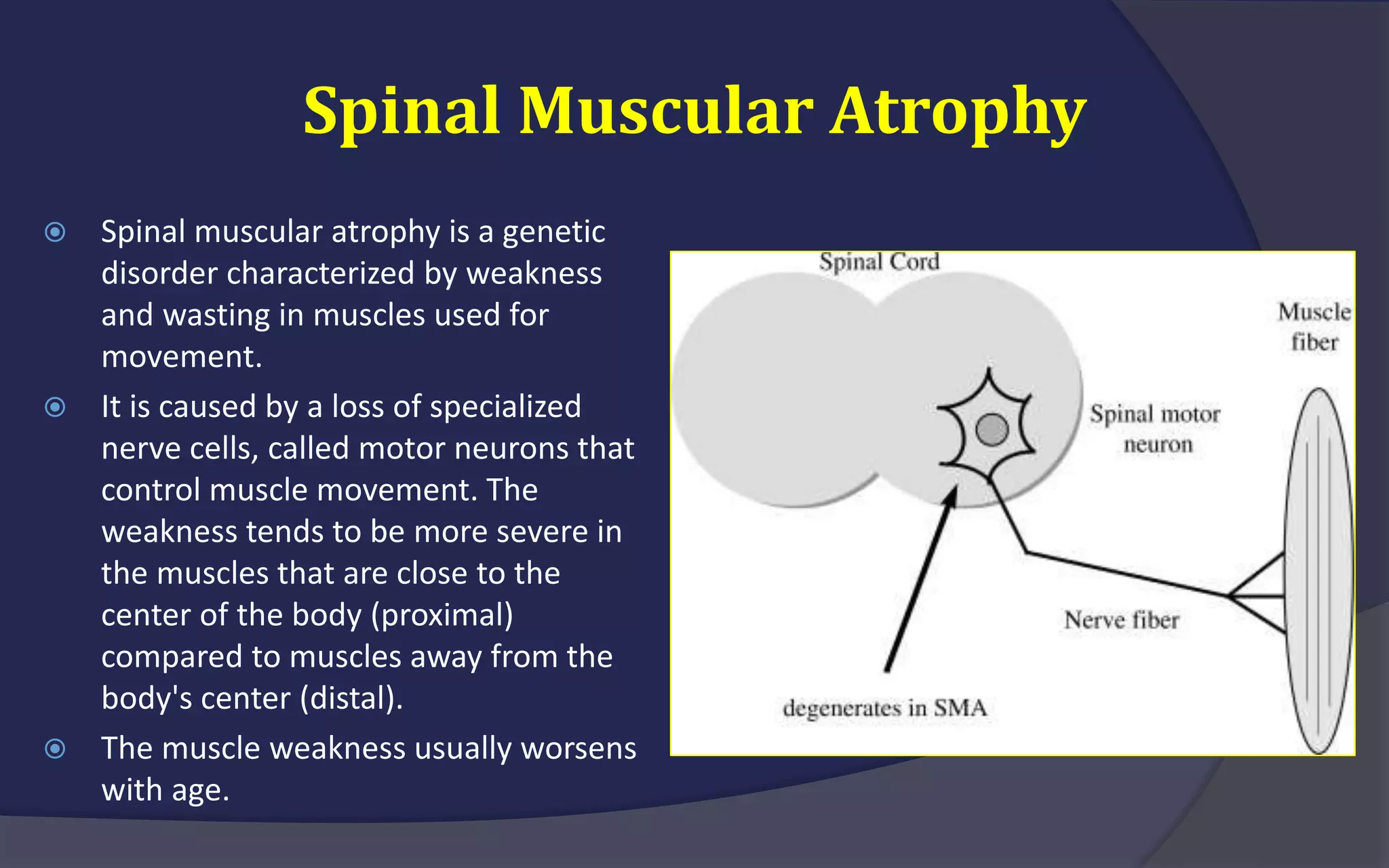
 Spinal muscular atrophy is a genetic
disorder characterized by weakness
and wasting in muscles used for
movement.
 It is caused by a loss of specialized
nerve cells, called motor neurons that
control muscle movement. The
weakness tends to be more severe in
the muscles that are close to the
center of the body (proximal)
compared to muscles away from the
body's center (distal).
 The muscle weakness usually worsens
with age.
Spinal Muscular Atrophy
 muscle weakness and
decreased muscle tone.
 limited mobility.
 breathing problems.
 problems eating and swallowing.
 delayed gross motor skills.
 spontaneous tongue movements.
 scoliosis (curvature of the spine)
Death of a Neuron
 Neurons are the longest living cells in our
body, but their lives can take abnormal
turns. Some diseases of the brain are the
result of the unnatural deaths of neurons.
 - In Parkinson’s disease, neurons that
produce the neurotransmitter dopamine die
off in the basal ganglia, an area of the brain
that controls body movements. This causes
difficulty initiating movement.
 - In Huntington’s disease, a genetic
mutation causes over-production of a
neurotransmitter called glutamate, which
kills neurons in the basal ganglia. As a result,
people twist and writhe uncontrollably.
Death of a Neuron
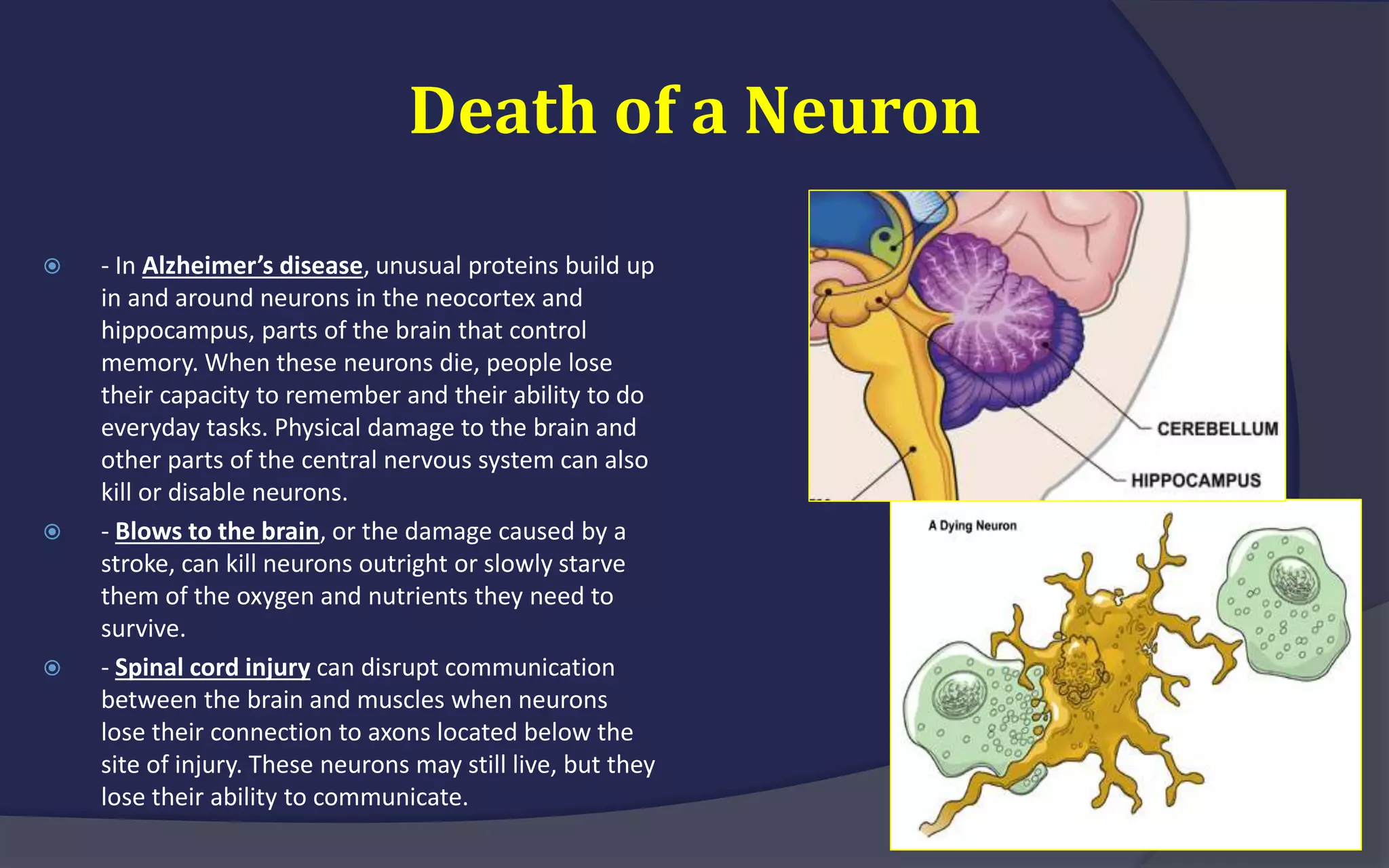
 - In Alzheimer’s disease, unusual proteins build up
in and around neurons in the neocortex and
hippocampus, parts of the brain that control
memory. When these neurons die, people lose
their capacity to remember and their ability to do
everyday tasks. Physical damage to the brain and
other parts of the central nervous system can also
kill or disable neurons.
 - Blows to the brain, or the damage caused by a
stroke, can kill neurons outright or slowly starve
them of the oxygen and nutrients they need to
survive.
 - Spinal cord injury can disrupt communication
between the brain and muscles when neurons
lose their connection to axons located below the
site of injury. These neurons may still live, but they
lose their ability to communicate.
Motor Neuron Diseases
Thank you for paying
attention.

Motor Neuron Diseases

  • 1.
    Motor Neuron Diseases Preparedby: Orlando A. Pistan, MAEd Psychology Instructor
  • 2.
    Motor Neuron Diseases Theyare a type of nerve cell, and their job is to send messages around your body so you can move. You have two main kinds:  Upper motor neurons are in your brain. They send messages from there to your spinal cord.  Lower motor neurons are in your spinal cord. They transmit messages sent from your brain to your muscles.
  • 3.
    Atrophy As nerve cellsdie when you have a motor neuron disease, electrical messages can't get from your brain to your muscles. Over time, your muscles waste away. When this happens, you lose control over movements. It gets harder to walk, talk, swallow, and breathe. Muscle atrophy is the wasting or loss of muscle tissue, especially as a result of the degeneration of cells.
  • 4.
    Amyotrophic Lateral Sclerosis(ALS)  ALS affects both your upper and lower motor neurons. With ALS, you gradually lose control over the muscles that help you walk, talk, chew, swallow, and breathe. Over time, they weaken and waste away. You may also have stiffness and twitches in your muscles.  It’s commonly known as Lou Gehrig’s disease, after the baseball player whose diagnosis and eventual death brought wide public attention to the illness.  Most of the time, ALS is what doctors call “sporadic.” This means anyone can get it.
  • 5.
    Amyotrophic Lateral Sclerosis(ALS)  ALS usually starts between the ages of 40 and 60. Most people with the disease live for 3 to 5 years after their symptoms start, yet some people can live for 10 years or longer.  Difficulty walking or doing normal daily activities  Tripping and falling  Weakness in your leg, feet or ankles  Hand weakness or clumsiness  Slurred speech or trouble swallowing  Muscle cramps and twitching in your arms, shoulders and tongue  Inappropriate crying, laughing or yawning  Cognitive and behavioral change
  • 6.
    Primary Lateral Sclerosis(PLS)  Primary lateral sclerosis (PLS) is a type of motor neuron disease that causes nerves within the brain to slowly break down. This makes the nerves unable to activate the motor neurons in the spinal cord, which control muscles. PLS causes weakness in your voluntary muscles, such as those you use to control your legs, arms and tongue.  PLS is similar to ALS, but it affects only upper motor neurons.  It causes weakness and stiffness in the arms and legs, a slowed walk, and poor coordination and balance. Speech also becomes slow and slurred.
  • 7.
    Primary Lateral Sclerosis(PLS)  Like ALS, it usually starts in people 40 to 60 years old. The muscles get stiffer and weaker over time. But unlike ALS, people don't die from it.  Stiffness, weakness and muscle spasms (spasticity) in your legs, often starting in one leg  Tripping, difficulty with balance and clumsiness as the leg muscles weaken  Weakness and stiffness progressing to your trunk, then your arms, hands, tongue and jaw  Hoarseness, as well as slowed, slurred speech and drooling as the facial muscles weaken  Difficulties with swallowing and occasionally breathing late in the disease.
  • 8.
    Progressive Bulbar Palsy(PBP)  This is a form of ALS. Many people with this condition will eventually develop ALS.  PBP damages motor neurons in the brain stem, which is at the base of your brain.  The stem has motor neurons that help you chew, swallow, and speak. With PBP, you might slur your words and have trouble chewing and swallowing. It also makes it hard to control emotions. You may laugh or cry without meaning to.
  • 9.
    Progressive Bulbar Palsy(PBP)  Pharyngeal muscle weakness (affects swallowing)  Weak jaw and facial muscles  Progressive loss of speech  Tongue muscle atrophy  Weak limbs
  • 10.
    Pseudobulbar Palsy  Pseudobulbarpalsy caused by lesions of the upper motor neuron fibers in the corticobulbar pathways, as opposed to bulbar palsy, which is caused by lesions of the brainstem or lower motor neurons.  Patients with pseudobulbar affect exhibit bouts of crying or laughter that are not associated with underlying feelings of sadness or happiness. Pseudobulbar affect has also been termed pathological laughing or crying.
  • 11.
    Dysarthria  Dysarthria isa condition in which the muscles you use for speech are weak or you have difficulty controlling them. Dysarthria often is characterized by slurred or slow speech that can be difficult to understand.  Common causes of dysarthria include nervous system (neurological) disorders such as stroke, brain injury, brain tumors, and conditions that cause facial paralysis or tongue or throat muscle weakness
  • 12.
    Dysphagia  Dysphagia isthe medical term for swallowing difficulties.  Some people with dysphagia have problems swallowing certain foods or liquids, while others can't swallow at all.  Other signs of dysphagia include:  coughing or choking when eating or drinking  bringing food back up, sometimes through the nose  a sensation that food is stuck in your throat or chest  persistent drooling of saliva
  • 13.
    Progressive Muscular Atrophy(PMA)  Most patients with PMA have a course indistinguishable from that of patients with classic ALS. However, some patients may have a longer course, particularly those with flail arm or flail leg syndrome.  PMA is considerably a form of ALS.Review of the medical records of 91 patients with PMA and 871 with ALS showed that patients with PMA were more likely to be male, to be older, and to live longer than those with ALS, but risk of death increased with age at onset in both patient groups.
  • 14.
    Spinal Muscular Atrophy Spinal muscular atrophy is a genetic disorder characterized by weakness and wasting in muscles used for movement.  It is caused by a loss of specialized nerve cells, called motor neurons that control muscle movement. The weakness tends to be more severe in the muscles that are close to the center of the body (proximal) compared to muscles away from the body's center (distal).  The muscle weakness usually worsens with age.
  • 15.
    Spinal Muscular Atrophy muscle weakness and decreased muscle tone.  limited mobility.  breathing problems.  problems eating and swallowing.  delayed gross motor skills.  spontaneous tongue movements.  scoliosis (curvature of the spine)
  • 16.
    Death of aNeuron  Neurons are the longest living cells in our body, but their lives can take abnormal turns. Some diseases of the brain are the result of the unnatural deaths of neurons.  - In Parkinson’s disease, neurons that produce the neurotransmitter dopamine die off in the basal ganglia, an area of the brain that controls body movements. This causes difficulty initiating movement.  - In Huntington’s disease, a genetic mutation causes over-production of a neurotransmitter called glutamate, which kills neurons in the basal ganglia. As a result, people twist and writhe uncontrollably.
  • 17.
    Death of aNeuron  - In Alzheimer’s disease, unusual proteins build up in and around neurons in the neocortex and hippocampus, parts of the brain that control memory. When these neurons die, people lose their capacity to remember and their ability to do everyday tasks. Physical damage to the brain and other parts of the central nervous system can also kill or disable neurons.  - Blows to the brain, or the damage caused by a stroke, can kill neurons outright or slowly starve them of the oxygen and nutrients they need to survive.  - Spinal cord injury can disrupt communication between the brain and muscles when neurons lose their connection to axons located below the site of injury. These neurons may still live, but they lose their ability to communicate.
  • 18.
    Motor Neuron Diseases Thankyou for paying attention.