Educational Psychology:
Theory and Practice
Chapter 10
Motivating Students to Learn
Organizing Questions
• What Is Motivation?
• What Are Some Theories of
Motivation?
• How Can Achievement
Motivation Be Enhanced?
• How Can Teachers Increase
Students’ Motivation to Learn?
Motivation
Definition: an internal process which
activates, guides, and maintains behavior
over time:
• Intensity and direction vary.
• Sources of motivation:
− Personality characteristic.
− Intrinsic characteristics of a task.
− Sources extrinsic to a task.
Motivation and Behavioral
Learning Theory
• Rewards and Reinforcement
‾ Inadequate to Explain Human
Motivation.
‾ Human Motivation is Highly
Complex and Context-Bound.
‾ Potential Reinforcers Determined
by Personal/Situational Factors.
‾ In Classrooms—it is Difficult to
Determine what Motivation Elicited
a Behavior
Maslow’s Hierarchy of
Needs
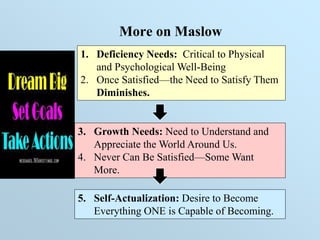
More on Maslow
1. Deficiency Needs: Critical to Physical
and Psychological Well-Being
2. Once Satisfied—the Need to Satisfy Them
Diminishes.
3. Growth Needs: Need to Understand and
Appreciate the World Around Us.
4. Never Can Be Satisfied—Some Want
More.
5. Self-Actualization: Desire to Become
Everything ONE is Capable of Becoming. .
Maslow and the Real Classroom
Teachers should do the following to Meet
the Needs Identified by Maslow:
1. Deficiency Needs Need to be Met BEFORE
Growth Needs can be Met.
2. Meet the Needs of Students—Cognitive and
Affective.
3. Nurture and Put Students at Ease.
4. Respect and Care for Students.
5. Realistic Expectations.
6. Teach with Passion.
Motivation and Attribution Theory
•Attribution Theory: deals with the ways
people explain success and failure.
• Characteristics for Explanations for
Success/ Failure:
1. Internal (within the Person) or
External.
2. Seen as Stable/Unstable.
3. Perceived as Controllable.
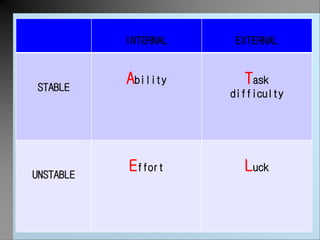
Attributions for Success and Failure
1. Ability—stable and internal.
2. Effort—can be altered and internal.
3. Task Difficulty—stable and external.
4. Luck—unstable and uncontrollable.
Locus of Control and Self-Efficacy
• Locus is LOCATION.
• Source of Success or Failure.
• Internal Locus of Control—Person Responsible
for Success/Failure.
• Self-Efficacy—Person’s Own Efforts.
• High Internal of Control Results in School Success.
OR
• External Locus of Control—Luck, task difficulty, or
Other People’s actions.
• Low Self-Efficacy Results in Limited School Success.
Implications of Attributions and Self-Efficacy for
Education
• Teacher Feedback Influences Students’ Self-
Perceptions.
• Consider HOW to Give Feedback that Builds Self-
Efficacy and Motivation.
• Praise Students for Effort Rather Than Intelligence.
Motivation and Self-Regulated Learning
• Self-Regulated Learning is Closely Related to
Students’ Goals.
• Highly Motivated Students :
‾ Plan Their Learning.
‾ Carry the Plan Out.
‾ Retain the Information.
• Source of Student Motivation:
‾ Social Modeling.
‾ Goal Setting.
‾ Feedback.
• Teacher Development of Engagement and
Investment in Learning Leads to Self-
Regulated Learning.
Giving Students Motivating Feedback
• Emphasize Effort rather than
Ability.
• Basis for Success is Progress at
Student’s Own Level.
• Effort should be Component of
Grading.
• Use of Rewards for Improvement.
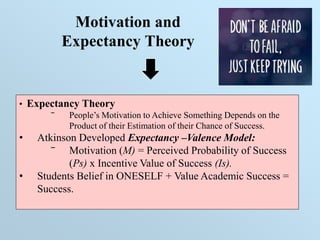
Motivation and
Expectancy Theory
• Expectancy Theory
‾ People’s Motivation to Achieve Something Depends on the
Product of their Estimation of their Chance of Success.
• Atkinson Developed Expectancy –Valence Model:
‾ Motivation (M) = Perceived Probability of Success
(Ps) x Incentive Value of Success (Is).
• Students Belief in ONESELF + Value Academic Success =
Success.
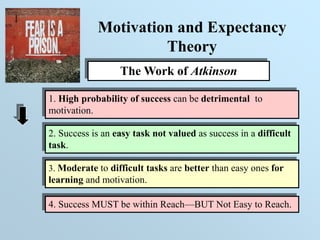
Motivation and Expectancy
Theory
The Work of Atkinson
1. High probability of success can be detrimental to
motivation.
2. Success is an easy task not valued as success in a difficult
task.
3. Moderate to difficult tasks are better than easy ones for
learning and motivation.
4. Success MUST be within Reach—BUT Not Easy to Reach.
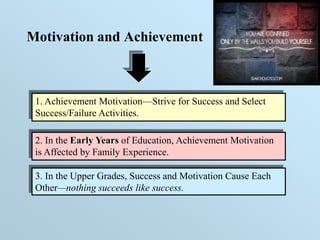
Motivation and Achievement
1. Achievement Motivation—Strive for Success and Select
Success/Failure Activities.
2. In the Early Years of Education, Achievement Motivation
is Affected by Family Experience.
3. In the Upper Grades, Success and Motivation Cause Each
Other—nothing succeeds like success.
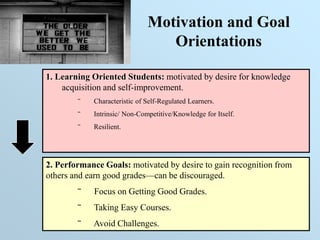
Motivation and Goal
Orientations
1. Learning Oriented Students: motivated by desire for knowledge
acquisition and self-improvement.
‾ Characteristic of Self-Regulated Learners.
‾ Intrinsic/ Non-Competitive/Knowledge for Itself.
‾ Resilient.
2. Performance Goals: motivated by desire to gain recognition from
others and earn good grades—can be discouraged.
‾ Focus on Getting Good Grades.
‾ Taking Easy Courses.
‾ Avoid Challenges.
Learned Helplessness
• Perception that No Matter What One Does, One is
Doomed to Failure/Ineffectuality.
• Caused from Inconsistent, Unpredictable Use of
Rewards and Punishments.
• Teachers can Help Students AVOID Learned
Helplessness by:
1. Convince Students of the Importance of Learning
over Grades.
2. Accentuate the Positive and Eliminate the Negative.
3. Experience Success in Small Steps.
4. Consistent, Feedback w/Clear Expectations.
5. Link New Knowledge to Old Knowledge.
Teacher Expectations and Achievement
• Students Live Up/Down to Teacher
Expectations.
• Communicate Positive Expectations.
• Utilize Wait Time—communicates High
Expectations.
• Keep Assessment/Test Results Private.
• Guard Against Bias—treat all Students
Equally.
Anxiety and Achievement
• Anxiety: a constant companion of education.
• Source: Fear of Failure + Loss of Self-Esteem.
Effects of Anxiety on Students:
1. Difficulty in Learning.
2. Difficulty in Transferring
Knowledge.
3. Self-Conscious in Performance
Settings.
4. Might Develop Math Anxiety.
Strategies to Reduce
Negative Impacts of Anxiety
Teachers should try to do the Following:
1. Create a Safe, Nurturing Classroom Environment.
2. Utilize Non-Competitive Instructional Strategies—
cooperative learning, individual progress rewarded
and Effort, not ability, is Emphasized.
3. Utilize Clear, Unambiguous Directions and
Expectations.
4. Provide Sufficient Time to Complete Tasks.
5. Utilize On-Going Assessment to help Plan
Appropriate Instruction.
6. Differentiate Instruction.
7. Provide Choice in the Selection of Assignments.
Intrinsic & Extrinsic
Motivation
Intrinsic Incentives: activity people enjoy and therefore find motivating and
fulfilling.
• Future Time Perspective: completing things now might bring benefit in the
future—can delay the reward.
• Students with intrinsic motivation want to learn without immediate incentives.
• Teachers should be Realistic and TRY to Make Learning Intrinsically satisfying.
• Teachers Should NOT Refrain from Using Extrinsic Awards when Needed.
Extrinsic Incentives: reward is external to the activity
• Necessary when material is not intrinsically interesting (grades, praise, or
other rewards).
Impact of Rewards on Motivation
• Avoid Promising Extrinsic Rewards for
Activities that ARE Already Intrinsically
Interesting.
• Intrinsic Motivation Generally Declines from
Early Elementary School through Secondary
School.
• Rewards Should be Contingent on the Quality of
Performance Rather than on the Participation in
an Activity.
• Strategic Use of BOTH Intrinsic and Extrinsic
Motivators is Necessary in Most Learning
Situations.
Enhancing Intrinsic Motivation
• Get students interested in the material by using Exciting
Motivations in Lessons.
• Present Lessons in an Organized and Appealing way.
• Maintain Engagement in Lessons by Using Enactive
Learning and
Together w/ Activities that Require Critical Thinking.
• Utilize a Variety of Presentation Modes—Embedded Video,
Discussions, Cooperative Learning, Animations, Podcasts.
• Know Students so that You can Utilize Instruction that Taps
into
their Interests and Learning Styles.
• Challenge Students’ Current Understanding of Concepts.
• Help Students Set their Own Realistic Goals.
Principles for Providing Extrinsic
Incentives to Learn
1. Express clear expectations: students should
know explicitly what is expected of them
2. Provide frequent, immediate and clear
feedback (specific praise, quizzes, asking questions,
etc.)
3. Increase the value and availability of extrinsic
motivators; reward and emphasize effort and
progress/ improvement over time—portfolios.
4. Teach Students to Praise Themselves—pat
themselves on the back.
Reflection
Based on the material in this
Chapter, how can Teachers
effectively motivate their
students?
Purpose of Praise:
1. Reinforce Appropriate Behavior
2. Provide Feedback to Students on what they are doing
RIGHT.
Using Praise Effectively
Praise is Effective to the extent
that it is:
1. Contingent.
2. Specific.
3. Credible.
4. Rewards should Neither be too
Easy Or Difficult to Obtain.
End of Chapter 10
SUPPLEMENTARY NOTES
Implications of Maslow’s Theory for Education
Physiological needs and Safety needs
Students who are very hungry or in physical danger will have little psychological
energy to put into learning.
Schools/ government agencies recognise that if students’ basic needs are not met,
learning will suffer. They have responded by providing free breakfast/ lunch
programmes.
Belongingness and love needs
Students who do not feel that they are loved and that they are capable are unlikely
to have a strong motivation to achieve the higher-level growth objectives.
Students who are unsure of their capabilities will tend to make a safe choice by
following the crowd e.g. study without interest in learning.
A teacher who can put students at ease and make them feel accepted/ respected as
individuals is more likely to help them become eager to learn for the sake of
learning and willing to risk being creative and open to new ideas.
Implications of Motivation and Attribution Theory
for Education
In classroom students receive constant information concerning their level
of performance on academic and feedback influences student’s
perception.
Attribution theory is important in helping teachers understand how
students might interpret and use feedback on their academic
performance.
Teachers should give feedback that has greatest motivational values
Implications of Motivation and Self-regulated
learning on Education
If students are to become self-directed learners they must believe that
teacher will respond fairly and consistently towards them that they will
not be ridiculed/ punished for honest errors.
Students who are highly motivated to learn something are more likely than
other students to consciously plan their learning, carry out a learning
plan and retain the information they obtain.
Students with high reading motivation will read on their own, use
effective comprehension strategies to build self-determination.
Motivation leads students to engage in self-regulated learning rather
than simply doing the work and following the rules.
Implications of Expectancy Theory for Education
The most important implication of expectancy theory is the common sense
proposition that tasks for students should be neither too easy nor too difficult.
If students believe that they are likely to get an ‘A’ no matter what they do, then
their motivation will not be at a maximum.
If students feel certain to fail no matter what they do, their motivation will be at
minimal .
Therefore, grading system should be set up so that earning an ‘A’ is difficult (but
possible) for as many students as feasible and so that earning a low grade is
possible for students who exert little effort.
A person’s motivation increases as task difficulty increases up to a point at
which the person decides that success is very unlikely or that the goal is not
worth the effort.
Moderate to difficult (but not impossible) tasks are better than easy ones for
learning and motivation.
Success must be within the reach but not easy reach of all students.
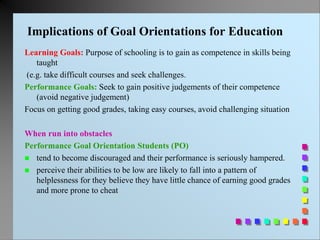
Implications of Goal Orientations for Education
Learning Goals: Purpose of schooling is to gain as competence in skills being
taught
(e.g. take difficult courses and seek challenges.
Performance Goals: Seek to gain positive judgements of their competence
(avoid negative judgement)
Focus on getting good grades, taking easy courses, avoid challenging situation
When run into obstacles
Performance Goal Orientation Students (PO)
 tend to become discouraged and their performance is seriously hampered.
 perceive their abilities to be low are likely to fall into a pattern of
helplessness for they believe they have little chance of earning good grades
and more prone to cheat
Implications of Goal Orientations for Education
Learning Goal Orientation Students (LO)
 tend to keep trying and their motivation and performance increase
 more likely to use metacognitive/ self-regulated learning strategies
 likely to learn more that PO students of the same abilities
 perceive their abilities to be low are concerned with how much the
themselves can learn without regard for the performance of others.
The most important implication of goal orientations is teachers should
convince students that learning is the purpose of academic work.
Using Praise Effectively
Contingent
Praise depends on student performance of well defined behaviour.
For example, if teacher says, “ I would like you all to open your books to page 92
and work problems one to ten,” then only give praise to the students who
follow directions.
Praise should be given only for appropriate behaviours.
Specificity
Praise students for specific behaviours, not for general “goodness.”
For example, you might say, “Susan, I am glad you followed my directions to start
work on your composition,’ rather than “Susan, you are doing great!”
Credible
Praise that is given sincerely to low-achieving/ disruptive students for good work.
Teachers often contradict their words with tone, posture or other nonverbal cues.
INTERNAL EXTERNAL
STABLE
Ability Task
difficulty
UNSTABLE
Effort Luck

Chapter 10 Motivating Students to Learn.
  • 1.
    Educational Psychology: Theory andPractice Chapter 10 Motivating Students to Learn
  • 2.
    Organizing Questions • WhatIs Motivation? • What Are Some Theories of Motivation? • How Can Achievement Motivation Be Enhanced? • How Can Teachers Increase Students’ Motivation to Learn?
  • 3.
    Motivation Definition: an internalprocess which activates, guides, and maintains behavior over time: • Intensity and direction vary. • Sources of motivation: − Personality characteristic. − Intrinsic characteristics of a task. − Sources extrinsic to a task.
  • 4.
    Motivation and Behavioral LearningTheory • Rewards and Reinforcement ‾ Inadequate to Explain Human Motivation. ‾ Human Motivation is Highly Complex and Context-Bound. ‾ Potential Reinforcers Determined by Personal/Situational Factors. ‾ In Classrooms—it is Difficult to Determine what Motivation Elicited a Behavior
  • 5.
  • 6.
    More on Maslow 1.Deficiency Needs: Critical to Physical and Psychological Well-Being 2. Once Satisfied—the Need to Satisfy Them Diminishes. 3. Growth Needs: Need to Understand and Appreciate the World Around Us. 4. Never Can Be Satisfied—Some Want More. 5. Self-Actualization: Desire to Become Everything ONE is Capable of Becoming. .
  • 7.
    Maslow and theReal Classroom Teachers should do the following to Meet the Needs Identified by Maslow: 1. Deficiency Needs Need to be Met BEFORE Growth Needs can be Met. 2. Meet the Needs of Students—Cognitive and Affective. 3. Nurture and Put Students at Ease. 4. Respect and Care for Students. 5. Realistic Expectations. 6. Teach with Passion.
  • 8.
    Motivation and AttributionTheory •Attribution Theory: deals with the ways people explain success and failure. • Characteristics for Explanations for Success/ Failure: 1. Internal (within the Person) or External. 2. Seen as Stable/Unstable. 3. Perceived as Controllable.
  • 9.
    Attributions for Successand Failure 1. Ability—stable and internal. 2. Effort—can be altered and internal. 3. Task Difficulty—stable and external. 4. Luck—unstable and uncontrollable.
  • 10.
    Locus of Controland Self-Efficacy • Locus is LOCATION. • Source of Success or Failure. • Internal Locus of Control—Person Responsible for Success/Failure. • Self-Efficacy—Person’s Own Efforts. • High Internal of Control Results in School Success. OR • External Locus of Control—Luck, task difficulty, or Other People’s actions. • Low Self-Efficacy Results in Limited School Success.
  • 11.
    Implications of Attributionsand Self-Efficacy for Education • Teacher Feedback Influences Students’ Self- Perceptions. • Consider HOW to Give Feedback that Builds Self- Efficacy and Motivation. • Praise Students for Effort Rather Than Intelligence.
  • 12.
    Motivation and Self-RegulatedLearning • Self-Regulated Learning is Closely Related to Students’ Goals. • Highly Motivated Students : ‾ Plan Their Learning. ‾ Carry the Plan Out. ‾ Retain the Information. • Source of Student Motivation: ‾ Social Modeling. ‾ Goal Setting. ‾ Feedback. • Teacher Development of Engagement and Investment in Learning Leads to Self- Regulated Learning.
  • 13.
    Giving Students MotivatingFeedback • Emphasize Effort rather than Ability. • Basis for Success is Progress at Student’s Own Level. • Effort should be Component of Grading. • Use of Rewards for Improvement.
  • 14.
    Motivation and Expectancy Theory •Expectancy Theory ‾ People’s Motivation to Achieve Something Depends on the Product of their Estimation of their Chance of Success. • Atkinson Developed Expectancy –Valence Model: ‾ Motivation (M) = Perceived Probability of Success (Ps) x Incentive Value of Success (Is). • Students Belief in ONESELF + Value Academic Success = Success.
  • 15.
    Motivation and Expectancy Theory TheWork of Atkinson 1. High probability of success can be detrimental to motivation. 2. Success is an easy task not valued as success in a difficult task. 3. Moderate to difficult tasks are better than easy ones for learning and motivation. 4. Success MUST be within Reach—BUT Not Easy to Reach.
  • 16.
    Motivation and Achievement 1.Achievement Motivation—Strive for Success and Select Success/Failure Activities. 2. In the Early Years of Education, Achievement Motivation is Affected by Family Experience. 3. In the Upper Grades, Success and Motivation Cause Each Other—nothing succeeds like success.
  • 17.
    Motivation and Goal Orientations 1.Learning Oriented Students: motivated by desire for knowledge acquisition and self-improvement. ‾ Characteristic of Self-Regulated Learners. ‾ Intrinsic/ Non-Competitive/Knowledge for Itself. ‾ Resilient. 2. Performance Goals: motivated by desire to gain recognition from others and earn good grades—can be discouraged. ‾ Focus on Getting Good Grades. ‾ Taking Easy Courses. ‾ Avoid Challenges.
  • 18.
    Learned Helplessness • Perceptionthat No Matter What One Does, One is Doomed to Failure/Ineffectuality. • Caused from Inconsistent, Unpredictable Use of Rewards and Punishments. • Teachers can Help Students AVOID Learned Helplessness by: 1. Convince Students of the Importance of Learning over Grades. 2. Accentuate the Positive and Eliminate the Negative. 3. Experience Success in Small Steps. 4. Consistent, Feedback w/Clear Expectations. 5. Link New Knowledge to Old Knowledge.
  • 19.
    Teacher Expectations andAchievement • Students Live Up/Down to Teacher Expectations. • Communicate Positive Expectations. • Utilize Wait Time—communicates High Expectations. • Keep Assessment/Test Results Private. • Guard Against Bias—treat all Students Equally.
  • 20.
    Anxiety and Achievement •Anxiety: a constant companion of education. • Source: Fear of Failure + Loss of Self-Esteem. Effects of Anxiety on Students: 1. Difficulty in Learning. 2. Difficulty in Transferring Knowledge. 3. Self-Conscious in Performance Settings. 4. Might Develop Math Anxiety.
  • 21.
    Strategies to Reduce NegativeImpacts of Anxiety Teachers should try to do the Following: 1. Create a Safe, Nurturing Classroom Environment. 2. Utilize Non-Competitive Instructional Strategies— cooperative learning, individual progress rewarded and Effort, not ability, is Emphasized. 3. Utilize Clear, Unambiguous Directions and Expectations. 4. Provide Sufficient Time to Complete Tasks. 5. Utilize On-Going Assessment to help Plan Appropriate Instruction. 6. Differentiate Instruction. 7. Provide Choice in the Selection of Assignments.
  • 22.
    Intrinsic & Extrinsic Motivation IntrinsicIncentives: activity people enjoy and therefore find motivating and fulfilling. • Future Time Perspective: completing things now might bring benefit in the future—can delay the reward. • Students with intrinsic motivation want to learn without immediate incentives. • Teachers should be Realistic and TRY to Make Learning Intrinsically satisfying. • Teachers Should NOT Refrain from Using Extrinsic Awards when Needed. Extrinsic Incentives: reward is external to the activity • Necessary when material is not intrinsically interesting (grades, praise, or other rewards).
  • 23.
    Impact of Rewardson Motivation • Avoid Promising Extrinsic Rewards for Activities that ARE Already Intrinsically Interesting. • Intrinsic Motivation Generally Declines from Early Elementary School through Secondary School. • Rewards Should be Contingent on the Quality of Performance Rather than on the Participation in an Activity. • Strategic Use of BOTH Intrinsic and Extrinsic Motivators is Necessary in Most Learning Situations.
  • 24.
    Enhancing Intrinsic Motivation •Get students interested in the material by using Exciting Motivations in Lessons. • Present Lessons in an Organized and Appealing way. • Maintain Engagement in Lessons by Using Enactive Learning and Together w/ Activities that Require Critical Thinking. • Utilize a Variety of Presentation Modes—Embedded Video, Discussions, Cooperative Learning, Animations, Podcasts. • Know Students so that You can Utilize Instruction that Taps into their Interests and Learning Styles. • Challenge Students’ Current Understanding of Concepts. • Help Students Set their Own Realistic Goals.
  • 25.
    Principles for ProvidingExtrinsic Incentives to Learn 1. Express clear expectations: students should know explicitly what is expected of them 2. Provide frequent, immediate and clear feedback (specific praise, quizzes, asking questions, etc.) 3. Increase the value and availability of extrinsic motivators; reward and emphasize effort and progress/ improvement over time—portfolios. 4. Teach Students to Praise Themselves—pat themselves on the back.
  • 26.
    Reflection Based on thematerial in this Chapter, how can Teachers effectively motivate their students?
  • 27.
    Purpose of Praise: 1.Reinforce Appropriate Behavior 2. Provide Feedback to Students on what they are doing RIGHT. Using Praise Effectively Praise is Effective to the extent that it is: 1. Contingent. 2. Specific. 3. Credible. 4. Rewards should Neither be too Easy Or Difficult to Obtain.
  • 28.
  • 29.
  • 30.
    Implications of Maslow’sTheory for Education Physiological needs and Safety needs Students who are very hungry or in physical danger will have little psychological energy to put into learning. Schools/ government agencies recognise that if students’ basic needs are not met, learning will suffer. They have responded by providing free breakfast/ lunch programmes. Belongingness and love needs Students who do not feel that they are loved and that they are capable are unlikely to have a strong motivation to achieve the higher-level growth objectives. Students who are unsure of their capabilities will tend to make a safe choice by following the crowd e.g. study without interest in learning. A teacher who can put students at ease and make them feel accepted/ respected as individuals is more likely to help them become eager to learn for the sake of learning and willing to risk being creative and open to new ideas.
  • 31.
    Implications of Motivationand Attribution Theory for Education In classroom students receive constant information concerning their level of performance on academic and feedback influences student’s perception. Attribution theory is important in helping teachers understand how students might interpret and use feedback on their academic performance. Teachers should give feedback that has greatest motivational values
  • 32.
    Implications of Motivationand Self-regulated learning on Education If students are to become self-directed learners they must believe that teacher will respond fairly and consistently towards them that they will not be ridiculed/ punished for honest errors. Students who are highly motivated to learn something are more likely than other students to consciously plan their learning, carry out a learning plan and retain the information they obtain. Students with high reading motivation will read on their own, use effective comprehension strategies to build self-determination. Motivation leads students to engage in self-regulated learning rather than simply doing the work and following the rules.
  • 33.
    Implications of ExpectancyTheory for Education The most important implication of expectancy theory is the common sense proposition that tasks for students should be neither too easy nor too difficult. If students believe that they are likely to get an ‘A’ no matter what they do, then their motivation will not be at a maximum. If students feel certain to fail no matter what they do, their motivation will be at minimal . Therefore, grading system should be set up so that earning an ‘A’ is difficult (but possible) for as many students as feasible and so that earning a low grade is possible for students who exert little effort. A person’s motivation increases as task difficulty increases up to a point at which the person decides that success is very unlikely or that the goal is not worth the effort. Moderate to difficult (but not impossible) tasks are better than easy ones for learning and motivation. Success must be within the reach but not easy reach of all students.
  • 34.
    Implications of GoalOrientations for Education Learning Goals: Purpose of schooling is to gain as competence in skills being taught (e.g. take difficult courses and seek challenges. Performance Goals: Seek to gain positive judgements of their competence (avoid negative judgement) Focus on getting good grades, taking easy courses, avoid challenging situation When run into obstacles Performance Goal Orientation Students (PO)  tend to become discouraged and their performance is seriously hampered.  perceive their abilities to be low are likely to fall into a pattern of helplessness for they believe they have little chance of earning good grades and more prone to cheat
  • 35.
    Implications of GoalOrientations for Education Learning Goal Orientation Students (LO)  tend to keep trying and their motivation and performance increase  more likely to use metacognitive/ self-regulated learning strategies  likely to learn more that PO students of the same abilities  perceive their abilities to be low are concerned with how much the themselves can learn without regard for the performance of others. The most important implication of goal orientations is teachers should convince students that learning is the purpose of academic work.
  • 36.
    Using Praise Effectively Contingent Praisedepends on student performance of well defined behaviour. For example, if teacher says, “ I would like you all to open your books to page 92 and work problems one to ten,” then only give praise to the students who follow directions. Praise should be given only for appropriate behaviours. Specificity Praise students for specific behaviours, not for general “goodness.” For example, you might say, “Susan, I am glad you followed my directions to start work on your composition,’ rather than “Susan, you are doing great!” Credible Praise that is given sincerely to low-achieving/ disruptive students for good work. Teachers often contradict their words with tone, posture or other nonverbal cues.
  • 37.