Copyright 2001 by Allyn and Bacon
Motivation: In Learning and
Teaching
Professor Dr. Bill Bauer
Chapter 10
EDUC 202
Copyright 2001 by Allyn and Bacon
Overview
What Is Motivation?
Four General Approaches to Motivation
Goal Orientation and Motivation
Interests and Motivation
Self-Schemas
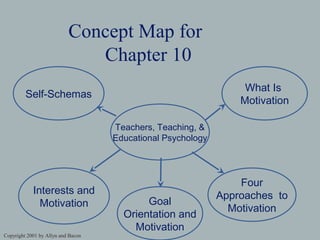
Concept Map for
Chapter 10
Four
Approaches to
Motivation
Self-Schemas
Interests and
Motivation Goal
Orientation and
Motivation
Teachers, Teaching, &
Educational Psychology
What Is
Motivation
Copyright 2001 by Allyn and Bacon
Motivation
Motivation defined:
Internal state
Arouses, directs, maintains behavior
Intrinsic / Extrinsic
Locus of causality
Copyright 2001 by Allyn and Bacon
Four General Approaches to
Motivation
Copyright 2001 by Allyn and Bacon
Behavioral Approach
Rewards are consequences of behaviors
Incentives encourage or discourage
behaviors
Copyright 2001 by Allyn and Bacon
Humanistic Approaches
Third force psychology
Emphasis on personal choice
Needs
Self-actualization / Self-determination
Maslow’s hierarchy
See Figure 10.1, Woolfolk, p. 371 and
Point▼Counterpoint p. 372
Copyright 2001 by Allyn and Bacon
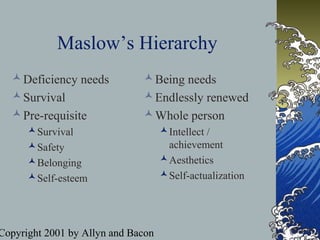
Deficiency needs
Survival
Pre-requisite
Survival
Safety
Belonging
Self-esteem
Being needs
Endlessly renewed
Whole person
Intellect /
achievement
Aesthetics
Self-actualization
Maslow’s Hierarchy
Copyright 2001 by Allyn and Bacon
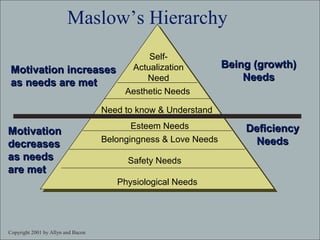
Maslow’s Hierarchy
Self-
Actualization
Need
Aesthetic Needs
Need to know & Understand
Esteem Needs
Belongingness & Love Needs
Safety Needs
Physiological Needs
Being (growth)Being (growth)
NeedsNeeds
DeficiencyDeficiency
NeedsNeeds
Motivation increasesMotivation increases
as needs are metas needs are met
MotivationMotivation
decreasesdecreases
as needsas needs
are metare met
Copyright 2001 by Allyn and Bacon
Cognitive Perspective
Focus on thinking
Emphasizes intrinsic motivation
People are active and curious
Plans, goals, schemas, and expectations
Copyright 2001 by Allyn and Bacon
Cognitive Perspective
Attribution theory
Perceived cause of successes or failures
Locus
Stability
Responsibility
Attributions in the classroom
Teacher actions influence student
attributions
Expectancy X Value Theory
Copyright 2001 by Allyn and Bacon
Attribution Theory
Copyright 2001 by Allyn and Bacon
Weiner’s Terms
Locus
Stability
Responsibility
Internal /
external
Stable / unstable
Controllable /
uncontrollable
Copyright 2001 by Allyn and Bacon
Examples of Attribution Theory
Internal locus, stable, controllable:
I am good at studying for multiple choice
tests, so I will do well on the next
Educational Psychology Exam.
Internal, stable, uncontrollable:
Essay tests are always hard for me, so I
won’t do well in American Literature.
Copyright 2001 by Allyn and Bacon
Sociocultural Conceptions of
Motivation
Emphasizes participation in communities
of practice
Legitimate peripheral participation
Relate to authentic tasks
See table 10.2, Woolfolk, p. 376 for a
comparison of all four approaches
Copyright 2001 by Allyn and Bacon
Goal Orientation and
Motivation
Copyright 2001 by Allyn and Bacon
Why Goals Improve
Performance
Direct attention to the task at hand
Mobilize effort
Increase persistence
Promote development of new strategies
Copyright 2001 by Allyn and Bacon
Four Kinds of Goals
Learning goals / task-involved
Performance goals / ego-involved
Work-avoidance goals
Social goals
The need for relatedness
They won’t care how much you know
until they know how much you care.
Copyright 2001 by Allyn and Bacon
Feedback & Goal Acceptance:
Effective Goals Are
Specific
Challenging
Attainable
Focused on the task
Supported by social relationships
Reinforced with feedback
Accepted by the student
See Family and Community
Partnerships, Woolfolk, p. 380
Copyright 2001 by Allyn and Bacon
Reflection Questions
What goal have you set for yourself
recently?
Did you follow good goal setting
principles?
How can you improve your personal goal
setting practices?
How does goal setting affect your
motivation?
Copyright 2001 by Allyn and Bacon
Interest and Emotions
Copyright 2001 by Allyn and Bacon
Interest and Emotions
Student interests linked with success in
school
Fantasy to stimulate challenge & interest
Ensure that ‘interesting details’ are
legitimately tied to learning
See Guidelines, Woolfolk, p. 382
Copyright 2001 by Allyn and Bacon
Arousal: Excitement & Anxiety
in Learning
Arousal: excitement, alertness, attention
Curiosity: novelty & complexity
Anxiety: uneasiness, tension, stress
Anxiety and effects on achievement
Coping with anxiety
Problem solving
Emotional management
Avoidance
Copyright 2001 by Allyn and Bacon
Implications for Teachers
Keep level of arousal right for learners
Sleepy students?
Introduce variety
Arouse curiosity
Surprise them
Wiggle break
See Guidelines, Woolfolk, p. 386
Copyright 2001 by Allyn and Bacon
Self-Schemas
Copyright 2001 by Allyn and Bacon
Beliefs about Ability
Entity view
Incremental view
Developmental differences
Effects on types of goals
Copyright 2001 by Allyn and Bacon
Beliefs about Self-Efficacy
Self-efficacy, self-concept, & self-esteem
Sources of self-efficacy
Mastery experiences
Vicarious experiences
Social persuasion
Efficacy and motivation
Teacher efficacy
Copyright 2001 by Allyn and Bacon
Beliefs about Self
Self-determination or other-determination
Classroom environment & self-
determination
Cognitive evaluation theory
Learned helplessness
Self-worth
Mastery-oriented
Failure-avoiding
Failure-accepting
Copyright 2001 by Allyn and Bacon
Reflection Questions
How will you deal with a student who is
exhibiting learned helplessness?
One of your students is avoiding failure
by not doing assignments. How will you
approach this challenge?
Copyright 2001 by Allyn and Bacon
Lessons for Teachers
Emphasize students’ progress
Make specific suggestions for improvement
Stress connection between effort &
accomplishment
Set learning goals for your students
Model mastery orientation
Copyright 2001 by Allyn and Bacon
Summary
What Is Motivation?
Four General Approaches to Motivation
Goal Orientation and Motivation
Interests and Motivation
Self-Schemas
Copyright 2001 by Allyn and Bacon
Review Questions
Define motivation.
What is the difference between intrinsic
and extrinsic motivation?
How does locus of causality apply to
motivation?
What are the key factors in motivation
according to a behavioral viewpoint?
Humanistic? Cognitive? Sociocultural?
Copyright 2001 by Allyn and Bacon
Review Questions
Distinguish between deficiency needs
and being needs in Maslow’s theory.
What are the three dimensions of
attribution in Weiner’s theory?
What are expectancy X value theories?
What is legitimate peripheral
participation?
What kinds of goals are most motivating?
Copyright 2001 by Allyn and Bacon
Review Questions
Describe learning, performance, work-
avoidance, and social goals.
What makes goal setting effective in the
classroom?
Do interests and emotions affect learning?
How?
What is the role of arousal in learning?
How does anxiety interfere with learning?
Copyright 2001 by Allyn and Bacon
Review Questions
How do beliefs about ability affect
motivation?
What is self-efficacy and how is it
different from other self-schemas?
What are the sources of self-efficacy and
how does efficacy affect motivation?
How does self-determination affect
motivation?
How does self-worth affect motivation?
Copyright 2001 by Allyn and Bacon
End Chapter 10

Motivation: In Learning and Teaching

  • 1.
    Copyright 2001 byAllyn and Bacon Motivation: In Learning and Teaching Professor Dr. Bill Bauer Chapter 10 EDUC 202
  • 2.
    Copyright 2001 byAllyn and Bacon Overview What Is Motivation? Four General Approaches to Motivation Goal Orientation and Motivation Interests and Motivation Self-Schemas
  • 3.
    Concept Map for Chapter10 Four Approaches to Motivation Self-Schemas Interests and Motivation Goal Orientation and Motivation Teachers, Teaching, & Educational Psychology What Is Motivation Copyright 2001 by Allyn and Bacon
  • 4.
    Copyright 2001 byAllyn and Bacon Motivation Motivation defined: Internal state Arouses, directs, maintains behavior Intrinsic / Extrinsic Locus of causality
  • 5.
    Copyright 2001 byAllyn and Bacon Four General Approaches to Motivation
  • 6.
    Copyright 2001 byAllyn and Bacon Behavioral Approach Rewards are consequences of behaviors Incentives encourage or discourage behaviors
  • 7.
    Copyright 2001 byAllyn and Bacon Humanistic Approaches Third force psychology Emphasis on personal choice Needs Self-actualization / Self-determination Maslow’s hierarchy See Figure 10.1, Woolfolk, p. 371 and Point▼Counterpoint p. 372
  • 8.
    Copyright 2001 byAllyn and Bacon Deficiency needs Survival Pre-requisite Survival Safety Belonging Self-esteem Being needs Endlessly renewed Whole person Intellect / achievement Aesthetics Self-actualization Maslow’s Hierarchy
  • 9.
    Copyright 2001 byAllyn and Bacon Maslow’s Hierarchy Self- Actualization Need Aesthetic Needs Need to know & Understand Esteem Needs Belongingness & Love Needs Safety Needs Physiological Needs Being (growth)Being (growth) NeedsNeeds DeficiencyDeficiency NeedsNeeds Motivation increasesMotivation increases as needs are metas needs are met MotivationMotivation decreasesdecreases as needsas needs are metare met Copyright 2001 by Allyn and Bacon
  • 10.
    Copyright 2001 byAllyn and Bacon Cognitive Perspective Focus on thinking Emphasizes intrinsic motivation People are active and curious Plans, goals, schemas, and expectations
  • 11.
    Copyright 2001 byAllyn and Bacon Cognitive Perspective Attribution theory Perceived cause of successes or failures Locus Stability Responsibility Attributions in the classroom Teacher actions influence student attributions Expectancy X Value Theory Copyright 2001 by Allyn and Bacon
  • 12.
    Copyright 2001 byAllyn and Bacon Attribution Theory
  • 13.
    Copyright 2001 byAllyn and Bacon Weiner’s Terms Locus Stability Responsibility Internal / external Stable / unstable Controllable / uncontrollable
  • 14.
    Copyright 2001 byAllyn and Bacon Examples of Attribution Theory Internal locus, stable, controllable: I am good at studying for multiple choice tests, so I will do well on the next Educational Psychology Exam. Internal, stable, uncontrollable: Essay tests are always hard for me, so I won’t do well in American Literature.
  • 15.
    Copyright 2001 byAllyn and Bacon Sociocultural Conceptions of Motivation Emphasizes participation in communities of practice Legitimate peripheral participation Relate to authentic tasks See table 10.2, Woolfolk, p. 376 for a comparison of all four approaches
  • 16.
    Copyright 2001 byAllyn and Bacon Goal Orientation and Motivation
  • 17.
    Copyright 2001 byAllyn and Bacon Why Goals Improve Performance Direct attention to the task at hand Mobilize effort Increase persistence Promote development of new strategies
  • 18.
    Copyright 2001 byAllyn and Bacon Four Kinds of Goals Learning goals / task-involved Performance goals / ego-involved Work-avoidance goals Social goals The need for relatedness They won’t care how much you know until they know how much you care.
  • 19.
    Copyright 2001 byAllyn and Bacon Feedback & Goal Acceptance: Effective Goals Are Specific Challenging Attainable Focused on the task Supported by social relationships Reinforced with feedback Accepted by the student See Family and Community Partnerships, Woolfolk, p. 380
  • 20.
    Copyright 2001 byAllyn and Bacon Reflection Questions What goal have you set for yourself recently? Did you follow good goal setting principles? How can you improve your personal goal setting practices? How does goal setting affect your motivation?
  • 21.
    Copyright 2001 byAllyn and Bacon Interest and Emotions
  • 22.
    Copyright 2001 byAllyn and Bacon Interest and Emotions Student interests linked with success in school Fantasy to stimulate challenge & interest Ensure that ‘interesting details’ are legitimately tied to learning See Guidelines, Woolfolk, p. 382
  • 23.
    Copyright 2001 byAllyn and Bacon Arousal: Excitement & Anxiety in Learning Arousal: excitement, alertness, attention Curiosity: novelty & complexity Anxiety: uneasiness, tension, stress Anxiety and effects on achievement Coping with anxiety Problem solving Emotional management Avoidance
  • 24.
    Copyright 2001 byAllyn and Bacon Implications for Teachers Keep level of arousal right for learners Sleepy students? Introduce variety Arouse curiosity Surprise them Wiggle break See Guidelines, Woolfolk, p. 386
  • 25.
    Copyright 2001 byAllyn and Bacon Self-Schemas
  • 26.
    Copyright 2001 byAllyn and Bacon Beliefs about Ability Entity view Incremental view Developmental differences Effects on types of goals
  • 27.
    Copyright 2001 byAllyn and Bacon Beliefs about Self-Efficacy Self-efficacy, self-concept, & self-esteem Sources of self-efficacy Mastery experiences Vicarious experiences Social persuasion Efficacy and motivation Teacher efficacy
  • 28.
    Copyright 2001 byAllyn and Bacon Beliefs about Self Self-determination or other-determination Classroom environment & self- determination Cognitive evaluation theory Learned helplessness Self-worth Mastery-oriented Failure-avoiding Failure-accepting
  • 29.
    Copyright 2001 byAllyn and Bacon Reflection Questions How will you deal with a student who is exhibiting learned helplessness? One of your students is avoiding failure by not doing assignments. How will you approach this challenge?
  • 30.
    Copyright 2001 byAllyn and Bacon Lessons for Teachers Emphasize students’ progress Make specific suggestions for improvement Stress connection between effort & accomplishment Set learning goals for your students Model mastery orientation
  • 31.
    Copyright 2001 byAllyn and Bacon Summary What Is Motivation? Four General Approaches to Motivation Goal Orientation and Motivation Interests and Motivation Self-Schemas
  • 32.
    Copyright 2001 byAllyn and Bacon Review Questions Define motivation. What is the difference between intrinsic and extrinsic motivation? How does locus of causality apply to motivation? What are the key factors in motivation according to a behavioral viewpoint? Humanistic? Cognitive? Sociocultural?
  • 33.
    Copyright 2001 byAllyn and Bacon Review Questions Distinguish between deficiency needs and being needs in Maslow’s theory. What are the three dimensions of attribution in Weiner’s theory? What are expectancy X value theories? What is legitimate peripheral participation? What kinds of goals are most motivating?
  • 34.
    Copyright 2001 byAllyn and Bacon Review Questions Describe learning, performance, work- avoidance, and social goals. What makes goal setting effective in the classroom? Do interests and emotions affect learning? How? What is the role of arousal in learning? How does anxiety interfere with learning?
  • 35.
    Copyright 2001 byAllyn and Bacon Review Questions How do beliefs about ability affect motivation? What is self-efficacy and how is it different from other self-schemas? What are the sources of self-efficacy and how does efficacy affect motivation? How does self-determination affect motivation? How does self-worth affect motivation?
  • 36.
    Copyright 2001 byAllyn and Bacon End Chapter 10