ELEMENTS /COMPONENTS
OF EDUCATIVE PROCESS
ELEMENTS/COMPONENTS OF
EDUCATIVE PROCESS
• Teacher
• The Learner
• The Content/Teaching Strategies
• The Learning Environment
• The Curriculum
• The Instructional Materials
• The Administration
THE CURRICULUM
THE
CURRICULUM
is the totality of activities
carried out under the auspices of
a school, in response to societal
demands.
Curriculum embraces all
experiences which children have
under the administration of the
school.
Curriculum is a combination of
classroom and out-of-classroom
activities.
Palma (1982) – Basic infrastructure
of a schools educational program.
Garcia (1973) –the collection of
learning experiences proposed as a
result of deliberation for student
attainment.
THE
CURRICULUM
THE
CURRICULUM TYPES OF CURRICULUM
1. FORMAL CURRICULUM
 sometimes referred to as the Intended or
Official Curriculum
 describes a deliberately planned
programme of activities which educational
institutions provide for learners for a
specified period of time to attain specified
objectives.
THE
CURRICULUM
2. CORE CURRICULUM
 refers to those aspects of curriculum required
of all the students as opposed to those
which are electives.
3. SCHOOL CURRICULUM
 is the most popular form of formal curriculum
refers to all the subjects offered by an
educational institution.
TYPES OF CURRICULUM
THE
CURRICULUM TYPES OF CURRICULUM
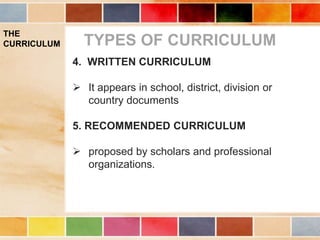
4. WRITTEN CURRICULUM
 It appears in school, district, division or
country documents
5. RECOMMENDED CURRICULUM
 proposed by scholars and professional
organizations.
THE
CURRICULUM TYPES OF CURRICULUM
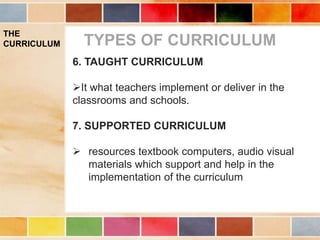
6. TAUGHT CURRICULUM
It what teachers implement or deliver in the
classrooms and schools.
7. SUPPORTED CURRICULUM
 resources textbook computers, audio visual
materials which support and help in the
implementation of the curriculum
THE
CURRICULUM TYPES OF CURRICULUM
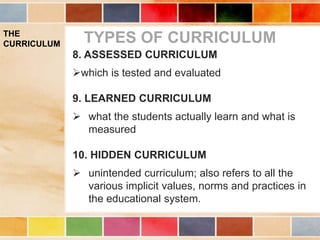
8. ASSESSED CURRICULUM
which is tested and evaluated
9. LEARNED CURRICULUM
 what the students actually learn and what is
measured
10. HIDDEN CURRICULUM
 unintended curriculum; also refers to all the
various implicit values, norms and practices in
the educational system.
THE
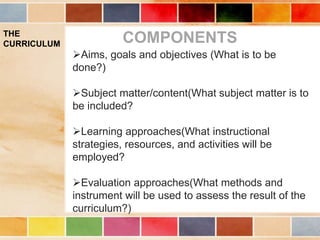
CURRICULUM COMPONENTS
Aims, goals and objectives (What is to be
done?)
Subject matter/content(What subject matter is to
be included?
Learning approaches(What instructional
strategies, resources, and activities will be
employed?
Evaluation approaches(What methods and
instrument will be used to assess the result of the
curriculum?)
THE
CURRICULUM Criteria of A Good Curriculum
1. The curriculum is continuously evolving.
2. Is based on the needs of the people-
begin w/ those that concern the people
themselves. We plan the curriculum with
people.
3. It is democratically conceived- “Two
heads are better than one”.
4. Is the result of long-term effort
5. A complex in details
THE
CURRICULUM
6. Provides for the logical sequence of subject
matter
7. Complements and cooperates with other
programs in the community
8. Has educational quality
9. Has administrative flexibity
Criteria of A Good Curriculum
THE INSTRUCTIONAL
MATERIALS
THE
INSTRUCTIONAL
MATERIALS These are devices that assist the
facilitator/teacher in the teaching-learning
process. It is not self-supporting; they are
supplementary training devices.
Are the materials that are designed for
use by pupils and their teachers as a
learning resource and help pupils to acquire
facts, skills, or opinions or to develop
cognitive processes.
THE
INSTRUCTIONAL
MATERIALS Instructional materials may be printed or non-
printed, and may include textbooks, technology-
based materials, other educational materials,
and tests.“
The educational resources used to improve
students’ knowledge, abilities, and skills, to
monitor their assimilation of information, and to
contribute to their overall development and
upbringing.
THE
INSTRUCTIONAL
MATERIALS
1. Concrete objects, including objects from the
world of nature;
2. Representations of concrete objects and
phenomena; and
3. Descriptions of such objects and phenomena
by means of the signs, words, and sentences
of natural and artificial languages.
3 BASIC TYPES OF
INSTRUCTIONAL MATERIALS
THE
INSTRUCTIONAL
MATERIALS
TYPES OF INSTRUCTIONAL MATERIALS
1. Concrete objects, including objects from
the world of nature
 Includes such objects and phenomena as
minerals, rocks, raw materials, semi-finished and
finished manufactured articles, and plant and
animal specimens;
 Also include reagents and apparatus for
producing chemical and other reactions and for
demonstrating and studying such reactions
during laboratory sessions.
THE
INSTRUCTIONAL
MATERIALS
TYPES OF INSTRUCTIONAL MATERIALS
2. Representations of concrete objects and
phenomena
 Are representations of actual objects and
phenomena, includes three-dimensional
Materials, two-dimensional materials, and
audiovisual materials
THE
INSTRUCTIONAL
MATERIALS
TYPES OF INSTRUCTIONAL MATERIALS
3. Representations of concrete objects and
phenomena
 Descriptions of such objects and phenomena
by means of the signs, words, and sentences of
natural and artificial languages.
THE
INSTRUCTIONAL
MATERIALS
Guidelines in Selecting
Instructional Materials
1. Do the materials give a true picture of the
ideas they present? To avoid
misconceptions
2. Do the materials contribute meaningful
content to the topic under study? Does the
material help you achieve the instructional
objective?
THE
INSTRUCTIONAL
MATERIALS
Guidelines in Selecting Instructional Materials
3. Is the material appropriate, it is always good
to ask when the materials was produced for
the age, intelligence and experience of the
learners?
4. Is the physical condition of the material
satisfactory? An example, is the microscope
properly working
THE
INSTRUCTIONAL
MATERIALS
Guidelines in Selecting Instructional Materials
5. Is there a teacher’s guide to provide for
effective use?
6. Can the materials in question help to make
students better thinkers and develop
their critical facilities?
7. Is the material worth the time, expense and
effort involved?
THE
INSTRUCTIONAL
MATERIALS
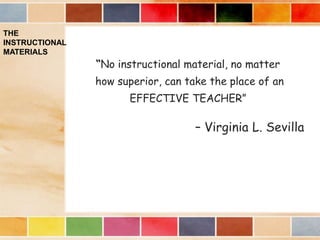
“No instructional material, no matter
how superior, can take the place of an
EFFECTIVE TEACHER”
– Virginia L. Sevilla
THE ADMINISTRATION
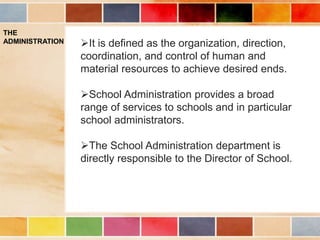
It is defined as the organization, direction,
coordination, and control of human and
material resources to achieve desired ends.
School Administration provides a broad
range of services to schools and in particular
school administrators.
The School Administration department is
directly responsible to the Director of School.
THE
ADMINISTRATION
THE
INSTRUCTIONAL
MATERIALS
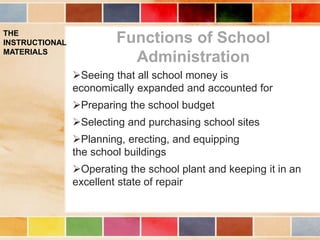
Seeing that all school money is
economically expanded and accounted for
Preparing the school budget
Selecting and purchasing school sites
Planning, erecting, and equipping
the school buildings
Operating the school plant and keeping it in an
excellent state of repair
Functions of School
Administration
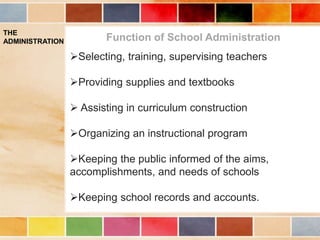
Function of School Administration
THE
ADMINISTRATION
Selecting, training, supervising teachers
Providing supplies and textbooks
 Assisting in curriculum construction
Organizing an instructional program
Keeping the public informed of the aims,
accomplishments, and needs of schools
Keeping school records and accounts.
Effective Strategies to Build a Community of
Learners
THE
ADMINISTRATION
1. Conducting an Interview
2. Dealing with difficult parents
3. Educational Leadership Philosophy
4. School Creed
5. School Gossip
6. School Improvement
Effective Strategies to Build a Community of
Learners
THE
ADMINISTRATION
7. School Leadership
8. School Pride
9. School Tragedy
10.Strategies for Hiring a Teacher
THE
ADMINISTRATION What Makes a School Administrator an
Effective School Leader?
Leadership is an essential component of a
school’s successes or failure.
The best schools will have an effective school
leader or group of leaders.
This is not an easy job, but many administrators
are experts at leading the various subgroups.
They can effectively work with and support every
person at the school.
THE
ADMINISTRATION What Makes a School Administrator an
Effective School Leader?
The administrator or School Principal should
be leading than managing
The administrator should be a leader not a
boss
The key to successful leadership today is
influence, not authority.
—Kenneth Blanchard
Presented by:
LOUISE C. INGCO
TEACH 1
Thank you!!!

Elements of educative process

  • 1.
  • 2.
    ELEMENTS/COMPONENTS OF EDUCATIVE PROCESS •Teacher • The Learner • The Content/Teaching Strategies • The Learning Environment • The Curriculum • The Instructional Materials • The Administration
  • 3.
  • 4.
    THE CURRICULUM is the totalityof activities carried out under the auspices of a school, in response to societal demands. Curriculum embraces all experiences which children have under the administration of the school.
  • 5.
    Curriculum is acombination of classroom and out-of-classroom activities. Palma (1982) – Basic infrastructure of a schools educational program. Garcia (1973) –the collection of learning experiences proposed as a result of deliberation for student attainment. THE CURRICULUM
  • 6.
    THE CURRICULUM TYPES OFCURRICULUM 1. FORMAL CURRICULUM  sometimes referred to as the Intended or Official Curriculum  describes a deliberately planned programme of activities which educational institutions provide for learners for a specified period of time to attain specified objectives.
  • 7.
    THE CURRICULUM 2. CORE CURRICULUM refers to those aspects of curriculum required of all the students as opposed to those which are electives. 3. SCHOOL CURRICULUM  is the most popular form of formal curriculum refers to all the subjects offered by an educational institution. TYPES OF CURRICULUM
  • 8.
    THE CURRICULUM TYPES OFCURRICULUM 4. WRITTEN CURRICULUM  It appears in school, district, division or country documents 5. RECOMMENDED CURRICULUM  proposed by scholars and professional organizations.
  • 9.
    THE CURRICULUM TYPES OFCURRICULUM 6. TAUGHT CURRICULUM It what teachers implement or deliver in the classrooms and schools. 7. SUPPORTED CURRICULUM  resources textbook computers, audio visual materials which support and help in the implementation of the curriculum
  • 10.
    THE CURRICULUM TYPES OFCURRICULUM 8. ASSESSED CURRICULUM which is tested and evaluated 9. LEARNED CURRICULUM  what the students actually learn and what is measured 10. HIDDEN CURRICULUM  unintended curriculum; also refers to all the various implicit values, norms and practices in the educational system.
  • 11.
    THE CURRICULUM COMPONENTS Aims, goalsand objectives (What is to be done?) Subject matter/content(What subject matter is to be included? Learning approaches(What instructional strategies, resources, and activities will be employed? Evaluation approaches(What methods and instrument will be used to assess the result of the curriculum?)
  • 12.
    THE CURRICULUM Criteria ofA Good Curriculum 1. The curriculum is continuously evolving. 2. Is based on the needs of the people- begin w/ those that concern the people themselves. We plan the curriculum with people. 3. It is democratically conceived- “Two heads are better than one”. 4. Is the result of long-term effort 5. A complex in details
  • 13.
    THE CURRICULUM 6. Provides forthe logical sequence of subject matter 7. Complements and cooperates with other programs in the community 8. Has educational quality 9. Has administrative flexibity Criteria of A Good Curriculum
  • 14.
  • 15.
    THE INSTRUCTIONAL MATERIALS These aredevices that assist the facilitator/teacher in the teaching-learning process. It is not self-supporting; they are supplementary training devices. Are the materials that are designed for use by pupils and their teachers as a learning resource and help pupils to acquire facts, skills, or opinions or to develop cognitive processes.
  • 16.
    THE INSTRUCTIONAL MATERIALS Instructional materialsmay be printed or non- printed, and may include textbooks, technology- based materials, other educational materials, and tests.“ The educational resources used to improve students’ knowledge, abilities, and skills, to monitor their assimilation of information, and to contribute to their overall development and upbringing.
  • 17.
    THE INSTRUCTIONAL MATERIALS 1. Concrete objects,including objects from the world of nature; 2. Representations of concrete objects and phenomena; and 3. Descriptions of such objects and phenomena by means of the signs, words, and sentences of natural and artificial languages. 3 BASIC TYPES OF INSTRUCTIONAL MATERIALS
  • 18.
    THE INSTRUCTIONAL MATERIALS TYPES OF INSTRUCTIONALMATERIALS 1. Concrete objects, including objects from the world of nature  Includes such objects and phenomena as minerals, rocks, raw materials, semi-finished and finished manufactured articles, and plant and animal specimens;  Also include reagents and apparatus for producing chemical and other reactions and for demonstrating and studying such reactions during laboratory sessions.
  • 19.
    THE INSTRUCTIONAL MATERIALS TYPES OF INSTRUCTIONALMATERIALS 2. Representations of concrete objects and phenomena  Are representations of actual objects and phenomena, includes three-dimensional Materials, two-dimensional materials, and audiovisual materials
  • 20.
    THE INSTRUCTIONAL MATERIALS TYPES OF INSTRUCTIONALMATERIALS 3. Representations of concrete objects and phenomena  Descriptions of such objects and phenomena by means of the signs, words, and sentences of natural and artificial languages.
  • 21.
    THE INSTRUCTIONAL MATERIALS Guidelines in Selecting InstructionalMaterials 1. Do the materials give a true picture of the ideas they present? To avoid misconceptions 2. Do the materials contribute meaningful content to the topic under study? Does the material help you achieve the instructional objective?
  • 22.
    THE INSTRUCTIONAL MATERIALS Guidelines in SelectingInstructional Materials 3. Is the material appropriate, it is always good to ask when the materials was produced for the age, intelligence and experience of the learners? 4. Is the physical condition of the material satisfactory? An example, is the microscope properly working
  • 23.
    THE INSTRUCTIONAL MATERIALS Guidelines in SelectingInstructional Materials 5. Is there a teacher’s guide to provide for effective use? 6. Can the materials in question help to make students better thinkers and develop their critical facilities? 7. Is the material worth the time, expense and effort involved?
  • 24.
    THE INSTRUCTIONAL MATERIALS “No instructional material,no matter how superior, can take the place of an EFFECTIVE TEACHER” – Virginia L. Sevilla
  • 25.
  • 26.
    It is definedas the organization, direction, coordination, and control of human and material resources to achieve desired ends. School Administration provides a broad range of services to schools and in particular school administrators. The School Administration department is directly responsible to the Director of School. THE ADMINISTRATION
  • 27.
    THE INSTRUCTIONAL MATERIALS Seeing that allschool money is economically expanded and accounted for Preparing the school budget Selecting and purchasing school sites Planning, erecting, and equipping the school buildings Operating the school plant and keeping it in an excellent state of repair Functions of School Administration
  • 28.
    Function of SchoolAdministration THE ADMINISTRATION Selecting, training, supervising teachers Providing supplies and textbooks  Assisting in curriculum construction Organizing an instructional program Keeping the public informed of the aims, accomplishments, and needs of schools Keeping school records and accounts.
  • 29.
    Effective Strategies toBuild a Community of Learners THE ADMINISTRATION 1. Conducting an Interview 2. Dealing with difficult parents 3. Educational Leadership Philosophy 4. School Creed 5. School Gossip 6. School Improvement
  • 30.
    Effective Strategies toBuild a Community of Learners THE ADMINISTRATION 7. School Leadership 8. School Pride 9. School Tragedy 10.Strategies for Hiring a Teacher
  • 31.
    THE ADMINISTRATION What Makesa School Administrator an Effective School Leader? Leadership is an essential component of a school’s successes or failure. The best schools will have an effective school leader or group of leaders. This is not an easy job, but many administrators are experts at leading the various subgroups. They can effectively work with and support every person at the school.
  • 32.
    THE ADMINISTRATION What Makesa School Administrator an Effective School Leader? The administrator or School Principal should be leading than managing The administrator should be a leader not a boss
  • 33.
    The key tosuccessful leadership today is influence, not authority. —Kenneth Blanchard
  • 34.
    Presented by: LOUISE C.INGCO TEACH 1 Thank you!!!