COMMUNICATION AND EDUCATION TECHNOLOGY
PRESENTATION
ON
MOTIVATION
Submitted To :-
Mrs. Priyanka Sinha
Mrs. Lehali Bala
Clinical Tutor
College of Nursing , RIMS , Ranchi
Submitted by;-
Shagufta Yasmin roll no.-
33
Nisha Kumari roll no.-14
Basic b.sc. Nursing - 2nd year
College of nursing
CONTENT :-
OBJECTIVE :-
INTRODUCTION :-
Motivation is an urge to behave or act in a way that satisfy certain
conditions, wishes, desires or goals.
Motivation is the reason for people’s action, willingness and goals.
It motivates people for better job performances and high productivity.
The term ‘MOTIVATION’ is derived from the latin word “MOVIRE”
meaning to move .
It is a result of interaction between external and internal behaviour
that arise enthusiasm and continuity to pursue a certain course of
action .
DEFINITION :-
• “ MOTIVATION refers to the states within a person or
animal that derives behaviour towards some goal.”
- MORGAN and KING
• “ The willingness to exert high level of effort towards
organisational goal, conditioned by efforts and ability
to satisfy some individual need.”
• - STEPHEN P. ROBBINS
• Motivation may be also defined as, “The complex of
forces inspiring a person at work in an organisation to
build his desire and willingness to use his
potentialities for achievements of organisational
objectives.”
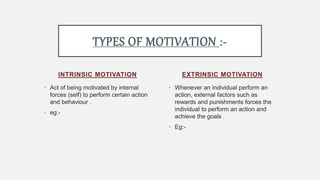
INTRINSIC MOTIVATION
• Act of being motivated by internal
forces (self) to perform certain action
and behaviour .
• eg:-
• Whenever an individual perform an
action, external factors such as
rewards and punishments forces the
individual to perform an action and
achieve the goals .
• Eg:-
EXTRINSIC MOTIVATION
TYPES OF MOTIVATION :-
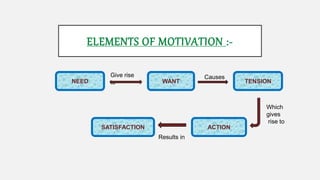
ELEMENTS OF MOTIVATION :-
Give rise
toNEED WANT TENSION
ACTIONSATISFACTION
Causes
Which
gives
rise to
Results in
CHARACTERISTICS OF MOTIVATION :-
• Complex
• Psychological
• Physical
• Unique to each and every person
• Context sensitive
QUALITIES OF MOTIVATION: -
Energises behaviour
Directs behaviour
Enables persistence towards
goal
Exists in varying details
10 MORALE BUILDING FACTORS :-
• Interesting work
• Full appreciation of work done
• Involvement
• Good pay
• Job security
• Promotion and growth
• Good working condition
• Loyality to employees
• Help with personal problems
• Tactful discipline
PRIMARY OR PHYSIOLOGICAL
NEEDS
Basic physiology – hunger, thirst,
breathe, sex, etc..
SECONDARY OR
PSYCHOLOGICAL NEEDS
NEEDS OF MOTIVATION :-
Since motivation is a cause and needs are elements of these cause. Needs have
been categorised in two forms : -
Power, achievements, status,
security, god and spirit, etc ;
rather than body.
As the basic or primary needs are satisfied, a person then seeks
for higher or secondary needs .
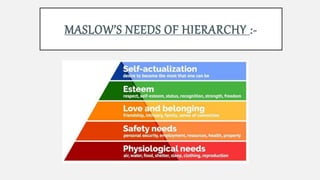
MASLOW’S NEEDS OF HIERARCHY :-
1. BASIC PHYSIOLOGICAL NEEDS :-
Food, drinks, shelter, sexual satisfaction and other bodily requirements.
2. SAFETY AND SECURITY :-
Need for safety and security of physical and emotional environment and
also free from threat to life.
3. LOVE AND BELONGINGNESS :-
A need to be accepted by peer, friendship and being part of a group.
4. SELF ESTEEM AND RESPECT :-
Opportunities for growth and advancement offer recognition, status,
challenges, merit pay, employee participation in making decisions .
5. SELF ACTUALISATION :-
Achieving ones potential, self fulfillness, accomplishment, self
improvement, improving others and society or becoming what one is capable of
becoming.
i.e. , “ BE ALL THAT YOU CAN BE ” .
PROCESS OF MOTIVATION :-
• Motivation is a series of steps that a motivator takes motivate the people in an organisation. The steps
are :-
1. It is required to determine purpose or objective . One cannot motivate someone in specific direction
without choosing the direction first.
2. Motivation needs to be empathetic. It is necessary because one can motivate the person only in
terms of the person’s need and not one’s own need.
3. Communication is important. Through communication only one can approach to motivate another
person.
4. Integrating intrests, relating organisation purpose to person’s need-want complex.
5. Provision of auxillary condition . It is motivator’s responsibilty to remove all possible obstacles that
hinders effective actions towards objectives.
6. Finally, exercising efforts to develop team work, integrating each employee’s goal seeking with the
actions of other employees so that there is coordinated group effort. This is operating aspect of
motivation.
Thus, the aforementioned ways motivator applies physiological realities in operating situations .
SELF- MOTIVATION STRATEGIES :-
• Take control of your expectations
• Learn to love the job you hate
• Fight the urge to underachieve
• Build immunity cynicism
• Strive to balance
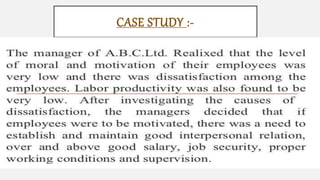
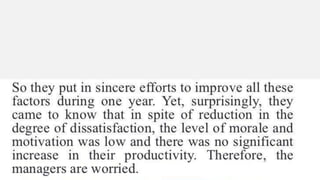
CASE STUDY :-
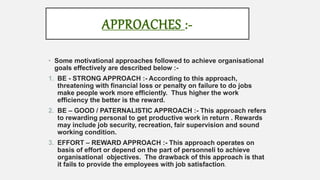
APPROACHES :-
• Some motivational approaches followed to achieve organisational
goals effectively are described below :-
1. BE - STRONG APPROACH :- According to this approach,
threatening with financial loss or penalty on failure to do jobs
make people work more efficiently. Thus higher the work
efficiency the better is the reward.
2. BE – GOOD / PATERNALISTIC APPROACH :- This approach refers
to rewarding personal to get productive work in return . Rewards
may include job security, recreation, fair supervision and sound
working condition.
3. EFFORT – REWARD APPROACH :- This approach operates on
basis of effort or depend on the part of personneli to achieve
organisational objectives. The drawback of this approach is that
it fails to provide the employees with job satisfaction.
REFERENCES :-
BIBLIOGRAPHY :-

Motivation

  • 1.
    COMMUNICATION AND EDUCATIONTECHNOLOGY PRESENTATION ON MOTIVATION Submitted To :- Mrs. Priyanka Sinha Mrs. Lehali Bala Clinical Tutor College of Nursing , RIMS , Ranchi Submitted by;- Shagufta Yasmin roll no.- 33 Nisha Kumari roll no.-14 Basic b.sc. Nursing - 2nd year College of nursing
  • 2.
  • 3.
  • 4.
    INTRODUCTION :- Motivation isan urge to behave or act in a way that satisfy certain conditions, wishes, desires or goals. Motivation is the reason for people’s action, willingness and goals. It motivates people for better job performances and high productivity. The term ‘MOTIVATION’ is derived from the latin word “MOVIRE” meaning to move . It is a result of interaction between external and internal behaviour that arise enthusiasm and continuity to pursue a certain course of action .
  • 5.
    DEFINITION :- • “MOTIVATION refers to the states within a person or animal that derives behaviour towards some goal.” - MORGAN and KING • “ The willingness to exert high level of effort towards organisational goal, conditioned by efforts and ability to satisfy some individual need.” • - STEPHEN P. ROBBINS • Motivation may be also defined as, “The complex of forces inspiring a person at work in an organisation to build his desire and willingness to use his potentialities for achievements of organisational objectives.”
  • 6.
    INTRINSIC MOTIVATION • Actof being motivated by internal forces (self) to perform certain action and behaviour . • eg:- • Whenever an individual perform an action, external factors such as rewards and punishments forces the individual to perform an action and achieve the goals . • Eg:- EXTRINSIC MOTIVATION TYPES OF MOTIVATION :-
  • 7.
    ELEMENTS OF MOTIVATION:- Give rise toNEED WANT TENSION ACTIONSATISFACTION Causes Which gives rise to Results in
  • 8.
    CHARACTERISTICS OF MOTIVATION:- • Complex • Psychological • Physical • Unique to each and every person • Context sensitive QUALITIES OF MOTIVATION: - Energises behaviour Directs behaviour Enables persistence towards goal Exists in varying details
  • 9.
    10 MORALE BUILDINGFACTORS :- • Interesting work • Full appreciation of work done • Involvement • Good pay • Job security • Promotion and growth • Good working condition • Loyality to employees • Help with personal problems • Tactful discipline
  • 10.
    PRIMARY OR PHYSIOLOGICAL NEEDS Basicphysiology – hunger, thirst, breathe, sex, etc.. SECONDARY OR PSYCHOLOGICAL NEEDS NEEDS OF MOTIVATION :- Since motivation is a cause and needs are elements of these cause. Needs have been categorised in two forms : - Power, achievements, status, security, god and spirit, etc ; rather than body. As the basic or primary needs are satisfied, a person then seeks for higher or secondary needs .
  • 11.
    MASLOW’S NEEDS OFHIERARCHY :-
  • 12.
    1. BASIC PHYSIOLOGICALNEEDS :- Food, drinks, shelter, sexual satisfaction and other bodily requirements. 2. SAFETY AND SECURITY :- Need for safety and security of physical and emotional environment and also free from threat to life. 3. LOVE AND BELONGINGNESS :- A need to be accepted by peer, friendship and being part of a group. 4. SELF ESTEEM AND RESPECT :- Opportunities for growth and advancement offer recognition, status, challenges, merit pay, employee participation in making decisions . 5. SELF ACTUALISATION :- Achieving ones potential, self fulfillness, accomplishment, self improvement, improving others and society or becoming what one is capable of becoming. i.e. , “ BE ALL THAT YOU CAN BE ” .
  • 13.
    PROCESS OF MOTIVATION:- • Motivation is a series of steps that a motivator takes motivate the people in an organisation. The steps are :- 1. It is required to determine purpose or objective . One cannot motivate someone in specific direction without choosing the direction first. 2. Motivation needs to be empathetic. It is necessary because one can motivate the person only in terms of the person’s need and not one’s own need. 3. Communication is important. Through communication only one can approach to motivate another person. 4. Integrating intrests, relating organisation purpose to person’s need-want complex. 5. Provision of auxillary condition . It is motivator’s responsibilty to remove all possible obstacles that hinders effective actions towards objectives. 6. Finally, exercising efforts to develop team work, integrating each employee’s goal seeking with the actions of other employees so that there is coordinated group effort. This is operating aspect of motivation. Thus, the aforementioned ways motivator applies physiological realities in operating situations .
  • 14.
    SELF- MOTIVATION STRATEGIES:- • Take control of your expectations • Learn to love the job you hate • Fight the urge to underachieve • Build immunity cynicism • Strive to balance
  • 15.
  • 17.
    APPROACHES :- • Somemotivational approaches followed to achieve organisational goals effectively are described below :- 1. BE - STRONG APPROACH :- According to this approach, threatening with financial loss or penalty on failure to do jobs make people work more efficiently. Thus higher the work efficiency the better is the reward. 2. BE – GOOD / PATERNALISTIC APPROACH :- This approach refers to rewarding personal to get productive work in return . Rewards may include job security, recreation, fair supervision and sound working condition. 3. EFFORT – REWARD APPROACH :- This approach operates on basis of effort or depend on the part of personneli to achieve organisational objectives. The drawback of this approach is that it fails to provide the employees with job satisfaction.
  • 18.
  • 19.