COMPETENCY BASED
EDUCATION
PRESENTED BY,
MRS. ARIFA T N
FIRST YEAR MSC NURSING
MIMS COLLEGE OF NURSING ,PUTHUKODE
INTRODUCTION
• There is quiet revolution at work in education
that started over 25 years ago.
• New directions for learning and being
advocated in all levels and types of education
• Increasing amount of information and new
technologies
• Increasing demands for accountability
• A major focus is a competency- based
approach to all levels and types of education
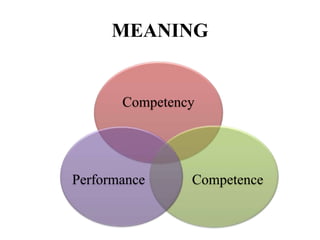
MEANING
Competency
CompetencePerformance
• Competency
– Focus on an individuals ability to perform activities
related to work, lifestyle skills , or learning
• Competence
– Describes actions or skills the person should be able
to demonstrate ,competence is concerned with
perceived skills and cannot be directly measured
• Performance
– Relate to specific behaviors that are measurable and
can reflect what workers actually do
COMPETETENCY BASED
EDUCATION
• Competetency based education (CBE) is
focused on outcomes (competencies) that are
linked to work force needs, as defined by
employers and the profession
DEFINITION
• Competency based education is defined as an
instructional system in which a performance
based learning process is used
• Competency based education is a combination
of the knowledge, attitudes and skills
necessary to meet a certain standard of practice
(Kelly 2002)
NEEDS
• Need as an evidence that any one who
compete a degree or course
• There is disconnection between education
and real world performance expectations
• To develop essential performance skills
• Prepare learners to function and be successful
• Accrediting and regulatory and professional
groups want assurance that completion of an
education endeavor
NEEDS
• Greater accountability for the cost and time
• Hiring of new workers
• For extensive learning programmes
• Regulatory, legal, external standards and quality
measures require demonstration of competencies
• Personal, professional development
• To advance their carriers and
• Make positive contributions to organization
PURPOSES
• It helps in instructing students by examples
• To understand skills when performing to the
standards required in employment
• To provide nursing care that clients require
• Safety and competency to ensure the
responsibilities necessary for public protection
• To provide safe and effective pracice
PRINCIPLES
PRINCIPLES
1. Responsibility
2. Assertiveness
3. Accountability
4. Authority
• Responsibility:
– The state or fact of having a duty to deal with
something or of having control over someone
• Assertiveness:
– Confident and forceful behavior
• Accountability:
– The fact or condition of being accountable;
responsibility
• Authority
– The power or right to give orders, make decisions,
and enforce obedience
LEVELS OF COMPETENCIES
Holistic
competencies
Integrated
competencies
Added competencies
Behavior competency
LEVELS OF COMPETENCIES
• Level 1: behavior competencies related to
operational work performance and have to
meet the demands of the work place
• Level 2 : added competencies based on
behavior and additional knowledge needed to
improve work
LEVELS OF COMPETENCIES
• Level 3: integrated competencies that
support change of internal and external
working conditions knowledge, skills and
understanding are integrated into external and
internal work conditions
• Level 4: it comprises holistic competencies
using different approaches to implementing
competency based programs- based on
identified needs
• Eg:
–Strategic direction developed by WHO to
improve the health for all , includes 5 key
interventions areas to improve nursing and
midwifery services.
1. Health and human recourse planning
2. Management of health personal
3. Practice and health system improvement
4. Education of nurses and midwifes
5. Leadership and governance
CHARACTERISTICS
• Acquisition of essential cognitive, psychomotor and
affective skill
• Continued development of skills
• Broadly based competency development derived from
the best professional evidence, current standards and
regulation
• Authentic assessments which are valid and reliable
• The use of adult learning principles
• Individual learning styles and abilities are recognized
and appreciate
ESSENTIAL ELEMENTS OF CBE
• Focus on outcome rather than processes
• Process is important when outcome is
considered
• Developed based on expectations
• Results are used to adjust the experiences
learner and promote competency in specific
areas
• Traditional and competency based
programmes (pass/ fail)
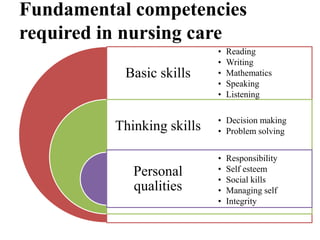
Fundamental competencies
required in nursing care
Basic skills
Thinking skills
Personal
qualities
• Reading
• Writing
• Mathematics
• Speaking
• Listening
• Decision making
• Problem solving
• Responsibility
• Self esteem
• Social kills
• Managing self
• Integrity
Fundamental competencies required
in nursing care
• Four basic competencies ( Evers, Rush And
Berdow 1998)
– Managing self
– Communicating
– Organizing innovation
– Managing change
DEVELOPING COMPETENCE
• Students
• Nurse educator
DEVELOPING COMPETENCE
• Students
– a nurse educator nourishes students efforts and
practice and expect success through
• Guided practice
• Feed back
• Role modeling
• Coaching
• Scaffolding of cognitive apprenticeship
DEVELOPING COMPETENCE
• Nurse educator
– Reflective practice and variety of experiences
• Clinical
• Laboratory
• Class
Qualities needed for both educator
and clinicians
• Quality assurance
• Accountability
• Dedication
• Good interpersonal
skills
• Professional affinity
• Accountability for
practice
• Bound by professional
regulations
• Adherence to safety
• Quality care
• People professionals
• Desire to help others
NURSE EDUCATOR
COMPETENCIES
Nurse educator competencies
• The council on collegiate education in nursing
an affiliate of the Southern regional education
board (SREB) developed abilities needed by
nurse educator using three roles
– Teacher
– Scholar
– Collaborator
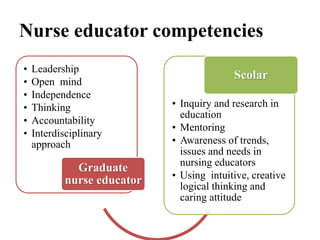
Nurse educator competencies
• Leadership
• Open mind
• Independence
• Thinking
• Accountability
• Interdisciplinary
approach
Graduate
nurse educator
• Inquiry and research in
education
• Mentoring
• Awareness of trends,
issues and needs in
nursing educators
• Using intuitive, creative
logical thinking and
caring attitude
Scolar
Nurse educator competencies
• Leadership
• Communication
• Negotiation
• Organization
• Change theories
• Problem solving
• Decision making
• Legislative and policy
development
Collaborator role
CORE COMPETENCIES
• Flensburg's framed group of 9 competencies
Core
competencie
s
Communication
skills Assessment and
intervention
skills
Computing
skills
Critical
thinking skills
Human caring
and
relationship
skills
Managing
skills
Leadership
skills
Teaching skills
Knowledge
integration
skills
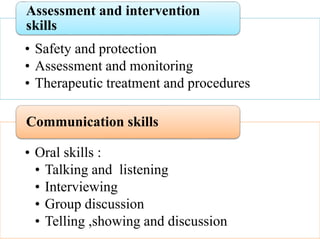
• Safety and protection
• Assessment and monitoring
• Therapeutic treatment and procedures
Assessment and intervention
skills
• Oral skills :
• Talking and listening
• Interviewing
• Group discussion
• Telling ,showing and discussion
Communication skills
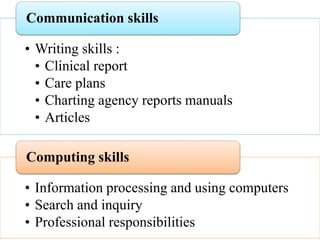
• Writing skills :
• Clinical report
• Care plans
• Charting agency reports manuals
• Articles
Communication skills
• Information processing and using computers
• Search and inquiry
• Professional responsibilities
Computing skills
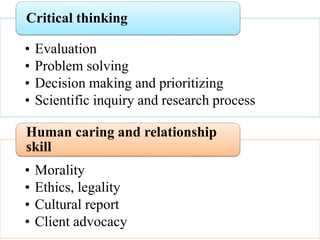
• Evaluation
• Problem solving
• Decision making and prioritizing
• Scientific inquiry and research process
Critical thinking
• Morality
• Ethics, legality
• Cultural report
• Client advocacy
Human caring and relationship
skill
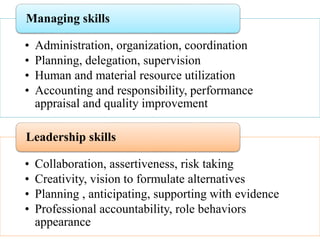
• Administration, organization, coordination
• Planning, delegation, supervision
• Human and material resource utilization
• Accounting and responsibility, performance
appraisal and quality improvement
Managing skills
• Collaboration, assertiveness, risk taking
• Creativity, vision to formulate alternatives
• Planning , anticipating, supporting with evidence
• Professional accountability, role behaviors
appearance
Leadership skills
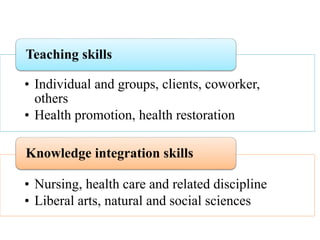
• Individual and groups, clients, coworker,
others
• Health promotion, health restoration
Teaching skills
• Nursing, health care and related discipline
• Liberal arts, natural and social sciences
Knowledge integration skills
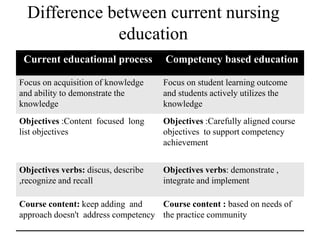
Difference between current nursing
education
Current educational process Competency based education
Focus on acquisition of knowledge
and ability to demonstrate the
knowledge
Focus on student learning outcome
and students actively utilizes the
knowledge
Objectives :Content focused long
list objectives
Objectives :Carefully aligned course
objectives to support competency
achievement
Objectives verbs: discus, describe
,recognize and recall
Objectives verbs: demonstrate ,
integrate and implement
Course content: keep adding and
approach doesn't address competency
Course content : based on needs of
the practice community
SUMMARY
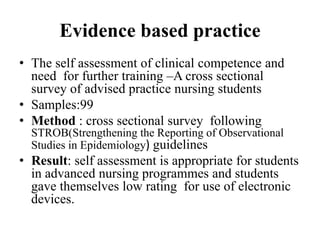
Evidence based practice
• The self assessment of clinical competence and
need for further training –A cross sectional
survey of advised practice nursing students
• Samples:99
• Method : cross sectional survey following
STROB(Strengthening the Reporting of Observational
Studies in Epidemiology) guidelines
• Result: self assessment is appropriate for students
in advanced nursing programmes and students
gave themselves low rating for use of electronic
devices.
CONCLUSION
ASSIGNMENT
• Write an assignment on quality measures
can be made in a nursing education
institution to improve the competency of
nursing students and nursing educator
and submit on 25/11/19
REFERENCES
1. SODHI. K, COMPREHENSIVE TEXT BOOK OF NURSING
EDUCATION.NEWDELHI;JAYPEE;2017.P.523-24
2. BASHEER P.TEXTBOOK OF NURSING EDUCATION
.EMMESS;NEWDELHI;2015.P.106-109
3. WIKIPEDIA.COMPETENCY
BASEDLEARNING.2019.HTTP://EN.W.WIKIPEDIA.ORG/WIKI/COMPE
TENCY BASED LEARNING
4. LOPEZ-ENTRAMBASAGUAR OM.ET.AL INT J ENVIRORS RES
PUBLIC HEALTH 2019.NEWLY QUALIFIED NURSES PERCEPTION
OF THEIR COMPETETENCY ACHEIVEMENTS ON LEAVING
UNIVERSITY;A QUALITATIVE STUDY
5. KURUVILA HM.ET.AL.NURSE EDU TODAY2019.HEALTH SCIENCES
STUDENT TEACHERS PERCEPTION OF TEACHER COMPETENCE; A
QUALITATIVE STUDY
6. SALLY.MJOHNSTONE&LOUISE SOARES.PRINCIPLES OF
DEVELOPING COMPETENCY BASED EDUCATION
PROGRAMMES.VOLUME46.2014.ISSUE(2)
THANK YOU

COMPETENCY BASED EDUCATION

  • 1.
    COMPETENCY BASED EDUCATION PRESENTED BY, MRS.ARIFA T N FIRST YEAR MSC NURSING MIMS COLLEGE OF NURSING ,PUTHUKODE
  • 2.
    INTRODUCTION • There isquiet revolution at work in education that started over 25 years ago. • New directions for learning and being advocated in all levels and types of education • Increasing amount of information and new technologies • Increasing demands for accountability • A major focus is a competency- based approach to all levels and types of education
  • 3.
  • 4.
    • Competency – Focuson an individuals ability to perform activities related to work, lifestyle skills , or learning • Competence – Describes actions or skills the person should be able to demonstrate ,competence is concerned with perceived skills and cannot be directly measured • Performance – Relate to specific behaviors that are measurable and can reflect what workers actually do
  • 5.
    COMPETETENCY BASED EDUCATION • Competetencybased education (CBE) is focused on outcomes (competencies) that are linked to work force needs, as defined by employers and the profession
  • 6.
    DEFINITION • Competency basededucation is defined as an instructional system in which a performance based learning process is used • Competency based education is a combination of the knowledge, attitudes and skills necessary to meet a certain standard of practice (Kelly 2002)
  • 7.
    NEEDS • Need asan evidence that any one who compete a degree or course • There is disconnection between education and real world performance expectations • To develop essential performance skills • Prepare learners to function and be successful • Accrediting and regulatory and professional groups want assurance that completion of an education endeavor
  • 8.
    NEEDS • Greater accountabilityfor the cost and time • Hiring of new workers • For extensive learning programmes • Regulatory, legal, external standards and quality measures require demonstration of competencies • Personal, professional development • To advance their carriers and • Make positive contributions to organization
  • 9.
    PURPOSES • It helpsin instructing students by examples • To understand skills when performing to the standards required in employment • To provide nursing care that clients require • Safety and competency to ensure the responsibilities necessary for public protection • To provide safe and effective pracice
  • 10.
  • 11.
  • 12.
    • Responsibility: – Thestate or fact of having a duty to deal with something or of having control over someone • Assertiveness: – Confident and forceful behavior • Accountability: – The fact or condition of being accountable; responsibility • Authority – The power or right to give orders, make decisions, and enforce obedience
  • 13.
  • 14.
  • 15.
    LEVELS OF COMPETENCIES •Level 1: behavior competencies related to operational work performance and have to meet the demands of the work place • Level 2 : added competencies based on behavior and additional knowledge needed to improve work
  • 16.
    LEVELS OF COMPETENCIES •Level 3: integrated competencies that support change of internal and external working conditions knowledge, skills and understanding are integrated into external and internal work conditions • Level 4: it comprises holistic competencies using different approaches to implementing competency based programs- based on identified needs
  • 17.
    • Eg: –Strategic directiondeveloped by WHO to improve the health for all , includes 5 key interventions areas to improve nursing and midwifery services. 1. Health and human recourse planning 2. Management of health personal 3. Practice and health system improvement 4. Education of nurses and midwifes 5. Leadership and governance
  • 18.
    CHARACTERISTICS • Acquisition ofessential cognitive, psychomotor and affective skill • Continued development of skills • Broadly based competency development derived from the best professional evidence, current standards and regulation • Authentic assessments which are valid and reliable • The use of adult learning principles • Individual learning styles and abilities are recognized and appreciate
  • 19.
    ESSENTIAL ELEMENTS OFCBE • Focus on outcome rather than processes • Process is important when outcome is considered • Developed based on expectations • Results are used to adjust the experiences learner and promote competency in specific areas • Traditional and competency based programmes (pass/ fail)
  • 20.
    Fundamental competencies required innursing care Basic skills Thinking skills Personal qualities • Reading • Writing • Mathematics • Speaking • Listening • Decision making • Problem solving • Responsibility • Self esteem • Social kills • Managing self • Integrity
  • 21.
    Fundamental competencies required innursing care • Four basic competencies ( Evers, Rush And Berdow 1998) – Managing self – Communicating – Organizing innovation – Managing change
  • 22.
  • 23.
    DEVELOPING COMPETENCE • Students –a nurse educator nourishes students efforts and practice and expect success through • Guided practice • Feed back • Role modeling • Coaching • Scaffolding of cognitive apprenticeship
  • 24.
    DEVELOPING COMPETENCE • Nurseeducator – Reflective practice and variety of experiences • Clinical • Laboratory • Class
  • 25.
    Qualities needed forboth educator and clinicians • Quality assurance • Accountability • Dedication • Good interpersonal skills • Professional affinity • Accountability for practice • Bound by professional regulations • Adherence to safety • Quality care • People professionals • Desire to help others
  • 26.
  • 27.
    Nurse educator competencies •The council on collegiate education in nursing an affiliate of the Southern regional education board (SREB) developed abilities needed by nurse educator using three roles – Teacher – Scholar – Collaborator
  • 28.
    Nurse educator competencies •Leadership • Open mind • Independence • Thinking • Accountability • Interdisciplinary approach Graduate nurse educator • Inquiry and research in education • Mentoring • Awareness of trends, issues and needs in nursing educators • Using intuitive, creative logical thinking and caring attitude Scolar
  • 29.
    Nurse educator competencies •Leadership • Communication • Negotiation • Organization • Change theories • Problem solving • Decision making • Legislative and policy development Collaborator role
  • 30.
    CORE COMPETENCIES • Flensburg'sframed group of 9 competencies
  • 31.
    Core competencie s Communication skills Assessment and intervention skills Computing skills Critical thinkingskills Human caring and relationship skills Managing skills Leadership skills Teaching skills Knowledge integration skills
  • 32.
    • Safety andprotection • Assessment and monitoring • Therapeutic treatment and procedures Assessment and intervention skills • Oral skills : • Talking and listening • Interviewing • Group discussion • Telling ,showing and discussion Communication skills
  • 33.
    • Writing skills: • Clinical report • Care plans • Charting agency reports manuals • Articles Communication skills • Information processing and using computers • Search and inquiry • Professional responsibilities Computing skills
  • 34.
    • Evaluation • Problemsolving • Decision making and prioritizing • Scientific inquiry and research process Critical thinking • Morality • Ethics, legality • Cultural report • Client advocacy Human caring and relationship skill
  • 35.
    • Administration, organization,coordination • Planning, delegation, supervision • Human and material resource utilization • Accounting and responsibility, performance appraisal and quality improvement Managing skills • Collaboration, assertiveness, risk taking • Creativity, vision to formulate alternatives • Planning , anticipating, supporting with evidence • Professional accountability, role behaviors appearance Leadership skills
  • 36.
    • Individual andgroups, clients, coworker, others • Health promotion, health restoration Teaching skills • Nursing, health care and related discipline • Liberal arts, natural and social sciences Knowledge integration skills
  • 37.
    Difference between currentnursing education Current educational process Competency based education Focus on acquisition of knowledge and ability to demonstrate the knowledge Focus on student learning outcome and students actively utilizes the knowledge Objectives :Content focused long list objectives Objectives :Carefully aligned course objectives to support competency achievement Objectives verbs: discus, describe ,recognize and recall Objectives verbs: demonstrate , integrate and implement Course content: keep adding and approach doesn't address competency Course content : based on needs of the practice community
  • 38.
  • 39.
    Evidence based practice •The self assessment of clinical competence and need for further training –A cross sectional survey of advised practice nursing students • Samples:99 • Method : cross sectional survey following STROB(Strengthening the Reporting of Observational Studies in Epidemiology) guidelines • Result: self assessment is appropriate for students in advanced nursing programmes and students gave themselves low rating for use of electronic devices.
  • 40.
  • 41.
    ASSIGNMENT • Write anassignment on quality measures can be made in a nursing education institution to improve the competency of nursing students and nursing educator and submit on 25/11/19
  • 42.
    REFERENCES 1. SODHI. K,COMPREHENSIVE TEXT BOOK OF NURSING EDUCATION.NEWDELHI;JAYPEE;2017.P.523-24 2. BASHEER P.TEXTBOOK OF NURSING EDUCATION .EMMESS;NEWDELHI;2015.P.106-109 3. WIKIPEDIA.COMPETENCY BASEDLEARNING.2019.HTTP://EN.W.WIKIPEDIA.ORG/WIKI/COMPE TENCY BASED LEARNING 4. LOPEZ-ENTRAMBASAGUAR OM.ET.AL INT J ENVIRORS RES PUBLIC HEALTH 2019.NEWLY QUALIFIED NURSES PERCEPTION OF THEIR COMPETETENCY ACHEIVEMENTS ON LEAVING UNIVERSITY;A QUALITATIVE STUDY 5. KURUVILA HM.ET.AL.NURSE EDU TODAY2019.HEALTH SCIENCES STUDENT TEACHERS PERCEPTION OF TEACHER COMPETENCE; A QUALITATIVE STUDY 6. SALLY.MJOHNSTONE&LOUISE SOARES.PRINCIPLES OF DEVELOPING COMPETENCY BASED EDUCATION PROGRAMMES.VOLUME46.2014.ISSUE(2)
  • 43.